
Key Takeaways
- Individual and group therapy do different clinical jobs on the same case file, so the real question is how a program sequences both, not which one to pick.
- Research shows group and individual therapy produce roughly equivalent substance use outcomes, with group being more cost-effective per hour 4, 5.
- Trauma is the clean exception — when PTSD is prominent, individual therapy consistently outperforms group formats and should carry the trauma work itself 5, 10.
- Opting out of group to protect privacy tends to undertreat addiction, because isolation and shame are mechanisms only a room of peers can dismantle 2.
- Not all group work is equal — structured relapse-prevention and CBT curricula outperform generic process time, so evaluate the type of group, not the hours 1, 11.
The Wrong Question, and the Better One
You probably came here to figure out which one matters more — the one-on-one work with a clinician, or the group room. Maybe you’re hoping the answer is individual, so you can quietly opt out of sitting in a circle with strangers and telling them how you got here.
That’s a fair instinct. It’s also the wrong question.
Individual therapy and group therapy aren’t rivals in rehab. They’re not two versions of the same tool. They do different clinical jobs on the same case file, and the research is unusually consistent on this: group work is roughly as effective as individual work for substance use outcomes, and in some studies slightly better 4, 2. Neither format wins the tournament, because there is no tournament.
The better question is this: what work belongs in which room, and how should a serious program sequence the two across your stay?
That reframe matters because the answer changes what you look for in a program. If you’re picking sides, you’ll evaluate a rehab by how much 1:1 time it offers. If you understand the actual division of labor, you’ll evaluate it by how deliberately it blends both — whether individual sessions are doing the deep personal work they’re built for, and whether the group content is structured and evidence-based rather than filler on a schedule.
The rest of this guide walks that division of labor, room by room.
What Each Room Is Actually For
What Individual Therapy Does That Group Cannot
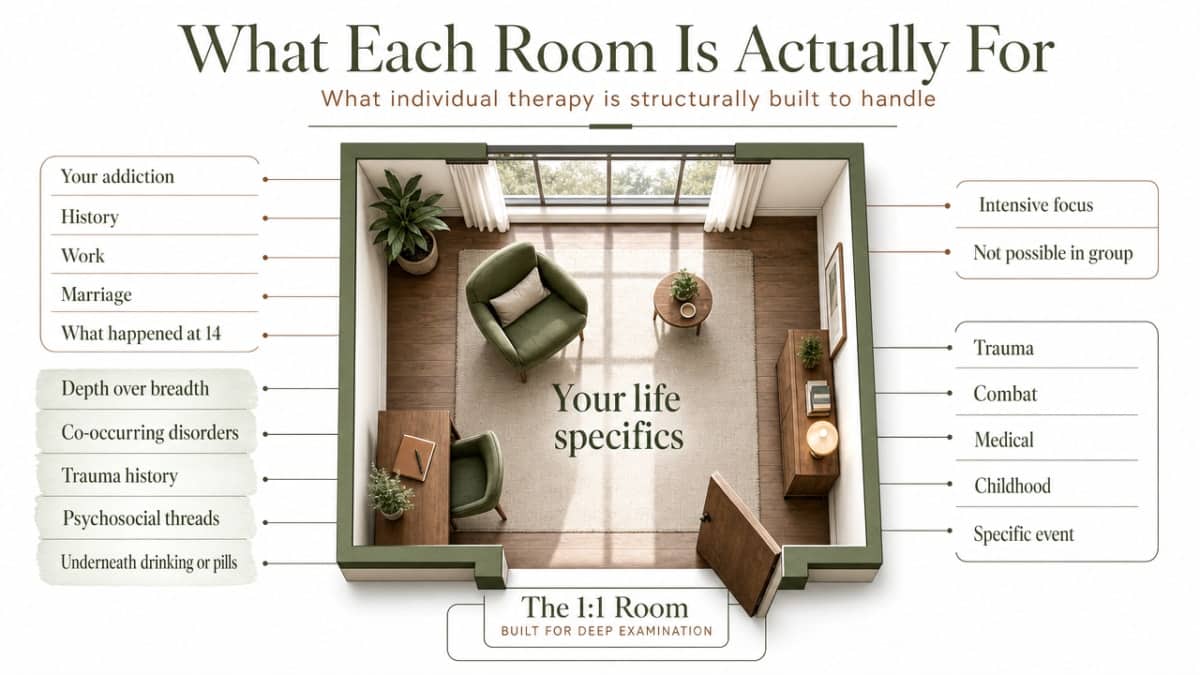
The individual room is where the specifics of your life get examined. Not addiction in the abstract — your addiction, wired to your history, your work, your marriage, the thing that happened when you were fourteen that you’ve never quite told anyone.
This is where a clinician does the work that requires depth over breadth: co-occurring psychiatric disorders, trauma history, and the complex psychosocial threads that run underneath the drinking or the pills. Individual psychotherapy is designed to allow that intensive focus on co-occurring disorders and trauma that isn’t possible in a group setting 8.
For a professional man, three kinds of work tend to live almost exclusively in the 1:1 room.
The first is trauma. If there’s a real trauma history in play — combat, medical, childhood, a specific event — you need a clinician who can pace exposure work carefully, in private, without seven other people in the room shaping what you say. Severe PTSD responds better to individual treatment than to group 5.
The second is the co-occurring disorder work. Anxiety that’s been medicated with alcohol for a decade. Depression that hides under productivity. ADHD you never told anyone about. These require diagnostic precision and often medication management, not group processing.
The third is career-specific pressure. The way your job actually functions — the on-call schedule, the partner track, the board dynamics, the licensing board that would care if it knew — belongs in a room where the clinician can build a plan around it.
Individual therapy is also where your treatment plan gets built and adjusted. It’s the room where the case file lives.
What Group Therapy Does That Individual Cannot
The group room does something the 1:1 room structurally cannot: it puts you in a space with other men who have some version of your problem, and it lets you see yourself in them.
That sounds soft until you sit in it. SAMHSA’s clinical guidance calls group therapy a powerful therapeutic tool
in substance abuse treatment, and points to a specific reason — group formats are particularly suited to the problems addiction creates, namely isolation and shame 2. You cannot talk yourself out of isolation. You have to be in a room.
Here is what the group actually delivers that no individual session can replicate:
Mirroring. You listen to another man describe his morning routine — the calendar block that hides the drinking, the workout that’s really a hangover management strategy — and you hear your own life in his sentences. That recognition does something to denial that a therapist saying the same words cannot.
Accountability among peers. A clinician can hold you accountable. Another man in recovery, six weeks ahead of you, can hold you accountable in a different register — one that lands harder because he’s not being paid to say it.
Skills practice with an audience. Refusal skills, difficult conversations, boundary-setting — these get rehearsed in group. You cannot practice saying no to a colleague’s drink offer alone in a room with your therapist. You can practice it with eight other men who will tell you what didn’t sound convincing.
Breaking isolation. Addiction runs on secrecy. Group work directly targets that mechanism.
The individual room handles what only you carry. The group room handles what you thought only you carried. Same case file, two different jobs 2, 8.
The Evidence on ‘Which Is Better’
Roughly Equivalent Outcomes, With One Real Exception
Here’s what the research actually says, stripped of hedging: for most people with substance use disorders, group and individual therapy produce roughly equivalent outcomes on abstinence and psychiatric measures. A meta-analysis of 24 studies reached that conclusion directly — group therapy is generally as effective as individual therapy for SUD treatment 4. SAMHSA’s clinical guidance goes a step further, calling group therapy as helpful as individual therapy, and sometimes more successful
in substance abuse care 2.
That’s not a marketing line. That’s decades of comparative data landing in the same place.
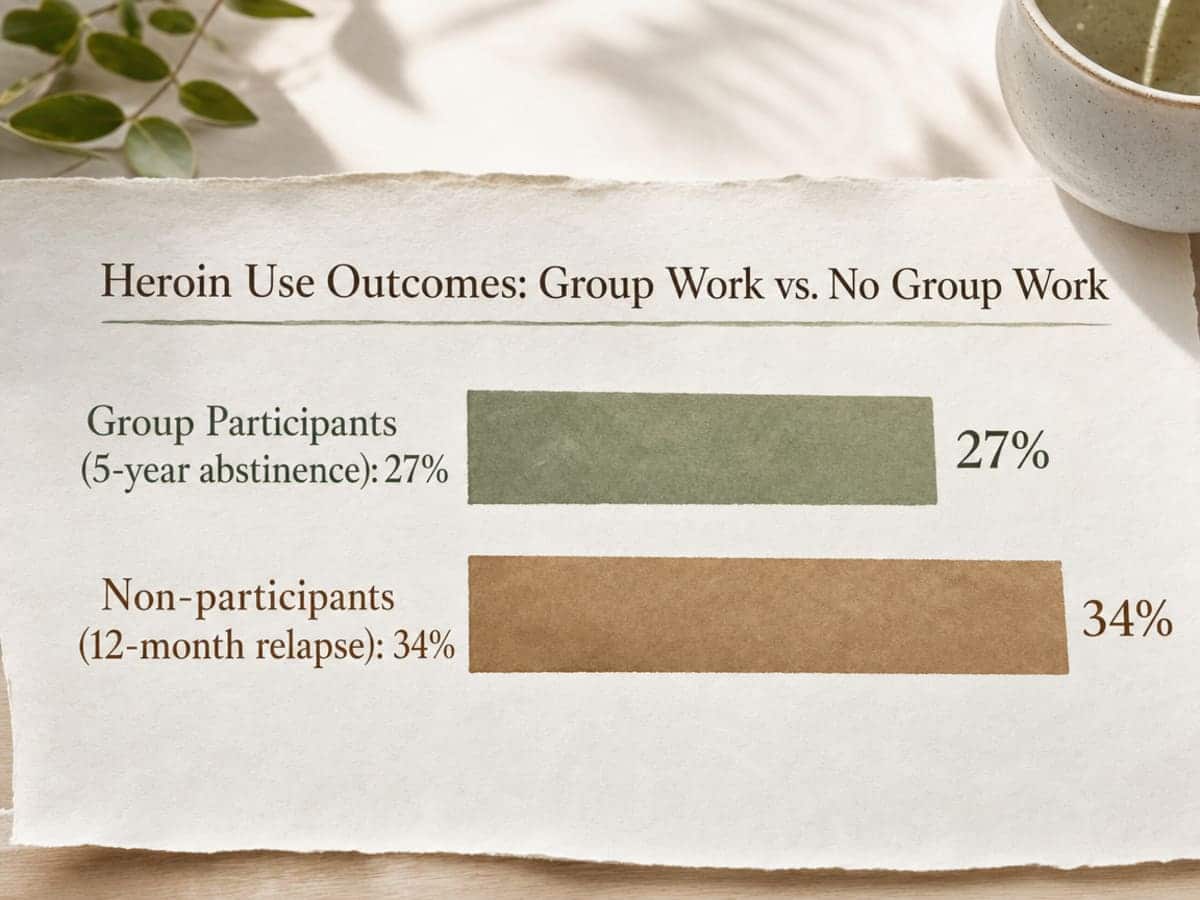
One empirical study of 6,204 heroin users illustrates the pattern, though it needs a careful read: 27% of participants in group work remained abstinent at a five-year follow-up, while 34% of those not in group work relapsed within one year 3. The timeframes don’t match — one measures sustained abstinence over five years, the other measures relapse within twelve months — so this isn’t a clean head-to-head. But the direction is telling. Group participation tracked with better long-term outcomes in a large sample, even against a shorter measurement window on the comparison side.
The direct group-versus-individual comparison literature reaches a similar conclusion and adds a cost dimension: group counseling is equally or more effective than individual counseling, and it’s more cost-effective per patient hour 5.
So the honest read of the evidence isn’t “individual wins” or “group wins.” It’s: they perform about the same on the main outcomes, group is cheaper per hour, and individual takes the lead when trauma is central. A serious program uses that map to assign the work — not to pick a side.
Group Is Not One Thing: Process, CBT, Relapse Prevention, Psychoeducation
When someone tells you a program “does a lot of group work,” ask what kind. The word covers at least four different formats, and they don’t do the same job.
- Process groups
are the format most people picture — a circle, a facilitator, people talking about what came up this week. Done well, they build cohesion and surface patterns you can’t see alone. Done poorly, they’re unstructured airtime.
- Cognitive behavioral therapy (CBT) groups
teach specific skills: identifying triggers, restructuring the thoughts that lead to use, building coping responses. The content is manualized. You’re learning something, not just talking.
- Relapse prevention groups
are a subset of CBT with a sharper focus — mapping high-risk situations, rehearsing responses, planning for the specific moments where use tends to happen. A randomized trial found that participants in structured relapse-prevention group therapy had significantly better abstinence and coping outcomes than those in treatment-as-usual 11. The design of the group mattered. Generic process time did not produce the same result.
- Psychoeducation groups
teach the neuroscience of addiction, the pharmacology of what you were using, the mechanics of withdrawal and craving. Less therapy, more information — but useful information, especially early in a stay when the brain is still catching up to the decision to stop.
The broader literature on group treatments for drug use disorders covers this range — CBT, contingency management, motivational interviewing, relapse prevention, social support, gender-responsive formats — and shows that several structured group modalities reduce use and psychiatric symptoms more than treatment as usual 1. “Group” is a category, not a method.
What this means for you: when you’re evaluating a program, the question isn’t how many hours of group are on the schedule. It’s what kind of group, taught by whom, using what curriculum. Structured beats generic. Every time.
The Professional Man’s Objection to the Group Room
Exposure, Status, and the Fear of Being Recognized
Let’s name what you’re actually worried about, because most articles on this topic pretend the concern isn’t there.
You’re worried about walking into a group room and seeing a face you know. A colleague. A patient. Opposing counsel from a case two years ago. Someone whose kid plays hockey with your kid. In a mid-sized city, the odds aren’t zero, and you’ve done the math.
You’re also worried about a subtler exposure. Even if no one in the room knows you, they’re going to hear things — that you drank a fifth a day for eleven months, that you diverted, that you drove your kids somewhere you shouldn’t have. Those sentences don’t sit easily in a mouth that spends its working hours being competent in front of other people.
And there’s the status problem. You’ve spent a career being the person in the room with the answer. The group format asks you to be the person in the room who is, at least for a while, the one being helped. That inversion is uncomfortable in a way that’s hard to admit out loud.
These fears are legitimate. They deserve a real answer, not a reassurance.
The real answer has three parts. Serious residential programs run small — Serenity Park caps at 20 men — which changes the room dynamic from a public disclosure to a closed circle. Confidentiality is a clinical and legal expectation reinforced in group ground rules, not a hope. And the group is specifically men, working the same kind of problem, which shrinks the status distance faster than you’d expect.
That doesn’t make the first group session comfortable. It makes it possible.
Why the ‘I’ll Just Do the 1:1’ Instinct Backfires
Here’s the move most professional men want to make: negotiate a program that’s mostly individual therapy, with group work minimized or optional. It feels like a reasonable ask. It’s the version of treatment that protects the parts of yourself you’re least willing to expose.
It also, in most cases, undertreats the addiction.
The reason has nothing to do with dosing hours. It has to do with what addiction actually is. Addiction runs on isolation and secrecy — the private ritual, the story you tell no one, the version of your day that only you can see. SAMHSA’s clinical guidance identifies this directly: group formats work because they target the isolation and shame that addiction feeds on 2. You cannot dismantle that mechanism in a room with one other person, even a skilled clinician. The mechanism requires witnesses.
There’s also a mirroring problem. In the 1:1 room, you can present a curated version of yourself — smarter, more insightful, more in control — and the therapist may not have the raw material to see through it. In group, another man tells his story and you hear yours in it. That recognition is not something you can manufacture alone.
And there’s the skills question. Refusal, boundary-setting, the difficult conversation with your spouse or your partner or your board — these need rehearsal in front of people. Structured relapse-prevention groups produce significantly better abstinence and coping outcomes than treatment-as-usual precisely because they build that rehearsal into the curriculum 11.
Opting out of group isn’t protecting your recovery. It’s protecting the part of you that got you here.
How the Two Modalities Sequence Across a Residential Stay
A serious residential program doesn’t run individual and group therapy on parallel tracks. It weaves them, and the weave shifts as you move through the stay.
Detox (roughly days 1–5). The individual room dominates, but not for therapy in the deep sense. It’s assessment. A psychiatric evaluation, a medical workup, a history that a clinician can actually use. Group work is minimal and mostly psychoeducational — what’s happening in your brain right now, why the sleep is wrecked, why the cravings spike at hour thirty-six. You are not ready to process anything. You’re ready to be stabilized and oriented.
Early residential (roughly week 2). The balance starts to shift. Individual sessions move from intake into treatment planning — mapping the co-occurring picture, naming what needs to happen with trauma, medication, and career-specific pressures 8. Group work opens up: CBT skills groups, psychoeducation on relapse mechanics, an introduction to process work. The group room in this phase is about getting used to the room. Showing up the first time is the work.
Mid-stay (roughly weeks 3–4). This is where group takes on more clinical weight. Structured relapse-prevention groups become central because the curriculum is where behavior change actually gets built — mapping high-risk situations, rehearsing refusal, running through the specific moments where use tends to happen. Participants in structured relapse-prevention group therapy show significantly better abstinence and coping outcomes than those in treatment-as-usual 11. Individual sessions continue in parallel, doing the deeper trauma and co-occurring work that group cannot hold 2.
Discharge planning (final week). Individual sessions come back to the front — building the specific plan for what happens on Monday morning at your job, in your home, in your city. Group work in this phase turns toward consolidation: aftercare mapping, alumni connection, the difficult conversations you’ll need to have in the first thirty days out.
The pattern isn’t rigid. Someone with prominent trauma will get more individual hours mid-stay. Someone whose isolation is the presenting problem will lean more heavily on group. What stays constant is the design: both rooms working the same case file, with the balance calibrated week to week rather than fixed on the intake form.
When Individual Work Should Take the Lead
Most of the time, a good residential program keeps individual and group therapy in rough balance. But there are specific presentations where the 1:1 room should carry more of the weight, and knowing which ones matters — both for you and for the clinician building your plan.
When trauma is doing significant work under the addiction. If PTSD or a serious trauma history is part of what’s driving the use, individual therapy takes the lead. This is the one place where the comparative literature breaks cleanly in favor of 1:1 work — patients with PTSD tend to do better with individual treatment than with group 5, and trauma-focused CBT delivered individually produces superior PTSD symptom reductions 10. Group can support the recovery around it, but the trauma work itself belongs in private, at a pace only you and one clinician set.
When the co-occurring picture is complicated. Bipolar II that’s been masked by alcohol. Severe anxiety with a medication history. An eating disorder running alongside the pills. These require diagnostic precision, medication management, and a level of clinical attention that a group cannot hold 8.
When the career-specific stakes need dedicated planning. A physician facing a monitoring program. An attorney with a bar issue. A founder whose company will notice a four-week absence. The plan for that reality gets built in the individual room, session by session.
When group is genuinely destabilizing early on. Some men, in the first days, cannot yet tolerate the group room. That’s clinical information, not failure. Individual work carries more weight until you’re ready — and then the group re-enters the plan.
How Serenity Park Designs the Blend
By now the argument should feel less like a choice and more like a design problem. Two rooms, one case file, calibrated week to week. Here is how that looks in practice at Serenity Park.
The program runs at a 20-man census. That number is not incidental. It’s small enough that the group room stays a closed circle instead of a crowd, and small enough that your individual clinician actually knows what came up in yesterday’s CBT group before your 1:1 session starts. The two rooms talk to each other, because the staff talking to each other is structurally possible at that scale.
The individual track carries the work that belongs in private — trauma, co-occurring psychiatric conditions, medication management, and the career-specific planning a physician or attorney or founder needs before discharge 8. When trauma is prominent, individual work takes the lead, in line with what the comparative literature indicates for PTSD presentations 5, 10.
The group track is not one room. It’s a curriculum: structured relapse-prevention groups, CBT skills groups, psychoeducation, and process work, sequenced across the stay rather than stacked on a schedule 1, 11. Wearable biotech from the Huml Health partnership feeds sleep, heart rate, and stress data back to clinicians, so when your individual therapist notices your recovery metrics dipped Tuesday night, that’s a conversation in Wednesday’s session — not a guess.
The blend is the design. Not the schedule.
Frequently Asked Questions
Can I do rehab with only individual therapy and skip group sessions?
You can ask, but most serious programs won’t design around it, and for a clinical reason. Addiction feeds on isolation and shame, and group formats are specifically built to target those mechanisms in ways one-on-one work structurally cannot 2. Skipping group tends to protect the same private space the addiction lives in. A better ask: which groups, when, and calibrated to what you can tolerate early on.
Is individual therapy more effective than group therapy for addiction?
Not by the evidence. A meta-analysis of 24 studies found group therapy generally as effective as individual therapy for substance use outcomes 4, and direct comparison research reaches the same conclusion while noting group is more cost-effective per hour 5. The exception is trauma — when PTSD is prominent, individual work outperforms group 5. Otherwise, the two produce roughly equivalent results and are meant to run together.
How is confidentiality protected in group therapy at a residential program?
Confidentiality in the group room is a clinical and legal expectation, established through written ground rules every member signs at intake and reinforced by facilitators in each session. At a small-census residential program like Serenity Park’s 20-man setting, the room stays a closed circle rather than a rotating crowd. Staff also screen for known conflicts — colleagues, patients, opposing counsel — before assignments are made, not after.
What if I have PTSD or trauma alongside substance use?
This is the one place the evidence breaks cleanly toward individual work. Patients with PTSD tend to do better in individual treatment than in group 5, and trauma-focused CBT delivered one-on-one produces superior PTSD symptom reductions compared to control conditions 10. A serious program leads with the individual room for the trauma work itself, using group to support recovery around it rather than to process the trauma directly.
What actually happens in a group session, and how is it different from a process group I’ve heard about?
“Group” covers at least four formats. Process groups involve open discussion with a facilitator. CBT groups teach specific skills — trigger identification, thought restructuring. Relapse prevention groups map high-risk situations and rehearse responses, with RCT evidence showing better abstinence outcomes than treatment-as-usual 11. Psychoeducation groups teach the neuroscience of addiction. Structured groups with a curriculum consistently outperform generic process time 1.
How do individual and group therapy fit together across a residential stay?
The balance shifts week to week. In detox, individual work dominates — assessment, medical workup, orientation. Early residential adds CBT skills groups and psychoeducation while individual sessions build the treatment plan 8. Mid-stay, structured relapse-prevention groups take on more clinical weight 11, while individual sessions hold the deeper trauma and co-occurring work 2. Discharge planning returns to the 1:1 room for the specifics of Monday morning.
References
- A review of research-supported group treatments for drug use disorders. https://pmc.ncbi.nlm.nih.gov/articles/PMC8215831/
- Groups and Substance Abuse Treatment (TIP 41, Chapter 1). https://www.ncbi.nlm.nih.gov/books/NBK64223/
- How Effective are Psychosocial Group Workings in Improving Substance Use Treatment?. https://pmc.ncbi.nlm.nih.gov/articles/PMC7481974/
- Group Therapy for Substance Use Disorders: A Survey of Clinician Practices. https://pmc.ncbi.nlm.nih.gov/articles/PMC6289265/
- Group versus individual treatment for substance use disorders. https://pmc.ncbi.nlm.nih.gov/articles/PMC7913269/
- Group Therapy for Women with Substance Use Disorders: Women’s Recovery Group vs. Group Drug Counseling. https://pmc.ncbi.nlm.nih.gov/articles/PMC4150678/
- Group therapy for women with substance use disorders: In-session processes and outcomes. https://pmc.ncbi.nlm.nih.gov/articles/PMC9976621/
- The Role of Individual Psychotherapy in Substance Use Disorder Treatment. https://pmc.ncbi.nlm.nih.gov/articles/PMC2897895/
- Project MATCH: Matching Alcoholism Treatments to Client Heterogeneity. https://pmc.ncbi.nlm.nih.gov/articles/PMC407889/
- A randomized controlled trial of trauma-focused cognitive behavioral therapy for PTSD and substance dependence. https://pmc.ncbi.nlm.nih.gov/articles/PMC4366769/
- Relapse prevention group therapy for substance use disorders: A randomized trial. https://pmc.ncbi.nlm.nih.gov/articles/PMC3113274/
- Contingency management in group-based substance use treatment. https://pmc.ncbi.nlm.nih.gov/articles/PMC2856849/