
Key Takeaways
- Arkansas covers all three FDA-approved MAT medications—buprenorphine, methadone, and naltrexone—through Medicaid, with Act 964 eliminating prior authorization across both Medicaid and private insurers 3.
- Medication choice depends on clinical factors like withdrawal timing, opioid tolerance, and detox status, so evaluate whether a program conducts individualized assessments rather than applying a uniform intake protocol 9.
- Methadone for opioid use disorder can only be dispensed through certified opioid treatment programs, meaning residential facilities must coordinate with a licensed OTP if that medication fits best 2, 11.
- Before enrolling, ask prescribers how they determine medication selection, time buprenorphine induction, integrate counseling with a DEA-waivered prescriber, and reassess treatment plans over time 6.
Is MAT Just Trading One Drug for Another?
You’re likely here because you’re questioning whether medication can truly help with substance use, and if accepting that help means admitting something you’re not ready for. It’s a common concern, especially the worry that medication-assisted treatment (MAT) with buprenorphine or naltrexone might just be swapping one dependency for another. This perspective, however, misrepresents how MAT functions.
A medication that stabilizes brain chemistry, blocks cravings, and allows for clear thinking and normal functioning is fundamentally different from a substance that hijacks these processes. The American Medical Association and the U.S. Surgeon General endorse MAT as the gold standard for opioid use disorder precisely because it provides therapeutic support, enabling individuals to reclaim their lives.3
This article will provide a straightforward overview of MAT, including FDA-approved medications, how Arkansas law and Medicaid cover these treatments, and crucially, how to discern whether a program offers MAT as a carefully integrated tool within an individualized plan or as a generic, one-size-fits-all solution. The distinction is vital for effective treatment.
Evidence-Based MAT: Medications and Clinical Application
FDA-Approved Medications and Their Specific Uses
The FDA has approved three medications for opioid use disorder, all of which are covered by Arkansas Medicaid.2 These medications are not interchangeable; they operate through different mechanisms and are appropriate for distinct clinical scenarios. The decision to incorporate any of them into a treatment plan is a clinical judgment based on individual needs.
Buprenorphine acts as a partial opioid agonist, meaning it activates opioid receptors but only partially, with a ceiling effect that significantly reduces its potential for misuse. It effectively reduces cravings and withdrawal symptoms without the intense highs and lows associated with full opioids. Clinically, buprenorphine induction should only occur when objective signs of withdrawal are present, as starting it too early can precipitate severe withdrawal.9 Arkansas Medicaid removed prior authorization for preferred buprenorphine products in 2020, allowing prescribers to initiate treatment based on clinical timing.1
Methadone is a full opioid agonist and the oldest of the three medications. It remains the appropriate choice for some patients, particularly those with extensive histories of opioid use or higher tolerance. Due to its nature, methadone for opioid use disorder is highly regulated under federal and Arkansas law, and can only be dispensed through certified opioid treatment programs (OTPs).2 Residential centers coordinate with licensed OTPs if methadone is deemed the most suitable medication.11
Extended-release injectable naltrexone is an opioid antagonist, meaning it blocks opioid receptors rather than activating them. It is primarily recommended for relapse prevention in individuals who are no longer physically dependent on opioids.9 Crucially, naltrexone should only be initiated after detoxification is complete, as early administration can trigger withdrawal. Its monthly injection schedule is often preferred by individuals seeking a non-daily medication option.
These medications are clinical tools, each with specific mechanisms, timing requirements, and appropriate settings of use, rather than moral choices.
The Clinical Basis for MAT’s “Gold Standard” Status
The designation of MAT as the “gold standard” for opioid use disorder originates from authoritative bodies like the U.S. Surgeon General and the American Medical Association, not from marketing claims. The AMA specifically recognized Arkansas as a national model for removing prior-authorization barriers for these medications, which previously caused delays in critical treatment initiation.3
The evidence supporting MAT is rooted in national practice guidelines, such as the ASAM National Practice Guideline, which details appropriate medication selection, transitions between medications, and the integration of psychosocial care.9 Arkansas Medicaid’s implementation adheres to current SAMHSA guidelines, ensuring that medical necessity reviews are conducted against these established standards.8 This demonstrates a clear chain of accountability from federal guidelines to the actual prescription received, underscoring what “evidence-based” truly means in this context.
However, guidelines provide clinicians with the available options and their appropriate contexts; they do not dictate which option is right for an individual. That decision requires a thorough assessment, open dialogue, and consideration of a patient’s unique history, personal circumstances, and willingness to engage with treatment. A gold-standard medication administered without a gold-standard assessment is merely a shortcut, highlighting the importance of choosing a program that prioritizes individualized care.
Arkansas’s Role in Expanding MAT Access
Act 964 and Medicaid Coverage Enhancements
Historically, initiating buprenorphine treatment in Arkansas often involved significant delays due to prior authorization requirements from insurers. Arkansas addressed this barrier through a series of legislative and policy changes.
A pivotal moment was Act 964 of 2019, which mandated that all health insurers and Arkansas Medicaid eliminate prior authorization for FDA-approved medications for opioid use disorder, including buprenorphine, methadone, and naltrexone.3 Following this, on January 1, 2020, Arkansas Medicaid removed prior authorization for preferred buprenorphine products, such as Suboxone film and buprenorphine tablets.1 This was extended to preferred injectable medications for opioid and alcohol addiction.1 Subsequently, State Plan Amendment 2021-0003 formally aligned Arkansas Medicaid with federal SUPPORT Act requirements, ensuring comprehensive coverage for all FDA-approved formulations of naltrexone, buprenorphine, and methadone.2
Currently, MAT for opioid and alcohol use disorders is covered for eligible Medicaid beneficiaries who meet medical necessity criteria, with coverage extending from October 1, 2020, through September 30, 2025.7 Medical necessity reviews are conducted in accordance with current SAMHSA guidelines, ensuring that treatment aligns with established evidence-based practices.8 This framework ensures that clinical decisions about your care are not hindered by administrative delays, making MAT a more accessible option in Arkansas compared to many other states.
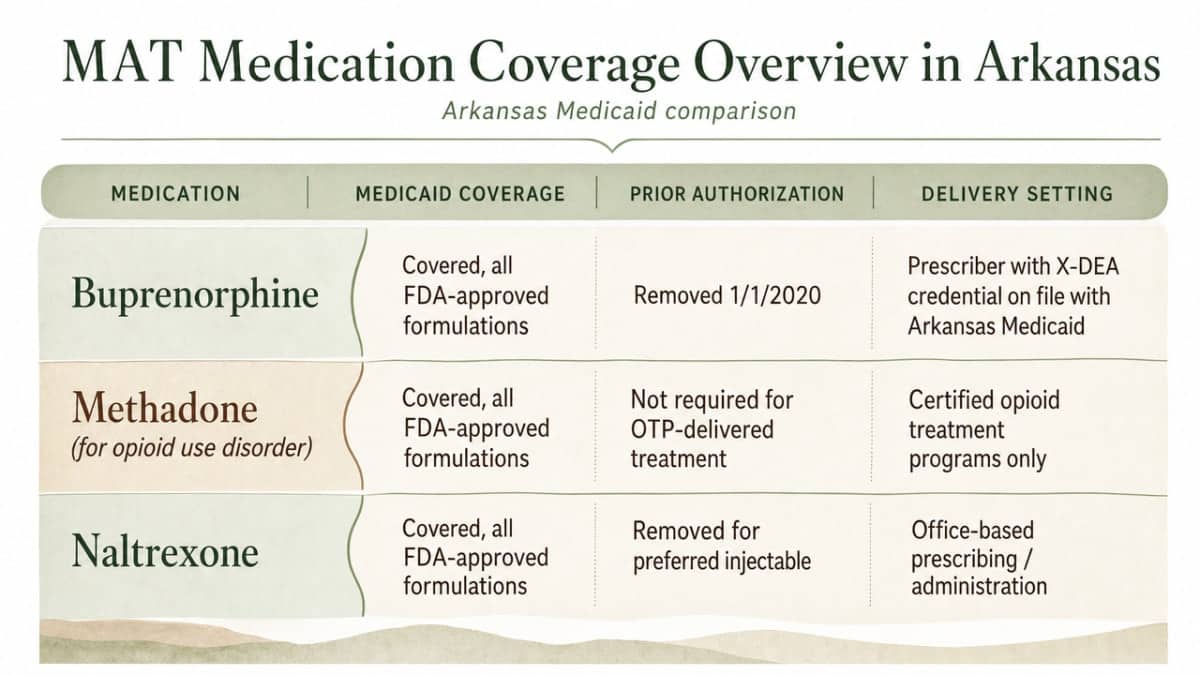
MAT Medication Coverage Overview in Arkansas
The following table summarizes MAT coverage based on Arkansas Medicaid and state regulations. Private insurers in Arkansas are also subject to Act 964’s prior-authorization removal for these medications, though specific plan details may vary.3
| Medication | Arkansas Medicaid Coverage | Prior Authorization | Where Delivered |
|---|---|---|---|
| Buprenorphine (preferred products, including Suboxone film and tablets) | Covered, all FDA-approved formulations2 | Removed 1/1/20201, 8 | Prescriber with X-DEA credential on file with Arkansas Medicaid6 |
| Methadone (for opioid use disorder) | Covered, all FDA-approved formulations2 | Not required for OTP-delivered treatment | Certified opioid treatment programs only2, 11 |
| Naltrexone (including extended-release injectable) | Covered, all FDA-approved formulations2; preferred injectable products no longer require PA1 | Removed for preferred injectables1 | Licensed Arkansas prescriber enrolled with Medicaid7 |
It’s important to note that Medicaid administratively links MAT coverage to psychosocial services, and the billing prescriber must hold a DEA waiver.6 This integration ensures that medication and counseling are treated as components of a unified treatment plan, reflecting how effective programs structure care.
Individualized MAT: A Mark of Quality Treatment
Key Questions for Evaluating MAT Programs
In Arkansas, access to MAT is no longer the primary hurdle; the focus has shifted to the quality of care. A crucial indicator of quality is whether a program approaches MAT as a clinical decision tailored to the individual or as a standard intake procedure. You can often discern this difference during an initial phone call.
Consider asking these questions to any program you evaluate:
- “How do you determine if medication, or which specific medication, is right for me?” A comprehensive assessment should be described, covering your substance use history, previous treatment attempts, medical and psychiatric conditions, social context, and personal preferences. The ASAM guideline emphasizes individualized, patient-centered medication selection.9 Be wary if the response suggests a uniform starting protocol for all patients.
- “If buprenorphine is indicated, how and when is it initiated?” The clinically correct procedure involves waiting for objective signs of withdrawal before induction.9 A program unable to articulate this timing may not be following best practices.
- “What if methadone is a better fit for my needs?” Residential facilities are not authorized to dispense methadone for opioid use disorder; it must be delivered through certified opioid treatment programs.2, 11 A reputable program will describe a clear process for coordinating with a licensed OTP.
- “How is counseling integrated with medication decisions?” Arkansas Medicaid rules require MAT prescribers to have a DEA waiver, and psychosocial services are administratively linked to medication.6 This should translate to active communication and collaboration between your therapist and prescriber.
- “How frequently is my treatment plan reviewed and by whom?” Effective programs regularly reassess treatment plans, as symptoms and life circumstances evolve. The medication regimen that was appropriate initially may need adjustment over time.
Asking these questions is a form of due diligence. A program that welcomes and thoroughly answers them is often one that provides high-quality, patient-centered care.

The Impact of Small Capacity on Clinical Possibilities
While individualization is frequently promised, delivering it effectively can be challenging, particularly in large facilities. When a treatment center accommodates a high volume of patients, clinical teams are often stretched thin, leading to the adoption of standardized protocols as operational defaults. This is a practical reality of managing large-scale operations.
Serenity Park, by contrast, serves a maximum of 20 men at a time. This limited capacity allows the psychiatric, counseling, and medical teams to gain an in-depth understanding of each client’s case—including their history, withdrawal timeline, professional situation, family dynamics, and past treatment experiences. The ASAM guideline emphasizes that medication choice should be individualized and combined with psychosocial care,9 and Arkansas regulations mandate that MAT be linked to counseling by a waivered prescriber.6 A 20-bed men’s residential setting provides the ideal environment for these requirements to translate into a truly personalized treatment plan.
Wearable monitoring further enhances this individualized approach by providing continuous data on heart rate, sleep patterns, and stress levels. This information offers the clinical team a more complete picture between visits, proving valuable during detox, medication adjustments, or when identifying challenges that might otherwise go unnoticed. While not a substitute for clinical judgment, it provides additional data to inform and refine treatment decisions.
Arkansas’s Progress in Overdose Prevention
Arkansas has seen a positive shift in drug overdose fatalities. Provisional data from the Arkansas Department of Health indicates 389 drug overdose deaths in 2024, a decrease from 516 in 2023.10 This represents 127 fewer families experiencing such a loss.
While this decline is significant and aligns with a national trend, it is not a complete victory. Provisional data can change as death certificates are finalized. This positive trend is also the result of multiple factors, including changes in fentanyl supply, increased naloxone distribution, improved emergency response, and the expansion of MAT itself. The numbers indicate a favorable direction, suggesting that the landscape for recovery is improving.
This context is relevant to MAT because it shows that efforts to combat the opioid crisis are yielding results. For individuals considering treatment, this means entering a system where the odds of successful recovery are quietly improving.
MAT and Professional Life: Returning to Work
A common concern for professional men considering MAT is how it will impact their ability to perform in demanding roles. The reality is that MAT, when properly managed, supports a return to professional life.
Buprenorphine, when taken as prescribed, does not produce the euphoria or sedation associated with opioid misuse due to its partial agonist and ceiling effect properties.9 Extended-release naltrexone, an opioid antagonist, produces no opioid effects at all.9 This means individuals on stable MAT can drive, engage in complex tasks, and maintain cognitive function, often with improved clarity due to reduced cravings and the absence of early recovery’s intrusive thoughts. Many professionals, including those holding licenses and running businesses, successfully manage their careers while on MAT.
Regarding privacy, a monthly naltrexone injection is similar to any other routine medical appointment. Buprenorphine is a daily prescription filled like any other medication. Under Arkansas regulations, the prescriber coordinating your care must hold a DEA waiver and integrate medication with counseling, forming a structured clinical framework.6 Information about your treatment is protected by the same medical privacy laws that apply to any other healthcare service.
The true challenge lies in building a comprehensive recovery plan around the medication, including consistent therapy, stable sleep, and a discharge plan tailored to your specific life. The medication facilitates these efforts but does not replace them.
Serenity Park’s Approach to MAT
Serenity Park, a men’s residential addiction treatment center in Little Rock, integrates MAT as a carefully considered component of individualized care. The process begins with a thorough assessment of your substance use history, physical health, psychiatric profile, past treatment experiences, and current willingness to engage. Based on this comprehensive evaluation, a decision is made regarding whether medication is appropriate for your plan.
This might involve initiating buprenorphine at the clinically correct moment, once objective withdrawal signs are present.9 Alternatively, extended-release naltrexone may be recommended after detoxification is complete. If methadone is determined to be the most suitable option, Serenity Park coordinates with a certified opioid treatment program, as Arkansas regulations mandate that methadone for opioid use disorder be delivered in such specialized settings.2, 11
The center’s capacity for up to 20 clients is fundamental to this personalized approach. This small client-to-staff ratio ensures that your prescriber, counselor, and medical team are intimately familiar with your case. Wearable monitoring provides continuous data on heart rate, sleep, and stress, offering real-time insights that inform medication adjustments and overall care. Counseling and medication are treated as a unified plan, aligning with both Arkansas regulations6 and evidence-based best practices.
To understand how MAT might specifically fit into your treatment at Serenity Park, a conversation with the clinical team is the next step. This discussion is where the development of your individualized plan begins.
Frequently Asked Questions
Is medication-assisted treatment just replacing one drug with another?
No. MAT involves medications that stabilize brain chemistry, reduce cravings, and improve cognitive function without producing the compulsive use, escalating tolerance, or life disruption characteristic of a substance use disorder. Leading medical authorities like the U.S. Surgeon General and the American Medical Association recognize MAT as the gold standard for opioid use disorder due to its therapeutic benefits.3
Which medications are approved for MAT in Arkansas?
Arkansas Medicaid covers all FDA-approved formulations of the three primary medications for opioid use disorder: buprenorphine (including Suboxone film and tablets), methadone, and naltrexone (including the extended-release injectable).2 Preferred injectable medications for opioid and alcohol addiction are also covered.1 The choice of medication is individualized based on your specific history, current condition, and clinical timing.9
Does Arkansas Medicaid cover MAT, and is prior authorization still required?
Yes, MAT is covered for eligible Medicaid beneficiaries who meet medical necessity criteria, with the current coverage period extending through September 30, 2025.7 Prior authorization for preferred buprenorphine products was removed on January 1, 2020, and for preferred injectable MAT medications shortly thereafter.1, 8 Act 964 also mandated that private insurers in Arkansas eliminate prior authorization for these medications.3
Can a residential program in Little Rock provide methadone on-site?
No. Under Arkansas regulations and ASAM guidelines, methadone for opioid use disorder can only be dispensed through certified opioid treatment programs (OTPs) that meet specific licensure standards.2, 11 If methadone is the appropriate medication, a residential program will coordinate your care with a licensed OTP rather than dispensing it directly.9
How can I tell if a program uses MAT thoughtfully or as a default protocol?
Assess how the intake team addresses key questions: how they determine the right medication (or if medication is needed), the timing for buprenorphine induction (which should await objective withdrawal signs9), and how counseling is integrated with prescribing decisions. Arkansas Medicaid rules require MAT prescribers to have a DEA waiver and link psychosocial services to medication.6 A program that describes a thorough, individualized assessment process, rather than a standard protocol, is likely to offer higher quality care.
Can I maintain a demanding professional role while on MAT?
Yes. Buprenorphine, when taken as prescribed, does not induce euphoria or sedation due to its partial agonist and ceiling effect. Extended-release naltrexone blocks opioid receptors without producing opioid effects.9 Individuals on stable MAT successfully hold professional licenses, manage companies, and practice medicine. Your medical privacy is protected by the same laws that apply to any other medical treatment.
References
- Medication Assisted Treatment for Opioid or Alcohol Use Disorders (Arkansas Medicaid Pharmacy Program). https://humanservices.arkansas.gov/wp-content/uploads/MAT-Revised-Website-posting-12.14.pdf
- 016.06.21 Ark. Code R. § 008 – State Plan Amendment 2021-0003 – Medication Assisted Treatment. https://www.law.cornell.edu/regulations/arkansas/016-06-21-Ark-Code-R-SS-008
- Arkansas sets standard for states by removing prior authorization for medication-assisted treatment. https://www.ama-assn.org/press-center/ama-press-releases/arkansas-sets-standard-states-removing-prior-authorization
- Improving Access to Treatment for Opioid Use Disorder (UAMS CAST). https://psychiatry.uams.edu/clinical-care/outpatient-care/cast/improving-access-to-treatment-for-opioid-use-disorder/
- Find Substance Abuse or Mental Health Treatment (Arkansas DHS Office of Substance Abuse and Mental Health). https://humanservices.arkansas.gov/divisions-shared-services/shared-services/office-of-substance-abuse-and-mental-health/samh-treatment/
- Counseling Services Section II – 214.200 Medication Assisted Treatment and Opioid Use Disorder Treatment Drugs. https://humanservices.arkansas.gov/wp-content/uploads/CNCLSERV_II.doc
- 016.29.23 Ark. Code R. 004 – Medication Assisted Treatment (MAT). https://www.law.cornell.edu/regulations/arkansas/016-29-23-Ark-Code-R-004
- MAT memorandum – Arkansas Department of Human Services. https://humanservices.arkansas.gov/wp-content/uploads/MATmemo.doc
- The ASAM National Practice Guideline for the Treatment of Opioid Use Disorder: 2020 Focused Update (Part 1). https://sites.rutgers.edu/mat-coe/wp-content/uploads/sites/473/2021/11/COPY-ASAM-National-Practice-Guideline-OUD-2020-Focused-Update_Part1.pdf
- Substance Misuse Education and Prevention – Arkansas Department of Health. https://healthy.arkansas.gov/programs-services/prevention-healthy-living/substance-misuse-education-and-prevention/
- 20 CAR § 433-323. Opioid treatment – Code of Arkansas Rules. https://codeofarrules.arkansas.gov/Rules/Rule?levelType=section&titleID=20&chapterID=128&subChapterID=170&partID=666&subPartID=3988§ionID=24551