
Key Takeaways
- Arkansas credentials peer support specialists through a three-tier system (CPRS, APRS, PRS) requiring two years of consecutive abstinence, supervised training hours, and a NAADAC-administered exam 1, 6.
- Peer support is a defined, Medicaid-reimbursable service under Arkansas’s Outpatient Behavioral Health Services rules, billed in 15-minute increments, which forces programs to staff the role formally rather than informally 11, 16.
- Research signals differ by setting: systematic reviews link peer services to better retention and satisfaction 8, while ED-based randomized trials like POINT found no significant advantage over standard care 12, 13.
- When evaluating an Arkansas program, ask about peer-to-resident ratios, certification tiers held, supervisor credentials meeting PRS requirements, and whether peer contact is billed as a defined OBHS service 1, 7, 11.
Who Sits With You at 6 A.M. on Day Three
Day three is the one nobody warns you about. The adrenaline of admission has faded. Your phone is somewhere you can’t reach it. The clinical team has done its rounds, and there’s a stretch of quiet before breakfast when the shame gets loud. That’s the moment the question stops being abstract: who is actually going to sit with you?
At Serenity Park, the answer on a lot of mornings is a peer support specialist. Six of them are on staff here, and you should know upfront that they are not volunteers, sponsors, or well-meaning alumni who dropped by. In Arkansas, “peer support specialist” is a state-credentialed role with three certification tiers, a two-year consecutive abstinence requirement, supervised training hours, and a credentialing exam administered through NAADAC 1, 6. Their work is a defined, Medicaid-reimbursable service under the state’s Outpatient Behavioral Health Services rules 11. That matters more than it sounds like it should.
You’ve probably read enough treatment brochures to be tired of the language. This piece is not going to tell you that someone will walk beside you. It’s going to tell you what Arkansas requires of the person sitting across from you at 6 a.m., what the research actually says about whether their presence changes anything, and how six specific staff members translate that into a Tuesday. Start with the credential, because that’s where the seriousness lives.
What Arkansas Actually Requires Before Someone Can Call Themselves a Peer
The Three-Tier Credential: CPRS, APRS, and PRS
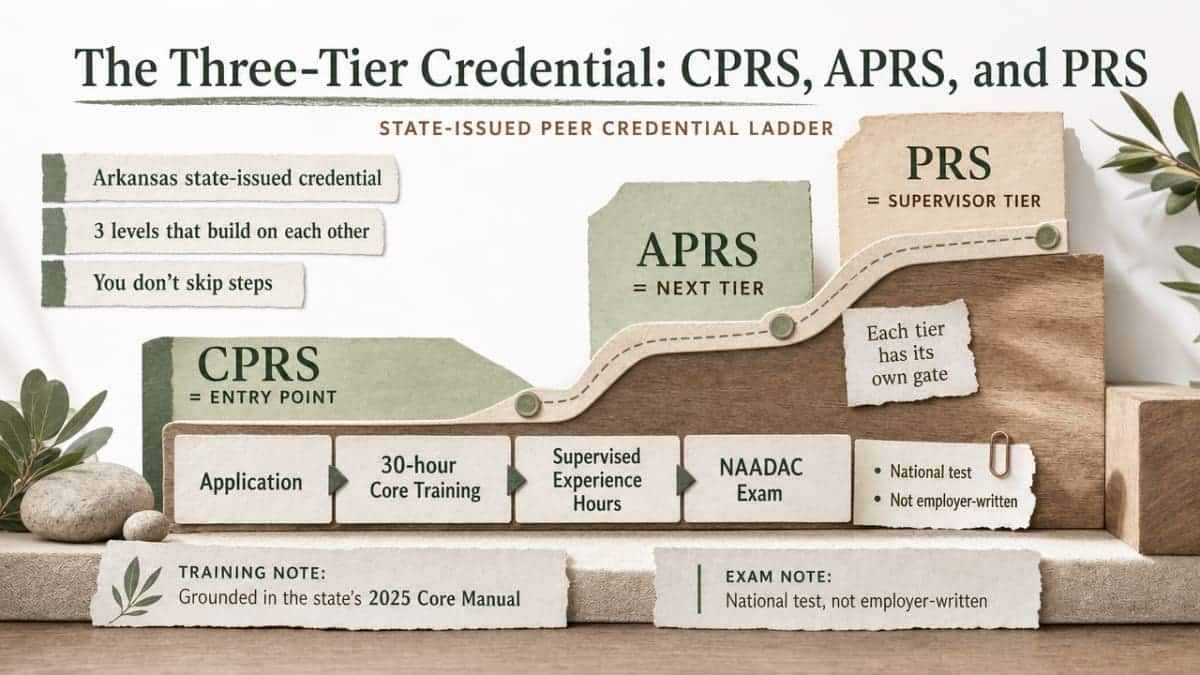
Arkansas does not treat “peer support specialist” as a job title someone gives themselves. It’s a credential the state issues, and it comes in three levels that build on each other: Core Peer Recovery Specialist (CPRS), Advanced Peer Recovery Specialist (APRS), and Peer Recovery Supervisor (PRS) 1. Each tier has its own gate, and you don’t skip steps.
The entry point is CPRS. To sit for it, a candidate submits an application, completes a 30-hour core training grounded in the state’s 2025 Core Manual, accrues supervised experience hours under a qualified supervisor, and then passes a credentialing exam administered through NAADAC 1, 3. That last piece matters. NAADAC is the national association that credentials addiction counselors, so the exam a peer takes is not a formality written by their employer. It’s a national test, scored externally, and it either happens or it doesn’t.
Advanced Peer Recovery Specialist is the next tier. It requires additional training rooted in the Advanced Manual and expanded supervised practice, signaling that the peer has moved past introductory work and can hold more complex cases and group facilitation 2, 3.
Peer Recovery Supervisor is where the ladder ends, and the thresholds are steep. A PRS must have:
- completed all three certification levels,
- hold at least four years of abstinence-based recovery,
- accrue 135 hours of continuing education,
- log 48 hours attending peer supervision and 150 hours facilitating it, and
- document 2,000 hours of paid peer employment 7.
Two thousand hours is roughly a year of full-time work in the peer role before you can supervise another peer. That’s the state saying, in numbers, that supervising someone in early recovery is not something you assign to a well-intentioned senior staffer. It’s a credential you earn.
When you’re evaluating a program, the question to hold is simple: which tier are the peers on this team credentialed at, and who supervises them?
The Two-Year Abstinence Rule and Background Check
Before any of the training or the exam, there’s a threshold most people don’t hear about until they start reading the standards. To be eligible as a peer worker in Arkansas at the core level, an applicant must have at least two years of consecutive abstinence from illicit substances or alcohol, and must pass a background check with no disqualifying offenses 6.
Two years. Not two months into someone else’s recovery, not eighteen months and a hard weekend. Two consecutive years, documented.
If you are a partner-track attorney, a surgeon, an executive whose license depends on a clean record, this is the part that should register. The person the state will let sit across from you in early recovery has been sober longer than most of your junior associates have been out of law school. They have already navigated the fragile middle stretch where relapse most commonly happens, and they’ve kept going.
The background check does the second half of the work. Arkansas peers are not screened casually. The standards require documentation, and the state’s DHS peer status is itself a requirement for Medicaid reimbursement of the services they deliver 5. That means a program that employs an uncredentialed “peer” cannot bill for that person’s time as peer support. The financial structure enforces the eligibility rules. You cannot fake your way onto this team.
Supervision as Infrastructure, Not Formality
Supervision is where peer support programs quietly succeed or quietly fail, and Arkansas has written the supervision expectation into the credential itself. Every CPRS candidate accrues supervised experience hours before certification, and every peer, once credentialed, continues to work under a qualified supervisor 1, 2. The three-tier system exists precisely to produce those supervisors from within the peer workforce, so the person overseeing a new peer has done the work themselves.
The requirements for that supervisor role are specific: four years of abstinence, 2,000 hours of paid peer employment, and 150 hours facilitating supervision before they can hold the PRS credential 7. What that means in practice is that a peer on a residential team in Arkansas is not floating. There is a documented chain of oversight above them, and the state’s 2025 Supervisor Manual gives that chain a shared vocabulary and set of competencies to work from 3.
For a resident, this infrastructure is invisible on a Tuesday morning. You will not see the supervision logs. But it is the reason the peer walking into the group room has a coach behind them, the same way a resident physician has an attending. It’s not decorative. It’s what keeps the role clinical.
A Billing Code Tells You What a State Believes
Here is a quiet test for how seriously a state takes a role: does it have a billing code? In Arkansas, peer support does. The Outpatient Behavioral Health Services manual defines it as a distinct service, spells out its goals, and reimburses it in 15-minute increments under the state’s Medicaid program 11. That is not a small detail. A billing code is a state saying, in the driest possible language, that this work counts.
The definition in the OBHS manual is worth reading closely. Peer support is described as a service delivered by someone who self-identifies as having received behavioral health services, whose expertise is not replicated by professional training, and whose work is oriented around education, hope, advocacy, self-responsibility, and empowerment 11. The state is explicit that lived experience is the qualifying credential, not a footnote to it. And DHS peer status is itself a requirement for that reimbursement to happen 5. No credential, no code. No code, no billable service.
Arkansas’s behavioral health rate schedule, updated in 2024, lists peer support alongside the other recognized services in the outpatient continuum 16. That placement matters more than the specific dollar amount. Peer support is not sitting in a philanthropic column funded by grants and goodwill. It’s in the same schedule as the clinical services that keep the lights on.
For you, the reader, this is the answer to a question you may not have known to ask: is the peer walking into your morning group a real staff member or a warm body? In Arkansas, the financing is structured so the answer has to be the first one.
What the Evidence Says, Honestly
The Case For: Engagement, Retention, and Satisfaction
You have probably read enough marketing language about peer support to be wary of it. So here is the honest version, starting with what the research actually shows.
A systematic review of peer support and recovery coaching in substance use disorder care found that across a range of settings and study designs, peer services were commonly associated with:
- reduced substance use and relapse rates,
- improved relationships with treatment providers and social supports,
- increased treatment retention, and
- greater satisfaction with treatment 8.
Those are four separate outcomes, and they matter in different ways. Retention keeps you in the room long enough for the clinical work to take. Satisfaction affects whether you tell the truth in group. Better relationships with providers change what you disclose to the psychiatrist adjusting your medication.
The review’s authors were also careful about what they did not find. Study quality varied. Designs were heterogeneous. They called for more rigorous randomized trials to clarify where peers exert the most impact 8. That call is important, because when those trials arrived, some of the answers were more complicated than the earlier literature suggested.
The Null Findings You Should Know About
Two randomized trials in emergency department settings are the ones you should know about, because they cut against the easy narrative and they are recent.
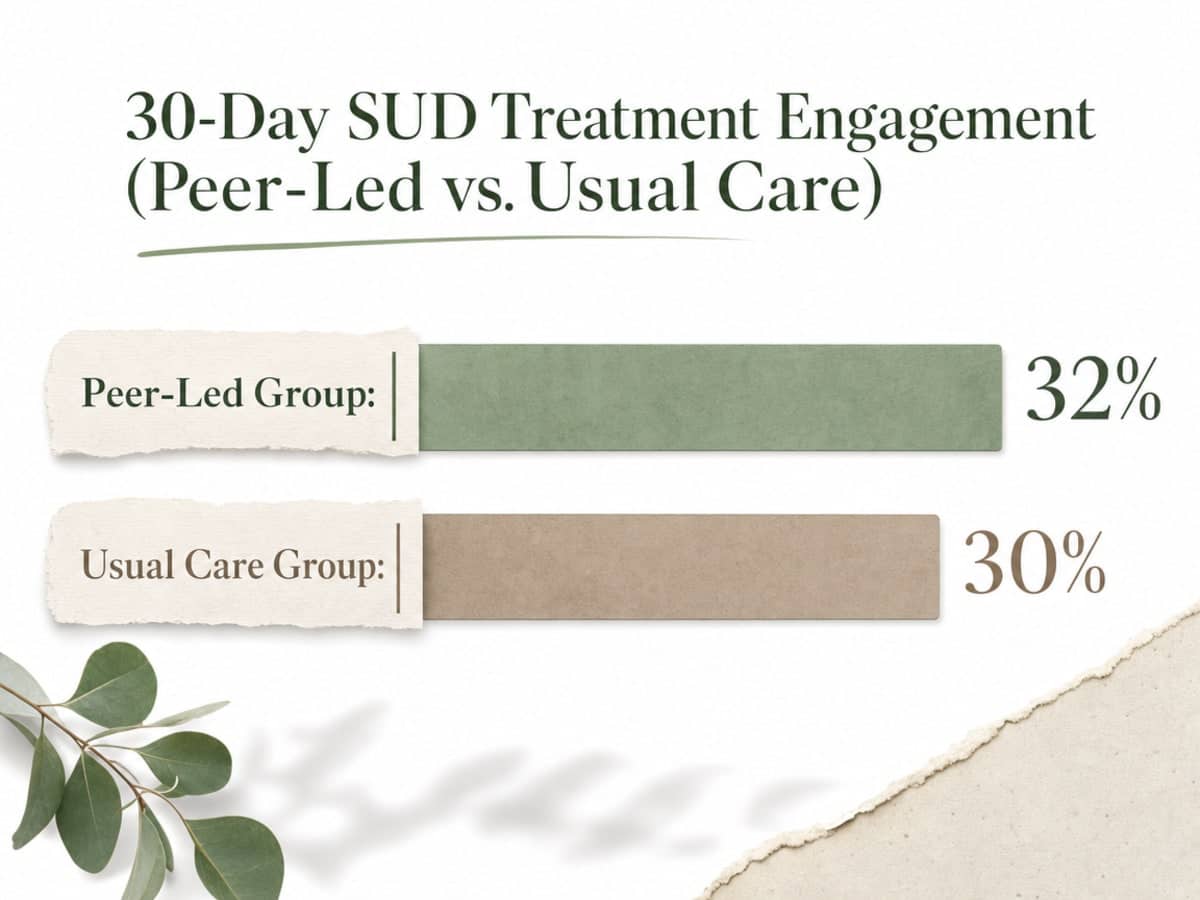
The first, published in 2022, compared a peer-led behavioral intervention with a standard clinician-led intervention for ED patients with substance use disorders. The outcome measured was engagement in SUD treatment within 30 days. The results: 32% of participants in the peer-led group engaged in treatment, versus 30% in the usual care group 13. Statistically, that is not a difference. The authors’ interpretation was measured. ED-based behavioral interventions promoted engagement, but who delivered the brief intervention, peer or clinician, did not clearly change the outcome 13.
The second is the POINT pragmatic randomized trial, published in 2024, which tested an ED-based peer recovery coach intervention against standard case management for patients with opioid use disorder. Across 12 months of follow-up, no significant differences were observed between groups for any outcome examined, including treatment linkage, recurrent overdose, and downstream ED and inpatient utilization 12. The authors noted that the trial was underpowered for some outcomes and that null findings do not rule out benefits in other settings or configurations of peer services 12. Both caveats are important.
Why Residential Recovery Is Not an Emergency Department
Here is the piece the headline version of those trials misses. An emergency department is a place people arrive at in crisis, often against their preference, and leave within hours. A peer coach in that setting has one conversation, maybe two, with a stranger who is stabilizing from an overdose or a withdrawal event. Residential treatment is a different structure. You are there for weeks. You see the same peer at breakfast, in the afternoon group, and again before evening reflection. The intervention is not a single encounter; it is a relationship that accumulates.
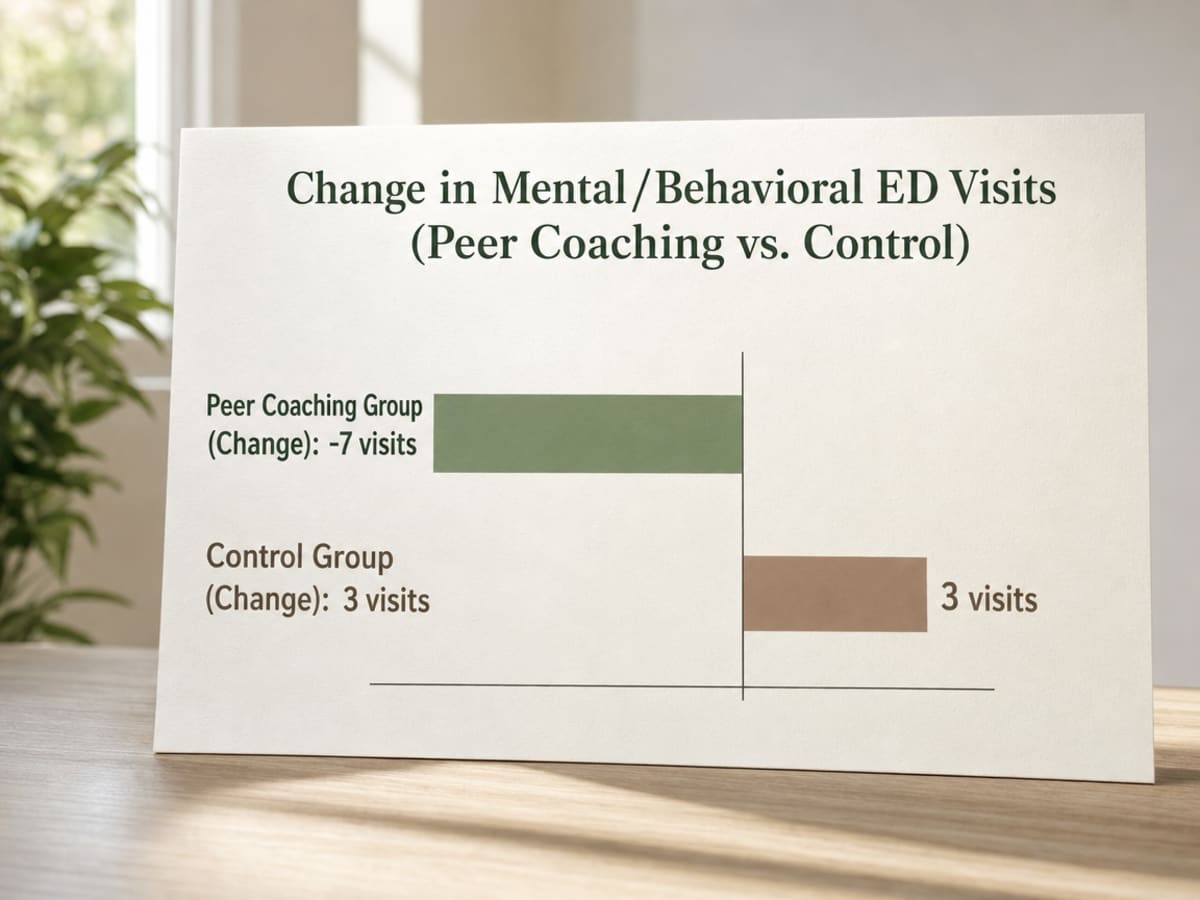
There is also a signal inside the acute-care research that hints at where peers do move the needle. A 2022 randomized study of inpatient recovery coaching linkage found no overall reduction in acute care encounters, but it did find a significant decrease in mental and behavioral ED visits in the peer recovery coach group: pre-enrollment 17 visits versus post-enrollment 10, compared with the control group’s 13 versus 16 14. A drop of seven against a rise of three, in one specific utilization domain. It is a narrow finding, and the authors treat it as such. What it suggests is that peer effects tend to be targeted rather than uniform, and they show up in the places where lived experience is doing something clinicians cannot do as easily, such as helping someone decide, at 2 a.m., not to go back to the ED for reasons that are really about isolation.
In a residential program, that dynamic runs all day. It is not one visit. It is a Tuesday.
What Six Peer Support Specialists Actually Do on a Tuesday at Serenity Park
Six peer support specialists are on staff at Serenity Park. That number matters when you consider the census: up to 20 men in residence at any given time. The ratio is not accidental. It’s what allows peer contact to be woven through the day instead of scheduled like a weekly extra.
A Tuesday looks something like this. Before breakfast, a peer is in the common area for the quiet check-in, the one where a resident might mention that he slept two hours and does not want to talk about why. Mid-morning, a peer co-facilitates a recovery education group grounded in the state’s 2025 Core competencies, working alongside the clinical staff running the curriculum 3. That co-facilitation is not stage dressing. The OBHS manual defines peer support around education, hope, advocacy, self-responsibility, and empowerment, and those goals show up in how the group is run 11.
After lunch, peers handle what the credentialing frameworks call navigation: sitting with a resident to think through the housing question, the employment question, the conversation he needs to have with a spouse or a managing partner 11. This is where lived experience does work a clinician cannot easily replicate, because the peer has made a version of that phone call himself.
In the afternoon, one peer might accompany a resident to a 12-step meeting off-site. Another leads a mindfulness or fitness activity. A third documents contact time in 15-minute increments, because in Arkansas peer support is a billable service and the paperwork is real 11, 16. In the evening, someone is available for the one-on-one that was not on any schedule but needed to happen.
Six people. Twenty residents. A day that never leaves you without one of them nearby.
The Question a Partner-Track Attorney Asks Before Admission
Here is the question that usually does not get asked out loud, because asking it feels like an admission. If you are a partner-track attorney, a practicing surgeon, an executive with fiduciary responsibilities, you want to know whether the person assigned to sit with you at your lowest point is going to understand what is at stake. Not in a soft, sympathetic way. In a serious way. The kind of serious that recognizes a bar license, a hospital privilege, or a board seat can be lost by the wrong phone call.
The Arkansas credential does most of the answering. Two years of consecutive abstinence before eligibility 6. A background check with no disqualifying offenses 6. A 30-hour core training, supervised experience hours, and a NAADAC-administered credentialing exam 1. These are not soft screens. The peer walking into your room has been vetted through the same kind of infrastructure your profession uses to gate its own credentials.
The other half of the answer is scope. Peer support in Arkansas is defined around education, hope, advocacy, self-responsibility, and empowerment 11. It is not clinical documentation of your case. It is not a channel back to your employer. The peer’s expertise is lived experience, and much of what he brings is a version of the story you have not told yet. He knows what a career looks like when it survives this. He has watched other men in similar positions decide, on a Wednesday afternoon, to make the harder call.
That is what you are getting. Not a well-meaning stranger. A credentialed staff member who has already walked the return trip you are considering.
How to Read a Program’s Peer Staffing Before You Sign
You are going to tour or interview at least one facility before you sign. Bring these questions with you, because they separate programs where peer support is designed in from programs where it is decoration.
- Ask how many peers are on staff and what the resident-to-peer ratio looks like on a typical shift. A number you can hold against the census tells you whether contact is possible or theoretical.
- Ask which certification tier each peer holds: CPRS, APRS, or PRS 1. If nobody on the team can name the tiers, that is your answer.
- Ask who supervises the peer team and whether that supervisor meets Arkansas’s PRS requirements, including four years of abstinence and 2,000 hours of paid peer employment 7.
- Ask whether peer contact is billed as a service under the state’s OBHS rules or provided informally 11. The billing question is not about your invoice. It’s about whether the program has built the role into its operating structure or is offering it as flavor.
- Ask what a peer does on a Tuesday: which groups, which one-on-ones, which off-site accompaniment. Vague answers here matter.
At Serenity Park, six credentialed peer support specialists are staff, not extras. That’s the standard to hold every program to.
Frequently Asked Questions
What is a certified peer support specialist in Arkansas?
A certified peer support specialist in Arkansas is a state-credentialed worker with lived experience of behavioral health or substance use recovery who provides education, hope, advocacy, and navigation support as a defined, Medicaid-reimbursable service under the state’s Outpatient Behavioral Health Services rules 5, 11. It’s a formal role, not a volunteer position.
How long must someone be in recovery before they can work as a peer in Arkansas?
At the core level, Arkansas requires at least two years of consecutive abstinence from illicit substances or alcohol, along with a background check clear of disqualifying offenses 6. Supervisor-tier peers must document four years of abstinence-based recovery and 2,000 hours of paid peer employment before earning that credential 7.
What is the difference between a CPRS, APRS, and PRS?
Arkansas uses a three-tier ladder. Core Peer Recovery Specialist (CPRS) is the entry credential, earned through a 30-hour core training, supervised experience, and a NAADAC-administered exam 1. Advanced Peer Recovery Specialist (APRS) adds training rooted in the Advanced Manual and expanded practice 2, 3. Peer Recovery Supervisor (PRS) requires all three levels plus 135 hours of continuing education and documented supervision hours 7.
Does peer support actually improve recovery outcomes?
The honest answer is: it depends on setting. A systematic review of SUD peer support found associations with reduced substance use, better treatment retention, stronger provider relationships, and higher satisfaction 8. Recent emergency department trials, including the POINT pragmatic randomized trial, showed no significant differences between peer-coached patients and standard care on treatment linkage or overdose outcomes 12. Peers appear to work best inside sustained, recovery-oriented programs rather than as brief crisis encounters.
Will a peer support specialist treat a professional’s situation with appropriate discretion?
The credential is built for that. Arkansas peers pass a background check, hold two or more years of documented abstinence, and complete a NAADAC-administered exam before certification 1, 6. Their scope is defined around education, hope, advocacy, and empowerment, not clinical documentation or outside reporting 11. The peer sitting with you is a vetted staff member, not a channel to your employer.
How is peer support different from a sponsor or a therapist?
A sponsor is a volunteer role inside a mutual-aid fellowship like 12-step, with no state credential or clinical scope. A therapist is a licensed clinician who provides diagnosis and treatment. A peer support specialist sits between them: state-credentialed, employed by a treatment program, working from lived experience within a defined scope of education, advocacy, and navigation 5, 11.
References
- How to get Certified – Arkansas Department of Human Services. https://humanservices.arkansas.gov/divisions-shared-services/shared-services/office-of-substance-abuse-and-mental-health/arkansas-peer-recovery/peer-training-and-certification/how-to-get-certified/
- Peer Training and Certification – Arkansas Department of Human Services. https://humanservices.arkansas.gov/divisions-shared-services/shared-services/office-of-substance-abuse-and-mental-health/arkansas-peer-recovery/peer-training-and-certification/
- Arkansas Peer Documents. https://humanservices.arkansas.gov/divisions-shared-services/shared-services/office-of-substance-abuse-and-mental-health/arkansas-peer-recovery/arkansas-peer-documents/
- National Model Standards for Peer Support Certification. https://library.samhsa.gov/sites/default/files/pep23-10-01-001.pdf
- Peer Support Specialist, Family Support Partner, and Youth Support Specialist Standards with Application. https://humanservices.arkansas.gov/wp-content/uploads/Peer-Support-Youth-Support-Family-Support-Standards-with-application-09.06.19.pdf
- Levels of Arkansas Peer Recovery Specialist and Requirements. https://humanservices.arkansas.gov/wp-content/uploads/Levels-of-Peer-Support-Specialist.pdf
- Arkansas Peer Recovery. https://humanservices.arkansas.gov/divisions-shared-services/shared-services/office-of-substance-abuse-and-mental-health/arkansas-peer-recovery/
- Lived Experience in New Models of Care for Substance Use Disorder: A Systematic Review of Peer Support and Recovery Coaching. https://pmc.ncbi.nlm.nih.gov/articles/PMC6585590/
- DAABHS Policies – Peer Support. https://humanservices.arkansas.gov/divisions-shared-services/aging-adult-behavioral-health-services/peer-support/
- SAMHSA releases model standards for peer support certification programs. https://www.aha.org/news/headline/2023-06-06-samhsa-releases-model-standards-peer-support-certification-programs
- Outpatient Behavioral Health Services (OBHS) Section II – Peer Support. https://humanservices.arkansas.gov/wp-content/uploads/180703_OBHS_II.doc
- An emergency department-based peer recovery coach intervention to increase opioid use disorder treatment linkage and reduce recurrent overdose: Results from the POINT pragmatic randomized trial. https://pmc.ncbi.nlm.nih.gov/articles/PMC11179981/
- Effect of a Peer-Led Behavioral Intervention for Emergency Department Patients With Substance Use Disorders: A Randomized Clinical Trial. https://pubmed.ncbi.nlm.nih.gov/35943744/
- Acute Care Utilization After Recovery Coaching Linkage During Hospitalization for Patients With Substance Use Disorder. https://pubmed.ncbi.nlm.nih.gov/35296984/
- Peer recovery coaches and emergency department utilization in patients with substance use disorders. https://pubmed.ncbi.nlm.nih.gov/37043924/
- Behavioral Health Services and Support Payment Rate Information – Arkansas. https://humanservices.arkansas.gov/u/bhrate/
- 2024 National Survey on Drug Use and Health (NSDUH) Releases. https://www.samhsa.gov/data/data-we-collect/nsduh-national-survey-drug-use-and-health/national-releases/2024