
Key Takeaways
- Arkansas has shifted its approach to substance use, with opioid overdose rates dropping from 14.2 to 11.0 per 100,000 between 2022 and 2023 and expanded naloxone distribution statewide 1.
- Traditional rehab programs are calibrated to men in their mid-40s, which is why guys in their 20s often disengage — age-relevant peer support is tied to stronger retention in this demographic 4.
- When choosing an Arkansas program, verify state licensure, ask the age of peer support specialists, confirm in-house psychiatric care for co-occurring conditions, and check that discharge planning starts in week one.
- Call two or three licensed Arkansas programs and put them through the same five questions before committing — a serious facility answers directly about licensure, census size, and co-occurring care.
You’re 23 and Reading This at 2 A.M.
You’ve been staring at your phone for an hour. Maybe longer. There’s a half-empty bottle on the desk, or a bag you swore last weekend was the last one, or a screenshot of a text from your girlfriend that starts with “I can’t do this anymore.” And somewhere between opening Instagram and closing it again, you typed something into Google. Rehab in Arkansas. Young adult rehab. What happens if I stop drinking. Something.
So first: it’s okay that you’re here. It’s okay that it took until 2 a.m. to admit you’re here. You are not weak for looking, and you are not broken for needing to look.
You’re also probably worried about a specific thing that most rehab websites don’t name. You’re worried you’ll walk into a room and be the youngest guy by fifteen years. That everyone else will be talking about their divorce and their kids and their second mortgage while you’re sitting there thinking about a chemistry final you failed or a group chat you can’t face.
That fear is real, and it’s fair. This guide is written for you — men in their 20s in Arkansas figuring out whether residential treatment is the next honest step, and what a program built around guys your age actually looks like. Keep reading. You don’t have to decide anything tonight.
What’s Actually Happening in Arkansas Right Now
Here’s something worth knowing before you decide anything: the ground has shifted in Arkansas over the last three years, and mostly in a direction that helps you.
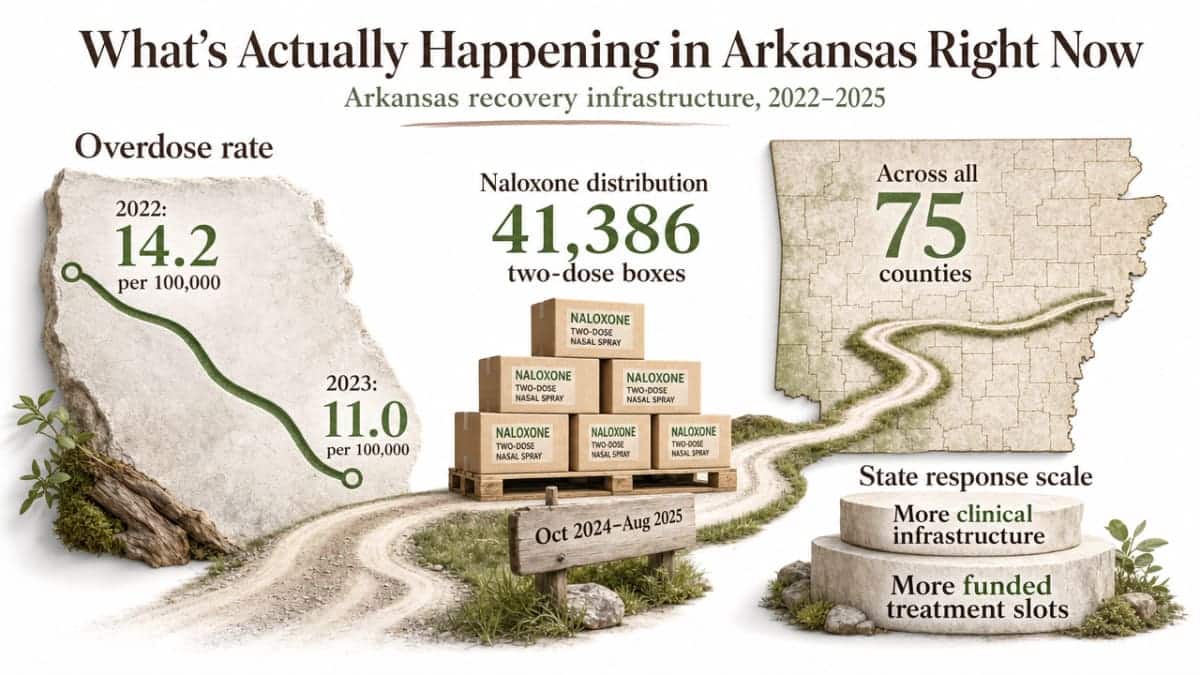
Between 2022 and 2023, Arkansas opioid overdose rates dropped from 14.2 to 11.0 per 100,000 people. In the same stretch, the state pushed out 41,386 two-dose naloxone boxes across all 75 counties between October 2024 and August 2025.1That’s not a small policy tweak. That’s the state treating substance use like the public health problem it actually is, and putting real money and real supplies behind that framing.
What that means for you, sitting there at 2 a.m.: the recovery environment around you in 2025 is not the same one your uncle or your dad might have described from twenty years ago. There is more clinical infrastructure, more funded treatment slots, and more people your age quietly doing the same thing you’re thinking about doing.
Some numbers to sit with. Under the state’s most recent opioid response reporting period, 2,870 unduplicated Arkansans received treatment services for opioid use disorder. Another 4,709 got treatment for stimulant use disorder — that’s the Adderall, the cocaine, the meth. And 7,615 overdoses were reversed with naloxone.2Every one of those numbers is a person. A lot of them are guys in their 20s.
You are not the only 23-year-old in Arkansas googling this at 2 a.m. You are one of thousands of men your age in this state who ran into the same wall you’re staring at. Most of them are still figuring it out. Some are further along than you. A few of them work as peer support specialists now — and that matters more than it sounds, which is what the next few sections are about.
The state is not perfect. Overdose deaths are still real, treatment beds are still limited in certain regions, and no amount of naloxone distribution replaces the harder work of getting into a program. But the direction has changed. That’s worth naming before we go further, because a lot of the internal script that keeps young men out of treatment — nobody actually recovers, this is pointless, I’ve already failed — was written in a different Arkansas than the one you’re in tonight.
Why Programs Built for 45-Year-Olds Lose Guys in Their 20s
Here’s the thing nobody tells you about traditional residential rehab: most of it was designed, staffed, and refined around a man in his mid-40s. A guy with a mortgage, a wife who’s given him one last chance, maybe a DUI that cost him his commercial license, and twenty-plus years of drinking or using behind him. The whole model — the group prompts, the family sessions, the relapse-prevention worksheets — assumes that history.
You don’t have that history. You have a different one. You have three semesters of college you might still finish. A roommate who deals Adderall and doesn’t think it’s a big deal. A job at a warehouse or a startup or your dad’s business where the stakes feel enormous and also somehow fake. A dating life. A phone that never stops. Parents who are still in the picture in a way a 45-year-old’s parents usually aren’t.
When you sit in a group where every other man is working through a divorce or a foreclosure, two things happen. You feel like a fraud — my problems aren’t real enough to be here — and you feel invisible. Neither of those feelings keeps you in treatment. Both of them are why guys your age walk out on day nine, tell everyone they’re fine, and are back in the same apartment by the weekend.
It’s not that older men have nothing to teach you. Some of them have exactly the thing you need to hear. But if the entire program is calibrated to their life stage, the daily texture of it won’t fit yours. The examples won’t land. The homework won’t map onto anything you’re actually doing on Tuesday afternoon.
The Load-Bearing Piece: Peer Support Specialists Close to Your Age
If there’s one thing that separates a residential program that holds men in their 20s from one that loses them, it’s this: whether there’s someone on staff who’s been where you are, and who’s close enough to your age that you actually believe them.
That role has a name. Peer support specialist. Peer recovery coach. Different programs use different titles. What matters is what the job is: a person in recovery themselves, trained and often state-certified, whose entire day is spent walking alongside guys in treatment. Not from behind a desk. Not with a clipboard. Alongside.
Here’s why that matters for you specifically. When a clinician who’s 52 tells you cravings will pass, you nod. When a peer support specialist who’s 28 and three years sober tells you the same thing — and mentions the exact bar on Kavanaugh he used to close down — you feel something different. You feel found. That’s not a soft outcome. Recent literature on peer recovery support services shows the model consistently improves treatment engagement and retention, with substance-use outcome evidence still developing but pointing in the right direction.5
The clinical reasoning goes deeper than vibe. Reviews of peer-delivered care report that peer support is linked to improved substance use outcomes, reduced relapse, greater client satisfaction, and — this one matters more than it sounds — higher post-discharge appointment adherence.9That last piece is the difference between finishing 30 days strong and vanishing from your outpatient therapist’s calendar by week two.
What does a peer support specialist actually do with you in a residential program? In the first few days, they’re often the first friendly face after intake — checking in, walking you to your room, helping you name what withdrawal is going to feel like without dressing it up. In week two, they might be the person who runs a small group where you finally admit you’ve been lying about how much you were drinking. By week three, they’re helping you sketch out what Monday morning looks like when you leave — the sponsor meeting, the outpatient appointment, the conversation with your boss or your dean.
For men your age, the near-age match does something specific. It undoes the story in your head that says nobody who’s actually made it out started where I did. Peer-reviewed work on young adults with SUD backs this up directly: age-relevant peer support is tied to better retention, stronger provider relationships, and reduced relapse in this exact demographic.4
Ask any program you’re considering in Arkansas one question early: Do you have peer support specialists on staff, and how old are they? If the answer is vague, keep looking.
What a Licensed Arkansas Residential Program Actually Has to Do
Before you commit to any program in this state, know what the state itself already requires. This matters because it separates real clinical treatment from a rebranded sober-living house with a nice website.
In Arkansas, any facility that calls itself an alcohol or drug abuse treatment program has to be licensed by the state, unless a narrow federal exemption applies.7There’s no informal version of this. The licensure standards are mandatory across the board, and a program either meets them and gets a one-year or three-year license, or it doesn’t operate.3
Here’s what that license actually covers. The state’s licensure manual sets requirements for how a program admits clients, who is allowed to provide clinical services, what the physical building has to look like, and how records are kept. Residential programs get extra scrutiny — Arkansas conducts on-site reviews and holds facilities to minimum service expectations specifically for the residential level of care.6If you’re staying overnight in a program’s beds, the state has already checked that certain baseline services are there.
A few practical things this means for you as a 20-something walking in the door:
- The counselors and clinicians running your groups have credentials the state has actually verified. This is not a peer’s living room with good intentions.
- The intake process — the assessment, the treatment plan, the discharge planning — is required, not optional. If a program tries to skip the paperwork, that’s a red flag.
- Residential facilities have to meet physical plant standards. Small things like sleeping arrangements, safety, and medication storage are regulated.
One question worth asking any Arkansas program directly: Are you licensed by the state as an alcohol and drug abuse treatment program, and can I see the license? A serious program will answer in about four seconds. If the response gets vague, or if someone tries to redirect you to accreditations that aren’t state licensure, keep looking.
Licensure isn’t a guarantee that a program will fit your life stage or that the peer support will land. It’s a floor, not a ceiling. But it’s the floor. Without it, nothing else on the tour matters.
The Anxiety, Depression, and ADHD Sitting Underneath
Here’s something worth saying out loud: for a lot of men in their 20s, the drinking or the pills or the powder isn’t the whole story. It’s the top layer. Underneath, there’s usually something else that’s been running for a long time.
Maybe you were the kid who couldn’t sit still in seventh-grade math and got labeled lazy instead of ADHD. Maybe the anxiety showed up around 15 and you figured out that beer flattened it. Maybe the depression is quieter — a fog you’ve learned to work through, until Adderall from a roommate made a Tuesday feel possible again. None of that makes you a bad guy. It makes you a guy who found a chemical solution to something no one taught him how to name.
SAMHSA’s guidance on young adults with co-occurring mental health and substance use is direct about this: care has to be individualized, recovery support has to be built in, and family engagement often matters more at this age than programs assume.8Translation — if a residential program treats the drinking but ignores the anxiety underneath it, you’re going to relapse. Not because you’re weak. Because half the problem is still there.
When you tour a program in Arkansas, ask directly whether they treat co-occurring conditions in-house. Ask if there’s a psychiatrist on staff, not just a counselor. If the answer is that they’ll refer you out after discharge, you’re being told the underneath part isn’t their job. For a 24-year-old, that’s the whole job.
A Day Inside a Small Men-Only Residential Program
You want to know what you’re actually walking into. That’s fair. Nobody signs up for a black box.
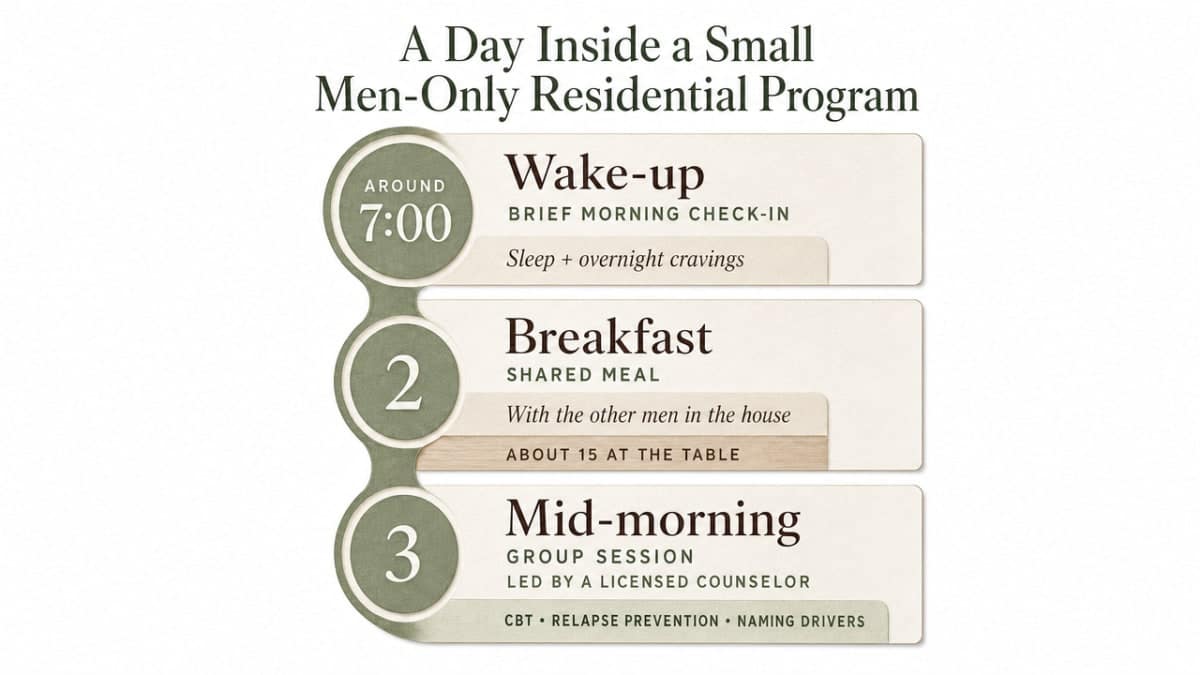
Here’s what a Tuesday looks like inside a small residential program built for men — the kind that houses up to 20 guys at a time, not 100. You wake up around 7. Somebody checks in with you before breakfast, usually a peer support specialist or a tech, and asks how you slept and whether the cravings hit overnight. It’s a short conversation. Nobody’s grading you.
Breakfast is with the other guys in the house. There are maybe 15 of you at the table. Some are 24, some are 40. You eat. You talk about the game, or you don’t talk at all, and nobody makes it weird.
Mid-morning is a group session. A licensed counselor runs it. This is where the clinical work happens — cognitive behavioral stuff, relapse prevention, learning to name what’s driving the drinking or the use. You might hate it the first three days. Most guys do.
Late morning, you meet one-on-one with your counselor or your psychiatrist. If anxiety or ADHD is part of your picture, this is where medication gets sorted out honestly — not as a favor, not as a workaround, but as part of the treatment plan.8
Afternoon is a mix. Some days it’s a fitness outing or time outside. Some days it’s a smaller group, sometimes led by a peer support specialist, where the conversation gets closer to the bone. Some days you meet with the discharge planner to start sketching out week five — the outpatient appointment, the sponsor, the housing question.
Evening is quieter. A 12-step meeting on-site or nearby. Dinner. Some free time where you can actually read a book or call your mom. Lights aren’t enforced like summer camp, but the house settles down.
What’s not in this picture: chaos. Waiting rooms with 80 people. Being processed. In a small men-only setting, the staff know your name by day two. The other guys know your story by week two. That’s the whole point of keeping the census low — you can’t hide, and nobody lets you.
How Serenity Park Fits This Picture
Serenity Park Recovery Center is a men-only residential program in Little Rock, licensed by the state of Arkansas, that keeps its census at up to 20 clients at a time. That number matters. In a house that small, the peer support specialist knows your name by day two, the counselors have actually read your intake, and the guy in the next room is close enough to your age that you don’t have to explain what a group chat is.
The clinical spine is what a serious residential program should offer: medically supervised detox, individual counseling, group therapy, psychiatric evaluation, and medication management for the anxiety, ADHD, or depression that’s often running underneath the drinking or the pills. Peer support meetings, 12-step integration, and discharge planning are built into the week, not tacked on at the end.
What’s different is the setting. Small house. Men only. Peer support specialists whose lived experience is closer to yours than to your dad’s. Wearable monitoring through a partnership with Huml Health that tracks sleep, heart rate, and stress so your clinical team can see, in data, when a rough night was actually rough.
If you’re 23 and reading this at 2 a.m., this is a place built for the shape of your life right now.
For Parents, Partners, and Older Brothers Doing the Research
This section is for you — the mom scrolling at midnight after your son went quiet on the phone again, the girlfriend who packed a bag last Tuesday and unpacked it Thursday, the older brother who’s watched this get worse for two years and doesn’t know what to say anymore. He didn’t type this into Google. You did.
First, the numbers you’re probably looking for. Arkansas recorded 389 drug overdose deaths in 2024, and 372 in 2025 based on provisional data.10Both directions matter here. The trend is nudging down, which means the state’s treatment and harm-reduction work is doing something. And it’s still 372 people last year — enough that acting now, rather than waiting for him to hit some imagined bottom, is the honest call.
What you can do that actually helps: get informed before you get insistent. Read what a licensed residential program in Arkansas is required to provide. Learn what a peer support specialist does. Understand that a small men-only setting with staff close to his age is not the same product as a 100-bed facility with a shared waiting room. When you call a program, ask the same questions he would ask if he were less afraid — about licensure, about co-occurring care, about who on staff is closest to his age.
What tends to backfire: ultimatums delivered in front of other people, surprise interventions that skip his consent entirely, and framing treatment as punishment for what he’s put you through. He already knows what he’s put you through. That’s part of why he’s stuck.
Make the call. Ask the questions. Bring him the answers when he’s ready to hear them.
What to Ask Before You Say Yes to Any Arkansas Program
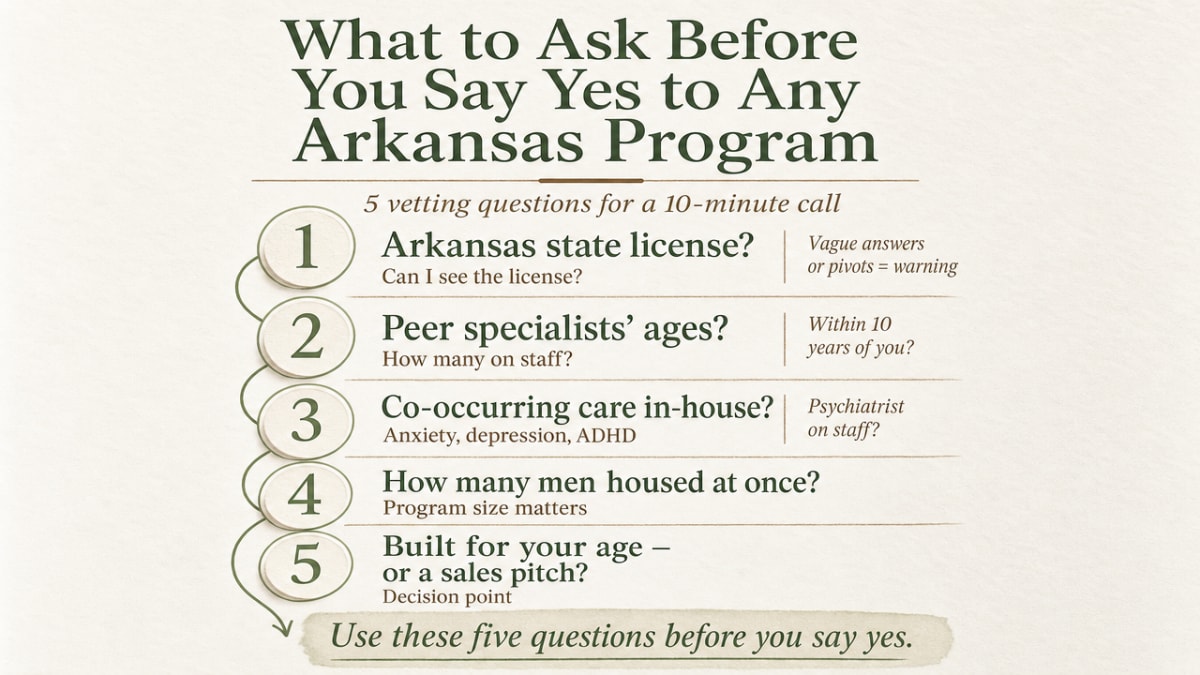
You don’t need to memorize a script. You need five questions that will tell you, in about ten minutes on the phone, whether a program is built for a guy your age or whether you’re being sold something.
- Are you licensed by the state of Arkansas as an alcohol and drug abuse treatment program, and can I see the license? A serious answer takes seconds. Vague answers, or pivots to other credentials, are the pivot.
- How old are your peer support specialists, and how many are on staff? If nobody on the team is within ten years of you, the group work is going to feel like visiting your dad’s office.
- Do you treat co-occurring anxiety, depression, or ADHD in-house, with a psychiatrist on staff? If they refer everything mental-health out after discharge, half of what’s driving the use isn’t getting touched.
- How many men do you house at once? A small census means staff will actually know your name. A 100-bed facility runs on a different logic.
- What does discharge planning look like starting in week one, not week four? Programs that wait until the last few days to sketch out your life after treatment are setting you up to disappear from follow-up.
Write the answers down. Compare two or three programs on the same five questions. The right place will sound relieved you asked.
Frequently Asked Questions
Will I be the youngest guy in the room?
In a small men-only residential program that keeps its census low and staffs peer support specialists in their late 20s or early 30s, no. You’ll be around guys close to your age and staff whose lived experience is closer to yours than to your dad’s. In a 100-bed facility that mixes all ages without age-specific programming, probably yes. Ask the census question before you commit.
How long does residential rehab in Arkansas usually last?
Length of stay depends on your clinical picture, not a fixed calendar. Some men need two weeks of medically supervised detox and stabilization. Others stay 30, 60, or 90 days depending on what’s driving the use and how discharge planning is going. A serious program will build the timeline around your assessment and your aftercare, not around a marketing package. Ask what determines discharge, not just duration.
What happens to my job, classes, or student loans while I’m in treatment?
The Family and Medical Leave Act protects many jobs during treatment. Colleges often allow medical withdrawals that preserve your standing, and federal student loans have deferment options for documented medical reasons. A good discharge planner will help you sort the paperwork in week one, not week four. Bring your employer’s HR contact and your school’s dean-of-students number to intake. This part is more workable than it feels tonight.
Can I still get treatment if I’m also dealing with anxiety, depression, or ADHD?
Yes, and honestly, you should look for a program that treats both. Co-occurring mental health conditions are common in young adult men, and treating the substance use without the underlying anxiety, depression, or ADHD tends to set relapse in motion. Look for a residential program with a psychiatrist on staff and integrated medication management, not one that refers all mental-health care out after you discharge.
How do I know if an Arkansas program is actually licensed and clinically serious?
Ask to see the state license. Arkansas requires any alcohol or drug abuse treatment program to hold a state-issued license, and a serious facility will produce theirs in seconds. Cross-check that residential services, psychiatric care, and discharge planning are named in what they offer. If a program pivots to accreditations that aren’t state licensure, or gets vague about credentials, that’s your answer.
What if my son or partner refuses to go?
Refusal usually isn’t final. It’s fear wearing a hard face. What tends to move the conversation: getting your own information first, staying calm when he pushes back, and offering a specific next step instead of a general demand. A phone call with an admissions counselor he can join, not a surprise intervention, tends to land better with men in their 20s. Keep the door open. Keep asking.
References
- 2025 – Arkansas State Opioid Response (SOR) 4. https://humanservices.arkansas.gov/wp-content/uploads/Y1-WYSAC-Eval-AR-SOR-4-Final-Draft.pdf
- Award Number: 5H79TI085733-02. https://humanservices.arkansas.gov/wp-content/uploads/SOR3-Closeout-Report-9.2024-1.pdf
- Licensure Standards for Alcohol and Other Drug Abuse Treatment Programs. https://humanservices.arkansas.gov/wp-content/uploads/Licensure_Standards_for_Alcohol_and_Other_Drug_Abuse_Treatment_Programs.pdf
- Support Services for Young Adults With Substance Use Disorders. https://pmc.ncbi.nlm.nih.gov/articles/PMC9034746/
- Peer Recovery Support Services and Recovery Coaching for Substance Use Disorder Treatment and Recovery: A Review of the Literature. https://pubmed.ncbi.nlm.nih.gov/41551498/
- Arkansas Summary — State Residential Treatment for Mental Health and Substance Use Disorder Services. https://aspe.hhs.gov/sites/default/files/2021-08/StateBHCond-Arkansas.pdf
- 007.25.00 Ark. Code R. 001 – Licensure Standards for Alcohol …. https://www.law.cornell.edu/regulations/arkansas/007-25-00-Ark-Code-R-001
- Treatment Considerations for Youth and Young Adults with Serious Emotional Disturbances and Serious Mental Illnesses and Co-occurring Substance Use. https://library.samhsa.gov/sites/default/files/pep20-06-02-001.pdf
- Lived Experience in New Models of Care for Substance Use Disorder Treatment. https://pmc.ncbi.nlm.nih.gov/articles/PMC6585590/
- Substance Misuse Education and Prevention – Arkansas Department of Health. https://healthy.arkansas.gov/programs-services/prevention-healthy-living/substance-misuse-education-and-prevention/