
Key Takeaways
- Arkansas folds CARF accreditation into its licensure process under 20 CAR § 433-206, verifying six clinical and safety areas before awarding a license 1.
- A CARF seal signals that an outside reviewer pulled actual treatment plans, progress notes, supervision records, and walked the med room—not that outcomes are guaranteed 6.
- With roughly 167 treatment facilities statewide 9, filtering to CARF-accredited residential programs for men in Arkansas leaves a short list rather than a crowded marketplace.
- On the intake call, confirm the accreditation term, license pathway, treatment plan review cadence, post-discharge measurement across all three outcome domains 4, and current staff-to-client ratio.
What an accreditation seal actually proves about a rehab
You already know how audits work. In your day job, you’ve probably sat across from one—maybe as the person being reviewed, maybe as the person doing the reviewing. So when you see a CARF seal on a rehab’s website, the right instinct is not to assume it means excellence. The right instinct is to ask what, specifically, someone checked.
CARF stands for the Commission on Accreditation of Rehabilitation Facilities. It’s a third-party body that sends reviewers into treatment programs to look at how the place actually runs: leadership, safety practices, clinical documentation, treatment planning, and how the program tracks whether people are getting better 11. The seal is not a promise about any single client’s outcome. It’s evidence that the program submitted to an outside review of its systems and passed.
That distinction matters when you’re choosing where to spend 30, 60, or 90 days of your life. A rehab can look polished on a tour and still keep sloppy progress notes. It can have a beautiful lobby and a treatment planning process that exists mostly in someone’s head. Accreditation is designed to catch that gap—not by trusting the marketing, but by pulling the actual files.
In Arkansas, this signal carries extra weight because the state formally recognizes it. A CARF-accredited program can receive licensure once Arkansas verifies specific clinical and safety areas 1. That’s the piece most articles skip, and it’s the piece that tells you what the seal is really doing here.
How CARF audits a residential program from the inside
What the auditor asks to see on day one
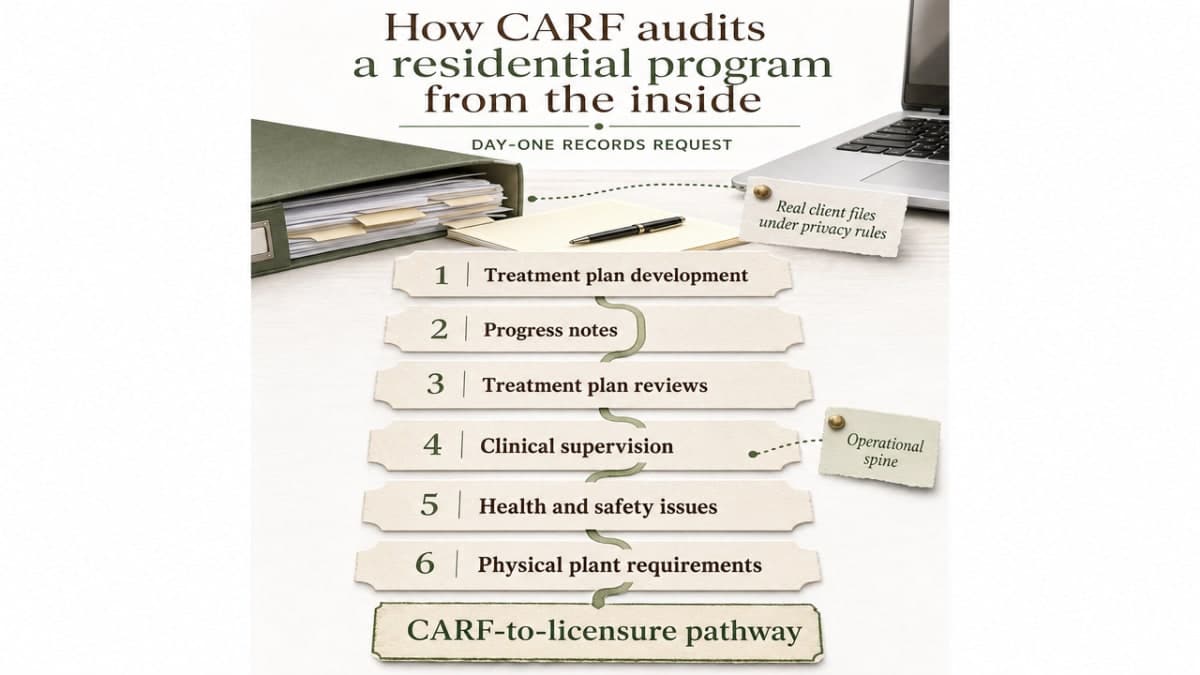
Picture the first morning of a site visit. A reviewer walks in with a binder, a laptop, and a list of things to pull. This is not a tour of the pool table and the meditation garden. It’s a records request.
In Arkansas, that request maps directly onto six areas the state itself verifies before it will treat a CARF accreditation as grounds for licensure:
- treatment plan development
- progress notes
- treatment plan reviews
- clinical supervision
- health and safety issues
- physical plant requirements 1
If you want a mental model for what accreditation actually inspects, start there. Everything else is texture on top of those six categories.
The auditor is going to ask for real client files, with identifying information handled under privacy rules. They’ll want to see the treatment plan the program built for the man who walked in three weeks ago. They’ll want the progress notes his primary counselor wrote after each session. They’ll ask when the plan was last reviewed and by whom. They’ll look at who supervised the clinicians doing the work and how that supervision was documented.
Then they walk the building. Are exit routes clear. Are medications stored the way they should be. Are staff-to-client ratios what the program claims on paper.
For you, sitting on the other side of this evaluation as a professional who has probably prepared for audits yourself, the takeaway is simple: a CARF seal on a program means someone with a checklist has already sat where you are now sitting, asked the harder version of your questions, and looked at the actual files—not the brochure.
Treatment planning, progress notes, and clinical supervision
Of the six areas Arkansas verifies, three are essentially about paper. Or, more accurately, about whether the clinical thinking behind care actually gets written down and revisited 1.
Treatment plans are the first checkpoint. When a man arrives at a residential program in Little Rock, someone has to sit with him, complete an assessment, and build a plan that names his diagnoses, his goals, and the specific interventions the program will use. A CARF reviewer will read that plan. They’ll ask whether it’s individualized or whether it looks copied from the last five admissions. Accredited programs are more likely to be using standardized assessment tools and evidence-based interventions to build those plans in the first place 12.
Progress notes are the second. Every session—individual counseling, group therapy, a psychiatric check-in—generates a note. The auditor will want to see whether those notes track the goals in the plan. If the plan says the client is working on relapse triggers tied to work stress, and the notes for the last month never mention work, that’s a gap. It’s the kind of gap that only shows up when someone pulls the files.
The third is clinical supervision. Who is reviewing the counselors’ work. How often. What gets documented from those supervision meetings. This is where accreditation quietly changes what happens inside a program: research on behavioral health accreditation finds it’s associated with stronger organizational processes and better adherence to clinical practice guidelines, even where the direct link to any single client’s outcome stays complex 11.
The point isn’t that paperwork heals anyone. It’s that a program without honest paperwork can’t tell whether anyone is being healed.
Safety, physical plant, and the parts most families never see
The last two verification areas are the ones nobody photographs for the website: health and safety, and physical plant 1. They matter more than a family touring the facility on a Sunday afternoon usually realizes.
Health and safety covers the boring, essential things. Medication storage and administration. Infection control. How the program handles a medical emergency in the middle of the night. What happens if a client goes into unexpected withdrawal and vitals shift fast. For a men’s residential program that offers medically supervised detox, this is not paperwork theater—it’s the difference between a manageable episode and a hospital transfer.
Physical plant sounds like building code. It is, partly. Are the smoke detectors working. Is the kitchen inspected. Are the bedrooms configured so a client on detox protocols is close enough to nursing eyes. But it also touches things you’d notice as a professional evaluator: whether the environment feels engineered for adult recovery or repurposed from something else.
An auditor pushes on both of these because they’re the areas where a well-marketed program can quietly fall behind. A polished intake team and a strong therapist bench can mask a lax medication room. Accreditation is one of the few checks that will actually walk into that room and open the log.
The Arkansas licensure pathway that turns CARF into a state trust signal
Here is the part most out-of-state articles miss. In Arkansas, CARF is not just a private badge floating in a marketing kit. The state has written it into the licensure process.
Start with the baseline. Every substance abuse treatment program operating in Arkansas has to be licensed. Not most. Every one. The Department of Human Services standards are explicit that licensure is required of any individual or organization running a program in the state 2. So when you see a rehab operating in Little Rock, the license is table stakes, not a differentiator.
What accreditation changes is how you get there. Under 20 CAR § 433-206, a CARF-accredited program can receive licensure once Arkansas verifies six specific areas: treatment plan development, progress notes, treatment plan reviews, clinical supervision, health and safety issues, and physical plant requirements 1. The DHS standards describe the same mechanism from the department’s side—the license is awarded on presentation of accreditation evidence plus verification of those areas by office personnel 2. Methadone treatment programs are carved out of this pathway and follow a separate route 1.
The signal for you is subtle but real. Arkansas is not saying an accredited program is automatically better than a non-accredited one. It’s saying the state has enough confidence in the CARF review process to fold it into its own oversight, rather than duplicating the work from scratch. The federal HHS summary of Arkansas’s behavioral health framework describes the same posture: CARF, The Joint Commission, and COA are all recognized, and programs are expected to document quality improvement, evidence-based practices, and outcomes measures 3.
So when you evaluate a Little Rock program that carries both a CARF seal and an active Arkansas license, you’re looking at a provider that has cleared two overlapping reviews of the same core clinical and safety areas. That’s not marketing. That’s the paperwork trail.
What accreditation tends to correlate with inside a program
Set aside the badge for a minute. The more useful question is what tends to be different about the inside of an accredited program versus one that has never invited an outside reviewer through the door.
Two patterns show up in the research. First, accredited substance use programs are more likely to use standardized assessment tools and evidence-based psychosocial interventions than non-accredited programs 12. That is not a claim that accreditation causes better clinicians. It’s a claim that the process of preparing for and passing a review nudges organizations toward tools and practices that can survive an outside look. Second, in the broader behavioral health literature, accreditation is associated with stronger organizational processes and closer adherence to clinical practice guidelines 11.
The other pattern is what accredited programs actually watch. CARF-style outcomes tracking rarely means one number on a dashboard. Recent SUD outcomes research organizes the field into three domains: substance use itself, treatment process measures, and general wellbeing 4. A program serious about accreditation is usually gathering data across all three—whether the man in front of them is drinking or using, whether he’s showing up to sessions and completing his plan, and whether the rest of his life (sleep, mood, work, relationships) is moving in the right direction.
For a program like Serenity Park, that last domain is where the wearable monitoring with Huml Health actually lines up with what accreditation expects: continuous data on heart rate, stress, and sleep feeding back into the treatment plan rather than being collected once at intake and forgotten. That’s what “outcomes tracking” looks like when it’s real.
The honest limits of what a CARF badge can tell you
If this piece stopped here, it would read like a sales page for accreditation. It shouldn’t, because a peer evaluator deserves the other half of the picture.
Accreditation is a signal about systems, not a promise about people. One peer-reviewed study of outpatient substance abuse programs found no association between licensing or accreditation status and better staff-to-client ratios or routine medical care, even though there were positive associations with some other aspects of treatment comprehensiveness 6. Translated into plain language: a seal on the door does not guarantee that the clinician you’ll actually work with has a manageable caseload, or that the medical side of the program is deeper than the minimum. Those are questions you still have to ask directly.
The second honest limit is about outcomes versus outputs. A study comparing accredited and non-accredited public health agencies found that accredited agencies were no more likely to write outcomes-focused objectives than non-accredited ones—most objectives on both sides were still output-focused, meaning they tracked activities completed rather than changes in the people served 7. That research is not about addiction treatment specifically, but the pattern travels. Passing an audit rewards a program for having the right processes in place. It does not automatically force the program to define success as “the man who came in is measurably better six months later.”
What this means for you is practical. When you’re on an intake call, treat the CARF seal as the floor, not the ceiling. Ask what the program measures beyond attendance and completion. Ask how they define a good outcome at 30, 60, and 90 days post-discharge. Ask what percentage of clients they’re still in contact with at those checkpoints, and how they know. A serious program will have real answers, or will tell you honestly what they’re still building. A program that treats the accreditation seal as the end of the conversation is telling you something too.
Where CARF-accredited programs sit inside Arkansas’s treatment system
Zoom out for a moment. It helps to see where a small, accredited residential program actually fits in the state you’d be entering treatment in.
SAMHSA’s most recent state profile counted 167 substance abuse treatment facilities operating in Arkansas, serving 7,640 clients on a single survey day, March 29, 2019 9. That’s a snapshot, not a running total. Real annual admissions across the state are much higher, because people cycle in and out of treatment through the year. But the snapshot tells you something useful: on any given Monday in Arkansas, there are roughly 7,600 people in some form of substance abuse care, spread across a system of about 167 licensed facilities.
Most of those facilities are outpatient. Only a subset offer residential treatment. A smaller subset of that group serves adult men specifically. A smaller subset still carries CARF accreditation on top of the mandatory state license. By the time you filter down to “CARF-accredited residential program for men in Arkansas,” you are looking at a short list, not a marketplace.
That matters for how you should read the credential locally. In a state with hundreds of accredited residential programs competing for attention, a CARF seal is one signal among many. In Arkansas, the pool is small enough that the credential meaningfully narrows your options—and the state’s licensure pathway 1gives it weight beyond a private logo. You are not searching for a needle. You are choosing among a handful of programs that have already cleared the higher bar.
A serious buyer’s checklist for the intake call
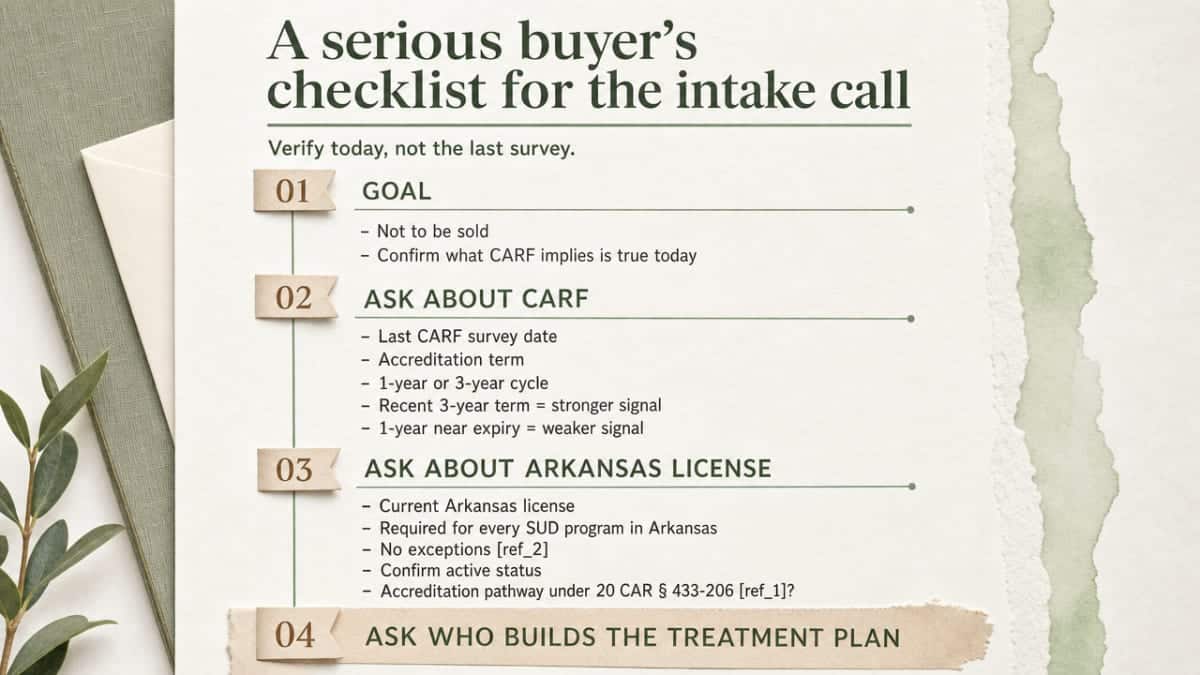
You vet vendors for a living. Apply the same instincts here. When you or someone acting for you gets on the phone with a Little Rock program, the goal is not to be sold. It’s to confirm that what the CARF seal implies about the inside of the program is actually true today, not on the day of the last survey.
A short list of questions gets you most of the way there.
- Ask when the last CARF survey was and what the accreditation term is. Programs earn one-year or three-year accreditation cycles. A recent three-year term is a stronger signal than a year that’s about to expire.
- Ask about the current Arkansas license. Every SUD program in the state has to be licensed, no exceptions 2. Confirm the license is active, and ask whether it was awarded through the accreditation pathway under 20 CAR § 433-206 1.
- Ask who builds the treatment plan and when it gets reviewed. You want a named clinician, an assessment process that uses standardized tools 12, and a review cadence—not “our team handles that.”
- Ask what they measure at 30, 60, and 90 days post-discharge. A serious program tracks across the three outcome domains research has settled on: substance use, treatment process, and general wellbeing 4. If they only cite completion rates, that’s an output, not an outcome 7.
- Ask about medical coverage during detox. Who is on-site overnight. What happens when vitals shift. This is one area where accreditation alone does not guarantee depth 6, so the answers have to come from the program directly.
- Ask what the staff-to-client ratio actually is this week. Not on the org chart. This week.
You’re not being difficult by asking. You’re doing what the auditor already did, in miniature. A program that treats these questions as reasonable is telling you something about how it operates when no one is watching.
Serenity Park as a working example in Little Rock
Everything in this piece has been abstract until now. Let’s ground it in one place, because you came here to evaluate a real decision, not to read a policy explainer.
Serenity Park Recovery Center is a men’s residential program in Little Rock that holds CARF accreditation. It runs at up to 20 clients at a time, which is small on purpose. The program covers medically supervised detox, residential addiction treatment, psychiatric care, individual counseling, group therapy, discharge planning, and alumni support. So when the six Arkansas verification areas 1map onto this specific building, they map onto files you could actually pick up: a treatment plan for the executive who came in on Tuesday, progress notes from his sessions, a review meeting on the calendar for next Friday, a named clinical supervisor, a med room log, a physical plant that was walked and signed off.
The piece that gives the accreditation signal extra teeth here is the continuous monitoring layer. Through a partnership with Huml Health, clients wear devices that feed real-time data on heart rate, stress patterns, and sleep back to the clinical team. That is not a marketing flourish; it is data landing in the general wellbeing domain that SUD outcomes research identifies as one of three that serious programs are expected to track 4. A treatment plan review with that data in the room is a different conversation than one without it.
You still have to make the intake call. You still have to ask the questions from the last section. But if you are choosing among a short list of Arkansas programs, Serenity Park is a working example of what the CARF seal is supposed to mean once you walk through the door.
Frequently Asked Questions
Is CARF accreditation required for a rehab to operate in Arkansas?
No. What’s required is a state license from the Arkansas Department of Human Services, and that applies to every substance abuse treatment program operating in the state, without exception 2. CARF accreditation is optional. It’s what lets a program take the licensure pathway under 20 CAR § 433-206, where the state verifies six specific clinical and safety areas and awards the license on that basis 1.
What does a CARF auditor actually look at during a review?
Real client files and the building itself. In Arkansas, the six areas the state checks alongside a CARF accreditation give you a clean map: treatment plan development, progress notes, treatment plan reviews, clinical supervision, health and safety issues, and physical plant requirements 1. The auditor reads actual plans and notes, asks who is supervising the clinicians, walks the med room, and confirms the physical space matches what the program claims.
How is CARF accreditation different from state licensure in Arkansas?
Licensure is mandatory and issued by the state. Every SUD program in Arkansas has to hold one 2. CARF accreditation is a voluntary, third-party review conducted by an outside body. The two overlap because Arkansas will award a license to a CARF-accredited program once it verifies the six clinical and safety areas in 20 CAR § 433-206 1. Think of the license as the floor and accreditation as an additional, external check on how the program runs.
Does CARF accreditation guarantee better treatment outcomes?
No, and any honest program will say so. One peer-reviewed study of outpatient SUD programs found no association between accreditation status and better staff-to-client ratios or routine medical care 6. Separate research on accredited public health agencies found they were no more likely to write outcomes-focused objectives than non-accredited ones 7. Accreditation is a strong signal about systems and documentation. Outcomes still depend on the clinicians and the program’s own measurement discipline.
What questions should I ask on an intake call to verify accreditation claims?
Ask when the last CARF survey was and how long the accreditation term runs. Ask whether the Arkansas license was awarded through the 20 CAR § 433-206 pathway 1. Ask who builds the treatment plan, what standardized assessment tools they use 12, and how often plans get reviewed. Ask what they measure at 30, 60, and 90 days post-discharge across substance use, treatment process, and general wellbeing 4. Ask this week’s staff-to-client ratio.
How many CARF-accredited residential rehabs are there in Arkansas?
There’s no public tally that filters cleanly to “CARF-accredited, residential, adult men.” What you can anchor to is the size of the overall system: SAMHSA counted 167 substance abuse treatment facilities in Arkansas on its 2019 survey day 9. Most are outpatient. Once you filter to residential programs for men that also carry CARF accreditation on top of the mandatory state license, you’re looking at a short list rather than a broad marketplace.
References
- 20 CAR § 433-206. Commission on Accreditation of Rehabilitation Facilities-, Joint Commission on the Accreditation of Health Care Organizations-, and Council on Accreditation-accredited programs. https://codeofarrules.arkansas.gov/Rules/Rule?levelType=section&titleID=20&chapterID=128&subChapterID=170&partID=666&subPartID=3987§ionID=24526
- Licensure Standards for Alcohol and Other Drug Abuse Treatment Programs. https://humanservices.arkansas.gov/wp-content/uploads/Licensure_Standards_for_Alcohol_and_Other_Drug_Abuse_Treatment_Programs.pdf
- Arkansas Summary — State Residential Treatment for Behavioral Health Conditions. https://aspe.hhs.gov/sites/default/files/2021-08/StateBHCond-Arkansas.pdf
- Substance Use Disorder Treatment Outcomes – PMC – NIH. https://pmc.ncbi.nlm.nih.gov/articles/PMC12180564/
- Evaluating the effectiveness of substance use disorder treatment centers: a systematic review of international standards and outcomes. https://pubmed.ncbi.nlm.nih.gov/42365295/
- Do licensing and accreditation matter in outpatient substance abuse treatment?. https://pubmed.ncbi.nlm.nih.gov/17588488/
- Outputs Versus Outcomes-A Comparison of Accredited and Non-Accredited Public Health Agencies’ Community Health Improvement Plan objectives. https://pubmed.ncbi.nlm.nih.gov/29218542/
- A comprehensive and comparative review of adolescent substance abuse treatment outcome. https://www.ncbi.nlm.nih.gov/books/NBK68420/
- National Survey of Substance Abuse Treatment Services (N-SSATS): 2019 Data on Substance Abuse Treatment Facilities – Arkansas. https://www.samhsa.gov/data/sites/default/files/quick_statistics/state_profiles/NSSATS-AR19.pdf
- Licensure Standards for Alcohol and Other Drug Abuse Treatment Programs (Arkansas regulation). https://www.law.cornell.edu/regulations/arkansas/016-25-19-Ark-Code-R-SS-015
- The role of accreditation in behavioral health care. https://www.ncbi.nlm.nih.gov/pmc/articles/PMC4939824/
- Implementation of evidence-based practices in substance use treatment programs. https://www.ncbi.nlm.nih.gov/pmc/articles/PMC3776541/