
Behavioral Therapy Little Rock, AR for Professionals
Key Takeaways
- Behavioral therapy for Little Rock professionals combines CBT, motivational interviewing, contingency management, and relapse prevention — each targeting a distinct point in the addiction cycle rather than working as interchangeable labels.
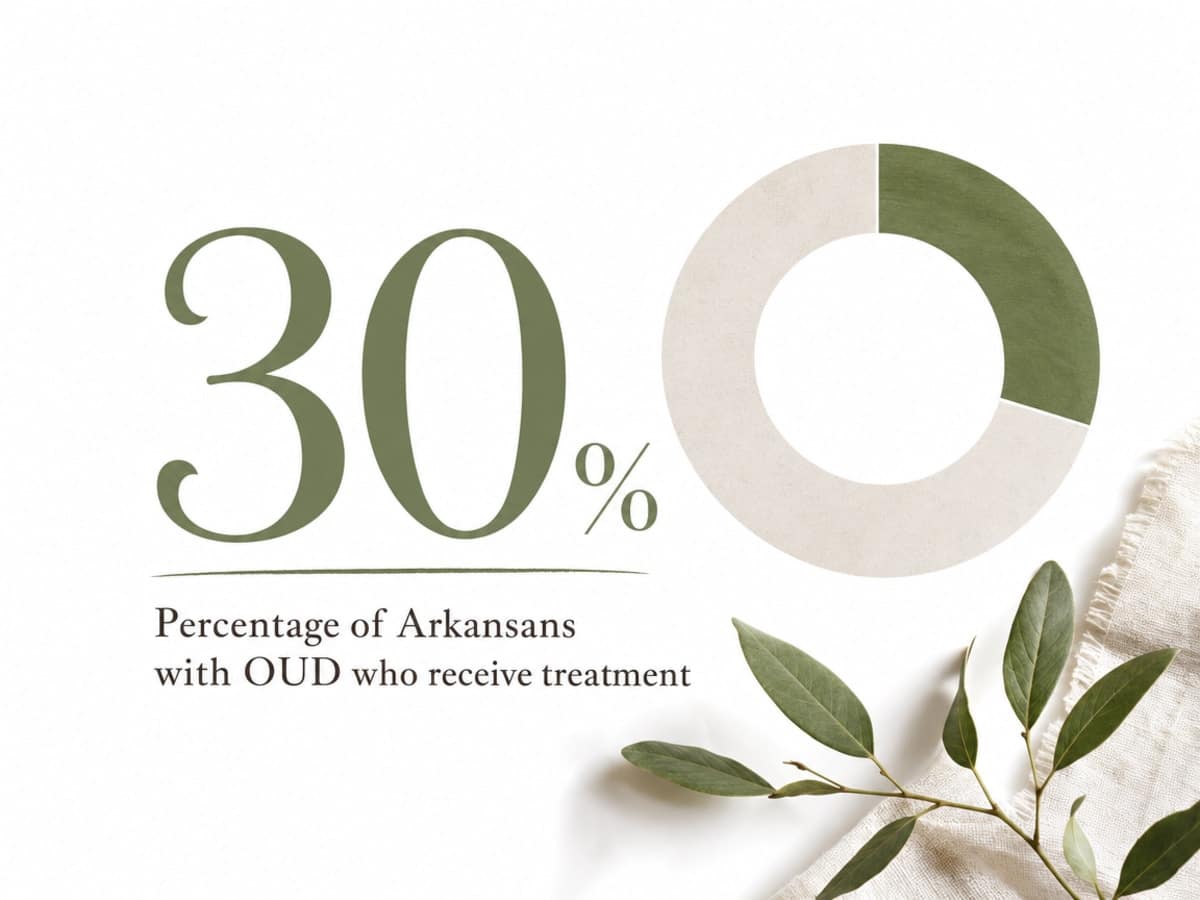
- Pulaski County’s density of physicians, attorneys, and executives means peers are quietly carrying the same burden, yet only about 30% of Arkansans needing OUD treatment actually receive it 3.
- Before choosing a program, compare clinician training across modalities, integration of medication when appropriate, and whether skills rehearsal maps to real professional triggers — not marketing that highlights a single therapy label.
- Weigh confidentiality protections under 42 CFR Part 2 and HIPAA, voluntary board recovery programs, and telehealth continuing care options 1against the calendar cost of a 20 to 90 day stay.
What behavioral therapy actually does for a working professional
You already know how to run a room. You’ve built a career on steady judgment, careful memory, and a face that doesn’t move when the news is bad. That skill set is exactly what makes admitting an alcohol or substance problem so hard — and it’s also why behavioral therapy, done well, matters more for you than for almost anyone else.
Here’s the honest version of what behavioral therapy is. It’s not a chair, a tissue box, and a slow conversation about your childhood. It’s a set of structured, evidence-based methods — cognitive behavioral therapy (CBT), motivational interviewing, contingency management, and relapse prevention — that build coping skills and help you manage co-occurring conditions like anxiety, depression, and insomnia 11. Each one has a specific job. CBT retrains the automatic link between a trigger, a thought, and a drink or a pill 12. The others fill gaps CBT alone doesn’t cover.
Inside a residential program, behavioral therapy is the working mechanism. Detox stabilizes your body. Therapy is what turns twenty to ninety days away from your practice into changes that survive the drive back into Little Rock traffic — the Thursday partner dinner, the on-call pager at 2 a.m., the quiet hour after the kids are asleep. You don’t need to surrender your identity to do this work. You need tools that hold up when your calendar comes back.
The Little Rock context: who’s actually walking through the door
Look around your building. If you work downtown, in the Heights, or out near the medical district, the person sitting two offices down might be quietly running the same internal calculation you are — how much longer, how much more, how to keep it hidden.
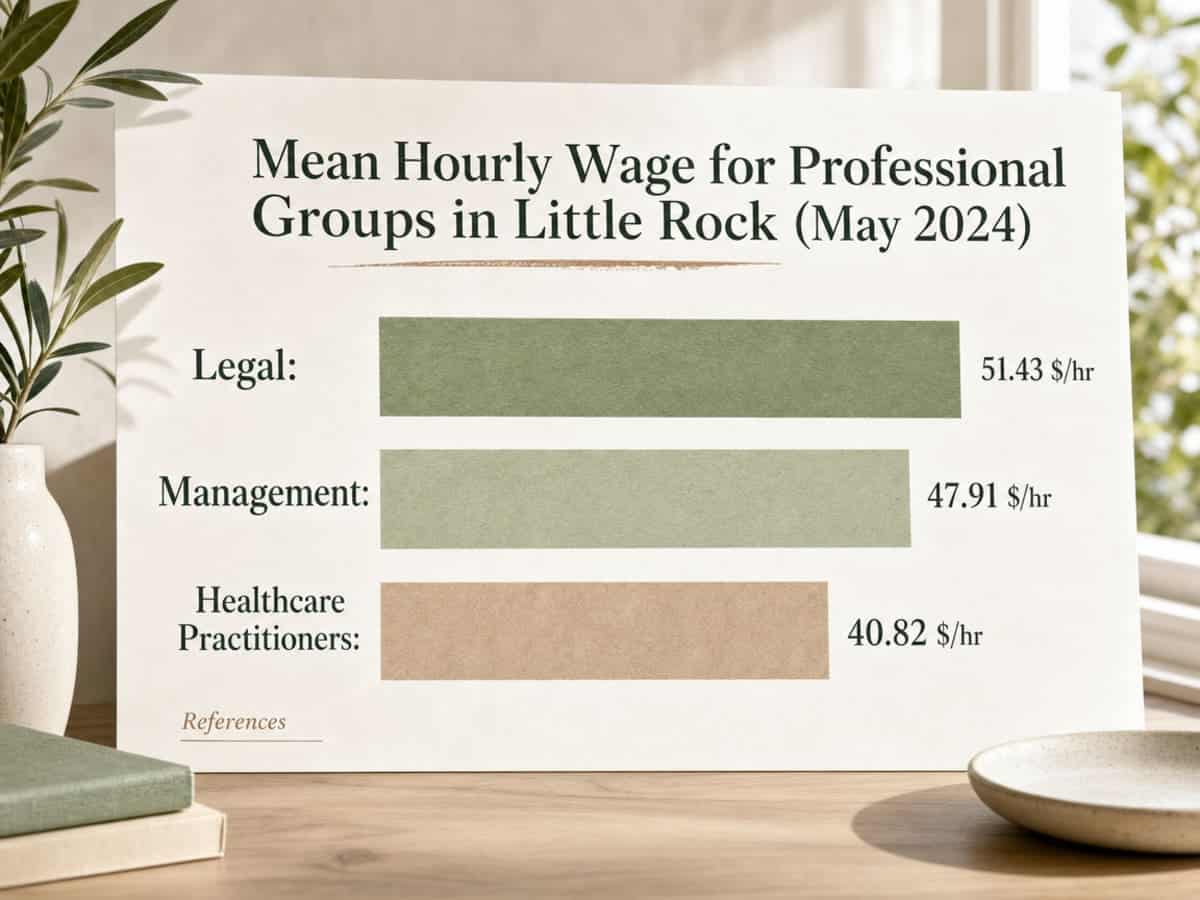
Little Rock is a professional town, and the numbers make that plain. In May 2024, legal occupations in the metro averaged $51.43 an hour, management $47.91, and healthcare practitioners and technical roles $40.82 — well above the metro’s overall mean hourly wage of $26.70 5. Healthcare practitioners alone made up 31,030 jobs, roughly 8.8% of local employment 5. The state labor report puts a finer point on it: registered nurses in the Little Rock workforce area averaged around $70,466 a year, and emergency medicine physicians cleared $360,000 6. Dentists, executives, and nurse anesthetists sit in that same upper band.
That density matters for two reasons. First, the men walking into a discreet residential program here are not outliers — they’re peers of the people running hospitals, firms, and companies across Pulaski County. Second, the burden is real. In 2023, 16.4% of Pulaski County adults reported their mental health was “not good,” out of an adult population of 307,397 9. That’s tens of thousands of working adults carrying something heavy while showing up on Monday morning.
You are not the only one. You may be the only one in your practice group willing to do something about it — but you’re not alone in the city.
Why the treatment gap catches high earners off guard
Most professionals assume that having good insurance and a good doctor means the treatment side of an addiction problem is solved. Arkansas data says otherwise, and the gap is sharpest in exactly the population you belong to.
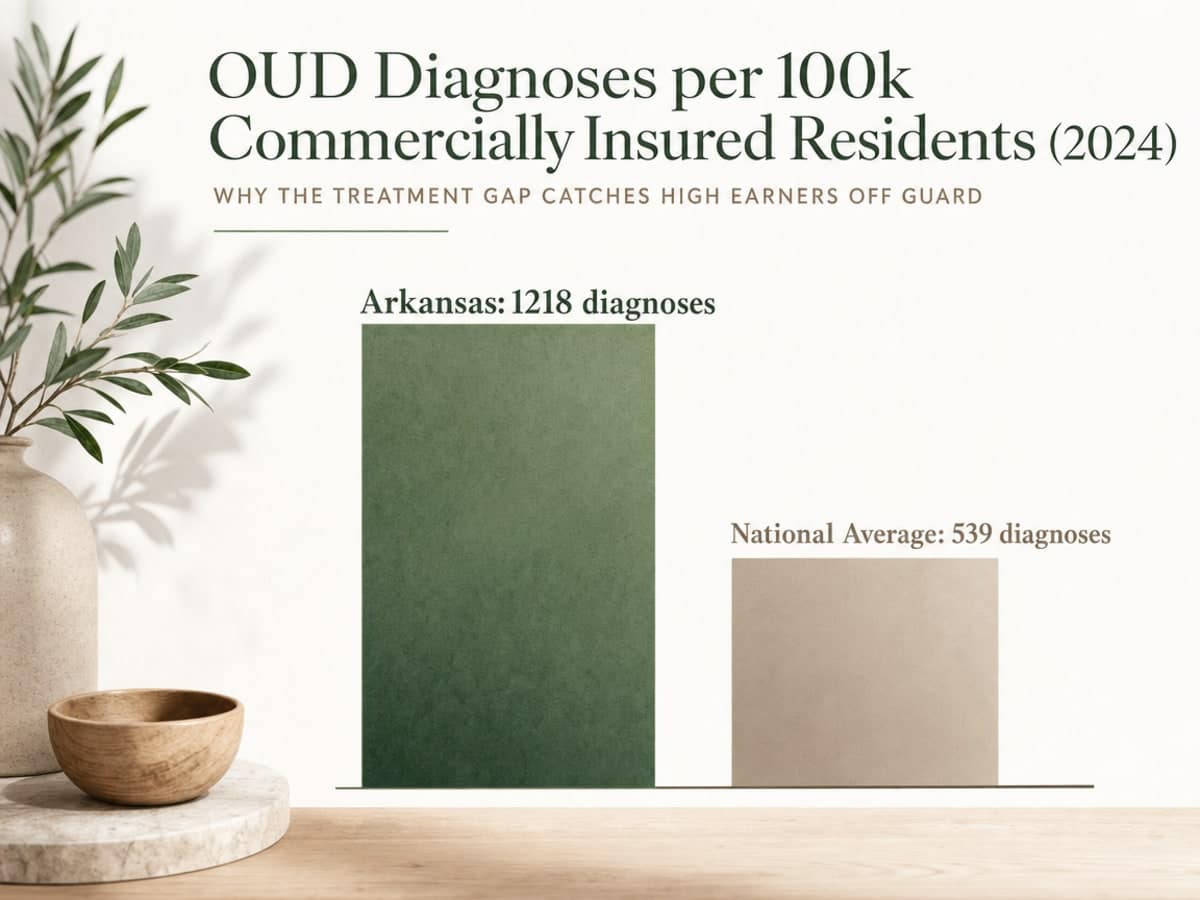
In 2024, Arkansas recorded 1,218 opioid use disorder diagnoses per 100,000 commercially insured residents, more than double the national average of 539. And only about 30% of Arkansans who need OUD treatment actually receive it 3. Read that again slowly. Commercial insurance — the kind you carry, the kind your partners carry — is not a shortcut past this problem. It is the population where the problem is most concentrated and least treated.
Some of that gap is supply. Some of it is stigma. A lot of it, for men in your position, is calendar. You cannot disappear for two hours on a Wednesday afternoon without someone noticing. You can, however, build a stretch of protected time around a residential admission — and that is often the only structure that actually lets evidence-based behavioral therapy work at full dose.
The direction is slowly turning. Arkansas saw 389 overdose deaths in 2024, down from 516 in 2023 2. That is real progress, but it does not tell you whether the person in the next office is getting help. It only tells you the system is capable of change when people step into it. Stepping in is still on you.
The four behavioral tools, and the distinct job each one does
“Behavioral therapy” is a category, not a single thing. Inside a good residential program, you’ll meet four distinct methods, each engineered for a specific failure point in the addiction cycle. NIMH names three of them directly — cognitive behavioral therapy, contingency management, and motivational interviewing — as effective for building coping skills and managing co-occurring conditions like anxiety and depression 11. Relapse prevention rounds out the set. Knowing which tool does which job helps you follow what’s happening in the room, and it helps you push back when a clinician glosses over the differences.
CBT: rewiring the thought-drink-relief loop
CBT is the workhorse. Its job is to interrupt the automatic sequence that runs under your day: trigger, thought, urge, use, relief. You know the loop. The email lands at 4:47 p.m., the shoulders tighten, the thought forms — I’ve earned this — and by 7:15 you’re two drinks in with no memory of deciding.
CBT slows that sequence down and puts you back inside it. Sessions teach you to identify the specific thought that bridges the trigger and the drink, test whether it’s actually true, and rehearse a different response before you need it. The peer-reviewed evidence base for CBT in substance use disorders is substantial, with an overall effect size in the moderate range, d = 0.45 12.
For a professional, the value is that CBT respects how your mind already works. You analyze problems for a living. CBT gives you a structured way to analyze your own — cravings, avoidance, catastrophic thinking about work — with the same rigor you’d apply to a case file or a patient chart. Nothing about it asks you to become a different person.
Motivational interviewing: for the part of you that still argues back
You wouldn’t be reading this if part of you weren’t already convinced. But there’s another part — the part that got you into your career, the part that solves problems by working harder — that still believes it can manage this alone. Motivational interviewing (MI) is built for that internal argument.
MI isn’t confrontation and it isn’t cheerleading. A clinician trained in MI asks careful questions that let you hear your own reasoning out loud: what you actually want, what you stand to lose, where the story you’re telling yourself stops matching the facts. NIMH lists MI alongside CBT as a core behavioral therapy for co-occurring substance use and mental disorders 11.
For high-functioning men, MI often does the quiet work no other modality can. It’s where ambivalence gets named honestly, without shame, so the rest of treatment has something real to build on.
Contingency management and relapse prevention: structure over willpower
Willpower is not a plan. Contingency management (CM) and relapse prevention are the two behavioral tools that admit this openly and build structure around it instead.
CM uses concrete reinforcement — verifiable milestones tied to tangible rewards — to make early sobriety pay off in ways your brain can register in real time. NIMH names it alongside CBT and MI as an effective behavioral therapy 11. The 2023 review of behavioral therapies for alcohol and other drug use disorders found that CBT combined with CM performs strongly, and CM often shows robust effects on its own 14. That last point matters: CM is not a lesser adjunct to CBT.
Relapse prevention is the map for after. Drawing on the Project MATCH coping skills framework, it teaches you to identify the high-risk situations that predict renewed drinking or use, and to rehearse specific responses — drink refusal language, problem-solving under pressure, managing the moments after a win or a loss 15. For you, those situations have names: the bar association reception, the closing dinner, the flight home from a deposition. Rehearsed responses beat improvisation every time.
How behavioral therapy actually performs against alcohol and drug use
You want to know if this works. Not in general — for people like you, with a schedule like yours, carrying what you’re carrying. That’s a fair question, and the honest answer has more nuance than most treatment marketing admits.
The strongest meta-analysis on this question looked at 30 randomized controlled trials of CBT for alcohol and other drug use disorders. CBT produced outcomes roughly 15% to 26% better than minimal or no treatment across those studies 13. The broader CBT-for-SUD literature places the overall effect size in the moderate range at d = 0.45 12. Those are real numbers, and they clear the bar you’d want any evidence-based intervention to clear.
What that means for you is practical. Don’t chase a program because it advertises CBT in bold letters. Ask instead whether the clinicians are trained in multiple modalities, whether they combine CBT with MI and CM depending on where you’re stuck, and whether the skills work translates to the specific pressures — the pager, the docket, the boardroom — you’ll walk back into. High-quality behavioral care, delivered inside a structure that protects your time and attention for a few weeks, is where the numbers get better. That’s the mechanism worth investing in.
A week inside a small-capacity men’s residential program
The best way to understand behavioral therapy is to watch it move through a day. A small-capacity men’s program — twenty beds, not two hundred — lets the schedule breathe around real clinical work instead of herd movement. What follows is the rhythm you can expect if the program is doing this right, and how each block of the day maps to a specific job the therapy is trying to do.
Mornings: individual CBT and medical stabilization
Your morning starts before the clinical day does. Vitals, medication check-ins if you’re on medically assisted treatment, breakfast, and a short window to write down what the night gave you — sleep quality, cravings, any dreams that involved the bottle or the pills. That log is not busywork. Your CBT clinician uses it in your one-on-one session an hour later.
Individual CBT in the morning is deliberate. Your mind is clearest before noon, and the work is cognitive: identifying the specific automatic thoughts that ran alongside yesterday’s urges, testing them, and building a written response for the next time they show up. This is the retraining process the CBT literature describes, with its moderate effect size in substance use populations 12. It also happens to be the block where the medical side of the program stays tight — psychiatric check-ins, medication adjustments, and monitoring for withdrawal symptoms in the first ten to fourteen days. You are being treated as a whole system, not a symptom.
Afternoons: skills groups mapped to real professional triggers
Afternoons shift into group work, and this is where the professional texture matters. A well-run men’s group is not a confession circle. It’s a working session where six to ten men rehearse specific skills against specific scenarios drawn from their actual lives.
The Project MATCH coping skills framework organizes this content clearly: coping with cravings, drink refusal, problem-solving, and managing high-risk situations 15. In a room full of physicians, attorneys, and executives, those categories get local names quickly. Drink refusal becomes what you say to the senior partner who orders a second bottle at the closing dinner. High-risk situations become the Friday after a difficult verdict, the flight home from a conference, the empty house on a call weekend. Problem-solving becomes how you handle a colleague’s question about where you’ve been.
Motivational interviewing threads through the week alongside skills groups, often in shorter one-on-one check-ins where a clinician helps you keep your own reasoning honest 11. Contingency management pieces show up as concrete milestone reinforcement — earned privileges, verified progress markers — that give early sobriety something your brain can register as a win 11. None of this is soft. It’s engineered.
Evenings: peer work, sleep, and the quiet part of recovery
Evenings turn down the clinical volume on purpose. AA or NA meetings run several nights a week, often on-site, and they do something the therapy hours can’t: they put you in a room with men further down the road than you are. Peer contact is where recovery gets its social scaffolding.
The quieter blocks matter as much as the meetings. Reading, journaling, exercise, actual sleep — the kind you probably haven’t had in years. Insomnia and anxiety travel with heavy drinking and stimulant use, and a stable sleep-wake cycle is one of the earliest measurable gains you’ll notice. That single change often does more for your mood by day ten than any single therapy session. Rest is not a break from the work. It is part of the work.
Return-to-practice: which skills work in which real situations
The whole point of doing this work is that the work travels home with you. A residential stay is a container. What matters is what you carry out of it and back into a Monday morning at your clinic, your firm, or your company. Here is how the four behavioral tools map onto the situations you actually face.
The call rotation and the 4:47 p.m. email. This is CBT territory. The trigger is fatigue and adrenaline, the thought is some version of I’ve earned this, and the response you rehearsed in your morning sessions is a written script — what you do instead in the next fifteen minutes. The Project MATCH framework calls this managing high-risk situations, and the answer is always a specific behavior, not a slogan 15.
The client dinner, the bar association reception, the closing. Drink refusal language, practiced out loud in group until it sounds like you rather than a workbook. The Project MATCH manual dedicates a full skill block to this because improvising in the moment is where most professionals fall 15. You want three sentences you can say without hesitation, in your own register.
The partner track pressure, the difficult case, the empty house on a call weekend. This is where motivational interviewing skills you internalized become an internal conversation. When ambivalence rises — I could probably handle one — you already know how to walk yourself through what you actually want and what the cost is. NIMH names MI as core precisely because this internal argument does not end at discharge 11.
The first ninety days back. Contingency management logic — concrete, verifiable milestones that reward the boring work of showing up — extends into aftercare through structured continuing care groups and check-ins 11. You don’t need a gold star. You need a system that registers the wins your calendar won’t.
None of this is theoretical. The skills that work are the ones you rehearsed against your own life while you were still in the room to get them right.
What wearables and telehealth can and can’t do yet
You’ve probably worn a fitness tracker for years. Sleep score, resting heart rate, HRV — you already read those numbers the way you read a P&L. It’s fair to ask whether that data can do real work inside addiction recovery, and the honest answer is: some of it, sometimes, with caveats worth naming out loud.
Inside a residential program, wearable data is genuinely useful as a clinical signal. Elevated resting heart rate, disrupted sleep architecture, and unusual stress readings can flag withdrawal, medication side effects, or a rough night before your clinician walks into a morning session blind. That kind of pattern-tracking, paired with a therapist who actually reads it, adds texture to individual CBT work. But the 2020 systematic review of wearable and wireless mHealth technologies for substance use disorders reached a plain conclusion: there is currently insufficient evidence to support remote monitoring of SUDs through wearable devices as a standalone tool 7. Promising signal, not yet a validated relapse-prevention system.
Telehealth sits in a different place. Arkansas Medicaid’s outpatient behavioral health manual formally recognizes telemedicine for individual counseling and group therapy when providers meet ATN audiovisual and HIPAA standards 1, and SOR III has expanded provider training through weekly Project ECHO sessions statewide 8. That means your continuing care after discharge — CBT booster sessions, MI check-ins, psychiatric follow-up — can plausibly run through secure video from your office or home. Use the tech for what it does. Don’t ask it to be the therapy.
Licensure, confidentiality, and time away from your practice
The three questions you haven’t asked out loud yet are the ones that matter most. Will my board find out. Will my partners find out. How do I disappear for a month without the whole thing unraveling.
Start with confidentiality. Federal 42 CFR Part 2 and HIPAA both apply to substance use treatment records, and they are stricter than the general privacy rules covering the rest of your medical care. Nothing about your admission, your diagnosis, or your therapy content is released to an employer, a hospital credentialing office, or a licensure board without your written, specific authorization. That protection is not a courtesy. It is the legal baseline.
Licensure is where the calculus gets more personal. Most state boards — medical, legal, dental, nursing — operate physician health, lawyer assistance, and professional recovery programs that exist precisely so people in your position can get evidence-based treatment without triggering discipline. Voluntary engagement, before a complaint or an incident, is treated very differently than exposure after one. Many boards actively partner with treatment providers and monitoring programs to keep licensed professionals working. Talk to a healthcare attorney who knows your specific board before you assume the worst.
Time away is the other real problem. Twenty to ninety days is a wide range, and the length that fits your case is a clinical decision, not a scheduling one. What you can plan for is the structure around it. A short medical leave, coverage arrangements with partners or associates, and a discreet return-to-practice plan built with your clinical team are all standard. Continuing care after discharge often runs through HIPAA-compliant telemedicine 1, which means CBT booster sessions and psychiatric follow-up can fit inside a normal workweek once you’re home.
The fear of exposure is doing more damage right now than the treatment ever would. Sit with that.
Frequently Asked Questions
Is behavioral therapy actually enough, or do I need medication too?
For alcohol and opioid use disorders, behavioral therapy and medication work best together, not against each other. Medication-assisted treatment stabilizes the body and reduces cravings; behavioral therapy retrains the thinking and situations that drive use 11. A good residential program builds both into one plan. The right answer for you is a clinical decision, not a philosophy.
How long do I need to be away from my practice for residential treatment to work?
Most residential stays run 20 to 90 days, and the length that fits your case is clinical, not administrative. Shorter stays can stabilize acute use; longer stays give behavioral therapy — CBT, MI, contingency management, relapse prevention — enough repetitions to hold under real pressure 11. Continuing care through telehealth can then extend the work inside your normal workweek 1.
Will my licensure board or employer find out I went to treatment?
Not without your written, specific authorization. Federal 42 CFR Part 2 and HIPAA protect substance use records more strictly than general medical records. Most boards also run confidential physician health, lawyer assistance, and professional recovery programs designed for voluntary engagement before any incident. Talk to a healthcare attorney familiar with your specific board before you assume disclosure is required.
Is CBT really the best behavioral therapy for alcohol or substance use?
CBT outperforms minimal or no treatment by roughly 15% to 26%, with a moderate effect size around d = 0.45 12, 13. But it is not consistently superior to contingency management or motivational enhancement therapy 14. Ask whether your clinicians are trained across modalities and combine them based on where you’re stuck. Delivery quality matters more than the label on the therapy.
Can I continue behavioral therapy through telehealth after I return to Little Rock?
Yes. Arkansas Medicaid’s outpatient behavioral health manual formally recognizes telemedicine for individual counseling and group therapy when providers meet ATN audiovisual and HIPAA standards 1. State SOR III efforts have also expanded provider training through weekly Project ECHO sessions 8. CBT booster sessions, MI check-ins, and psychiatric follow-up can plausibly run through secure video from your office or home.
What if I’m functioning fine at work — do I really need residential care?
Functioning at work is not the threshold; sustainability is. Arkansas records 1,218 OUD diagnoses per 100,000 commercially insured residents, and only about 30% of those needing OUD care receive it 3. Many of them looked fine on Monday morning. Residential care exists because a protected stretch of time is often the only structure that lets behavioral therapy work at full dose.
References
- Arkansas Medicaid Outpatient Behavioral Health Services Manual – Telemedicine Section. https://humanservices.arkansas.gov/wp-content/uploads/SP-19-0054_Attachment_S_-_Arkansas_Medicaid_Outpatient_Behavioral_Health_Manual.pdf
- Substance Misuse Education and Prevention – Arkansas Department of Health. https://healthy.arkansas.gov/programs-services/prevention-healthy-living/substance-misuse-education-and-prevention/
- Buprenorphine Saves Lives. https://humanservices.arkansas.gov/wp-content/uploads/2510253-PRI-Buprenorphine-FLY-003.pdf
- Behavioral Health Barometer: Arkansas, Volume 5. https://www.samhsa.gov/data/sites/default/files/cbhsq-reports/Arkansas-BH-BarometerVolume5.pdf
- Occupational Employment and Wages in Little Rock-North Little Rock-Conway, AR. https://www.bls.gov/regions/southwest/news-release/occupationalemploymentandwages_littlerock.htm
- 2022 Arkansas Labor Market and Economic Report. https://www.dol.gov/sites/dolgov/files/eta/Performance/pdfs/annual_economic_reports/PY2021/AR%20PY21%20Economic%20Analysis%20Report.pdf
- Wearable and Wireless mHealth Technologies for Substance Use Disorders: A Systematic Review. https://pubmed.ncbi.nlm.nih.gov/33738178/
- Arkansas State Opioid Response (SOR) III Final Evaluation Report (2024). https://humanservices.arkansas.gov/wp-content/uploads/WYSAC-SOR-3-Final-Eval-Report-12162024.pdf
- 2023 BRFSS County Estimates – Arkansas Department of Health. https://healthy.arkansas.gov/wp-content/uploads/2023_Collection-of-County-Estimates.pdf
- Annual Statistical Report – Arkansas Department of Human Services. https://humanservices.arkansas.gov/wp-content/uploads/Annual-Statistical-Report-v7.pdf
- Finding Help for Co-Occurring Substance Use and Mental Disorders – NIMH. https://www.nimh.nih.gov/health/topics/substance-use-and-mental-health
- Cognitive-Behavioral Therapy for Substance Use Disorders. https://pmc.ncbi.nlm.nih.gov/articles/PMC2897895/
- A Meta-Analysis of Cognitive-Behavioral Therapy for Alcohol or Other Drug Use Disorders (Journal of Consulting and Clinical Psychology). https://addictions.psych.ucla.edu/wp-content/uploads/sites/160/2020/01/JCCP-A-meta-analysis-of-cognitive-behavioral-therapy-for-alcohol-or-other-drug-use-disorders-Treatment-efficacy-by-contrast-condition.pdf
- Efficacy of Cognitive Behavioral Therapy for Alcohol and Other Drug Use Disorders. https://pmc.ncbi.nlm.nih.gov/articles/PMC9948631/
- Project MATCH Volume 3: Cognitive-Behavioral Coping Skills Therapy Manual (NIAAA). https://www.niaaa.nih.gov/sites/default/files/match03.pdf