
Key Takeaways
- Meta-analytic and federal clinical data show group therapy matches or slightly exceeds individual therapy on abstinence outcomes for substance use disorder 2, 4, making it a primary modality rather than a support add-on.
- All-male groups reduce the shame and stoic self-reliance that keep professional men silent, letting them speak honestly and rebuild self-esteem through peer feedback that cannot be dismissed 5, 13.
- The real work sits beneath the drinking: structured group interventions targeting shame and trauma produce fewer substance use days and higher post-discharge engagement in residential care 6, 9.
- Judge a program by who runs the room, how small and male-only the composition is, and whether structured group work addresses shame and trauma directly 4, 5, 6.
The Objection Every Professional Man Raises First
Before you read another paragraph, name the thing you’re actually thinking: I am not sitting in a circle telling strangers my problems. You’ve built a career on discretion. You bill by the hour, run the board meeting, sign the payroll, close the surgery. The idea of trading that posture for a folding chair and a first-name introduction feels, at best, undignified. At worst, it sounds like the beginning of a story you’d never want told about you.
That reaction is not a character flaw. It’s the exact conditioning that has kept your drinking or your use in place for years. The privacy that protects your reputation is the same privacy that lets the problem grow. You already know this, or you wouldn’t be reading.
Here is what the clinical literature actually shows, and what this article will make the case for: a well-run men-only group is not a support circle. It is a clinical instrument with measurable outcomes that meet or match individual therapy for substance use disorder 1, 4. Federal treatment guidance from SAMHSA treats group work as a primary modality, not an add-on, and specifically identifies all-male groups as a setting where men speak more honestly and carry less shame 5.
You are not being asked to perform vulnerability for an audience. You are being asked to sit in a room with eight other men who are running similar calculations about their own lives. What that room does to a professional man over the arc of a residential stay is the rest of this piece.
What the Outcome Data Actually Says
Group Therapy Matches Individual Therapy on Abstinence
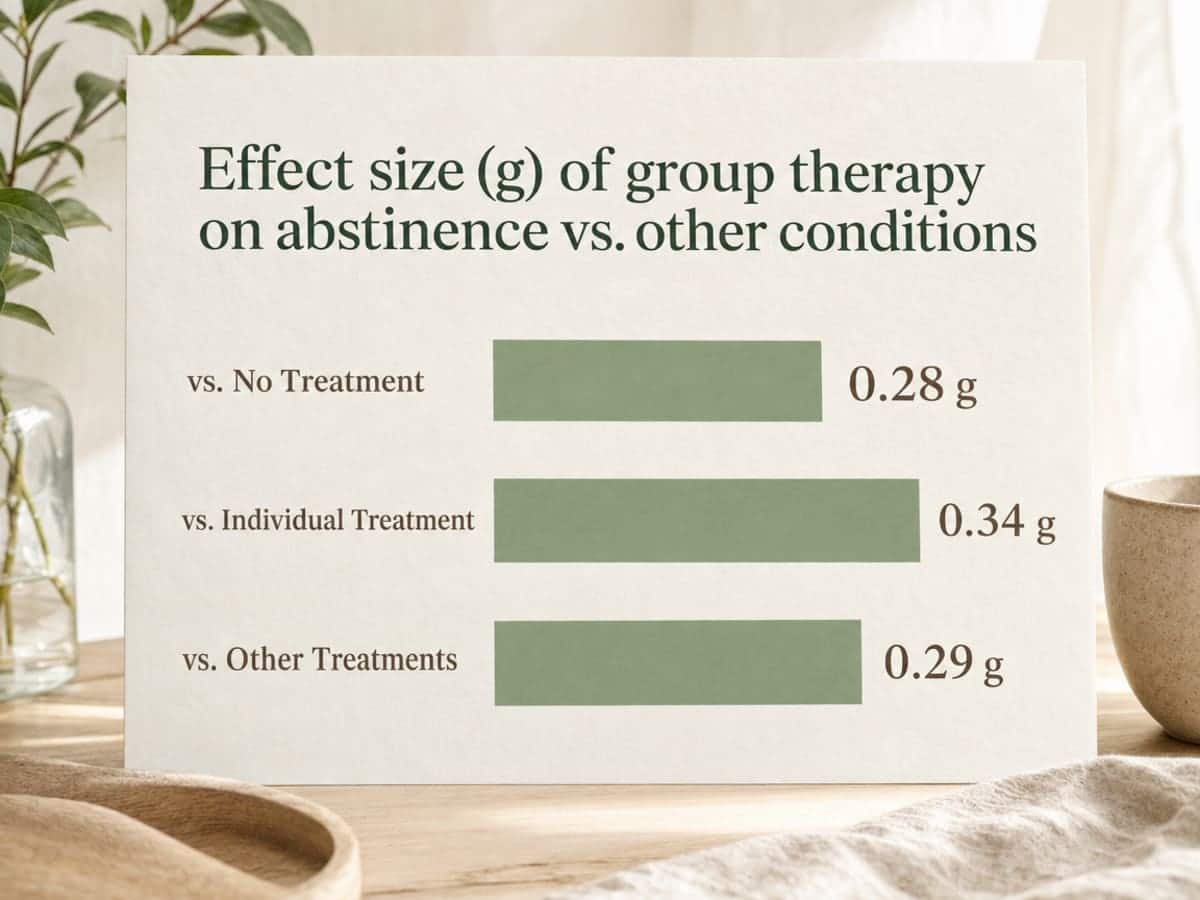
Start with the number that most professional men need to see before they’ll take the rest of this seriously. The largest meta-analysis of randomized trials on group treatment for adult substance use disorder found small but statistically significant effects favoring group therapy on abstinence, with Hedges’ g effect sizes of 0.28 versus no treatment, 0.34 versus individual treatment, and 0.29 versus other active treatments 2. Read that middle number again. Against individual therapy — the format you probably assumed would be the gold standard — group work came out slightly ahead on the primary outcome that matters to you: staying stopped.
Effect sizes in that range are considered small in statistical terms, and it’s worth being honest about what they do and don’t say. They do not mean group therapy is a miracle. They do mean that across pooled randomized data, sitting in a facilitated room with other men in recovery is not a downgrade from a one-on-one office. It is, at minimum, a peer modality. The same body of evidence found moderately sized improvements in mental state when group therapy was compared to no treatment 1, which matters if your drinking has been quietly braided into anxiety, insomnia, or a low mood you’ve been managing with a second glass.
SAMHSA’s federal treatment improvement protocol lands in the same place. Its guidance to clinicians states plainly that research generally indicates group therapy is as effective as individual therapy for treating substance use disorders, and it names decreased isolation, mutual support, and social learning as the mechanisms doing the work 4. That guidance also notes that residential treatment specifically shows significantly better abstinence outcomes for men — a data point worth holding onto as you weigh what setting your recovery actually needs 4.
The parity finding is the door. What you walk into once you step through it is the more interesting question.
Why Clinicians Build Programs Around the Group Room
Parity on outcomes is one reason clinical programs make group therapy the backbone of a residential day. Efficiency is the other, and it matters to you more than it might seem.
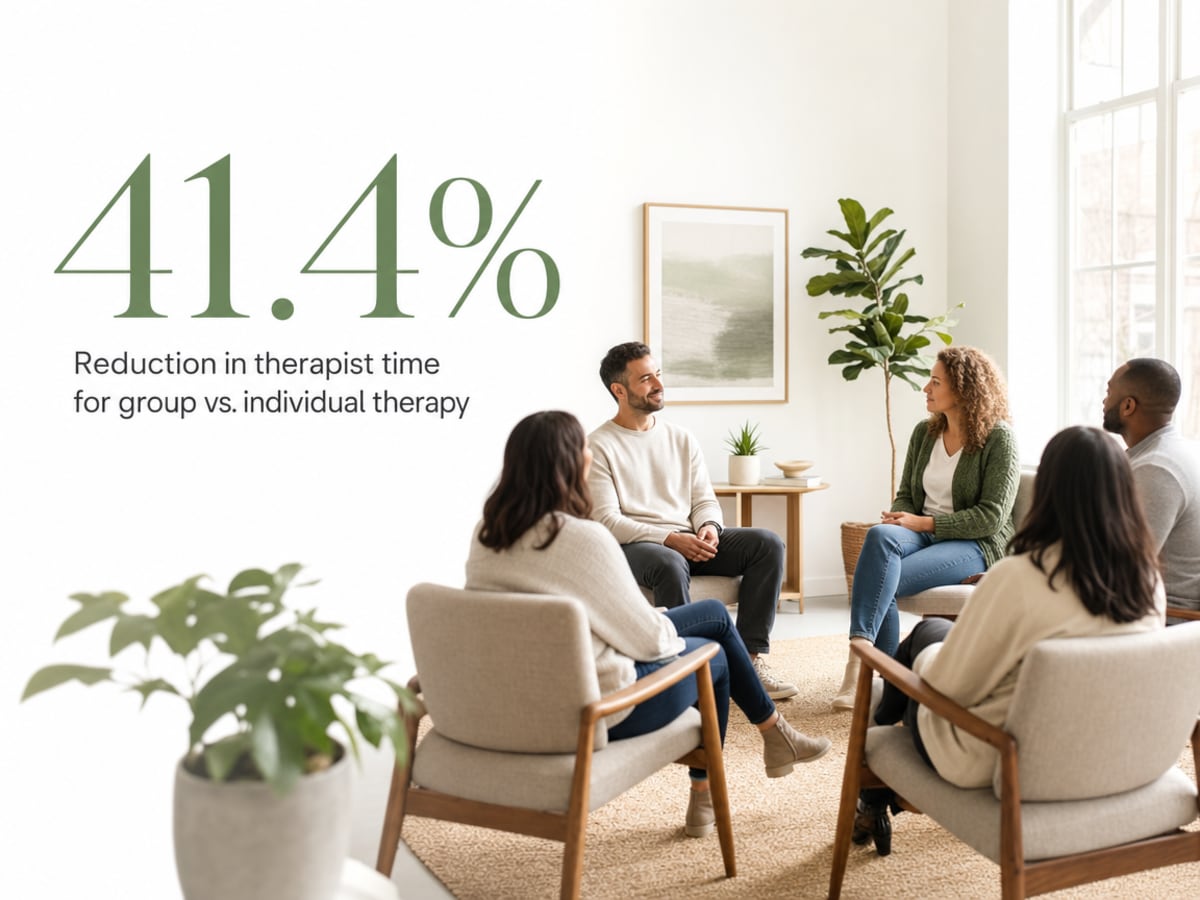
A randomized controlled trial comparing a cognitive-behavioral motivational intervention delivered in group versus individual format found something worth pausing on: both formats produced large reductions in alcohol and drug use during treatment and at twelve-month follow-up, with no significant difference in outcomes between them — and the group format used 41.4% less therapist time to get there 7. Same clinical result. Substantially less clinician labor per patient.
Translate that into what your day looks like inside a residential program. A well-designed men’s schedule doesn’t ration you to fifty minutes of a therapist’s attention per week. It puts you in structured group work for multiple hours daily, then wraps individual sessions, psychiatric care, and medical monitoring around that spine. You get more therapeutic exposure, not less, because group is where the leverage sits. The trial also documented strong group cohesion, low conflict, and high engagement in the group condition 7— evidence against the assumption that group work is a diluted version of “real” therapy.
There is a second thing efficiency buys, and it’s specifically valuable to a professional reader. The hours group therapy frees up in a clinical program are hours a good facility can reinvest into things individual work cannot supply on its own: peer confrontation from men who recognize your specific evasions, real-time practice in disclosing hard things without collapsing, and repeated exposure to other men doing the same difficult work in front of you. Individual therapy gives you a mirror. Group gives you a room.
You need both. Most residential programs are built to deliver both, in that ratio, for exactly this reason.
Why the Room Has to Be All Men
The Masculine Code That Keeps Addiction Alive
You learned the rules early. Handle it. Don’t complain. Don’t ask. Solve the problem yourself, and if you can’t solve it, at least don’t let anyone see you struggling with it. SAMHSA’s clinical guidance on men in behavioral health treatment names this cluster directly: men are expected to be independent, self-sufficient, stoic, and invulnerable, and those expectations actively interfere with identifying a problem, naming it out loud, and asking someone else for help 5.
For a while, that code served you. It got you through law school, through residency, through the first bad quarter, through the divorce, through the funeral. The same discipline that made you good at your work made you good at hiding how much you were drinking to keep doing your work. Then, at some point, the code stopped being an asset and became the container the addiction lives in.
Qualitative research on men with depression describes this collision precisely. Men in focus groups reported that traditional male roles felt in conflict or incongruent with admitting distress or seeking treatment 10. A larger interview study found that internalized masculine norms negatively affected help-seeking before treatment even began — men filtered their symptoms through what a man was supposed to be able to handle, and delayed care until the situation was severe 11. Clinicians looking at the same dynamic from the other side of the desk describe shame and invulnerability as the two forces most likely to keep a man silent in the room 14.
None of this is news to you. You have been running the code for decades. What may be new is the clinical case that the room where you finally break it should be a room where every other person has been running the same code.
What Changes When the Other Chairs Are Also Men
Put a professional man in a mixed-gender group and watch what he does. He performs. He explains. He becomes the responsible one, the articulate one, the one who is fine and here to support others. The code does not turn off because the setting changed. It just finds new work.
Put the same man in a room of eight other men who have all traded the same excuses, and something else becomes possible. SAMHSA’s guidance for men in treatment notes many potential benefits to having all-male group sessions, specifically because shame and stigma are strong obstacles to men seeking help and speaking honestly once they arrive 5. Qualitative interviews with men in mental health support groups describe those spaces as offering something they could not find elsewhere: a safe space with opportunities to reconstruct traditional masculine norms, and a sense of purpose through reciprocal support that further facilitated mental health management 13.
Read that mechanism carefully. It is not that the men-only room asks you to stop being a man. It is that the room lets you keep the parts of masculinity you actually value — discipline, loyalty, protecting the people who depend on you — while cutting out the parts that were killing you. Men in one study of peer-led men-only groups described them as key for successful service use, saying the format was what finally let them open up and rebuild self-esteem 11.
Clinicians describe the same effect from their side of the room: group therapy becomes the setting where a man can process the pain associated with shame and vulnerability, and have his emotional expression validated through feedback from other men who have earned the right to give it 14. That validation lands differently coming from someone who has been where you are. It is harder to dismiss.
Inside a Session: What Actually Happens
The room is smaller than you’re picturing. Eight or nine chairs, arranged in something closer to a circle than a classroom. A clinician sits with the group, not above it, with a notebook and a light agenda. No stage. No microphone. No exercise where you hold hands.
A session usually opens with a check-in. Each man says his first name and gives a short read on where he is that morning — sleep, cravings, what’s loud in his head, what he’s carrying from yesterday’s group. You are allowed to pass. Nobody scripts the check-in for you. Most men, in the first week, keep it short. A sentence. Sometimes two. That is fine. The floor is not a courtroom.
From there, the facilitator picks up a thread. It might be a cognitive-behavioral topic — the story you’ve been telling yourself about why the drinking is under control. It might be something one man raised the day before that the group didn’t finish. The clinician’s job is to keep the work honest and safe, which means interrupting performance and inviting silence when silence is what the room needs.
You will hear another man describe, out loud, a version of something you’ve never said to anyone. A missed anniversary. A drink hidden in a desk drawer. A morning he does not remember. You will notice your body react before your mind catches up. That reaction is the mechanism the clinical literature describes as social learning and reduced isolation — the two advantages federal guidance names as central to why group therapy works 4.
You will not be forced to share. You will, at some point, choose to. When you do, the feedback will not come from a therapist alone. It will come from men who have run your exact evasions and can name them faster than you can. That is the room. It is quieter, and more serious, than you expected.
Shame, Trauma, and the Work Underneath the Drinking
By the time a professional man walks into residential treatment, the drinking is usually the smallest part of the story. It’s the visible layer. Underneath sit the things you have not said out loud in years, or ever: the client you lost and blamed yourself for, the marriage you couldn’t save, the father who never softened, the assault at nineteen you filed away as “just something that happened.” Alcohol was never the problem. It was the answer to a problem you were not allowed to name.
Shame is the operating system that keeps that arrangement running. Clinicians who work with men describe it directly: group therapy becomes the setting where a man can process the pain associated with shame and vulnerability, with his emotional expression validated through feedback from other group members 14. That is not a soft claim. Shame does not respond to argument. It responds to being witnessed by people who cannot be shocked because they have carried the same weight.
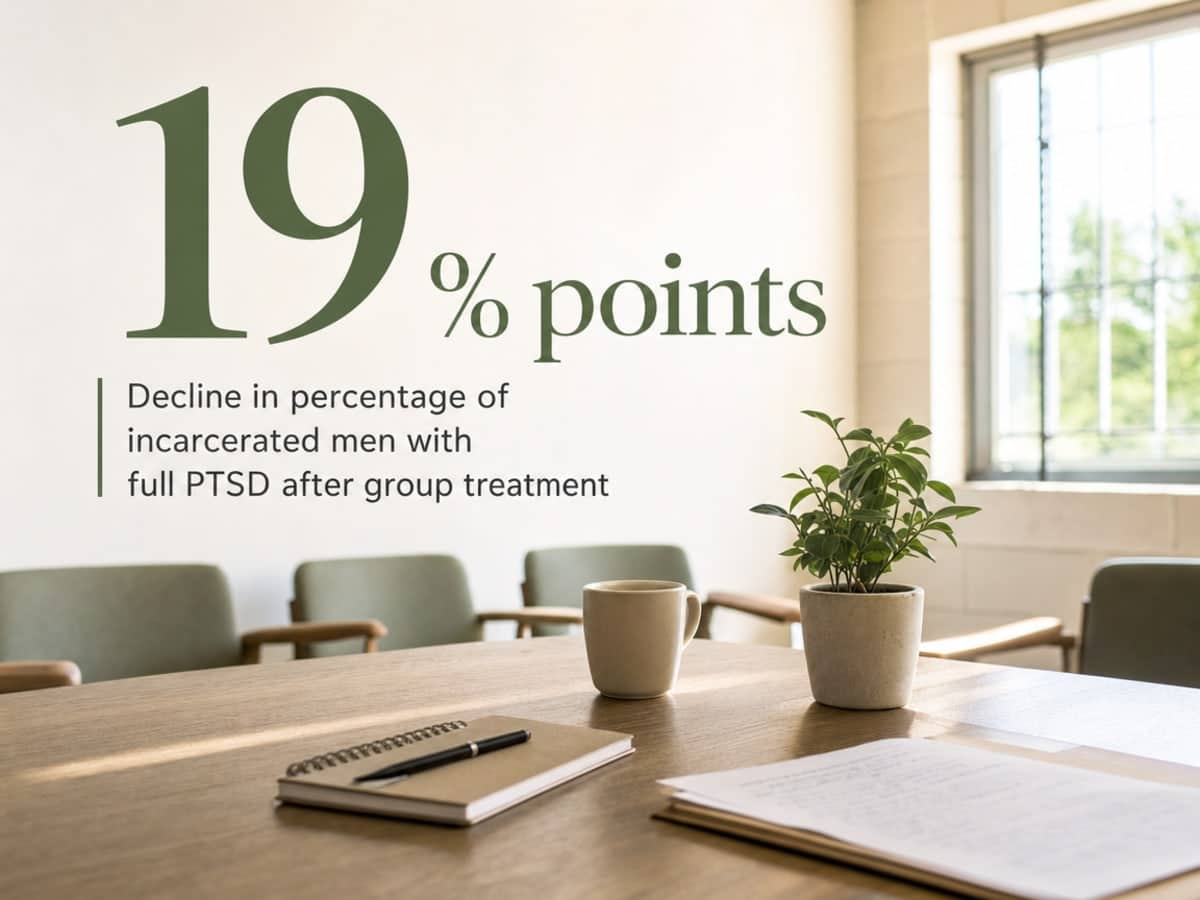
The trauma layer is worth pulling out on its own. A trial of two structured, trauma-informed group interventions — Seeking Safety and the Men’s Trauma Recovery and Empowerment Model — was run with incarcerated men who had both PTSD and substance use disorders. That is a narrower population than you, and the setting matters: the sample was incarcerated men, not professionals in residential care, so read the numbers as evidence that structured men’s group work can move trauma outcomes, not as a direct forecast for your stay. Across the intervention, mean CAPS PTSD severity dropped by 13 points and the percentage of men meeting full PTSD criteria fell by 19 percentage points 9. Structured group work, done well, moved the needle on the thing underneath the substance use.
There is also evidence from residential SUD settings closer to your scenario. A randomized trial of a group-based Acceptance and Commitment intervention in residential care found that group work specifically targeting shame led to fewer substance use days and increased treatment utilization in the four months after discharge 6. The mechanism is the same one you have been avoiding: say the thing out loud, in front of men who will not flinch, and it loses some of its authority over you.
This is the work group therapy is built to do. Individual sessions can name the shame. The group is where it gets metabolized.
The Arc of a Residential Stay in a Small Men’s Program
Group therapy is not a single event. Inside a residential program of twenty men or fewer, it is a repeating structure that changes shape as you do. What happens in your first week is not what happens in your third, and the reason to name that arc is simple: if you know what the room is asking of you at each phase, you stop treating early discomfort as evidence the format isn’t working.
Week one is disclosure. You are running detox or just past it. Your job in group is small — show up, check in, answer honestly when asked, notice which other men in the room you already trust and which ones you don’t. Most of the therapeutic action this week is passive. You are watching other men name things you have not yet said, and your nervous system is learning that the ceiling does not fall when they do. Federal guidance identifies decreased isolation and social learning as two of the core mechanisms group work delivers 4, and week one is where those mechanisms first take hold.
The middle stretch is confrontation. By your second or third week, the group knows your patterns. They have heard the version of your story you tell strangers, and they have heard the small revisions you make when you think no one is tracking. This is when peer feedback sharpens. Another man will name an evasion out loud that your individual therapist has been circling for a week. It will sting. That sting is the shame moving, which is precisely the outcome the clinical literature identifies as central to why group work reduces post-discharge substance use days 6.
The final stretch is reintegration. Group shifts from excavation to rehearsal. You practice, in front of the same eight men, what you will say to your partner, your firm, your board, your sponsor. You leave with a room full of people who know the actual shape of your risk, not the sanitized version. That is what daily group inside a small residential program compounds into — and what a weekly outpatient hour cannot replicate.
How to Judge Whether a Men’s Group Is Worth Your Time
You are going to be asked to hand over three to six weeks of your life. Before you do, you need a way to tell the difference between a men’s group that will actually move something in you and one that will just fill hours on a schedule. A few things separate the two.
Ask who runs the room. A serious group is led by a licensed clinician working from a defined evidence-based model — cognitive-behavioral, motivational, acceptance-based, trauma-informed — not a facilitator improvising from personal recovery. Federal guidance treats group therapy as a primary clinical modality precisely because it is delivered with fidelity to a model 4. If the program cannot name the model, that is your answer.
Ask about the composition. Small enough that eight men can actually hear each other. All men, for the reasons already covered — SAMHSA identifies specific benefits to all-male sessions in reducing shame and increasing openness 5. If the group runs at fifteen or twenty men, or mixes gender because it’s easier to schedule, the mechanism is diluted.
Ask what the group does about shame and trauma. A residential program worth your time treats the drinking as the surface and builds structured group work around what sits underneath. Evidence from residential care shows group interventions targeting shame produce fewer substance use days and higher continued treatment engagement after discharge 6. That is the mechanism you are paying for.
Frequently Asked Questions
Is group therapy actually as effective as individual therapy for addiction?
Yes. A randomized trial comparing a cognitive-behavioral motivational intervention in group versus individual formats found no significant difference in alcohol and drug use outcomes at twelve-month follow-up 7. SAMHSA’s federal clinical guidance states directly that research generally indicates group therapy is as effective as individual therapy for substance use disorder 4. A good residential program uses both, because each does work the other cannot.
How is a men-only group different from a mixed-gender group or AA meeting?
A clinical men-only group is led by a licensed clinician working from a defined evidence-based model, not a peer facilitator. SAMHSA specifically identifies all-male sessions as a setting where shame and stigma loosen enough for men to speak honestly 5. Qualitative research on men in mental health support groups describes them as safe spaces for reconstructing masculine norms rather than performing them 13. AA is valuable, but it is not clinical treatment.
What happens in a typical group session, and will I be forced to share?
Eight or nine men, a licensed clinician, a check-in, and a structured topic drawn from a cognitive-behavioral, motivational, or trauma-informed model. You can pass on the check-in. Nobody is forced to speak. Most men keep it short the first week and share more as they see other men do the same — the social learning and reduced isolation SAMHSA names as core mechanisms of why group therapy works 4.
How is my confidentiality protected in a group of other men?
Clinical groups operate under written confidentiality agreements that every member signs, backed by federal health privacy protections that cover the clinician and the facility. What is said in the room stays in the room, and violations carry real consequences. In a small residential setting of twenty men or fewer, the other participants are men running the same calculations about their own reputations. Discretion is a shared interest, not a hope.
I’m a professional with a visible role. Will group therapy feel beneath me?
No, once you’re in the room. The men sitting with you are attorneys, executives, physicians, and founders running the same code you are. Clinicians who work with men describe group as the setting where shame and vulnerability get processed and validated through peer feedback 14. Nothing about that is beneath a serious professional. What is beneath you is continuing to manage this privately while the problem quietly compounds.
How do I evaluate whether a men’s group program is clinically serious?
Three questions. Who runs the room — a licensed clinician working from a named evidence-based model, per SAMHSA guidance on group as a primary modality 4? What is the composition — small, all men, so the shame-reduction mechanism holds 5? What does the program do about trauma and shame underneath the drinking, given evidence that group work targeting shame reduces post-discharge substance use days 6? Clear answers mean a serious program.
References
- Group treatment for substance use disorder in adults. https://pubmed.ncbi.nlm.nih.gov/30797382/
- Group Treatment Effectiveness for Substance Use Disorders. https://digitalcommons.odu.edu/cgi/viewcontent.cgi?article=1120&context=chs_etds
- Group Therapy for Substance Use Disorders: A Survey of Clinicians’ Practices. https://pmc.ncbi.nlm.nih.gov/articles/PMC6289265/
- Treatment Modalities and Settings (Treatment Improvement Protocol for Substance Use Disorders). https://www.ncbi.nlm.nih.gov/books/NBK144286/
- Treatment Issues for Men (Addressing the Specific Behavioral Health Needs of Men). https://www.ncbi.nlm.nih.gov/books/NBK144290/
- A randomized controlled trial of a mindfulness and acceptance group therapy for residential substance use patients. https://www.ncbi.nlm.nih.gov/pmc/articles/PMC6080615/
- Randomized Controlled Trial of a Cognitive-Behavioral Motivational Intervention in Group Versus Individual Formats for Substance Use Disorders. https://pubmed.ncbi.nlm.nih.gov/20025373/
- A Randomized Clinical Trial of Group versus Standard Behavioral Couples Therapy for Substance Use Disorders. https://pmc.ncbi.nlm.nih.gov/articles/PMC4873359/
- Implementation and effectiveness of integrated trauma-informed group treatments for incarcerated men with PTSD and substance use disorders. https://pmc.ncbi.nlm.nih.gov/articles/PMC4620997/
- Barriers in Diagnosing and Treating Men with Depression: A Focus Group Report. https://pubmed.ncbi.nlm.nih.gov/19477750/
- Masculinity and Help-Seeking Among Men With Depression: A Qualitative Study. https://pmc.ncbi.nlm.nih.gov/articles/PMC7732518/
- Engaging Men in Psychological Treatment: A Scoping Review. https://pmc.ncbi.nlm.nih.gov/articles/PMC6199457/
- Men’s experiences of using mental health support groups: A qualitative study. https://pmc.ncbi.nlm.nih.gov/articles/PMC10078724/
- Masculinity, Mental Health, and Modern Psychotherapy. https://pdxscholar.library.pdx.edu/cgi/viewcontent.cgi?article=1637&context=honorstheses