
Residential Addiction Treatment in Little Rock, AR
Key Takeaways
- Licensed residential programs in Little Rock must deliver at least 28 hours of structured treatment weekly inside a 24/7 live-in setting, so families comparing facilities are really evaluating what’s built above that state-mandated floor.1,2
- Research shows residential care produces stronger abstinence outcomes for men than outpatient, and community-based stays paired with real aftercare lower one- and two-year readmission rates.6,7
- Length of stay should match the substance, history, and home environment — repeat-attempt men often needed 60 to 90 days rather than the shorter episodes they previously received.
- Staying in Arkansas makes family therapy, discharge planning, and continuity with local MOUD prescribers, peer specialists, and recovery housing far more accessible than out-of-state options.12
What a Live-In Program Actually Looks Like on a Tuesday in Little Rock
If you’re reading this at 2 a.m. after another hard night, or you’re a wife who found the empty bottles again, here’s what a normal Tuesday inside a licensed men’s residential program in Little Rock actually looks like. Not the brochure version. The real one.
Breakfast is early. By 9 a.m., he’s in group therapy with seven or eight other men. That’s not a coincidence or a scheduling accident. Arkansas licensure requires a minimum of five hours of structured treatment every weekday, and at least 28 hours across the week, inside a 24/7 non-medical live-in setting. So the day is built, not improvised. Individual counseling. Psychiatric check-ins. A break for lunch. More group in the afternoon, this time focused on something specific like relapse triggers, family patterns, or how to tell an employer the truth. An AA or NA meeting in the evening. Lights out.1,2
What surprises most families is how ordinary the rhythm feels once it starts. Beds, meals, laundry, coffee. Men laughing at something stupid. Someone crying quietly in a chair because he just called his daughter for the first time in six months.
That’s the shape of it. Not a hospital. Not a retreat. A house full of men doing hard work on a schedule the state won’t let anyone shortcut, twenty minutes from where his family lives.
What Arkansas Requires of Any Licensed Residential Program
Here’s something worth knowing before you tour a single facility: Arkansas already sets a floor. Any residential addiction program in Little Rock that holds a state license has to clear the same regulatory bar, and that bar is more demanding than most families realize.
The state defines a residential program as a 24-hour, seven-days-a-week, non-medical live-in facility that provides intake, individual and group therapy, case management, and room and board so a man can eventually live and work in the community again. That’s the baseline definition. From there, the licensure standards get specific about time on task. Residential services must deliver a minimum of 28 hours of structured treatment every week, with at least 5 hours daily Monday through Friday. Bedroom areas for men and women have to be separated, and adult and adolescent populations kept apart. These are not preferences. They’re conditions of holding the license at all.1,2
The oversight sits with the Division of Provider Services and Quality Assurance, which certifies, licenses, and surveys substance abuse providers across Arkansas. DPSQA is the entity that walks the halls and checks the files. If a program in Little Rock is operating legitimately, it has been reviewed against these standards and continues to be reviewed.3
Why does this matter to you? Because it means the questions you might feel embarrassed to ask — Is he actually going to be in therapy, or just sitting around? Who is watching this place? Are the sleeping quarters appropriate? — are already answered by the rulebook. When you’re comparing programs, you’re not comparing whether they hit the floor. You’re comparing what they build on top of it: the quality of the clinicians, the group work, the psychiatric care, the food, the aftercare planning, and the way the staff treats a scared man on his first night.
That’s the real evaluation. The state guarantees the frame. You’re choosing the house that gets built inside it.
Why Residential, and Why Men in Particular
You might be asking a fair question: does he really need to live somewhere else for a month, or can he just do outpatient after work? The honest answer depends on the man, but the research points somewhere specific.
SAMHSA’s clinical guidance for men, TIP 56, is unusually direct about it. Residential treatment, compared with outpatient, is associated with much better abstinence outcomes for men. That finding is specific — it’s about men, and it’s about abstinence outcomes, not every measure of recovery — but it holds up in the literature the federal government hands to clinicians. The reason, roughly, is that residential care pulls a man out of the environment that’s been feeding the addiction. The bar he stops at on the way home. The buddy who texts at 4 p.m. The garage where the bottle lives. For thirty or sixty or ninety days, none of that reaches him.6
There’s a second piece, older but still cited: a VA study of male patients found that men discharged to community-based residential programs had lower one- and two-year readmission rates than men who received hospital-based residential care, especially when residential episodes were longer and paired with outpatient follow-up. Community-based. Longer stays. Real aftercare. That’s the shape of what works for men, and it’s exactly what a licensed Little Rock program is built to deliver.7
So if you’ve been wondering whether residential is overkill, it isn’t. For a lot of men, it’s the dosage the problem actually requires.
The Three Men Who Walk Through the Door
The High-Functioning Professional Who Has Been Hiding It
He’s the attorney downtown, the surgeon at Baptist, the sales director who closed a big quarter last month. Nobody at work suspects. His wife knows something is wrong but can’t quite name it. He drinks a bottle of wine a night, or he’s been refilling a benzo script through three different providers, or he keeps a flask in the truck.
What he needs most is discretion, and what he’s most afraid of is being seen. Residential care actually solves both problems at once. Pulling him out of the environment — the client dinners, the airport bars, the 5 p.m. ritual — is the clinical intervention itself, and it works for men in a way outpatient often doesn’t. A small-capacity men’s setting means he isn’t in group with 60 strangers. He’s with seven or eight other guys who look a lot like him and have been hiding a lot like him.6
Twenty to thirty days can be enough for a first residential episode if his detox is uncomplicated and his home life is stable. The harder question is whether he’ll take the time. Almost everyone in his position underestimates how much he needs it.
The Man in Acute Crisis Who Needs Medical Detox First
Sometimes the phone call comes at 3 a.m. from a Pulaski County ER. Sometimes it’s a wife who found him unresponsive on the bathroom floor. Sometimes it’s the man himself, sober enough for one clear thought: I can’t do this anymore.
The sequence matters. A man who gets detoxed in an ER and sent home with a pamphlet is very likely to be using again within the week. A man who walks straight from detox into a licensed residential program — same organization, same staff, no gap — has a real shot. If you’re the family member making calls right now, ask specifically about that handoff. It’s the difference between a hospital visit and the start of recovery.
The Man on Attempt Number Three or Four
If you’re the wife, mother, or grown daughter reading this, and he’s been to rehab before — maybe twice, maybe more — you’re probably exhausted and quietly afraid this one won’t work either. That’s a fair thing to feel. Say it out loud.
Here’s what the research says about repeat attempts: length of stay and real aftercare are what move the needle for men. The VA study that followed male patients found that longer residential episodes, community-based rather than hospital-based, combined with outpatient follow-up afterward, produced lower one- and two-year readmission rates. Translation: if the last three attempts were 14 days each with no aftercare, he wasn’t given a fair shot at recovery. He was given a fair shot at another relapse.7
The man on attempt number four often benefits from a 60- to 90-day residential stay rather than 30. Not because he failed, but because the previous doses were too short. Layer in medication for opioid use disorder if that’s the substance, structured continuing care after discharge, and peer recovery support, and the picture changes. Relapse is not evidence that he can’t recover. It’s often evidence that treatment was under-dosed.12,14
Day One, Day Thirty, Day Ninety: A Length-of-Stay Map
One of the hardest questions a family asks in the first phone call is how long. You want a number so you can plan the leave from work, the childcare, the mortgage. Here is the honest way to think about it: the state sets the floor for what a week of residential care looks like, and length of stay decides how many of those weeks he gets.
Every licensed residential program in Arkansas has to deliver at least 28 hours of structured treatment each week, and at least 5 hours each weekday, inside a 24/7 live-in setting. That’s the constant. What changes across a 20-, 30-, 60-, or 90-day stay is how many cycles of that structure he gets, and how much of the deeper work fits inside.1,2
| Timeline | What Happens |
|---|---|
| Day One (roughly 20–30 days) | The first three to seven days may be medical detox if his body needs it. From there, the residential clock starts. He settles into the daily 5-hour rhythm, meets his individual counselor, gets a psychiatric evaluation, and starts group work on the surface layer: what he uses, when, and what happens right before. Family sessions usually begin in the second or third week. Aftercare planning starts before he leaves. Twenty to thirty days is enough for a first episode when detox is uncomplicated and his home life is stable. |
| Day Thirty (roughly 30–60 days) | The second month is where the harder material comes up. Trauma. Grief. The reason he started drinking at 16. Individual counseling deepens. Group work moves from surface behavior to underlying patterns. Psychiatric care has time to adjust medications and see how he responds. Family sessions can happen more than once, which matters when the marriage is what’s actually on the line. |
| Day Ninety | Ninety days gives the same 28-hour weekly structure roughly twelve times over. That’s the dosage repeat-attempt men often needed the first three times and didn’t get. By day 60 to 90, he isn’t just talking about triggers — he’s rehearsed them, mapped his aftercare, connected with peers he’ll see after discharge, and built a discharge plan with real appointments already on the calendar. |
Longer isn’t automatically better. The right length is the one that matches the substance, the history, and what he’s walking back into. Ask the program to explain the recommendation in those terms.
Where the Family Fits Inside the Schedule
One of the quiet fears families carry into a residential admission is that they’re about to hand him over and lose their voice in his care. That’s not how a licensed program is built to work. Arkansas licensure defines residential care as a live-in setting designed to help him eventually live and work in the community again — meaning your community, the one he’s coming back to. You are part of the treatment, not an interruption to it.2
Here is roughly how the family calendar fits inside the residential arc. The first week is usually protected. He needs to detox, sleep, eat real meals, and start groups without his phone ringing. Most programs keep contact limited and structured during this stretch. By the second week, phone calls open up on set days. Visits typically begin around week two or three, in blocks the program schedules so they don’t cut into the required 28 hours of weekly treatment 1.
Family therapy sessions are separate from visits. These are clinical hours with a counselor, often starting in week two or three and continuing every week or two after that. This is where the marriage gets worked on, where an adult son sits across from his father, where a mother finally hears what her boy has been carrying. Discharge planning meetings pull the family in again near the end — usually the last week or two — because whoever he’s going home to needs to know the aftercare plan, the medications, the meetings, and the warning signs.
If you’re driving in from Conway, Benton, or Hot Springs, the practical value of in-state care shows up here. You can actually make the Thursday family session. You can be in the room for the discharge meeting. That access is the clinical piece out-of-state care quietly gives up.
Why This Moment Matters in Arkansas
There is a reason the phone calls to Little Rock treatment programs feel different this year than they did two years ago. The state is quietly showing that recovery infrastructure is starting to work, and that shifts what a family should expect when they ask for help.
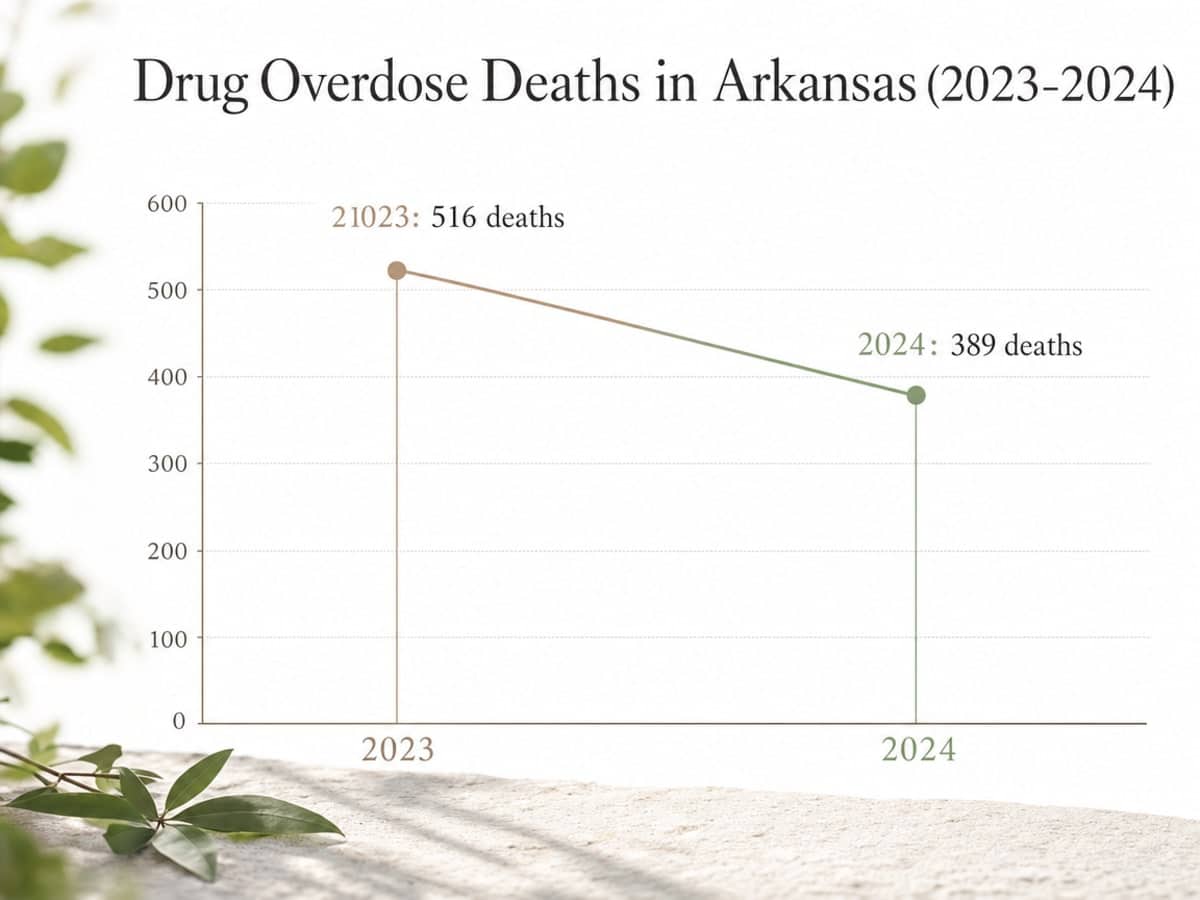
According to provisional data from the Arkansas Department of Health, statewide drug overdose deaths fell to 389 in 2024, down from 516 in 2023. That is a real drop — roughly one in four fewer Arkansans lost — and it happened while treatment programs, medication access, and peer recovery services expanded across the state. The scope matters: these are statewide, provisional numbers from ADH, not final figures and not specific to Pulaski County. But the direction is unmistakable, and it lines up with what people working inside Arkansas programs have been seeing.11
Hold that number next to another one. In a single-day count, 7,640 Arkansans were enrolled in substance use treatment. Thousands of people, on any given Tuesday, are somewhere in the system doing the work. He would not be the first man in his zip code to make this call. He would be joining a group that is, right now, changing the state’s numbers.9
Here is what that means for you, sitting with this decision. The window when reaching out feels most impossible is also the window when the ground underneath you is more solid than it has been in years. Treatment access has grown. Overdose deaths are moving the right direction. If he has been on the edge of picking up the phone, this is a reasonable week to pick it up.
What Happens After Discharge: The Continuum That Holds
Residential is not the finish line. It’s the loudest, most concentrated part of the work, but the months after discharge are where recovery either takes root or quietly slips. A good Little Rock program starts building that bridge weeks before he walks out the door.
Here’s what a real continuum looks like in Arkansas right now. If opioids are part of his story, medication for opioid use disorder — buprenorphine or naltrexone, typically — continues seamlessly from residential into outpatient care. The state’s opioid response work has expanded access to MOUD, peer recovery services, and recovery housing across community and clinical settings, and gaps still exist, but the infrastructure is there. In the first half of fiscal 2025 alone, Arkansas SOR IV programs treated 90 unduplicated clients for opioid use disorder and delivered recovery support services to another 208. Those are the same peer specialists, MOUD prescribers, and recovery housing beds his aftercare plan can plug into.12,13
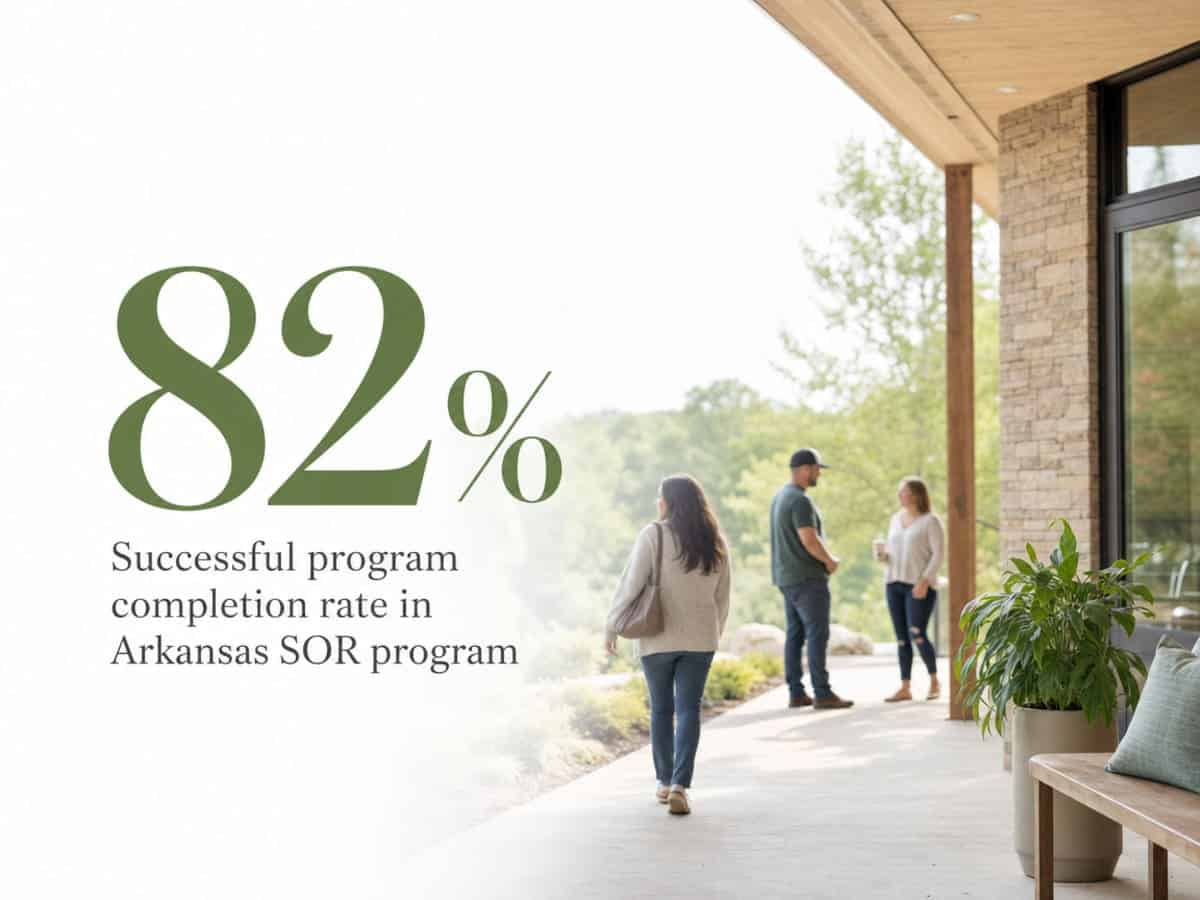
The outcomes when men actually stay engaged are worth sitting with. In the SOR IV Year 1 annual report, 99 of 121 participants — 82% — successfully completed the program. That’s not a marketing number. It’s what happens when residential treatment is followed by structured continuing care instead of a handshake and a phone list.14
For him, aftercare usually looks like this:
- a weekly continuing care group,
- individual counseling every one to two weeks,
- ongoing psychiatric follow-up if he’s on medication,
- an AA or NA home group he actually shows up to,
- and an alumni community that remembers his name.
If he’s coming home to Conway, Benton, or Hot Springs, those appointments should be on the calendar before discharge day — not something he’s supposed to figure out on his own in week one. That’s the piece that holds.
Little Rock, Access, and Who Actually Reaches Care
Little Rock is a young adult city in ways that matter for this conversation. The largest population segment is adults aged 25 to 34, and the poverty rate sits at 16.6%, above the national average of 15.5%. That’s a lot of working-age men with jobs that don’t come with generous leave, insurance that doesn’t always stretch, and families depending on the next paycheck. In-state care isn’t a soft preference for this population — it’s often the only version of residential treatment that’s financially and logistically possible.15
There’s a harder data point worth sitting with. In Arkansas TEDS-D 2022 data, White clients accounted for 80.3% of all substance use treatment discharges. That number describes who is reaching care, not who needs it. Addiction doesn’t sort itself along those lines, and the gap almost certainly reflects access — referral networks, insurance, transportation, trust — more than prevalence. If you’re a Black, Latino, or Marshallese family in Pulaski County making this call, the door is the same door. Ask about payment options, ask about outreach staff, and don’t assume the numbers describe who belongs inside.10

Discharges from Arkansas substance use treatment by race (White)
How to Start the Conversation This Week
You don’t have to have the whole plan figured out to make the first call. You just have to make it.
If you’re the man reading this, pick a quiet hour and call a licensed men’s residential program in Little Rock. Ask three questions:
- whether they handle medical detox in-house or through a direct handoff,
- what a typical weekday schedule looks like, and
- how they involve family.
You’ll hear a lot in how they answer.
If you’re the wife, mother, sister, or grown daughter, you can make that same call on his behalf. Programs talk to family members all the time. Ask about admission timing, what to pack, and how the first 72 hours work. Then sit down with him, tell him what you learned, and ask him to take the next step with you in the room.
You are not late. You are not the first family to feel this scared. Serenity Park Recovery Center and other licensed Little Rock programs answer the phone every day. Today is a reasonable day to use it.
Frequently Asked Questions
How long does residential addiction treatment in Little Rock usually last?
Most residential stays run 20 to 90 days, and the right length depends on the substance, his history, and what he’s coming home to. Arkansas licensure requires a minimum of 28 hours of structured treatment per week inside a 24/7 live-in setting, so every week of stay carries the same clinical floor. Longer stays give repeat-attempt men more of that dosage.1
What is the difference between residential treatment and medical detox?
Medical detox is the short, medically supervised phase that stabilizes his body during withdrawal, usually three to seven days. Residential treatment is the longer therapeutic phase that follows — a non-medical, 24/7 live-in setting with intensive counseling and structured groups. Detox handles the physical crisis. Residential is where the behavior change work actually happens. The handoff between them matters as much as either alone.2
Can my family visit during a residential stay, and how are they involved?
Yes. Most programs open phone contact after the first week and start in-person visits by week two or three, scheduled around the required 28 hours of weekly treatment. Family therapy sessions are separate clinical hours where marriages, parenting, and old wounds get worked on directly. Discharge planning meetings usually pull family in during the final week. Being local makes those appointments possible to attend.1
Is staying in Arkansas for treatment as effective as going out of state?
Clinically, community-based residential care combined with real outpatient aftercare produced lower one- and two-year readmission rates for men in the research literature. Translation: staying close to home, with structured follow-up in the community he’ll actually live in, is a legitimate clinical choice — not a downgrade. Out-of-state programs often make the family sessions and discharge planning meetings much harder to attend in person.7
What happens after residential treatment ends?
Aftercare usually includes a weekly continuing care group, individual counseling every one to two weeks, psychiatric follow-up, an AA or NA home group, and peer recovery support. If opioids are part of his story, medication for opioid use disorder continues into outpatient care. In Arkansas SOR IV programs, 99 of 121 participants (82%) completed the program when this kind of structured continuation was in place.12,14
What if this is not the first time he has tried treatment?
Relapse after prior treatment is often a dosing problem, not a character problem. Research on male patients found that longer residential episodes paired with real outpatient aftercare produced lower readmission rates. If the earlier attempts were short stays with no follow-through, he was not given a fair shot. A 60- to 90-day residential episode with structured continuing care afterward changes the math considerably.7
References
- Licensure Standards for Alcohol and Other Drug Abuse Treatment Programs. https://humanservices.arkansas.gov/wp-content/uploads/Licensure_Standards_for_Alcohol_and_Other_Drug_Abuse_Treatment_Programs.pdf
- ARKANSAS DEPARTMENT OF HUMAN SERVICES – Licensure Standards for Alcohol and Other Drug Abuse Treatment Programs. https://www.sos.arkansas.gov/uploads/rulesRegs/Arkansas%20Register/2011/Jan11Reg/016.23.10-003.pdf
- How to Become a Provider – Licensing, Requirements, and Processes. https://humanservices.arkansas.gov/divisions-shared-services/provider-services-quality-assurance/how-to-become-a-provider-licensing-and-requirements-and-processes/
- Programs for Mental Health & Substance Abuse Issues – Arkansas Department of Human Services. https://humanservices.arkansas.gov/learn-about-programs/programs-for-mental-health-substance-abuse-issues/
- About DAABHS – Division of Aging, Adult, & Behavioral Health Services. https://humanservices.arkansas.gov/divisions-shared-services/aging-adult-behavioral-health-services/about-daabhs/
- Addressing the Specific Behavioral Health Needs of Men (Full PDF). https://library.samhsa.gov/sites/default/files/sma14-4882.pdf
- Outcomes of residential treatment of substance abuse in hospital and community settings. https://pubmed.ncbi.nlm.nih.gov/8925349/
- Arkansas: National Survey of Substance Abuse Treatment Services (N-SSATS), 2019 State Profile. https://www.samhsa.gov/data/sites/default/files/quick_statistics/state_profiles/NSSATS-AR19.pdf
- Behavioral Health Barometer: Arkansas, Volume 6. https://www.samhsa.gov/data/sites/default/files/reports/rpt32820/Arkansas-BH-Barometer_Volume6.pdf
- 2022 Treatment Episode Data Set: Discharges (TEDS-D) Arkansas. https://www.samhsa.gov/data/node/51427
- Substance Misuse Education and Prevention – Arkansas Department of Health. https://healthy.arkansas.gov/programs-services/prevention-healthy-living/substance-misuse-education-and-prevention/
- 2024 – Arkansas State Opioid Response (SOR) III Final Evaluation Report. https://humanservices.arkansas.gov/wp-content/uploads/WYSAC-SOR-3-Final-Eval-Report-12162024.pdf
- Mid-Year SOR IV FY25 Report (Arkansas). https://humanservices.arkansas.gov/wp-content/uploads/SOR4-6-Month-1-FY25-Report-1.pdf
- Year 1 SOR IV Annual Program Report (Arkansas). https://humanservices.arkansas.gov/wp-content/uploads/SORIV-FY25-Year-1-Annual-Report.pdf
- Community Profile – City of Little Rock. https://www.littlerock.gov/media/20744/community-profile.pdf