
Key Takeaways
- Traditional masculine norms like toughness and self-reliance measurably reduce men’s willingness to seek help, with the men most in need of treatment being the least likely to pursue it 2.
- Men-only settings work by removing the mixed-gender audience men have been performing for since adolescence, which lowers impression management and makes honest disclosure less costly 11.
- Population data does not show men-only care universally outperforms mixed-gender treatment; the gains concentrate in men with trauma, high shame, sex-role conflict, or unspoken relational damage 5, 7.
- Retention is the variable that actually predicts abstinence, and for men specifically, personal responsibility, on-site services, and frequent counseling drive both satisfaction and reduced post-treatment use 9, 15, 16.
The Private Belief That Keeps Stalling Your Call
You’ve had the number saved for months. Maybe longer. You’ve drafted the email to your assistant about being unreachable, then closed the tab. You’ve told yourself you’ll handle it after the quarter closes, after the deal, after the holidays.
Here’s what’s actually in the way. It isn’t logistics. It isn’t cost. It isn’t even the fear of withdrawal. It’s a quieter belief you’ve never said out loud: that picking up the phone means admitting you couldn’t handle it. That asking for help is a demotion from the person everyone else counts on.
The research is unusually direct on this. Traditional masculine norms — self-reliance, emotional control, invulnerability — reshape how men experience distress and whether they ever get to a clinician’s office 1. Men who endorse toughness and anti-femininity norms most strongly are the same men most likely to use substances and least likely to walk into treatment 2. The belief system is doing measurable work against you.
You’re not weak for having it. You were trained into it. You were rewarded for it. It’s the same operating code that got you the corner office, the practice, the crew that shows up because you do.
What this article is going to do is name that code precisely, show you what a men-only residential setting changes about the emotional math, and give you the honest research — the parts that support men-only care and the parts that complicate it. No lecture. No journey language. Just the read you’ve been looking for.
Why Admitting Need Feels Like Losing Rank
The Performance Loop You’ve Been Running for Decades
Notice the sequence. Something goes wrong at work or at home. You feel it — the pressure in your chest, the loop of thoughts that won’t quiet down. But you don’t say it. You handle it. You pour a drink, or you take the pill, or you order another round because the client is watching. The edge softens. You get through the dinner, the deposition, the flight home.
That’s the loop. Project strength. Suppress the need. Self-medicate the gap. Isolate so nobody sees the seams. Repeat.
You didn’t invent this. It’s the operating code most men are handed by twelve. Traditional masculine norms — self-reliance, emotional control, invulnerability — reshape which symptoms you notice, which ones you’ll admit to, and whether you’ll ever tell a professional about any of them 1. Distress rarely shows up in a man as sadness. It shows up as irritability, as a shorter fuse with your kids, as the third drink you promised yourself you’d skip 1.
The loop works, in the short term. That’s the trap. It got you through the last twenty years. It’s why you’re reading this at 11 p.m. instead of having read it at 30. What it doesn’t do is stop. It just gets more expensive to run.
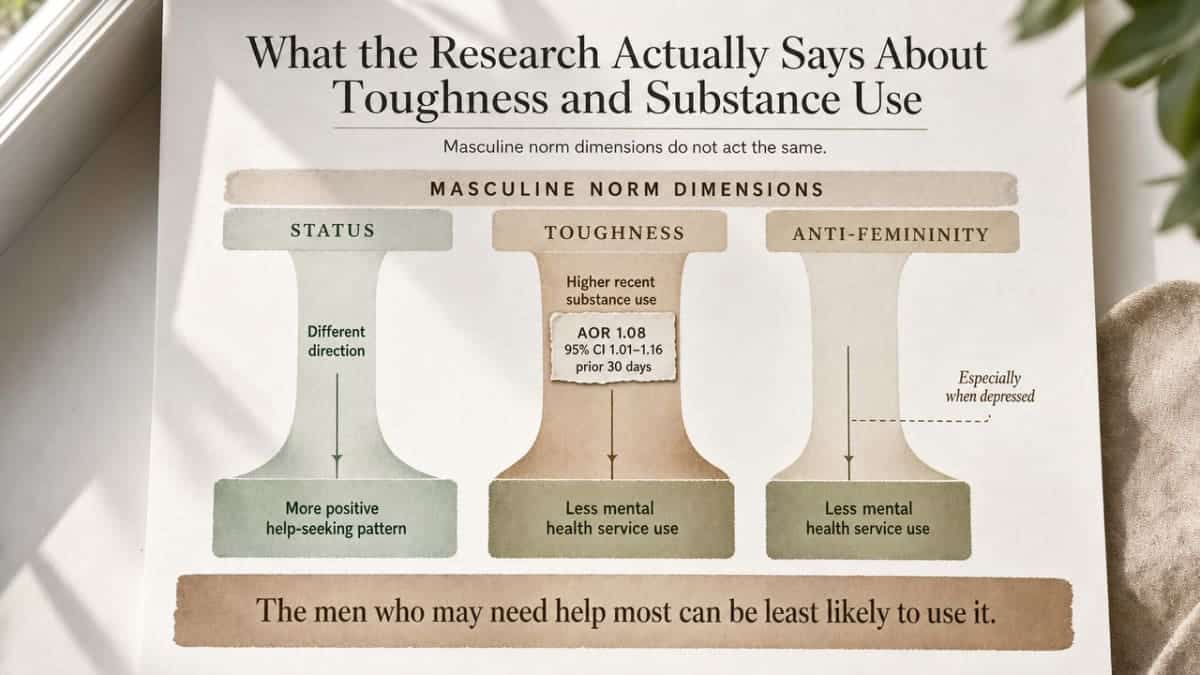
What the Research Actually Says About Toughness and Substance Use
Here’s where the research gets specific, and specific is what you need. “Masculinity” is not one thing. Researchers break it into dimensions — status, toughness, anti-femininity — and they behave very differently in men’s lives.
A 2020 study of emerging adult men found that endorsing masculine toughness was associated with greater odds of reporting substance use in the prior 30 days (adjusted odds ratio 1.08, 95% CI 1.01–1.16). The same study found that greater endorsement of anti-femininity and toughness norms was linked to less mental health service utilization, particularly among men who were already depressed 2. Read that again. The men who most needed help were the ones whose norms made them least likely to get it.
Status, interestingly, ran the other direction. Men who scored high on status-related masculine norms actually reported fewer depressive symptoms and more service use 2. Which tells you something useful: not every part of how you carry yourself is working against you. The parts that value responsibility, provision, and being someone others count on — those can be pointed toward treatment, not away from it 1.
What this means in plain English: the belief that toughing it out is the manly move is a specific belief that predicts specific harms. It’s not your entire identity. It’s one setting on the dashboard, and it’s the one turned up too high.
You can respect the parts of your code that got you here — the discipline, the accountability, the refusal to quit on the people who depend on you — and still take that one setting down a notch. That’s not surrender. That’s maintenance on a machine you plan to run for another forty years. And it’s the same machine, incidentally, that’s going to have to make the call.
The Performances Men Run in Mixed-Gender Rooms
Posturing, Minimizing, Chivalry-as-Deflection
Picture the circle. Twelve folding chairs, fluorescent light, a box of tissues on a side table. Six men, five women, one counselor. The counselor asks who wants to check in first.
Watch what you do. You sit up a little straighter. You crack the joke that lands the room, because getting a laugh is a currency you know how to spend. When it’s your turn, you edit. The quart of vodka becomes “a lot.” The morning shakes become “rough starts.” The fight with your wife becomes “stuff at home.” You don’t lie. You just translate.
Then the woman across from you shares something hard, and you feel the old reflex — lean in, offer the reassurance, become the steady one. Chivalry as deflection. It looks like decency. It functions like a shield. You spent the whole hour holding a role instead of dropping one.
SAMHSA’s clinical guidance names this pattern directly: men are expected to be independent, self-sufficient, stoic, and invulnerable, and they often have trouble identifying or expressing weakness in treatment, which can read to clinicians as guardedness or lack of trust 12. The 2024 review on men’s help-seeking is blunter — masculinity gets policed in social settings, and emotions get framed as signs of vulnerability to be hidden 13. You are not imagining the pressure. It’s in the room with you.
What Changes When the Audience Leaves the Room
Now change one variable. Same twelve chairs, same fluorescent light, same box of tissues. Every seat is a man.
Something loosens in the first ten minutes, and it isn’t magic. It’s math. The performance you’ve been running has an audience baked into it — the opposite-sex audience you’ve been performing for since middle school. Remove that audience, and the performance loses its point.
SAMHSA’s men-focused Treatment Improvement Protocol puts it plainly.All-male group therapy “provides an opportunity for men to relate to other men without being distracted into game playing to impress women,” and it lets men take on caregiving roles — checking on each other, sitting with another guy’s grief — that they’d typically leave to women in mixed settings 11.That same chapter notes that residential treatment, compared with outpatient, is associated with significantly better abstinence outcomes for men specifically, which is not the case for women 11. The setting matters, and it matters more for you than it does for a general population average.
Three things shift when the audience leaves.
- Impression management drops — you stop editing the quart down to “a lot.”
- Caregiving gets shared — the guy next to you asks how your kid is doing, and you’re the one being checked on for once.
- Topic disclosure expands — sex, shame, the thing you did at 22 you’ve never told anyone, the fear that your father was right about you.
Not because men are magically braver in a men-only room, but because the cost of saying it out loud just dropped 4.
That’s the emotional math of a men-only setting. Not a values claim. A specific reduction in what you have to spend energy hiding, so more of your energy can go into the actual work.
The Honest Counter-Evidence: When Men-Only Actually Helps
The Population Data Is Mixed. That Matters.
Here’s where a lot of men’s-only facilities get sloppy, and where you deserve a straighter answer.
At the population level, the research does not show that men-only programs beat mixed-gender programs. A review of gender differences in substance use treatment concluded that gender-specific treatment is generally no more effective than mixed-gender treatment overall, while noting that some subgroups of men and women do benefit in important ways from single-gender care 5. A mixed-methods study of men’s and women’s experiences in SUD group therapy found that men, on average, actually endorsed the helpfulness of mixed-gender groups more often than women did, though the authors also documented preliminary support for male-only groups and stressed that preferences are heterogeneous 6.
SAMHSA’s own men-focused clinical guidance is candid about this. The expert panel writing that chapter reported it was unable to find strong research evaluating the advantages of single-gender substance abuse settings for male clients, and cited at least one study where men in all-male versus mixed programs showed no significant outcome differences 11.
Who Gains the Most From an All-Male Setting
The older but still-cited review on single- versus mixed-gender programs named the mediating factors plainly: victimization history, sexual orientation, sex-role conflict, and antisocial traits shape whether an all-male setting is optimal for a given man 7. Translate that into your life, and the profile sharpens fast.
You gain the most from a men-only room if any of these are true:
You carry trauma you’ve never named out loud — combat, an assault in childhood, something that happened at a job site or in a locker room. SAMHSA’s chapter on specific populations of men is direct that masculine ideology limits the language available for trauma, and that treatment has to explicitly address how you internalized that code before real processing happens 3.
Your shame runs high and your impression management runs higher. If you’re the guy who edits the quart down to “a lot,” the 2024 narrative review on men’s help-seeking would predict you’ll perform harder in a mixed room, not less, because masculinity gets policed in social settings and emotions get read as vulnerabilities to hide 13.
You have sex-role conflict — the tension between the man you were told to be and the man you actually are — running loud in the background. You have relational damage as a father, a partner, a son that you cannot talk about with a woman in the circle because the guilt is too fresh.
If none of those apply, mixed-gender care may serve you just fine 5. If two or more do, the men-only room isn’t a preference. It’s the setting where the real work has a chance of starting.
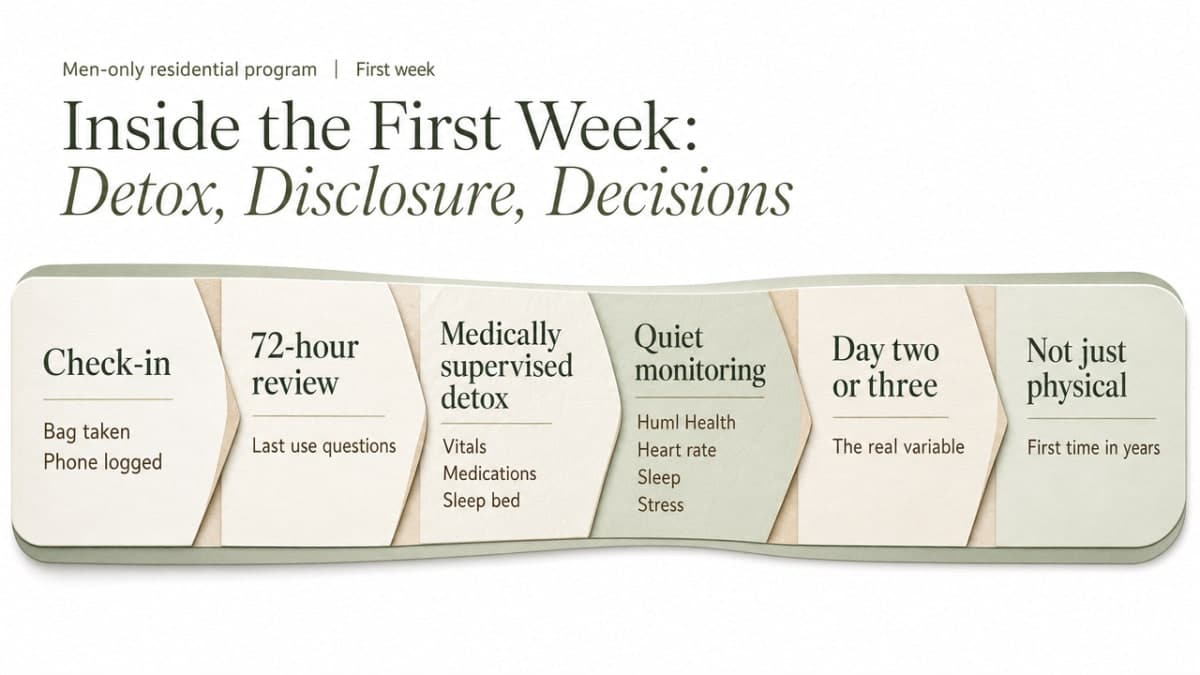
Inside the First Week: Detox, Disclosure, Decisions
The first week is the one you’re most afraid of, and it’s the one that decides the most.
Day one at a men-only residential program looks less dramatic than the movies. You check in. Somebody takes your bag, your phone gets logged, a nurse walks through your last 72 hours of use with the kind of unflinching questions your primary care doctor never asks. Medically-supervised detox starts here — vitals, medications to blunt the worst of withdrawal, a bed you’re supposed to actually sleep in. At Serenity Park in Little Rock, wearable monitoring through Huml Health runs quietly in the background during those first nights, tracking heart rate, sleep, and stress so the clinical team catches shifts before you have to name them out loud.
Day two or three is where the real variable kicks in. Detox isn’t just physical. It’s the first time in years your nervous system isn’t muffled, and everything you’ve been outrunning shows up in the room at once. This is where guarded men decide whether to keep performing or start talking.
In a mixed-gender setting, that decision often defaults to performing. In a men-only setting, the audience you’ve been managing since middle school isn’t there 11. SAMHSA’s clinical guidance is direct: men often have trouble identifying or expressing weaknesses in treatment, which clinicians can misread as guardedness rather than the trained response it is 12. Twenty beds. Nineteen other men who edited the quart down to “a lot” too. The first honest sentence you say out loud is the one that starts the work.
Fatherhood, Partnership, and the Roles You’ve Been Failing At
Here’s the part most men can’t say out loud in a mixed room. It’s not the drinking that keeps you up at night. It’s what the drinking has cost the three or four people who share your last name.
The missed recital. The Tuesday you don’t remember. The argument with your wife that ended with a door and a silence you still haven’t repaired. The look your fourteen-year-old gave you at breakfast that told you he already knows. You’ve been failing at the roles you built your whole identity around — provider, partner, father — and the shame of that is louder than the shame of the addiction itself.
You cannot work on this in a room where a woman is sitting three chairs down. Not because she wouldn’t be gracious about it. Because the guilt is too fresh, and your instinct in front of her will be to defend yourself, to explain, to soften the story into something you can live with telling. That’s the performance running again. Different room, same shield.
A men-only setting is where that specific work gets done. SAMHSA’s clinical guidance points out something men rarely hear said plainly: emotional vulnerability isn’t optional in your recovery — it’s what makes you a nurturing, present husband and father on the other side of it 12. You don’t get one without the other. The men who stay closed stay sick, and the families keep paying.
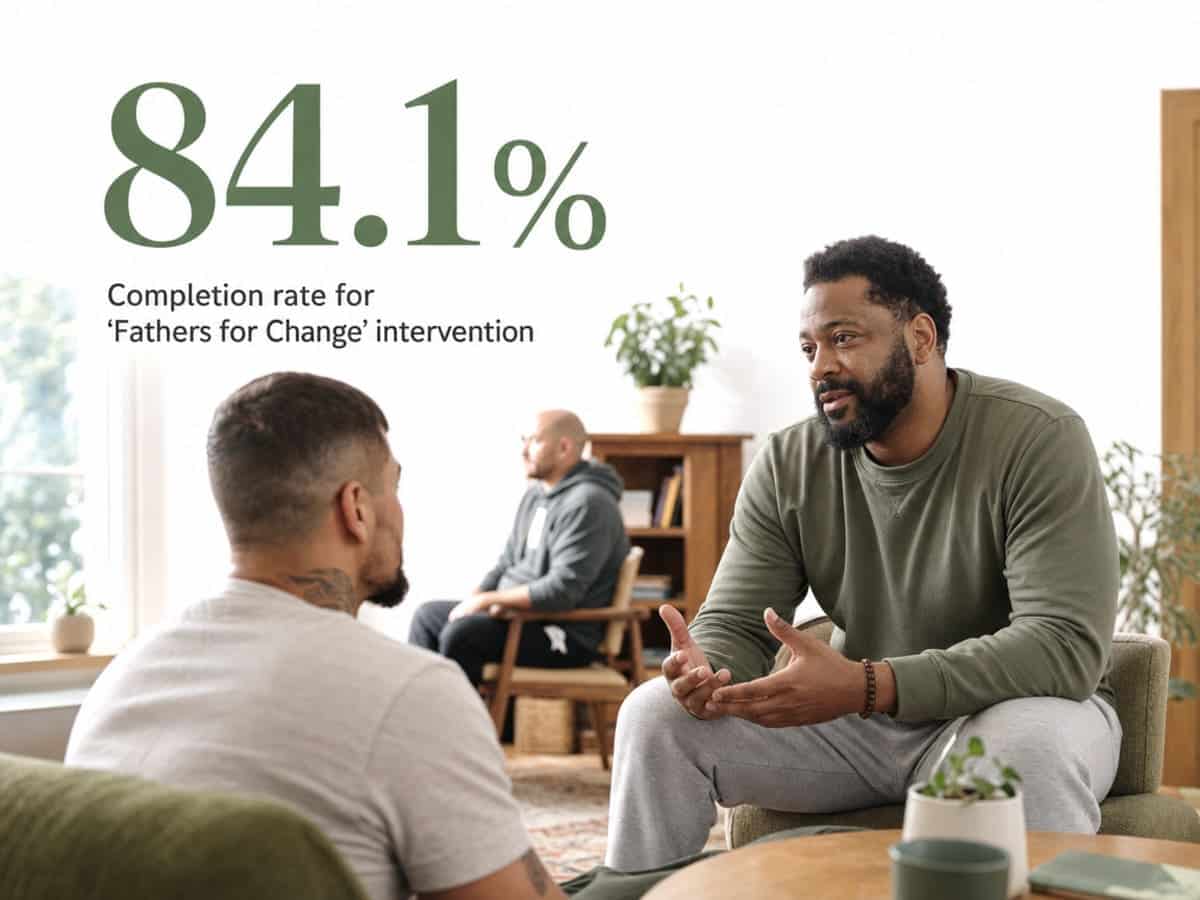
The research on fatherhood-focused work inside men’s residential treatment is unusually clear on this point. In an evaluation of the “Fathers for Change” intervention integrated into a men’s residential SUD program — specifically for fathers with histories of intimate partner violence and parenting struggles — 84.1% of participants completed the program, with measurable reductions in anger-related thoughts and improved affect regulation 10. Read the scope carefully: this is a narrow population inside a men-only residential setting, not a promise for every dad. But it tells you something important. When you put fathers in a room with other fathers, and you let them talk about the actual damage without the mixed-gender audience, they don’t run. They finish.
The men next to you at Serenity Park will have their own versions of the story. The son who won’t take the call. The wife who’s already spoken to a lawyer. The daughter who flinches. You will not be the only father in the room. That, more than anything else, is what makes the sentence you’ve never said finally sayable.
Agency, Retention, and What Actually Predicts Getting Sober
Here’s a piece of the research that will probably surprise you, because it lines up with how you already think.
A recent study of residential SUD patients found that when you control for age and time in treatment, two patient-reported experiences predict overall satisfaction: self-determination and personal responsibility. The kicker — personal responsibility predicts satisfaction more strongly for men than for women 9. Read that carefully. The thing that keeps you engaged in treatment isn’t being told what to do. It’s being handed back the wheel.
That matters because retention is the outcome variable that actually moves the needle. Hser and colleagues followed 511 patients across drug treatment programs and found that for both men and women, longer treatment retention predicted drug abstinence and reduced criminal activity at one-year follow-up. Twelve-step participation and the absence of spousal drug use during follow-up also predicted abstinence 16. Staying in the room is what works. Everything else is scaffolding around that.
The comprehensive services data adds one more piece. Analysis of 3,142 clients found that for men specifically, on-site services and more frequent counseling significantly predicted reduced post-treatment substance use — a relationship that didn’t hold the same way for women 15. Translation: how much clinical contact you get, and whether the practical supports are in the same building, moves your outcome more than it moves the average patient’s.
Put the three findings together and the picture sharpens. You stay if you feel like an adult with agency, not a patient being managed. You get better if you stay. And you get more out of staying if the counseling is dense and the wraparound is on-site. A men-only residential program that reframes vulnerability as a decision you’re making — not a state being imposed on you — is playing to exactly the variable the research says drives your satisfaction.
What Serenity Park Is, Plainly
No brochure language. Here’s the actual shape of the place.
Serenity Park is a men’s residential addiction treatment facility in Little Rock, Arkansas. Twenty beds. Not two hundred. The scale matters because the work in this article — dropping the performance, saying the sentence you’ve never said, sitting with another father who’s failed the same way you have — doesn’t happen in a room of sixty strangers. It happens in a room small enough that the guy across from you knows your name by Wednesday.
The clinical spine is straightforward. Medically-supervised detox with a physician and nursing team managing withdrawal. Residential treatment with individual counseling, group therapy, psychiatric care, and 12-step integration. Discharge planning and alumni support so the work you start in week one has somewhere to go in month six. The comprehensive-services research on male outcomes points the same direction: for men specifically, on-site services and frequent counseling predict reduced post-treatment use 15, and longer retention predicts abstinence 16. The program is built around the variables that actually move.
The one piece that isn’t standard: wearable monitoring through a partnership with Huml Health. During detox and early residential days, the device tracks heart rate, sleep, and stress in the background. Clinicians see the shifts before you have to name them. For men trained to say “I’m fine” when they’re not, that data closes a gap the old model left open.
What Serenity Park is, plainly, is a room where the audience you’ve been performing for isn’t there — and a clinical team paying attention to the parts of you that were never going to volunteer the information.
Frequently Asked Questions
Is a men-only rehab actually more effective than mixed-gender treatment?
At the population level, no. Reviews find gender-specific treatment is generally no more effective than mixed-gender treatment overall 5, and men often endorse mixed-gender groups as helpful 6. Where men-only care pulls ahead is for specific subgroups — men with trauma, high shame, sex-role conflict, or heavy impression management 7. If that’s you, the setting matters more than the average suggests.
How do I know if I’m the kind of man who would benefit from an all-male setting?
Ask yourself four questions honestly. Do you carry trauma you’ve never named out loud? Does your shame around the addiction run high? Do you edit your story in front of women? Is there relational damage as a father or partner you can’t discuss with a woman in the room? Two or more yeses, and a men-only room is where the real work starts faster 3, 7.
Won’t going to residential treatment mean everyone in my life finds out?
No. Federal privacy rules for SUD treatment are stricter than general medical privacy, and disclosure requires your written consent. What actually gets said, and to whom, is your call. Most professionals frame the absence as a medical leave. Serenity Park’s 20-bed scale means you’re not walking through a crowded lobby. Discretion is built into the size of the place.
I run a company. Can I really step away for weeks of residential care?
The honest answer is that you already are stepping away — in the hungover mornings, the mid-afternoon reset, the meetings you can’t fully recall. The question is whether the absence is planned or unplanned. Retention is the variable that predicts abstinence and reduced problem behavior at follow-up 16. Weeks now, one time, beats the slow drain of running the loop for another decade.
What does the first week at Serenity Park actually look like?
Day one: intake, medical assessment, phone logged, and medically-supervised detox begins with a physician and nursing team managing withdrawal. Wearable monitoring through Huml Health tracks heart rate, sleep, and stress overnight. Days two through four: symptoms peak and start easing. You meet your counselor, sit in your first small groups, and begin the individual work. It’s less dramatic than the movies and more clinical than you expect.
If vulnerability isn’t weakness, why does it still feel that way?
Because you were trained for thirty or forty years to feel it that way. The reflex is older than the reasoning. SAMHSA’s clinical guidance names the trap directly: men are socialized to be stoic and invulnerable, and expressing weakness reads internally as loss of control 12. The feeling doesn’t disappear on day one. It gets quieter each time you say a true sentence and the room doesn’t collapse.
References
- The role of masculinity in men’s help-seeking for depression. https://pubmed.ncbi.nlm.nih.gov/27664823/
- Dimensions of Masculine Norms, Depression, and Mental Health Service Utilization among Emerging Adult Men. https://pmc.ncbi.nlm.nih.gov/articles/PMC7036518/
- Working With Specific Populations of Men in Behavioral Health Services. https://www.ncbi.nlm.nih.gov/books/NBK144297/
- Addressing the Specific Behavioral Health Needs of Men (SAMHSA TIP 56). https://library.samhsa.gov/sites/default/files/sma14-4882.pdf
- Gender and Use of Substance Abuse Treatment Services. https://pmc.ncbi.nlm.nih.gov/articles/PMC6470905/
- Women’s and Men’s Experiences in Group Therapy for Substance Use Disorders. https://pmc.ncbi.nlm.nih.gov/articles/PMC8799487/
- Treatment of substance abusers: single or mixed gender programs?. https://pubmed.ncbi.nlm.nih.gov/9293039/
- Gender differences in outcomes from prison-based residential substance abuse treatment. https://pubmed.ncbi.nlm.nih.gov/12745032/
- Relationship Between Patient-Reported Experiences and Treatment Satisfaction Among Men and Women in Residential Substance Use Treatment. https://pubmed.ncbi.nlm.nih.gov/40755442/
- Integrating intimate partner violence and parenting intervention into residential substance use disorder treatment for fathers. https://pubmed.ncbi.nlm.nih.gov/28847453/
- Treatment Modalities and Settings – Addressing the Specific Behavioral Health Needs of Men. https://www.ncbi.nlm.nih.gov/books/NBK144286/
- Treatment Issues for Men. https://www.ncbi.nlm.nih.gov/books/NBK144290/
- Patterns and Challenges in Help-Seeking for Addiction among Men: A Narrative Review. https://pmc.ncbi.nlm.nih.gov/articles/PMC11508344/
- Gender and Overdose Risk Factors Among Clients Entering Residential Treatment for Opioid Use. https://pubmed.ncbi.nlm.nih.gov/40624830/
- Gender differences in the impact of comprehensive services in substance abuse treatment. https://pubmed.ncbi.nlm.nih.gov/15610830/
- Gender comparisons of drug abuse treatment outcomes and predictors. https://pubmed.ncbi.nlm.nih.gov/14643942/