
Key Takeaways
- ‘Functioning alcoholic’ is not a medical diagnosis. Clinicians diagnose alcohol use disorder using 11 DSM-5-TR criteria measured over 12 months, and meeting just two qualifies 1.
- The ‘functioning’ label persists because it lets heavy drinking feel respectable, but major clinical bodies discourage terms like ‘alcoholic’ as stigmatizing and imprecise 6.
- For men, heavy drinking begins at more than 4 drinks in a day or 14 in a week—thresholds many professionals cross without noticing because peers drink the same way 6.
- Sleep quality, cognitive edge, blood pressure, and long-term cancer and liver risk are the private costs subsidizing the performance, and voluntary treatment before a crisis tends to protect the career the drinking is quietly threatening 15, 10.
The Label That Lets You Keep Drinking
You know the term. You may have already applied it to yourself, quietly, in the way people negotiate with things they don’t want to name: functioning alcoholic. It sounds almost respectable. It has “functioning” in front of it, like a qualifier that softens the harder word behind it.
Here is the first honest thing worth saying: it isn’t a diagnosis. No physician can write it on a chart. It doesn’t appear in the DSM-5-TR, and major clinical bodies actively discourage terms like “alcoholic” because they carry stigma without carrying medical precision 6. What clinicians diagnose is alcohol use disorder, or AUD, and the criteria don’t ask whether you closed the quarter, made partner, or ran a good clinic day 1.
The label is doing something for you, though. That’s worth noticing. “Functioning” is the part that lets the rest of the sentence stay in the room. It’s the alibi. It’s the reason the bourbon after a fourteen-hour day feels earned, the airport scotch feels civilized, and the 2 a.m. wake-up feels like something other than what it is.
If you’re reading this at night, alone, wondering whether the word applies to you—that’s not weakness. That’s the first clear look you’ve taken in a while. Keep going.
What Clinicians Actually Diagnose (and Why ‘Functioning Alcoholic’ Isn’t It)
Alcohol Use Disorder: The Diagnosis Behind the Folk Term
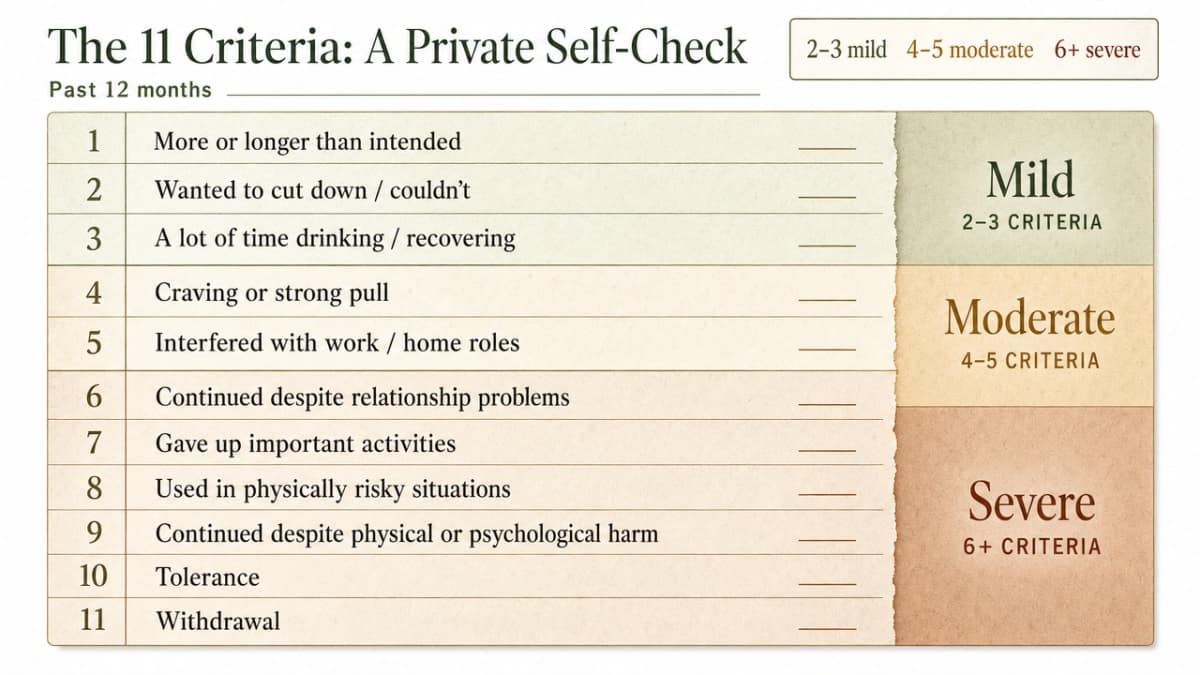
The name on the chart, if it ever gets written, is alcohol use disorder. Not alcoholism. Not functioning alcoholic. AUD. The DSM-5-TR defines it as a problematic pattern of alcohol use that leads to clinically significant impairment or distress, measured against 11 specific criteria over the past 12 months 1. Meeting two or three of them places an individual in the mild range, four or five in the moderate, and six or more in the severe range 4.
Here’s what matters about that framework: the criteria don’t ask what you do for a living. They don’t weigh your title against your intake. They ask whether you’ve tried to cut back and couldn’t. Whether you’ve kept drinking even after it caused problems with people you love. Whether you spend more time recovering from drinking than you used to. Whether you drink more, or longer, than you meant to 1.
The older split—alcohol abuse versus alcohol dependence—is gone. DSM-5 folded both into one diagnosis on a spectrum, precisely because the old binary made too many people look fine when they weren’t 4. Colloquially, this is still what most people mean when they say alcoholism. Medically, it’s AUD 7. And impairment, in the clinical sense, includes social and health consequences—not just the ones your boss would notice 3. A quiet slide in your marriage counts. So does a liver enzyme trending the wrong direction. So does the sleep you stopped getting years ago.
Why the ‘Functional’ Label Persists—and What It Hides
So why does the phrase stick around? Because it’s useful—to the person using it. It reframes a medical condition as a lifestyle. It lets the drinking sound like a personality quirk instead of a diagnosis. That’s the argument one clinical commentary makes plainly: the label “functional alcoholic” risks trivializing a serious medical condition by emphasizing preserved occupational status over significant health and relational harms 13.
Major clinical bodies have gone further. BMJ Best Practice states outright that terms like “alcoholic,” “alcoholism,” and “addict” are not clinical terms, are associated with stigma, and should not be used 6. NIAAA has moved toward person-first, spectrum-based language for the same reason 2. When you keep calling it functioning alcoholism, you’re using a word your own doctor is being trained not to use.
The word “functioning” does specific work here. It draws a line between you and the version of the problem you’re comfortable rejecting—the person on the bench, the DUI, the ruined marriage. As long as you’re on the other side of that line, the label reassures you. What it hides is that the criteria don’t care about the line. UNC’s Bowles Center describes AUD as involving impaired control, preoccupation, continued use despite consequences, and distorted thinking—especially denial 5. The phrase you’ve been using to describe yourself may be part of the distorted thinking, not evidence against it.
The 11 Criteria: A Private Self-Check
You don’t need a clinician in the room to run this. You need honesty and twelve months of memory. The DSM-5-TR asks whether, in the past year, you’ve experienced any of the following. Read them slowly. Answer them for yourself.
- You drank more, or longer, than you meant to.
- You wanted to cut down or stop, and you couldn’t—or you tried and it didn’t hold.
- You spent a lot of time drinking, or getting over drinking.
- You felt a craving, a strong pull, a need.
- Drinking got in the way of what you’re supposed to do—at work, at home, with the people who depend on you.
- You kept drinking even though it caused problems in your relationships.
- You gave up or cut back on things that used to matter—exercise, hobbies, time with your kids—because of drinking.
- You drank in situations where it was physically risky, like driving.
- You kept drinking even after it made a physical or mental health problem worse.
- You needed more to get the same effect. Tolerance.
- You had withdrawal—sweating, shaking, nausea, trouble sleeping, anxiety—or you drank to avoid it 1.
Most professional men reading this land somewhere in the middle and are surprised by it. The criteria don’t ask about hangovers you pushed through, deals you still closed, or mornings you showed up sharp. They ask about the private evidence—the drinks you didn’t plan, the promises to yourself that you broke, the sleep you traded, the small arguments with your wife that you now recognize as a pattern. Denial correlates with continued use despite mounting evidence of harm 14. That means the version of this list your brain wants to run—the one that finds a reason to say no to each item—is itself a symptom, not a rebuttal.
Write your number down somewhere private. You don’t have to do anything with it tonight. But knowing it changes what the next drink means.
How Much Is Actually Too Much for Men
You’ve probably done the math in your head at some point. Two glasses with dinner. A nightcap. Maybe three on a Friday. You compared it to the guys you know, decided you’re on the reasonable end of the curve, and moved on.
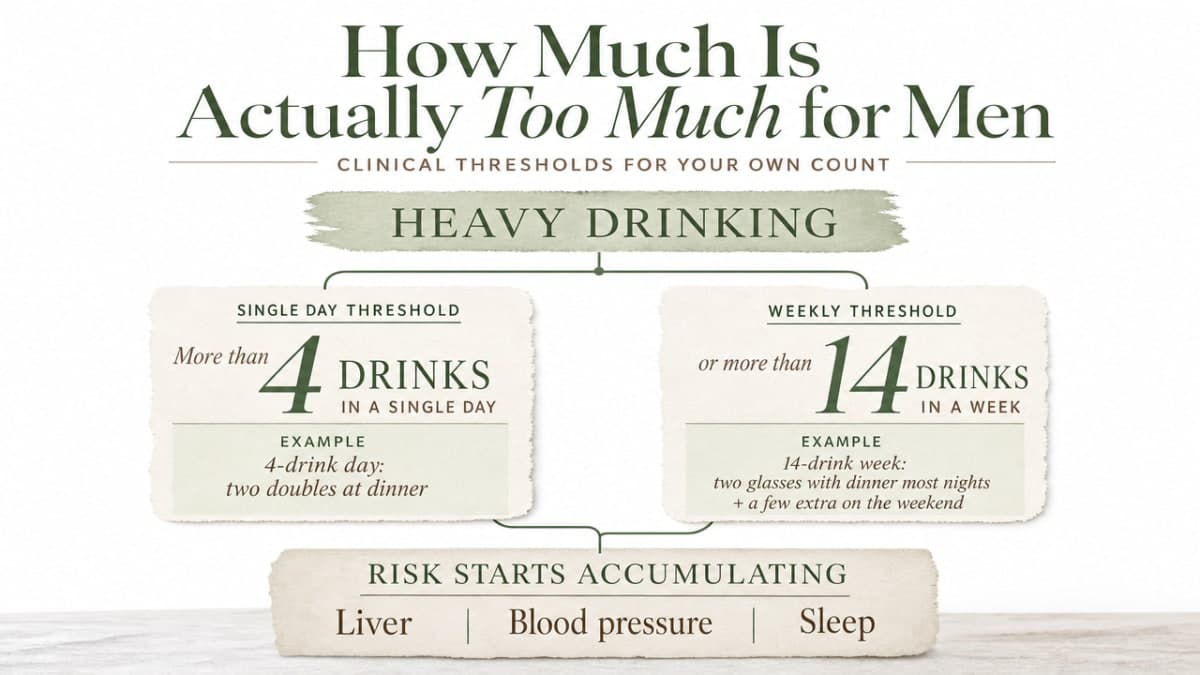
Here’s the number the math should have been checked against. NIAAA defines heavy drinking for men as more than 4 drinks in a single day or more than 14 drinks in a week 6. Not “drunk.” Not “visibly impaired.” Heavy. That’s the clinical threshold—the line above which risk stops being theoretical and starts accumulating in your liver, your blood pressure, and your sleep architecture.
Look at what that actually is. A four-drink day is two doubles at a client dinner. A 14-drink week is two glasses of wine with dinner most nights and a few extra on the weekend. That’s not the stereotype of a problem drinker. That’s a lot of men you know. That’s possibly you, most weeks, without a second thought.
Binge drinking is the more familiar cousin—five or more drinks on a single occasion for men—and the CDC notes it’s the most common form of excessive drinking in the United States 8. It doesn’t have to happen often to matter. A monthly bachelor party, a quarterly close, a golf weekend. Add it to your weekly average and the picture shifts.
What men in your position get wrong is comparing themselves to their peers instead of to the threshold. If everyone in your circle drinks like this, the reference point drifts. The clinical line doesn’t move because your industry normalizes bourbon 10. It’s the same line whether you’re a partner at a firm or a foreman on a job site. Run the count for the past seven days. Then the seven before that. Be exact—no rounding down for the pour size you actually use at home.
The Professional Man’s Version: Denial, Tolerance, and the Alibi of Performance
Here is what makes your version of this harder to see: you’re good at your job. The drinking hasn’t taken that yet. In fact, the drinking and the performing have been running in parallel for so long that they feel connected—as if the discipline that got you here is the same discipline that keeps the bourbon inside acceptable lines.
That parallel is the alibi. Clinical reviews of high-functioning AUD describe a specific pattern: preserved work identity, socially normalized heavy drinking, and delayed presentation until a medical event or relationship crisis forces evaluation 10. In physicians, a group with everything to lose from being labeled, a notable share meet criteria for alcohol misuse or dependence while continuing to practice 11. You are not an outlier. You are inside a well-documented profile.
Tolerance is the quiet driver. What used to be two drinks became three, then four, and the effect stayed roughly the same. Your body learned to compensate. Meetings went fine. So did the workout the next morning, mostly. The problem with tolerance is that it looks like strength. It reads, from the inside, as evidence you can handle it. Clinically, it’s one of the 11 criteria—your nervous system adapting to a substance it is working around 1.
Then there is denial, which in men with intact careers is unusually sturdy. The paper on insight in AUD describes it as a defense that correlates with continued use despite mounting evidence of harm, and it grows stronger, not weaker, when external life still looks orderly 14. Men in particular tend to delay treatment until consequences accumulate—a pattern documented across the literature on male AUD 12. You have been running an internal argument for a while now: the job is fine, so the drinking is fine. That argument has a name, and it isn’t reason. It’s the disorder talking through you.
The alibi of performance is convincing because it’s partly true. You are still performing. The question the criteria ask is different: at what private cost, and for how much longer.
What the Drinking Is Actually Costing You Underneath
The argument you’ve been making to yourself is that you’re still performing. Fine. Let’s take that seriously and look at what the performance is being subsidized by.
Start with sleep. You probably think alcohol helps you sleep, and in the narrow sense of falling asleep faster, it does. What it does after that is different. In middle-aged adults who are otherwise employed and functional, higher alcohol consumption is associated with poorer sleep efficiency and subtle cognitive deficits 15. Efficiency, in sleep terms, is how much of the time you spent in bed you were actually asleep and cycling through the stages your brain needs to consolidate memory, regulate mood, and clear metabolic waste. Alcohol shortens REM. It fragments the second half of the night. That 3 a.m. wake-up you’ve written off as stress is often the drink metabolizing out and your nervous system rebounding. You are not resting the way you think you are.
Then the cognitive piece. “Subtle” is the operative word. You are not slurring in meetings. You are losing a step you can’t quite measure—the name you used to have on the tip of your tongue, the second read you used to do on a contract before signing, the sharper version of the joke that used to land. It is not dementia. It is the ceiling of your capacity, lowered 15. You compare yourself to yourself last week and it looks flat. You compare yourself to yourself five years ago and something has moved.
The cardiovascular ledger is less subtle. Heavy alcohol consumption has a clear association with increased hypertension and cardiomyopathy, and long-term heavy use elevates arrhythmia risk as well 16. Your blood pressure numbers at your last physical—the ones you told yourself were age—may be reading a different story. Excessive alcohol use is also linked to liver disease and several cancers, risks the CDC groups under the broader category of long-term harms from excessive drinking 8. None of this shows up in a quarterly review. All of it shows up in a stress test at 55.
So the ledger, plainly: sleep quality down, cognitive edge dulled, cardiovascular risk climbing, liver and cancer risk accumulating quietly. The drinking is not free. It is being paid for—by the version of you that will exist in a decade, and by the version of you that could have been sharper this week.
The Career Question: Licensure, Reputation, and Getting Help Without Detonating Your Life
Say it plainly, because you’ve already thought it: the reason you haven’t picked up the phone isn’t the drinking. It’s what happens after you admit it. The partners’ meeting. The medical board. The client roster. The wife who might reframe the last ten years in a single conversation. That fear is legitimate. It’s also the mechanism that keeps the problem in place.
Physicians are the case study worth looking at, because they have the most to lose and the same fear as you. A notable share of physicians meet criteria for alcohol misuse or dependence while continuing to practice, and stigma plus concerns about licensure are documented barriers to help-seeking 11. What you’ll notice about that sentence is that the fear does not prevent the disorder. It only prevents the treatment. The two go on running side by side until something forces the issue—a medical event, a relationship crisis, a mistake at work that couldn’t be walked back 10.
Tell one person this week. A doctor you trust, not your business partner. Start there.
What Serious Treatment Actually Looks Like
Residential Care for People Who Can’t Simply Disappear
The image most men carry of “rehab” is out of date and unhelpful. It looks like a court-ordered facility with fluorescent lighting and a payphone in the hallway. That is not what serious residential treatment for a working professional looks like, and it is not what you would be walking into.
Residential care means you live on site while a medical team manages the parts of this that are actually dangerous—withdrawal, which for heavy drinkers can be serious, and the co-occurring anxiety or depression that has probably been running underneath the drinking for longer than you’ve admitted. Then it means structured therapy, education, and group work in a setting that isolates you from the triggers you would otherwise be negotiating with all day. That’s the point of the residential part. You cannot outthink this in your kitchen at 10 p.m. with a decanter across the room.
The outcome data supports the intensity. Studies of residential AUD treatment report improved abstinence rates and psychosocial functioning at follow-up among participants who complete the program 18. That’s the version of the ledger that matters to you: not just did he stop drinking, but did his life work afterward. For men who have delayed treatment until consequences accumulate—a pattern well-documented in the male AUD literature 12—the concentrated environment does what outpatient sessions between meetings often cannot.
You will not disappear. You will be gone from your office for a defined stretch, with a discharge plan and an aftercare structure waiting on the other side.
Continuous Biometric Monitoring as a Clinical Tool
You are a man who reads dashboards. You trust data more than you trust how you feel on a given morning, and you have probably owned a sleep tracker or an HRV monitor for years. That instinct translates into modern residential care in a specific way.
Wearable biosensors—transdermal alcohol monitors, heart rate variability trackers, sleep stage monitors—can provide continuous, objective monitoring of alcohol use and its physiological correlates in real-world settings 17. Inside a residential program, that means your clinical team is not relying only on self-report and a morning check-in. They see your resting heart rate normalize as detox progresses. They see sleep architecture rebuild, night by night, in a way you can watch happen. They see autonomic markers of stress and craving before you have the words for them.
This is not a gimmick, and it is not surveillance dressed up as care. It is the same clinical logic that runs a cardiac unit: continuous data lets the team adjust medication, therapy intensity, and pacing to the person in front of them, not to an average. For a professional accustomed to being measured against real numbers, treatment that operates that way tends to feel like medicine, not like a lecture.

A Straight Answer to the Question You’re Actually Asking
The question you came here with wasn’t really about a definition. It was: am I one, and what does that mean for the life I’ve built?
Here is the straight answer. “Functioning alcoholic” is not a diagnosis. It is a phrase your mind has been using to keep a medical condition at arm’s length. If two or more of the eleven criteria described earlier fit you honestly, the clinical name for what you have is alcohol use disorder, and it exists on a spectrum that has nothing to do with your title or your income.
The good news, if you can hear it as good, is that the same qualities that made you successful—discipline, follow-through, willingness to look at hard numbers—are the qualities that make treatment work. Men who enter care voluntarily, before a crisis forces the issue, tend to protect the careers they were afraid of losing.
Making one private call this week is not the end of the life you built. It is how you keep it. Serenity Park was built for men in exactly your position.
Frequently Asked Questions
Is ‘functioning alcoholic’ an actual medical diagnosis?
Can you have alcohol use disorder if your job performance is still strong?
Yes, and this is the most common version among professional men. Clinical reviews describe a well-documented profile: preserved work identity, socially normalized heavy drinking, and delayed presentation until a medical or relationship crisis forces the issue 10. The DSM criteria measure impaired control and continued use despite consequences, not your last performance review 1.
Will going to treatment put my professional license or career at risk?
The fear is legitimate—stigma and licensure concerns are documented barriers to help-seeking, particularly in physicians 11. What that fear often misses: voluntary treatment entered before a public incident is usually the version boards and firms respond to best. A discreet residential program with a return-to-work plan protects the career the drinking is quietly threatening 10.
How do I know if I need residential treatment instead of outpatient care?
Two signals push toward residential. First, heavy daily drinking that raises the risk of medically serious withdrawal—shakes, sweats, elevated heart rate when you skip a night. Second, an environment you cannot outthink at home, where triggers surround you. Residential AUD programs show improved abstinence and psychosocial functioning at follow-up in participants who complete them 18.
What should I do if I recognize myself in the DSM-5-TR criteria but I’m not ready to stop?
You don’t have to be ready to stop to be ready for a conversation. Tell one physician you trust, honestly, in the next week. Denial in AUD grows sturdier the longer external life stays orderly 14. A single confidential appointment doesn’t commit you to anything. It just moves the problem from inside your head into a room with someone qualified to look at it.
How do I talk to my spouse or partner about this without blowing up my family?
She has probably noticed more than you think. Men often delay these conversations until consequences accumulate, which makes the eventual disclosure harder, not easier 12. Keep it short and specific: name what you’ve been doing, name that you’ve read about AUD, name that you’re talking to a doctor. You are not asking her to fix it. You are telling her you’ve stopped hiding it.
References
- Alcohol Use Disorder: From Risk to Diagnosis to Recovery. https://www.niaaa.nih.gov/health-professionals-communities/core-resource-on-alcohol/alcohol-use-disorder-risk-diagnosis-recovery
- Health Topics: Alcohol Use Disorder. https://www.niaaa.nih.gov/alcohols-effects-health/alcohol-topics/health-topics-alcohol-use-disorder
- Understanding Alcohol Use Disorder. https://www.niaaa.nih.gov/publications/brochures-and-fact-sheets/understanding-alcohol-use-disorder
- Alcohol Use Disorder: A Comparison Between DSM–IV and DSM–5. https://www.niaaa.nih.gov/publications/brochures-and-fact-sheets/alcohol-use-disorder-comparison-between-dsm
- Alcohol Use Disorder and Alcohol Abuse | Bowles Center for Alcohol Studies. https://www.med.unc.edu/alcohol/education-prevention/alcoholism-and-alcohol-abuse/alcoholism/
- Alcohol use disorder – Symptoms, diagnosis and treatment. https://bestpractice.bmj.com/topics/en-us/198
- What Is Alcohol Use Disorder (AUD). https://alcoholtreatment.niaaa.nih.gov/what-to-know/alcohol-use-disorder
- Alcohol Use and Your Health. https://www.cdc.gov/alcohol/fact-sheets/alcohol-use.htm
- Alcohol use disorders in the workplace: epidemiology and prevention. https://www.ncbi.nlm.nih.gov/pmc/articles/PMC6761815/
- High-functioning alcohol use disorder: clinical features and treatment considerations. https://www.ncbi.nlm.nih.gov/pmc/articles/PMC5513689/
- Alcohol use among physicians and other healthcare professionals. https://www.ncbi.nlm.nih.gov/pmc/articles/PMC6019930/
- Alcohol use disorders in men: patterns, consequences, and treatment. https://www.ncbi.nlm.nih.gov/pmc/articles/PMC4041343/
- The “functional alcoholic”: myth or clinical reality?. https://www.ncbi.nlm.nih.gov/pmc/articles/PMC3860466/
- Denial and insight in alcohol use disorder. https://www.ncbi.nlm.nih.gov/pmc/articles/PMC6768970/
- Alcohol use, sleep, and cognitive functioning in middle-aged adults. https://www.ncbi.nlm.nih.gov/pmc/articles/PMC6874503/
- Alcohol and cardiovascular risk: dose-response and thresholds. https://www.ncbi.nlm.nih.gov/pmc/articles/PMC5808383/
- Wearable sensors for monitoring alcohol use and related physiology. https://www.ncbi.nlm.nih.gov/pmc/articles/PMC6281322/
- Residential treatment outcomes for alcohol use disorder. https://www.ncbi.nlm.nih.gov/pmc/articles/PMC7062377/