
Key Takeaways
- Xanax dependence often develops from a legitimate prescription in Little Rock men, and FDA labeling itself warns that alprazolam use can lead to abuse, misuse, and addiction even when taken as prescribed 4.
- Stopping alprazolam abruptly after a month or more of daily use is medically risky, which is why SAMHSA calls for a gradual, individualized taper under clinical supervision 5.
- Local decisions hinge on what else is in the picture: alcohol, opioids, or sleep medications alongside Xanax raise overdose risk and often push care from outpatient taper toward residential detox.
- Before committing, weigh level of care needed, insurance or Arkansas Medicaid coverage including the IMD waiver and prior authorization requirements 13, 14, transportation, and how intake protects your privacy.
When the prescription stopped working
You didn’t set out to have a Xanax problem. You went to a doctor because your chest was tight during a merger, or because you hadn’t slept a full night since your father’s diagnosis, or because the panic attacks in the parking garage were making you late for court. The prescription helped. For a while, it really helped.
Then the 0.5 mg stopped touching Sunday nights. You started taking one before the flight, then one in the terminal. The refill date started arriving four or five days early. You told yourself it was a rough stretch.
If you’re reading this on your phone at 6 a.m., or in the parking lot before a meeting, you already know something has shifted. You’re not looking up Xanax because you’re curious. You’re looking it up because the medicine that used to be a tool has started running the schedule.
Here’s what nobody says out loud: alprazolam is one of the few medications where the FDA label itself warns that use can lead to abuse, misuse, and addiction, even when the pills came from your own doctor with your own name on the bottle 4. That isn’t a character judgment. That’s pharmacology. The drug does what the drug does, and enough months of daily use will change how your brain expects to feel at baseline.
So no, you’re not weak. You’re not a cautionary tale. You’re a man whose prescription stopped working the way it used to, and who is quietly trying to figure out what to do next.
That’s a reasonable place to start. The rest of this piece walks through what actually happens from here, in plain terms, without the shame.
How a real prescription becomes a quiet problem
The first month, the pill did its job. You took 0.5 mg before the presentation and your hands stopped shaking. You slept through the night for the first time in weeks. Your doctor asked how it was going and you said, honestly, it was helping.
What you couldn’t see from inside that first month is what alprazolam does to your brain’s baseline. Take it daily for long enough, and your nervous system quietly recalibrates around the drug. The dose that used to feel like a soft landing starts to feel like nothing. The anxiety it was treating comes back louder between doses. That isn’t your original anxiety returning. That’s your brain asking for the next dose.
This is why the FDA label on alprazolam itself warns that use, even prescribed use, exposes you to the risk of abuse, misuse, and addiction, which can lead to overdose or death 4. Not because you did anything wrong. Because that’s what this particular molecule does to a human nervous system given enough time.
So the shift happens in small, defensible steps. The prescription says one as needed, up to three times a day. You start needing all three. You start taking one before bed even though it wasn’t prescribed for sleep, because you can’t fall asleep without it anymore. You have a glass of bourbon with the evening dose because the edge is still there. You call the office on a Thursday because the refill won’t last until Monday.
Each individual decision made sense in the moment. Strung together, they describe something else.
Look at where you actually are, not where the prescription says you should be. Ask yourself:
- Are you dosing to sleep?
- Are you drinking on top of it, or taking it alongside a pain medication?
- Are you running out early and rationing the last few days?
- Are you carrying a pill in your wallet for the meeting, the flight, the drive home?
None of those questions are accusations. They’re the same questions a careful physician would ask you, out loud, if you gave them the chance. The gap between a working prescription and a quiet dependence isn’t a moral line. It’s a medical one, and it’s usually crossed before anyone thinks to name it.
Why stopping on your own is the dangerous part
Once you realize the pills are running your week, the next instinct is usually the wrong one. You decide, quietly and on a Sunday, that you’re just going to stop. No more refills. No more bourbon-and-a-half-milligram at 10 p.m. You’re going to white-knuckle it and be done.
Please don’t.
Cold-turkey benzo withdrawal is not the same as a bad hangover. We’re talking rebound anxiety that dwarfs whatever sent you to the doctor in the first place. Insomnia that stacks up night after night. Tremors. Sweats. Blood pressure spikes. In more serious cases, seizures. This is one of the few classes of drugs where stopping without medical supervision can actually kill you, particularly if you’ve been on higher doses or mixing with alcohol.
Here’s the part that catches men off guard: the worst of it doesn’t always hit on day one. You can feel almost okay for 24 or 36 hours and start telling yourself you’ve beaten it. Then day three arrives and your nervous system files its full complaint at once, usually somewhere inconvenient. In a hotel room. Behind the wheel. During a deposition.
A supervised taper isn’t about willpower. It’s about giving your brain a controlled runway to relearn its own baseline, with someone watching the vitals and adjusting the plan when your body pushes back. That’s not weakness. That’s how this particular medicine has to be put down.
The Xanax-plus-something-else problem
Here’s the part almost nobody puts on the intake form, but every honest man knows about his own week: the Xanax isn’t the only thing you’re taking.
Maybe it’s the two bourbons after the kids go to bed, timed so the drink and the pill hit together. Maybe it’s the hydrocodone left over from the shoulder surgery, or a current pain prescription from your orthopedist who has no idea what your psychiatrist prescribed. Maybe it’s an Ambien on the nights the Xanax alone stops working.
Each of those combinations is more dangerous than any of the drugs alone. The FDA carries a boxed warning on alprazolam and on prescription opioids specifically because taking them together suppresses breathing in a way neither drug does by itself 3. The CDC is blunter about it: combining opioids with other sedating drugs, especially benzodiazepines like Xanax and Valium, is a leading pathway to fatal overdose 1. Alcohol works on the same brain systems as both.
This matters for you specifically because the pathway is so easy to build without noticing. A CDC prescribing guideline exists precisely because a knee injury plus a panic disorder plus a sleep problem can put three sedating prescriptions in the same medicine cabinet, written by three physicians who never spoke to each other 2.
You are not stacking these drugs because you want to. You’re stacking them because each one is treating something real, and nobody has looked at the whole picture at once.
An honest assessment starts with that whole picture. Not just what’s on the label of the orange bottle in your kitchen, but the drink at 9 p.m., the pain pill on the bad-back days, the sleep aid you keep in the nightstand. All of it, laid out on one table, without anyone flinching.
Arkansas in context, without the scare tactics
Little Rock is not New York or Los Angeles, and the story here is not the story on the evening news. But Arkansas has been living through the same prescription-drug reckoning as the rest of the country, quietly, and the numbers matter for one reason: they tell you that you’re not alone, and they tell you the direction is finally moving.
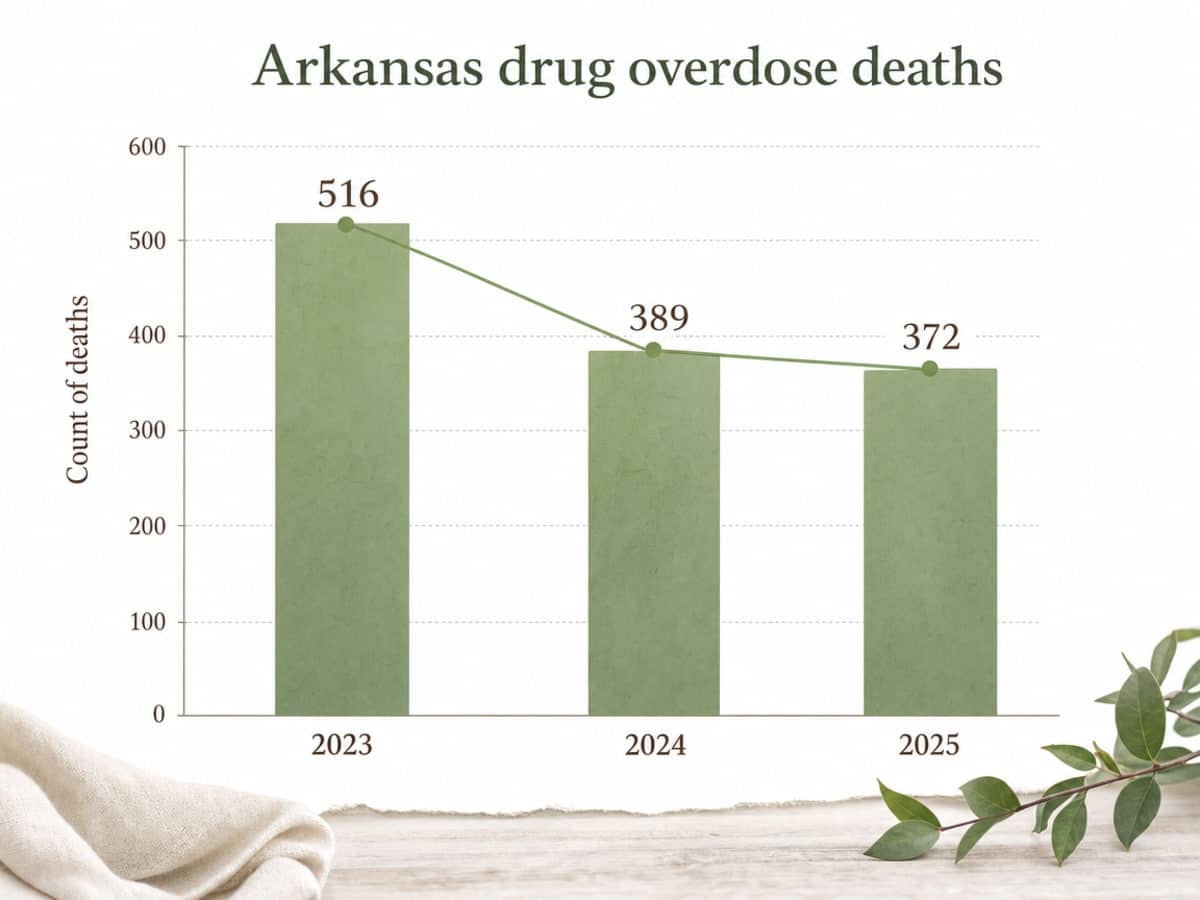
Statewide drug overdose deaths in Arkansas dropped from 516 in 2023 to 389 in 2024, then to 372 in 2025 11. Those figures are all-drug overdose deaths across the whole state, not benzodiazepine-specific, and they include everything from fentanyl to alcohol-plus-pills. But the shape of the trend is worth sitting with. More men are getting to help sooner. More families are catching the problem before it catches them.
The state’s own opioid response work has documented what clinicians see up close: benzodiazepines and opioids often show up in the same overdose response, in the same medicine cabinets, in the same men 12. That’s not a coincidence. It’s the pattern this article has been describing.
What this means for you, specifically: the man walking into a Little Rock intake office with a Xanax problem is not an outlier. He is part of a group large enough that the state health department tracks it and large enough that treatment infrastructure has been built around it. You are not the first person to make this call from central Arkansas. You will not be the last. And the numbers suggest that calling earlier, before another year passes, is exactly what the data is asking for.
What the first call actually sounds like
Most men rehearse this call for weeks before they make it. You picture some intake person asking you to justify yourself, or worse, sounding surprised. You picture having to say the words out loud for the first time and not knowing what words to use.
Here is what actually happens.
Someone answers the phone. You say something like, “I’ve been on Xanax for a while and I think it’s a problem.” That’s usually enough. You don’t need a diagnosis. You don’t need a speech.
Then the person on the other end starts asking medical questions, because that is what this call is: a medical intake, not a confession. Questions like:
- What’s your current dose?
- When was your last dose?
- How long have you been taking it?
- Are you drinking, and if so, roughly how much and when?
- Are there other prescriptions in the picture, particularly opioids or sleep medications?
- Any history of seizures? Any heart conditions?
- Are you safe right now?
The questions are clinical because your answers determine one specific thing: whether stopping the drug at home is safe for you, or whether you need supervised detox before anything else can happen. A man taking 0.5 mg twice a day for six months without alcohol is a different medical situation than a man taking 4 mg with bourbon and leftover hydrocodone. The intake team needs to know which man is on the phone.
Here is what you will not be asked. Nobody asks you to prove you have a problem. Nobody asks you to rate your character. Nobody calls your employer, your spouse, or your medical board. The information you share is protected health information, and it stays inside the clinical team unless you sign paperwork saying otherwise.
This is not a stylistic choice. It is what SAMHSA calls low-barrier care, and the evidence is direct: welcoming, non-judgmental intake keeps people engaged with treatment, and the punitive version keeps them home 6. Serenity Park runs its intake that way because it is what works, not because it is soft.
The call itself is shorter than you think. Twenty minutes, sometimes thirty. By the end of it, you’ll have a clearer picture of whether you need medically supervised detox, residential care, or a slower-paced outpatient conversation. You’ll know what the next 48 hours could look like. You’ll know what to tell your family, if you’re ready to tell them.
You will not have to have decided anything on that first call. You will just have made it.
What supervised care in Little Rock looks like
Once the intake team has a picture of what you’re taking and how much, the next question is simple: what level of care actually keeps you safe? Not the most convenient option. Not the one that lets you keep your Tuesday morning meeting. The one that matches what your body is doing.
For men whose Xanax use has stayed relatively contained, that answer might be an outpatient taper with regular check-ins. For men whose use has escalated, whose evenings involve bourbon or a leftover pain pill, or who have tried to stop before and ended up back at a higher dose, the answer is often residential care. Both paths exist in Little Rock. What follows is what each one actually looks like on the ground.
Assessment and medically supervised taper
The taper itself is not one number written on a prescription pad. It’s a plan built around your specific dose, your specific timeline, and what your body does when the level in your bloodstream drops.
A supervised taper starts with a full medical assessment. A physician looks at your current alprazolam dose, how long you’ve been on it, what else is in your system, and whether you have any underlying conditions that change the calculus. Factors on the table include:
- Blood pressure
- Liver function
- Sleep patterns
- Any history of seizures, which raises the stakes considerably
- Any prior withdrawal experiences, which tell the team what your nervous system tends to do under stress
From there, the dose comes down in scheduled steps rather than in one drop. SAMHSA’s guidance on benzodiazepine discontinuation is explicit that this needs to be gradual and individualized, particularly for anyone who has been taking the medication regularly for more than a month 5. The exact schedule varies. What doesn’t vary is the principle: your brain gets a runway, not a cliff, and someone is watching the vitals while you walk it.
Residential care at Serenity Park when outpatient isn’t safe
Some men can taper at home with weekly appointments and a spouse who knows what to watch for. Some can’t, and pretending otherwise is how people end up in an emergency room at 2 a.m.
Residential care exists for the second group. At Serenity Park, that means a small men’s facility in Little Rock, up to 20 clients at a time, with medical detox on-site when it’s needed and 24-hour staff who know what benzodiazepine withdrawal looks like at hour 12, hour 36, and hour 72. Vitals get checked. Sleep gets tracked, in part through the wearable monitoring the program uses to catch changes in heart rate and stress patterns that a self-report would miss.
The residential piece matters most when there’s alcohol in the picture, when there’s an opioid in the picture, or when previous attempts to stop at home ended with a return to a higher dose. The FDA label on alprazolam is direct about why that combination changes the risk profile: co-use with opioids or alcohol pushes respiratory depression and overdose into real possibility 4. That is not a situation for willpower and a quiet weekend.
Paying for care and getting there
Two practical questions usually sit under all the medical ones: how do you pay for this, and how do you actually show up.
On the payment side, most private insurance plans in Arkansas cover residential substance use treatment when it’s medically necessary, which for Xanax dependence with co-use or withdrawal risk usually isn’t a hard case to make. The intake team runs your benefits before you commit to anything. You’ll know what’s covered, what your out-of-pocket looks like, and what a self-pay option involves before you pack a bag.
If you’re on Arkansas Medicaid, residential care is available, but the paperwork is real. Under the state’s IMD waiver, Medicaid can cover services in a residential facility for up to 90 days on admission 13, and every rehabilitation-only admission for substance use disorder requires prior authorization based on medical necessity 14. That’s not a wall. It’s a step the intake team walks you through, not something you handle alone at your kitchen table.
Getting there is the smaller question. Little Rock is a drivable city for most of the men reading this, and Serenity Park’s location keeps admission simple. If a family member can drive you, that’s the cleanest option. If not, transportation from within central Arkansas can be arranged as part of admission. Roughly one in ten Little Rock households don’t have a vehicle available 15, and the intake team has heard that before. It doesn’t stop the process. It just changes the first phone call slightly.
None of this is a reason to wait another month.

The quiet next step
You don’t have to decide anything tonight. You don’t have to tell your spouse, your partners, your board, or your kids. You don’t have to have a plan for the next 90 days.
All you have to do is make one phone call, and let a clinical team ask you the medical questions that determine what comes next. That’s it. That’s the whole first step.
Serenity Park treats prescription drug addiction the same way it treats any other medical situation involving a man’s brain and body: with a full assessment, a plan built around what your specific case actually needs, and staff who have heard your story before from men who look a lot like you.
No shame. No labels. No lecture about the pills in your kitchen.
Just a phone call, and someone on the other end who already knows this isn’t the version of your life you planned on.
When you’re ready, that call is where this stops being something you carry alone.

Frequently Asked Questions
How do I know if I’m dependent on Xanax or actually addicted?
Dependence means your body has adjusted to the drug and expects it. Addiction adds the behavioral piece: taking more than prescribed, dosing to sleep or drink, running out early, hiding the pill count. If you’re doing the medical math on refill dates or carrying a pill for the meeting, you’re past pure dependence. Either way, a clinical assessment sorts it out. You don’t have to self-diagnose to make the call.
Is it dangerous to stop taking Xanax on my own?
Yes, and this is the part that catches men off guard. If you’ve been taking alprazolam daily for more than a month, SAMHSA is direct that it should not be discontinued abruptly; a gradual, individualized taper is the safer path 5. Cold-turkey withdrawal can bring rebound anxiety, insomnia, tremors, blood pressure spikes, and in some cases seizures. Talk to a clinician before you change the dose, not after.
What happens on the first call to a treatment center like Serenity Park?
Someone answers. You say you think Xanax has become a problem. Then the questions are medical: your dose, your last dose, how long you’ve been taking it, alcohol or other prescriptions in the picture, seizure history, whether you’re safe right now. Twenty to thirty minutes, no interrogation, no lecture. By the end, you’ll know whether you need supervised detox, residential care, or a slower outpatient conversation.
Will my employer, my family, or my medical board find out?
No. What you share on the intake call is protected health information. Nobody calls your employer, your spouse, your partners, or a licensing board. Serenity Park does not release information without paperwork you sign. This is part of why welcoming, non-judgmental intake exists in the first place; SAMHSA notes that punitive or exposing environments simply keep men from seeking care 6. Discretion is a clinical requirement, not a favor.
Do I need residential treatment, or can I taper as an outpatient?
It depends on what your body is actually doing. A lower dose, no alcohol, no other sedating prescriptions, no seizure history, a stable home, someone who can watch for trouble: outpatient taper is often reasonable. Higher doses, drinking on top, a leftover pain pill in the mix, or a previous attempt that ended back at a higher dose: residential care is the safer answer. The intake assessment makes that call, not you alone.
Does insurance or Arkansas Medicaid cover residential care for Xanax?
Usually yes, with paperwork. Most private plans cover medically necessary residential SUD treatment, and the intake team verifies benefits before you commit. For Arkansas Medicaid, the state’s IMD waiver allows coverage in a residential facility for up to 90 days on admission 13, and every rehabilitation-only SUD admission requires prior authorization based on medical necessity 14. It’s a real process, but it’s one the intake team walks you through.
References
- Save a Life from Prescription Opioid Overdose. https://www.cdc.gov/rx-awareness/prevent/index.html
- CDC Clinical Practice Guideline for Prescribing Opioids for Pain. https://www.cdc.gov/mmwr/volumes/71/rr/rr7103a1.htm
- Benzodiazepines and Opioids | National Institute on Drug Abuse. https://nida.nih.gov/research-topics/opioids/benzodiazepines-opioids
- RISKS FROM CONCOMITANT USE WITH OPIOIDS; ABUSE. https://www.accessdata.fda.gov/drugsatfda_docs/label/2023/013263s097lbl.pdf
- Dear Colleague Letter: Benzodiazepine Use in Older Adults. https://www.samhsa.gov/sites/default/files/dear-colleague-letter-benzodiazepine-06052025.pdf
- Advisory: Low Barrier Models of Care for Substance Use Disorders. https://library.samhsa.gov/sites/default/files/advisory-low-barrier-models-of-care-pep23-02-00-005.pdf
- The Power of Perceptions and Understanding. https://www.samhsa.gov/substance-use/treatment/stigma-language
- Stigma: Beyond the Numbers | Stop Overdose. https://www.cdc.gov/stop-overdose/stigma-reduction/stigma-beyond-the-numbers.html
- Stigma and Discrimination – National Institute on Drug Abuse. https://nida.nih.gov/research-topics/stigma-discrimination
- Breaking Down Barriers to Treatment. https://www.samhsa.gov/substance-use/treatment/integrating-sud-services/breaking-barriers
- Substance Misuse Education and Prevention – Arkansas Department of Health. https://healthy.arkansas.gov/programs-services/prevention-healthy-living/substance-misuse-education-and-prevention/
- 2024 – Arkansas State Opioid Response (SOR) III. https://humanservices.arkansas.gov/wp-content/uploads/WYSAC-SOR-3-Final-Eval-Report-12162024.pdf
- Arkansas – Medicaid. https://www.medicaid.gov/sites/default/files/2024-02/ar-opport-transi-stratg-supp-comm-incar-instit-mentl-diseas-pa-02282024.pdf
- HOSPITAL_II.docx – Arkansas Department of Human Services. https://humanservices.arkansas.gov/wp-content/uploads/HOSPITAL_II.docx
- Little Rock. https://www.littlerock.gov/media/21838/little_rock_transportation_report.pdf