
Key Takeaways
- Continuing care groups in Little Rock meet Tuesday and Thursday evenings because the first year after residential carries the steepest relapse risk, and a fixed calendar outperforms good intentions.
- Serenity Park rotates four outside-speaker categories through the room — sober living operators, IOP clinicians, employer or EAP voices, and peers at 18 to 36 months — each mapped to a specific post-discharge risk window 13.
- Little Rock’s tight professional network means recovery overlaps with your career, so the group functions as a place to rehearse return-to-work conversations before facing them at the office.
- Before committing, compare cadence, in-person versus remote format, speaker rotation, length of engagement, and whether individual counseling runs alongside the group — the evidence favors combining both 8.
The Tuesday You Don’t Want to Go
It’s 5:40 p.m. on a Tuesday. You’ve had a long day at the office. There’s a plausible reason to skip the group tonight — a client email that could wait until morning, a headache, a workout you keep meaning to get to. You’ve already done the hard part, right? You completed residential. You’re back at your desk. You’re functioning.
This is the moment continuing care groups are built for. Not the crisis moment. The ordinary Tuesday when nothing is wrong and that’s exactly why your brain is quietly rearranging your evening.
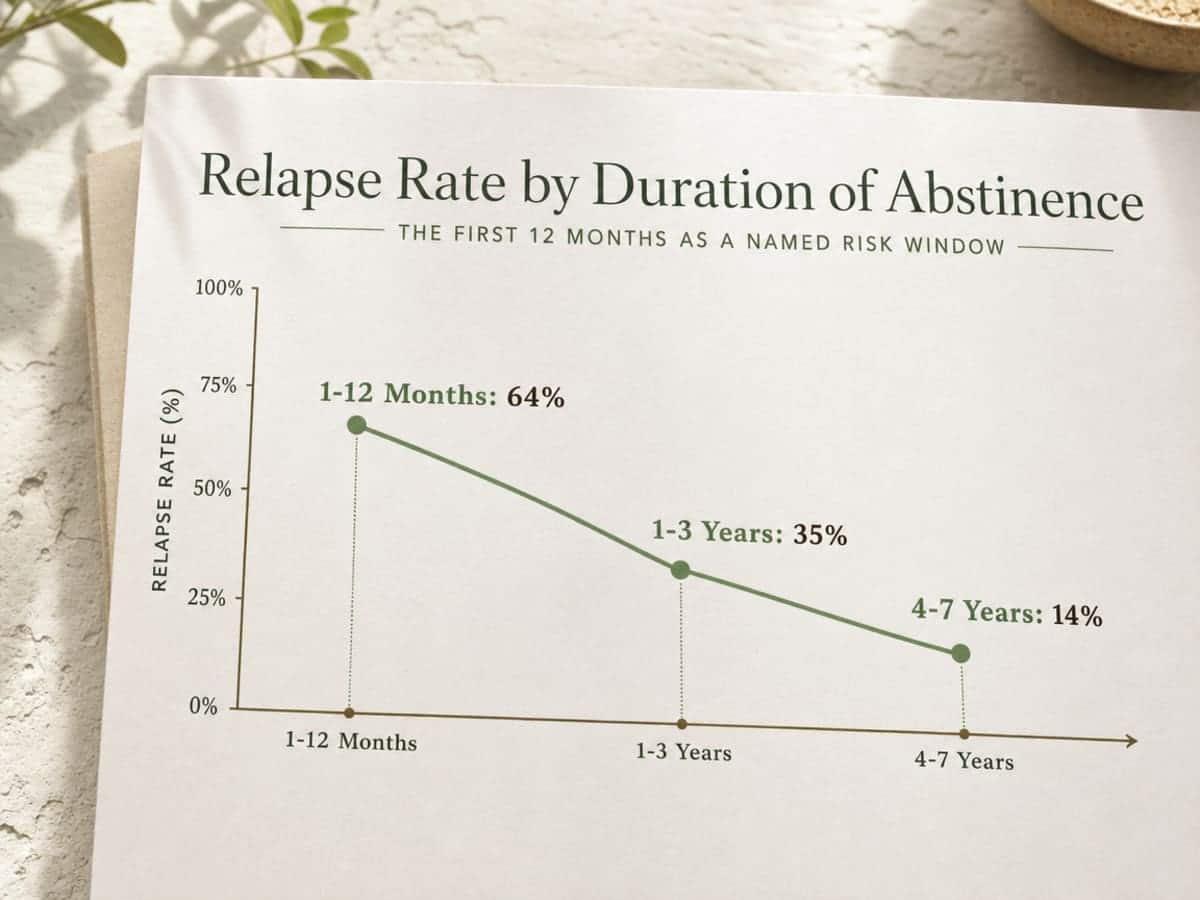
Relapse rarely announces itself. In the first year after residential treatment, the odds are stacked against a man walking back into his old life alone — roughly 64% of people in publicly funded programs relapse during months one through twelve of abstinence 11. That number isn’t meant to scare you. It’s meant to explain why showing up on a night you don’t feel like it isn’t willpower. It’s the design of the bridge.
This piece is about that bridge — how it’s built, who sits in the room with you, and why the calendar itself is doing more work than you think.
Why a Scheduled Room Beats Good Intentions
Here’s the part most people get wrong about aftercare: they think it works because you talk about your feelings in a circle. It doesn’t. It works because a specific room, on a specific night, at a specific time, gives your week a shape that your good intentions cannot produce on their own.
When researchers put this to the test, they compared structured aftercare — scheduled, manualized sessions over six months — against the more common approach of “call us if you need us.” The structured version produced better attendance and lower rates of uncontrolled substance use 1, 12. Not because the content was magic. Because the calendar was.
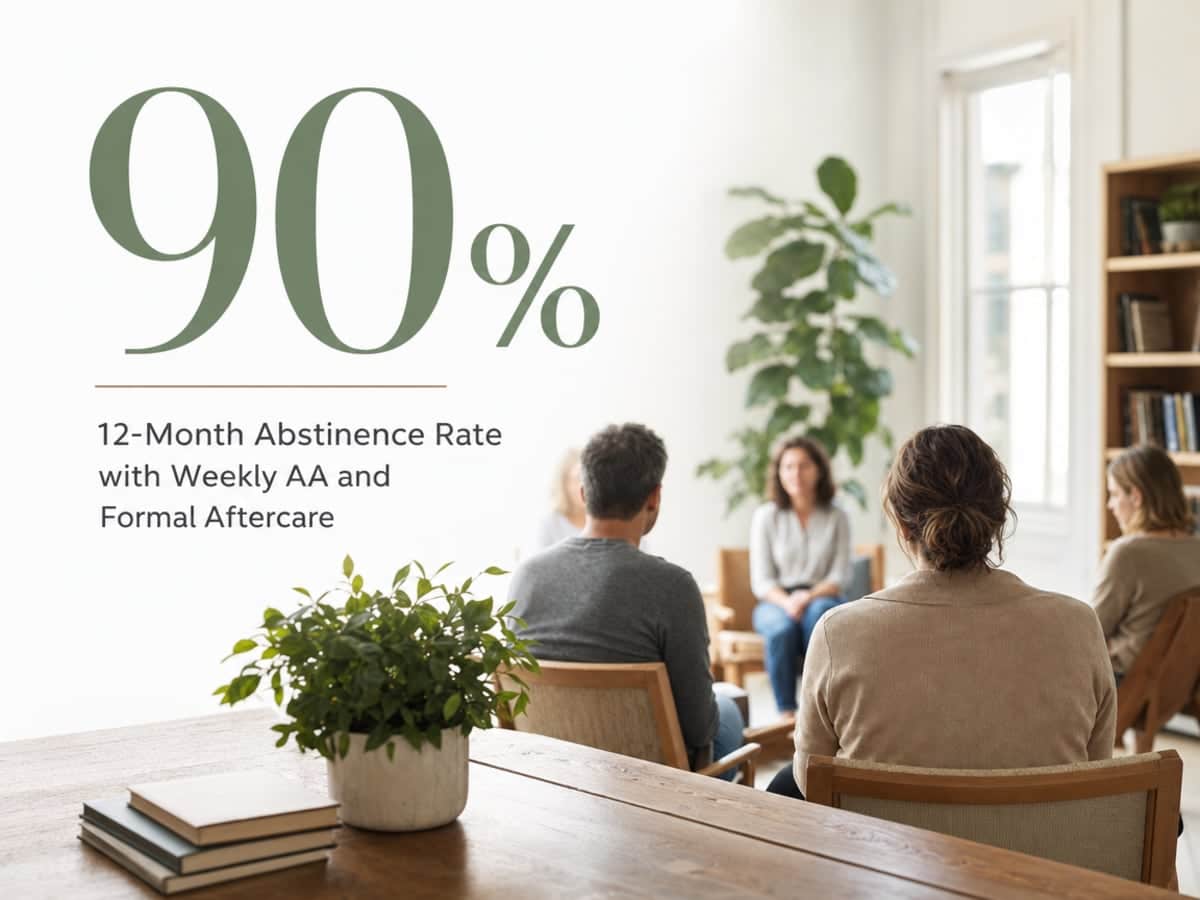
The numbers on what happens when a man actually stays engaged are hard to argue with. In one analysis of adults who completed treatment, those who received both outpatient care and self-help group participation reported 62.5% abstinence at 12 months. Those who received no continuing care after discharge reported 33.1% 2. Same starting line. Different scaffolding around the next twelve months. Nearly double the odds of holding your gains.
That’s the mechanism. Not motivation. Structure. The group is a scheduled room where relapse has to compete with a standing commitment, and where the standing commitment is reinforced by other men who are further down the same road you’re walking. Good intentions don’t survive a hard Tuesday. A calendar does.
The First 12 Months as a Named Risk Window
Recovery isn’t a flat line. It’s a curve, and the steepest part is right in front of you.
In publicly funded programs, 64% of people relapse during months one through twelve of continuous abstinence. That number drops to 35% during years one through three, and falls below 14% once someone has strung together four to seven years 11. Read that sequence twice. The first year isn’t just harder than the ones that follow — it’s dramatically harder. Your risk in month three is roughly four to five times what it will be if you get to year five.
That curve is the reason the Tuesday/Thursday cadence exists. Twice a week isn’t a random dose. It’s a response to where you actually are on the graph. You are standing on the steepest part of the slope right now, and the group is dosed to match.
Here’s what that means in practice. Month one, you’re still riding the momentum of residential. You feel clear. Sleep is coming back. Your first paycheck since discharge lands and it feels earned. This is not the danger window. The danger window is month four, when the novelty is gone, when the people who checked in on you daily have moved on, when a bad quarter at work coincides with a rough conversation at home and there is suddenly a quiet, familiar voice offering you an old solution.
Month four is why you need month one, two, and three of scheduled attendance. Not because you’re fragile in the early weeks — but because the group has to already be a habit, a fixed feature of your Tuesday and Thursday, before the harder months arrive. You don’t build the bridge while you’re falling off the cliff. You build it in the calm stretch so it holds when the ground shifts.
Evidence backs this front-loaded design. Interventions that provide support for 12 months or longer, and that actively reach out to clients rather than waiting for self-initiation, produce better outcomes than short bursts of care followed by silence 11. The clock doesn’t reset at 90 days. The risk math changes gradually, month by month, and the group is what stays constant while it does.
So when you look at that curve, don’t read it as bad news. Read it as a map. You now know exactly where the steep grade is. And you know that the men further up the slope — six, eighteen, thirty-six months ahead of you — are the ones sitting in the room with you on Tuesday, showing you what the climb looks like from a little higher up.
Who Sits in the Speaker’s Chair, and Why It Rotates
The chair at the front of the room is not decorative. Who sits in it on any given Tuesday or Thursday is a clinical decision, and the rotation itself is part of the treatment.
Here’s the logic. A closed group of men who just left residential is, by definition, a room full of people at the same point on the curve. Everyone is somewhere in month two or three. Everyone is figuring out the same things at the same time. That produces solidarity, which matters. But it doesn’t produce information. Nobody in that room has already survived the month-four dip, negotiated a return-to-work conversation with a general counsel, or lived in a sober house long enough to know what the rent structure actually feels like in month six.
Multi-modal continuing care — the kind that blends outpatient aftercare with mutual-help participation and active linkage to community systems — consistently outperforms single-modality follow-up 13. The clinical reason to rotate outside speakers into the room is to make that multi-modal reality visible on a weekly basis. Each speaker category isn’t a topic. It’s a live connection to a system you are going to depend on, sitting three feet away and taking questions.
Assertive continuing care models — the ones that reach into community environments rather than waiting for the client to show up — outperform passive referral on abstinence days and remission 14. Bringing the community into the room is one form of that same logic. You don’t have to go find these people later. They’re already at the Tuesday group.
The Sober Living Operator: Housing Stability as a Clinical Variable
Where you sleep in month three is not a lifestyle question. It’s a clinical variable.
A sober living operator in the speaker’s chair can tell you what happens when a housemate relapses at 2 a.m., how house rules actually get enforced, and what the honest math is on staying six months versus three. He can name the two or three houses in the Little Rock area that fit a working professional and the ones that won’t. If you’re going home to a spouse instead, he can tell you what he’s seen work in that setup and what predictably breaks.
That conversation belongs in the room before you need it, not after.
The IOP Clinician: Making the Clinical Step-Down Real
The step-down from residential to intensive outpatient is where a lot of men quietly fall off. The referral is made, the intake is scheduled, and then a work trip comes up and the IOP slot goes unfilled.
When an IOP clinician sits in the speaker’s chair, that abstraction becomes a person. You hear how her groups actually run, what she looks for in the first four weeks, how she handles a missed session. Rapid initiation of continuing care — within about two weeks of discharge — is associated with lower relapse rates 6. That transition is easier to make when the clinician on the other end is already a familiar face from Thursday night.
The Employer or HR/EAP Voice: Career Continuity Without Fantasy
This is the speaker most professional men are quietly waiting for and most afraid to hear.
An employer representative, an HR director, or an EAP counselor in the chair does something no counselor can do: he tells you what the return-to-work conversation actually sounds like from the other side of the desk. What documentation gets requested. What accommodations are routine and which ones raise eyebrows. How a leave of absence gets structured when the reason is treatment.
You don’t leave that session with a fantasy about your career being untouched. You leave with a realistic script — and the specific knowledge that other men in the room have used something close to it and are still employed.
The Peer at 18 or 36 Months: Lived-Experience Modeling
The last chair belongs to a man who was where you are, eighteen or thirty-six months ago.
He is not a counselor. He is not selling anything. He is a person who took the same Tuesday/Thursday seat, worked through the same month-four dip, and is now further up the slope. What he offers is proof of concept — a working example of a life you are still assembling. Combining structured groups with mutual-help participation and community linkage produces better long-term outcomes than any single component alone 13.
What Actually Happens Inside the Room
Forget the movie version. There’s no circle of folding chairs, no dramatic confession, no counselor with a clipboard walking the room. A continuing care group at its best looks a lot like a well-run meeting you’d sit through at work — except the agenda is your life.
A typical Tuesday runs about 90 minutes. The first ten are check-ins. Not “how do you feel” check-ins. Concrete ones. What happened this week that surprised you. What did you almost skip. What conversation went sideways. The check-in is short on purpose. It sets a floor of honesty without letting the room slide into monologue.
The middle stretch belongs to the outside speaker, if it’s a speaker night. If it’s not, the middle stretch is skill work — often something drawn from relapse-prevention or mindfulness-based curricula. That content matters. In one pilot, men and women who added mindfulness-based relapse prevention to their aftercare showed an average 86% decrease in substance use for each two-month increase in time over the four-month follow-up window 5. You’re not doing yoga on the floor. You’re learning to notice the specific mental move that happens ninety seconds before you make a decision you’ll regret.
The last twenty minutes are the part most men underestimate. It’s when someone asks a real question and three people who’ve been where he is answer it plainly. That’s where the room stops being a program and starts being a resource. You leave with two phone numbers and a plan for Thursday. Not a breakthrough. A next step.
The Honest Effect Size: What the Group Will and Won’t Do
Here’s where a lot of aftercare pitches go sideways. Someone quotes a big number, you nod, and six months later you’re wondering why the group didn’t feel like the magic bullet you were sold.
So let’s be straight about what the evidence actually says. The meta-analysis that pooled 33 controlled studies of continuing care — group counseling, relapse-prevention groups, telephone contacts, the whole range — found a small but statistically significant positive effect on substance use outcomes both at the end of the intervention and at follow-up 3. Small. Not transformative. Real, but modest.
That should reassure you, not deflate you. The group is not a rescue mechanism. It’s a compounding advantage. It moves the odds a little, and you stack it against every other advantage you can hold together — the sober living, the IOP appointment, the standing call with your sponsor, the fact that your spouse now knows what a hard week looks like from the inside.
What the group will do: keep you connected to people and systems that catch you before month four turns into month five. What it won’t do: make the craving disappear, repair the marriage on its own, or hand you back the version of your career you had before treatment. Anyone selling you the second list is selling you something else.
Show up for the first list. That’s the honest deal, and it’s the one that holds.
In-Person on Tuesday and Thursday, Not a Phone Call
A question that comes up almost every intake: can I just do this by phone? You’re busy. You travel. A video link would be easier to fit around a client dinner.
Here’s the honest answer. Telephone-based continuing care does work as a step-down for lower-risk patients. In a randomized trial comparing phone-based care to standard group counseling and relapse prevention after intensive outpatient treatment, the phone version held up well overall — but higher-risk patients had better outcomes when they first received face-to-face group counseling before any step-down to remote contact 9. Translation: you don’t start with the phone. You earn your way to it.
Think about what a screen strips out. It removes the walk into the building, which is itself a ritual. It removes the man three seats down whose posture tells you he had a hard week before he opens his mouth. It removes the parking lot conversation after group that is often where the real work happens. Those are not small losses in the first year, when the curve is at its steepest.
Show up on Tuesday. Show up on Thursday. Once you’re deeper into year one and the room knows you, the step-down conversation can be a real one. Not before.
Returning to a Little Rock Office, Firm, or Practice
The elevator ride up to your floor on the first Monday back is its own small event. You’ve rehearsed the small talk. You’ve decided what you’re saying to the two people who need to know and what you’re saying to everyone else. And somewhere between the lobby and your office, your body remembers exactly what this building used to mean.
That’s the part the group is built to hold.
Little Rock is a small enough market that your recovery will overlap with your professional life in ways it wouldn’t in Dallas or Houston. The lawyer across the hall knows the partner at the other firm. The physician on your service went to school with your neighbor. The client you’re presenting to on Thursday plays golf with someone on your board. You are not returning to an anonymous city. You are returning to a network, and the network has a memory.
What the Tuesday and Thursday group does is give you a room where that reality is not a secret. The other men in the chairs are running practices, managing teams, sitting in depositions, closing deals. When you say the words “my client noticed I was gone for six weeks,” nobody in that room needs it explained. Someone has already had that conversation. Someone else is having it next month.
That’s why the employer and EAP speakers matter so much in the first ninety days — they turn the return-to-work conversation from a private fear into a rehearsed skill 13. You stop carrying it alone. You start carrying a script.
The Long Horizon: Where This Leads if You Stay
Pull the camera back for a minute. You’re not going to be sitting in a Tuesday group forever. So what does the finish line actually look like?
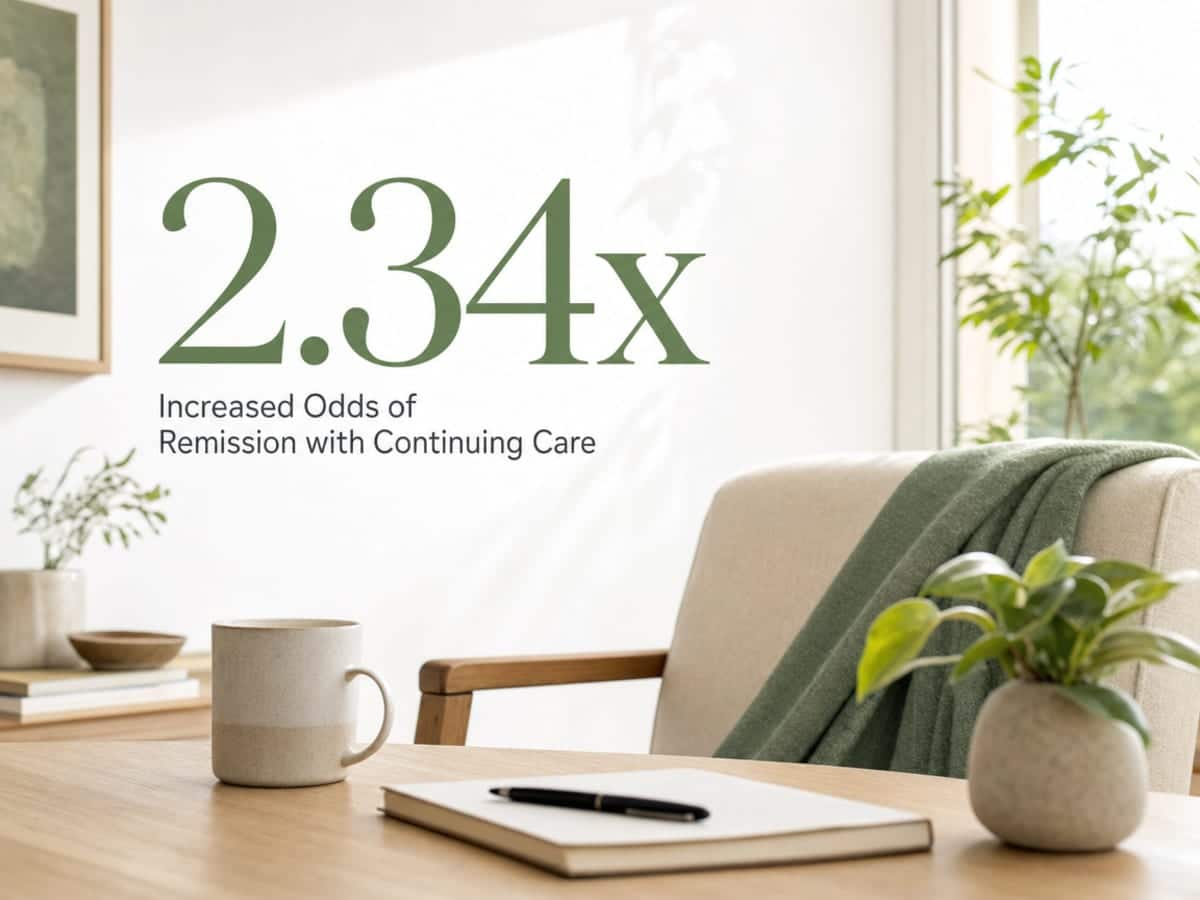
Here is the number worth carrying with you. In a nine-year study of adults in a private integrated health plan, people who received continuing care — defined as yearly primary care plus specialty substance use and psychiatric services as needed — had 2.34 times the odds of achieving remission at follow-up compared to those who did not 10. Nine years. Not nine months. That’s the horizon this Tuesday is buying you a ticket to.
What that looks like in real life is quieter than you’d expect. Year two, you’re probably down to one group a week and a standing call with a peer. Year three, the room has become a place you visit rather than a place you need. By year four or five, you’re the man in the speaker’s chair on a Thursday night, taking questions from someone who just walked out of residential and is trying to figure out how any of this is supposed to work.
That’s where staying leads. Not to a fixed destination, but to a life where recovery has stopped being the thing you manage and become the thing that quietly holds everything else up.
How Serenity Park’s Continuing Care Groups Fit Into Your Plan
You already know the mechanism. Scheduled room. Twice a week. Outside speakers who make the real world visible before you have to face it alone. Here is where that model actually lives.
Serenity Park’s continuing care groups meet on Tuesday and Thursday evenings in Little Rock, and they are built into the discharge plan you leave with — not offered as an optional add-on you have to chase down. The rotation of sober living operators, IOP clinicians, employer and EAP voices, and peers who are eighteen or thirty-six months ahead of you is deliberate. Each chair maps to a risk window the research has already named 13.
If you completed residential somewhere else, that’s fine. The room is open to alumni of other programs in central Arkansas. What matters is that you have a Tuesday and a Thursday on your calendar before the month-four dip arrives.
One more thing. Pair the group with individual counseling if you can. Group formats produce higher complete-abstinence rates; individualized relapse-prevention work limits the damage if a slip happens 8. You want both. The bridge holds better with two cables.
Frequently Asked Questions
How often do continuing care groups meet at Serenity Park in Little Rock?
Serenity Park’s continuing care groups meet twice a week, on Tuesday and Thursday evenings. That cadence is deliberate. The first year after residential is when relapse risk runs highest, so the schedule is front-loaded to match the curve. Two fixed nights a week, on your calendar before you leave residential, give the room a chance to become a habit before month four ever arrives.
Do aftercare groups actually reduce the odds of relapse, or is that just reassurance?
The effect is real but modest. A meta-analysis of 33 controlled studies found structured continuing care produces a small, statistically significant positive effect on substance use outcomes both at the end of treatment and at follow-up 3. Read that plainly: the group won’t rescue you, but it moves the odds in your favor when stacked with sober housing, IOP, and peer contact. Compounding advantages, not magic.
Why bring in outside speakers from sober livings, IOPs, and employers instead of a closed group?
Because multi-modal continuing care that blends outpatient aftercare with community systems outperforms single-modality follow-up 13. A closed room of men at the same point on the curve builds solidarity but not information. Rotating in a sober living operator, an IOP clinician, an employer or EAP voice, and a peer at 18 or 36 months puts the systems you’ll actually depend on in the chair three feet away.
How long should I stay in a continuing care group after residential treatment?
Plan on twelve months of active attendance, minimum. Interventions that provide support for 12 months or longer produce meaningfully better outcomes than short bursts of care 11. Most men taper naturally in year two — down to a weekly meeting and a standing peer call. By year three or four, the room becomes a place you visit rather than a place you need. Don’t taper on your own timeline in year one.
Can I do continuing care by phone or video instead of showing up in person?
Not at the start. Telephone-based continuing care works as a step-down for lower-risk patients, but higher-risk patients have better outcomes when they first receive face-to-face group counseling before moving to remote contact 9. Show up in person on Tuesday and Thursday through the first year. Once the room knows you and the curve has flattened, a step-down conversation can be a real one. Earn the phone.
How does a continuing care group fit alongside IOP, sober living, and 12-step meetings?
It’s the connective tissue. Patients who combine outpatient treatment with self-help group participation reach 62.5% abstinence at 12 months, compared to 33.1% for those with no continuing care 2. The Tuesday/Thursday group is where those threads meet weekly — your IOP clinician, your sober housing situation, your sponsor, your employer conversation — and where a slip in one system gets caught by the other men before it becomes a full relapse.
References
- Continuing Care Research: What We’ve Learned and Where We Are Going. https://pmc.ncbi.nlm.nih.gov/articles/PMC2670779/
- The Continuing Care Model of Substance Use Treatment. https://pmc.ncbi.nlm.nih.gov/articles/PMC4007701/
- How effective is continuing care for substance use disorders? A meta-analytic review. https://pmc.ncbi.nlm.nih.gov/articles/PMC3840113/
- Impact of Continuing Care on Recovery From Substance Use Disorder. https://pmc.ncbi.nlm.nih.gov/articles/PMC7813220/
- Mindfulness-Based Relapse Prevention for Substance Use Disorders: A pilot efficacy trial. https://pmc.ncbi.nlm.nih.gov/articles/PMC3280682/
- Continuing care for adolescents in treatment for substance use disorders. https://pmc.ncbi.nlm.nih.gov/articles/PMC5018300/
- The Efficacy of Aftercare for Adolescents with Alcohol Use Disorders: A Randomized Controlled Study. https://www.ncbi.nlm.nih.gov/pmc/articles/PMC2597424/
- Group counseling versus individualized relapse prevention aftercare for cocaine dependence. https://pubmed.ncbi.nlm.nih.gov/9337497/
- The effectiveness of telephone-based continuing care for alcohol and cocaine dependence. https://pubmed.ncbi.nlm.nih.gov/15699297/
- Continuing Care and Long-Term Substance Use Outcomes in Managed Care. https://pmc.ncbi.nlm.nih.gov/articles/PMC3242696/pdf/nihms328718.pdf
- Aftercare, Relapse Prevention and Continuing Care. https://www.wicourts.gov/courts/programs/problemsolving/docs/aftercarerelapseprevention.pdf
- Detailed tables from Continuing Care Research review. https://pmc.ncbi.nlm.nih.gov/articles/PMC2670779/pdf/nihms60264.pdf
- Supplemental materials for Continuing Care Model of Substance Use Treatment. https://pmc.ncbi.nlm.nih.gov/articles/PMC4007701/pdf/nihms556747.pdf
- Supplemental tables for Continuing Care for Adolescents in Treatment for Substance Use Disorders. https://pmc.ncbi.nlm.nih.gov/articles/PMC5018300/pdf/nihms799929.pdf
- Supplemental data for Mindfulness-Based Relapse Prevention trial. https://pmc.ncbi.nlm.nih.gov/articles/PMC3280682/pdf/nihms258589.pdf