
Key Takeaways
- Treating PTSD and substance use concurrently outperforms sequential care—dually diagnosed veterans in integrated VA programs achieved better PTSD outcomes than those with PTSD alone.7
- The VA continuum runs from self-help and outpatient through IOP, MAT, and residential tracks like SARRTP, PRRTP, and domiciliary care, each with distinct lengths and admission criteria.3,13
- Match length of stay to clinical complexity: 28–42 days may suffice for single-substance alcohol use, while polysubstance use or combat PTSD generally warrants 60 days or more.8,10
- Choose between VA and private residential by identifying the actual constraint—cost points to VA’s no-cost scale, while speed of admission, cohort size, or discretion points to smaller private settings.3,4
Why Treating the Addiction Without the Trauma Usually Fails
Here is the finding that should reframe how you think about your options: in specialized VA residential programs, veterans with both PTSD and a substance use disorder had significantly better PTSD outcomes than veterans with PTSD alone, and the difference tracked closely with improvements in their substance use symptoms. That is not what most people assume. Comorbidity is supposed to make prognosis worse. In integrated care, it often does the opposite.7
You have probably already run the sequential experiment on yourself. Get the drinking under control first, then deal with the sleep, the hypervigilance, the memories. Or the reverse: manage the PTSD and expect the drinking to fade. It rarely holds. The two conditions feed each other, and treating one while the other keeps firing tends to end in relapse, dropout, or a quieter version of the same problem.
The clinical direction has moved accordingly. Concurrent treatment models, where PTSD and substance use are addressed in the same setting during the same admission, now show meaningful symptom reductions in as little as two weeks, with gains that hold at three months. That is the frame this article uses to walk you through the continuum, the VA’s residential architecture, and where a smaller private setting fits when access, timing, or discretion matter.9
The Full Continuum of Care Available to Veterans
From Self-Help to 24/7 Residential: What Each Level Actually Delivers
The VA describes its own SUD services as a ladder, not a menu. Each rung exists because the one below it stopped being enough. Knowing the actual vocabulary matters when you call intake, because the language you use shapes where you land.1,2
- At the base sit self-help groups — AA, NA, SMART Recovery, VA-run peer support. Free, flexible, and useful as a supplement, but they are not clinical treatment.
- Above that is standard outpatient counseling: weekly individual or group sessions with a therapist, usually cognitive behavioral therapy or motivational interviewing, sometimes paired with medication management. This is what most veterans try first, and it fits people who are stable, employed, and using at a level that has not yet started tearing things down.
- When weekly sessions cannot keep pace, the next rung is intensive outpatient (IOP) — typically nine to fifteen hours of structured programming a week across three to five days, without leaving home. IOP is where a lot of high-functioning veterans stall, either because the schedule collides with work or because the hours away from the drink or the pill are not enough to interrupt the pattern.
- Medication-assisted treatment (MAT) runs alongside these levels rather than sitting between them. For alcohol use disorder, that means naltrexone, acamprosate, or disulfiram; for opioid use disorder, buprenorphine, methadone, or extended-release naltrexone. Medically supervised detox is a separate short-term stabilization step for people withdrawing from alcohol, benzodiazepines, or opioids where the physical risk is real.
- The top rung is residential rehabilitation — 24/7 structured care in a live-in setting, which the VA delivers primarily through its Mental Health RRTPs, including tracks that integrate PTSD and SUD treatment in the same admission. After discharge, continuing care — relapse prevention groups, alumni contact, ongoing MAT — is what protects the gains.
Medications and Evidence-Based Therapies the VA Uses
The clinical toolkit itself is not the differentiator between VA and private care. The same medications and the same therapies show up in both settings. What varies is intensity, cohort size, wait time, and how tightly the PTSD work is stitched to the substance use work.
On the medication side, VA guidance names naltrexone, acamprosate, and disulfiram for alcohol use disorder, and buprenorphine, methadone, and extended-release naltrexone for opioid use disorder. These are the standard-of-care options. If a clinician is telling you medication is off the table because you should just white-knuckle it, that is not aligned with current VA practice.2
On the therapy side, the workhorses are cognitive behavioral therapy (CBT) for relapse prevention, motivational interviewing for ambivalence, and contingency management in some settings. For the trauma layer, Prolonged Exposure (PE) and Cognitive Processing Therapy (CPT) are the two evidence-based PTSD protocols the VA uses most, and they are increasingly being delivered concurrently with SUD treatment rather than after it.2,9
What this means practically: at intake, ask what medications the program prescribes on-site, whether PE or CPT is offered during the same admission, and how psychiatric medication management runs day to day. One 2015 study of dually diagnosed veterans in specialized inpatient PTSD programs found that psychiatric medication use during treatment was one of the correlates of better substance use outcomes. Medications and therapy are not competing lanes. They work together, and the programs that treat them as one system tend to hold their gains longer.10
The VA Residential System: Program Types, Lengths, and Capacity
MH RRTP, SARRTP, PRRTP, and Domiciliary Care Explained
Most competitor content lumps everything into “the VA offers residential care.” That vagueness costs you at intake, because the VA runs several distinct residential program types, each with its own admission criteria and clinical focus. Knowing the acronyms is the difference between landing in the right track and spending three weeks in a program that was not built for what you actually need.3,4,5,11,12,13
| Program | Description |
|---|---|
| Mental Health Residential Rehabilitation Treatment Program (MH RRTP) | The umbrella term. This is the system-wide category covering roughly 250 programs at approximately 120 to 123 sites nationwide, with capacity for more than 6,500 veterans at any given time. Within that umbrella sit the specialized tracks. |
| Substance Abuse Residential Rehabilitation Treatment Program (SARRTP) | The SUD-focused residential unit. It provides a substance-free, supervised recovery environment for veterans whose diagnosis and clinical picture require 24-hour structure. These tend to be smaller units — the Wilkes-Barre SARRTP, for example, runs 10 beds with a day treatment component layered on top. |
| Psychosocial Residential Recovery Treatment Program (PRRTP) | A broader residential model that typically runs separate tracks under one roof: one for substance use, one for service-related PTSD, and often one for other mental health conditions. Admission requires a qualifying diagnosis, an assessed need for residential structure, and stability sufficient to avoid acute psychiatric admission. |
| Domiciliary care | The oldest branch — originally residential housing for veterans, now often used for homeless veterans and those needing longer-term stabilization, including chemical dependency recovery. |
When you call intake, ask which track you would be routed to, not just whether beds are open.
How Long Treatment Actually Lasts Across VA Tracks
Length of stay is not a marketing variable. It is a clinical one, and the VA’s own program documents show meaningful variation across tracks. Treating a 28-day stay and a 63-day stay as roughly equivalent is a mistake — they are structurally different interventions.12,13
- The Central Arkansas SUD Dom runs a 28-day residential program with 24/7 structured support, aimed squarely at substance use recovery.
- A PRRTP substance abuse track averages 42 days, giving more room for behavioral consolidation and post-discharge planning.
- A PRRTP service-related PTSD track averages 63 days, reflecting the longer arc of trauma-focused work when protocols like Prolonged Exposure or Cognitive Processing Therapy are running alongside relapse prevention.
- Private residential settings typically fall in a 20-to-90-day range, with the longer end reserved for veterans with heavy comorbidity or multiple prior treatment attempts.
The clinical logic behind these differences matters. A 2015 study of dually diagnosed veterans in specialized inpatient PTSD programs found that longer program duration correlated with slightly better substance use outcomes at follow-up. That is not an argument for the longest stay you can get. It is an argument for matching length to complexity. If you are dealing with a single-substance alcohol use disorder and a stable home environment, 28 to 42 days may be exactly right. If you are carrying combat-related PTSD, polysubstance use, and a history of relapse after outpatient, the 60-day range starts to look less like an indulgence and more like the minimum viable dose.10
Ask any program — VA or private — what their average length of stay is and how they decide when to extend it.
Integrated PTSD and SUD Treatment: The Evidence That Should Drive Your Decision
Why Dual Diagnosis Outcomes Can Beat PTSD-Only Outcomes
The intuition most people carry into this decision is wrong, and it costs veterans years. The assumption goes: PTSD alone is hard, PTSD plus a substance use disorder is harder, so a dually diagnosed veteran should expect a rougher outcome. In specialized VA inpatient and residential PTSD programs, the opposite has shown up. Veterans with both diagnoses had significantly better PTSD outcomes than veterans with PTSD alone, and the difference tracked closely with how much their substance use symptoms improved during the same admission. The authors describe a possible synergistic effect when the two disorders are treated together.7
The mechanism is not mysterious once you sit with it. Alcohol, benzodiazepines, and opioids do a specific job for a PTSD brain — they blunt hyperarousal, quiet intrusive memories, and force sleep. Treat only the PTSD and you leave the coping tool in place, so the trauma work has to fight the sedation every session. Treat only the substance and you pull the tool without replacing what it was doing, which is why the drinking usually comes back within months. Concurrent treatment addresses both loops at once.
A 2023 study of post-9/11 veterans in a two-week intensive program that delivered Prolonged Exposure alongside SUD interventions saw significant drops in substance use at two weeks and again at three months, with lower PTSD symptoms at discharge predicting less substance use at follow-up. That is the pattern to look for when you are asking a program what they actually do: PE or CPT running in the same admission as MAT and relapse prevention, not sequenced across two separate stays.9
Single-Substance vs. Polysubstance Use: Why the Intake Assessment Matters
Not every dually diagnosed veteran responds to integrated care the same way, and the difference starts with what is actually in the bloodstream. A 2019 study of veterans in an exposure-based PTSD/SUD program compared single-substance users to polysubstance users and found both groups improved on both fronts — but the pattern of gains diverged. Polysubstance users saw larger reductions in substance use frequency, while single-substance users saw larger reductions in PTSD severity.8
That is a clinically useful split, not a trivia point. If you are a veteran whose problem is a nightly bottle of bourbon and nothing else, you can reasonably expect the trauma work to move faster than the drinking, and a program that runs PE or CPT hard in the first two weeks will feel productive. If you are mixing alcohol with prescription opioids, a benzodiazepine script, and occasional stimulants, the early gains are more likely to show up as reduced use across the board, with PTSD symptoms shifting later.
At intake, push for a substance-by-substance history, not just a checkbox. Ask how the program adjusts its sequencing when polysubstance use is present, and whether MAT options extend beyond alcohol to opioids in the same admission. The assessment on day one shapes what the fourth week looks like.2
What Residential Treatment Actually Changes: Outcomes and Mortality Data
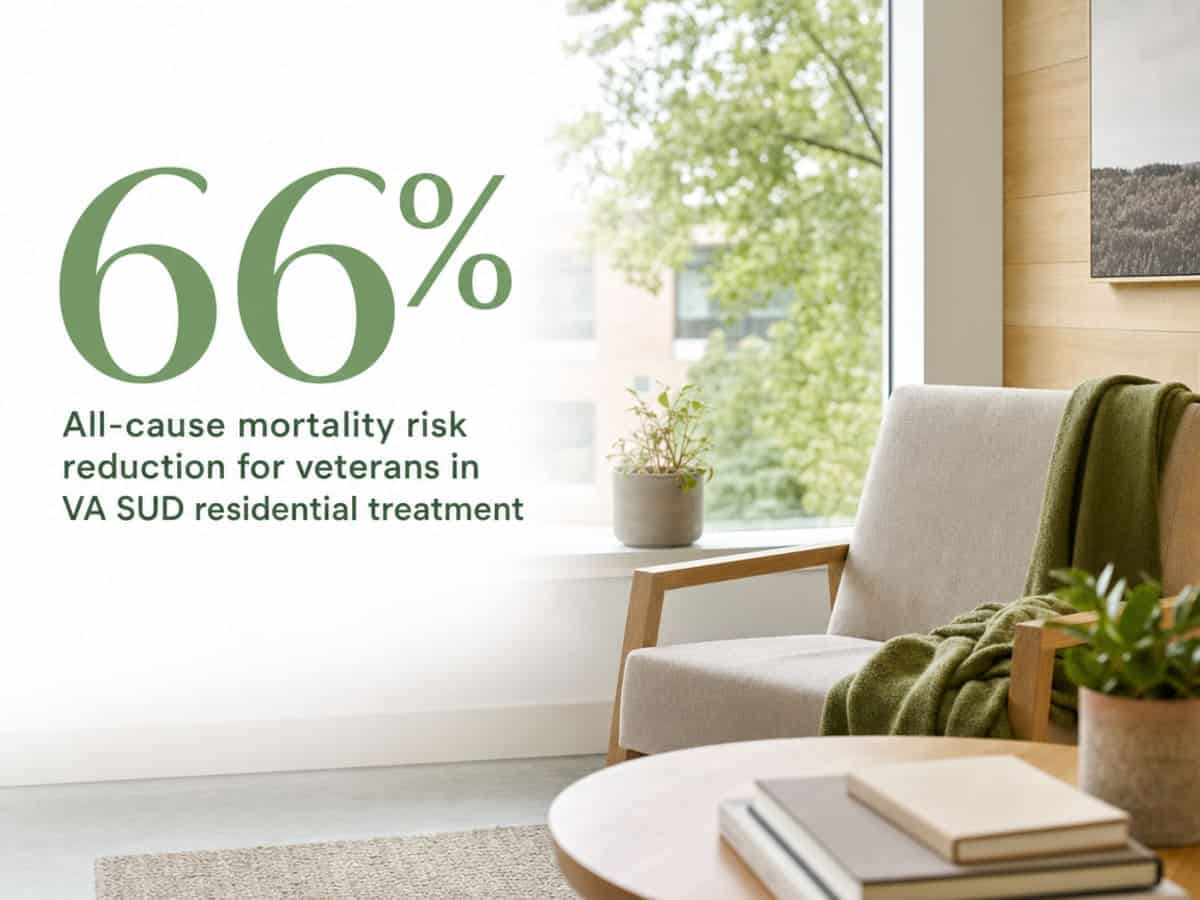
Mortality is the ceiling metric, but it is not the only one that moved. The same study found medium-to-large improvements in self-reported mental health and SUD symptoms from pre-treatment to post-treatment, with gains that held at one year after screening. Translation: the veterans who went through residential care did not just live longer on average — they reported meaningfully better functioning twelve months out, not just at discharge.6
The clinical implication is narrower than the headline suggests. Residential care shows its strongest returns for veterans with higher-acuity presentations — heavy use, prior failed outpatient attempts, co-occurring PTSD, unstable home environments. If your pattern is closer to that profile, the 24/7 structure is doing work that weekly outpatient sessions structurally cannot. If your use is milder and your supports are intact, the same intensity may be more than you need. The point of the data is not that everyone belongs in a bed. It is that when the acuity warrants it, this level of care changes the arc of the disease.
Where Private Residential Fits: Discretion, Speed, and Small-Cohort Structure
The VA runs the largest veteran-focused residential system in the country — roughly 250 programs at about 120 to 123 sites, with more than 6,500 beds nationally. That scale is a genuine strength, and it is also the source of the friction. A federal system of that size moves at the pace a federal system of that size moves. The VA has publicly acknowledged this and rolled out initiatives in 2024 to streamline referrals and cut wait times. Progress is real. It is also uneven by region and by track. If your local SARRTP is full and the nearest PRRTP substance track has a queue, you are looking at weeks, sometimes longer, before a bed opens.3,4
Private residential fills three specific gaps, and it is worth being clear about which ones actually apply to you.8,12,13
| Factor | Description |
|---|---|
| Speed of admission | A small-capacity men’s residential program that manages its own intake can typically move from initial call to bed in days, not weeks. When the drinking is at the point where you are hiding bottles from your spouse or dosing before client calls, the difference between a Tuesday admission and a wait-listed one matters clinically, not just logistically. |
| Cohort size and composition | A 30-bed federal unit and a 20-bed private setting are different clinical environments. Smaller cohorts mean more individual counseling time, tighter group dynamics, and less mixing across acuity levels. For a veteran who is still leading a team on Monday morning conference calls, sitting in a group of nineteen other adult men — many of them professionals — is a different experience than a mixed-acuity federal cohort. |
| Length and pacing flexibility | VA tracks run on defined averages: 28 days at the Central Arkansas SUD dom, 42 days in a PRRTP substance track, and 63 days in a PRRTP PTSD track. Private residential typically operates on a 20-to-90-day window, with clinical extensions when co-occurring PTSD or polysubstance use warrants more time. That is not a slogan. It is the room to hold you for the additional three weeks that a specific case actually needs. |
None of this makes private care universally better. VA offers scale, no cost, and a clinician workforce fluent in combat exposure and moral injury. Private offers speed, discretion, and cohort control. Match the setting to the constraint you are actually solving for.
Career, Family, and Confidentiality: The Practical Layer
The clinical case for residential care is one conversation. The one you are actually stuck on is different: what happens to your team, your marriage, and your reputation while you are gone for four to six weeks. That layer is not addressed anywhere in the VA program documents, and it is usually where the decision stalls.
On the employment side, a residential admission for substance use disorder qualifies as treatment for a serious health condition under federal medical leave protections. Your employer is entitled to know you need medical leave and its approximate duration. They are not entitled to your diagnosis. In practice, most professionals frame it as inpatient treatment for a medical condition and route paperwork through HR, not a direct manager. Confidentiality of your treatment records is protected under federal substance use privacy rules that are stricter than standard medical privacy — records cannot be released to an employer, spouse, or command without your written consent.
For family, the harder question is what they hear during the stay. VA residential programs and private residential settings both structure phone and visit windows deliberately, and both offer family programming. Ask specifically how the program handles spouse involvement, whether children can visit, and what the reintegration plan looks like in week one at home.
Small-cohort settings tend to make the discretion problem easier — you are not sitting in a 30-bed federal cohort, and the intake and discharge logistics are handled with fewer touchpoints. That is an operational difference, not a clinical one, and it is a legitimate reason to weigh it in your decision.3,13
A Decision Framework for Choosing Your Level of Care
By this point you have the vocabulary. The harder question is which rung actually fits your situation. A few clinical variables do most of the sorting.
- Start with acuity, not preference. If you are withdrawing from alcohol, benzodiazepines, or opioids at a level that carries physical risk, medically supervised detox comes first — everything else waits. If you have tried outpatient or IOP and relapsed within months, that is diagnostic information. Weekly sessions did not hold, and repeating them at the same intensity rarely produces a different result.1
- Then layer in the trauma picture. Untreated combat-related PTSD alongside active substance use pushes you toward integrated residential care rather than sequential outpatient tracks. Ask any program whether Prolonged Exposure or Cognitive Processing Therapy runs during the same admission as your SUD treatment.7,9
- Match length to complexity. Single-substance alcohol use disorder with intact supports may resolve in a 28-to-42-day stay. Polysubstance use, prior relapses, or heavy PTSD comorbidity generally warrant 60 days or more.8,10
- Then solve for the constraint that is actually stopping you. If cost is the barrier, VA residential is the answer, and the wait is worth it. If timing, cohort size, or discretion is what has kept you out of care for two years, a small-capacity private setting like Serenity Park Recovery Center exists for exactly that reason. Pick the setting that removes the barrier keeping you from starting.3
Frequently Asked Questions
Can I get addiction treatment through the VA if I’m still working full-time?
Yes. VA outpatient counseling and intensive outpatient (IOP) programs are structured for veterans who are still working, with evening groups available at many sites. Medication-assisted treatment for alcohol or opioid use disorder also runs on an outpatient basis. If your use has escalated past what weekly sessions can hold, residential care is the next rung — and it requires time away from work.1,2
Do I have to treat my PTSD before I can start substance use treatment?
No, and sequencing them that way often backfires. In specialized VA programs, veterans treated for PTSD and SUD together had significantly better PTSD outcomes than those treated for PTSD alone. Concurrent Prolonged Exposure plus SUD interventions produced sustained reductions in both at three-month follow-up. Ask any program whether PE or CPT runs during the same admission as your substance use treatment.7,9
How long does residential addiction treatment actually last for veterans?
It depends on the track. The Central Arkansas VA SUD Dom runs 28 days. A PRRTP substance abuse track averages 42 days; the service-related PTSD track averages 63 days. Private residential typically operates within a 20-to-90-day window, with the longer end used when polysubstance use or heavy PTSD comorbidity is present. Match length to clinical complexity, not to convenience.8,10,12,13
What’s the real difference between VA residential care and private residential treatment?
The clinical toolkit overlaps heavily — same medications, same evidence-based therapies. What differs is scale and operations. The VA runs roughly 250 residential programs at about 120 sites with 6,500+ beds nationally, offering no-cost care but sometimes longer waits. Small-capacity private settings typically offer faster admission, smaller cohorts, and more flexibility on length of stay when acuity warrants it.2,3,4
Will my employer or command find out if I go to residential treatment?
Not without your written consent. Federal substance use privacy rules are stricter than standard medical privacy — treatment records cannot be released to an employer, spouse, or command without your authorization. Under federal medical leave protections, your employer is entitled to know you need medical leave and its approximate duration, but not your diagnosis. Most professionals route paperwork through HR rather than a direct manager.
Does residential treatment work if I’ve already tried outpatient and relapsed?
Prior outpatient relapse is diagnostic information, not a personal failure — it tells you weekly sessions did not match your acuity. Residential care is designed for exactly that scenario. Participation in VA SUD residential treatment is associated with medium-to-large improvements in mental health and SUD symptoms, sustained at one year. Longer program duration correlated with slightly better substance use outcomes in dually diagnosed veterans.6,10
References
- Substance Use Treatment For Veterans. https://www.va.gov/health-care/health-needs-conditions/substance-use-problems/
- Alcohol & Drug Addiction Treatment for Veterans – Mental Health. https://www.mentalhealth.va.gov/substance-use/treatment.asp
- VA Mental Health Residential Rehabilitation Treatment. https://www.mentalhealth.va.gov/get-help/va-residential-rehabilitation/index.asp
- Veterans get faster access to residential treatment. https://news.va.gov/135714/veterans-faster-access-to-residential-treatment/
- The Veterans Health Administration’s Mental Health Services. https://www.ncbi.nlm.nih.gov/books/NBK499499/
- Effectiveness of residential treatment services for veterans with substance use disorders. https://pubmed.ncbi.nlm.nih.gov/38211367/
- Comparison of treatment outcomes for veterans with posttraumatic stress disorder with and without comorbid substance use/dependence. https://pubmed.ncbi.nlm.nih.gov/22743092/
- Veterans with PTSD and comorbid substance use disorders: Does single versus poly-substance use disorder affect treatment outcomes?. https://pmc.ncbi.nlm.nih.gov/articles/PMC6534455/
- Substance Use after Completion of an Intensive Treatment Program with Concurrent Treatment for Posttraumatic Stress Disorder and Substance Use among Veterans: Examining the Role of PTSD Symptoms. https://pubmed.ncbi.nlm.nih.gov/38122816/
- Correlates of Improvement in Substance Abuse among Dually Diagnosed Veterans in Specialized Intensive Inpatient PTSD Treatment Programs. https://pmc.ncbi.nlm.nih.gov/articles/PMC4487392/
- Substance Abuse Residential Rehabilitation Treatment Program (SARRTP) – Wilkes-Barre VA Medical Center. https://www.va.gov/wilkes-barre-health-care/programs/substance-abuse-residential-rehabilitation-treatment-program-sarrpt/
- Residential Rehabilitation Treatment Programs – Central Arkansas Veterans Healthcare System. https://www.va.gov/central-arkansas-health-care/programs/residential-rehabilitation-treatment-programs/
- Psychosocial Residential Recovery Treatment Programs (PRRTP). https://www.va.gov/files/2025-12/MH%20RRTP%20Program%20Brochure.pdf
- Mental Health Care for Iraq and Afghanistan Veterans: A RAND Assessment. https://www.rand.org/pubs/research_reports/RR158.html