
Key Takeaways
- Layered withdrawals from alcohol, benzodiazepines, and opioids interact rather than run in parallel, making medically supervised detox essential because one substance can mask another’s emerging signature 8.
- Polysubstance use is a distinct clinical class with worse medical and mental health outcomes than single-substance patterns, so treatment plans must map every drug and psychiatric symptom together 1.
- Arkansas requires residential providers to screen for co-occurring disorders and trauma and deliver integrated, trauma-informed care as a baseline — a floor, not a ceiling 3.
- For men in Arkansas weighing inpatient care, the practical next step is a call to a small, dual-diagnosis-capable program that can hold layered withdrawal, psychiatric care, and discharge planning under one roof.
When Two Substances Change the Clinical Math
If you’re using more than one substance regularly — say, a nightly bourbon habit alongside a Xanax script, or opioids you started for a back injury layered on top of drinking — you already know the pattern is not simple. What you may not know is that the clinical picture isn’t simple either. Coming off two substances at once is harder than coming off one. That’s not weakness. It’s chemistry.
Withdrawal syndromes from alcohol, benzodiazepines, and opioids don’t run on parallel tracks. They interact. One can mask the other. One can compound the other. Clinicians managing detox in polysubstance users are trained to look for exactly this, because missing a second dependency changes the medication plan and the risk profile 8. Layered underneath, there is usually something else: anxiety, depression, trauma, sleep collapse. Untreated, that psychiatric layer pulls people back toward use faster than any single trigger 6.
The rest of this piece walks through what that means in Arkansas — what overlapping withdrawals actually look like, what the state now requires of residential providers, and what the sequence of care should feel like when you or someone you love is weighing inpatient treatment in Little Rock or elsewhere in the state.
How Overlapping Withdrawals Actually Behave
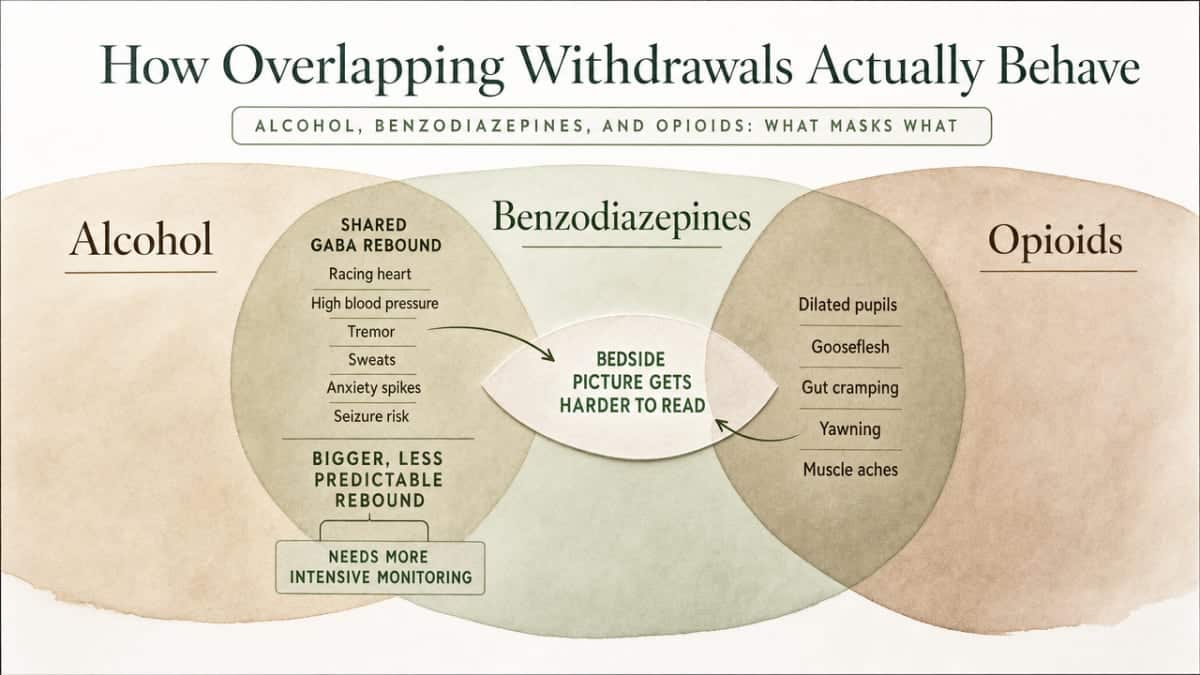
Alcohol, Benzodiazepines, and Opioids: What Masks What
When you stop two substances at the same time, the withdrawal syndromes don’t line up neatly. They cross-wire.
Alcohol and benzodiazepines both act on GABA. When you stop either one, the nervous system rebounds into a state of autonomic hyperactivity: racing heart, high blood pressure, tremor, sweats, anxiety spikes, and in serious cases seizures. When you’ve been using both, that rebound is bigger and less predictable. Clinicians treating alcohol withdrawal already know that concurrent sedative use raises the risk of complicated withdrawal and requires more intensive monitoring, not less 9. Add opioids into the mix, and the picture gets harder to read at the bedside.
Opioid withdrawal produces its own set of signs: dilated pupils, gooseflesh, gut cramping, yawning, muscle aches, and restlessness. Some of those signs — the sweating, the anxiety, the elevated pulse — look exactly like alcohol or benzodiazepine withdrawal. So a man detoxing from both alcohol and oxycodone can present with tachycardia and diaphoresis that a less-experienced eye might attribute entirely to the alcohol, while opioid symptoms drive part of the picture underneath 10.
The autonomic storm of alcohol withdrawal can cover early opioid symptoms in the first 24 to 48 hours. And when the alcohol side calms down, the opioid syndrome can surface later than expected, catching an outpatient plan off guard. The general principle in detox medicine is that clinicians must actively look for multiple substance dependencies, because the presence of a second dependency changes both the timeline and the medication strategy 8.
The Alcohol-Plus-Opioid Overdose Corridor
There is one combination worth calling out on its own: alcohol and opioids together. Both depress breathing. Used at the same time, they substantially increase the risk of respiratory depression and overdose, and the danger is not limited to the moment of heavy use 11.
The corridor of risk widens during early recovery too. If you take a break, lose tolerance, and then return to your previous dose of either one — or both — the same amount that felt routine last month can stop your breathing. This is one of the reasons a supervised detox and structured residential stay matter for men using both. You are not just clearing substances. You are moving through a window where tolerance is shifting and the margin for error is narrow.
Guidance for treating patients with both alcohol and opioid use disorders simultaneously is still thinner than either single-substance protocol, and that gap in the literature is honest to name 11. What it means in practice is that the team caring for you should be experienced with the combination, not improvising. Ask directly. Anyone running a serious detox program will answer plainly.
The Arkansas Pattern: Who Is Actually Presenting
Polysubstance Use Is a Distinct Clinical Class, Not a Rounding Error
When clinicians talk about polysubstance use, they don’t mean two separate problems stacked on top of each other. They mean a distinct pattern with its own trajectory. That distinction matters because it changes how a treatment team plans your care.
The STEP study, a three-year longitudinal look at stimulant users, identified a subgroup that made up 29% of the cohort — a class defined by high concurrent use of nonprescribed opioids, alcohol, marijuana, crack, and powder cocaine 1. Over the follow-up window, that group showed worse medical and mental health outcomes than users with narrower patterns. The scope matters here: this was a stimulant-user cohort followed for three years, not a general population sample. But the signal is clear. When substances layer, the outcomes diverge from what single-substance protocols predict.
What that means for a man walking into an Arkansas program with, say, alcohol and cocaine on his history, or opioids and benzodiazepines, is this: he is not a single-substance case with an extra note in the chart. He is his own clinical category. The assessment needs to map every substance and every psychiatric symptom. The medication plan needs to account for how those substances interact during withdrawal. The therapy plan needs to address triggers that stack across drugs — the drink that leads to the pill, the stimulant that leads to the sedative used to come down.
Treating polysubstance use as additive rather than distinct is one of the more common mistakes in outpatient care. It’s also one of the reasons men cycle back through treatment.
The Early Pipeline in Arkansas Data
The adult patterns you see in Little Rock detox beds don’t come out of nowhere. They start earlier, and the state’s own data gives you a look at the front of the pipeline.
The 2021 Arkansas Statewide Collegiate Substance Use Assessment surveyed college students across the state and found that in the past 30 days, 1.65% had used prescription opioids and 1.84% had used another person’s prescription drugs 2. The most common age for first prescription opioid use fell between 16 and 20. Those numbers are self-reported, and response rates varied across campuses, so treat them as directional rather than precise.
Directional is enough. What the survey shows is nonmedical prescription drug exposure happening in late adolescence and early adulthood, often alongside drinking that has already been going on for years. That’s the on-ramp. Ten or fifteen years later, the man who first tried a friend’s Adderall at 18 and mixed it with alcohol in college may be sitting in his office in Fayetteville or Bentonville, using a benzo to sleep and drinking through the evenings to manage a stress load that has quietly grown teeth.
If that arc feels familiar, you are not an outlier in Arkansas. You are the pattern.


What Arkansas Regulation Now Requires — and What Sits Above That Line
Arkansas has already moved the floor up. Under the state’s residential and acute behavioral health rules, providers must complete integrated assessments on every client that screen for co-occurring mental health and substance use disorders and for trauma, and their services must be co-occurring disorder capable and trauma informed 3. That is the baseline. It is the minimum any residential program in Little Rock, Fayetteville, or anywhere else in the state should be able to describe when you call.
The honest read on that regulation is that it fixes a floor, not a ceiling. Making every program truly integrated for dual diagnosis is a workforce problem as much as a policy one — clinicians trained to manage layered withdrawal, psychiatric medication, and therapy under the same roof are not evenly distributed across the state. Programs meet the letter of the requirement at different depths.
What sits above the line is worth asking about directly. A few things distinguish stronger polysubstance-capable programs. First, a small enough census that the medical team can actually track each man through the shifting phases of layered withdrawal, rather than managing a ward. Second, psychiatric care embedded on-site instead of referred out mid-stay. Third, continuous physiological monitoring — heart rate, sleep, autonomic signals — that gives clinicians objective data alongside self-report. Wearable and mHealth tools for substance use care are feasible and acceptable, though the effectiveness evidence is still maturing 5. Ask what a program actually does with the data, not just whether they collect it.
Dual Diagnosis Is the Rule, Not the Exception
Under the substance use, there is almost always something else. Depression that has been running for a decade. An anxiety pattern that first showed up in your twenties. Trauma you have never fully talked about. Sleep that stopped working right somewhere along the way. For men using more than one substance, the psychiatric layer isn’t a side note. It’s part of the reason the pattern got layered in the first place — the drink to slow the anxiety, the stimulant to push through the depression, the benzo to shut the day off.
The clinical literature is direct about what happens when that layer goes untreated. People with co-occurring mental health and substance use disorders show more severe psychiatric symptoms, higher hospitalization rates, and poorer treatment outcomes than people with a single disorder 6. Substance use disorders also worsen the course of severe mental illness, driving higher relapse and rehospitalization when the two are treated separately or sequentially rather than together 7.
The men-specific piece matters too. Men are more likely to present with polysubstance use and less likely to seek help for co-occurring depression or anxiety, which means the psychiatric side often shows up first inside a treatment stay rather than at the family doctor’s office months earlier 12. If you are the man reading this, that lag is not a character flaw. It is the pattern the research keeps finding.
Practically, dual diagnosis capable means psychiatric assessment happens in the same building, on the same team, on the same schedule as detox and substance-focused therapy. Not a referral out. Not a callback next week. A program built for polysubstance care assumes the second diagnosis is there and screens for it on day one — which is what Arkansas regulation now requires as the baseline 3, and what a small, integrated residential setting is structurally positioned to actually deliver.
The Sequence a Polysubstance Patient Should Expect
Assessment: Getting the Full Substance and Psychiatric Picture
The first day matters more than most people realize. A good assessment is not a checklist. It’s a careful conversation, run by clinicians who know what to ask and what to listen for underneath the answer.
For a polysubstance case, that conversation covers every substance, not just the one you called about. How much alcohol, over what timeline. Which pills, from whose prescription, at what dose. What you use to sleep. What you use to wake up. Alongside that, a psychiatric history: depression, anxiety, trauma, prior diagnoses, prior medications, family patterns. Arkansas rules require integrated screening for co-occurring disorders and trauma on every admission, and that requirement is there because missed information changes the medication plan 3.
Tell the truth on day one. It is the single most useful thing you can do for the team, and nothing you say will surprise them.
Medically Supervised Detox With Layered Protocols
Detox for a polysubstance case is not one protocol running from admission to discharge. It’s several protocols running in parallel, with the team adjusting hour by hour as each substance’s withdrawal signature emerges.
If alcohol is in the picture, expect symptom-triggered benzodiazepine dosing to manage the autonomic side and prevent seizures, with heavier monitoring when other sedatives are also in play 9. If opioids are in the picture, expect a decision about buprenorphine or methadone induction, with clonidine or lofexidine available for autonomic symptoms — and expect that decision to be made carefully, because concurrent benzodiazepine or alcohol use complicates opioid induction and raises safety risk 10. If benzodiazepines have been part of the pattern, expect a taper rather than an abrupt stop, sometimes stretched over weeks.
What makes layered detox work is active clinical attention to the possibility of multiple dependencies, so the plan can shift as the second and third drugs surface 8. That’s the argument for doing this inside a program, not on your own. Someone has to be watching when the picture changes.
Integrated Residential Care and Continuous Physiological Monitoring
Once acute withdrawal settles, the work shifts. This is where the psychiatric layer gets addressed on the same schedule as the substance work, not sequenced after it. Individual counseling, group therapy, medication management, and behavioral therapy run together, because for men with layered use and co-occurring depression or anxiety, separating them is what drives the relapse cycle in the first place 6, 7.
A small residential setting changes what’s possible here. When a program serves twenty men at a time rather than a hundred, the clinical team can actually track each man’s sleep, mood, medication response, and craving pattern week to week. That kind of attention is hard to fake at scale.
Continuous physiological monitoring adds another layer of information. Wearable devices can capture heart rate, heart rate variability, sleep architecture, and autonomic signals throughout the stay, giving clinicians objective data alongside what you report in session. The evidence base for wearable and mHealth tools in substance use care shows feasibility and acceptability; effectiveness data is still building 5. Biosensor work in alcohol use disorder specifically has shown that continuous monitoring can reveal patterns self-report misses and inform more tailored interventions 4. Treat the technology as a useful input for the clinical team, not a magic layer on top of care. That framing is how Serenity Park’s partnership with Huml Health is designed to function in practice.
Discharge Planning and Aftercare That Holds
Discharge is not the end of treatment. For a polysubstance case, it’s the phase where most of the risk moves back into your daily life at once — the commute, the client dinner, the Sunday night dread.
A discharge plan worth the name is written well before your last week. It names the outpatient psychiatrist, the therapist, the continuing care group, the peer support meetings in your zip code, and the family members who know what to watch for. If medication-assisted treatment continues, the handoff to the prescribing clinician is scheduled, not suggested. If wearable monitoring has been useful during your stay, the plan addresses whether and how that continues.
Ask what happens at week six, month three, month twelve. The answer tells you whether the program is built for the arc or just the stay.
Why Men in Arkansas Often Delay — and What Changes the Calculus
Most men reading this have already thought about treatment more than once. The delay is not about not knowing. It’s about the math you keep running in your head — the job, the mortgage, the kids’ schedules, the people who don’t know yet. You tell yourself you’ll handle it after the next quarter. Then the next quarter arrives with a heavier drink count and a second prescription.
The pattern is well documented. Men are more likely to present with polysubstance use and less likely to seek help for the depression or anxiety sitting underneath it, which pushes the entry point later and sicker than it needs to be 12. That’s not a moral failing. It’s the shape of the problem.
What changes the calculus is usually one of two things. Either the layered use crosses a line that can’t be walked back — a near miss, a blackout, a lab result, a conversation with a spouse that lands differently this time — or the clinical picture gets complex enough that outpatient stops being safe. Alcohol plus a benzo script. Alcohol plus opioids and the respiratory risk that combination carries 11. A stimulant pattern with a sedative chaser that neither of you can time anymore.
If you’re in that range, the argument for a small, medically supervised residential setting in Little Rock is not that it’s easier. It’s that the team can hold every piece of the picture at once — the layered withdrawal, the psychiatric layer, the physiological data, the discharge plan — instead of asking you to coordinate specialists while you’re still detoxing. Serenity Park is built for that whole picture, not for one substance at a time. The next step is a phone call, not a decision about the rest of your life.
Questions Families and Referring Physicians Ask
Frequently Asked Questions
Is medical detox necessary if someone is using alcohol along with benzodiazepines or opioids?
In most layered cases, yes. Concurrent sedative use raises the risk of complicated alcohol withdrawal and requires closer monitoring than outpatient settings usually offer 9. Opioid withdrawal also gets more complex when alcohol or benzodiazepines are in play, especially during buprenorphine induction 10. A supervised setting lets the team adjust hour by hour as each drug surfaces.
How is polysubstance abuse treatment in Arkansas different from single-substance treatment?
Polysubstance care is not two protocols stacked. It’s one integrated plan that accounts for how withdrawal syndromes interact, how triggers layer across drugs, and how psychiatric conditions sit underneath the pattern 8. Arkansas rules require residential providers to screen for co-occurring disorders and deliver integrated care as a baseline 3, so ask any program how they actually run that integration.
What does dual diagnosis care actually involve during residential treatment?
It means psychiatric assessment, medication management, and therapy for depression, anxiety, or trauma happen on the same team and schedule as substance work — not sequenced after it. Co-occurring conditions treated separately drive worse outcomes and higher relapse 6, 7. In practice, look for on-site psychiatric care, integrated treatment planning, and staff trained to hold both sides of the picture at once.
How long does residential treatment for polysubstance use typically last?
Length varies with the substances involved, withdrawal course, and psychiatric picture. Layered detox alone can run longer than single-substance detox because a benzodiazepine taper may stretch over weeks and opioid induction needs careful sequencing when alcohol is present 8, 10. Expect a stay measured in weeks, not days, followed by a structured aftercare arc that carries the work forward.
Can a working professional keep his job while in residential treatment?
Often, yes. FMLA, short-term disability, and employee assistance programs are the usual paths, and many men in Arkansas coordinate treatment quietly through HR or a physician. Men are less likely to seek help early for co-occurring depression or anxiety 12, so waiting until the job is already at risk is common — and avoidable. Ask a program’s admissions team how they handle discretion and documentation.
What should families or referring physicians look for in an Arkansas residential program?
Confirm co-occurring disorder capability and trauma-informed care as the floor 3. Above that, ask about census size, on-site psychiatric coverage, layered detox experience with alcohol plus benzodiazepines or opioids, and how continuous physiological monitoring feeds clinical decisions — recognizing wearable evidence is still maturing 5. A concrete discharge plan naming the outpatient psychiatrist, therapist, and continuing care group matters as much as the stay itself.
References
- Polysubstance Use by Stimulant Users: Health Outcomes Over Three Years in the STEP Study. https://pmc.ncbi.nlm.nih.gov/articles/PMC6240007/
- Arkansas Statewide Collegiate Substance Use Assessment, 2021. https://humanservices.arkansas.gov/wp-content/uploads/wellbeing2021.pdf
- Arkansas Summary – State Residential Treatment for Behavioral Health Conditions: Regulation and Policy. https://aspe.hhs.gov/sites/default/files/2021-08/StateBHCond-Arkansas.pdf
- A Review of Wearable Biosensors in Alcohol Use Disorder Treatment. https://pmc.ncbi.nlm.nih.gov/articles/PMC8019775/
- Wearable and Wireless mHealth Technologies for Substance Use Disorders: A Systematic Review. https://pubmed.ncbi.nlm.nih.gov/33738178/
- A review of co-occurring mental health and substance use disorders. https://pmc.ncbi.nlm.nih.gov/articles/PMC3658560/
- The impact of substance use disorders on recovery from severe mental illness. https://pmc.ncbi.nlm.nih.gov/articles/PMC2851027/
- Detoxification and Substance Abuse Treatment. https://pmc.ncbi.nlm.nih.gov/articles/PMC5308108/
- Clinical management of alcohol withdrawal: A systematic review. https://pmc.ncbi.nlm.nih.gov/articles/PMC6761813/
- Managing opioid withdrawal symptoms: A systematic review. https://pmc.ncbi.nlm.nih.gov/articles/PMC4429248/
- Co-Use of Alcohol and Opioids. https://pmc.ncbi.nlm.nih.gov/articles/PMC7571854/
- Addiction treatment for men: A review of gender-specific considerations. https://pmc.ncbi.nlm.nih.gov/articles/PMC5472010/