
Key Takeaways
- Arkansas licenses residential SUD programs under DHS and DAABHS, requiring 24/7 operation and at least 28 structured treatment hours weekly, with clear billing standards.1,11
- Length of stay depends on pathway: Act 10 court-ordered care caps at 21 days, Medicaid hospital-based units authorize up to 30 days with extensions, and voluntary care has no statutory limit.2,12
- Staying in-state supports family involvement and continuing care, which research links to stronger long-term recovery outcomes than residential treatment alone.14,15
- Uninsured Arkansans can call the DHS helpline for a designated provider in one of eight catchment areas, while insured individuals should verify residential SUD benefits with their carrier.4,5
Why Staying in Arkansas for Residential Care Can Work in Your Favor
If you’re considering residential addiction treatment, the question of where to go is significant. While many might initially look to out-of-state options, Arkansas provides a robust framework for care that offers distinct advantages.
Arkansas mandates a clear regulatory standard for residential addiction treatment. State-licensed programs must operate 24/7 and provide a minimum of 28 hours of structured treatment each week. This isn’t a marketing claim; it’s a legal requirement. The Department of Human Services (DHS) also organizes the state into eight catchment areas with designated providers and offers a toll-free helpline for individuals without insurance. This infrastructure ensures that whether you are in a major city or a smaller community, there is an accessible pathway to care within the state.1,4
The proximity of in-state treatment offers clinical benefits beyond just logistics. Family members can visit regularly, sponsors can maintain contact, and your continuing care team can be the same professionals you will work with after discharge. This continuity is often a critical factor in sustaining long-term recovery.
The Arkansas Picture Right Now
Overdose Trends in Arkansas
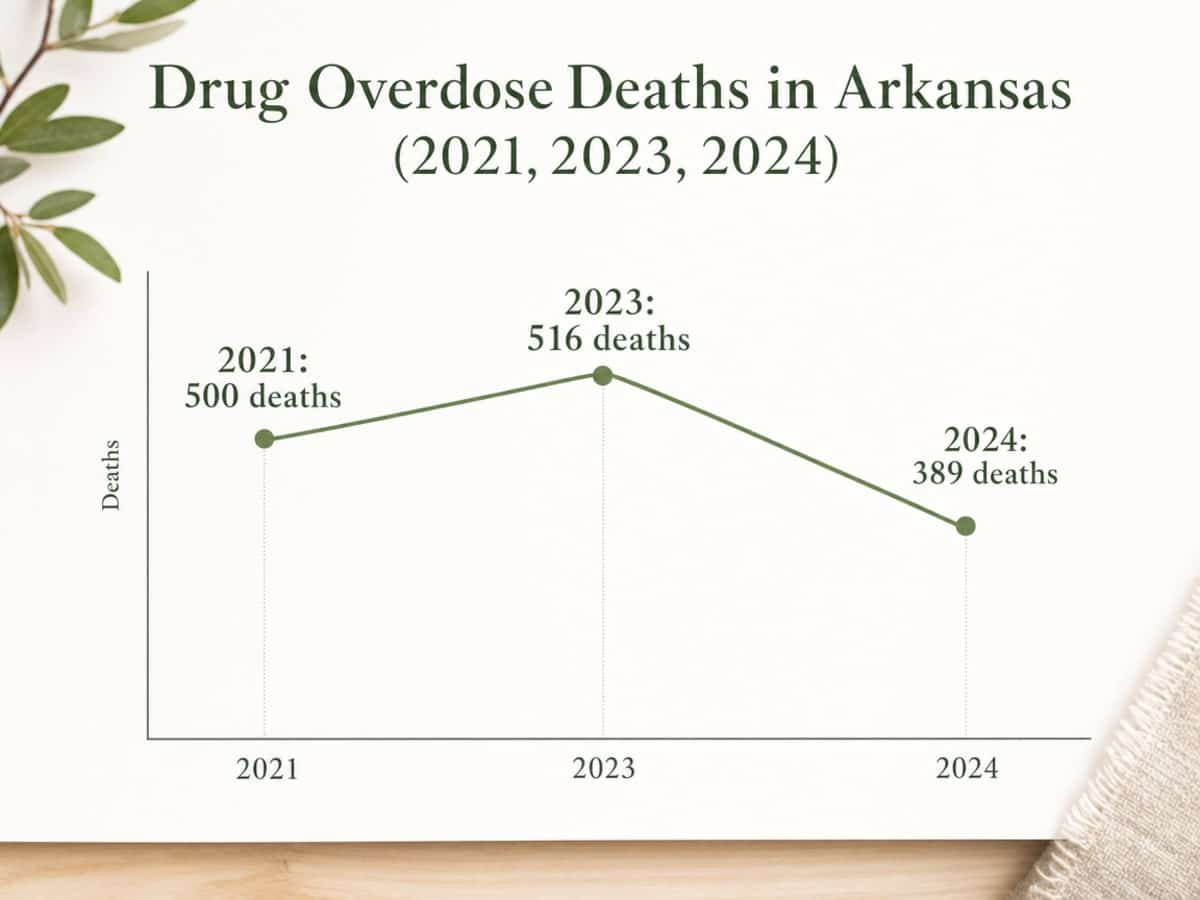
Understanding the current landscape of substance use in Arkansas can help inform treatment decisions. Provisional data from the Arkansas Department of Health indicates 389 drug overdose deaths in 2024, a decrease from 516 in 2023. While this decline is positive, it’s important to consider the broader context. In 2022, there were 3,837 nonfatal overdoses across the state. These individuals survived, often due to interventions like naloxone or emergency medical care, and many are still in a position where residential treatment could be life-changing.8,10
A reduction in overdose deaths signifies that existing tools, such as Narcan, hospital interventions, and expanded treatment access, are effective when utilized. For those considering residential care, engaging with these resources contributes to this positive trend. Seeking care is an active step towards recovery, driven by agency rather than fear or shame.
Demographics of Individuals Entering Treatment
The profile of individuals entering residential care in Arkansas is evolving. Data from the State Epidemiological Outcomes Workgroup shows a decline in treatment admissions among youth and young adults, while admissions for adults aged 26 and older are increasing. This suggests that a growing number of people seeking residential care are working adults with established lives, who are addressing a problem before it escalates to a crisis point.6
Opioid-related admissions further illustrate this trend. Between October 2023 and September 2024, 622 opioid-related admissions were recorded through State Opioid Response tracking. Of these, 24% were due to a substance use disorder, and 2.8% were post-overdose. This indicates that most individuals entering treatment are not in immediate post-overdose crisis but are proactively seeking help. This demographic shift highlights that residential care is increasingly sought by individuals who recognize a problem and choose to act before an emergency dictates their path.7
What Arkansas Requires a Real Residential Program to Do
The 28-Hour Rule and 24/7 Standard
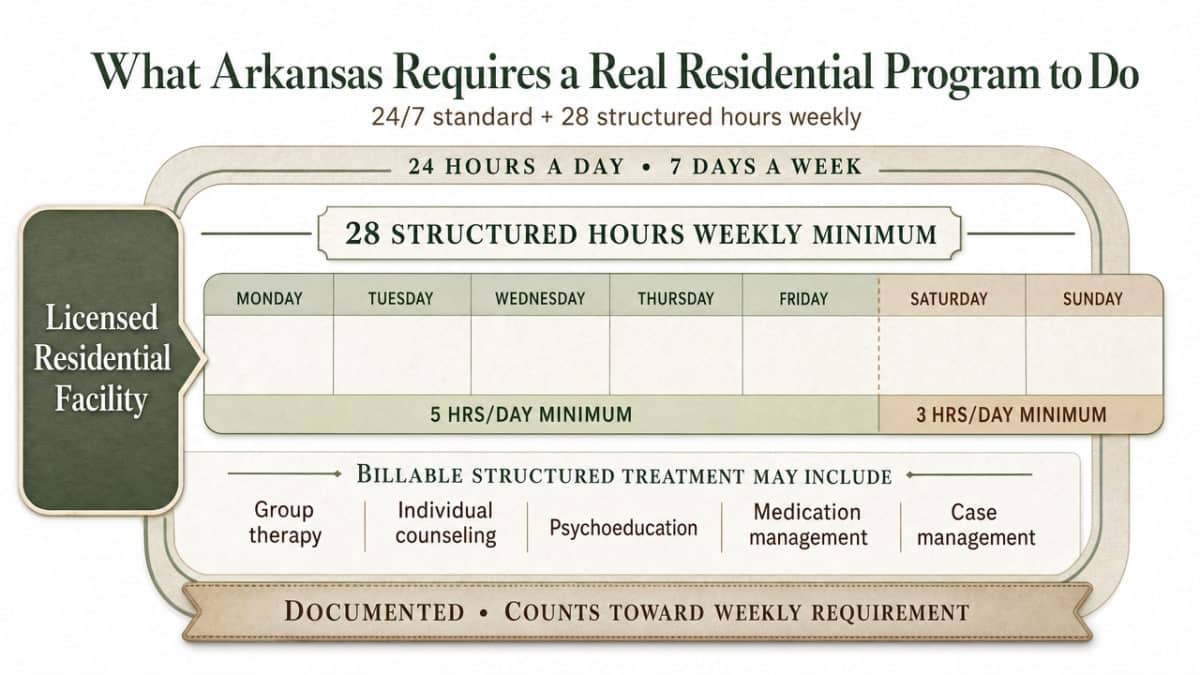
When evaluating residential programs, it’s important to look beyond marketing materials and understand the state’s minimum requirements. Arkansas mandates that licensed residential facilities operate 24 hours a day, seven days a week, and provide at least 28 hours of structured treatment weekly. This structured treatment includes a minimum of five hours per day from Monday to Friday, and at least three hours on Saturdays and Sundays. This ensures that treatment is continuous and comprehensive, even on weekends.1
Structured treatment encompasses clinical activities such as group therapy, individual counseling, psychoeducation, medication management, and case management. These activities must be documented and contribute to the weekly hour requirement. Programs should be able to clearly articulate how they meet this 28-hour standard and what a typical day or week of treatment entails.
The 24/7 operational requirement means that staff are always on-site and available, particularly during overnight hours when individuals may experience cravings or difficulties. This constant supervision and support distinguish a residential program from less intensive settings. Prospective clients should inquire about overnight staffing patterns to ensure adequate support is provided.
Regulatory Bodies: DAABHS, DHS, and Licensure
Navigating the regulatory landscape of behavioral health in Arkansas can be complex. The Division of Aging, Adult and Behavioral Health Services (DAABHS) serves as Arkansas’s single state agency for behavioral health treatment, covering both public mental health services and substance abuse prevention and treatment. DAABHS operates under the Department of Human Services (DHS), which is responsible for setting the licensure standards for residential substance use disorder (SUD) programs.1,5
When a program states it is “state-licensed,” it means it adheres to DHS standards under DAABHS oversight. For billing purposes, residential services must include intake, individual and group therapy, case management, and room and board. Clients must be physically present at the facility for any day billed. This ensures accountability and protects clients from being charged for services not received.11
Prospective clients should directly ask programs if they are licensed by DHS as a residential SUD provider and who their DAABHS point of contact is. A legitimate program will provide this information transparently, confirming its compliance with state regulations.
How Long Should You Actually Stay?
Variations in Length of Stay
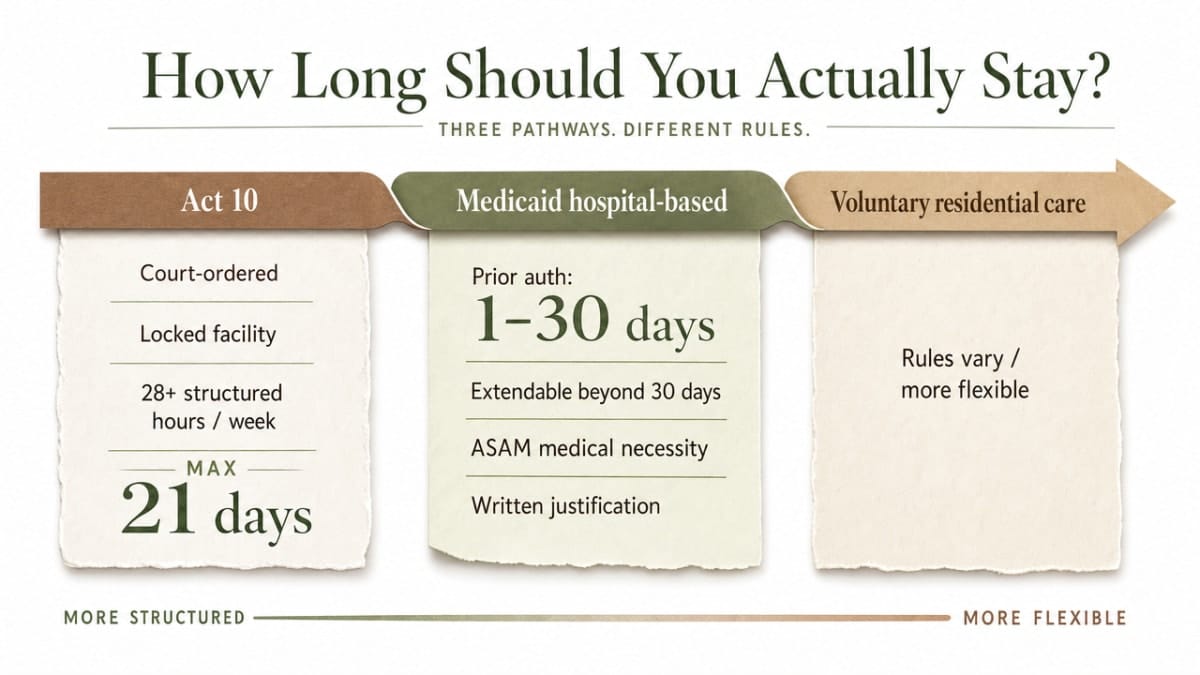
The duration of residential treatment can vary significantly based on the pathway to care. For individuals entering treatment through Act 10, the court-ordered commitment pathway, the state limits the stay to 21 days. The DHS contract for Act 10 vendors specifies a locked-down facility, at least 28 structured treatment hours weekly, and a maximum treatment duration of 21 days.2
For hospital-based residential SUD units, which are part of a newer Medicaid pathway, prior authorizations range from a minimum of one day up to a maximum of 30 days per authorization. Extended stays beyond 30 days are possible if medical necessity is documented according to ASAM criteria. This pathway offers more flexibility than Act 10, but each extension requires written justification.12
Voluntary residential care, which applies to most individuals seeking treatment, has no statutory cap on length of stay. The state’s requirements for voluntary programs focus on the structure of the stay: 24/7 operation and the 28-hour-per-week minimum of clinical treatment. In this context, the length of stay becomes a clinical decision made collaboratively between the individual and the program, rather than being dictated by legal or authorization deadlines.1
Research on Longer Stays and Continuing Care
While short stays can initiate sobriety, sustained recovery often requires more than just a few weeks. A four-year longitudinal study on men who completed community residential SUD treatment found that AA-related coping at the one-year mark was a strong predictor of long-term outcomes. This suggests that what happens after residential treatment is as crucial as the treatment itself.14
This finding aligns with the continuing care model, which emphasizes sustained support after intensive treatment as essential. Residential care serves as the initial phase, but continuing care provides the ongoing support necessary to maintain progress. For example, a 30-day voluntary stay followed by robust aftercare—such as outpatient sessions, a home group, a sponsor, or alumni programs—can often yield better results than a longer stay without adequate follow-up.15
When considering a program, inquire about their plans for day 91 and beyond. A program that can clearly outline post-discharge support—including who will provide follow-up calls, recommended groups, and connections to local counselors—demonstrates an understanding of the long-term nature of recovery.
Paying for Residential Care in Arkansas Without Guessing
Financial concerns are a common barrier to seeking residential treatment, but Arkansas offers multiple avenues for payment. It’s important to understand these options before dismissing residential care as unaffordable.
For individuals without insurance, state-funded care is available. DHS divides Arkansas into eight catchment areas, each with designated providers, and operates a toll-free helpline for those with a drug or alcohol use disorder who lack insurance. This pathway is supported by federal block grant dollars channeled through the Division of Aging, Adult and Behavioral Health Services. This should be the first point of contact for uninsured individuals.4,5
Medicaid is another option, with recent changes expanding coverage for residential SUD treatment in hospital-based units. Prior authorizations are issued for one to 30 days, with extensions possible based on ASAM medical-necessity criteria. It is crucial to bring all relevant treatment records to ensure comprehensive care and authorization.12
For those with private insurance, coverage for residential care is often available. A benefit-cost analysis of addiction treatment in Arkansas found benefit-cost ratios exceeding 4:1, meaning more than four dollars in societal return for every dollar spent on treatment. This economic benefit is a reason why many employer plans offer coverage. It is advisable to contact your insurer directly to inquire about residential SUD benefits and in-network Arkansas facilities, and to obtain this information in writing.13
Family Involvement as a Clinical Advantage
The idea that recovery requires isolation from loved ones is a misconception. Family members are often deeply affected by substance use and can be invaluable allies in the recovery process. Maintaining connections with family during treatment, particularly when staying in-state, provides a crucial support system for when an individual returns home.
The clinical rationale for family involvement is supported by continuing care research. A review of the continuing care model highlights that sustained support after intensive treatment is essential, and recovery outcomes improve when residential care is integrated with ongoing aftercare, monitoring, and mutual-help involvement. Family members often facilitate this integration by providing accountability and encouragement.15
A four-year outcomes study on men in residential treatment further emphasized the importance of ongoing support. It found that lasting improvement was predicted not only by the intensity of the treatment itself but also by active AA-related coping and supportive relationships a year later. Local proximity makes it easier for family to participate in sessions and provide ongoing support, thereby strengthening the foundation for long-term recovery.14
How to Choose a Program Without Leaving the State
Key Questions to Ask Prospective Programs
When selecting a residential program, it’s important to ask specific questions to ensure it meets your needs and state standards. Begin by verifying licensure: “Are you licensed by DHS as a residential SUD provider, and can you provide your license number?”. A reputable Arkansas program will readily provide this information.1
Next, inquire about the treatment schedule: “Can you describe a typical Tuesday and Sunday? How do you meet the 28-hour weekly minimum, and what activities count towards it?” Look for detailed answers that include group therapy, individual counseling, psychoeducation, and case management.1,11
Ask about staffing, particularly overnight: “Who is on duty at 2 a.m., and what is the protocol for medical issues during those hours?” Also, clarify family involvement policies: “When are visiting hours, do you offer family sessions, and can my spouse participate by phone if they cannot visit in person?”
Finally, address financial aspects: “Do you accept my insurance, and if not, what are the self-pay options?” If uninsured, ask if the program works with the DHS catchment system or can refer you to the state helpline. Programs that are evasive about these specifics may not be fully transparent or compliant.4
The Importance of Continuing Care Planning
Effective residential treatment includes a robust plan for continuing care that begins early in the process. For voluntary residents, the period after the initial intensive phase is crucial. A strong program will start discharge planning within the first week, not just before departure.
Inquire about the specifics of the discharge plan: “What will my discharge plan include, and when do we start developing it?” You should expect to hear about a clear outpatient step-down plan, strategies for finding a home group and sponsor, family sessions that extend beyond discharge, and connections to alumni networks.15
Ask about post-discharge follow-up: “Does the program schedule check-ins at 30, 60, and 90 days? Do you coordinate with local counselors in my hometown?” The goal is to ensure that the support system established during residential care continues after you leave. If a program cannot provide a clear and comprehensive plan for continuing care, it may indicate a gap in their long-term recovery strategy.
Making the Call
Initiating the call for help can be the most challenging step. It’s common to feel hesitant, but remember that you don’t need to have all the answers before reaching out. If you have insurance, contact your carrier to inquire about residential SUD benefits and in-network Arkansas facilities. If you are uninsured, call the DHS helpline to identify your catchment area and designated provider. When contacting a licensed program directly, ask about their 28-hour weekly structure, overnight staffing, family visitation policies, and their continuing care plans.1,4
By reading this far, you’ve already taken a significant step towards making a decision. Arkansas offers accessible and regulated residential treatment options that can provide the foundation for lasting recovery. Serenity Park is one of several licensed programs in the state; reaching out to any of them today can be the start of your journey.
Frequently Asked Questions
Does insurance or Medicaid cover residential addiction treatment in Arkansas?
Yes, often. Arkansas Medicaid now covers residential SUD treatment in hospital-based units, with prior authorizations for one to 30 days, extendable based on ASAM medical-necessity criteria. Commercial insurance coverage varies by plan. Contact your carrier to confirm residential SUD benefits and in-network Arkansas facilities, and request this information in writing.12
Can my family visit me during residential treatment in Arkansas?
Yes. Most licensed Arkansas programs include regular visiting hours and family therapy sessions as part of their structured treatment. Family involvement is crucial for continuing care and long-term recovery. Inquire about specific visiting policies, family sessions, and options for remote participation if family members cannot visit in person.1,15
What should I bring to a residential program?
Each program provides a specific packing list. Generally, bring seven to ten days of comfortable clothing, basic toiletries (alcohol-free), a photo ID, your insurance card, a current medication list, and any relevant court documents. Avoid bringing valuables, electronics with cameras, or outside food/supplements unless explicitly approved by the program. Always confirm with the intake coordinator.
What’s the difference between voluntary residential treatment and Act 10 court-ordered treatment?
Act 10 is a court-ordered commitment, requiring a locked facility, at least 28 structured treatment hours weekly, and a maximum stay of 21 days. Voluntary residential treatment is self-initiated, adheres to the same 28-hour weekly minimum and 24/7 licensure standards, but has no statutory limit on the length of stay. The duration is determined by the individual and the clinical team.1,2
What happens if I don’t have insurance and can’t afford private-pay residential care?
State-funded SUD treatment is available for uninsured Arkansans. The DHS operates a toll-free helpline to connect individuals with designated providers in their specific catchment area (Arkansas is divided into eight such areas). These services are supported by federal block grant funds channeled through DAABHS. Contact the helpline first to determine your options.4,5
How do I know if a residential program in Arkansas is properly licensed?
Ask directly: “Are you licensed by DHS as a residential SUD provider under DAABHS oversight?” A licensed program will clearly state its license, explain how it meets the 28 structured hours per week and 24/7 operational standards, and detail its overnight staffing. They should also outline billable services such as intake, individual and group therapy, case management, and room and board. Any hesitation in providing this information is a red flag.1,11
References
- Licensure Standards for Alcohol and Other Drug Abuse Treatment Programs. https://humanservices.arkansas.gov/wp-content/uploads/Licensure_Standards_for_Alcohol_and_Other_Drug_Abuse_Treatment_Programs.pdf
- Arkansas Department of Human Services – Act 10 Court-Ordered Substance Abuse Treatment Residential Contract Attachment. https://humanservices.arkansas.gov/wp-content/uploads/Attachment-C.pdf
- Residential Substance Abuse Treatment for State Prisoners (RSAT) Program. https://www.dfa.arkansas.gov/office/intergovernmental-services/grant-programs/residential-substance-abuse-treatment-for-state-prisoners-program-rsat/
- Find Substance Abuse or Mental Health Treatment – Arkansas Department of Human Services. https://humanservices.arkansas.gov/divisions-shared-services/shared-services/office-of-substance-abuse-and-mental-health/samh-treatment/
- Division of Aging, Adult & Behavioral Health Services – Draft FFY 2024 Combined Application. https://humanservices.arkansas.gov/wp-content/uploads/Draft-FFY-2024-Combined-Application-with-Memo.pdf
- Annual Profile of Substance Use – Arkansas State Epidemiological Outcomes Workgroup 2021. https://humanservices.arkansas.gov/wp-content/uploads/SEOW-2021-Annual-Profiles-Report-Part-1.pdf
- 2024 – Arkansas State Opioid Response (SOR) III Final Evaluation Report. https://humanservices.arkansas.gov/wp-content/uploads/WYSAC-SOR-3-Final-Eval-Report-12162024.pdf
- Substance Misuse Education and Prevention – Arkansas Department of Health. https://healthy.arkansas.gov/programs-services/prevention-healthy-living/substance-misuse-education-and-prevention/
- New Public Opioid Dashboard Serves as Tool to Shine Light on Epidemic. https://humanservices.arkansas.gov/news/new-public-opioid-dashboard-serves-as-tool-to-shine-light-on-epidemic/
- All Drug Nonfatal Overdose Rates per 100,000 People per County – Arkansas 2022. https://healthy.arkansas.gov/wp-content/uploads/3-7-23_age_adjusted_nonfatal_overdose_per_100000.pdf
- Rules of Practice and Procedure – Arkansas Office of Alcohol and Drug Abuse Prevention. https://www.sos.arkansas.gov/uploads/rulesRegs/Arkansas%20Register/2004/jan_2004/016.02.03-002.pdf
- Hospital Treatment for SUD – Emergency Rule. https://humanservices.arkansas.gov/wp-content/uploads/Hospital-Treatment-for-SUD-Emergency-Rule-A.pdf
- Benefit–cost analysis of addiction treatment in Arkansas. https://pubmed.ncbi.nlm.nih.gov/12444359/
- Predictors of 4-year outcome of community residential treatment for patients with substance use disorders. https://pubmed.ncbi.nlm.nih.gov/18339113/
- The Continuing Care Model of Substance Use Treatment. https://pmc.ncbi.nlm.nih.gov/articles/PMC4007701/