
Key Takeaways
- “I can handle this urge without using” strengthens self-efficacy, a consistent mediator of behavior change in psychosocial alcohol treatment 12, by making a small, verifiable claim about a single craving.
- “Using won’t fix what I think it will” directly challenges positive outcome expectancies, the core CBT target that cognitive restructuring is built to dismantle 1.
- “A slip is data, not a verdict” interrupts the abstinence-violation cascade Marlatt identified 5, preventing a single lapse from spiraling into full relapse.
- “This craving will crest and pass” compresses urge surfing into a falsifiable observation the client can time on his phone, aligning with MBRP practice 3.
- “I have a plan for this trigger” points at coping deficits, which predict relapse more reliably than nearly any other residential-outcome variable 14.
- “One day at a time is a full commitment” borrows the mutual-help time horizon 13while closing the loophole clients use to keep tomorrow open for using.
- “I don’t have to do this alone” targets social support, one of the strongest predictors of post-residential outcomes 14, and only works when paired with real names and numbers.
- “My body is telling me something, not commanding me” builds the mindful interoceptive gap MBRP teaches 3, buying seconds between stimulus and substance response.
- “I am practicing recovery, not performing it” confronts the fluency chronic relapsers develop across multiple programs, where looking sober substitutes for the actual work.
- “The next right action is small and specific” applies behavioral activation 6to shrink overwhelm into completable steps that accumulate as evidence of follow-through.
Why Affirmations Fail Chronic Relapsers Without Clinical Framing
You’ve watched it happen. A well-meaning tech hands a client a laminated card that reads “I am strong, I am healthy, I am free,” and the client — three treatment attempts deep, currently white-knuckling day nine — quietly puts it in a drawer. Nothing changes. Sometimes something gets worse.
The failure isn’t the practice. Cognitive restructuring and coping self-statements are load-bearing pieces of relapse prevention, targeting the exact beliefs that drive use: “there is no point in trying to be abstinent, I can’t do it” 2. Marlatt’s model treats self-efficacy and outcome expectancies as central levers, and CBT trials keep showing that adjusting internal dialogue moves the needle on abstinence 5, 1. The mechanism is real.
What fails is unframed language. A slogan pulled off a Pinterest board has no cognitive target, no anchor to the client’s actual belief system, and no place in the day where it gets rehearsed. For a chronic relapser, whose self-story is already dense with evidence of failure, a generic affirmation can read as a lie — and the client’s brain files it exactly that way.
The rest of this piece treats each affirmation as a clinical micro-intervention: engineered to hit a specific mechanism, calibrated to belief, and deployable inside a residential rhythm you already run.
The Low-Self-Esteem Paradox: Calibrate Before You Prescribe
Chronic relapsers arrive with a self-story built from prior failed attempts. Ask a man on his fourth admission to say “I am a lovable person” in the mirror and his brain runs an instant contradiction check. The louder the claim, the louder the counter-evidence. He walks out of the exercise feeling worse than when he walked in, and now he also thinks the program is naive.
Calibration is the fix. Two moves matter.
First, keep affirmations specific and behavioral rather than global and characterological. “I can sit with this craving for ten minutes” lands. “I am powerful beyond measure” does not. The former is a testable claim the client can verify by 3:10 p.m.; the latter is a slogan his history rejects on contact.
Second, anchor the statement to a belief the client already partly holds. Motivational interviewing calls this meeting the client where he is. If he believes he wants his kids back but doubts he can stay sober, the affirmation targets the doubt, not the desire. You are not installing new beliefs by force. You are strengthening the ones already flickering.
Deliver this caveat once, in orientation, and don’t relitigate it every group. Staff who understand the paradox stop distributing laminated cards and start writing affirmations with clients on notecards the clients themselves draft.
Everything that follows assumes you’ve done this calibration work up front.
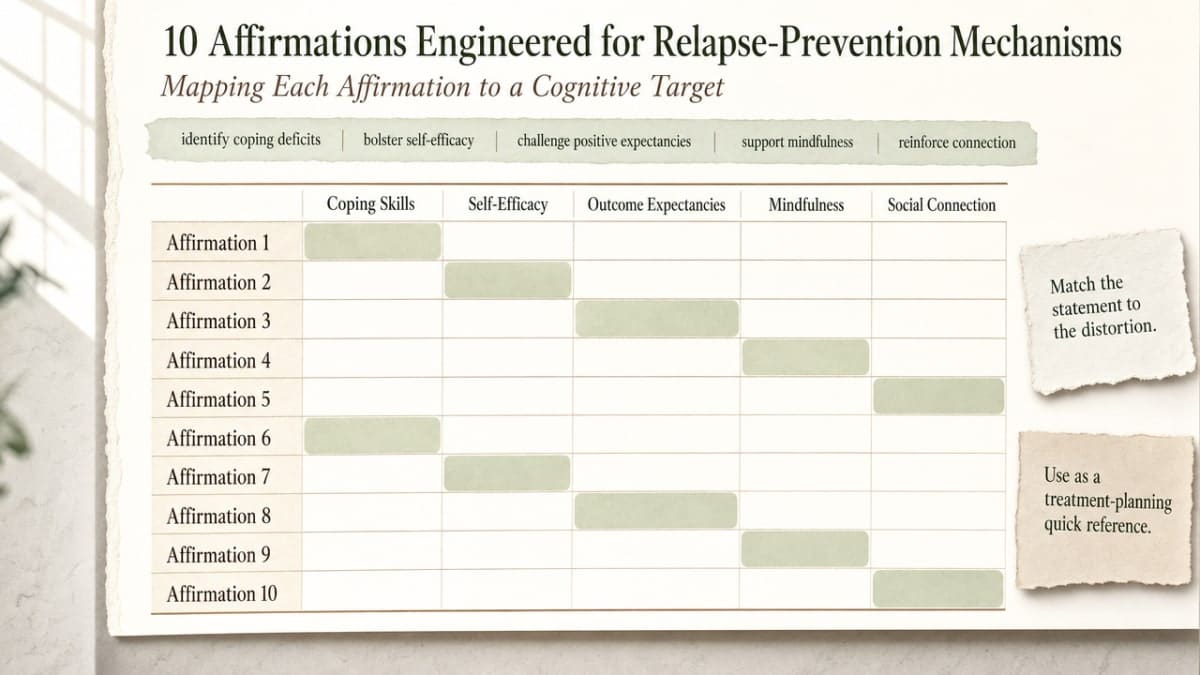
10 Affirmations Engineered for Relapse-Prevention Mechanisms
Mapping Each Affirmation to a Cognitive Target
Before you hand a client any of the ten statements below, know what each one is doing under the hood. The cornerstone of relapse prevention is “the identification and modification of deficits in coping skills, the bolstering of self-efficacy and the challenging of positive outcome expectancies” 3. Every affirmation in this list points at one of those levers, plus the mindfulness and social-connection targets that round out the current MBRP and mutual-help evidence base.
Use the matrix below as a quick reference during treatment planning. When a client’s weekly review shows he’s spiraling on abstinence-violation thinking after a weekend pass, you don’t reach for the self-efficacy affirmation — you reach for the one built for that specific cognitive distortion. When a man’s craving log spikes at 9 p.m., you deploy the urge-surfing statement, not a general motivation quote.
The ten that follow are ordered roughly by mechanism cluster: self-efficacy and expectancy first, then abstinence-violation and urge work, then coping and connection, then mindfulness and self-compassion, closing with behavioral activation. Read them as a toolkit, not a sequence a client must complete.
“I can handle this urge without using” — Self-Efficacy
This is the workhorse. Self-efficacy — the client’s confidence that he can execute the coping behavior — is one of the most consistent mediators of behavior change in psychosocial alcohol treatments 12. Strengthening it directly reduces relapse probability 2.
Notice what the statement does not say. It does not claim he will never use again. It does not claim he is strong. It makes a small, verifiable claim about this urge, right now.
Introduce it in individual work after a client has already survived one craving in the unit. Point to the evidence: he already did it. The affirmation is retrospective proof reframed as forward-facing confidence. For a chronic relapser, this matters — his history contains countless moments of white-knuckling successfully before an eventual slip. Mine those. Build the statement on his real timeline, not a hypothetical one.
“Using won’t fix what I think it will” — Outcome Expectancy
Positive outcome expectancies — the belief that a drink or a hit will deliver relief, connection, sleep, or peace — are a core CBT target 1. Cognitive restructuring works precisely by challenging these predictions 10.
This affirmation is a preemptive strike. It doesn’t tell the client using is bad. It tells him the promised payoff is fiction. That distinction matters. A chronic relapser has heard “drinking will ruin your life” for years and continued anyway, because in the moment the drink promises to solve something specific: the anxiety before a job interview, the loneliness at 11 p.m., the rage he can’t name.
Pair the statement with a written expectancy log. Client lists what he expected the substance to do, then what it actually delivered. The affirmation becomes shorthand for the whole exercise once he’s done it three or four times.
“A slip is data, not a verdict” — Abstinence-Violation Effect
The abstinence-violation effect is Marlatt’s contribution and possibly the single most important concept for the chronic relapser population 5. A client who has been sober 42 days takes one drink at a wedding. If he interprets that drink as proof he’s a failure who was fooling himself, the cognitive cascade turns a slip into a full relapse by Monday.
This affirmation interrupts that cascade. It doesn’t excuse the slip. It reframes it as information the client can use.
Deliver it in orientation, not after a lapse. If the first time a client hears “a slip is data” is when he’s shame-spiraling at 2 a.m., the timing reads as permission-giving. Introduced early, it becomes a pre-installed circuit breaker. Some programs have clients write the statement on the back of their notecard next to a two-line lapse protocol: call your sponsor, tell your counselor within 24 hours. The affirmation and the action live together.
“This craving will crest and pass” — Urge Surfing
Urge surfing is the mindfulness intervention with the strongest fit for acute craving moments 3. The client observes the urge as a wave — rising, peaking, falling — without acting on it and without fighting it.
The affirmation compresses the whole practice into six words. Say it once, then breathe. Say it again at the peak. Say it a third time as the physiological intensity starts to drop, which for most cravings happens within 20 to 30 minutes.
What makes this work for chronic relapsers is that it’s falsifiable in real time. He can time the craving on his phone. He can watch the crest. The affirmation stops being a claim and becomes an observation. That shift — from believing a statement to noticing a phenomenon — is often what finally makes cognitive work feel real to a client on his fourth admission.
“I have a plan for this trigger” — Coping Skills
Coping deficits predict relapse more reliably than almost any other variable in the residential outcome literature 14. Coping skills training — the concrete rehearsal of what to do when the trigger fires — is what CBT actually delivers when it works 1.
The affirmation is only true if the plan exists. That’s the point. It forces the clinical work to be done before the statement gets used.
In individual sessions, build a written trigger map: top five high-risk situations, each with a two- or three-step response. Bar after work becomes: call sober contact, drive the alternate route home, eat before you’re hungry. When the trigger fires in the field, the client says the affirmation and reaches for the map. The statement is a pointer to real infrastructure, not a substitute for it.
“One day at a time is a full commitment” — Time-Bounded Motivation
The mutual-help tradition contributes something CBT sometimes misses: a way to make lifetime abstinence tolerable by shrinking the time horizon 13. “One day at a time” works because the human nervous system can’t sustain dread of a 40-year abstinence but can absolutely commit to today.
The added phrase — “a full commitment” — is deliberate. Some clients hear the slogan as a hedge, an escape clause, a way to keep tomorrow open for using. Reframing it as a complete commitment to this 24 hours closes that loophole without extending the horizon.
This one integrates naturally into morning check-in. Clients state the affirmation aloud, then name one thing they’re committing to today that supports it — a meeting, a call, an exercise, a difficult conversation. The verbal commitment plus the specific action is what makes it more than a slogan.
“I don’t have to do this alone” — Social Support
Support networks are among the strongest predictors of post-residential outcomes 14. Mutual-help engagement compounds that effect 13. The affirmation names what the client actually needs to do: pick up the phone.
For men, this is often the hardest statement on the list. The masculine script that got many chronic relapsers here in the first place — handle it yourself, don’t burden anyone, drink until it passes — runs directly counter to what recovery requires. Handing him a card that says “I don’t have to do this alone” and expecting him to feel it is optimistic.
Make the affirmation actionable. Client identifies three names and three phone numbers on the back of the card. When he says the statement, he has to look at the numbers. If he hasn’t called anyone from the list in a week, that’s a clinical data point worth surfacing in his next individual session.
“My body is telling me something, not commanding me” — Mindful Awareness
MBRP teaches clients to notice physiological states — the tightness in the chest, the flutter in the hands, the sudden thirst — as information rather than instruction 3. The affirmation names that distinction explicitly.
This matters for chronic relapsers because their interoceptive signals have often been overwritten by years of using-in-response. Anxiety no longer means anxiety; it means it’s time to drink. The nervous system has learned a shortcut, and the affirmation is the first step in unlearning it.
Pair the statement with a brief body scan in group. Client names the sensation, names its intensity on a 1-10 scale, names one non-substance response. Over weeks, the sequence — sensation, observation, choice — becomes automatic. The affirmation is the entry point. It buys three seconds between stimulus and response, which is often all that’s needed for the prefrontal cortex to catch up.
“I am practicing recovery, not performing it” — Self-Compassion
Chronic relapsers often arrive with a performance frame. They know how to look sober. They’ve done group before, they know the vocabulary, they can produce the right answers in a check-in. That fluency is part of what makes them chronic — the appearance of recovery has substituted for the practice of it.
The affirmation targets that split. Practice implies imperfection, repetition, failure, adjustment. Performance implies an audience and a passing grade. Only one of those framings survives contact with a real craving.
Use this statement in individual work when you notice a client answering questions the way he thinks you want them answered. Name the performance gently. Introduce the affirmation as a corrective frame he can use with himself when he catches the pattern. Chronic relapsers who have been through multiple programs often find this the most uncomfortable and most useful item on the list.
“The next right action is small and specific” — Behavioral Activation
Overwhelm is a relapse driver. A client who thinks about the totality of what recovery requires — the amends, the career rebuild, the marriage, the health, the years — often responds by shutting down. Behavioral activation shrinks the field to the next small action he can actually take 6.
The affirmation trains that focus. Not what should I do with my life. What should I do in the next 15 minutes.
Deploy this in evening reflection. Client names one small, specific action for the following morning: make the bed, attend the 7 a.m. group, drink a full glass of water. The action must be small enough that failure is nearly impossible and specific enough that completion is unambiguous. Across a residential stay, a few dozen of these accumulate into evidence — real, dated, undeniable — that he can execute what he decides to execute. That evidence is what self-efficacy is built from.
Integrating Affirmations Into the Residential Day
The affirmations only work if they show up at the moments the client actually needs them. That means anchoring each statement to a specific touchpoint in the residential rhythm you already run, not adding a new block to the schedule.
Morning check-in is the natural home for the day-scoped commitment work. Clients arrive, state their one-day commitment out loud, and name one specific action that supports it. Twelve men saying it in sequence creates something a laminated card can’t — a room full of witnesses. The verbal commitment plus the specific action is what pulls it out of slogan territory.
Group therapy is where the expectancy and abstinence-violation statements get processed. A client shares a lapse from a prior treatment attempt. The group works the reframe together: what did he expect the substance to deliver, what did it actually deliver, what data did the lapse produce. The affirmation is the compressed output of that shared cognitive work, not the starting point.
Urge moments are where the notecard earns its place. The University of Washington clinical training material describes clients carrying a physical notecard listing motivations for abstinence and using cognitive restructuring in the field — a concrete practice that translates directly into carrying two or three affirmations on the same card 7. When a craving hits at 3 p.m. on a pass, the client pulls the card. The tactile ritual matters. Reaching into a pocket and reading printed words interrupts the automatic sequence in a way that trying to remember a phrase does not.
Evening reflection closes the loop. Clients name the next small, specific action for tomorrow morning. They note which affirmations they used during the day and which ones stayed in the pocket. That data goes into the weekly individual session. Affirmations a client never reaches for are either miscalibrated or attached to the wrong touchpoint, and either finding is useful.
Build the rhythm once. Train staff to reference it consistently. The day does the work.
When Objective Feedback Reinforces the Words
Affirmations survive contact with a chronic relapser’s skepticism when the words get corroborated by something outside the client’s own head. That’s where objective feedback earns its keep.
Wearable sensors are now used in substance use disorder care to track physiological markers, monitor for craving states, and deliver just-in-time interventions 8. For a client saying “this craving will crest and pass,” a heart-rate trace showing the actual crest and fall turns the affirmation from a claim into a documented pattern. He watched it happen. The graph agrees.
Use the data conservatively. Show a client his sleep improving across weeks two and three when he’s been repeating the self-compassion affirmation. Show him his resting heart rate dropping when he’s actually been using the urge-surfing statement instead of white-knuckling. The affirmation gets an evidence base built from his own body, which is the one authority a chronic relapser has trouble dismissing.
Don’t over-narrate the numbers. One data point per week, tied to one affirmation he’s been working, delivered in individual session. The words and the trace reinforce each other.
Common Deployment Mistakes and How to Fix Them
A few patterns show up across programs that adopt affirmation work and then quietly abandon it. Worth naming so you can catch them early.
- Handing out pre-printed cards. If the client didn’t write the words, the words aren’t his. Have him draft the statement in individual session, in his own handwriting, on a card he keeps in his pocket. The physical act of writing is part of the intervention 7.
- Using the same affirmation for every client. Coping, self-efficacy, and outcome expectancy are distinct mechanisms with distinct measurement targets 12. Match the statement to the client’s specific cognitive gap, not to the group’s average.
- Skipping the calibration step with low-self-esteem clients and hoping they’ll grow into the language. They won’t. Rewrite the statement smaller and more specific until it lands as true.
- Treating affirmations as a standalone practice. They’re pointers to the underlying CBT and MBRP work — coping skills, urge surfing, trigger maps 1, 3. Without that infrastructure behind them, they’re slogans.
- Never revisiting the list. Affirmations that worked in week one may be stale by week six. Review them in weekly individual sessions and retire what he’s outgrown.
Frequently Asked Questions
How often should clients repeat affirmations during a residential day?
Anchor them to three or four fixed touchpoints rather than a repetition count. Morning check-in, one group processing moment, urge instances as they arise, and evening reflection is usually enough. Repetition without a trigger turns the statement into background noise. The goal is retrieval under stress, which requires context pairing more than volume 7.
Can affirmations replace CBT or MBRP groupwork?
No. Affirmations are pointers to the cognitive and behavioral work, not substitutes for it. Coping-skills training, cognitive restructuring, and urge surfing are what actually move outcomes 1, 3. A statement without the underlying skill rehearsal is a slogan. Use affirmations as retrieval cues for interventions the client has already practiced in group and individual sessions.
What do you do when a chronic relapser rejects an affirmation as untrue?
Treat the rejection as clinical data. The statement is likely miscalibrated for his current self-story, which the low-self-esteem research predicts 11. Rewrite it smaller and more behavioral together. “I can stay sober forever” becomes “I can call my sponsor before I pour a drink.” The client’s objection is telling you exactly where his belief actually sits.
Should affirmations be written down or spoken aloud?
Both, at different moments. Handwriting the statement on a notecard in individual session gives the client ownership and a physical retrieval object he can pull in the field 7. Speaking it aloud in morning check-in adds public commitment and witness. Silent repetition alone tends to drift. The card in the pocket and the voice in the room work together.
How do you introduce affirmations without triggering the abstinence-violation effect after a lapse?
Introduce them before any lapse, ideally in orientation, so the reframing language is already installed when needed 5. Post-lapse is the worst timing for new material — the client’s shame filter reads anything hopeful as excuse-making. If you must introduce one after a slip, start with the coping-skills statement tied to a concrete next action, not the self-compassion one.
Are affirmations appropriate for clients with co-occurring depression or trauma?
Yes, with heavier calibration. Depression amplifies the low-self-esteem backfire risk documented in the self-statement literature 11. Trauma histories often make global positive claims feel unsafe. Keep statements small, behavioral, and present-tense. Coordinate with the client’s psychiatric provider so the affirmation work reinforces rather than competes with trauma-focused therapy. Skip characterological language entirely with these clients.
References
- Cognitive-Behavioral Therapy for Substance Use Disorders. https://pmc.ncbi.nlm.nih.gov/articles/PMC2897895/
- Cognitive behavioural interventions in addictive disorders. https://pmc.ncbi.nlm.nih.gov/articles/PMC5844158/
- Mindfulness-Based Relapse Prevention for Alcohol and Substance Use Disorders. https://depts.washington.edu/abrc/mbrp/reprints/MBRPAlcoholSUDs2005.pdf
- Cognitive Behavioral Interventions for Alcohol and Drug Use Disorders. https://pmc.ncbi.nlm.nih.gov/articles/PMC5714654/
- Relapse Prevention: An Overview of Marlatt’s Cognitive-Behavioral Model. https://pmc.ncbi.nlm.nih.gov/articles/PMC6760427/
- Relapse prevention for alcohol and drug problems. https://pubmed.ncbi.nlm.nih.gov/15149263/
- CBT Approaches for Alcohol Relapse Prevention. https://ictp.uw.edu/wp-content/uploads/2026/02/UW-PACC-2026_02_06-CBT-approaches-for-alcohol-relapse-prevention-compressed.pdf
- Wearable and Wireless mHealth Technologies for Substance Use Disorders: A Systematic Review. https://pubmed.ncbi.nlm.nih.gov/33738178/
- Efficacy of Cognitive Behavioral Therapy for Alcohol and Other Drug Use Disorders. https://pmc.ncbi.nlm.nih.gov/articles/PMC9948631/
- [Cognitive-behavioral therapy for alcohol and drug use disorders]. https://pubmed.ncbi.nlm.nih.gov/19039449/
- Positive Self-Statements: Power for Some, Peril for Others. https://pubmed.ncbi.nlm.nih.gov/11268830/
- Mechanisms of behavior change in psychosocial alcohol treatments. https://pubmed.ncbi.nlm.nih.gov/25844796/
- Mutual-help groups for alcohol and other substance use disorders. https://pubmed.ncbi.nlm.nih.gov/20653636/
- Factors associated with relapse among men and women in residential substance abuse treatment. https://pubmed.ncbi.nlm.nih.gov/11519743/