
Key Takeaways
- Build a defensible short list by treating federal quality signals — licensure, accreditation, evidence-based therapies, medications, family involvement, continuing care — as questions rather than accepting marketing claims.1,3
- Match the specific man to the program by asking how the biopsychosocial assessment shapes a written treatment plan and how length of stay is decided clinically, not by insurance cycles.5,6
- Learn ASAM Level 3.1 versus 3.5 before calling so you can ask which level the program is credentialed for and how his acuity is assessed across ASAM’s six dimensions.16
- Verify Arkansas DHS licensure and national accreditation from JCAHO, CARF, or COA yourself, treating hesitation from the intake coordinator as meaningful data.14,15
- Translate SAMHSA’s five quality signs into concrete intake questions on accreditation, FDA-approved medications, named therapies, family engagement, and written continuing care.1,2,3
- Confirm that detox is medically supervised with defined withdrawal protocols and that the program uses FDA-approved medications for alcohol and opioid use disorders rather than refusing them on philosophy.2,7
- Expect family involvement to be structured into the weekly schedule with a licensed family therapist, clear confidentiality rules, and psychoeducation for you.10,11,12
- Treat wearables as a clinical adjunct only when the program can explain which devices, which purpose, who reviews the data, and how it changes his written plan.17,18,20
Building a Short List When You Are the One Making the Calls
You are probably reading this at an odd hour, with a browser full of tabs and a notebook that has more crossed-out phone numbers than you would like to admit. Choosing a residential substance abuse treatment program for your husband or partner is a heavy decision to carry, and the fact that you are approaching it methodically instead of grabbing the first facility that answers the phone already puts him in a better position.
This guide is built for that work. Not for a first-time overview of what addiction is, but for the shorter, sharper task in front of you: narrowing a field of glossy websites down to two or three programs you can defend on the intake call. The framework leans on the same signals federal agencies use to evaluate quality care — state licensure, national accreditation, evidence-based therapies, appropriate use of medications, structured family involvement, and continuing care. Each of those becomes a question you get to ask out loud, not a marketing claim you have to accept.1,3
You will find sections on matching a specific man to the right level of care, reading ASAM residential intensity, verifying Arkansas licensure, structuring family therapy, and how wearable monitoring actually fits — separating what the research supports from what still lives in a brochure. Take it one call at a time. Finishing the licensure check on one program is a real win. So is crossing a facility off the list because the intake coordinator could not answer a straight question.
Match the Man, Not the Brochure
What Individualized Care Actually Looks Like
The first thing to notice when you read a program’s website is how much it tells you about their approach versus how much it tells you about the specific man walking through the door. Those are not the same thing. NIDA’s research-based guide is blunt about this: no single treatment is appropriate for everyone, and matching the setting, interventions, and services to a person’s particular problems is what separates effective care from a template.5
So when you are on the intake call, listen for how the clinical team plans to actually learn about him. A quality program conducts a full biopsychosocial assessment that covers his substance use history, medical conditions, psychiatric history, trauma, family relationships, work context, and legal situation — then updates that picture as treatment progresses. If the intake coordinator cannot describe how the initial assessment translates into a written treatment plan, or how that plan gets revisited, that is useful information.6
Individualized care also means adequate duration. Research consistently ties treatment effectiveness to time in care, not to a fixed 28-day calendar. Ask what determines his length of stay, who decides, and how they communicate that timeline with you. A program that gives you a real answer — tied to clinical milestones rather than insurance cycles — is telling you something important about how they operate.6
Why Men’s Residential Care Is a Distinct Clinical Category
Gender-responsive treatment is not a marketing category. It is a clinical distinction grounded in how men experience substance use, how they present in treatment, and what they tend to avoid talking about. The NCBI treatment modalities chapter states it directly: substance abuse treatment for men should account for the impact of gender on use, abuse, and recovery, examining the role of masculinity and targeting the emotional and behavioral issues common among men.13
In practice, that shows up in the group therapy room. Men in mixed-gender residential settings often perform a version of themselves — protective, contained, reluctant to describe shame or fear. In a men-only environment with clinicians trained in male-specific issues, the conversation tends to reach the actual material sooner: anger, grief, sexuality, fatherhood, work identity, and the ways drinking or drug use became a solution to feelings he was never taught to name.
When you evaluate a men’s residential program, ask how the clinical team is trained in gender-responsive care and what that looks like in the weekly schedule. “We’re all men here” is a demographic fact. “Our groups are structured around masculinity, emotional literacy, and relational patterns” is a clinical model. You want the second answer, and you want it in specifics.
Reading ASAM Levels So You Know What Intensity You Are Buying
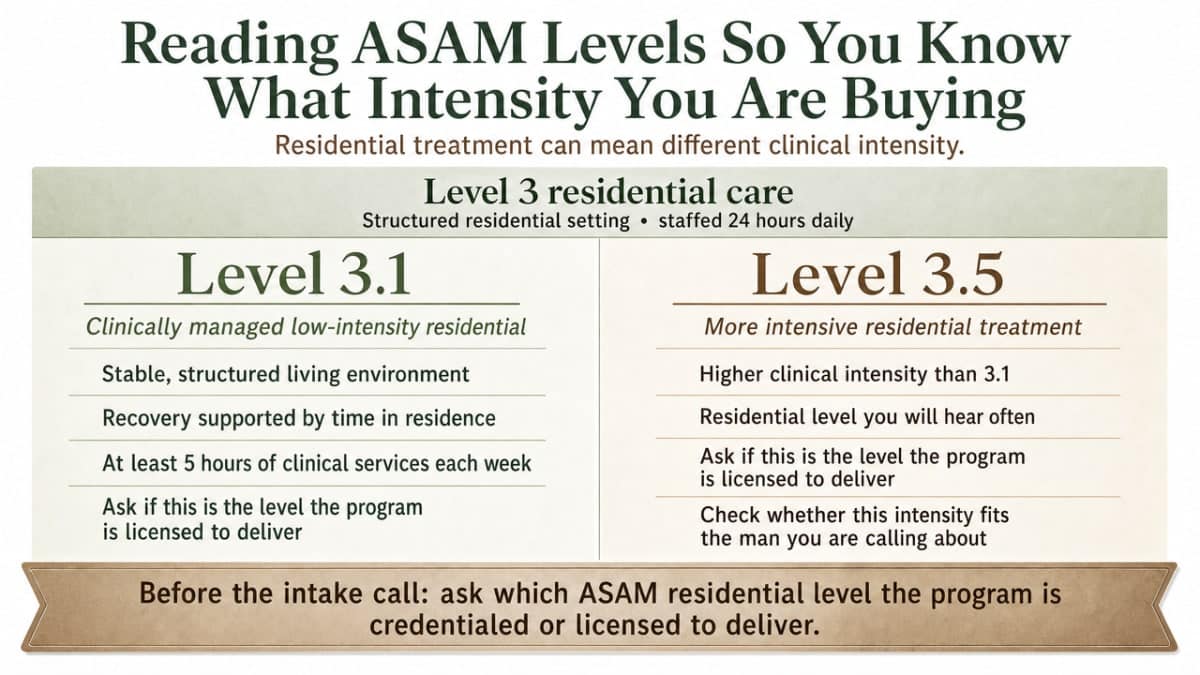
When a program tells you it offers “residential treatment,” that phrase covers a wide clinical range. The American Society of Addiction Medicine sorts residential care into sublevels, and the two you will hear most often are Level 3.1 and Level 3.5. Knowing the difference before the intake call means you can ask a program which level it is licensed to deliver, and whether that intensity actually fits the man you are calling about.
Level 3 programs are provided in a structured, residential setting that is staffed 24 hours daily. Inside that umbrella, Level 3.1 is clinically managed low-intensity residential care, designed for patients whose recovery is aided by time spent living in a stable, structured environment. Think of 3.1 as a supportive living setting where he receives at least five hours of clinical service per week, participates in recovery groups, and rebuilds daily structure — appropriate for someone whose withdrawal risk is low and whose primary need is a sober environment with modest clinical support.16
Level 3.5 is clinically managed high-intensity residential care. Staffing and clinical hours are substantially higher, and the population is different: men with more severe substance use, unstable emotional or behavioral function, or co-occurring conditions that would derail them in a lower-intensity setting. The daily schedule is denser, individual and group therapy are more frequent, and medical and psychiatric services are more readily available on-site.16
On the call, ask which ASAM level the program is credentialed for, how they assess a candidate against ASAM’s six dimensions, and what happens if his acuity shifts mid-stay. A program that answers in ASAM language is speaking the same clinical dialect your insurer and any downstream provider will use. A program that cannot name its level, or waves the question off, is telling you it does not organize care around the standard the rest of the field uses.
Verifying Licensure and Accreditation Before You Trust Anything Else
Before a program’s philosophy, amenities, or wearable partnerships matter, one question has to clear: is this facility actually licensed to do what it says it does? A polished website is not evidence of oversight. The verification takes an afternoon, and it is the single most useful hour you will spend on this decision.
Start with the state. Arkansas DHS defines a residential SUD program as a twenty-four hour, seven days per week, non-medical, live-in facility that must, at minimum, provide intake, individual and group therapy, case management, and room and board. That definition matters because it tells you what the state expects the program to be doing every single day. Ask the intake coordinator for the facility’s DHS license number and confirm it against Arkansas’s provider licensing records. If the coordinator hesitates or redirects you to marketing, treat that as data.14,15
Then check national accreditation. Arkansas licensure standards recognize accreditation from bodies such as JCAHO (The Joint Commission), CARF, and COA. Any of these means an outside team has reviewed the program’s clinical protocols, staff credentialing, safety practices, and quality processes on a defined cycle. Ask which body accredits the program, when the most recent survey was completed, and whether any conditions or corrective actions were issued. A confident clinical director will answer without flinching.14

The Five Signs of a Quality Program, Translated Into Intake-Call Questions
SAMHSA distills quality into five signs: accreditation, appropriate use of medications, evidence-based practices, the program’s position on the role of families, and support networks for continuing care. That list is useful, but it lives at the altitude of a brochure. What you need on the phone is a set of specific questions that force an intake coordinator to speak in specifics, not adjectives.3
On accreditation, do not accept “yes, we’re accredited” as a full answer. Ask which body — JCAHO, CARF, or COA — completed the most recent survey, what year, and whether any corrective actions remain open. Ask separately about state licensure and request the Arkansas DHS license number so you can verify it yourself.1,2
On medications, ask directly whether the program prescribes FDA-approved medications for alcohol use disorder (naltrexone, acamprosate, disulfiram) and for opioid use disorder (buprenorphine, naltrexone, methadone referral pathways). If the answer is that the program does not use medications, or only in narrow cases, ask why — and listen for whether the reasoning is clinical or philosophical.2,7
On evidence-based practices, ask what specific therapies drive the weekly schedule. You are listening for named modalities — cognitive behavioral therapy, motivational interviewing, contingency management, twelve-step facilitation — and for who delivers them. “Holistic” is not a therapy. Yoga and mindfulness can support a program but should not replace clinical hours.5
On the role of families, ask how the program engages family members from intake forward, what the family therapy schedule looks like, and how confidentiality is handled. On support networks, ask what the written continuing-care plan includes and who owns it after discharge. If an intake coordinator answers each of these with specifics rather than reassurance, you have a program worth keeping on the short list.1,3,10
Medically Supervised Detox and Medications for Alcohol and Opioid Use
If he has been drinking daily or using opioids or benzodiazepines regularly, the first seventy-two hours are a medical event, not a motivational one. Alcohol and benzodiazepine withdrawal can escalate into seizures and delirium; opioid withdrawal, while rarely fatal in a healthy adult, can drive people out of treatment and back to use within hours. A residential program that admits him directly without medical assessment, or that treats detox as a quiet room and a promise to check in, is not the program you want on your short list.
Ask the intake coordinator who supervises detox, what their credentials are, and how often a physician or nurse practitioner sees him during the first days. Ask what withdrawal scales the nursing staff uses, and what the protocol is if his vitals or symptoms escalate overnight. NIDA is direct that detox alone is not treatment — it is a medical entry point, and the transition from detox into ongoing care is where many episodes fall apart.5,7
Then ask about medications for the specific substance. For alcohol use disorder, that means naltrexone, acamprosate, or disulfiram. For opioid use disorder, that means buprenorphine, naltrexone, or a defined methadone referral pathway. If a program declines to use FDA-approved medications on philosophical grounds, ask them to walk you through the clinical reasoning. “We prefer abstinence” is a preference, not a protocol.2,7
How Family Involvement Should Be Structured, Not Just Welcomed
Almost every program will tell you families are important. What separates a serious program from a friendly one is whether that welcome is structured into the weekly clinical schedule or left to the goodwill of whichever counselor picks up the phone. The distinction matters: a peer-reviewed scoping review of addiction treatment policies found that family involvement can reduce harm to family members and improve treatment entry, completion, and outcomes for the person with the substance use disorder. That is a clinical intervention, not a courtesy.11
Ask the intake coordinator to walk you through the family therapy schedule specifically. How often does a licensed family therapist meet with the two of you, together or separately? What configurations does the program use — couples work, whole-family sessions, or multi-family groups — and how are those decisions made? SAMHSA’s Advisory 39 calls for clinicians to engage family members throughout treatment and to communicate openly about confidentiality rules, regulations, and boundaries from the start. You want to know how consent works, what he agrees to share, and what the program can and cannot tell you when you call.10
Then ask about the practical mechanics. The University of Washington’s retention toolkit recommends including family in early appointments, providing a direct phone line, and offering structured education so you understand what he is working on week to week. A program that gives you a facility tour, a scheduled call cadence, and psychoeducation on your own recovery is treating you as part of the treatment system. One that promises “we’ll keep you updated” without specifics is offering reassurance, not structure. Cross the difference off your list clearly.9,12
Wearables and Biosensors: What the Evidence Actually Supports
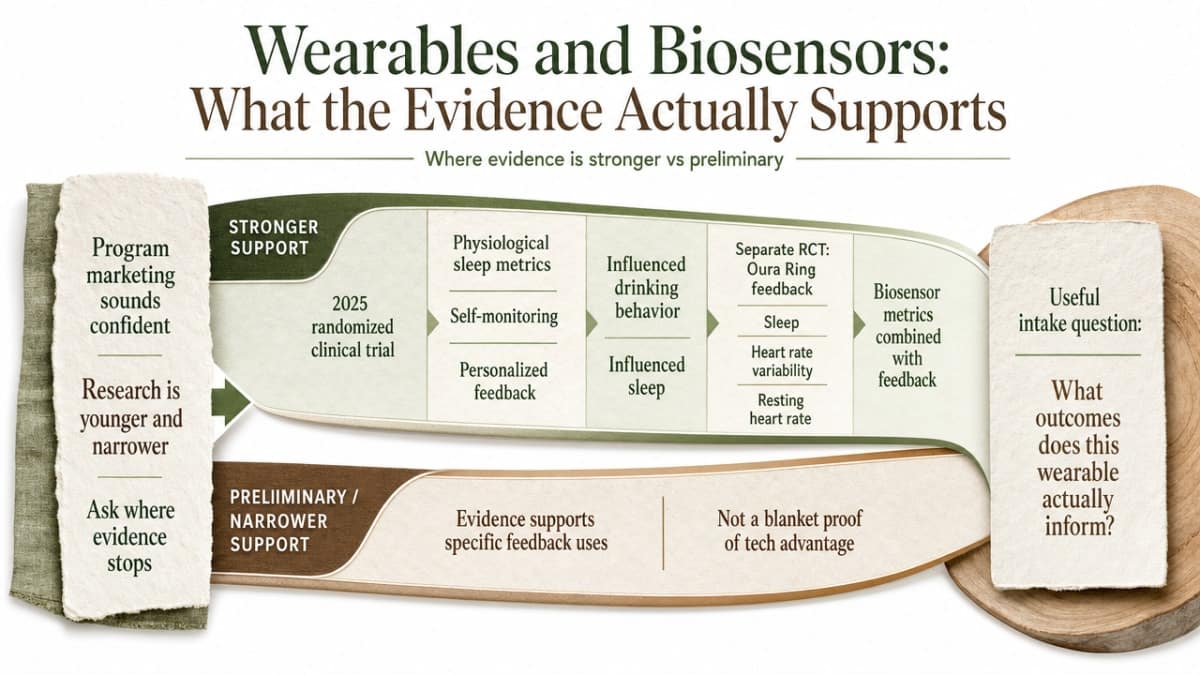
By the time you reach the tech section of a program’s website, the language often turns confident: real-time monitoring, personalized data, biosensor-informed care. It sounds like a decisive advantage, and it may be. But the research behind wearables in addiction treatment is younger and narrower than the marketing suggests, and you deserve to know exactly where the evidence stops.
Here is what the strongest recent studies actually show. A 2025 randomized clinical trial tested a wearable intervention that used physiological sleep metrics and self-monitoring to reduce risky alcohol use, and found the tool could deliver personalized feedback that influenced drinking behavior and sleep. A separate RCT of an Oura Ring feedback intervention combined biosensor metrics — sleep, heart rate variability, resting heart rate — with daily self-report diaries and reported reductions in risky drinking. Both of those trials studied young adults, not men in their forties or fifties entering residential care after a decade of daily drinking. The finding is real; the population is narrow.17,18
For adults already in treatment, the evidence is thinner and earlier. A 2024 protocol describes a pilot feasibility trial of transdermal alcohol sensors paired with contingency management in people with alcohol dependence attending treatment services — a study designed to explore feasibility, strengths, and limitations, not to prove outcomes. A review of wearable biosensors in alcohol use disorder catalogs the same picture: promising, actively studied, with real questions about accuracy, comfort, adherence, and privacy. Biosensor monitoring for medically complex populations, like men with alcohol-related liver disease, is proceeding under a clinical trial protocol rather than as established practice.19,20,21
On the intake call, ask specific questions. Which devices does the program use, and for which clinical purpose — sleep and recovery tracking, physiological stabilization during detox, or alcohol biosensing? Who reviews the data, how often, and how does it change his treatment plan in writing? Where is the data stored, who owns it after discharge, and what happens if he wants it deleted? A program that treats wearables as a clinical adjunct will answer in operational detail. One that treats them as a differentiator will answer in adjectives. You want the first kind, and you want the fundamentals — licensed staff, medically supervised detox, structured therapy, family work, continuing care — to be intact before any device gets involved.
Discharge Planning and Continuing Care Are Part of the Product
A residential episode is not the deliverable. What he leaves with — a written continuing-care plan, scheduled outpatient appointments, medication continuity, and named humans he can call at week three when the structure disappears — is what actually determines whether the last thirty days hold. SAMHSA lists support networks and continuing care among the five signs of a quality program for exactly this reason. Ask early, not on the day before discharge.1,3
On the intake call, ask who owns discharge planning and when it starts. In a serious program, a discharge planner or clinical case manager is assigned within the first week, not the final one. Ask what the written plan will include: the level of outpatient care he steps down to, the specific clinician or program that will see him, medication prescriptions and refill logistics, sober living or housing if relevant, and a relapse response protocol you both understand. NIDA is explicit that adequate duration and ongoing services — not a discharge date — drive outcomes.4,5,6
Ask what happens at ninety days. Alumni check-ins, continuing care groups, and a direct line back to the clinical team are the difference between a program that finished treating him and one that keeps a hand on his shoulder. If the answers are specific, keep the program on your list.
Carrying the Weight of the Decision
You have been doing something quiet and hard: turning a crisis into a checklist. That is not cold. It is love with a project plan attached, and it is what gives him the best odds of walking into a program that actually fits.
When your short list is down to two, put the programs side by side on one page. State license number. Accrediting body and last survey year. ASAM level. Detox protocol and prescriber. Named therapies and who delivers them. Family therapy cadence and confidentiality terms. Written continuing-care plan and who owns it at day ninety. The program that answers in specifics on each row is the one worth the deposit.1,3,4
Then let yourself stop researching. You are not going to find a perfect facility, because it does not exist. You are going to find a licensed, accredited program with clinicians who spoke to you like an adult, a detox plan that treats the first days as medicine, family work with a real schedule, and a discharge plan written before he needs it. That is the standard. When you find it — Serenity Park or elsewhere — trust the work you did to get here, and make the call.
Frequently Asked Questions
How do I verify that a residential program is properly licensed in Arkansas?
Ask the intake coordinator for the facility’s Arkansas DHS license number, then confirm it against the state’s provider licensing records. Arkansas defines a residential SUD program as a twenty-four hour, seven days per week live-in facility that must provide, at minimum, intake, individual and group therapy, case management, and room and board. A confident coordinator will give you the number without hesitation.14,15
What is the difference between ASAM Level 3.1 and 3.5, and how do I know which one he needs?
Level 3.1 is clinically managed low-intensity residential care — a structured living environment with at least five clinical hours per week, suited to someone whose withdrawal risk is low and who needs stability. Level 3.5 is clinically managed high-intensity residential care with denser daily programming and stronger clinical support for men with severe use, unstable behavior, or co-occurring conditions. A licensed clinician assessing him against ASAM’s six dimensions determines the fit.16
Why should I consider a men’s residential program specifically, rather than a mixed-gender facility?
Gender-responsive treatment is a clinical distinction, not a marketing label. Substance abuse treatment for men should account for how gender shapes use, abuse, and recovery — examining the role of masculinity and targeting the emotional and behavioral issues common among men. In a men-only setting, group work tends to reach shame, anger, grief, and identity material sooner because he is not performing for a mixed room.13
What should family involvement actually look like in a quality program?
Look for structure, not just welcome. A serious program schedules regular sessions with a licensed family therapist, uses configurations like couples work or multi-family groups deliberately, and explains confidentiality rules upfront. Family involvement improves treatment entry, completion, and outcomes when it is built into the schedule rather than left to goodwill. Expect a facility tour, a direct phone line, and psychoeducation for you.10,11,12
Are wearables and biosensors a real clinical tool or just marketing?
Both, depending on the program. Randomized trials show biosensor feedback combining sleep, heart rate variability, and daily diaries can reduce risky drinking — but the strongest studies were done in young adults, not middle-aged men in residential care. Transdermal alcohol sensors paired with contingency management are still at the pilot feasibility stage in adult treatment populations. Ask how the data changes his written treatment plan and who owns it after discharge.17,18,20
What questions should I ask about discharge planning and continuing care on the intake call?
Ask when discharge planning begins, who owns it, and what the written plan will include: step-down level of care, the specific outpatient clinician, medication continuity, sober living if relevant, and a relapse response protocol. Then ask what happens at ninety days — alumni contact, continuing care groups, and a direct line back to his clinical team. Support networks and continuing care are core signs of a quality program.1,3,4
References
- Struggling with Addiction? Tips on Finding Quality Treatment. https://www.samhsa.gov/blog/struggling-addiction-tips-finding-quality-treatment
- Quality Treatment for Mental Health, Drugs and Alcohol. https://www.samhsa.gov/find-support/learn-about-treatment/finding-quality-treatment
- Finding Quality Treatment for Substance Use Disorders. https://library.samhsa.gov/product/finding-quality-treatment-substance-use-disorders/pep18-treatment-loc
- A Quick Guide to Finding Effective Alcohol and Drug Addiction Treatment. https://www.michigan.gov/-/media/Project/Websites/mdhhs/Folder2/Folder62/Folder1/Folder162/SAMHSA_Quick_Guide_Find_Treatment.pdf
- Principles of Drug Addiction Treatment: A Research-Based Guide (Third Edition). https://nida.nih.gov/sites/default/files/podat-3rdEd-508.pdf
- NIDA Treatment Guidelines. https://webcampus.med.drexel.edu/nida/module_1/content/5_0_Treatment.htm
- Treatment and Recovery | National Institute on Drug Abuse. https://nida.nih.gov/publications/drugs-brains-behavior-science-addiction/treatment-recovery
- Chapter 1—Substance Use Disorder Treatment. https://www.ncbi.nlm.nih.gov/books/NBK571084/
- Chapter 3—Family Counseling Approaches. https://www.ncbi.nlm.nih.gov/books/NBK571088/
- The Importance of Family Therapy in Substance Use Disorder Treatment (Advisory 39). https://library.samhsa.gov/sites/default/files/pep20-02-02-016.pdf
- Family-focused practices in addictions: a scoping review of substance use treatment policies and guidelines. https://pmc.ncbi.nlm.nih.gov/articles/PMC5781095/
- Retention Toolkit: Family Involvement. https://adai.uw.edu/retentiontoolkit/family.htm
- Treatment Modalities and Settings. https://www.ncbi.nlm.nih.gov/books/NBK144286/
- Licensure Standards for Alcohol and Other Drug Abuse Treatment Programs. https://humanservices.arkansas.gov/wp-content/uploads/Licensure_Standards_for_Alcohol_and_Other_Drug_Abuse_Treatment_Programs.pdf
- How to Become a Provider – Licensing, Requirements, and Processes. https://humanservices.arkansas.gov/divisions-shared-services/provider-services-quality-assurance/how-to-become-a-provider-licensing-and-requirements-and-processes/
- Overview of Substance Use Disorder (SUD) Care Clinical Guidelines and the ASAM Criteria. https://www.medicaid.gov/state-resource-center/innovation-accelerator-program/iap-downloads/reducing-substance-use-disorders/asam-resource-guide.pdf
- Wearable Intervention for Alcohol Use Risk and Sleep in Young Adults: A Randomized Clinical Trial. https://pubmed.ncbi.nlm.nih.gov/40445615/
- Oura Ring Behavioral Feedback Intervention for Alcohol Reduction in Young Adults: Randomized Controlled Trial. https://pmc.ncbi.nlm.nih.gov/articles/PMC12677873/
- A Review of Wearable Biosensors in Alcohol Use Disorder. https://pubmed.ncbi.nlm.nih.gov/33828497/
- Use of Transdermal Alcohol Sensors in Conjunction With Contingency Management to Reduce Alcohol Consumption in People With Alcohol Dependence Attending Alcohol Treatment Services: Protocol for a Pilot Feasibility Randomized Controlled Trial. https://pubmed.ncbi.nlm.nih.gov/39083798/
- Alcohol Biosensor Monitoring for Alcohol Related Liver Disease (Protocol). https://cdn.clinicaltrials.gov/large-docs/60/NCT03533660/Prot_SAP_000.pdf