
Key Takeaways
- A credible pathway for professionals runs longer than 28 days — medical detox, residential care, and structured continuing care in the first 90 days post-discharge produce significantly better 12-month outcomes.9
- Residential treatment shows a men-specific advantage over outpatient for abstinence, particularly for those with moderate-to-severe use, co-occurring conditions, or a history of failed outpatient attempts.7
- Most people with substance use disorders are currently employed, and staying employed through treatment is one of the strongest predictors of completion and sustained recovery.2,1
- Protect the return by scheduling continuing care before anything else, mapping MAT and licensing disclosure with a healthcare attorney, and naming specific triggers before re-entering the calendar.
The Question Behind the Question
You didn’t type “men’s recovery” into a search bar at 11 p.m. because you were curious. You typed it because something is wrong, and you already know it, and you’re trying to figure out what a fix would actually cost you — not in dollars, but in career, reputation, license, marriage, and the version of yourself your team relies on Monday morning.
So let’s skip the part where an article explains what addiction is. You know.
The real question you’re asking is narrower and harder: Is there a version of treatment that a person like me can actually do without detonating everything I’ve built? Can a partner, a physician, a founder, a managing director step away long enough to get clinically serious help — and still have a firm, a practice, a company, a board seat to return to?
The honest answer is yes, but only if you understand what “real help” looks like at your level. Recovery isn’t a 28-day retreat. It isn’t a willpower project. The Surgeon General’s report on addiction frames recovery as a chronic-care process — an organizing framework for a long-arc condition, not an event you complete and file away.6
That reframe matters. Because the pathway that protects your career is not the one built for someone hitting rock bottom. It’s built for someone still holding the rope. This article walks you through what that pathway actually involves — clinically, professionally, and practically.
Why the 28-Day Model Quietly Fails Executives
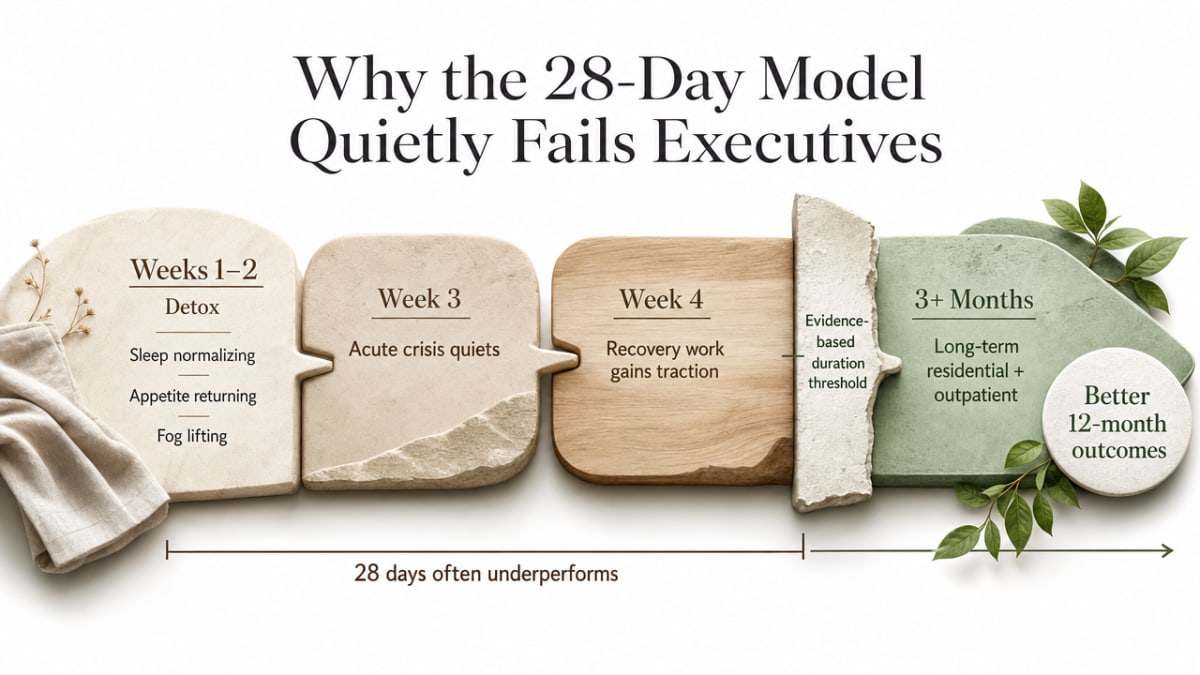
Here’s the number that reframes everything: patients who receive three months or more of treatment across long-term residential and outpatient settings show significantly better outcomes at 12-month follow-up than those who stop before that threshold. Not marginally better. Significantly.9
That finding is the reason the 28-day program — the one your assistant could probably block on your calendar without anyone noticing — often underperforms for men in your position. It’s not that a month of clinical care is worthless. It’s that a month is where the acute crisis quiets down and the actual work of recovery is just starting to have traction. Then you leave.
Think about how this plays out for someone with your responsibilities. Weeks one and two are essentially medical: detox, sleep normalization, appetite returning, the fog lifting. Weeks three and four are when you start engaging with the thing underneath — the reasons the drinking or the pills stopped being optional. You are, in clinical terms, just becoming a good patient. And then a discharge planner hands you a folder and wishes you luck.
The clinically credible pathway has four phases, and the duration threshold runs through all of them:9
- Medical detox — days to roughly two weeks, depending on substance and severity.
- Residential care — the core inpatient stretch where the psychological work begins in earnest.
- Structured continuing care in the first 90 days post-discharge — the window where relapse risk is highest and where evidence shows active aftercare protects the gains you just made.
- Long-term monitoring and alumni support — the year-two-and-beyond scaffolding that treats recovery as ongoing, not completed.
Total structured engagement, if you add it honestly: at least three months of concentrated treatment, followed by another three months of active continuing care. That’s the floor the evidence points to — not the ceiling.
You’ve probably spent longer preparing for a deal, a trial, a board transition. The question isn’t whether you can afford this arc. It’s whether the 28-day fantasy is actually a decision, or a way to keep the problem the same size.
Residential Care and the Men-Specific Evidence
Most articles about addiction treatment talk about residential care as if it were gender-neutral. It isn’t.
Here’s the finding that should reframe your decision: residential treatment, compared with outpatient treatment, is associated with significantly better abstinence outcomes for men — but not for women. That’s not a marketing angle. It’s a treatment-modality review that noticed something the field doesn’t talk about enough. For men with more entrenched or more severe use, the setting itself appears to do work that outpatient settings can’t reliably replicate.7
Why that would be true is worth sitting with. Residential care removes you from the environment where the use is happening — the client dinners, the airport bars, the medicine cabinet, the home office where the second glass turns into the fifth. It gives you a container. It also removes, temporarily, the professional identity that has become both the reason you drink and the reason you tell yourself you can’t stop. When you’re not being the partner, the physician, the founder, the closer for a few weeks, you have room to look at what’s underneath.
None of this means residential is universally superior. A systematic review of 23 studies on residential SUD treatment describes the overall evidence as moderate quality — meaning residential care improves outcomes across substance use and life domains, but is not consistently shown to outperform other modalities for every population. The review is worth taking seriously precisely because it doesn’t oversell.8
Put the two findings together and a specific picture emerges. Residential care is not the answer for everyone. It appears to be an especially strong answer for men — particularly men with moderate-to-severe use, co-occurring conditions, or a history of failed outpatient attempts. That last group matters. If you’ve tried to “just cut back,” or worked with a therapist while continuing to use, or done a brief outpatient stint that didn’t hold, you have already run the experiment that outpatient works for you. It didn’t.
What residential does well, when it’s clinically serious, is dense: medical stabilization, daily individual and group work, psychiatric evaluation for co-occurring anxiety or depression, structured routine, and enough time away from your usual triggers for new patterns to actually form. It is not a retreat. It is not a wellness vacation. It is closer to a compressed inpatient rotation where you are the case.
The gender-specific finding also lines up with what researchers have noted about how men engage intensive treatment. In some studies, men in more intensive modalities like residential show greater abstinence gains than women in the same setting — a pattern that likely reflects a mix of clinical, social, and role-related factors rather than any single mechanism. The takeaway isn’t that men are “better” at residential. It’s that when men do the work in that setting, the setting itself amplifies the work.13
For a professional weighing whether to step out of the office for weeks, that evidence should carry more weight than any brochure. The question isn’t whether residential is inconvenient. It’s whether the inconvenience is buying you something outpatient probably won’t.
You Are Not the Exception You Think You Are
Here is the quiet math that undoes the story you’ve been telling yourself: in a 2022 systematic review of workplace-based interventions, 60% of people with substance use disorders were found to be currently employed. Not unemployed. Not on the street. Working.2
Sit with that number for a second, because it contradicts the mental image that has probably been keeping you out of treatment. The person you picture when you picture “someone with a real problem” — the one who lost the job, the house, the family, the driver’s license — is not the statistical center of this population. The statistical center is closer to you. Employed. Showing up. Hitting the deliverables. Maintaining the exterior.
The professional version of this problem has its own signature, and researchers have documented it. Problematic alcohol use is consistently associated with decreased work performance and increased absenteeism — even in people who look, from the outside, like they’re still executing. You know what that looks like from the inside. The missed morning. The recycled excuse. The slightly slower turnaround on the memo you used to produce in half the time. The quiet renegotiation of what “a good day” means.14
You have been telling yourself that because you are still functioning, you are not one of them. The evidence says you are exactly one of them. Most of them are you.
This matters for one specific reason: if the mental prerequisite for asking for help is that you have to lose everything first, you have set a bar that will almost certainly be met — just not on a timeline you’d choose. The men who go into treatment while still employed have significantly more recovery capital to work with. Employment itself is one of the strongest predictors of sustained recovery, and clients who are working while in treatment are significantly more likely to complete it than those who aren’t.1
Which means the version of you that walks into a clinical intake next month — still with the title, the license, the team, the calendar — is not the failed version of this story. It’s the version most likely to finish it.
MAT, Licensing, and the Stigma You’ll Actually Face
Let’s talk about the fear you haven’t said out loud to anyone.
If you’re a physician, an attorney, a pilot, a nurse anesthetist, a financial advisor with a Series 7 — the word “medication-assisted treatment” probably lands in your chest before it lands in your head. You’re not just weighing a clinical option. You’re weighing a paper trail that could route through a licensing board, a Physician Health Program, a state bar, or an employer’s HR file.
The clinical case for MAT is unambiguous. NIOSH’s workplace-focused review is direct: MAT that combines medications with psychosocial treatment reduces cravings and the euphoric effects of opioids, and is associated with improved retention in treatment and reduced illicit use. For opioid use disorder in particular, it is not a fringe option. It is the standard of care that gives you the best odds of not relapsing, not overdosing, and not repeating the cycle that put you here.4
And the same review is equally direct about the part nobody wants to acknowledge: people using MAT often face stigma in both recovery communities and workplaces, where they may not be seen as “abstinent”. That’s the piece that scrapes at you. In some 12-step rooms, in some HR conversations, in some board evaluations, being on buprenorphine or naltrexone gets read as “still using.” It isn’t. But the misread is real, and pretending otherwise doesn’t help you plan.4
What does help you plan is knowing three things.12
- For most licensed professionals, the reporting pathway is not automatic and not punitive. Physician Health Programs, lawyer assistance programs, and their equivalents are generally designed as confidential, monitored alternatives to disciplinary action — you are more exposed by an untreated problem that surfaces through an incident than by a proactive engagement with a monitoring program. Your treatment team and a healthcare attorney familiar with your specific board should map this before you disclose anything to anyone.
- The stigma is real but selective. Choose your disclosure audience deliberately. Your clinical team needs the full picture. Your monitoring program needs the full picture. Your spouse needs the full picture. Your colleagues, most of the time, need a competent, medically-supervised absence — nothing more.
- MAT is a clinical decision, not a moral one. If the medication protects your sobriety and your life, the workplace optics come second. There’s also broader evidence that workplace stigma interventions can lift intentions to seek help without reliably closing the gap to actual help-seeking behavior. Translation: waiting for the culture to catch up is not a strategy. Getting the care that works is.
Continuing Care: The First 90 Days After You Leave
The day you walk out of residential is not the finish line. It’s the part of the process where most of the fragile gains get won or lost.
The continuing care research is blunt about this. The same evidence that supports at least three months of concentrated treatment also identifies the first 90 days after discharge as the window where structured aftercare separates the men who hold their recovery from the men who quietly lose it. Not because they lacked willpower. Because they returned to the environment that shaped the problem, without the scaffolding that helped them see it clearly.9
Think about what your first week back actually looks like. The inbox has 1,400 unread emails. Two clients want a call by Wednesday. Your partner is watching you a little more closely than she’ll admit. The bar in your kitchen is still stocked. The colleague who used to text you at 9 p.m. to close out the day over drinks doesn’t know you spent the last several weeks somewhere else. Every one of those inputs is a decision point you didn’t have inside a residential program.
Structured continuing care is what turns those decision points from tests of willpower into managed clinical touchpoints. In practice, for a professional, it usually means a stack that looks something like this:
- Weekly individual therapy with a clinician who knows your full case file — not a new intake with someone starting from scratch.
- A continuing care group two or three times a week, ideally with other men in similar recovery timelines. The peer piece isn’t decorative. It’s where you hear your own excuses in someone else’s mouth.
- Medication management if you’re on MAT or being treated for a co-occurring condition like anxiety or depression — with the psychiatrist you established care with in residential, not a handoff to someone new.
- A monitoring or accountability component, which for licensed professionals often runs through a Physician Health Program or its equivalent, and for others may involve alumni check-ins or, increasingly, biometric monitoring.
- A relapse-response plan you wrote down before you left — who you call, what you do in the first hour, who tells your spouse. Not aspirational. Written.
That’s not a soft landing. It’s roughly the same clinical intensity you’d expect if you’d just had a cardiac event and were in the first quarter of cardiac rehab. The Surgeon General’s chronic-care framing applies here directly: recovery behaves like a long-arc condition, and the post-acute period is where the chronic-care model actually earns its keep.6
Wearable Monitoring: What It Can and Can’t Do Yet
You are probably wearing one right now. A watch that tracks your resting heart rate, your sleep stages, your steps, maybe your HRV. The idea that the same class of device could support your recovery is not marketing fiction — it’s an active area of clinical research, and the evidence deserves an honest read.
The optimistic case is real. A systematic review of wearable and wireless mHealth tools in SUD treatment concluded that wearable sensors can be used to decrease heavy substance use, mitigate factors related to relapse, and monitor for overdose risk. Physiological signals — heart rate variability, sleep disruption, skin conductance, stress markers — do carry information about craving states, autonomic arousal, and the kinds of sleepless nights that often precede a slip. For a professional whose life doesn’t slow down after discharge, continuous, non-invasive data is genuinely useful clinical input.10
Now the honest counterweight. A separate systematic review, focused specifically on remote wearable monitoring for detecting non-alcohol and non-nicotine substance use, was blunt: there is currently insufficient evidence to fully support remote monitoring of substance use disorders through wearable devices. Small samples, inconsistent compliance with wearing the devices, and heavy computational demands are still real limits. The field is early.11
Both things are true at once. Wearables are not a substitute for clinical care, a therapist, a psychiatrist, or a monitoring program. They are also not a gimmick. The right frame is what the more optimistic review itself recommends: incorporate the technology into a multifactorial treatment plan rather than use it in isolation.10
What that looks like in practice for someone like you: your clinical team sees your sleep collapse three nights in a row and calls you before you notice you’re rationalizing a drink. Your continuing care therapist walks into a session already knowing your stress markers spiked around a specific meeting. The data doesn’t replace the work — it makes the work more precise. Treat it as one instrument on the panel, not the whole cockpit.
Returning to Work Without Losing the Recovery
The re-entry conversation is the one you’re most worried about, and it deserves more than a script.
Start with the finding that should change how you think about the return itself: employment is reported as a top life priority by people in all stages of recovery, and individuals who work — paid or volunteer — are more likely to reduce substance use and maintain sobriety. Your job isn’t the obstacle to your recovery. Handled correctly, it’s one of the strongest assets you have. Structure, identity, purpose, financial stability, a reason to be somewhere at 8 a.m. on a Wednesday — those aren’t decorative. They’re recovery capital.1
The practical question is how you re-enter without unwinding what you just built. A few moves matter more than the rest.
Renegotiate the first 30 days, not the whole year. You don’t need a permanent accommodation. You need a landing pad. That usually means a lighter travel schedule, protected time for continuing care appointments, and — if your role allows — a slightly compressed client-facing calendar while your new rhythms harden. Frame it internally as a medical return-to-work protocol, because that’s what it is.
Pick your triggers before they pick you. The client dinner. The industry conference. The quarterly close-out drinks. Decide now what you will and won’t do, and tell your continuing care therapist the specific calendar events that scare you. Walk through the first three by name. Vague plans lose to specific bars.
Rebuild the professional identity, don’t hide from it. The version of you that returns is not damaged goods on probation. He’s a man who ran a serious clinical process to protect his work, his family, and his life. Most colleagues will read your steadiness long before they read anything else. Let the work speak.
One caveat worth naming: workplace culture isn’t going to save you. Reviews of stigma and help-seeking interventions show that programs can shift intentions and literacy, but the gap to actual behavior change remains real. Don’t wait for your firm to become a recovery-friendly workplace. Build the recovery-friendly week yourself, and let the culture catch up on its own timeline.12

What a Credible Pathway Looks Like From Here
If you’ve read this far, you already know the shape of the decision. What’s left is sequencing it.
A credible pathway, for a professional in your position, has a few non-negotiable pieces. A medically-supervised detox, not a hotel-room taper. Residential care long enough to actually change something — not a symbolic month. Continuing care that starts the day you leave, with your name already on the calendar. And a monitoring layer, clinical or biometric, that gives your team early signal instead of late damage control.9
The men who protect their careers through this process share one habit: they treat recovery with the same operational seriousness they’d bring to any other high-stakes situation they’ve managed. They engage a healthcare attorney before disclosing to a board. They line up continuing care before they leave residential. They tell their spouse the truth about the calendar. They stop negotiating with the problem.
You have more to work with than you think. A functioning career, a marriage still intact, a license still clean, and — if the research is right — a strong statistical case that a serious clinical process will hold. The version of this story that ends well starts with one honest call. If a men’s residential program built around this pathway is the right fit, Serenity Park Recovery Center is one place that call can go.7
Frequently Asked Questions
Can I keep my job while going through residential treatment?
In most cases, yes — and the evidence suggests you should try. Clients who are employed while in treatment are significantly more likely to complete it than unemployed clients. FMLA, short-term disability, and executive medical leave provisions cover this scenario more often than professionals realize. Work with a healthcare attorney and HR benefits contact before you disclose anything specific. Frame the absence as a medically-supervised leave, not a resignation letter.1
Is 30 days of treatment enough for a working professional?
Usually not. The continuing care research is direct: patients receiving three months or more of treatment across residential and outpatient settings show significantly better outcomes at 12-month follow-up than those with shorter durations. That doesn’t mean 90 days in a residential bed. It means a structured arc — detox, residential, and active continuing care in the first 90 days post-discharge — that adds up to a real clinical dose rather than a symbolic one.9
Will medication-assisted treatment affect my professional license?
MAT is the standard of care for opioid use disorder and is associated with improved retention and reduced illicit use. For most licensed professionals, engaging a Physician Health Program or equivalent monitoring pathway is protective, not punitive. That said, the same evidence acknowledges MAT still carries stigma in some workplaces and recovery communities. Have a healthcare attorney familiar with your specific board map the disclosure pathway before you talk to anyone.4
How do I explain an extended absence to my firm or colleagues?
Keep it clinical and brief. “I’m taking a medically-supervised leave under my physician’s care” is a complete sentence. Your clinical team, spouse, and any monitoring program need the full picture. Colleagues typically need competent coverage, not a diagnosis. Workplace stigma programs improve intentions to seek help but often fail to change actual behavior or reduce stigma— meaning the smart move is disclosure discipline, not waiting for a culture shift.12
What does continuing care actually look like after I leave residential?
A working stack: weekly individual therapy with a clinician who has your full case file, a continuing care group two or three times per week, medication management if applicable, and a monitoring or accountability layer. The first 90 days post-discharge are the highest-risk window and the period where structured aftercare most clearly protects gains. Put those appointments on your work calendar before anything else. Treat them with the same weight as a board meeting.9
Are wearable monitoring devices reliable enough to trust in recovery?
They’re useful as one input, not the whole picture. Systematic review evidence shows wearables can help decrease heavy substance use, mitigate relapse-related factors, and monitor for overdose risk when integrated into a multifactorial treatment plan. A separate review focused on remote monitoring of non-alcohol substance use concluded current evidence is insufficient to fully support the approach. Use the data to inform your clinical team’s decisions — don’t let it replace them.10,11
References
- Substance Use Disorders Recovery with a Focus on Employment and Education. https://library.samhsa.gov/sites/default/files/SAMHSA_Digital_Download/pep21-pl-guide-6.pdf
- A systematic review of the efficacy, effectiveness and cost-effectiveness of workplace-based interventions for the prevention and treatment of problematic substance use. https://pmc.ncbi.nlm.nih.gov/articles/PMC9676969/
- Workplace Wellness Programs Study. https://www.rand.org/pubs/research_reports/RR254.html
- Medication-Assisted Treatment for Opioid Use Disorder Study (MAT Study). https://www.cdc.gov/niosh/docs/wp-solutions/2019-133/default.html
- A Review of the U.S. Workplace Wellness Market. https://www.rand.org/pubs/technical_reports/TR984.html
- Facing Addiction in America: The Surgeon General’s Report on Alcohol, Drugs, and Health. https://www.ncbi.nlm.nih.gov/books/NBK424857/
- Treatment Modalities and Settings. https://www.ncbi.nlm.nih.gov/books/NBK144286/
- The effectiveness of residential treatment services for individuals with substance use disorders: A systematic review. https://pubmed.ncbi.nlm.nih.gov/31254749/
- The Continuing Care Model of Substance Use Treatment. https://pmc.ncbi.nlm.nih.gov/articles/PMC4007701/
- Wearable and wireless mHealth technologies for substance use disorders: A systematic review. https://pubmed.ncbi.nlm.nih.gov/33738178/
- Wearable remote monitoring to detect nonalcohol/nonnicotine substance use: A systematic review. https://pubmed.ncbi.nlm.nih.gov/36062888/
- Workplace interventions targeting mental health literacy, stigma, and help-seeking: A systematic review. https://pubmed.ncbi.nlm.nih.gov/38581228/
- Gender differences in substance use disorder treatment outcomes. https://pmc.ncbi.nlm.nih.gov/articles/PMC3860462/
- Alcohol use and work performance: A review of the literature. https://pmc.ncbi.nlm.nih.gov/articles/PMC3772287/