
Key Takeaways
- Arkansas layers DHS licensing, X-DEA waivered prescribers, the state PDMP, and Medicaid rules tied to SAMHSA TIP 63 to govern how medications are prescribed and administered inside residential care 16, 3.
- Roughly 108,000 Arkansans misused prescription pain relievers in a recent three-year window, and 1,031 were receiving methadone on a single day in March 2019 — medication-based recovery is already widespread here 15.
- Act 964 of 2019, the 2020 Medicaid change, SPA 20-0013, and Act 451 of 2023 removed prior authorization on preferred MAT products, so an X-DEA waivered Arkansas prescriber can start treatment locally within days 18, 3, 4, 2.
- Before committing to a program, confirm Arkansas licensure and X-DEA waivers, two-hour detox vitals until eight hours of stability, PDMP checks at admission and discharge, and a named outpatient prescriber with a scheduled first appointment 1, 8, 6, 14.
What safe medication looks like inside an Arkansas addiction program
If you’re reading this for yourself or for someone you love, take a breath. The word “medication” in an addiction program can feel loaded, especially when the person walking in the door is already scared, sick, or ashamed. You deserve straight answers about what actually happens.
Safe medication management in an Arkansas residential setting is not one clinician making judgment calls in a back room. It is a layered system with real names and real rules: DHS licensing for the facility, X-DEA waivered prescribers, the Arkansas Prescription Drug Monitoring Program tracking every controlled dispense 6, SAMHSA’s TIP 63 guiding buprenorphine, methadone, and naltrexone decisions 16, and Arkansas Medicaid policy tying medical necessity review directly to those national standards 3.
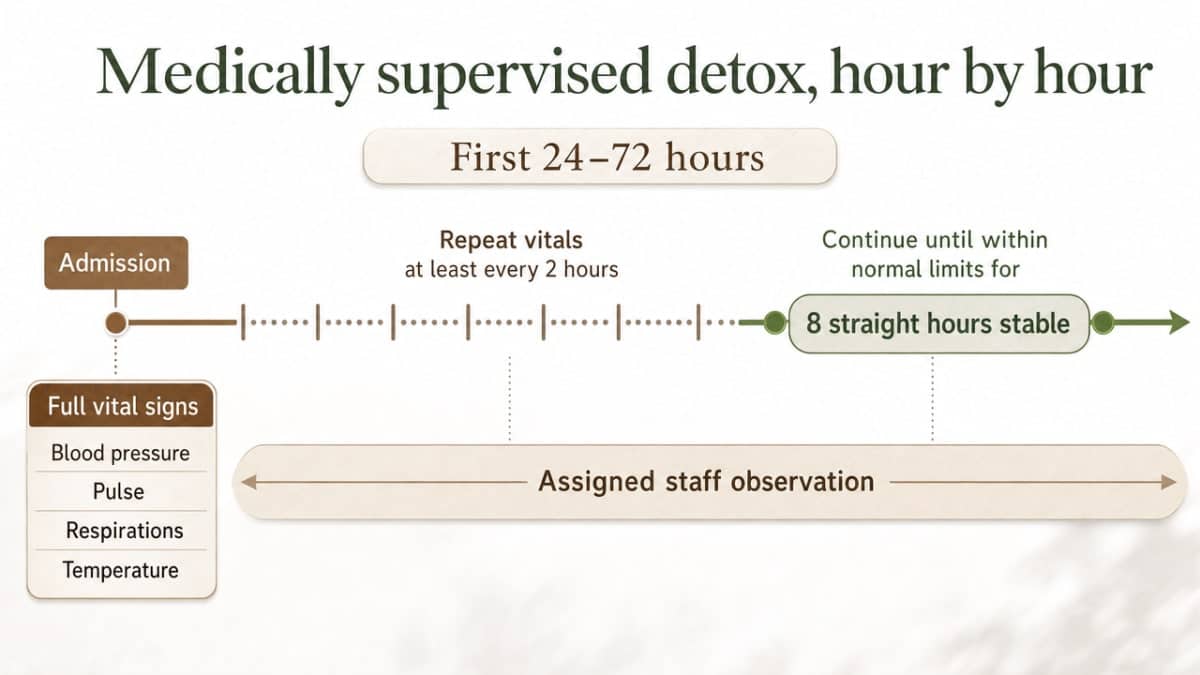
On the ground, that translates into small, concrete things you can actually see. Vital signs on a clipboard every two hours during detox 8. A locked med cart with a signed log. A prescriber who checks the PDMP before writing a single order. A treatment plan that names the medication, the dose, the reason, and the plan for what happens after discharge.
Here is what that looks like, piece by piece.
The scope of the need in Arkansas
Before you can weigh what safe medication management looks like, it helps to see how many of your neighbors are already living inside this conversation. You are not the only family in Little Rock, Fayetteville, or Jonesboro pulling into a parking lot at 6 a.m. wondering if a loved one will actually walk in the door.
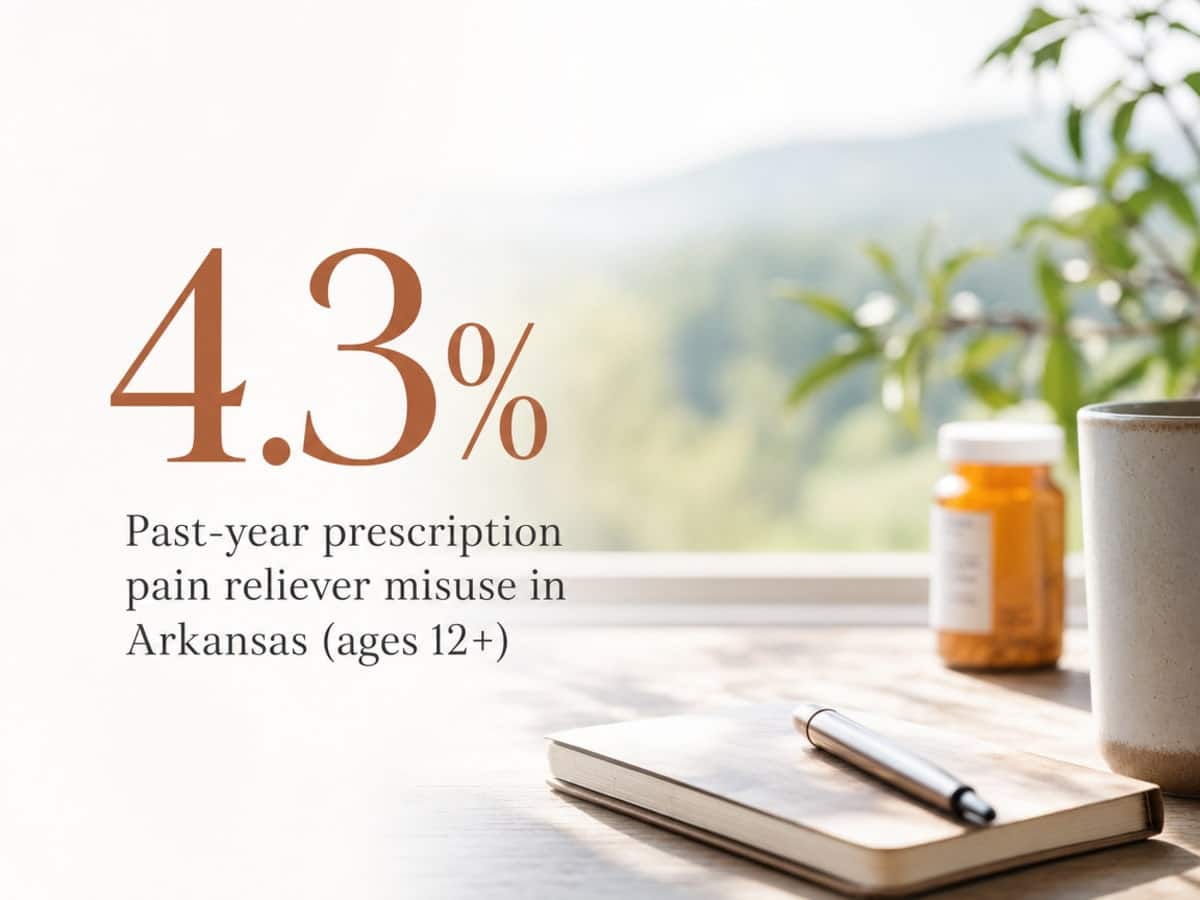
From 2017 to 2019, SAMHSA’s Behavioral Health Barometer reported that 4.3% of Arkansans aged 12 and older misused prescription pain relievers in the past year — roughly 108,000 people 15. That figure is a three-year rolling average from a household survey of people 12 and up, so it does not capture everyone (homeless Arkansans, incarcerated Arkansans, and those who declined to answer are underrepresented), and it does not include heroin, fentanyl, or alcohol on its own. Even with those limits, it is a real, measured slice of the state.
The same report counted 1,031 Arkansans receiving methadone in an opioid treatment program on a single day in March 2019 15. One day. One medication. That is a thousand people already trusting a structured medication routine to keep them alive and functional.
Sit with that for a moment. If you’re afraid you’re doing something unusual by asking about buprenorphine, methadone, or naltrexone for someone you love, you’re not. You’re joining a large, quiet group of Arkansans who figured out that medication, used carefully, is often what makes the rest of recovery possible.
Who is legally allowed to prescribe and administer these medications
Not everyone in scrubs can write an order for buprenorphine. Not every nurse can hand you a pill from an unlabeled cup. Arkansas has clear rules about who prescribes and who administers, and those rules exist because your safety depends on knowing the answer is yes before a medication ever reaches your mouth.
Prescribers: X-DEA waivers, Arkansas licensure, and Medicaid enrollment
The person writing the order matters. Arkansas Medicaid is direct on this point: providers of Medication-Assisted Treatment for opioid or alcohol use disorder must be licensed in Arkansas and enrolled with Arkansas Medicaid, and MAT is available to qualifying beneficiaries only when the prescriber has an X-DEA waiver on file 1, 2. That waiver is what allows a physician, nurse practitioner, or physician assistant to prescribe buprenorphine products for opioid use disorder in the first place.
Arkansas rule goes a step further. Preferred oral prescription drugs used to treat opioid use disorder — think Suboxone film and buprenorphine sublingual tablets — bypass prior authorization and monthly prescription limits only when an X-DEA waivered provider writes them as part of a documented MAT plan 5. If the person prescribing does not have that credential, the pharmacy will not fill it under those protections.
Ask the question plainly when you tour a program. Who will actually see your loved one? Are they licensed in Arkansas? Are they X-DEA waivered? Are they Medicaid-enrolled if that is your coverage? A program that welcomes those questions is a program that has already answered them internally.
Administration: physician orders, the Nurse Practice Act, and the medication log
Prescribing is one job. Actually placing the medication in someone’s hand is a separate one, and Arkansas treats it that way. Under 20 CAR § 414-702, medications must be administered according to physician orders and in line with the Arkansas Nurse Practice Act — meaning a nurse operating within their scope, following a written order from an authorized prescriber, not a tech acting on a verbal hunch 13.
The paperwork is not busywork. Rule 210 requires a written medication management plan for any prescribed medication and a medication log documenting every administration — the drug, the dose, the time, the initials of the person who gave it 12. That log is where errors get caught. It is also where a family member, with the right release signed, can eventually see exactly what their loved one received on Tuesday night at 10 p.m.
If you ever walk through a residential program and see a nurse pause to sign a med log before moving on, that pause is doing real work. It is the small, boring act that keeps a scared person from getting the wrong dose at the wrong time.
Medically supervised detox, hour by hour
The first 24 to 72 hours are the part families lose sleep over. You picture the worst — a seizure at 3 a.m., a heart racing so hard it stops, no one noticing. Arkansas rules for licensed detox exist precisely because that fear is legitimate, and they translate into a monitoring cadence you can actually picture.
While that is happening, a staff member is specifically assigned to observation detoxification on a 24-hour basis, trained to recognize withdrawal signs and act on emergency procedures 9. Someone is awake, watching, when your loved one is sweating through the sheets at 2 a.m. Bedrooms used for detox must have single beds — no bunks — so there is clear physical access to the person if something changes fast 8.
Medications during this window are guided by symptoms, not a fixed script. For alcohol withdrawal, that usually means a CIWA-driven benzodiazepine taper. For opioid withdrawal, buprenorphine induction once the person is in enough withdrawal to start safely, following SAMHSA TIP 63 protocols that Arkansas Medicaid explicitly ties medical necessity to 16, 3. Comfort medications — for nausea, muscle aches, insomnia, blood pressure spikes — get layered in as needed.
The right level of care matters here too. The RADD manual defines Level IV-D as medically managed intensive inpatient detoxification with 24-hour care in an acute care setting, reserved for the most medically complex withdrawals 10. A residential program with on-site medical supervision handles a large share of cases, and coordinates a transfer up if a patient’s picture demands it.
If you are the family member sitting in the parking lot: the first calm set of vitals, the first four hours of sleep, the first meal kept down — those are wins. Small ones. Real ones. That is what the two-hour clipboard is measuring.
Medication-assisted treatment after the acute phase
Detox ends. The person is stable, sleeping, eating, maybe cracking a joke for the first time in weeks. That is the moment the real conversation about medication starts — the one about staying well, not just getting through the night.
Arkansas Medicaid and state rule treat MAT as an ongoing service, not a discharge-day handshake. Coverage continues, prescribers keep writing, and the plan of care specifies which medication, at what dose, for how long, and how the taper (if any) will be handled 2, 5. Here is what those next weeks and months actually involve.
Buprenorphine, methadone, and naltrexone for opioid use disorder
Three medications carry most of the weight for opioid use disorder in Arkansas, and each one earns its place differently. SAMHSA’s TIP 63 — the guideline Arkansas Medicaid explicitly ties medical necessity to — describes all three as safe and effective when used appropriately, and recommends that medication be considered for every patient with OUD 16, 3.
Buprenorphine, usually as Suboxone film or a sublingual tablet, is the workhorse inside residential care. It can be started once withdrawal is underway, dosed daily, and continued after discharge with an X-DEA waivered prescriber 1. Under Arkansas Medicaid, preferred oral buprenorphine products no longer require prior authorization and do not count against the monthly prescription limit when prescribed as part of a MAT plan 5.
Methadone lives in a different system — federally regulated opioid treatment programs where the medication is dispensed on-site, often daily at first. On a single day in March 2019, 1,031 Arkansans were receiving methadone through those programs 15. A residential program does not dispense methadone itself, but it can coordinate the referral so the first dose lands the day after discharge.
Naltrexone, especially the extended-release monthly injection, is an option for someone who has completed detox and wants no opioid agonist on board at all. UAMS’s CAST program describes MAT as first-line for moderate-to-severe OUD, with at least one urine drug screen a month once maintenance begins 14.
Naltrexone and adjunct medications for alcohol use disorder
Alcohol use disorder has its own medication toolkit, and it is quieter than the opioid conversation but no less important. Naltrexone — the same molecule used for opioids, in oral or extended-release injectable form — reduces the reward pull of a drink and lowers heavy-drinking days. Arkansas Medicaid covers preferred injectable MAT agents for alcohol use disorder without prior authorization under the changes carried by Act 451 of 2023 2.
Acamprosate helps with the long tail of post-acute withdrawal — the restless, edgy, sleep-broken weeks after the shakes stop. Disulfiram is the older option, useful for a specific kind of patient who wants a hard chemical guardrail against impulse drinking.
None of these are stand-alone answers. Arkansas rule requires residential SUD programs to provide at least 28 hours of structured treatment weekly, so the medication sits inside counseling, group work, and skill-building rather than replacing them 7. That is the design. Medication quiets the biology enough for the therapy to actually land.
How long maintenance lasts and when tapering is appropriate
You may want a number. Six weeks? Six months? A year? Arkansas rule on opioid treatment is deliberately careful here. Under 20 CAR § 433-323, some clients may remain on methadone or buprenorphine maintenance for relatively long periods, and periodic consideration of withdrawing from opioid agonist therapy is appropriate only when it is in the individual client’s interest 11. Not on a calendar. Not because insurance changed. Because the person is ready.
UAMS CAST expects documentation supporting MAT beyond 90 days — a note that the medication is still working, cravings are managed, functioning is intact 14. That documentation is a feature, not a hoop. It means someone is actually looking at whether the current plan is right for right now.
If tapering does happen, it happens slowly, with the same monitoring cadence and the same prescriber relationship. A relapse during or after taper is not a failure of the medication. It is information that the maintenance dose was doing more work than anyone realized, and Arkansas rule allows readmission to maintenance when that is what the patient needs 11.
Why Arkansans no longer have to leave the state for MAT access
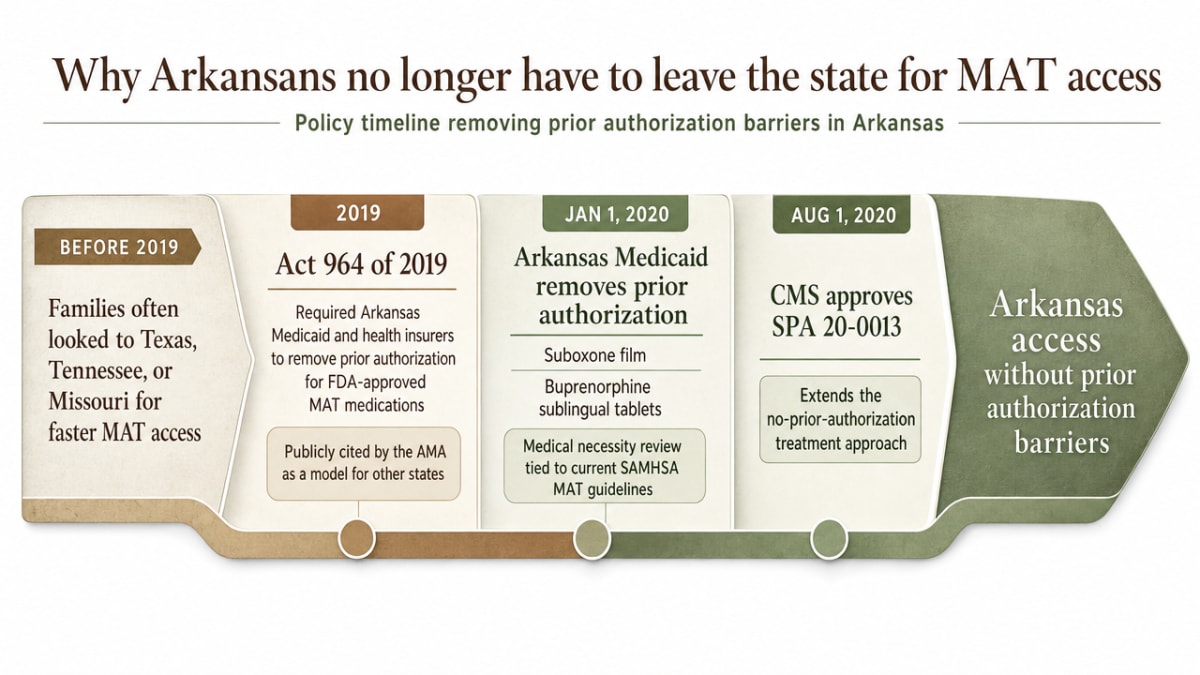
For years, families here heard the same advice: if you want fast, reliable access to buprenorphine or methadone, you may need to look at a program in Texas, Tennessee, or Missouri. That advice is out of date.
Two policy changes rewrote the map. Act 964 of 2019, which the American Medical Association publicly held up as a model for other states, required Arkansas Medicaid and health insurers to remove prior authorization for FDA-approved MAT medications 18. Then, effective January 1, 2020, Arkansas Medicaid formally removed the prior authorization requirement on Suboxone film and buprenorphine sublingual tablets, tying medical necessity review to current SAMHSA MAT guidelines instead of a paperwork gate 3. CMS approved State Plan Amendment 20-0013 effective August 1, 2020, extending that no-prior-authorization treatment to preferred buprenorphine, naltrexone, methadone, and naloxone products on the Medicaid preferred drug list and excluding those MAT prescriptions from the monthly prescription limit 4. Act 451 of 2023 layered on top, removing prior authorization for preferred injectable MAT agents used for opioid and alcohol addiction as well 2.
Before those changes, a prescriber in Little Rock could write the right prescription and still watch a patient walk out without medication while a form sat in a queue. That queue was where relapses lived. After those changes, an X-DEA waivered provider writing a preferred oral buprenorphine product as part of a documented MAT plan sends it straight to the pharmacy, and the pharmacy fills it 5.
Be precise about what shifted, though. The strongest guarantees sit inside Arkansas Medicaid. Commercial plans are covered by the Act 964 mandate the AMA praised 18, but plan-by-plan details still vary, so ask your carrier what the fill process actually looks like today. What Arkansans have gained is real: a local prescriber, a local pharmacy, and a first dose within days rather than weeks — without a road trip across state lines.
The PDMP and the psychiatric side of dual diagnosis
Most men who need medically supervised detox are not walking in with a single prescription problem. They are walking in with a whole shelf — a benzodiazepine for panic attacks, an SSRI that stopped working two years ago, a sleep aid a friend handed over, maybe a leftover opioid script from a back injury. Safe medication management has to see the whole shelf, not just the drug that brought them in.
That is where Arkansas’s Prescription Drug Monitoring Program and coordinated psychiatric prescribing do their quiet, structural work.
How the Arkansas PDMP protects a patient on multiple controlled prescriptions
The Arkansas PDMP is a database, but it functions like a second set of eyes on every prescriber in the state. Pharmacies and other dispensers must report every dispensation of a Schedule II–V controlled substance to the program, at a frequency of the next business day, with zero reports filed on days when nothing controlled was dispensed 6. That next-business-day cadence is what makes the record actually useful in real time — not a snapshot from six months ago.
Inside a residential program, a prescriber pulls that report before writing an order. If your loved one is starting buprenorphine and also carrying a lorazepam prescription from a family doctor in Conway and a zolpidem script from an urgent care in North Little Rock, the PDMP surfaces it. That matters because combining benzodiazepines and opioid agonists raises overdose risk, and the response is not necessarily to stop everything cold — it is to know, plan, and taper safely.
Ask the intake nurse if the psychiatric provider checks the PDMP at admission and at discharge. Both checkpoints matter. One protects the plan going in; the other protects the plan going home.
Coordinated prescribing for anxiety, depression, PTSD, and sleep
Dual diagnosis is the rule, not the exception. A man who drinks a fifth a night to sleep is often also treating undiagnosed PTSD. A professional tapering off Xanax is often managing a decade of untreated generalized anxiety. Pulling the substance out without treating what sat underneath it is how relapses happen at week three.
Good residential programs handle this with a single psychiatric provider coordinating the whole picture rather than three prescribers writing past each other. Rule 210 requires a written medication management plan for every prescribed medication, and a medication log that captures each administration — the drug, the dose, the time, and who gave it 12. That plan is where the psychiatric medications live alongside the MAT: the SSRI restart, the non-controlled sleep aid, the prazosin for nightmares, the mood stabilizer that finally gets the right dose.
Controlled psychiatric medications get extra scrutiny. A benzodiazepine taper for genuine dependence looks different from continuing a benzodiazepine indefinitely alongside buprenorphine, and Arkansas’s medication administration rule keeps that decision anchored to a physician order and Nurse Practice Act scope 13. Non-controlled alternatives — buspirone, hydroxyzine, gabapentin where clinically appropriate — often carry more of the anxiety and sleep load during the residential stay.
Tell the psychiatric provider everything. The half-truths you told your last doctor do not have to travel with you here.
The handoff from detox to aftercare
Discharge day is where a lot of good detoxes quietly fall apart. The person feels better, the paperwork gets signed, and the medication plan that kept them steady for two weeks turns into a printed sheet and a wave goodbye. That is the gap Arkansas rules and quality standards try to close, and it is the gap you should ask about directly.
A safe handoff has four moving parts:
- The residential prescriber writes a bridge supply of the MAT medication — usually buprenorphine — long enough to cover the days between discharge and the first outpatient appointment.
- The outpatient prescriber is identified by name before your loved one leaves, not promised as a phone call next week.
- The PDMP record follows them, so the new prescriber sees exactly what was given inside the program on the next business day after each fill 6.
- The aftercare plan documents why MAT continues, especially past 90 days, in the language UAMS CAST expects: cravings managed, functioning intact, monthly urine drug screen scheduled 14.
Ask three questions before signing anything. Who is my prescriber on day eight? What day is my first appointment? What happens if I miss a dose on the way there? A program that can answer all three has done the work. If the answers get vague, that is your signal to push — because the medication that carried someone through withdrawal only keeps carrying them if the next hand is ready.
Questions to ask an Arkansas residential program before you commit
You do not need a clinical degree to vet a program. You need a short list of questions that force specifics, and the willingness to keep asking until the answers stop sounding rehearsed.
Bring these with you, on paper if it helps:
- Is your medical director licensed in Arkansas, and are your MAT prescribers X-DEA waivered and enrolled with Arkansas Medicaid? The right answer is yes on all three, with names you can look up 1, 5.
- What is your detox monitoring schedule during the first 72 hours? You want to hear vital signs every two hours until stable for eight consecutive hours, with a staff member specifically assigned to 24-hour observation 8, 9.
- Do you check the Arkansas PDMP at admission and again at discharge? Both, not one 6.
- Which MAT medications do you start on-site, and how do I get my first outpatient appointment scheduled before I leave? A concrete date beats a promise 14.
- How do you document medication administration, errors, and disposal? Rule 210 language should sound familiar to them 12.
A program that answers plainly is a program that has done the work. That is the one worth driving to in Little Rock instead of across a state line.
Frequently Asked Questions
Do I have to leave Arkansas to get on buprenorphine or methadone quickly?
No. Since January 1, 2020, Arkansas Medicaid removed prior authorization for Suboxone film and buprenorphine sublingual tablets, tying medical necessity review to SAMHSA MAT guidelines instead 3. SPA 20-0013 extended that to preferred naltrexone, methadone, and naloxone products 4. An X-DEA waivered Arkansas prescriber can start you locally, often within days.
Who is actually allowed to prescribe MAT inside an Arkansas residential program?
Arkansas Medicaid requires that MAT providers be licensed in Arkansas, enrolled with Medicaid, and hold an X-DEA waiver on file to prescribe buprenorphine products for opioid use disorder 1, 2. Preferred oral MAT drugs bypass prior authorization and monthly prescription limits only when that waivered provider writes them as part of a documented MAT plan 5. Ask for names and credentials.
What does medically supervised detox look like during the first 24 to 48 hours?
A nurse takes full vital signs on admission, then repeats them at least every two hours until they stay within normal limits for eight consecutive hours 8. A staff member is specifically assigned to 24-hour observation and trained in withdrawal signs and emergency procedures 9. Detox bedrooms use single beds — no bunks — so staff have clear access if something changes fast 8.
Isn’t MAT just trading one drug for another?
That worry is understandable, and SAMHSA’s TIP 63 addresses it directly: OUD medications are safe and effective when used appropriately, and medication should be considered for every patient with opioid use disorder to reduce illicit use and improve functioning 16. Arkansas Medicaid explicitly ties medical necessity for MAT to those guidelines 3. A stable, prescribed dose is not the same as active addiction.
How does the Arkansas PDMP protect someone taking multiple prescriptions for dual diagnosis?
Pharmacies must report every Schedule II–V dispensation to the Arkansas PDMP at a frequency of the next business day, with zero reports filed when nothing controlled was dispensed 6. A prescriber pulls that report before writing orders, so overlapping benzodiazepines, sleep aids, or opioid scripts get surfaced. That lets the psychiatric provider plan a safe taper instead of stacking risky combinations.
What happens to my medications after I leave residential treatment?
A safe handoff includes a bridge supply of your MAT medication, a named outpatient prescriber, and a scheduled first appointment before discharge day. The PDMP record follows you 6. Arkansas rule allows long-term buprenorphine or methadone maintenance when clinically appropriate 11, and UAMS CAST expects at least one urine drug screen a month plus documentation supporting MAT beyond 90 days 14.
References
- PHYSICN-1-23 Provider Manual Update. https://humanservices.arkansas.gov/wp-content/uploads/PHYSICN-1-23up.doc
- Medication Assisted Treatment for Opioid or Alcohol Use Disorders – Arkansas Medicaid Guidance. https://humanservices.arkansas.gov/wp-content/uploads/MAT-Revised-Website-posting-12.14.pdf
- MAT memorandum – Arkansas Department of Human Services. https://humanservices.arkansas.gov/wp-content/uploads/MATmemo.doc
- AR SPA 20-0013 Approval Package. https://www.medicaid.gov/medicaid/spa/downloads/AR-20-0013.pdf
- 016.27.20 Ark. Code R. 010 – SPA #20-0013 Medication Assisted Treatment. https://www.law.cornell.edu/regulations/arkansas/016-27-20-Ark-Code-R-010
- PDMP – For Healthcare Providers – Arkansas Department of Health. https://healthy.arkansas.gov/programs-services/prevention-healthy-living/substance-misuse-injury-prevention/prescription-drug-monitoring-program/pdmp-for-healthcare-providers/
- Arkansas Summary – State Residential Treatment for Behavioral Health Conditions. https://aspe.hhs.gov/sites/default/files/2021-08/StateBHCond-Arkansas.pdf
- Arkansas Department of Human Services – Residential and Detoxification Standards. https://www.sos.arkansas.gov/uploads/rulesRegs/Arkansas%20Register/2011/Jan11Reg/016.23.10-003.pdf
- Title 20. Public Health and Welfare – Detoxification Standards. https://webftp.blr.arkansas.gov/Home/FTPDocument?path=CAR/Parts/20CARpt433.pdf
- Regional Alcohol and Drug Detoxification (RADD) Manual – Arkansas DHS. https://humanservices.arkansas.gov/wp-content/uploads/RADD_Manual_2020_FINAL.pdf
- 20 CAR § 433-323 – Opioid Treatment. https://codeofarrules.arkansas.gov/Rules/Rule?levelType=section&titleID=20&chapterID=128&subChapterID=170&partID=666&subPartID=3988§ionID=24551
- Adult Behavioral Health Services for Community Independence – Medication Management Provisions. https://humanservices.arkansas.gov/wp-content/uploads/Rule-210-Final-Posting-Packet.pdf
- 20 CAR § 414-702 – Administration of Medication. https://codeofarrules.arkansas.gov/Rules/Rule?levelType=section&titleID=20&chapterID=38&subChapterID=50&partID=790&subPartID=4229§ionID=26476
- Improving Access to Treatment for Opioid Use Disorder – UAMS CAST Program. https://psychiatry.uams.edu/clinical-care/outpatient-care/cast/improving-access-to-treatment-for-opioid-use-disorder/
- Behavioral Health Barometer: Arkansas, Volume 6. https://www.samhsa.gov/data/sites/default/files/reports/rpt32820/Arkansas-BH-Barometer_Volume6.pdf
- TIP 63: Medications for Opioid Use Disorder – Full Document. https://library.samhsa.gov/sites/default/files/pep21-02-01-002.pdf
- Hospital-Based Residential Treatment for Substance Use Disorder – Emergency Rule. https://humanservices.arkansas.gov/wp-content/uploads/Hospital-Treatment-for-SUD-Emergency-Rule-A.pdf
- Arkansas sets standard for states by removing prior authorization for MAT. https://www.ama-assn.org/press-center/ama-press-releases/arkansas-sets-standard-states-removing-prior-authorization