
Key Takeaways
- High-functioning addiction hides behind intact performance, revealed instead by a climbing dose, calendars built around access, and small lies told to people you love.
- Trying to out-discipline the substance keeps failing because the contest is on its terrain; shift to controlling the clinical process — detox, residential care, continuing care.
- Residential completion predicts twelve-month outcomes for men, including staying drug-free, employed, and out of legal trouble, while wearables function as monitoring adjuncts, not treatments 15, 3.
- Move this week with three calls: a physician outside your circle, a residential program that treats professionals, and whoever holds your calendar — date range only.
The man who’s still winning on paper
You are reading this at 11:47 p.m. on a device that belongs to you, not the firm. The door is closed. Tomorrow you have a deposition, a board call, a surgery, a jobsite walk, a closing — something that requires you to be exactly the person everyone thinks you are. And you are that person. The record backs it up.
The bourbon in the coffee started as a joke. The 2 mg out of your wife’s prescription bottle was supposed to be once. The second phone made sense at the time. None of it has shown up in a review, a chart note, a client email, a P&L. On paper, you are winning.
That is the problem this article takes seriously.
Most writing about men and addiction is aimed at a man who has already lost something visible — the job, the license, the marriage, the driver’s license, the freedom. You are not that man yet, and the distance between you and him is the exact space where good decisions are still cheap and private. The men who come through this well are almost never the ones who waited until the wheels came off. They are the ones who, at some point in a quiet room, decided to treat what was happening as a medical and structural issue rather than a character test — and moved before they were forced to.
You have not lost control of the story. You are still the one telling it. That is the starting position, not the ending.
What high-functioning addiction actually looks like
It does not look like the intake photos. It looks like you.
It looks like a 6 a.m. pour of bourbon into a to-go coffee before the drive to the office, because the tremor in your hands would show up in a signature or a scalpel. It looks like the Adderall you started borrowing in residency and never stopped, now bought through a channel you would not describe out loud. It looks like the second phone, the separate credit card, the hotel room booked two blocks from the conference hotel. It looks like a Sunday spent recovering that you have quietly rebranded as “catching up on reading.”
The clinical name for what you have is a substance use disorder. Men meet criteria for substance dependence at higher rates than women, particularly for alcohol and illicit drugs 8. That statistic includes a lot of men who look nothing like the stereotype. It includes the ones running the meeting.
High-functioning addiction has a specific architecture. Performance stays intact, sometimes even sharpens, because the substance is doing a job — smoothing anxiety, extending focus, shutting off a brain that will not stop running case law or deal terms at 2 a.m. The cost is paid privately: sleep, cardiovascular load, memory, the person you are inside your own house, the margin you used to have for your kids.
Three signs tend to show up before anything visible breaks:
- The dose or frequency has quietly climbed, and you know the number.
- You have started building your calendar around access — when you can, where you can, who cannot be there.
- You have caught yourself lying about something small, to someone you love, for no reason except that the truth would require a conversation you are not ready to have.
None of that means you are weak. It means a substance has been doing work for you, and the work has gotten larger than the substance can carry. That is a medical situation with a defined pathway, not a verdict on who you are.
Why the numbers matter, and what they don’t tell you
You are the kind of reader who wants the data before the argument. Here it is, with the scope attached.
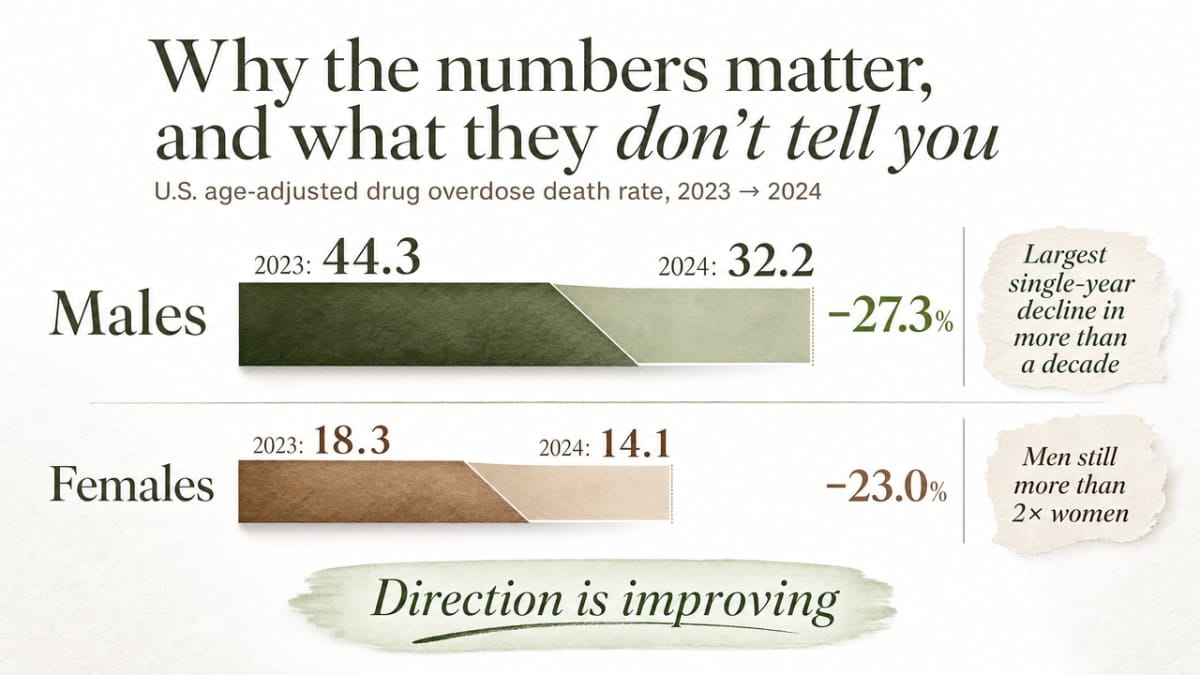
From 2023 to 2024, the age-adjusted drug overdose death rate in the United States dropped 27.3% for males, from 44.3 to 32.2 per 100,000, and 23.0% for females, from 18.3 to 14.1 per 100,000 2. That is the largest single-year decline in more than a decade. Two things are true at the same time. Men are still dying at more than twice the rate women are. And the number is moving in the right direction for the first time in a long time, which means what people are doing — treatment, medication, harm reduction, earlier intervention — is measurably working.
Hold that second part. This is a period in which walking into a clinical pathway is not a symbolic gesture. It is a decision that shows up in the mortality tables.
What the numbers do not tell you is where you sit in them. Age-adjusted national rates include fentanyl deaths in populations you do not resemble, and they exclude the slower harms that are more likely to reach you first: the liver panel that quietly drifts, the blood pressure that stops responding to the usual medication, the atrial fibrillation that shows up at 51, the cognitive fog you have started scheduling around. Mortality is the loudest signal in the data because it is the easiest to count. It is rarely the first signal in a life.
Read the trend as context, not as a verdict on you. The direction of travel says intervention works at population scale. The rate gap says men, as a group, still wait too long. Your job is not to be a data point in either column. It is to make the private, early decision that keeps you out of both.
Why men delay, and why professional men delay longer
Men, as a group, take longer to walk into a treatment room than women do. That is not an opinion. A 2024 review of help-seeking among men found the same barriers turning up across studies and countries: public stigma, self-stigma, embarrassment, the pull of hegemonic masculinity, and a lack of clear information about what treatment actually involves 13. The last one matters more than people give it credit for. You cannot walk into a door you cannot picture.
Layer a profession on top of that, and the delay gets longer.
The clearest analogy comes from medicine. Male physicians are significantly less likely than female physicians to use mental health services, even when their level of distress is the same 9. Same job, same pressure, same access, and the men still opt out. Read that finding as a proxy for what happens in law firms, C-suites, trading floors, operating rooms, and cap tables. When the professional identity depends on being the person who solves other people’s problems, admitting a problem of your own feels like a category error.
A broader review of help-seeking barriers puts three forces at the front of the line: stigma, the desire to handle it independently, and confidentiality concerns 10. You have probably felt all three in the last month. The stigma piece is the one people talk about. The self-reliance piece is the one that actually runs the calendar — a man who has spent thirty years being the competent one in every room does not experience “I need help” as neutral information. He experiences it as a demotion.
The confidentiality piece is where professional men add their own weight. You are not just afraid of what your neighbors will think. You are running a specific risk model that includes your licensing board, your partners, your carrier, your employment agreement, your custody arrangement, and the reporter who occasionally covers your industry. That is a real model. It is not paranoia. It is also solvable, and the delay you are paying while you avoid solving it is expensive in ways that do not show up on the risk model — sleep, marriage, cognition, the slow drift of tolerance that turns a manageable problem into a medical one.
The men who move earliest tend to be the ones who stop asking whether they should get help and start asking who they can talk to privately about what help would look like. That is a smaller, more answerable question. It is also the one you can act on this week.
Reframing control: the substance vs. the process
Here is the reframe that changes the math.
You have been trying to control the substance. Cut back on weekdays. Skip Mondays. Only after 7 p.m. Only wine. Only on the road. Only in the study. The rule set has gotten more complicated over time, which is the tell. A thing that is genuinely under control does not require a rule set.
Trying to out-discipline a substance that is doing neurochemical work for you is the wrong contest. You are a competent adult who has out-disciplined a lot of things. This one keeps winning, and it will keep winning, because the fight is happening on its terrain.
The process is something you are actually good at. You already know how to run one. You pick the right people. You define the intake, the sequence, the timeline, the reporting cadence, the exit criteria. You keep the circle small. You protect the calendar. You measure what matters and adjust when the data says so. You have done this for cases, patients, deals, builds, quarters.
Run this the same way. The variables are medical detox where indicated, a residential or structured clinical setting, real psychiatric assessment, and a continuing care plan that survives your return to work. Control the sequence and the substance stops being the thing you are negotiating with. It becomes an output of a process you are running.
That is a version of control you can actually keep.
What a real clinical pathway looks like
Medical detox and stabilization
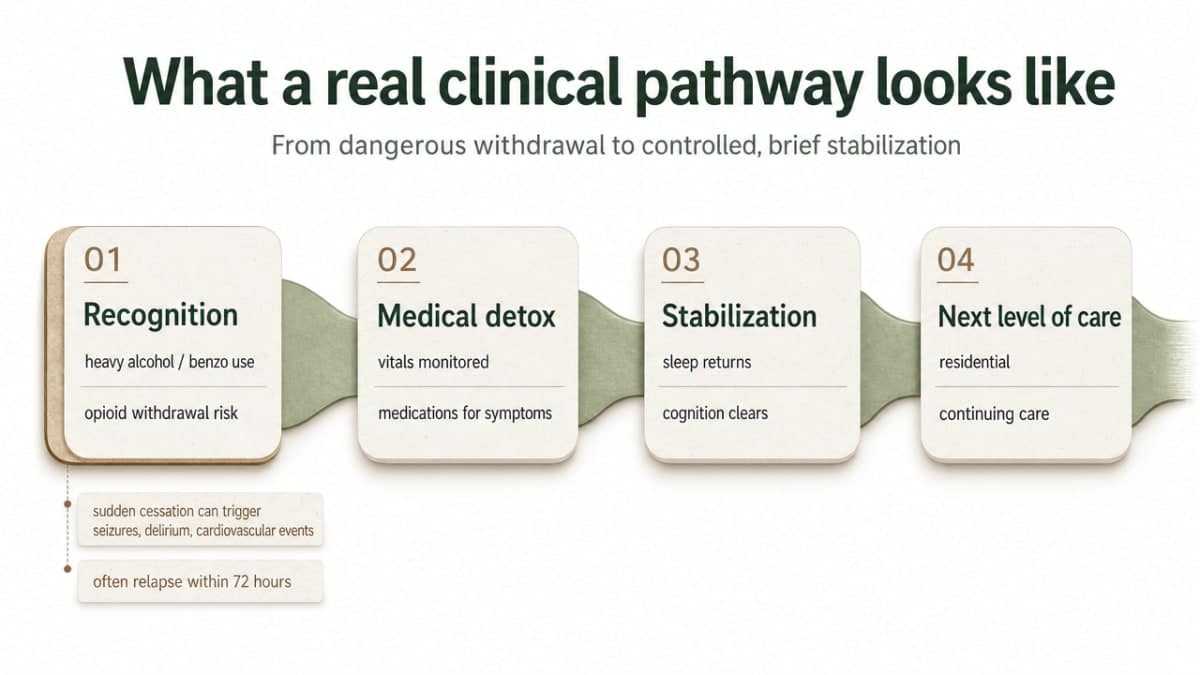
If your body has been running on daily alcohol or benzodiazepines for a long stretch, the first step is not a decision about willpower. It is a medical one. Sudden cessation of heavy alcohol or benzo use can produce seizures, delirium, and cardiovascular events that a hotel room and a bottle of Gatorade will not manage. Opioids do not usually kill you on the way down, but they can make you feel like they might, which is enough to send most attempts back to the substance within seventy-two hours.
Medically supervised detox exists to move that window from dangerous and demoralizing to controlled and brief. You are monitored on vitals. Medications are used to blunt withdrawal symptoms and prevent the worst of them. Sleep starts to return. Cognition clears enough that you can participate in the next decision instead of just surviving the current one.
Detox is not treatment. It is stabilization. Skipping it when your use pattern calls for it does not make you tougher. It makes the next step harder and, in some cases, unsafe. Get through this piece with clinical supervision so the rest of the process is something you can actually run.
Residential care and the outcomes that matter to a professional
The question you are actually asking is not whether treatment works in the abstract. It is whether stepping away from your desk for a defined period produces a return that justifies the absence. That is a fair question, and the evidence answers it in the terms you care about.
Residential treatment, compared with outpatient, is associated with significantly better abstinence outcomes for men in several studies of SUD treatment settings 15. That is the first data point. The second is more specific to your situation. Men who complete residential programs are more likely to be drug-free and employed, and significantly less likely to have been arrested, at twelve-month follow-up than men who do not complete 15. Read that sentence twice. Employment retention and clean legal records are not soft outcomes for you. They are the entire ballgame.
Broader outcome reviews of residential programs support the same direction of travel. Structured, 24-hour care produces substantial reductions in substance use and improvements in psychosocial functioning, particularly when combined with continuing care after discharge 11. The programs that work are not the ones that isolate you for the longest. They are the ones that stabilize you clinically, treat what is underneath the use — anxiety, trauma, chronic pain, ADHD, depression, the sleep debt that started in your thirties — and hand you off to a real aftercare plan.
What does this look like in practice for someone at your level? A small-capacity setting matters more than a large one. You are not going to do the work in a group of eighty. You will do it in a small group where the clinicians actually know your history and the men in the room have jobs and licenses and marriages that resemble yours. Medical detox where indicated, real psychiatric evaluation for co-occurring conditions, individual counseling with someone who has treated professionals before, group therapy that is not performative, and time on your body — sleep, food, movement, sun — that most of your peers have not had in years.
The duration piece is where men argue with the model. Shorter is not better. It is just shorter. The programs that produce the outcomes above are the ones men finish, and completion is the variable that keeps showing up in the twelve-month numbers 15. If you are going to do this, do it long enough to keep the outcomes on your side. The absence is a defined line item. The alternative — three more years of drift, then a forced exit — is not.
Continuing care: what year two actually looks like
Most writing about addiction stops at the intake call. The real work — and the part that determines whether you are still sober at your daughter’s college graduation — starts the week you go home.
The evidence on continuing care is quieter than the evidence on residential treatment, and more honest. A review of aftercare interventions following intensive treatment — outpatient counseling, mutual-help groups, digital check-ins, extended monitoring — concludes that continuing care produces “small but consistent” improvements in substance use outcomes over time 12. Small but consistent is not a marketing line. It is what a functional second year looks like from the inside. You do not feel transformed on a Tuesday. You feel like a person who kept the plan, one week at a time, for fifty-two weeks.
What is on the plan varies, and it should. For most professional men the ingredients cluster around a few nonnegotiables:
- A therapist who knows your history and sees you on a real cadence, not “as needed.”
- A prescriber managing any co-occurring psychiatric conditions or medication-assisted treatment, if that is part of your protocol.
- A peer group of some kind — a men’s meeting, an alumni group, a private circle of two or three people who have been where you are and will pick up the phone.
- Someone who has permission to notice when you are drifting before you do.
Layer in a monitoring piece if it helps you stay honest with yourself. That is where wearables and check-ins earn their keep, and it is the last piece of this pathway worth talking about straight.
An honest read on wearables and remote monitoring
The treatment center you eventually choose may put a wearable on your wrist. It is worth understanding what that device is doing and, more importantly, what it is not.
Here is the cleanest recent trial. A 2025 randomized study of a multi-component wearable program for at-risk drinking — biosensors, coaching, web-based sleep advice, smartphone self-monitoring, the whole stack — did not detect a significant effect on its primary outcome of total drinks compared with an active control 3. Read the full-text version and the picture sharpens: the intervention did not show a significant benefit on total drinks or alcohol-related consequences, though participants across all conditions significantly reduced their drinking and consequences during follow-up 14. Sleep and self-monitoring measures moved. The headline drinking number did not.
That is not a reason to write off the technology. It is a reason to place it correctly.
Transdermal alcohol sensors are accurate enough to provide objective continuous monitoring of alcohol use for up to three months among outpatients with alcohol use disorder, which is a genuine clinical capability 5. A 2025 systematic review of remote monitoring in AUD treatment confirms that smartphones, breathalyzers, and transdermal wearables are the most frequently deployed devices, and that they function primarily as monitoring instruments rather than standalone treatments 7. Earlier work on wearable and wireless mHealth tools reached the same conclusion from a different angle: useful in contingent-reinforcement protocols and in extending the clinician’s view between visits, still experimental as a primary intervention 6.
Put those pieces together and the honest read is this. A wearable will not fix your drinking. A wearable can give a clinician who knows your case a continuous data stream on sleep, heart rate, stress load, and, in the case of transdermal devices, alcohol exposure. That stream lets the person treating you personalize the plan and notice drift earlier than a monthly check-in would. It also gives you a mirror. Some men need the mirror.
The trap to avoid is the one the marketing sometimes sets: a device you buy, wear alone, and expect to do the work of a program. That is not what the evidence supports. The device belongs inside the pathway — detox, residential, continuing care — as a monitoring adjunct that makes the clinical work sharper. Treat it that way and it earns its place. Treat it as the treatment and you have just built a more sophisticated version of the rule set that got you here.
Handling privacy, employment, and disclosure in one honest pass
The confidentiality question is the one that keeps most professional men out of treatment for an extra year or three. Handle it once, cleanly, and it stops being the reason you are still reading this instead of on the phone.
Start with what is actually protected. Communications with a licensed clinician for substance use treatment are covered by federal confidentiality rules that are stricter than standard medical privacy. Your employer does not get a call. Your licensing board does not get a report simply because you walked in. The exceptions are narrow and mostly involve imminent harm or a court order — worth knowing, not worth building your whole risk model around.
Insurance is the seam most men worry about. You can pay privately. Many professional men do, precisely to keep the record off a claims trail. That is a legitimate choice, not a red flag.
Time away is the next question. Short-term medical leave exists for exactly this kind of situation, and the underlying diagnosis on paperwork can be handled at the clinical level you and your prescriber agree on. Colleagues do not need a story. They need a date range.
Disclosure to your spouse, your partners, or your board is a separate decision on a separate timeline. The barriers research names confidentiality as one of the top three reasons men stall 10. Solve it as a logistics problem, not an identity one, and the delay ends.
What to do this week if you’ve read this far
You do not need a plan for the next year. You need three phone calls and a calendar hold.
- The first call is to a physician you trust who is not in your immediate professional circle. Not your golf partner. Not the internist who shares a hospital lounge with your spouse. Someone who can look at your use pattern, your labs, and your medication list, and tell you whether medically supervised detox is on the table. That is a clinical judgment, not a self-assessment. Make the appointment for this week.
- The second call is to a residential program that treats men at your functional level. Ask three questions. What does a typical admission look like for a professional with a demanding role. How is confidentiality handled with insurance, employers, and any licensing exposure. What does the continuing care plan look like on the back end, given that the twelve-month picture is where the outcomes actually live 12. If the answers are vague, keep calling.
- The third call is the one you make to whoever needs to hold your calendar. Not the story. Just the date range.
You have already done the hardest part, which is reading this far without closing the tab.
Frequently Asked Questions
Can I get treatment for addiction without my employer or licensing board finding out?
In most cases, yes. Clinician communications for substance use treatment are covered by federal confidentiality rules stricter than standard medical privacy, and licensing boards are not notified simply because you sought care. Paying privately keeps the record off an insurance claims trail, which is why many professional men do exactly that. Confidentiality concerns are one of the top reasons men stall 10; solve it as logistics.
How do I know if I actually need residential treatment or if outpatient is enough?
The clinical answer comes from an assessment, not a self-test. That said, residential care is associated with significantly better abstinence outcomes for men than outpatient in several studies, particularly for heavier or longer use patterns 15. If daily use, withdrawal symptoms, failed cutback attempts, or a co-occurring psychiatric condition are in the picture, residential is usually the right call. A physician outside your professional circle can help you decide.
Will a wearable or app be enough to help me control my drinking on my own?
No. A 2025 randomized trial of a multi-component wearable program did not detect a significant effect on total drinks compared with an active control, though sleep and self-monitoring measures moved 3. Wearables and remote monitoring function as adjuncts to clinical care, not replacements 7. The device gives your clinician a continuous data stream and gives you a mirror. It does not do the treatment work.
How long does residential treatment take, and can a working professional realistically step away?
Programs typically run several weeks, with the exact length depending on your clinical picture. The variable that predicts twelve-month outcomes is completion, not brevity 15. Shorter stays that you finish beat longer stays that you cut short. Short-term medical leave exists for exactly this situation, and colleagues need a date range, not a diagnosis. Treat the absence as a defined line item against three more years of drift.
What happens after I finish treatment? Am I on my own?
You are not, and this is the piece that determines whether you are still sober in year two. Continuing care — therapy on a real cadence, prescriber follow-up, a peer group, and often some form of monitoring — produces small but consistent improvements in substance use outcomes over time 12. The plan should be built before discharge and survive your return to work. Aftercare is where the outcomes actually live.
I’m still performing at work. Is my drinking or drug use really a problem?
Performance is the last thing to break, not the first. Men meet criteria for substance dependence at higher rates than women, and many of them are still showing up on paper 8. If you have a private rule set, a rising dose or frequency, calendar decisions built around access, or small lies to people you love, the substance is already doing work you are paying for elsewhere.
References
- Men Died of Overdose at 2–3 Times Greater a Rate Than Women in the US in 2020–2021. https://nida.nih.gov/news-events/news-releases/2023/06/men-died-of-overdose-at-2-3-times-greater-a-rate-than-women-in-the-us-in-2020-2021
- Drug Overdose Deaths in the United States, 2023–2024. https://www.cdc.gov/nchs/products/databriefs/db549.htm
- Wearable Intervention for Alcohol Use Risk and Sleep in Young Adults: A Randomized Clinical Trial. https://pubmed.ncbi.nlm.nih.gov/40445615/
- Using mobile phone technology to treat alcohol use disorder: study protocol for a randomized controlled trial. https://pubmed.ncbi.nlm.nih.gov/30594232/
- Accuracy of Wearable Transdermal Alcohol Sensors. https://pmc.ncbi.nlm.nih.gov/articles/PMC9052024/
- Wearable and Wireless mHealth Technologies for Substance Use Disorders. https://pmc.ncbi.nlm.nih.gov/articles/PMC7963000/
- Current approaches using remote monitoring technology in alcohol use disorder treatment: A systematic review. https://pmc.ncbi.nlm.nih.gov/articles/PMC12159286/
- Gender differences in substance use and psychiatric disorders. https://pmc.ncbi.nlm.nih.gov/articles/PMC3777197/
- Gender differences in physician use of mental health services. https://pmc.ncbi.nlm.nih.gov/articles/PMC1447051/
- Barriers to help-seeking for substance use disorders: a systematic review. https://pmc.ncbi.nlm.nih.gov/articles/PMC2847868/
- Residential treatment for substance use disorders: A review of clinical outcomes. https://pmc.ncbi.nlm.nih.gov/articles/PMC3882469/
- Continuing care for substance use disorders: A review of the evidence. https://pmc.ncbi.nlm.nih.gov/articles/PMC5710271/
- Patterns and Challenges in Help-Seeking for Addiction among Men. https://pmc.ncbi.nlm.nih.gov/articles/PMC11508344/
- Wearable Intervention for Alcohol Use Risk and Sleep in Young Adults (Full Text). https://pmc.ncbi.nlm.nih.gov/articles/PMC12125640/
- Treatment Modalities and Settings. https://www.ncbi.nlm.nih.gov/books/NBK144286/
- Interested Persons – Hospital Based Residential Treatment for Substance Use Disorder. https://humanservices.arkansas.gov/wp-content/uploads/Hospital-Based-Residential-Treatment-for-Substance-Use-Disorder-A.pdf