
Key Takeaways
- Intensive outpatient care protects a career only when the level of care fits the clinical picture, workplace protections are used deliberately, and the program treats the job as part of recovery.13
- IOP requires at least 9 hours of weekly structured treatment and matches residential outcomes for patients with low withdrawal risk, stable health, and a supportive home; otherwise residential is often the shorter road back.1, 13
- ADA accommodations and FMLA leave, including intermittent leave, cover schedule adjustments for treatment without requiring you to disclose a diagnosis to HR or your manager.8, 10, 15
- Clinical treatment alone rarely improves employment outcomes, so prioritize programs with built-in vocational support and sequence assessment, legal cover, work handoff, and phased recovery before disclosing anything.5, 7
The Quiet Decision Every High-Functioning Professional Faces
You are probably reading this in a browser tab you will close the moment someone walks by. Maybe it’s between meetings, or after a long closing, or in the car before you go inside. You have been running the same math for months: the drinking or the use is a problem, and pretending it isn’t is starting to cost more than admitting it would.
The fear underneath the search is specific. Not just “can I get better,” but “can I get better without losing what I’ve built.” The partnership track. The practice. The team you hired. The quiet respect of people who have no idea anything is wrong.
Here is the honest frame. Intensive outpatient rehab can absolutely protect a career, and for many working professionals the clinical outcomes are comparable to residential care.1 But that is only true when three things line up: the level of care actually fits your clinical picture, your workplace situation is planned deliberately using the protections you already have, and the program treats your job as part of your recovery instead of a distraction from it.13, 12
This piece will not sell you on outpatient by default. It will help you decide, with the same rigor you would bring to any high-stakes call at work. Read it through once. Then decide what the next call looks like.
What Intensive Outpatient Rehab Actually Looks Like on a Workweek
Hours, Evenings, and the 9-Hour Threshold
The clinical definition is simpler than most people expect. Intensive outpatient treatment means at least 9 hours of structured care per week, delivered to people who don’t need 24-hour supervision but need more than a weekly therapist visit.2 That’s the floor. Many programs run 9 to 12 hours; some go higher in early phases and taper down.
What that looks like on a calendar matters more than the number itself. A common structure is three sessions per week, roughly three hours each, most often scheduled in the evening. Picture Monday, Wednesday, and Thursday from 6:00 to 9:00 p.m. You keep the workday. You keep the morning stand-up, the afternoon deposition, the drive home. Then you go to treatment instead of the bar, the client dinner, or the empty condo.
Some programs offer early-morning tracks that end before 9:00 a.m., which can work if your calendar loads up in the afternoon. Weekend intensives exist too, usually a longer Saturday block for men whose weekdays cannot bend.
The point of the 9-hour threshold isn’t just dose. It’s frequency.2 Meeting three times a week creates enough contact to interrupt patterns that a once-weekly session can’t touch. That’s why IOP is designed the way it is, and why it works around a real job instead of replacing one.
What Happens Inside the Room: Group, Individual, Medication, Family
Most of your hours will be in group. Not the caricature you’re picturing. A well-run group is eight to twelve adults with a licensed clinician, working through relapse triggers, cognitive-behavioral skills, and the actual mechanics of not drinking or using when the week goes sideways. The other men in the room will look more like you than you expect.
You’ll also get individual counseling, usually weekly, sometimes more in the first month. This is where the personal history lives: the marriage, the fight with your dad, the deal that nearly broke you last year.
If your clinical picture calls for it, medication is part of the plan. Naltrexone, acamprosate, or disulfiram for alcohol. Buprenorphine or naltrexone for opioids. Psychiatric medication for the depression or anxiety underneath the use. A prescriber inside the program manages it so nothing falls through the cracks between providers.13
Family sessions are optional in most programs and worth taking. Your spouse has been carrying something too, and giving her a room and a clinician tends to change the odds at home. IOPs also typically integrate 12-step or SMART Recovery meetings on the nights you’re not in program, so support keeps running when clinical hours don’t.13
Confidentiality, Telehealth, and Discretion
Your medical records for substance use treatment sit under stricter federal protection than most of your other health information. Programs can’t confirm you’re a patient, share notes, or respond to a subpoena without your written authorization, with narrow exceptions. That’s real cover, not marketing language.
Telehealth widens the discretion further. Many IOPs now run all or part of programming over secure video. You can do group from a home office, a hotel room during a work trip, or a locked door in the guest room after the kids are asleep. No parking lot, no waiting room, no one who might recognize you from the firm’s floor.
Practical discretion is worth planning explicitly. Ask how the program bills, how it appears on an EOB your spouse might see, whether appointments show up on any shared calendar system, and whether messages arrive by text, email, or portal. These are ordinary questions. A program used to working with professionals will have clean answers.
Is IOP the Right Level of Care for You, Honestly
When IOP Fits, and When Residential Is the Shorter Road Back to Work
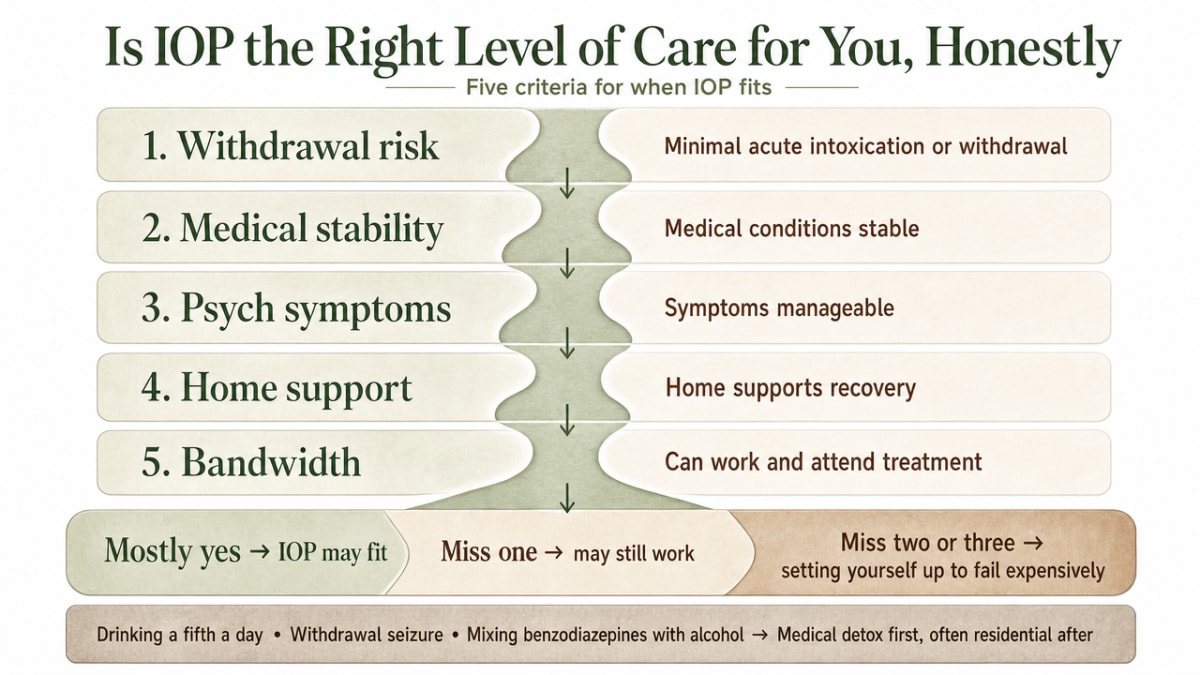
The honest answer depends on five things, and any decent clinical assessment will walk you through all of them. SAMHSA’s guidance on IOP places the threshold where you’d expect it: outpatient works when:
- the risk of acute intoxication or withdrawal is minimal,
- medical conditions are stable,
- psychiatric symptoms are manageable,
- your home environment supports recovery, and
- you have the bandwidth to hold a job and show up to treatment.13
Miss on one, and IOP can still work. Miss on two or three, and you’re setting yourself up to fail expensively.
Read that list against your actual life. If you’re drinking a fifth a day, or you’ve had a withdrawal seizure, or you’ve been mixing benzodiazepines with alcohol, medical detox comes first and often residential after that. If the depression underneath the drinking has you thinking about not being here anymore, that’s a psychiatric stability question, and outpatient is not the containment you need. If home is where the drinking happens because your marriage is in freefall or your business partner drinks with you every night, the environment criterion is failing.2
The Clinical Equivalence Claim, Read Carefully
You have probably seen the headline: IOP works as well as residential. It’s mostly true, and the qualifier matters.
A systematic review of intensive outpatient programs found that substance use outcomes at follow-up did not differ significantly between inpatient and intensive outpatient settings, with substantial reductions in use and increases in abstinence across both.1 SAMHSA states the same thing in plainer language: IOP outcomes are comparable to residential services for clients with minimal risk of acute withdrawal, stable health conditions, and manageable psychological symptoms.13
Notice what that sentence is actually saying. Equivalence holds for the population that meets IOP criteria in the first place. It is not a claim that IOP is as good as residential for a man in acute withdrawal, or for someone whose home is a trigger factory, or for a partner who cannot get through a Tuesday without using at lunch. Comparing outcomes across settings only makes sense when patients are matched to the setting they belong in.1
Take the equivalence claim as permission, not a promise. If you fit the criteria, you can protect your calendar and get results in line with what residential would deliver. If you don’t fit, the same evidence base is quietly telling you a different answer. Use the assessment to find out which one you are before you commit to a schedule.
Your Legal Cover: ADA and FMLA in Plain Language
ADA Accommodations You Can Actually Ask For
Substance use disorder can qualify as a disability under the Americans with Disabilities Act, which means you have the right to request a reasonable accommodation to attend treatment. That’s the headline. The useful part is what the accommodation actually looks like on your calendar.
The EEOC lists concrete examples: an altered break or work schedule so you can attend treatment, a change in shift assignment, or a temporary transfer to another position.8 In IOP terms, that’s the difference between explaining a mysterious three-evening pattern and having a documented schedule adjustment on file. If you’re on medication-assisted treatment, the ADA also protects you from being fired or denied a job because you’re in a MAT program, unless you cannot safely and effectively perform the job or another federal law disqualifies you.9
What you cannot get with an accommodation: a pass on performance or conduct standards. Employers can still hold you to the same output and behavior as anyone else in your role.15 Miss the deadline and the ADA does not undo the miss. That cuts both ways. It also means a well-timed accommodation, requested before performance slips, is far stronger than one requested after a warning.
Ask in writing. Keep it short. Say you have a medical condition, you’re pursuing treatment, and you need a specific schedule adjustment for a defined period.
FMLA Leave, Partial Leave, and the Safety-Sensitive Exception
The Family and Medical Leave Act gives eligible employees up to 12 weeks of job-protected, unpaid leave in a 12-month period for a serious health condition. The Department of Labor is explicit that substance use disorder treatment can qualify as a serious health condition when provided by a healthcare provider.10 That means your job and group health benefits stay in place while you’re in treatment, if you qualify.
You qualify if you’ve worked for a covered employer for at least 12 months, put in 1,250 hours in the prior year, and work at a site with 50 or more employees within 75 miles.10 Most professionals at established firms clear the bar without thinking about it.
Two features matter for IOP specifically. FMLA leave can be taken intermittently or on a reduced schedule when medically necessary. That’s the mechanism for leaving early three days a week for evening group, or blocking off Wednesday afternoons for individual counseling and medication management, without burning through 12 straight weeks. And FMLA runs concurrently with any ADA accommodation, so you can use both at once.
The narrow exception: FMLA protects leave for treatment, not consequences of violating workplace substance policies.10 If you’re in a safety-sensitive or federally regulated role, some opioid or MAT restrictions may still apply.9 Ask about your specific role before you assume full cover.
What to Say to HR, and What You Don’t Have to Disclose
You do not have to name the diagnosis. Not to your manager, not to HR, not on the FMLA paperwork you sign. You have to say enough to trigger the process, and no more.
Here is what that sounds like in practice. To HR:“I have a serious health condition and I’m starting a course of treatment with my healthcare provider. I’d like to request FMLA leave and a reasonable accommodation for my schedule. My provider can complete the medical certification.”That’s the whole disclosure. Your clinician fills in the clinical details on the certification form, which HR is required to keep confidential and separate from your personnel file.15To your direct manager, even less:
“I’ll be out early on Mondays, Wednesdays, and Thursdays for the next few months for a medical reason. HR has the paperwork.”No diagnosis. No program name. No apology.
Ask HR two questions before you sign anything:
- Where is medical information stored, and who has access.
- What is the process if my role changes or a new manager comes in.
Get the answers in writing. That paper trail is your protection if anything drifts later.
The Missing Ingredient: Vocational Support Built Into Treatment
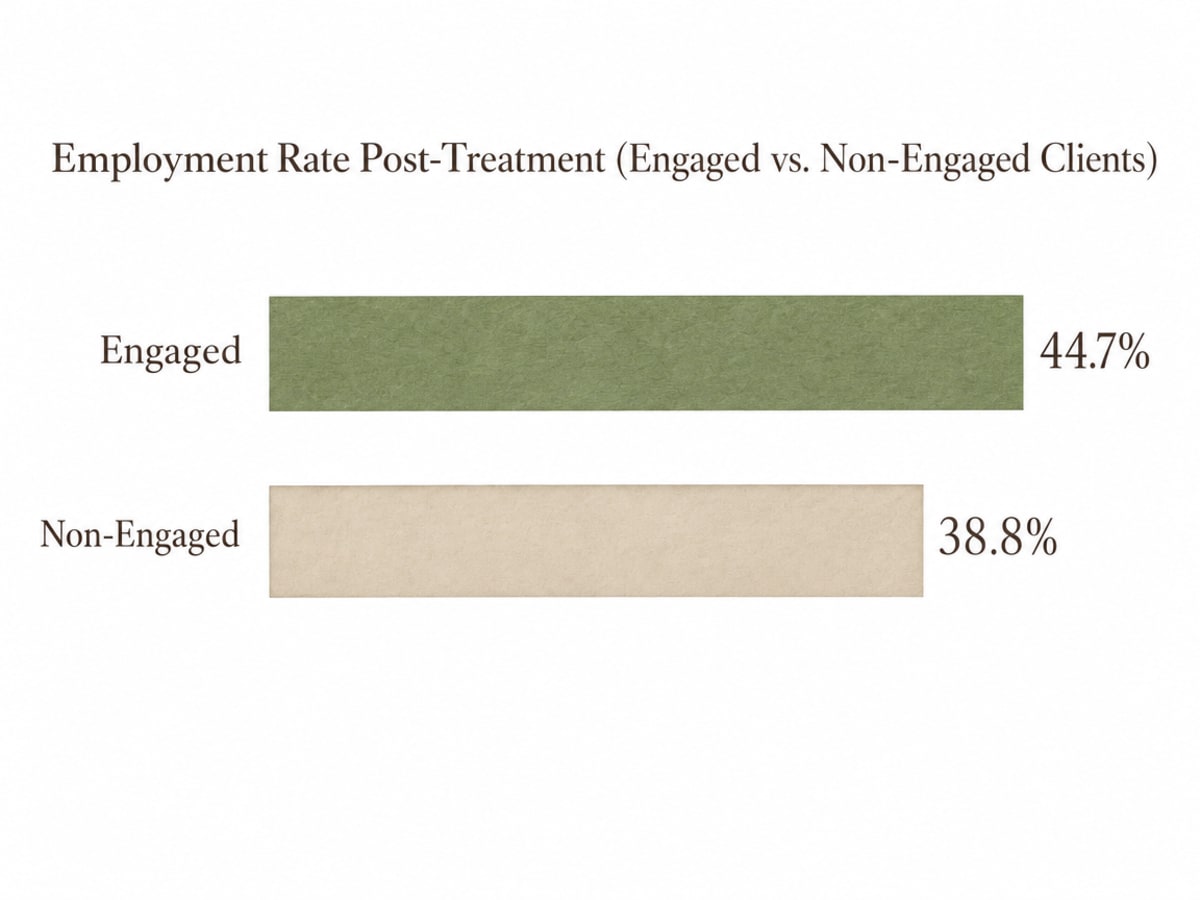
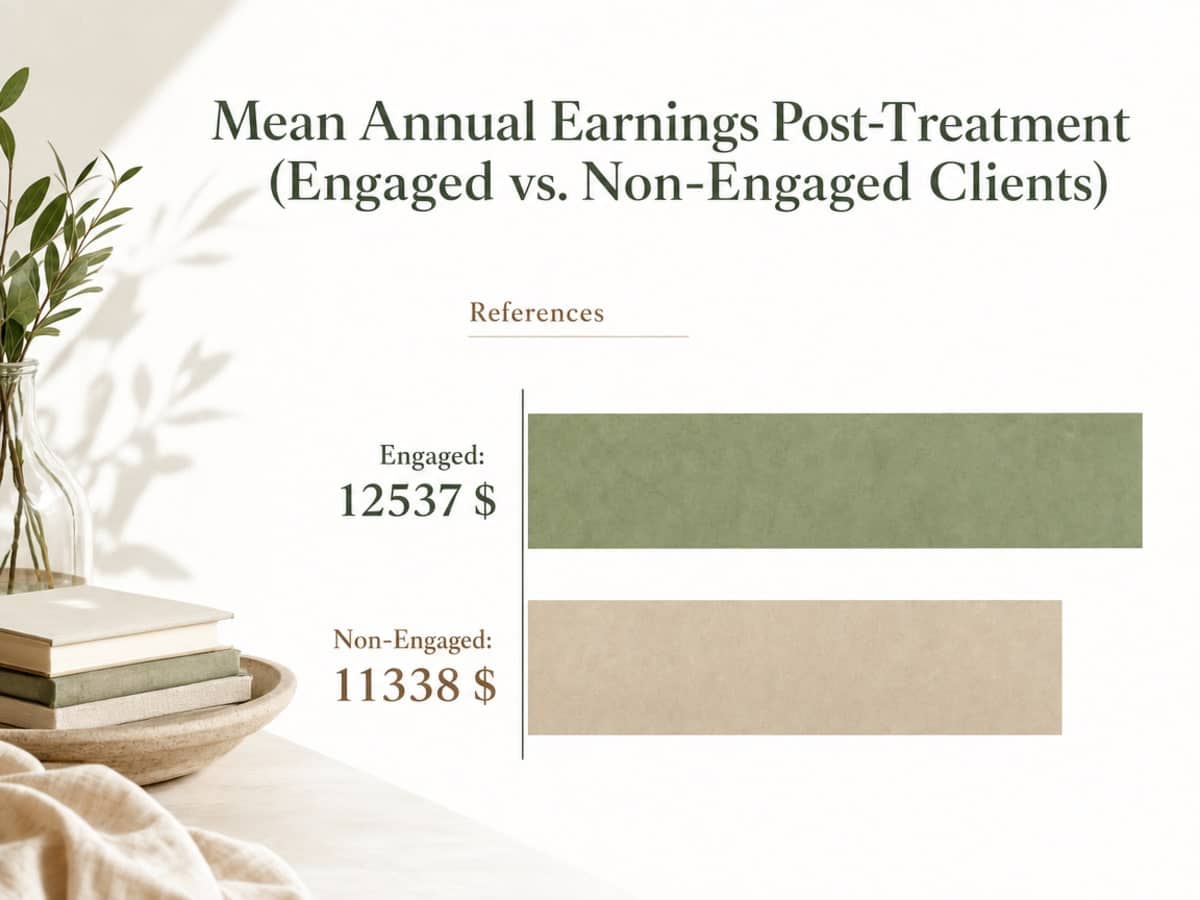
Here is the tension most articles about outpatient rehab quietly avoid. The clinical evidence for IOP is real, and the employment evidence is thinner than you’d hope. A study using administrative and employment records found that clients engaged in outpatient treatment had a 44.7% employment rate in the year after, compared to 38.8% for non-engaged clients, and mean earnings of $12,537 versus $11,338.3 Better, yes. But when researchers controlled for other variables, treatment engagement was not a significant predictor of employment.3 A broader federal review reaches the same conclusion in plainer terms: substance use treatment programs on their own do not reliably improve the employment status of the people who complete them.5
Read that carefully before you draw the wrong conclusion. It is not that treatment doesn’t work. It is that treatment alone treats the addiction and leaves the work life to chance. For a professional whose career is the thing he’s trying to protect, that is the gap to close.
What closes it is vocational support built into the program itself. A systematic review of employment interventions for people with substance use disorders identified Individual Placement and Support and Customized Employment Supports as the models with the strongest evidence.7 In a randomized trial with dual-diagnosis clients, IPS produced a cumulative competitive employment rate of 60% over 18 months, compared to 24% in traditional vocational services.6 A dissertation study of an IOP with a vocational counseling component found that longer participation was associated with higher rates of full- and part-time employment and lower drug-use severity.14
Practically, this means asking a program a different set of questions:
- Do you have a vocational counselor on staff.
- Can my treatment plan include performance-related goals, like managing a return from FMLA leave or rebuilding trust with a partner at work.
- Do you coordinate with an executive coach or an employment specialist if I need one.
If the answers are vague, you are being offered clinical care and hoping the work part sorts itself out. It usually doesn’t.5 For a career you’ve spent twenty years building, that hope is too expensive.
Relapse Prevention That Fits a Professional Calendar
Wearables, Biosensors, and EMA: What They Can and Can’t Do
Relapse rarely announces itself on a Monday morning. It builds over a week you didn’t sleep well, a client that pushed a deadline, a Thursday night where the old script started running in your head. The point of tech-enhanced monitoring is to catch that arc earlier than you would on your own.
A systematic review of wearable and wireless mHealth technologies concluded these tools can help decrease heavy substance use, address relapse triggers, and monitor for overdose risk in people with SUD.11 The mechanism is passive. A wrist-worn device tracks heart rate, heart rate variability, and sleep. A short prompt on your phone asks how you’re doing at unpredictable moments. Over time, the pattern of your baseline becomes visible, and so do the deviations from it.
The evidence is early but real. A pilot study using wrist sensors detected self-reported stress and craving episodes with 75 to 77 percent accuracy, and participants in recovery generally accepted continuous monitoring.16 A 2023 study combining wearables with ecological momentary assessment found that heart rate variability was significantly elevated in the week before drug use recurrence compared to periods of sustained abstinence.17 For alcohol specifically, biosensor reviews report good feasibility and acceptability of continuous monitoring in outpatient treatment.19
Use these tools for what they are: an early warning system that gives your clinician a reason to call before Thursday, not a lie detector or a guarantee.
Privacy Trade-Offs Worth Naming
Anything that generates data about you is a decision about who sees that data. Worth naming before you strap on a device.
Ask three questions of any program using wearables:
- Who owns the raw data, you or the vendor.
- Who inside the clinical team can see it, and under what circumstances would it ever leave the clinical team, including in response to a subpoena or an employer request.
- What happens to the data if you leave the program.
Reviewers of this technology have flagged privacy and data security as ongoing concerns, along with the possibility of coercive use by courts or employers.11, 19 Your treatment records for SUD sit under strong federal protection, but consumer wearable accounts often do not. If the device syncs to a personal cloud account, that account is not covered by the same rules as your clinical chart.
The practical move is to use a program-issued device, tied to a program account, with a written data policy you’ve actually read. That way the monitoring works for you, not around you.
Sequencing Treatment So Your Job, Reputation, and Income Stay Intact
Think of the next six months as a project plan. You would not launch a product without a rollout sequence, and your recovery deserves the same discipline. The order of operations matters more than any single decision inside it.
- Start with the clinical assessment before you touch HR. A licensed provider needs to tell you whether IOP fits or whether a short residential stay is the shorter road back.13 Do that first, in a private appointment, and get the level-of-care recommendation in writing. It becomes the anchor for everything that follows: the medical certification for FMLA, the accommodation request under the ADA, the timeline you give your spouse.
- Secure the legal cover before you disclose anything narrative. File FMLA paperwork with your provider’s certification, and submit the ADA accommodation request in writing for the schedule shape you need.10, 15 Both go through HR, not your direct manager. You are building a paper record that protects you if leadership changes or someone in the org gets curious later.
- Plan the work handoff. Identify the two or three matters that cannot wait, hand them to a trusted colleague with a clear scope, and set an out-of-office rhythm that matches your IOP schedule. If a full residential block is the right call, block the calendar as a defined medical leave and let a covering attorney, partner, or deputy carry the load for a discrete window.
- Sequence the recovery work itself as phases, not a sprint. The first 30 days inside IOP are stabilization: full attendance, medication dialed in, sleep back on the rails. The next 60 to 90 days are integration, where you rebuild performance rhythm at work while continuing group and individual sessions. Aftercare and alumni support extend past program completion, because recovery outcomes track with sustained employment, not with graduation dates.12, 14
One more move worth making early. Tell one person outside of work who is not your spouse. A brother, a longtime friend, a sponsor. Reputation risk at the office is real, but isolation is what actually breaks men in the first six weeks. A single trusted voice outside the calendar is not weakness. It is the redundancy any serious plan builds in.
Frequently Asked Questions
How many hours per week does intensive outpatient rehab actually require?
The clinical floor is 9 hours of structured treatment per week for adults who do not need 24-hour supervision.2Most programs run 9 to 12 hours across three sessions, often scheduled in the evening so the workday stays intact. Some offer early-morning or weekend tracks. Hours typically taper as you progress through phases.
Can my employer fire me for going to intensive outpatient rehab?
Not for seeking treatment itself. Substance use disorder can qualify as a disability under the ADA, which protects you from being fired for being in treatment or on medication-assisted treatment, unless you cannot safely perform the job or a federal safety law disqualifies you.9Performance and conduct standards still apply, so request accommodations before problems surface.15
Is IOP as clinically effective as residential treatment?
For the right patient, yes. A systematic review found substance use outcomes at follow-up did not differ significantly between inpatient and intensive outpatient settings.1SAMHSA states IOP outcomes are comparable to residential for clients with minimal withdrawal risk, stable health, and manageable psychological symptoms.13Equivalence assumes you meet IOP criteria; miss them, and residential is often the shorter road back.
Do I have to tell HR the specific reason I need time off?
No. You need to say enough to trigger the FMLA and ADA process, not name a diagnosis. Tell HR you have a serious health condition, you are pursuing treatment, and you need a schedule adjustment and leave. Your provider fills in clinical details on the medical certification, which HR must keep confidential and separate from your personnel file.15
What if IOP isn’t enough and I need residential care partway through?
Stepping up in care is a clinical decision, not a failure. If withdrawal risk rises, psychiatric symptoms destabilize, or your home environment stops holding, a short residential stay may be the shorter path back to work.13Your existing FMLA leave and ADA accommodations can flex to cover a residential block, provided your provider updates the medical certification with the new plan.10
Does FMLA cover leave for substance use disorder treatment?
Yes, when the treatment is provided or referred by a healthcare provider. The Department of Labor confirms substance use disorder treatment can qualify as a serious health condition, and eligible employees may take up to 12 weeks of job-protected leave, including intermittent leave for evening IOP sessions.10FMLA protects leave for treatment, not consequences of violating workplace substance policies.10
References
- Substance Abuse Intensive Outpatient Programs: Assessing the Evidence. https://www.ncbi.nlm.nih.gov/pmc/articles/PMC4152944/
- Chapter 8. Intensive Outpatient Treatment Approaches. https://www.ncbi.nlm.nih.gov/books/NBK64102/
- Engagement in Outpatient Substance Abuse Treatment and Employment Outcomes. https://www.ncbi.nlm.nih.gov/pmc/articles/PMC3796147/
- Intensive Case Management Improves Substance Abuse and Employment Outcomes of Female Welfare Recipients: Preliminary Findings. https://aspe.hhs.gov/sites/default/files/migrated_legacy_files/113501/substance_abuse.pdf
- Building Evidence-Based Strategies to Improve Employment and Earnings for People with Substance Use Disorders. https://acf.gov/sites/default/files/documents/opre/BEES_SUD_Paper_508.pdf
- The Effectiveness of Supported Employment in People With Dual Diagnosis: A Randomized Controlled Trial. https://www.ncbi.nlm.nih.gov/pmc/articles/PMC3530026/
- The Effectiveness of Interventions Intended to Improve Employment Outcomes for People with Substance Use Disorder: A Systematic Review. https://pubmed.ncbi.nlm.nih.gov/32781876/
- How Health Care Providers Can Help Current and Former Patients Who Have Used Opioids: Information for Health Care Providers. https://www.eeoc.gov/laws/guidance/how-health-care-providers-can-help-current-and-former-patients-who-have-used-opioids
- Use of Codeine, Oxycodone, and Other Opioids: Information for Employees. https://www.eeoc.gov/laws/guidance/use-codeine-oxycodone-and-other-opioids-information-employees
- Family and Medical Leave Act: Frequently Asked Questions. https://www.dol.gov/agencies/whd/fmla/faq
- Wearable and Wireless mHealth Technologies for Substance Use Disorders: A Systematic Review. https://pubmed.ncbi.nlm.nih.gov/33738178/
- An Overview of Recovery-Oriented Systems of Care: Implications for Future Addiction Treatment. https://pmc.ncbi.nlm.nih.gov/articles/PMC6019008/
- Clinical Issues in Intensive Outpatient Treatment for Substance Use Disorders. https://library.samhsa.gov/sites/default/files/pep20-02-01-021.pdf
- The Impact of a Vocational Counseling Based Substance Abuse Intensive Outpatient Program on Work and Well-Being Outcomes. https://thescholarship.ecu.edu/items/d8b0eaf1-9237-4fea-a7c9-d02b28140b53
- Mental Health Conditions: Resources for Job Seekers, Employees, and Employers. https://www.eeoc.gov/mental-health-conditions-resources-job-seekers-employees-and-employers
- Wearable Sensor-Based Detection of Stress and Craving in Substance Use Disorder: A Pilot Study. https://pmc.ncbi.nlm.nih.gov/articles/PMC7197459/
- Identifying Biomarkers of Drug Use Recurrence Using Wearable Biosensors and Ecological Momentary Assessment. https://pmc.ncbi.nlm.nih.gov/articles/PMC10416187/
- Portable Biosensors for Assessment of Drug Use in the Natural Environment. https://dspace.mit.edu/bitstream/handle/1721.1/106171/13181_2014_Article_439.pdf
- A Review of Wearable Biosensors in Alcohol Use Disorder Treatment. https://pmc.ncbi.nlm.nih.gov/articles/PMC8019775/
- SSA Disability Evaluation Under Social Security: 12.00 Mental Disorders – Adult. https://www.ssa.gov/disability/professionals/bluebook/12.00-MentalDisorders-Adult.htm