
Key Takeaways
- A state license alone does not guarantee evidence-based care, since fewer than half of state regulations require proven therapies 2; ask which specific modalities you will receive and from whom.
- A polished daily schedule is not a clinical model; demand named therapies, individualized weekly hours, a board-certified medical director, and access to FDA-approved medications when clinically indicated 1.
- Patient brokers target commercially insured professionals with unsolicited calls, free flights, and cash inducements 11; ask directly whether the caller is a facility employee or a paid referral partner, and hang up if the signals appear.
- Excessive urine drug screening tied to affiliated labs and multiple billing entities per admission mirrors patterns in federal fraud actions 7, 8; require a plain-English walkthrough of testing frequency, lab ownership, and billing structure.
- Specific success-rate claims cannot be substantiated because rigorous peer-reviewed outcome studies of residential treatment are lacking 3; press for population, definition, follow-up window, and independent audit, or discount the number entirely.
Why the premium end of the market attracts the worst actors
If you are quietly reading this from a corner office, an empty exam room, or a hotel bar on a Tuesday night, you already know the stakes. A private residential program is supposed to buy you the two things you cannot get on an outpatient schedule: distance from your usual triggers and a clinical team paying attention to you around the clock. What you may not know is that the same profile that makes you a good candidate for premium care — commercial insurance, personal funds, willingness to travel, a strong reason to stay quiet — is exactly what makes you a target.
Federal investigators keep finding the pattern. The 2024 National Health Care Fraud Enforcement Action charged addiction treatment cases tied to more than $146 million in allegedly false and fraudulent claims for services billed against vulnerable patients seeking care for drug or alcohol addiction 7. Those patients were not just uninsured people on the margins. Many of them were commercially insured adults who walked in, or were flown in, believing they had chosen a serious clinical program.
The premium tier attracts bad actors because the margins are highest there, oversight is thinnest, and the buyers rarely file complaints. You are not going to call your state licensing board and explain how you ended up in a facility that bills your carrier for a urine screen every 48 hours. That silence is priced into the model.
The five red flags below are the ones you can screen for on a phone call and a short document review, before you ever board a flight or sign an admissions agreement.
Red Flag 1: Licensure without evidence-based treatment requirements
Every private rehab you will call has a license. That is table stakes. The problem is that the license, on its own, tells you far less than the marketing pages imply.
A peer-reviewed review of state oversight of adult residential treatment for behavioral health conditions found that while most states require licensure and some inspections, less than half of state regulations for substance use disorder residential treatment explicitly require the use of any evidence-based treatment 2. This does not mean half of facilities deliver bad care, but rather that the licensing floor in most states does not mandate therapies with clinical evidence. A program can be fully licensed, pass its inspections, and still rely on methods its clinical director prefers.
That gap is the one you have to close yourself, on the phone, before you ever talk about arrival dates.
When you call, ask which specific evidence-based modalities the program uses and how they are integrated into your weekly schedule. You are listening for named therapies with real research behind them: cognitive behavioral therapy, motivational enhancement, contingency management, relapse prevention, and, where clinically indicated, FDA-approved medications for alcohol or opioid use disorder. You are also listening for a coherent answer about who delivers each modality — a licensed clinical psychologist, a master’s-level therapist, a board-certified addiction psychiatrist — and how often. A serious program can tell you within two minutes which therapies you will receive, from whom, and how many hours per week. A thin program will pivot to amenities, community, or the founder’s story.
Ask, plainly, whether the program follows ASAM criteria for placement and continued stay decisions. Ask whether the medical director is board-certified in addiction medicine or addiction psychiatry, and how often that physician is on site. Ask how co-occurring depression, anxiety, ADHD, or trauma is assessed and treated, not just acknowledged. If the answer is that everyone gets the same package, you are looking at a program built around a schedule, not around patients.
Then request two documents before you commit: the current state license with expiration date, and any national accreditation from The Joint Commission or CARF, including the survey date. Accreditation is not a guarantee of clinical rigor either, but the absence of it in a facility charging premium rates is worth an explanation.
None of this is hostile. You are a professional making a medical decision that will pull you offline for weeks. Asking a treatment center to describe its clinical model in specific terms is the same due diligence you would bring to any other consequential vendor. The programs worth your time will welcome the questions. The ones that get defensive have just told you something useful.
Red Flag 2: A thin clinical model dressed as a residential program
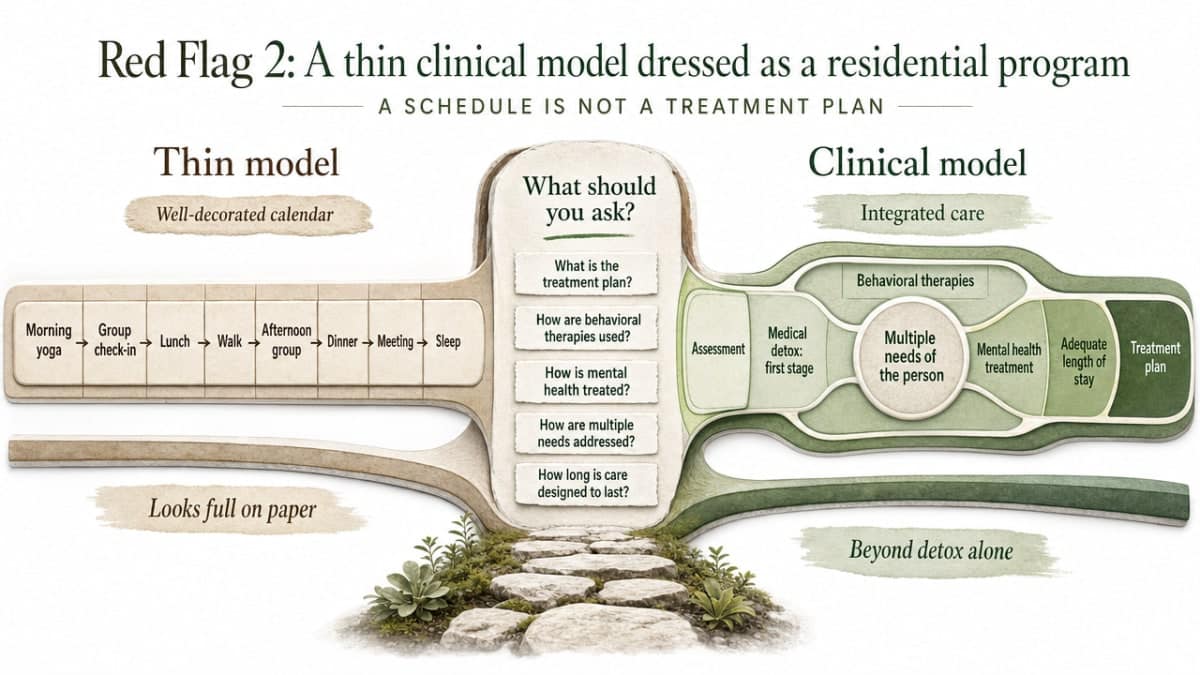
A schedule is not a treatment plan. That distinction matters, because a lot of what gets sold as premium residential care is a well-decorated calendar: morning yoga, a group check-in, lunch, a walk, an afternoon group, dinner, a meeting, sleep. Add a beach or a mountain view and the whole thing photographs beautifully. What it does not do, on its own, is treat a substance use disorder.
NIDA’s principles of effective treatment are clear on this point. Medical detoxification is only the first stage and by itself does little to change long-term substance use. Effective care attends to the multiple needs of the person, not just the drug or alcohol, and integrates behavioral therapies with mental health treatment over an adequate length of stay 1. That means the residential program you are paying for should look, on paper, like a coordinated clinical intervention with named modalities, defined dosing, and a physician accountable for the medical plan. Not a wellness retreat with a nurse on call.
Here is how you tell the difference on a phone call. Ask the admissions clinician to walk you through a typical week for a patient with your presentation — not a marketing overview, an actual week. You want to hear specific counts: how many hours of individual therapy with a licensed clinician, how many hours of clinician-led group therapy (not peer-led community meetings, which are valuable but different), how many psychiatric appointments, how many family sessions if that applies. Ask what happens in weeks two, three, and four, and how the plan changes based on what the team is seeing. If everyone gets roughly the same schedule from day one to discharge, the program is not individualizing care.
Then ask about the medical model. Who is the medical director, and what are their credentials in addiction medicine or addiction psychiatry? How often are they physically on site, and who covers when they are not? Is medication for alcohol or opioid use disorder — naltrexone, buprenorphine, acamprosate — available when clinically appropriate, or does the program’s philosophy quietly rule it out? A program that treats FDA-approved medication as ideologically off the table is telling you it prefers a brand over the evidence.
Co-occurring conditions deserve their own answer. Depression, anxiety, ADHD, insomnia, trauma histories — these travel with high-functioning drinking and stimulant use more often than not, and they are the exact conditions a thin program will acknowledge in a brochure and ignore in a treatment plan. Ask specifically who diagnoses and treats co-occurring disorders, how often you would see a psychiatrist, and whether medication management is included or billed as an outside consult you have to arrange yourself.
The last question is about time. NIDA emphasizes adequate duration 1, and adequate is longer than most people expect. If a program’s default stay is built around a 28-day insurance cycle and the clinical team has no clear process for extending when the work is not done, you are looking at a business calendar dressed as a clinical decision.
None of this means amenities are bad. A comfortable environment matters, especially when you are stepping away from a demanding role and need to actually sleep. But amenities are the wrapper, not the medicine. If the answers to these questions come back thin — vague on modalities, evasive on the medical director, silent on medication options, uniform on schedule — the residential setting is doing decorative work. You deserve a program where the clinical model is the product and the setting is the support, not the other way around.
Red Flag 3: Patient brokers, free flights, and the professional’s insurance card
You are the profile brokers hunt for. Not because you are naive, but because your insurance card, your discretion, and your travel flexibility make you the highest-margin admission a facility can book. When federal investigators describe how the addiction treatment industry monetizes vulnerable patients, they are describing a machine that runs on exactly your inputs.
The House Energy and Commerce Committee’s hearing memo on patient brokering laid out the mechanic plainly: individuals known as patient brokers treat people seeking treatment for addiction as a commodity, using bribes and kickbacks and steering them to facilities that bill for unnecessary services rather than helping them receive legitimate care 11. That is not a colorful metaphor. It is a description of a referral economy where your body, once admitted, generates billable events for a facility that paid to get you there.
GAO investigators found the same pattern extending into affiliated recovery homes: some operators exploit residents by sending them to providers who bill insurance for unneeded tests and share the insurance payments with the operators 5. The tests are real. The billing is real. What is not real is the clinical necessity.
Here is what the broker approach looks like when it reaches you. An unsolicited call from a warm, sympathetic voice who somehow knew to reach out — often after you filled out an online form, called a hotline, or clicked a search ad that was not, in fact, the facility it appeared to be. A quick offer to verify your insurance benefits over the phone. An unusually smooth pivot to a specific facility in Florida, California, or Arizona. Then, if you hesitate: an offer to cover your flight, arrange ground transportation, or waive a portion of your out-of-pocket cost as a scholarship or professional courtesy. In some cases, a direct cash inducement to check in.
Ask that question out loud. “Are you an employee of the facility, or are you a referral partner compensated for admissions?” A clinical admissions team will answer without hesitation. A broker will hedge, redirect to your insurance benefits, or reframe the question as trust.
Two more questions worth asking on that same call. First: “Which entity will actually bill my insurance — the facility, an affiliated lab, or a separate management company?” Multiple billing entities attached to a single admission is a pattern that shows up repeatedly in enforcement actions. Second: “How does the facility handle urine drug screening — how often, at what cost, and billed to whom?” You are not being rude. You are asking the questions the fraud examiners ask, before you become the case study.
If any of the broker signals show up, hang up. The right program will still be there when you call it directly, through a number you found on its licensed state record, not the number that called you.
Red Flag 4: Billing patterns that look like fraud enforcement actions
The clearest way to spot a fraudulent private rehab is to read a federal press release and then ask the facility, directly, whether any of the described patterns apply to how it operates. The cases are not subtle. They are billing patterns you can name.
Two figures are worth holding in your head as you screen. The 2024 National Health Care Fraud Enforcement Action charged addiction treatment cases tied to more than $146 million in allegedly false and fraudulent claims for services billed to vulnerable patients seeking care for drug or alcohol addiction 7. And the largest addiction treatment fraud case prosecuted by DOJ to date involved a physician who pled guilty to conspiracy for authorizing fraudulent tests for addiction patients across more than 50 treatment centers and sober homes, with bogus urine drug screens and procedures billed at scale 8. One action, one case, two very different scales — and both center on the same mechanic: services that were billed but not clinically necessary.
Urine drug screening is the piece to watch. Screening has a legitimate clinical purpose. It confirms sobriety, catches early relapse, and informs medication decisions. What it should not be is a revenue center. When a facility runs high-cost confirmatory panels multiple times a week on every patient regardless of clinical indication, sends specimens to an affiliated lab, and structures its billing so the lab and the facility are the same economic interest under different names, you are looking at the pattern the FY 2023 HHS OIG report describes 8. A peer-reviewed analysis of fraud, waste, and abuse in SUD treatment frames this cleanly: as the opioid crisis has re-intensified, the potential for fraudulent, wasteful, or abusive practices has grown, and excessive testing is one of the recurring signals 6.
Ask the questions in the order a fraud examiner would.
- How often will urine drug screens be ordered for a patient with my presentation, and what triggers a confirmatory test versus a point-of-care cup?
- Which laboratory processes the samples, and does the facility have any ownership stake, referral relationship, or shared management with that lab?
- What is the expected total billed amount for testing across a typical 30-day stay, and how is that split between the facility and the lab?
- Are any other services — psychiatric consults, group therapy hours, medication management — billed by separate entities that will appear as distinct line items on my explanation of benefits?
You are not looking for a facility with zero testing. You are looking for a facility that can explain, without pausing, why each test is ordered, who performs it, who bills it, and what the aggregate looks like. A clinical program will have those answers rehearsed because clinicians ask them internally. A billing-driven program will treat the questions as intrusive.
One more filter. Ask whether the admissions team can send you a sample explanation of benefits or itemized bill from a recent patient, redacted for privacy. Some programs will. When they do, look for the same service billed in tight repetition, multiple billing entities tied to one admission, and lab charges that dwarf the therapy charges. The enforcement actions above did not require insider knowledge to detect. They required someone to read the bill.
If a facility cannot walk you through its billing structure in plain English, that is your answer. Federal takedowns keep charging the same schemes because the schemes keep working on people who did not ask.
Red Flag 5: Marketing that promises outcomes no one can substantiate
The moment a facility quotes you a specific success rate, you are looking at a marketing decision, not a clinical one. There is no shared definition of success in addiction treatment. There is no independent registry that verifies what any private rehab reports. And the underlying research base is thinner than the brochures suggest.
HHS ASPE’s review of residential treatment for behavioral health conditions is direct on this point: the search did not identify any rigorous peer-reviewed studies of the effectiveness of residential treatment programs in the past five years, and patient outcome data across the field are limited 3. That is not a claim that residential care does not work. It is a claim that the evidence base for making precise, comparative outcome promises does not exist. When a facility tells you it has a 78 percent success rate, or a 92 percent completion rate, or a specific one-year sobriety figure, ask what population that number describes, how success was defined, who collected the data, over what follow-up window, and whether an independent party audited any of it. Most of the time the conversation ends there.
Congress has treated this as a documented problem, not a vibe. The Senate report accompanying the Opioid Addiction Recovery Fraud Prevention Act cited media reports uncovering scam treatment centers and questionable industry practices, and proposed making it unlawful to make deceptive representations about the cost, price, efficacy, performance, benefit, risk, or safety of opioid treatment programs 10. Efficacy claims are named explicitly because they are the lever that closes admissions.
Listen for the softer versions too. Testimonials from a handful of grateful alumni. Celebrity affiliations. Language like “industry-leading outcomes” or “proven results” with no attached methodology. A guarantee of anonymity that quietly becomes a guarantee of sobriety by the third paragraph. None of these are illegal on their own. What they signal is a marketing operation that has learned what a professional wants to hear.
Ask instead what the program measures and how. A serious clinical team will talk about completion of the treatment plan, engagement in aftercare, medication adherence where relevant, and structured follow-up at 30, 90, and 180 days. They will tell you where the data is thin and what they are still building. That answer is less satisfying than a percentage. It is also the honest one.
A screening script and document request you can use before you commit
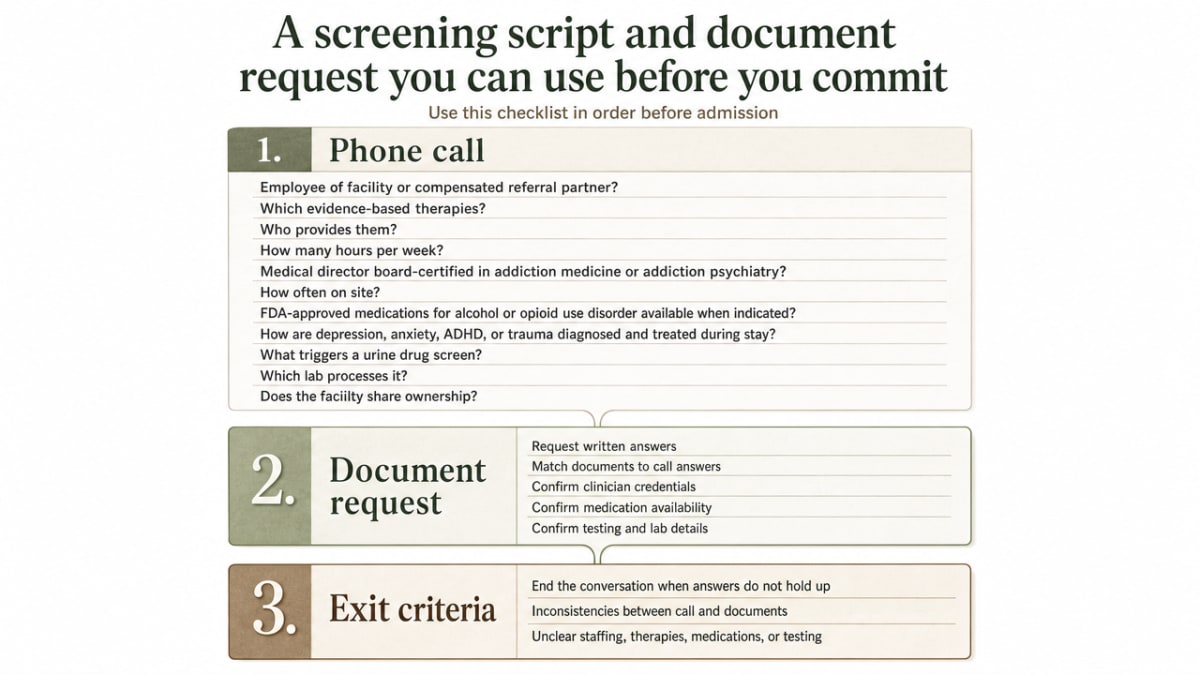
You do not need a consultant to vet a private rehab. You need a short call, a document request, and the willingness to end the conversation when the answers do not hold up. Here is what to run through, in order.
The phone call. Ask, in this sequence:
- Are you an employee of the facility or a compensated referral partner?
- Which specific evidence-based therapies will I receive, from whom, and how many hours per week?
- Is the medical director board-certified in addiction medicine or addiction psychiatry, and how often are they on site?
- Are FDA-approved medications for alcohol or opioid use disorder available when clinically indicated?
- How are co-occurring depression, anxiety, ADHD, or trauma diagnosed and treated during my stay?
- What triggers a urine drug screen, which lab processes it, and does the facility share ownership or referral relationships with that lab?
- Which entities will bill my insurance, and can I see a redacted sample explanation of benefits from a recent patient?
The documents. Before you sign anything, request:
- The current state license with expiration date
- Joint Commission or CARF accreditation with survey date
- A written weekly clinical schedule showing individual therapy hours with a licensed clinician
- The medical director’s credentials
- The admissions contract in full
- The facility’s written policy on discharge, length-of-stay extensions, and refunds
Legitimate programs send these without friction.
The exit criteria. Hang up if anyone offers to pay for your flight, waive out-of-pocket costs as a courtesy, or close you on an admission date before a clinician has assessed you. Walk away from any facility that quotes a specific success rate without naming its population, definition, follow-up window, and auditor. And step back from any program that treats these questions as adversarial rather than expected.
You are making a medical decision under real pressure, and it is fair that this feels heavy. The questions above take about twenty minutes. They will not tell you which program is best. They will tell you which programs are serious enough to earn the next conversation.
Frequently Asked Questions
How do I verify a private rehab’s licensure and clinical credentials without revealing who I am?
Search your state’s behavioral health licensing board and SAMHSA’s treatment locator using the facility’s legal name, not the marketing name. Both are public and require no login. Then check The Joint Commission and CARF directories for accreditation status and survey date. You can request a copy of the current license and accreditation letter through a personal email address, framed as due diligence on behalf of a family member if you prefer.
What specific questions should I ask on a first phone call to a private rehab?
Ask whether the person speaking is a facility employee or a compensated referral partner. Ask which evidence-based therapies you will receive, from whom, and how many hours per week. Ask about the medical director’s board certification in addiction medicine and on-site frequency. Ask whether FDA-approved medications for alcohol or opioid use disorder are available when clinically indicated 1. Ask which entities will bill your insurance and how urine drug screening is ordered.
Is it a red flag if a facility contacts me first or offers to arrange travel?
Yes. Legitimate premium programs do not pay for your flight, offer cash inducements, or close you on an admission date before a clinician has assessed you. The House Energy and Commerce Committee documented how patient brokers treat individuals seeking treatment as a commodity, using bribes and kickbacks to steer them to facilities that bill for unnecessary services 11. Hang up and call a facility directly through its licensed state record.
Should I trust a rehab that advertises a specific success rate?
No, not without pressure-testing the number. HHS ASPE found no rigorous peer-reviewed studies of residential treatment effectiveness in the prior five years and noted that patient outcome data across the field are limited 3. Ask what population the figure describes, how success was defined, the follow-up window, who collected the data, and whether an independent party audited it. Most facilities cannot answer, which is itself the answer.
What billing patterns suggest a facility may be engaged in fraud?
Watch for high-frequency confirmatory urine drug screens sent to an affiliated lab, multiple billing entities attached to one admission, and lab charges that dwarf the therapy charges. The largest addiction treatment fraud case prosecuted by DOJ involved bogus urine drug tests billed across more than 50 treatment centers and sober homes 8. Request a redacted sample explanation of benefits before you sign. Legitimate programs can walk you through their billing structure plainly.
How do I protect my confidentiality and professional standing during admission?
Use a personal email and personal phone number for all communication. Ask, in writing, how the facility handles verification-of-treatment requests from employers, licensing boards, and insurers, and what a signed release does and does not authorize. Confirm FMLA and short-term disability documentation practices with your HR contact independently. Request the facility’s written privacy policy and staff confidentiality training standards before you sign the admissions contract, not after.
References
- NIDA Treatment Guidelines (Principles of Effective Treatment). https://webcampus.med.drexel.edu/nida/module_1/content/5_0_Treatment.htm
- State Oversight of Adult Residential Treatment for Behavioral Health Conditions. https://pmc.ncbi.nlm.nih.gov/articles/PMC7440586/
- State Residential Treatment for Behavioral Health Conditions. https://aspe.hhs.gov/sites/default/files/migrated_legacy_files//192871/BehHeaConLR.pdf
- Residential Facilities: State and Federal Oversight Gaps. https://www.govinfo.gov/content/pkg/GAOREPORTS-GAO-08-696T/html/GAOREPORTS-GAO-08-696T.htm
- Substance Use Disorder: Prevalence of Recovery Homes, and Selected States’ Investigations and Oversight. https://www.gao.gov/products/gao-20-214t
- Detecting fraud, waste, and abuse in substance use disorder treatment. https://pmc.ncbi.nlm.nih.gov/articles/PMC9441269/
- National Health Care Fraud Enforcement Action Results in Charges Against 193 Defendants. https://www.justice.gov/archives/opa/pr/national-health-care-fraud-enforcement-action-results-193-defendants-charged-and-over-275-0
- Health Care Fraud and Abuse Control Program for FY 2023. https://oig.hhs.gov/documents/hcfac/10087/HHS%20OIG%20FY%202023%20HCFAC.pdf
- National Health Care Fraud Takedown Results in 455 Defendants Charged. https://www.justice.gov/opa/pr/national-health-care-fraud-takedown-results-455-defendants-charged-connection-over-65
- Calendar No. 490 (Senate Report on Opioid Addiction Recovery Fraud Prevention Act). https://www.govinfo.gov/content/pkg/CRPT-115srpt285/pdf/CRPT-115srpt285.pdf
- Examining Concerns of Patient Brokering and Other Fraud in the Treatment Industry (Hearing Memo). https://docs.house.gov/meetings/IF/IF02/20171212/106716/HHRG-115-IF02-20171212-SD002.pdf