
Key Takeaways
- Research shows men and women achieve similar completion and abstinence rates when receiving comparable evidence-based care, so gender composition alone does not reliably predict recovery outcomes 10.
- Men’s-only settings primarily accelerate disclosure and engagement by reducing self-monitoring tied to masculine norms, emotional restriction, and stigma rather than promising superior abstinence numbers 4.
- Setting intensity matters more than milieu for men, with residential treatment linked to significantly better abstinence outcomes than outpatient care, a pattern not seen for women 9.
- Co-ed programs designed primarily around women’s needs can produce weaker engagement for men, so vet whether male-specific programming is substantive or a superficial adaptation 12.
- The decisive trade-off is engagement, not label: choose the environment where trauma history, professional exposure risk, and disclosure comfort allow full honesty during the critical first weeks.
The Question Underneath the Question: Co-ed vs. Men’s-Only Rehab
You’re here because you need to make a critical decision about substance use treatment: co-ed or men’s-only. The real question isn’t just about gender composition, but about finding an environment that supports your recovery, family, and career. While large reviews of substance use treatment indicate that gender itself doesn’t reliably predict recovery success, and men and women complete treatment at similar rates, the nuance lies in engagement. Outcomes converge when engagement is equal, and for men, particularly those accustomed to performing competence, engagement can differ significantly between settings. The environment’s approach to emotional restriction and shame will profoundly influence your ability to complete the program effectively.
Research on Gender Composition in Treatment
Outcomes Converge When Engagement is Equal
The peer-reviewed literature, including an NIH-backed review, indicates that men and women do not significantly differ in treatment outcomes when receiving similar evidence-based therapies. Most large-scale randomized trials have not found gender differences in outcomes 10. A comprehensive review of gender and treatment utilization further supports this, reporting that women’s outcomes are often as good as or better than men’s, with similar completion rates. Limited research directly comparing women-only and mixed-gender programs shows no overall difference in outcomes 3. For opioid use disorder treatment, studies present mixed results regarding relapse and retention, with some showing no sex-based difference 11.
These findings suggest that sex alone is not a reliable predictor of recovery. Program quality, evidence-based methodology, and sustained engagement are more critical than the gender of other participants. While outcomes may converge on paper, engagement often diverges in practice. Mixed groups can show more variation in interpersonal style for men, whereas women tend to participate more in single-gender groups 1. SAMHSA’s guidance highlights how masculine norms, emotional restriction, and stigma can influence what men are willing to disclose 4. This distinction in engagement is crucial.
The Advantage of Men’s-Only Settings for Disclosure
The primary advantage of a men’s-only setting lies in facilitating disclosure. SAMHSA’s Treatment Improvement Protocol for men notes that men are significantly more likely than women to develop a substance use disorder and often enter treatment with specific barriers: masculine norms, emotional restriction, and stigma, which hinder both entry and disclosure 4. Gender-specific strategies are framed as tools to address these distinct experiences and engagement patterns, rather than promising superior abstinence rates 5. The guidance emphasizes that men’s-only settings can lower the initial barrier to entry and engagement.
Research on group processes illustrates this mechanism: men’s interpersonal style varies more in mixed groups, often leading to self-editing, posturing, or deflecting with humor or competence when women are present. In single-gender groups, this surface layer is less prevalent 1. For men who have spent decades maintaining an image of competence, the initial act of honest disclosure can be challenging. A men’s-only environment can reduce the perceived audience for this vulnerability. A narrative review on gender considerations in addiction supports that while gender doesn’t predict retention, men and women may benefit from different behavioral approaches, and program design should account for gendered social contexts 8. This suggests that a men’s-only residential program can shorten the path to the crucial disclosures that drive effective treatment.
How Professional Men’s Circumstances Impact Treatment Choices
Masculine Norms, Disclosure, and the Initial Weeks of Treatment
For professional men, a career often involves cultivating an image of strength and avoiding any display of weakness. This skill, while valuable professionally, can complicate the initial weeks of treatment. SAMHSA’s guidance on treating men directly addresses this, identifying internalized masculine norms, emotional restriction, and the stigma of seeking help as significant barriers to both treatment entry and the disclosure necessary for effective treatment 4. High-functioning professional men, whose identities are often built on being the expert, may find it particularly difficult to admit vulnerability.
The first two weeks of treatment are disproportionately important because early disclosures shape the treatment plan. If this period is spent maintaining a facade, the treatment team receives an incomplete picture. Group-process research highlights that men’s interpersonal style varies more in mixed groups 1, meaning a greater likelihood of self-monitoring when women are present. A men’s-only environment, while not eliminating the performance entirely, removes one significant audience for it, potentially accelerating the path to genuine disclosure and more effective treatment.
Exposure Risk and Focus in Treatment
Professional men often face unique fears regarding treatment, such as concerns about professional reputation, licensure, client perception, and impact on partnerships. These anxieties can divert attention needed for recovery. A narrative review on gender considerations in addiction notes that while gender doesn’t predict retention, men and women benefit from different behavioral approaches, and program design should reflect gendered social contexts 8. For professional men, this context includes specific exposure risks that consume mental energy.
A residential setting designed for men with similar professional pressures can streamline interactions, reducing the need to manage perceptions among individuals with vastly different social reference points. This conserves valuable energy, especially during the vulnerable initial weeks of treatment. SAMHSA’s protocol emphasizes early rapport building and explicit exploration of fears related to work and relationships as engagement strategies for men 4. These conversations can progress more efficiently when the group’s demographics don’t add an extra layer of self-monitoring. A distracted admission is inefficient; maximizing focus on recovery is essential, especially given the time commitment involved.
Setting Intensity May Outweigh Gender Composition
The level of care, or setting intensity, is a crucial variable often overlooked in discussions about co-ed versus men’s-only programs. An NCBI review found that residential treatment is associated with significantly better abstinence outcomes for men compared to outpatient treatment, a difference not observed for women 9. This suggests that for men, the decision between residential and outpatient care may be more impactful than the gender composition of the program.
Practically, if a choice is between a co-ed residential program and a men’s-only outpatient program, the residential option is likely to offer stronger outcome potential, irrespective of gender composition. If comparing a men’s-only residential program with a co-ed residential program, both operate from the same intensity baseline, where research indicates outcomes converge 10. The gender composition question is secondary to ensuring the appropriate level of care, particularly for men who benefit more from the immersive environment of residential treatment 9. For high-functioning professional men, the temptation to choose outpatient care for convenience or discretion is strong, but this may compromise the effectiveness of treatment if residential care is clinically indicated. Prioritizing the correct level of care, then optimizing the milieu, is essential for successful recovery.
The Trade-Offs in Co-ed Programs
Co-ed programs are not inherently neutral; they involve design choices that prioritize certain needs, which can have consequences for other participants. Federal guidance on supporting women in co-ed substance use disorder services explicitly states that programs primarily adapted to women’s needs may experience poorer engagement and outcomes for male participants 12. This highlights a critical design challenge: when a program focuses its trauma-informed practices, safety protocols, and group composition around women, men in the same program may become under-engaged.
Conversely, a co-ed program that hasn’t intentionally developed gender-responsive practices for both populations often defaults to prioritizing one, to the detriment of the other’s participation and completion. SAMHSA’s companion protocols, TIP 51 for women and TIP 56 for men, exist precisely because the clinical strategies for engaging each population are distinct 5, 6. For individuals evaluating co-ed programs, the key question is whether the program has invested equally in male engagement, or if the male-specific programming is merely a superficial adaptation of the women’s track. Inquiring about the specifics of male-focused programming can reveal the program’s true commitment to gender-responsive care for men.
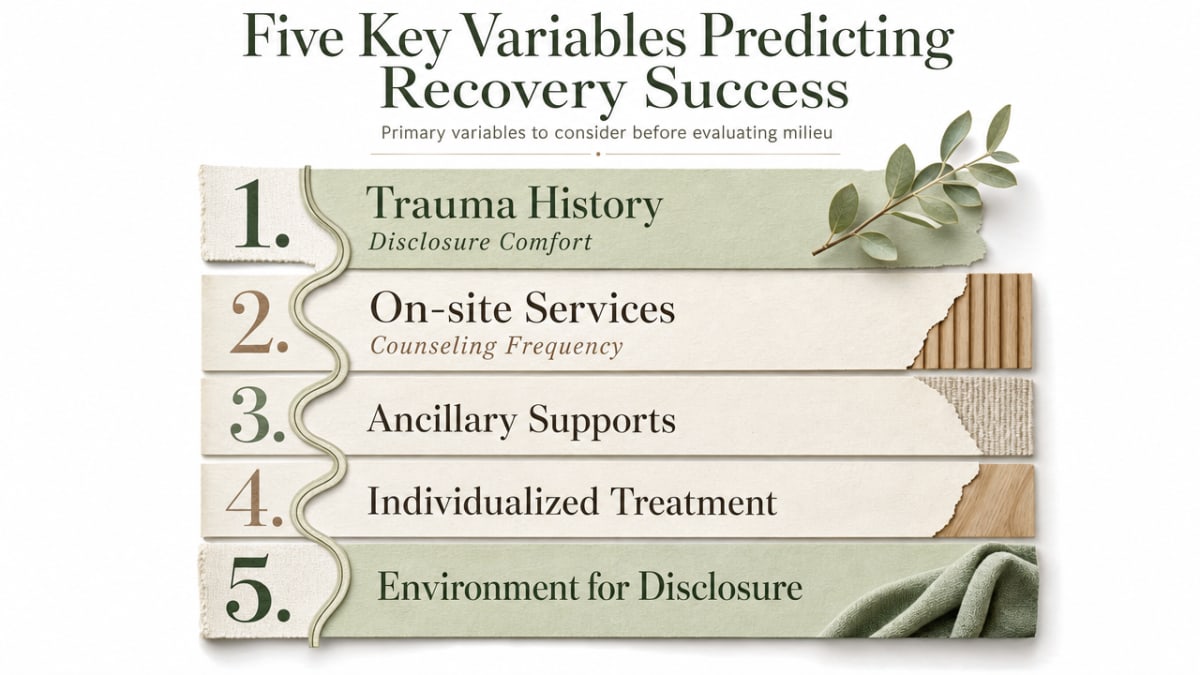
Five Key Variables Predicting Recovery Success
While gender composition is a secondary factor, several primary variables consistently predict treatment effectiveness for men. Consider these factors before evaluating the milieu:
- Trauma History and Disclosure Comfort: Trauma is a critical factor in treatment design. SAMHSA’s protocol for men identifies emotional restriction and stigma as barriers to disclosure 4, while guidance for women notes trauma history as a reason for single-gender settings 6. The environment that best facilitates disclosure of trauma is paramount.
- On-site Comprehensive Services and Counseling Frequency: Research indicates that for men, the availability of on-site services and frequent counseling sessions predict reduced post-treatment substance use 2. This includes whether the program integrates necessary ancillary supports and provides sufficient individual therapy.
- Co-occurring Conditions and Gender-Responsive Assessment: Co-occurring mental health conditions (e.g., depression, anxiety, ADHD) require gender-informed assessment and tailored behavioral and pharmacological approaches 8. A program that doesn’t screen for these comorbidities will only address part of the problem.
- Help-Seeking Barriers Tied to Masculine Norms: Masculine norms, emotional restriction, and the stigma of asking for help are documented barriers to treatment entry and disclosure for men 4. The ideal environment is one that actively lowers these barriers, whether through a men’s-only milieu or robust male-specific programming in a co-ed setting.
- Residential vs. Outpatient Fit: Setting intensity is a stronger predictor for men than gender composition. Residential treatment is associated with significantly better abstinence outcomes for men, a difference not seen in women 9. Prioritizing the correct level of care is the first step.
Honestly assessing these five variables will provide a clearer direction for treatment choices, especially if multiple factors point towards higher intensity, greater disclosure demands, or significant comorbidity.
Interviewing a Program Effectively
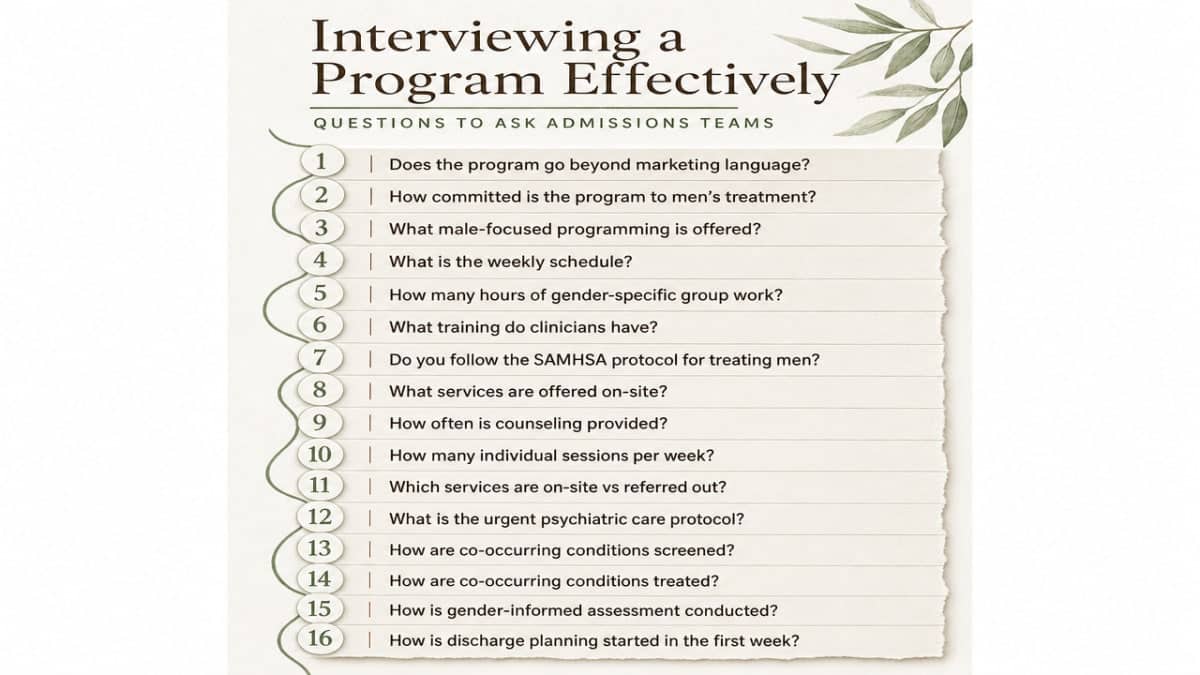
When speaking with admissions teams, move beyond marketing language to assess the program’s genuine commitment to men’s treatment. Ask specific questions about the male-focused programming, not just its philosophy. Inquire about the weekly schedule, the number of hours dedicated to gender-specific group work, and the training of the clinicians leading these groups, particularly regarding SAMHSA’s protocol for treating men 5.
Ask about on-site services and counseling frequency. Specifically, how many individual sessions are provided per week, not per month, and which services are available on-site versus referred out. Understand their protocol for urgent psychiatric care. Inquire about their screening and treatment processes for co-occurring conditions and whether their assessment is gender-informed 8. Ask about discharge planning from the first week, and the specifics of alumni engagement beyond basic communication.
Finally, ask a question that reveals a program’s honesty: “What kind of man does not do well in your program?” A reputable program will provide a candid answer, indicating a realistic understanding of its strengths and limitations. A program that claims universal success may be prioritizing sales over genuine care.
Making an Informed Decision
There is no definitive, evidence-backed verdict that men’s-only programs consistently outperform co-ed programs on outcomes 3, 10. The goal is to identify the environment that best reduces your specific barriers to engagement, disclosure, and successful completion.
Prioritize your decision-making process: First, ensure the level of care is appropriate. If residential treatment is clinically indicated, this factor holds more weight for men than gender composition 9. Second, acknowledge your personal barriers. If masculine norms, stigma, or professional pressures would inhibit disclosure in a mixed-gender setting 4, a men’s-only environment might offer a faster path to honesty. Third, thoroughly vet programs on critical mechanics: on-site services, counseling frequency, gender-informed assessment, and robust male-specific programming 2, 8.
Regret in this decision stems not from choosing the “wrong” label, but from selecting an environment where you cannot fully engage. Choose the setting that empowers you to be fully present and honest in your recovery journey.
Frequently Asked Questions
Does a men’s-only rehab actually produce better outcomes than a co-ed program?
Research does not broadly support that men’s-only programs yield superior abstinence or completion rates compared to co-ed programs when evidence-based care is comparable 3. The primary advantage of men’s-only settings lies in fostering quicker disclosure and engagement, addressing the gap in how men participate rather than a difference in ultimate outcome numbers.
I’m a private person worried about disclosure. Will a men’s-only setting really make it easier to open up?
For many men, a men’s-only setting can reduce the friction associated with disclosure. Group-process research indicates that men’s interpersonal style varies more in mixed groups, suggesting a tendency to self-monitor when women are present 1. SAMHSA’s guidance identifies masculine norms and stigma as barriers to disclosure 4. A single-gender environment can lessen the pressure of performing for a broader audience, though it doesn’t eliminate the challenge of vulnerability entirely.
If I can’t take time away from work, is co-ed outpatient just as good as men’s residential?
For men, residential treatment is associated with significantly better abstinence outcomes than outpatient care, a distinction not observed for women 9. If residential care is clinically appropriate, scheduling challenges should be addressed as practical hurdles, not clinical determinants. Choosing outpatient care for convenience may compromise treatment effectiveness if your situation warrants a higher level of care.
What should I ask a program to tell if it’s genuinely men-focused or just marketing itself that way?
Ask for concrete details: the weekly schedule for male-specific group work, the qualifications of clinicians leading these groups (especially regarding SAMHSA’s protocol for men 5), and the number of individual counseling sessions per week, as counseling frequency impacts post-treatment use for men 2. Inquire about on-site services versus referrals. Finally, ask what type of man typically does not succeed in their program; an honest answer indicates a serious, well-understood approach.
Does a co-ed program hurt men if it’s designed around women’s needs?
Yes, it can. Federal guidance acknowledges that co-ed services primarily adapted to women’s needs may lead to poorer engagement and outcomes for male participants 12. The crucial factor is whether the program has equally invested in male engagement strategies and trauma-informed care for men, or if one gender’s track is less developed.
I have significant trauma history and co-occurring depression. Does that change the co-ed vs men’s-only decision?
Yes, these factors increase the importance of the disclosure environment. SAMHSA’s guidance considers trauma history a key indicator for single-gender settings 6, and gender-informed assessment is crucial for co-occurring conditions 8. If disclosing your trauma feels more challenging with women present, choosing an environment that facilitates earlier and deeper disclosure is vital for effective treatment.
References
- Treatment of substance abusers: single or mixed gender groups?. https://pubmed.ncbi.nlm.nih.gov/9293039/
- Gender differences in the impact of comprehensive services in substance abuse treatment. https://pubmed.ncbi.nlm.nih.gov/15610830/
- Gender and Use of Substance Abuse Treatment Services. https://pmc.ncbi.nlm.nih.gov/articles/PMC6470905/
- Addressing the Specific Behavioral Health Needs of Men (SAMHSA TIP 56 Quick Guide / Advisory). https://library.samhsa.gov/sites/default/files/sma14-4882.pdf
- Addressing the Specific Behavioral Health Needs of Men. https://pubmed.ncbi.nlm.nih.gov/23805437/
- Substance Abuse Treatment: Addressing the Specific Needs of Women (Quick Guide for Clinicians Based on TIP 51). https://library.samhsa.gov/product/substance-abuse-treatment-addressing-specific-needs-women-quick-guide-clinicians-based-tip
- Gender impact on the outcome of rehabilitation programs in patients with schizophrenia: A naturalistic study. https://pmc.ncbi.nlm.nih.gov/articles/PMC10126770/
- Gender Considerations in Addiction: Implications for Treatment. https://pmc.ncbi.nlm.nih.gov/articles/PMC4578628/
- Treatment Modalities and Settings. https://www.ncbi.nlm.nih.gov/books/NBK144286/
- Sex and Gender Differences in Substance Use Disorders. https://pmc.ncbi.nlm.nih.gov/articles/PMC5945349/
- Sex-based Differences in Treatment Outcomes for Persons with Opioid Use Disorder. https://pmc.ncbi.nlm.nih.gov/articles/PMC6591072/
- Guidance Document for Supporting Women in Co-ed Substance Use Disorder Treatment Services. https://www.govinfo.gov/content/pkg/GOVPUB-HE20_400-PURL-gpo143823/pdf/GOVPUB-HE20_400-PURL-gpo143823.pdf
- Gender-related differences in addiction: a review of human and animal studies. https://pmc.ncbi.nlm.nih.gov/articles/PMC11784943/