
Key Takeaways
- Depression and anhedonia treated as passing moods rather than diagnoses walk out the door with the patient; ask if screening happens at admission and discharge, with psychiatric care inside the walls.13,15
- Craving is physiology, not willpower, and programs that never teach nervous system regulation leave patients fighting invisible opponents; look for distress tolerance work, pain treatment, and sustained stress regulation.10,12
- Detox spent only on rest and vitals wastes the window when motivation is most vivid; cognitive-motivational work built into detox cut relapse by roughly one-fifth in one cohort.4
- Aftercare that ends at the front door collapses in the first ninety days when most relapses occur; real continuity means a named clinician calling within 72 hours and structured daily activity.2,5
The morning after discharge, when the plan starts to bend
You know the feeling. The bag is packed, the paperwork is signed, and someone hands you a printed aftercare schedule with meeting times and a therapist’s number. For a few hours, you believe it. Then Sunday afternoon arrives. The house is quiet in a way the treatment center never was. Your phone lights up with a text from someone who does not know you just got home. And the plan, the one that felt so solid on the whiteboard, starts to bend at the edges.
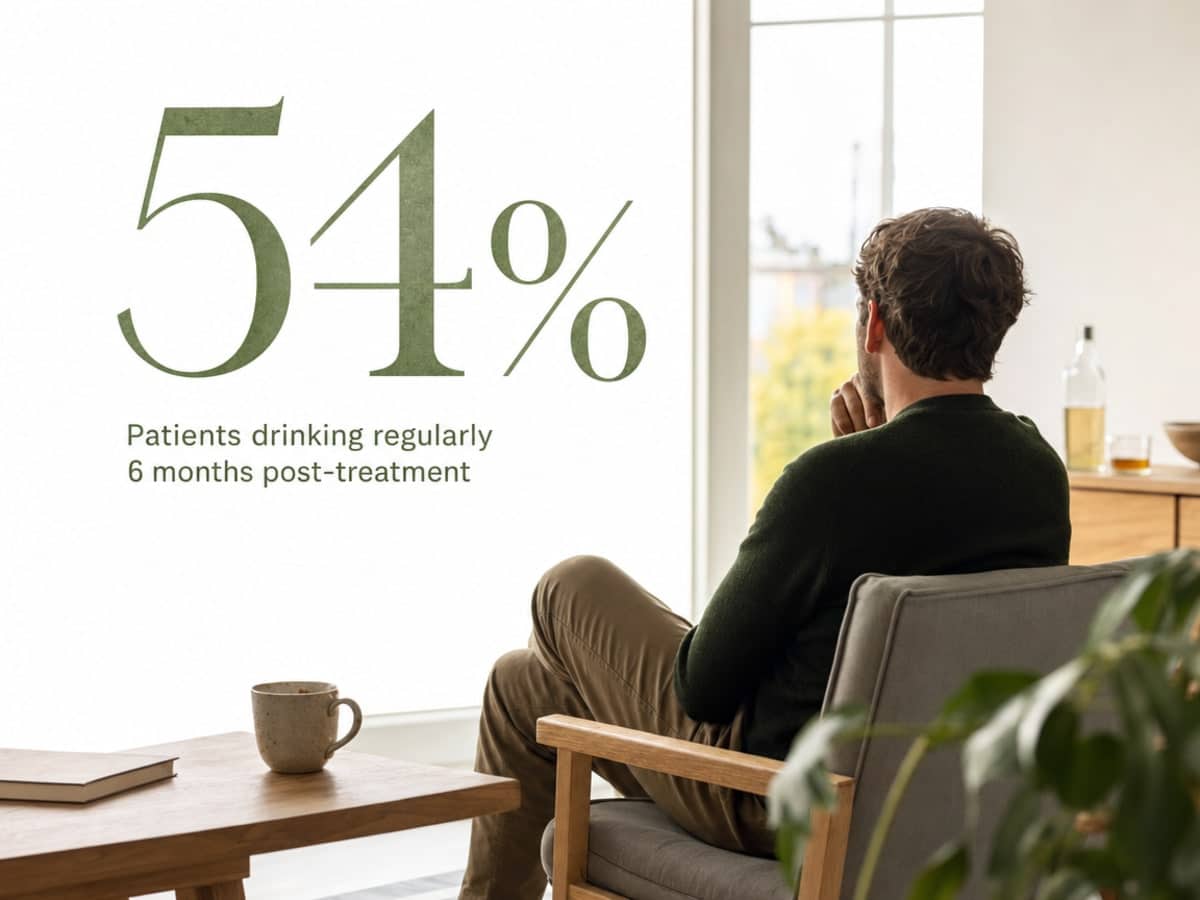
If this is your second or third time reading an article like this, you already know the statistics are not gentle. In one residential cohort followed for six months, more than half of patients were drinking regularly again by the half-year mark. That is not a story about weak people. It is a story about what happens when a structured environment ends and an unstructured one begins, often on the same afternoon.2
Here is what this piece will do, and what it will not. It will not tell you to try harder. It will walk through the specific, patterned reasons alcohol treatment programs fail, especially for men who have been through this before. Some of those reasons belong to the program. Some belong to you. Naming which is which is the first honest thing anyone can do for you right now. That distinction is what the next sections are built on.
Relapse is a signal about program design, not a verdict on you
Before you read another line, sit with this: relapse is common, and it is common across the best programs, the worst programs, the ones with ocean views and the ones in strip malls. That is not an excuse. It is the terrain.
Look at how the numbers cluster:
- In a Belgian residential cohort, 53.6% had relapsed by six months.2
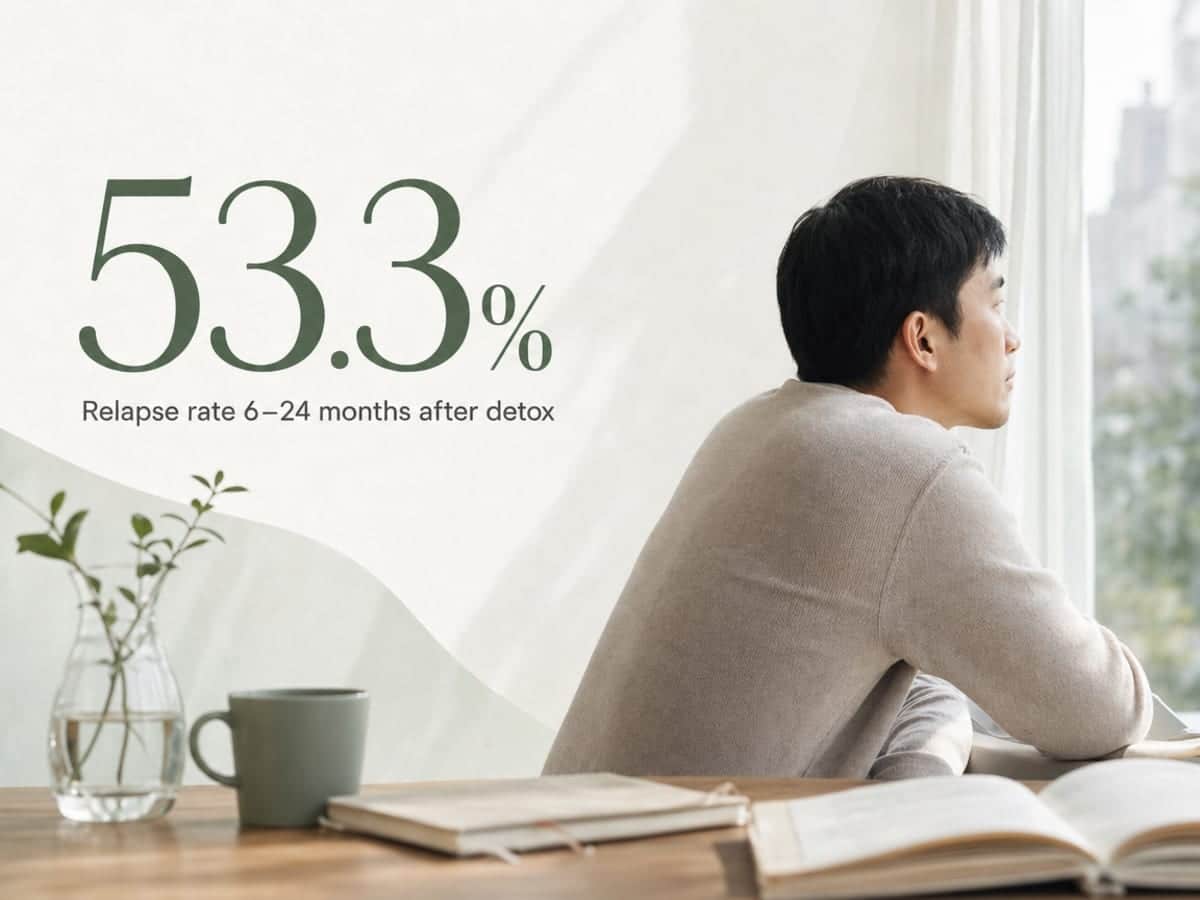
- In a Chinese detox cohort followed 6 to 24 months out, the relapse rate landed at 53.3%.4
- A Turkish inpatient sample reached 74.6% at the twelve-month mark.5
- In a veterans residential program, 69% relapsed within six months.15
Four different countries, four different care models, four different patient populations. The floor and ceiling move a little. The pattern does not.
What that pattern tells you matters more than the individual percentages. If half or more of people leaving a well-run program drink again within a year, then relapse cannot be the thing that separates the strong from the weak. It is a feature of the disease and a stress test of the program’s design. The right question is not whether it happens. The right question is what the program did to reduce the odds, and what it did the moment it noticed you slipping.6
Some researchers have started framing the first year after treatment as a set of trajectories rather than a pass/fail exam. A large secondary analysis of Project MATCH and COMBINE data found six distinct patterns, and several of them involved returning to heavy drinking and then finding remission again, with meaningful long-term benefits for people who bounced back. That is a very different picture than the one you probably carry: one drink, one verdict, done.
So if you relapsed after your last program, the honest reading is this. You are not the exception. You are inside a distribution the field already knows well. What matters now is looking at which parts of that distribution the next program can actually move, and and which parts are yours to move. That is the work of the next section.
Count your risk factors before you count your days
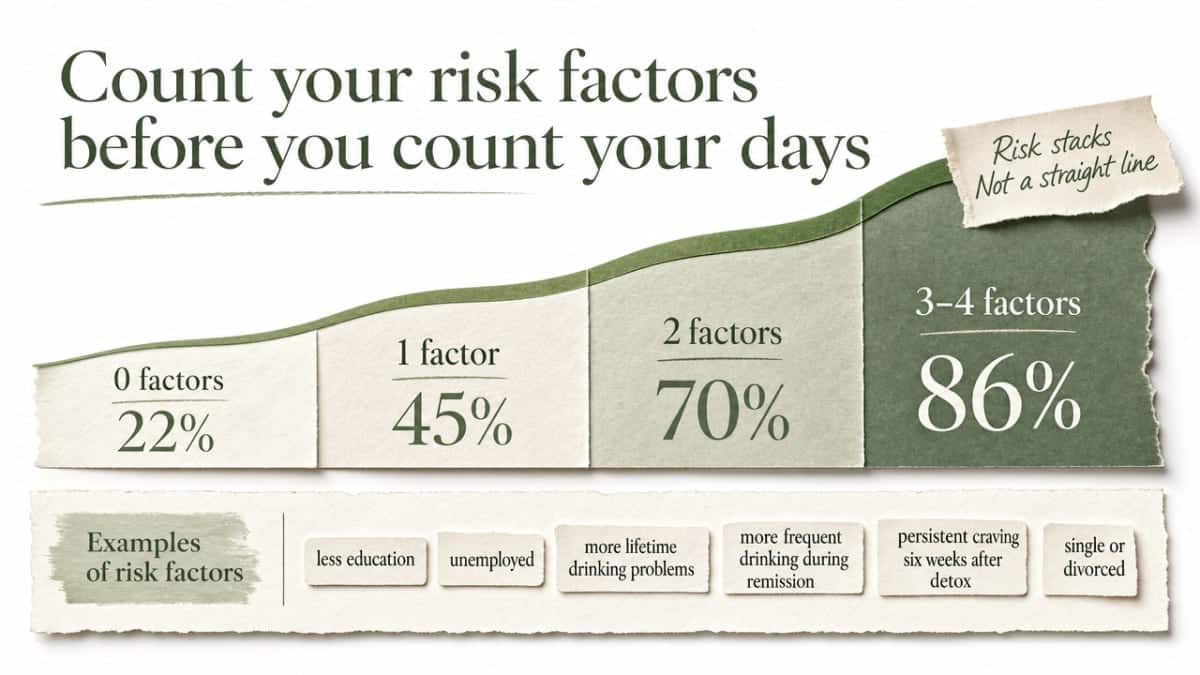
Here is a more useful exercise than counting sober days: count your risk factors. A 16-year community study by Moos and Moos tracked what actually predicts whether someone stays remitted from an alcohol use disorder, and the finding is worth carrying with you into every treatment conversation:14
- People with none of the identified risk factors had a 22% chance of relapse.
- Add one factor, and the odds rose to 45%.
- Two factors pushed it to 70%.
- Three or four factors put the likelihood at 86%.
Read that again slowly. The risk does not grow in a straight line. It stacks.
The factors themselves are not exotic:14
- Less education
- Being unemployed
- More lifetime drinking problems
- More frequent consumption during periods of remission
Other studies add their own to the pile: persistent craving six weeks after detox, being single or divorced, rural isolation, comorbid personality features. In a veterans residential cohort, active cigarette smoking and higher anhedonic depressive symptoms (that flattened, joyless feeling that lingers after the drinking stops) predicted relapse strongly enough that they outperformed a formal major depression diagnosis.15,19
So sit with the honest question. How many of these describe your situation right now, or the situation you would return to in a few weeks? Not to shame you. To calibrate.
If you counted three, that is not a life sentence. It is a treatment specification. It tells you what the next program needs to actually address, versus what a brochure says it addresses. A program aimed at someone with zero risk factors and one aimed at someone with four are not the same product, even if they use similar words. Aftercare intensity, dual diagnosis capacity, help finding work or housing, sustained craving management past week six, smoking cessation offered alongside alcohol treatment, structured daily activity that outlasts discharge day. Each of these maps onto a factor on the list.
You do not need to add up sober days yet. You need to add up what is loaded against you, then choose a program built to carry that weight.
Failure modes programs rarely name out loud
Every program has a brochure. What the brochure does not tell you is where that program tends to break down, and why the break happens in the same four places over and over. The failures below are not exotic. They are just rarely spoken about honestly, because naming them means owning them. If your last program dropped one of these on the floor, that is worth knowing before you sign paperwork for the next one.
Depression and anhedonia treated as a mood, not a diagnosis
You finish detox. The tremor is gone. The bloodwork looks better. And you feel… nothing. Not relief. Not gratitude. A gray flatness where feeling used to be. Staff call it “early recovery.” You call it something worse when the lights go out.
Here is what programs miss when they treat that flatness as a phase. In a residential cohort study, clinically significant depressive symptoms measured at admission and at discharge predicted shorter abstinence and worse outcomes after program completion. The depression did not lift on its own. It walked out the front door with the patient.13
The finding that matters most for chronic relapsers is more specific. In a veterans residential program where 69% relapsed within six months, the strongest mood predictor was not a formal major depressive disorder diagnosis. It was anhedonia, the dimensional loss of pleasure and interest, which outperformed the DSM-5 label once you controlled for it. That means a program can screen you, decide you do not meet criteria for major depression, and still send you home carrying the exact symptom that best predicts your next drink.15
Craving and stress physiology left as willpower problems
Three a.m. Your eyes open. Your heart is pounding for no reason you can name. Your mouth is dry. You are not thinking about a drink yet, but your body already is. If a program taught you to “ride out the urge” without ever explaining what is happening in your nervous system, it left you fighting an opponent you cannot see.
Alcohol use disorder rewires stress physiology. Patients entering treatment often show high baseline stress and poor distress tolerance, with disrupted cortisol, CRF, and autonomic function that keep craving alive long after the last drink. This is not weakness. It is a measurable state, and it does not resolve just because you completed a curriculum.10
The physical signals are trackable. In a prospective study, cue-elicited heart rate variability and attentional bias toward alcohol cues during treatment predicted who would relapse afterward. Your body was showing the answer before your calendar did. Pain matters too: baseline physical pain predicted higher drinking frequency and intensity twelve months later, with negative affect carrying the connection.11,12
A program that treats craving as a character flaw will hand you slogans. A program that treats it as physiology will teach you what a spike in your heart rate at 3 a.m. actually means, help you build distress tolerance, address chronic pain instead of ignoring it, and keep working on stress regulation past the first week. If nobody ever mapped your nervous system for you, that is a gap, not a moral failing.
Detox without cognitive-motivational work built in
Detox looks like the hard part. You get through the sweats, the sleep is bad, your appetite comes back in strange bursts. Then someone hands you a lunch tray and says the real work starts next week. If “next week” is where the structured thinking begins, the program has already lost ground it did not need to lose.
Consider what happens when cognitive and motivational work is layered into detox itself, not saved for later. In a Chinese hospital cohort where the overall relapse rate was 53.3% over the 6 to 24 month follow-up period, adding a comprehensive cognitive-motivational-behavioral intervention during detox cut the relapse rate by roughly one-fifth. Same patients. Same withdrawal. Different curriculum inside the detox window.4
The mechanism is not mysterious. During detox, your reasons for being there are still vivid. The last night before admission is close enough to touch. Motivation, however fragile, is present. A program that lets those days pass with only medication management, vitals checks, and rest is banking calmness that will fade before the harder therapy begins. A program that starts building motivation, teaching relapse-signal recognition, and rehearsing high-risk situations while you are still on the detox unit is using the window instead of wasting it.
Ask what happens on days two through five. Not what group you attend on day ten. If the answer is “you rest,” the program is skipping a step research says matters.
Aftercare that ends at the front door
The discharge folder is impressive. Meeting schedule, therapist contact, primary care handoff, a laminated relapse prevention card. On paper, it is a plan. In practice, it is a list of phone numbers waiting for you to make the first call while your motivation is at its most brittle.
Relapse timing tells you where aftercare quietly fails. In a Turkish inpatient sample, 40.5% relapsed by three months and 74.6% by twelve months, with motivation to quit and depression risk driving the earliest returns to drinking. The first ninety days are when the plan bends. That is exactly when generic aftercare is at its thinnest, because the program has already discharged you and moved on to the next admission.5
What holds up in this window is not paperwork. It is structure. In a residential cohort, patients who were satisfied with how they spent their day were more than five times less likely to relapse. That is not a mystical finding. It means unstructured hours are dangerous hours, and a program that discharges you without helping you rebuild a defensible daily schedule has handed you the hardest work at the worst moment.2
Real continuity looks concrete:19
- A named clinician who calls you in the first 72 hours, not just “reaches out.”
- A weekly group that started before discharge and continues after, so the faces are already familiar.
- A written plan for the first Saturday, the first wedding, the first work trip.
- Craving check-ins past week six, because that is when persistent craving still predicts relapse.
If aftercare ends at the front door, so does the program.
What the first drink actually looks like, and what it isn’t
The first drink after a stretch of sobriety almost never looks like the movie version. There is no slow-motion walk into a bar. There is a Tuesday. There is a text you almost did not open. There is a wedding with an open bar and a cousin who says, “just one, come on.” What actually breaks the streak is usually smaller and closer to home than the story you have been telling yourself about willpower.
In a case-control study of 100 male relapsers, craving was named as the reason for the first drink by 53% of both relapsers and abstainers, followed by tension and stress (8.5%) and social pressure (7.5%). Read that carefully. Craving is not the villain. Both groups felt it. The difference sat in what happened around the craving. Relapsers had significantly more undesirable life events in the months before, along with higher negative mood and more social anxiety. A divorce filing. A parent’s diagnosis. A job that quietly slipped. The craving was the last mile. The road was longer.3
Here is what the first drink is not. It is not a decision made in a single moment of weakness. It is not proof that you never wanted sobriety. It is not a sign that the last program was worthless. It is the point where accumulated pressure, unaddressed mood, and a specific trigger meet an unstructured hour. That is why a program that never mapped your real triggers, never taught you what your craving actually feels like in your body, and never rehearsed the Sunday afternoon at your brother-in-law’s house left you standing at that meeting point unarmed.
If you want to know whether the next program is serious, listen for whether anyone asks you to describe, in detail, the moment before your last first drink. Not the drink. The moment before. That is where the work lives.
What the program owns, and what you own
One of the quietest reasons treatment fails is that nobody ever draws a clear line between the work that belongs to the program and the work that belongs to you. Without that line, you end up carrying blame for structural gaps, or waiting for a program to fix things only you can touch. Both are dead ends.
Here is what a serious program owns:
- Screening and treating depression and anhedonia inside the walls, not just noting them on discharge paperwork.13,15
- Building cognitive and motivational work into the detox window, when it actually moves outcomes.4
- Teaching the physiology of craving and stress, so a racing heart at 3 a.m. is a signal you can name, not a mystery.10,12
- Aftercare that starts before discharge and shows up in the first 72 hours, not a folder of phone numbers.
- Dual diagnosis capacity for the psychiatric comorbidities that consistently drive relapse.1
- A working definition of success that does not treat a single slip as a verdict.6
Here is what you own:
- Telling the truth about craving, even the day it feels most embarrassing.
- Naming the life events piling up behind the urge, before they become the story of your next first drink.3
- Changing what you can about environment: who is in your kitchen, what is in your calendar, whether Sunday afternoons have a shape.
- Showing up to aftercare when motivation is thin, because early motivation predicts early relapse and skipping is the first evidence of it.5
- Being honest about smoking, sleep, and the flat feeling nobody asked about.15
Neither side of that list works alone. A program that owns its half cannot force yours. You cannot substitute effort for clinical design you never received. Match the two honestly, and the next attempt has a real chance.
Where wearables and remote monitoring actually fit
You have probably seen the pitch. A ring, a wristband, a patch that reads your heart rate variability while you sleep and flags a spike in stress before you consciously feel it. If your last program did not use any of this, you might be wondering whether the next one should. The honest answer is nuanced, and worth saying out loud, because a program that oversells the technology is a program you cannot trust on the harder questions.
Here is what the evidence actually supports. Ecological momentary assessment through smartphones and remote breathalyzers have the strongest clinical case so far, while wearables with transdermal alcohol sensors have barely been tested inside interventions, and evidence for improved outcomes is preliminary. Adherence drops over time. Some patients react poorly to continuous monitoring. Data can pile up faster than clinicians can act on it.20,22
So the reason to care about wearables is not the marketing. It is that the predictors of relapse are physiological in ways your calendar cannot see. Cue-elicited heart rate variability during treatment predicts who relapses afterward. Stress dysregulation drives craving between sessions. A device that surfaces those signals, paired with a clinician who actually looks at them, turns invisible risk into something you can talk about on Tuesday.10,12
Choosing what comes next without absorbing all the blame
If you have read this far, you already know something most brochures will not tell you: the last program did not fail because you are broken. It failed at specific joints, and some of those joints were yours to tighten and some were not. That distinction matters when you sit across from an admissions coordinator this week and try to decide whether to try again.
Bring a short list of questions with you:19
- Who screens depression and anhedonia at admission and again at discharge, and what happens inside the walls if the score is high?13
- Does structured cognitive and motivational work start during detox, or does the schedule really begin on day seven?4
- Who calls in the first 72 hours after I leave, by name?
- Is there a plan for the first Saturday, not just a list of meetings?
- What happens at week six if craving is still loud?
If the answers are vague, the program is telling you what it will do to you rather than what it will do with you.
Then take the harder step. Look at your own list from earlier in this piece and pick one thing you are willing to change on your side before intake. The kitchen. The Sunday calendar. The phone contact you have been pretending is harmless. You do not have to fix all of it. You have to move one piece so the program has something to build on.
Relapse, when it happens, is a signal about design and circumstance, not a verdict on your worth. Somewhere in Little Rock, Serenity Park Recovery Center is doing this kind of work for men who have been here before. Wherever you land, land somewhere that will name the failure modes out loud before you sign the paperwork. That is the honest start.6
Frequently Asked Questions
If I relapsed after treatment, does that mean the program failed or I failed?
Neither, and both, in patterned ways. Relapse is common enough across residential programs that it cannot separate the strong from the weak. The honest reading is that specific ingredients were missing on the program side, the person side, or both. Long-term research shows many people remit after one or more relapses and still reach durable recovery. It is a signal about design and circumstance, not a verdict.6
How do I know if a program can actually treat depression alongside alcohol use, not just refer it out?
Ask three concrete questions. Is depression screened at admission and again at discharge, since symptoms at both points predict shorter abstinence? Is a psychiatrist on staff, not just on a referral list? Does treatment address anhedonia specifically, since flat, joyless mood outperformed formal major depression diagnoses as a relapse predictor in a residential cohort where 69% relapsed within six months? Vague answers mean the work will happen outpatient, if at all.13,15
What should aftercare look like so it doesn’t collapse in the first month home?
It should start before discharge, not after. Look for a named clinician who calls in the first 72 hours, a group that began inside the program and continues weekly outside it, and a written plan for the first Saturday, not just a list of meetings. Craving check-ins should extend past week six, when persistent craving still predicts relapse. Structured daily activity matters too, since satisfaction with how you spend your day protects against relapse.2,19
Is residential treatment worth trying again if I’ve already been through it once or twice?
Yes, if the next program is designed for your actual risk profile, not a generic one. Chronic relapsers often carry stacked factors: anhedonia, active smoking, short pre-treatment abstinence, unresolved craving. A program that names those explicitly, builds cognitive-motivational work into detox, and holds continuity past discharge is a different product than one that repeats a standard curriculum. Trying again is not the problem. Trying the same thing again is.4,15
Do wearables and remote monitoring actually help prevent relapse, or is it marketing?
The honest answer is somewhere in between. Ecological momentary assessment through smartphones and remote breathalyzers have the strongest evidence so far, while wearables with transdermal sensors are rarely tested in interventions and the outcome data is preliminary. The value depends entirely on whether a clinician reads the data and acts on it. A dashboard nobody watches is a gadget. A call when your HRV crashes for three nights is a tool.20,22
What questions should I ask a program before admitting to make sure it’s not going to repeat what failed before?
Ask who screens depression at admission and discharge, and what happens inside the walls if the score is high. Ask whether structured cognitive-motivational work starts during detox or waits until week two. Ask who calls in the first 72 hours after discharge, by name. Ask what happens at week six if craving is still loud. Vague answers mean the program is describing what it does to you, not with you.4,13,19
References
- Alcohol use disorder relapse factors: A systematic review. https://pubmed.ncbi.nlm.nih.gov/31174033/
- Determinants of relapse and re-admission among alcohol abusers after intensive residential treatment. https://pmc.ncbi.nlm.nih.gov/articles/PMC3436679/
- To identify predictors of relapse in cases of alcohol dependence syndrome in relation to life events. https://pmc.ncbi.nlm.nih.gov/articles/PMC6198591/
- A real-world study on clinical predictors of relapse after hospitalized detoxification in a Chinese cohort with alcohol dependence. https://pubmed.ncbi.nlm.nih.gov/31523508/
- Predictors of Relapse to Alcohol and Substance Use: Are There Any Differences between 3 and 12 Months after Inpatient Treatment?. https://pubmed.ncbi.nlm.nih.gov/34553671/
- Patterns of Transitions between Relapse to and Remission from Heavy Drinking over the First Year after Outpatient Alcohol Treatment and Their Relation to Long-Term Outcomes. https://pmc.ncbi.nlm.nih.gov/articles/PMC7900838/
- Alcohol Biosensor Monitoring for Alcohol Related Liver Disease (Study Protocol and Statistical Analysis Plan). https://cdn.clinicaltrials.gov/large-docs/60/NCT03533660/Prot_SAP_000.pdf
- Psychiatric, demographic, and brain morphological predictors of relapse after treatment for an alcohol use disorder. https://pubmed.ncbi.nlm.nih.gov/27851682/
- Frontal white matter integrity predictors of adult alcohol treatment outcome. https://pubmed.ncbi.nlm.nih.gov/22289118/
- How does stress lead to risk of alcohol relapse?. https://pubmed.ncbi.nlm.nih.gov/22289119/
- Association between physical pain and alcohol treatment outcomes: The mediating role of negative affect. https://pubmed.ncbi.nlm.nih.gov/26098384/
- Cue-elicited heart rate variability and attentional bias predict alcohol relapse following treatment. https://pubmed.ncbi.nlm.nih.gov/21696918/
- Depressive symptoms as a predictor of alcohol relapse after residential treatment programs for alcohol use disorder. https://pubmed.ncbi.nlm.nih.gov/21726388/
- Rates and predictors of relapse after natural and treated remission from alcohol use disorders. https://pubmed.ncbi.nlm.nih.gov/12529071/
- Predicting Relapse After Alcohol Use Disorder Treatment in a High-Risk Cohort: The Roles of Anhedonia and Smoking. https://pmc.ncbi.nlm.nih.gov/articles/PMC8476113/
- Factors Associated with Relapses in Alcohol and Substance Use Disorder. https://pmc.ncbi.nlm.nih.gov/articles/PMC11075040/
- Do Alcohol Relapse Episodes During Treatment Predict Long-Term Outcomes?. https://pmc.ncbi.nlm.nih.gov/articles/PMC5048537/
- Rates and Predictors of Relapse After Natural and Treated Remission from Alcohol Use Disorders. https://pmc.ncbi.nlm.nih.gov/articles/PMC1976118/
- Assessment of Addiction Management Program and Predictors of Relapse. https://pmc.ncbi.nlm.nih.gov/articles/PMC9579533/
- Current Approaches Using Remote Monitoring Technology in Alcohol Use Disorder (AUD): An Integrative Review. https://pubmed.ncbi.nlm.nih.gov/40501058/
- Oura Ring Behavioral Feedback Intervention for Alcohol Reduction: Randomized Controlled Trial. https://pmc.ncbi.nlm.nih.gov/articles/PMC12677873/
- Alcohol Use Disorder in the Age of Technology: A Review of Wearable Biosensors in AUD Treatment. https://pmc.ncbi.nlm.nih.gov/articles/PMC642813/