
Key Takeaways
- Day treatment is a distinct category from weekly therapy: IOP runs at least nine service hours a week, while PHP and partial day treatment reorganize your schedule around 20-plus hours 4, 2.
- Before calling any program, do an honest self-inventory of use patterns, withdrawal signs, and co-occurring conditions so an intake clinician can place you at the right level the first time 3.
- For medically stable adults, IOP and day treatment produce outcomes comparable to inpatient care — residential is warranted mainly for higher severity, withdrawal risk, or unstable housing 6.
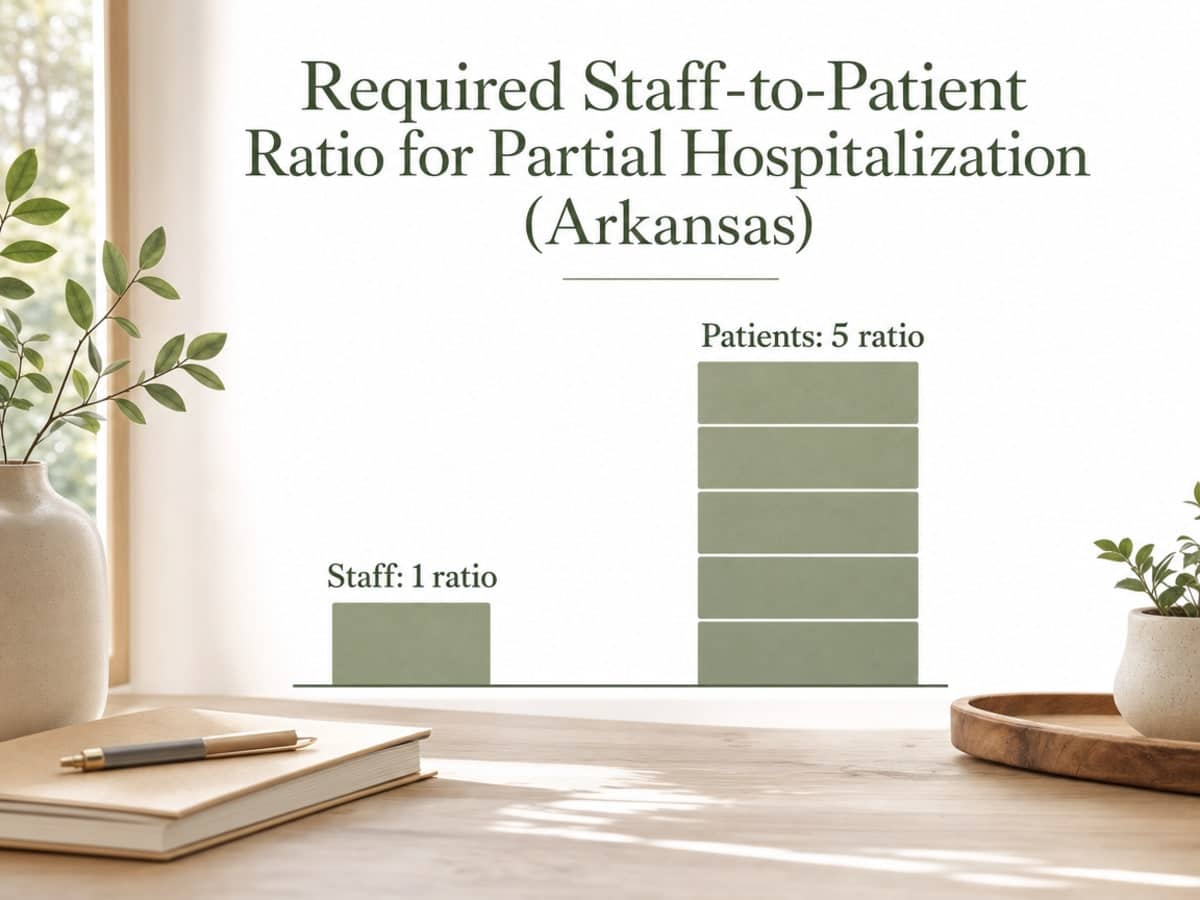
- Verify legitimacy by confirming Arkansas DHS certification and checking staffing floors like PHP’s 1:5 clinician ratio and 90 minutes of daily professional services 11, 2.
- A credible program integrates dual-diagnosis psychiatric care and offers medication-assisted treatment on-site rather than deflecting co-occurring conditions to outside referrals 3.
- Run the intake call like a specialist consult: ask specific questions about certification, group leadership, MAT, evening tracks, family involvement, and aftercare planning 1, 5.
- Protect the treatment window with a fixed cohort schedule and use HR, FMLA, or EAP channels to secure time without disclosing a diagnosis to your manager.
- Expect the first week to focus on intake and a specific treatment plan, with week two bringing sleep shifts and cravings — finishing that stretch is the retention win that matters 5.
When outpatient talk therapy stops being enough
You already know the pattern. The weekly 50-minute session helps you talk about the drinking or the pills, but by Thursday night the wheels are off again. You are functional at work — maybe visibly successful — and that is part of the problem. Nobody in your life has enough evidence to intervene, and your therapist is doing good work with the wrong dose.
If you are searching for day treatment programs near you, you have probably crossed a line most people never see. Standard outpatient therapy is one hour a week. Day treatment — the umbrella that covers intensive outpatient (IOP), partial hospitalization (PHP), and state-defined partial day treatment — is measured in hours per day, not minutes per week. For adults, SAMHSA sets the floor for intensive outpatient at nine or more service hours a week, delivered on a scheduled program of counseling, group work, and case management 4. That is a different category of care, not a longer version of the same thing.
This is a hard call to make. It is also a reasonable, adult decision — not a confession. You are not failing at therapy. You are recognizing that a Tuesday-at-6 session cannot compete with a Friday night, a stressful deal close, or a body that has learned to expect a substance at 5 p.m.
The rest of this guide is written the way a good intake clinician would think it through with you: match the level of care to what is actually going on, then verify the program is real.
What actually counts as a day treatment program
IOP, PHP, and partial day treatment: the real differences
The phrase “day treatment” gets used loosely, and that is where a lot of confusion starts. There are three distinct labels you will see on brochures and intake calls, and they mean different things clinically and on the schedule.
Intensive Outpatient Program (IOP). This is the least intensive of the three. SAMHSA’s threshold for adult IOP is at least 9 service hours per week, delivered on a prearranged schedule of individual counseling, group therapy, family psychoeducation, and case management 4. In practice that often looks like three evenings a week, three hours a night — which is why IOP is the format most working professionals end up in.
Partial Day Treatment. Arkansas draws a distinct middle tier here. State licensure defines partial day treatment as a minimum of 4 hours per day for 5 days per week — roughly 20 hours weekly — and requires intake, individual and group therapy, psychosocial education, case management, and at least one hot meal per day 8. It sits above IOP in dose and structure but stops short of hospital-level intensity.
Partial Hospitalization Program (PHP). This is the top of the day-treatment continuum. Arkansas requires certified PHPs to run at least 5 hours per day, generating 20+ service hours across 4 or more days a week, and to function as an alternative to inpatient care on a less-than-24-hour basis 2. PHP is what you look at when you are medically stable but need something close to hospital-grade structure.
The gap between 9 hours and 25 hours a week is not a rounding error. It is the difference between adding treatment to your life and reorganizing your week around it. Picking the right label matters because the label sets the dose.
How day treatment fits in the continuum of care
Day treatment is not a standalone tier. It is a hinge in a longer arc that runs from standard outpatient therapy up through residential and medical detox.
SAMHSA describes IOPs as serving three roles:
- Primary treatment for people who do not need 24-hour care,
- Step-down care after inpatient or residential, and
- Step-up care when standard outpatient therapy is no longer enough 7.
Day treatment exists precisely for that middle band where weekly sessions are not holding, but you are not in medical crisis.
Movement between tiers is expected, not a failure. A good program will step you down to IOP as you stabilize, or step you up to residential if the intensity is not enough. Ask on the intake call how they handle transitions in both directions. Programs that only move one way — or that treat every caller as a fit for the level they happen to sell — are showing you something about how they think.

Matching level of care to your actual clinical picture
The honest self-assessment before you call anyone
Before you dial a single number, spend ten minutes with yourself. Not to talk yourself out of the call — to make it a better one when you place it.
Here is what an intake clinician is going to ask you, so you might as well ask yourself first:
- How many days in the last month did you use or drink? How much, on those days?
- Have you tried to stop or cut back on your own, and what happened by day two or three — sweats, shakes, elevated heart rate, insomnia, a spike in anxiety?
- Have you missed work, missed a deadline you would have caught six months ago, or made a decision at 11 p.m. you would not have made at 11 a.m.?
- Is there a co-occurring piece — depression, anxiety, ADHD, trauma, chronic pain — that has been running underneath this for years?
NIDA is direct on this: no single treatment is right for everyone, and effective care has to address medical, psychological, social, vocational, and legal needs, not just the substance use itself 3. That is not a marketing line. It is the reason honest self-inventory matters. If you walk into a program that only treats the drinking and ignores the panic disorder that is fueling it, you are going to be back on this same search page in six months.
Write it down. Bring the list to the phone. You are not confessing — you are giving a clinician the information they need to place you correctly the first time.
Day treatment vs. residential: what the evidence says
The question you are probably circling is whether you should be doing this from home at all, or whether you need to disappear for 30 days.
The honest answer, backed by a peer-reviewed review of intensive outpatient programs, is that for most adults seeking care, IOP and day treatment produce outcomes — reduced substance use, increased abstinence — comparable to inpatient treatment 6. This means the guilt-tinged assumption that “real” recovery requires a residential stay is not supported for the average patient. Day treatment is not the discount version. For many working adults, it is the appropriate version.
The practical read: if you are medically stable, have a home environment that will not actively sabotage you, and can commit to the schedule, day treatment is a defensible clinical choice — not a compromise. If any of those three is shaky, say so on the intake call and let the program tell you whether they are the right starting point or whether you need to step up first.
How to verify a program is clinically legitimate
Arkansas certification and staffing floors you can check
Here is the good news: you do not have to take a program’s word for anything. Arkansas publishes the floor, and you can hold any local provider up against it in about five minutes.
Start with certification status. Arkansas DHS requires that partial hospitalization be delivered in a certified facility, and providers that are not certified cannot be reimbursed for PHP services 11. A program that either dodges the certification question or gets fuzzy about what level of care they are billing is telling you something. Ask directly: are you a DHS-certified partial hospitalization provider, and is that the level of care you would bill for my treatment?
Then check staffing. For PHP, Arkansas mandates a minimum 1 clinician to 5 patient ratio, with at least 90 minutes per day of services delivered by a mental health professional 2. This is the operational floor for calling something partial hospitalization in this state. If a program groups you into a room of twelve with one facilitator and calls it PHP, they are either miscategorizing the service or cutting corners.
For partial day treatment, the licensure standard is different: 4 hours per day, 5 days a week, with intake, individual and group therapy, psychosocial education, case management, and at least one hot meal per day 8. The meal requirement sounds minor. It is not — it is a signal that the state expects the program to hold you through the middle of the day, not run a two-hour group and send you home to your kitchen.
Write these numbers down before you call. When the intake coordinator describes the schedule, match what they say against the floor. If the math does not work, you have your answer.
Dual diagnosis and MAT: non-negotiables for most working adults
Certification and staffing get you a legitimate program. Dual diagnosis and medication-assisted treatment get you one that can actually help you.
If you are the person this article is written for — high-functioning, holding a job, quietly escalating — there is almost always something running underneath the substance use. Anxiety that has been managed with a nightly drink for a decade. Untreated ADHD that made stimulants feel like clarity. Sleep problems, chronic pain, low-grade depression, a trauma history nobody at work knows about. NIDA is explicit that effective treatment has to address medical, psychological, social, vocational, and legal needs together, not just the drug or alcohol use in isolation 3. A program that treats only the substance and refers the rest out is running half the play.
Ask two specific questions on the intake call:
- Do you have a psychiatric provider on staff who can evaluate and manage medications for co-occurring conditions, and is that integrated into the treatment plan or handled separately?
- Do you offer medication-assisted treatment for alcohol or opioid use disorder — naltrexone, buprenorphine, acamprosate — as part of the program, or do you refer out?
The answers tell you whether you are looking at a coordinated clinical team or a group therapy schedule with a referral list stapled to the back. For most working adults with any real duration of use, the coordinated team is what you need. Refusing MAT on principle, or treating co-occurring mental health as somebody else’s problem, is a red flag — not a philosophy.

The phone screen: questions that separate real programs from marketing
Most intake calls last about fifteen minutes, and most of that time gets spent on your insurance and your schedule. That is backwards. You are the one buying a clinical service you cannot easily return. Run the call the way you would run a first meeting with a specialist your primary care doctor sent you to — polite, direct, and unwilling to leave with vague answers.
Here are seven questions worth asking, and what a good answer sounds like.
Are you certified by Arkansas DHS for the level of care you would bill for me? A real answer names the certification and the level. A soft answer talks about “licensure” in general terms. Certification is the reimbursement gate for PHP, and it is checkable 11.
What is your staff-to-patient ratio in group, and who runs the group? You are listening for a specific number and a specific credential — licensed clinician, not peer facilitator alone. TIP 47 is explicit that IOP core services include clinician-led counseling and group work, not just support meetings 1.
Do you evaluate and treat co-occurring mental health conditions on-site? The right answer is yes, with a psychiatric provider integrated into the treatment plan. NIDA frames this as non-optional: effective treatment addresses medical and psychological needs together, not just the substance 3.
Do you offer medication-assisted treatment for alcohol or opioid use disorder as part of the program? Naltrexone, buprenorphine, acamprosate — you want them named, not deflected. A program that will not prescribe or that treats MAT as philosophically suspect is out of step with current evidence 3.
What does the schedule look like, and do you have an evening or step-down track? This is where your working life meets their program design. IOP principles emphasize making treatment readily available and easing entry — a program with only one daytime cohort is telling you who they actually serve 5.
How do you involve family or significant others, and how do you handle my privacy at work? Family psychoeducation is a core IOP component 1, but you get to decide the scope. The right answer respects both.
What does aftercare look like, and when do we start planning it? Discharge planning that starts in week one is a good sign. IOT principles treat continuing care and community supports as part of the program, not an afterthought 5.
If the person on the phone cannot answer these without checking with someone, that is fine — ask them to call you back. If the answers get evasive or the coordinator pivots to a hard close, you have your answer without needing another call.
Fitting treatment around a working life without gutting the intensity
Scheduling, discretion, and what to tell your employer
Here is the tension you are trying to solve: the program needs enough of your week to actually work, and your calendar cannot go dark for a month without questions. Both things are true. The good news is that IOP and evening PHP tracks are designed for exactly this problem — nine to fifteen hours a week, often scheduled from 5 to 8 p.m., three to five nights, so your daytime meetings stay intact.
Book the intake for a real hour, not a lunch break. Then ask about a fixed cohort schedule you can put on your calendar for eight to twelve weeks. Predictability is what lets you protect the treatment window from the client who always wants a 6 p.m. call.
On the employer question, you have more room than you think. You are not legally required to disclose a diagnosis to your manager. If you need protected time, an HR conversation about FMLA or a short-term accommodation can be framed around “a medical condition I am being treated for” — no substance named. Many EAPs will coordinate confidentially and never route details back to your supervisor. If your role is licensed or safety-sensitive, the calculus is different and worth running past an attorney before you say anything.
Making the call is the win this week. Everything else is logistics.
Family involvement without losing your privacy
Family psychoeducation is a core component of intensive outpatient care 1, and there is a reason for it. The people who live with you see the pattern you cannot see, and they are already carrying part of the weight. Bringing them in — carefully — usually helps the treatment stick.
Carefully is the operative word. You get to define the scope. A good program will offer options: a single psychoeducation session for your spouse, a limited number of family therapy sessions, or a broader circle that includes an adult child or sibling. You do not have to say yes to all of it, and you do not have to say yes on day one.
Ask the intake coordinator two things. What does family involvement look like in practice, and what stays confidential between you and your clinician? HIPAA protects the clinical detail — your program cannot share what you say in a session without your written consent. That distinction matters. It lets your wife sit in a Wednesday psychoeducation session without becoming a party to every disclosure you make in individual counseling on Thursday.
Start small. You can widen the circle later if it helps.
What the first two weeks actually look like
The first week is mostly about lowering the activation energy of showing up. Day one is a longer intake — typically 60 to 90 minutes — where a clinician walks through your use history, medical history, mental health, medications, and the goals you actually care about. You will get a preliminary treatment plan by the end of the week, not a generic packet. If the program is doing this right, the plan names your co-occurring conditions and lists specific services attached to each — not just “attend group.”
Groups in week one feel awkward. That is normal. You are sitting with three to eight other adults, most of whom are also professionals or parents, and the first two sessions are largely about learning the format. By session three or four you stop performing and start listening. Individual counseling usually starts in week one and runs weekly. If MAT is part of your plan, the psychiatric evaluation happens early so a prescription can be in place before the first hard weekend.
Week two is where the work starts to bite. You will notice sleep changing, cravings showing up on a predictable clock, and old friends texting at inconvenient times. Bring that material into group and into your one-on-one. Retention is the whole game in this stretch 5. Finishing week two is a real win — mark it.
Frequently Asked Questions
What is the difference between IOP, PHP, and partial day treatment?
Intensity and hours. Intensive outpatient runs on the lighter end — often three evenings a week — and gives you a structured schedule of counseling and group work while you live at home. Partial day treatment sits in the middle. Partial hospitalization is the closest thing to inpatient without staying overnight, with a psychiatric provider involved and a full daytime schedule. The right one depends on what your week can hold and what your clinical picture actually needs.
How do I know if I need day treatment instead of standard outpatient therapy?
If you are already in weekly therapy and the drinking or use keeps escalating between sessions, that is your signal. Standard outpatient is roughly an hour a week. Day treatment gives you a prearranged schedule of counseling, group work, family psychoeducation, and case management 1. You do not need a crisis to justify stepping up — you need honest evidence that the current dose is not holding. Bring that evidence to an intake call.
Can a day treatment program be as effective as inpatient rehab?
For most adults, yes. A peer-reviewed review of intensive outpatient programs found outcomes comparable to inpatient treatment for reducing substance use and increasing abstinence 6. The exceptions are real, though: higher clinical severity, unstable housing, active withdrawal risk, or repeated failed outpatient attempts point toward residential care. If you are medically stable and your home environment will not actively sabotage you, day treatment is a defensible clinical choice — not a compromise.
How can I verify that a day treatment program in Arkansas is legitimate?
Ask two questions and check one page. First, is the program certified by Arkansas DHS for the level of care they would bill — certification is required for reimbursement of partial hospitalization 11. Second, does the schedule and staffing match state minimums for that level of care? Then confirm the provider is recognized through the Arkansas DHS behavioral health resources page 9. If any answer gets fuzzy, that is data.
Do I have to tell my employer that I am attending a day treatment program?
No, not in most cases. You are not required to disclose a diagnosis to your manager. If you need protected time, an HR conversation about FMLA or an accommodation can be framed around a medical condition being treated — no substance named. Many EAPs coordinate confidentially. If your role is licensed or safety-sensitive, run the disclosure question past an attorney before you say anything. Discretion is a legitimate part of the plan.
Should a day treatment program offer medication-assisted treatment and dual-diagnosis care?
Yes. NIDA is direct that effective care addresses medical, psychological, social, vocational, and legal needs together, not just the substance use 3. That means a psychiatric provider integrated into the treatment plan and medication-assisted options — naltrexone, buprenorphine, acamprosate — available in-program, not deflected to a referral list. A program that refuses MAT on principle or treats co-occurring mental health as somebody else’s problem is out of step with current evidence.
References
- Substance Abuse: Clinical Issues in Intensive Outpatient Treatment (TIP 47). https://library.samhsa.gov/product/tip-47-substance-abuse-clinical-issues-intensive-outpatient-treatment/sma13-4182
- Outpatient Behavioral Health Services (OBHS) Section II. https://humanservices.arkansas.gov/wp-content/uploads/180703_OBHS_II.doc
- Principles of Drug Addiction Treatment: A Research-Based Guide (Third Edition). https://nida.nih.gov/sites/default/files/podat-3rdEd-508.pdf
- Clinical Issues in Intensive Outpatient Treatment for Substance Use Disorders. https://library.samhsa.gov/sites/default/files/pep20-02-01-021.pdf
- Chapter 2. Principles of Intensive Outpatient Treatment. https://www.ncbi.nlm.nih.gov/sites/books/NBK64087/
- Substance Abuse Intensive Outpatient Programs: Assessing the Evidence. https://pmc.ncbi.nlm.nih.gov/articles/PMC4152944/
- Advisory: Clinical Issues in Intensive Outpatient Treatment for Substance Use Disorders. https://library.samhsa.gov/product/advisory-clinical-issues-intensive-outpatient-treatment-substance-use-disorders-based-tip
- Licensure Standards for Alcohol and Other Drug Abuse Treatment Programs. https://humanservices.arkansas.gov/wp-content/uploads/Licensure_Standards_for_Alcohol_and_Other_Drug_Abuse_Treatment_Programs.pdf
- Programs for Mental Health & Substance Abuse Issues. https://humanservices.arkansas.gov/learn-about-programs/programs-for-mental-health-substance-abuse-issues/
- NIDA Treatment Guidelines (Web Campus Module). https://webcampus.med.drexel.edu/nida/module_1/content/5_0_Treatment.htm
- Partial Hospitalization Certification. https://humanservices.arkansas.gov/wp-content/uploads/Partial_Hospitalization_Certification.pdf