
Key Takeaways
- Arkansas prescribed opioids at nearly twice the national rate in 2017, and two-thirds of the state’s opioid overdose deaths that year traced back to prescription pills.2
- Tighter state rules now cap most APRN Schedule II prescriptions at five days and log every controlled-substance fill in the PDMP, which is why refills feel different.3,7
- Treatment options range from a primary care buprenorphine taper to outpatient MAT, Crisis Stabilization Units for acute withdrawal, and residential care when home tapering is not safe.5,8
- Records are shielded by HIPAA and 42 CFR Part 2, and Arkansas support lines answer questions before asking for identifying details, so one discreet call can start a plan built around prescription-origin dependence.10
When the Prescription Outlasted the Injury
The surgery was three years ago. Or the back injury was two. Or the shoulder repair was last spring. Whatever brought you to that first bottle of Oxycodone, Hydrocodone, or Vicodin, the injury has mostly healed — and the medication is still in your week. Maybe still in your day.
You are probably not thinking of yourself as someone with an addiction problem. You are thinking of yourself as someone who is handling a lot: a caseload, a call schedule, a project, a family, a body that never fully came back after the accident. The pills started as part of a treatment plan a doctor wrote for you. Somewhere along the way, the dose crept up. The refill window got tighter. You started counting hours instead of days.
That gap — between how you started and where you are now — is where a lot of Arkansas men are living right now, quietly. This article is written for you, not for someone else. It walks through what prescription painkiller dependence actually looks like when it grows out of legitimate care, why Arkansas in particular produced so many of these stories, and what treatment here actually offers a man who does not use the word “addict” about himself. You do not have to accept a label to look at the map.
Why This Started in an Arkansas Recovery Room, Not a Back Alley
If you started on Oxycodone after a rotator cuff repair, or Hydrocodone after a car wreck, or Vicodin after a molar extraction that went sideways, you were not making a bad choice. You were following the standard of care in a state where that standard prescribed a lot of opioids to a lot of people for a long time.
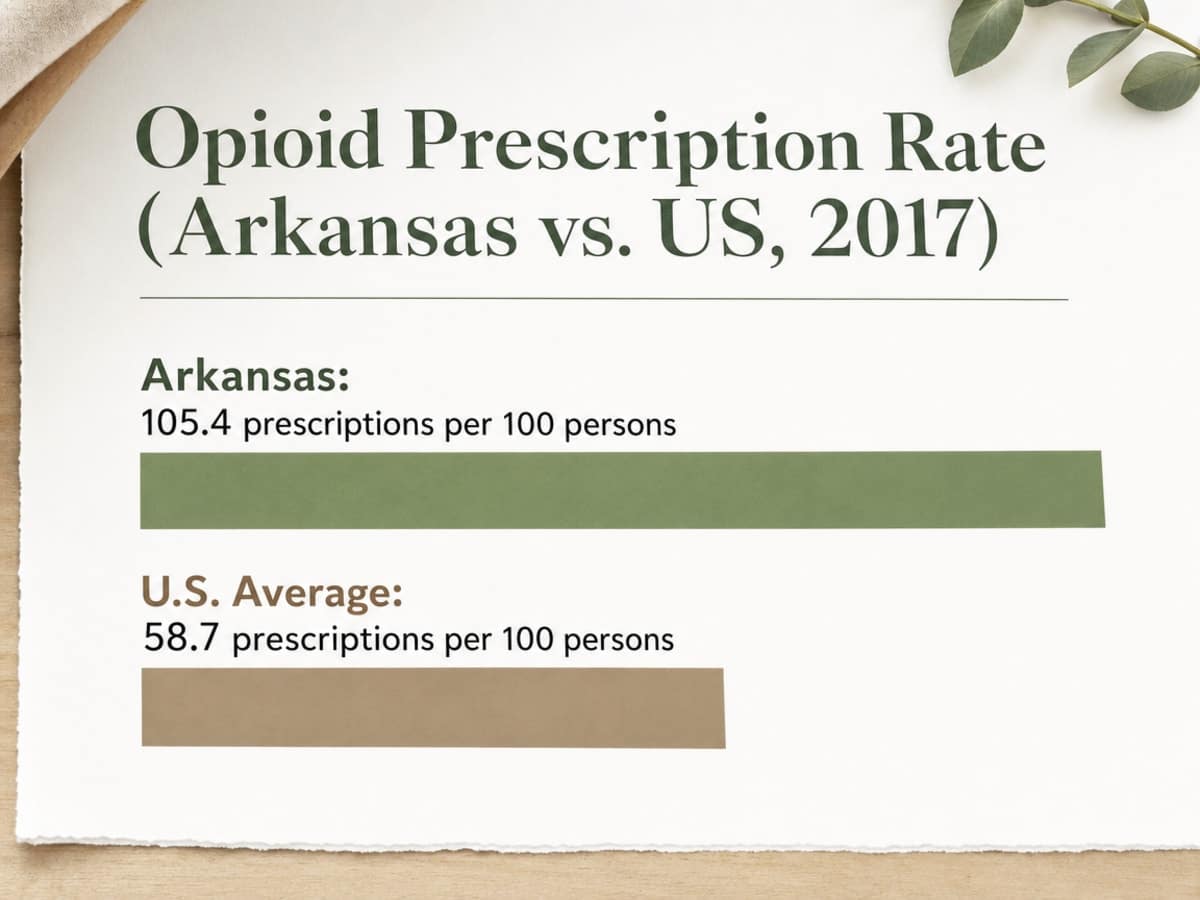
Here is the number that matters. In 2017, Arkansas providers wrote 105.4 opioid prescriptions for every 100 residents. The U.S. average that year was 58.7 per 100. Arkansas prescribed opioids at nearly twice the national rate. Not to a fringe population — to everyone. Post-op patients, workers’ comp cases, back injuries, dental procedures, chronic pain from the kind of physical labor that built a lot of this state.2
That same year, 188 Arkansans died from opioid-involved overdoses. Of those, 125 involved prescription opioids. Not heroin. Not something bought in a parking lot. Pills that came out of a pharmacy with a name on the label. Two-thirds of the state’s opioid overdose deaths that year traced back to legitimate prescriptions or the pills those prescriptions eventually became.2
Sit with that for a second. If your relationship with Oxycodone or Hydrocodone changed after a surgery or an injury, you are not an outlier in Arkansas. You are part of a very large group of men whose bodies did exactly what opioids do when you take them for weeks or months — adapted, adjusted, and started asking for more to feel the same.
This matters because the story you may be telling yourself — that something is wrong with you specifically, that you should have been stronger, that other people took the same pills and were fine — does not match the data. The exposure was massive. The prescribing was aggressive. And the fact that your body responded to a powerful drug the way that drug is known to work is not a character defect. It is pharmacology meeting a prescribing culture that has since been dialed back, hard, for exactly this reason.
Understanding that changes what treatment is. It is not punishment for a choice. It is the next medical step after a chapter of care that did what it was supposed to do for the pain, and then kept going past the point where it was helping.
How Dependence Actually Shows Up in a Working Week
You will not find yourself in a checklist. The signs that get printed on pamphlets — missed work, family blowups, obvious impairment — are not usually the first signs. The first signs are quieter, and they show up inside a week that still looks, from the outside, like a week you are winning.
It is Sunday night. You count what is in the bottle and count the days until the refill. The math is tighter than it was six months ago. You move a pill from Wednesday to Tuesday because the deposition is Tuesday and you need to be sharp, not sweating. You tell yourself you will make it up on Thursday.
It is Monday, 2 p.m. You are in a meeting and part of your attention is on the clock, because you know the window. You are not high. You are managing. But a small piece of your bandwidth is running a background process it did not used to run.
It is Wednesday. You dread the dentist appointment on the calendar — not the drill, the conversation. The last time you asked, the tone shifted. You leave with less than you expected and spend the drive home already rearranging the next two weeks.
It is Friday. A client dinner runs late. You skipped the afternoon dose to stretch the supply, and now your legs are restless under the tablecloth and your back aches in a way that feels older than you are. You order another drink because it takes the edge off the edge.
None of that is weakness. That is a body that adapted to a medication it was told to take, doing exactly what opioids do — building tolerance, then asking for more to reach the same floor. Nationally representative Arkansas survey data shows past-year prescription pain reliever misuse affects a meaningful share of adults in this state, not a fringe group. If your week has started to look like this, you have plenty of company you never see, because men like you are, by definition, still holding it together.4
Why Refills Suddenly Got Harder
The Five-Day Schedule II Limit and Naloxone Rule
If your last refill conversation felt shorter, colder, or more clinical than the one before it, there is a reason that has nothing to do with you personally. Arkansas tightened the rules on who can prescribe what, and for how long.
Under state code, an advanced practice registered nurse in Arkansas — the NP or CRNA who may be the one writing your script — cannot prescribe most Schedule II opioids for more than a five-day period. Hydrocodone combination products are the exception, but Oxycodone and most other Schedule II painkillers now come in short windows. If your prescription used to run 30 days and now runs 5, that is the rule, not a judgment about you.3
The same rule requires a prescription for naloxone — the overdose reversal medication — whenever an APRN prescribes an opioid at or above 50 morphine milligram equivalents per day, or in other higher-risk situations. Being handed a naloxone script alongside your painkiller is not an accusation. It is now standard practice for a category your prescription may fall into, based on dose alone.3
What the PDMP Sees That You Don’t
Every controlled-substance prescription filled in Arkansas gets logged in the state Prescription Drug Monitoring Program. Your prescriber can pull up a complete picture of every opioid, every benzodiazepine, every stimulant you have filled — across every provider, every pharmacy, going back years.7
That is why the urgent care doctor who used to write you a small bridge script now hesitates. Why the dentist pulls up something on his screen before he answers your question. Why the orthopedic follow-up feels different than it did after the surgery. They are not guessing about your history. They are reading it.
You are not being singled out. Provisional data showed 547 Arkansas residents died from a drug overdose in 2020, up sharply from prior years, and the PDMP is one of the tools built to change that trajectory. But the practical effect on a working man whose script has crept up is real: the doors that used to open quietly are closing quietly, and the exposure that used to feel invisible is not.7
The State Is Bending the Curve — But the Exposure Remains
Here is the part of the story that does not get told enough. Arkansas is measurably safer to enter treatment in right now than it was four years ago.
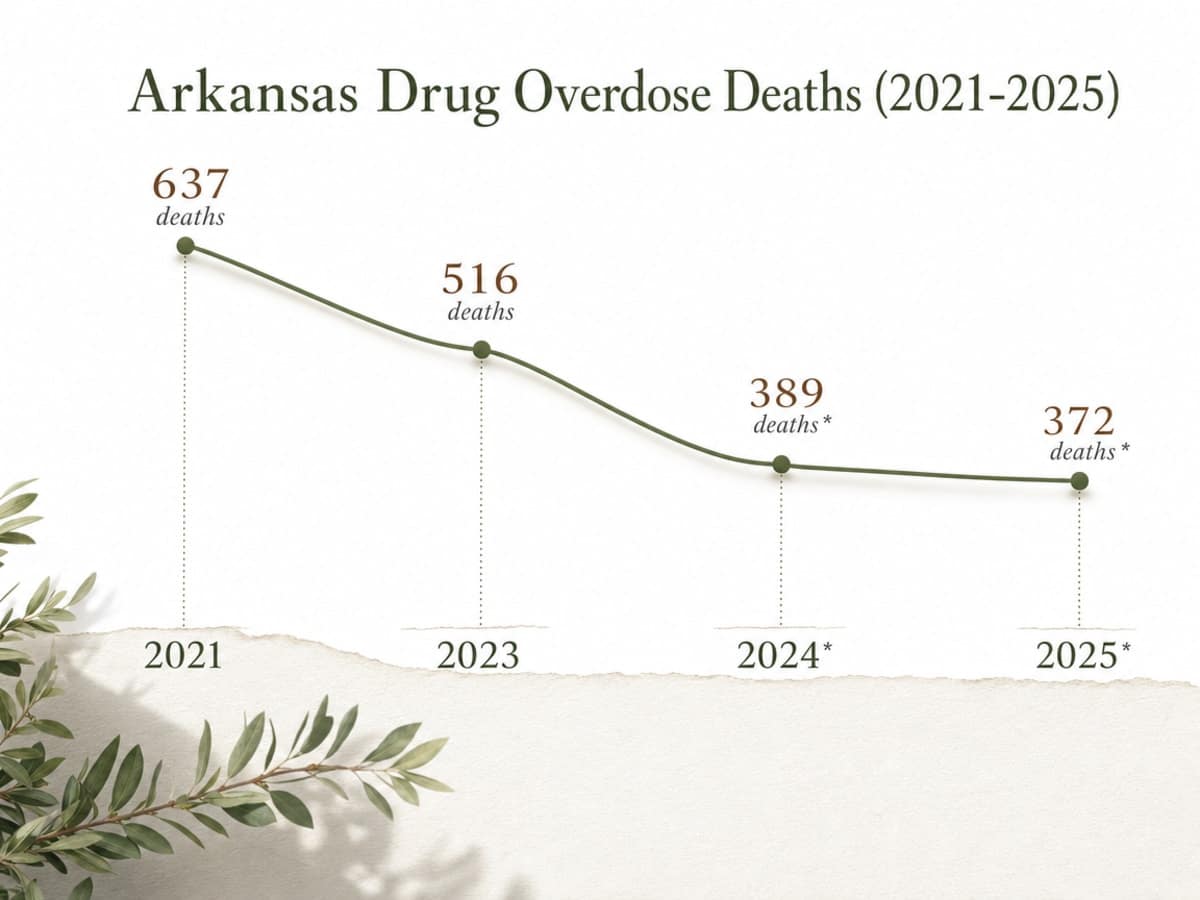
In 2021, 637 Arkansans died from a drug overdose. By 2023, that number was 516. In 2024, it dropped to 389. Provisional data for 2025 puts it at 372. That is a 42% decline from the peak in four years. Not a rounding error. Not a blip. A sustained bend in a curve that had been climbing for a decade.1
Some of that came from tighter prescribing and the PDMP. Some came from naloxone in more hands. And a meaningful share came from Arkansas’s State Opioid Response work, which expanded MAT access, trained more prescribers in buprenorphine, and built out the treatment infrastructure that used to be thin outside of Little Rock and Fayetteville. The overdose rate fell from 14.2 to 11.0 per 100,000 between 2022 and 2023 alone. Non-fatal ED overdoses dropped too.5
What that means for you, practically, is this. If part of what has kept you from making a call is a quiet sense that there is nowhere good to go, or that the system in this state is broken, that is not the current picture. The waiting rooms, the prescribers, the outpatient programs, the residential beds — the capacity has grown. People walking in now are walking into something better resourced than what existed when your prescription first started.
The exposure that created your situation, though, is still on the books. A generation of Oxycodone and Hydrocodone prescriptions did not disappear because the prescribing rules changed. The men who took those prescriptions are still here, still working, still figuring out what to do next. The curve is bending because more of them are getting help, not because the underlying problem solved itself. That is the door you are looking at. It is more open than it used to be.
Four On-Ramps for Arkansas Men Who Don’t Call Themselves Addicts
Primary Care Taper With a MAT-Trained Prescriber
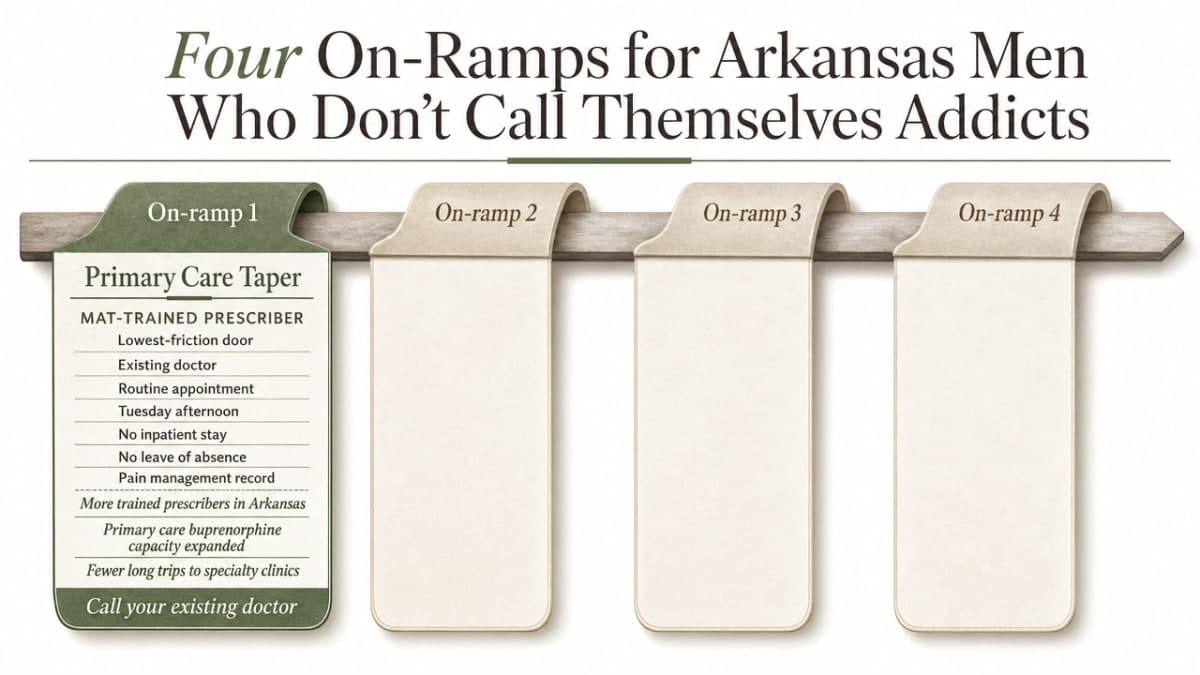
The lowest-friction door is the one you probably already have a relationship with. If your primary care doctor is trained in medication-assisted treatment — or works in a practice where someone is — a taper can happen inside a routine appointment on a Tuesday afternoon. No inpatient stay. No leave of absence. No mention on any record that says anything other than what it already says: you are being treated for pain management.
What has changed in Arkansas is how many prescribers now hold that training. The State Opioid Response effort has spent the last several years expanding buprenorphine capacity in primary care, adding prescribers in parts of the state that used to send everyone to a specialty clinic an hour away. That means a call to your existing doctor is more likely to land somewhere useful than it would have been in 2019.5
You can ask directly:
“Do you prescribe buprenorphine, or can you refer me to someone in this practice who does?”
That single sentence starts the conversation without you having to name yourself as anything. The medical answer takes it from there.
Outpatient MAT: Buprenorphine and Methadone
If a primary care taper is not the right fit — either because your dose is high, your use has moved beyond the original prescription, or the physical dependence is severe enough that stopping on your own has already failed — outpatient medication-assisted treatment is the next tier. You go to a clinic. You get evaluated. You start on buprenorphine (often under brand names like Suboxone or Sublocade) or, in some cases, methadone through a licensed opioid treatment program.
Both medications do the same essential job: they occupy the same receptors your prescribed painkiller does, without the peaks and crashes that drive tolerance higher. The withdrawal stops. The hourly clock in your head stops. You can sit through a two-hour meeting without part of your brain running dose math in the background.
Arkansas’s Office of Substance Abuse and Mental Health maintains a dedicated contact line for opioid treatment providers and can direct you to a program in your region. The Mental Health & Addiction Support Line at 1-844-763-0198 will locate providers near your ZIP code without asking for identifying details up front. Sessions are typically weekly to start, then space out. Most men keep working full schedules through the entire process.10,11
Crisis Stabilization Units for Acute Episodes
There is a tier most people do not know exists until they need it. If a refill falls through and withdrawal hits harder than you expected — the sweating, the restless legs, the nausea that folds you in half, the anxiety that feels like your chest is being sat on — the emergency room is not your only option. Arkansas has built a network of regional Crisis Stabilization Units for exactly this kind of acute episode.
CSUs are short-term, 24/7 facilities that stabilize you medically and psychologically over a few days, then link you to whatever comes next — outpatient MAT, residential care, a return to your regular provider with a plan that actually works. They accept referrals from any county in the state. You do not need to be suicidal or in handcuffs to walk in. Acute withdrawal from a prescribed medication qualifies.8
For a working man, the practical value of a CSU is that it is not a hospital admission and it is not rehab. It is a short, clinical stop that keeps a bad weekend from becoming a career event. It buys you time to make a longer decision from a stable place instead of a desperate one.
Residential Treatment When Outpatient Isn’t Enough
Residential is the tier most men on this article’s search path assume they will need first. Often, they will not. But sometimes it is the right answer — and knowing when saves you months of half-measures that do not hold.
Residential makes sense when outpatient has been tried and did not stick, when the dose or the duration of use has produced a physical dependence severe enough that stepping down at home is not medically safe, when co-occurring anxiety or depression has been quietly running underneath the pain, or when the environment you would be tapering inside of — the same office, the same medicine cabinet, the same evening — is exactly the environment that made the dose creep in the first place. Two to four weeks in a residential setting resets the physiology and separates the medication from the routine that keeps summoning it.
Serenity Park Recovery Center in Little Rock is one of those settings, built specifically for men, capped at 20 clients, with medical detox and continuous biotech monitoring that tracks sleep, heart rate, and stress data throughout stabilization. That last piece matters for prescription-origin cases: the taper can be adjusted to what your body is actually doing, not what a standard protocol predicts. Where you land on this ladder is not a verdict on you. It is a match to the medicine.
What Individualized Treatment Planning Actually Changes
Here is the honest reason a lot of men on your search path stall out. You read the standard treatment descriptions and none of them sound like your situation. You did not start with heroin. You are not in crisis. You are not unemployed. The protocols on the intake pages seem built for someone whose story you do not recognize as yours. So you close the tab.
Individualized treatment planning is the part that changes that math. It is not a marketing phrase. It is the actual clinical work of building a taper and a recovery plan around the specific medication that got you here, the specific dose you are on, the specific reason it started, and the specific life you need to keep functioning inside. For prescription-origin dependence, that specificity matters more than usual, because your starting point is not the average starting point.
A generic protocol assumes a certain drug history, a certain withdrawal profile, and a certain psychosocial picture. Yours may not match any of those defaults. Your original injury may still generate real pain that needs a real answer — not just detox and a shrug. Your dose curve may have been shaped by legitimate prescribing decisions that a good clinician needs to read backward before designing the taper forward. Your co-occurring picture may be sleep debt and untreated anxiety, not the classic trauma history the intake forms are built around.
At Serenity Park in Little Rock, individualized planning has a physiological component most residential programs do not carry. Continuous biotech monitoring through Huml Health wearables tracks heart rate variability, sleep architecture, and autonomic stress signals throughout detox and stabilization. That data lets the clinical team adjust the taper based on what your nervous system is actually doing on day three versus day seven, rather than on what a standard buprenorphine induction curve predicts for an average patient. For a man whose dependence built slowly, over months of prescribed use, that responsiveness matters. The withdrawal you experience is not the withdrawal in the textbook.
What that looks like practically: a plan that treats your pain as a real medical question, not a suspect story. A schedule that accounts for whether you have court dates, a surgery follow-up, or a licensure obligation waiting on the other side. A discharge that hands you back to a primary care relationship or an outpatient MAT provider who has the full clinical picture — not a photocopy of a generic aftercare sheet. Individualized means the plan fits the man. That is the piece worth calling about.5,9
Discretion, Career, and What Happens Next
You have a license, a firm, a practice, a shift schedule, a reputation. Any decision you make about treatment has to sit inside those realities, not pretend they aren’t there. Here is what actually happens on the discretion front.
What happens next is one call, made on your own timing, to a place that treats prescription-origin dependence as the medical situation it is. Serenity Park’s individualized planning was built for a man whose starting point is not the story in the pamphlet. Your case genuinely is different. The plan should be too. That is the first small win worth counting.
Frequently Asked Questions
I started Oxycodone after surgery and now I’m taking more than prescribed. Does that mean I’m addicted?
It means your body adapted to a medication doing exactly what opioids do — building tolerance, then asking for more to reach the same relief. Clinically, that is physical dependence, which is a medical situation with a medical answer. You do not have to accept a label to talk to a prescriber about a taper or medication-assisted treatment. The starting point is the biology, not the identity.
Can I get treatment for prescription painkiller dependence in Arkansas without going to residential rehab?
Yes. Most Arkansas men start with outpatient options — a taper through a MAT-trained primary care doctor, or buprenorphine through an outpatient clinic. Sessions are typically weekly at first, then space out. You keep working. Residential is reserved for cases where outpatient has not held or the physical dependence is too severe to step down safely at home. The tier matches the medicine, not the moral weight.5
Will my employer or medical board find out if I seek treatment in Arkansas?
Substance use treatment records are protected by HIPAA and by a stricter federal rule, 42 CFR Part 2, that keeps this information more shielded than most other medical care. Nothing goes to your employer, licensing board, or insurance network without a specific release you sign. Arkansas’s Office of Substance Abuse and Mental Health also maintains contact lines that answer questions before asking for identifying details.10
Why did my Hydrocodone refill suddenly get harder to get in Arkansas?
State rules tightened. Arkansas APRNs cannot prescribe most Schedule II opioids for more than a five-day window, and naloxone must be co-prescribed at higher doses. Every controlled-substance fill is also logged in the state Prescription Drug Monitoring Program, so any prescriber can see your full opioid history across pharmacies. Your prescriber is not judging you — they are reading a database that did not exist before.3,7
What is MAT, and is buprenorphine just trading one drug for another?
Medication-assisted treatment uses buprenorphine or methadone to occupy the same receptors your painkiller does, without the peaks and crashes that push tolerance higher. Withdrawal stops. The hourly dose math in your head stops. It is not a swap — it is a stable, long-acting medication that lets your nervous system reset. Arkansas expanded MAT access substantially through its State Opioid Response work, and it is now widely available.5
What’s the difference between a Crisis Stabilization Unit and a residential treatment program?
A Crisis Stabilization Unit is a short-term, 24/7 medical stop — usually a few days — for acute episodes like severe withdrawal after a missed refill. CSUs stabilize you and connect you to what comes next. Residential treatment is two to four weeks of structured care with medical detox, individualized planning, and time away from the environment that shaped the dose. One handles the bad weekend. The other resets the pattern.8
References
- Substance Misuse Education and Prevention. https://healthy.arkansas.gov/programs-services/prevention-healthy-living/substance-misuse-education-and-prevention/
- Arkansas Opioid Summary. https://nida.nih.gov/sites/default/files/21948-arkansas-opioid-summary.pdf
- 17 CAR § 123-604. Prescribing privileges. https://codeofarrules.arkansas.gov/Rules/Rule?levelType=section&titleID=17&chapterID=85&subChapterID=110&partID=1158&subPartID=6329§ionID=41315
- ARKANSAS – National Survey on Drug Use and Health State Tables (2023). https://www.samhsa.gov/data/sites/default/files/reports/rpt56188/2023-nsduh-sae-state-tables_0/2023-nsduh-sae-state-tabs-arkansas.pdf
- Arkansas State Opioid Response (SOR 4) Evaluation – Year 1. https://humanservices.arkansas.gov/wp-content/uploads/Y1-WYSAC-Eval-AR-SOR-4-Final-Draft.pdf
- Arkansas Prescription Drug/Opioid Overdose (PDO) Prevention Strategic Plan. https://humanservices.arkansas.gov/wp-content/uploads/PDO_Strategic_Plan_v3_rev_052318.pdf
- 2020 Annual Report – Prescription Drug Monitoring Program. https://healthy.arkansas.gov/wp-content/uploads/2020_Annual_Report_PDMP.pdf
- Crisis Stabilization Units. https://humanservices.arkansas.gov/divisions-shared-services/shared-services/office-of-substance-abuse-and-mental-health/crisis-stabilization-units/
- Programs for Mental Health & Substance Abuse Issues. https://humanservices.arkansas.gov/learn-about-programs/programs-for-mental-health-substance-abuse-issues/
- Contact OSAMH. https://humanservices.arkansas.gov/divisions-shared-services/shared-services/office-of-substance-abuse-and-mental-health/contact-osamh/
- Specialized Women Services (SWS). https://humanservices.arkansas.gov/divisions-shared-services/shared-services/office-of-substance-abuse-and-mental-health/specialized-women-services-sws/