
Key Takeaways
- Large randomized trials have not found that program gender composition drives primary outcomes like abstinence or retention, so neither coed nor men’s-only is clinically superior on average 5.
- The real decision variables are disclosure, distraction, and shame — frictions that determine whether you stay engaged past day nine, not aggregate outcome numbers.
- Single-gender care matters more for men with high psychiatric symptom severity, undisclosed trauma, or a pattern of using relationships to regulate discomfort 11.
- A men’s-only label does not fix weak psychiatric care, thin evidence-based therapy, poor aftercare, or ambivalence about stopping — composition is a variable, not a cure 14.
- Evaluate any program on individual-therapy hours, psychiatric access speed, retention approach on the day you want to leave, census size, and aftercare across the first year.
The question underneath the question
You’re not really asking whether coed or men’s-only rehab is “better.” You’re asking whether you can walk into a room of strangers and be honest for thirty days. Whether you can sit in a group and stop performing. Whether the setting will let you do the work, or quietly get in the way of it.
That’s the real question. And it’s a fair one.
Here’s what makes it hard: the marketing on both sides is loud, and the research is quieter than either camp admits. Most large randomized trials comparing SUD treatment across gender lines have not found that program composition drives primary outcomes like abstinence or retention 5. Once someone actually enters treatment, gender itself is a weak predictor of who finishes and who doesn’t 14. That’s the unglamorous headline.
But aggregate outcome data isn’t the same as your experience inside the program. Fit matters. Distraction matters. Whether you’ll actually disclose what’s driving the drinking matters. Those are the variables where coed and men’s-only settings genuinely diverge, and where a thoughtful choice can protect the thing you can’t afford to lose in treatment: your engagement.
This piece walks through what the evidence supports, what it doesn’t, and how to decide for your specific situation.
What the evidence actually says about gender and rehab outcomes
Large trials keep finding the same unglamorous result
Here’s the finding the rehab industry rarely puts on a billboard: when researchers actually compare treatment outcomes between men and women in controlled trials, gender of the program keeps failing to move the needle on the things you’d expect it to move.
Most large randomized clinical trials of substance use disorder treatment have not found evidence of gender differences in primary treatment outcomes, and men and women generally do not substantively differ in how they respond to SUD care 5. A 2025 review looking across the current literature reached the same conclusion — several large randomized trials have not identified gender differences in primary treatment outcomes 6. In one controlled trial of a psychosocial intervention, gender did not moderate outcomes for abstinence, retention, social adjustment, or craving 13. Four domains people worry about most. All of them, statistically, gender-neutral.
That is the load-bearing, counterintuitive fact of this whole conversation. If you were expecting the research to hand you a clean answer — men do better in men’s-only, women do better in women-only, case closed — it doesn’t. The averages look similar.
Why does this matter to you? Because it means you can stop treating the coed-versus-men’s-only decision as a binary between “clinically superior” and “clinically inferior.” Neither one is. Both formats can produce strong outcomes when the underlying treatment is good. That frees you to decide on the variables that actually differ — the ones the trials weren’t designed to measure. Which is where the next section goes.
Where subjective experience diverges from outcome data
Outcome parity is not the same as experiential parity. A trial measures whether you stopped drinking at ninety days. It does not measure whether you dreaded walking into group on day four, whether you edited your story for the room, or whether the person across the circle reminded you of someone you were sleeping with the last time you tried to get sober.
This is where the picture gets more interesting — and, for you, more useful.
A qualitative study of men and women in SUD group therapy found something worth sitting with. Women in mixed-gender groups rated the group composition as less helpful than women in women-only groups. Men, on the other hand, often described mixed-gender groups as beneficial 7. The fuller analysis went further: women more often discussed comfort, safety, and shame as reasons they struggled in mixed-gender settings, while men more often described mixed-gender interaction as valuable to their process 8.
Read that carefully, because the recovery industry tends to skip past it. When researchers actually asked men what they thought of coed groups, a meaningful share said the mixed setting helped. Not hurt. Helped.
That doesn’t mean coed is always right for you. Averages hide the person. But it does mean the reflexive assumption — that a man will automatically do better surrounded only by other men — is not what the patient-experience data actually shows.
So the real question isn’t which format wins on paper. It’s which specific frictions apply to your situation, and whether the coed dynamic that helped some men in that study would help you, or quietly derail you. The next section names those frictions so you can check your own case against them honestly.
The friction points that quietly derail engagement
Performative masculinity and the disclosure problem
Here is the quiet problem with a lot of coed group work: you will edit yourself, and you may not even notice you’re doing it.
Not because anyone told you to. Because you’ve been doing it for decades. You learned young that certain things — the crying, the fear, the specific shape of the wreckage at home — belong in a different room than the one with women in it. So when the group leader asks what the drinking is actually about, you give the tidy version. The one that lands. The one that doesn’t make you look like you’re falling apart in front of someone you might sit next to at lunch.
That editing is the disclosure problem. And it matters clinically, because the work of residential treatment happens in the specifics, not the summary.
Men’s behavioral health research has flagged this pattern for years — that men present and engage differently, often shaped by masculinity norms and help-seeking barriers that make full disclosure harder 15. A men’s-only room doesn’t eliminate performance. Men perform for other men constantly. But it changes which performance you’re running, and for some men it lowers the specific tax of being watched by women while admitting the things you were raised not to admit. That’s not a moral claim. It’s a friction claim. And frictions compound over thirty days.
Romantic and sexual distraction as a clinical variable
Nobody in a brochure will tell you this cleanly, so here it is: romantic and sexual attention inside residential treatment is a real clinical variable, and it derails people. Not because anyone is a bad actor. Because early recovery is a raw, intimate state, and raw intimate states find each other quickly in confined settings.
If your drinking has ever been tangled up with relationships — the ones that ended, the ones that shouldn’t have started, the ones you were hiding — then a coed residential floor asks you to manage a variable you’re actively trying to stop managing. That is a lot to hold at week two.
A men’s-only setting doesn’t make you a monk. It removes one specific category of distraction so your attention can stay on the work. For some men that’s incidental. For others, especially those with a pattern of using relationships to regulate discomfort, it’s the difference between finishing the program and finding a reason to leave.
Shame, help-seeking, and why men leave treatment early
The hardest part of residential treatment for most men isn’t the detox or the schedule. It’s the moment on day nine when the shame catches up with you and you start looking for a reason to go home.
Men carry a specific shape of shame about needing help — shaped by decades of being the one others lean on, the one who fixes it, the one who doesn’t ask. Behavioral health literature on men has consistently found that presentation and engagement patterns differ, and that help-seeking barriers change what men will and won’t say in a room 15. When shame spikes and you’re in a group where you feel watched or judged, the fastest relief is to minimize what you said the day before, or to leave.
When single-gender care matters more than average
The averages tell one story. Subgroups tell another. And if you’re in one of the subgroups where fit shifts the calculus, the aggregate data quietly stops describing you.
The clearest example comes from work looking at psychiatric symptom severity as a moderator of treatment response. Single-gender group treatment appeared to confer added benefit for patients with high psychiatric symptom severity — meaning that when depression, anxiety, PTSD, or other symptoms were running hot alongside the substance use, the composition of the room actually did move outcomes in ways it didn’t for lower-severity patients 11. That study was done in women, and it’s worth naming that honestly. But the mechanism it points to — that heavier psychiatric load makes group environment matter more, not less — is not gender-locked. If your drinking is riding on top of untreated depression, an anxiety pattern you’ve been medicating with alcohol for years, or trauma symptoms you’ve never named out loud, the room you’re in stops being incidental.
The second subgroup is the one men’s behavioral health literature has been describing for a long time: men whose engagement and disclosure patterns are shaped by masculinity norms and help-seeking barriers, where presentation itself differs from what clinicians see in women 15. If you’ve spent your adult life being the one others rely on, if asking for help feels like a category violation, if you’ve already tried a program and left early because you couldn’t get past the surface — you are in this subgroup whether or not you’d put it in those words.
And there’s a third, quieter subgroup worth naming: men with a trauma history they’ve never disclosed to a clinician. Not because the trauma is a men’s-only issue, but because disclosure in a coed room, for a man carrying that specific weight, is often a bridge too far in week one.
If one of these describes you, single-gender isn’t a preference. It’s a fit variable that actually matters.
What a men’s-only setting does not fix
A men’s-only floor is not a treatment plan. It’s a room. And rooms don’t do clinical work — clinicians and curricula do.
The honest thing to say here, because it separates real programs from marketing: switching a program from mixed-gender to single-gender does not, on its own, improve results. Composition is a variable, not a cure 14. If the underlying treatment is thin — light on evidence-based therapy, weak on psychiatric care, generic on discharge planning — a men’s-only label will not compensate. You will just be in a worse program with fewer women in it.
A few things a men’s-only setting specifically does not fix:
- untreated depression or anxiety driving the drinking
- trauma that needs modality-specific care rather than just a like-gendered room
- weak medical detox protocols
- thin family and aftercare work
- and the harder truth — your own ambivalence about actually stopping
None of that gets solved by demographics.
What single-gender can do is reduce specific frictions so the clinical work has a fair shot at landing. That’s meaningful. It’s also not the same as the work itself. When you evaluate programs, keep the composition question separate from the quality question. Both matter. Only one of them heals.
A five-question decision framework
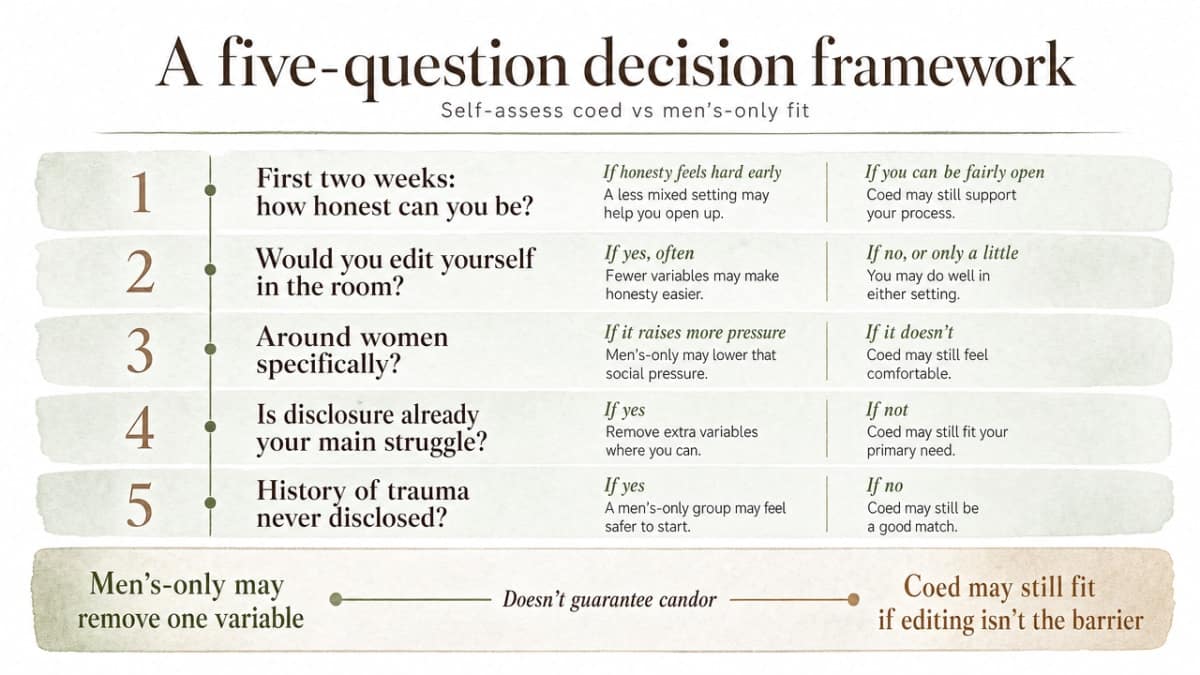
How honest can you actually be in the first two weeks?
Sit with this one. Not the version of the answer you’d give a colleague — the version you’d give yourself at 2 a.m.
Picture the group. Ten people, a facilitator, a question about what you were feeling the night the drinking got out of hand. Can you say the real thing? Or do you go to the version that sounds like insight without actually being it?
If you know you’ll edit — around women specifically, or around anyone at all — a men’s-only room removes one variable from that equation. It doesn’t guarantee candor. But if disclosure is already the thing you struggle most with, and masculinity norms have shaped how you engage in mixed rooms your whole life 15, you don’t want to add a coed dynamic on top of week-one shame.
Does your history include trauma you have never disclosed?
Not trauma you’ve processed. Trauma you’ve never said out loud to anyone with a clinical license.
If the answer is yes, the room matters more than the average patient’s room matters. Trauma disclosure in week one is already a high bar. Adding a coed dynamic — where a specific person in the circle might resemble, remind, or represent the exact context you’ve been avoiding — raises that bar in ways clinicians see repeatedly.
A men’s-only setting doesn’t do the trauma work for you. But it removes a category of trigger from the room where you’re being asked to name the thing for the first time.
Is distraction a known pattern for you?
You know your patterns. If your drinking has run parallel to relationships you shouldn’t have started, affairs you were hiding, or a habit of using attention to manage discomfort, the coed floor is asking you to hold a variable you’re trying to put down.
Some men can. Some men in the research actually described mixed-gender group interaction as useful to their process 7. So this isn’t a moral question. It’s a self-knowledge question.
If romantic attention has historically been how you leave the room emotionally, don’t design your treatment to test that muscle in week two.
How psychiatrically complex is the picture?
If the drinking is riding on top of depression you’ve medicated with alcohol, anxiety you’ve never named to a doctor, or trauma symptoms that show up as anger and insomnia, you are not a straightforward SUD case. You are dual diagnosis, whether or not the intake form has said so yet.
Work on psychiatric symptom severity as a moderator of treatment response found that single-gender group treatment appeared to confer added benefit for patients with high psychiatric symptom severity 11. That study was in women — worth naming honestly — but the mechanism isn’t gender-locked. Heavier psychiatric load makes room composition matter more, not less.
If the picture is complex, weight this variable heavily.
What is your realistic exposure risk if this becomes visible?
This one is practical, not clinical. Who in your professional world would see it, and what would it cost you if they did?
A smaller residential setting reduces the number of people you’ll cross paths with on the way in and out. A men’s-only setting narrows the demographic further. If you practice law in a mid-size market, run a business where clients know your name, or hold a hospital-privilege position, the size of the community you enter treatment alongside is not a vanity concern. It’s a risk-management one.
This variable doesn’t override the clinical ones above. But if two programs are otherwise comparable, exposure math is a legitimate tiebreaker — not a superficial one.
A brief, honest word on cost and small-capacity programs
You will notice, if you make more than three phone calls this week, that premium residential programs cost meaningfully more than mid-tier ones, and that men’s-only programs cluster on the higher end. That’s not a scam. It’s math. Smaller census, higher clinician-to-patient ratios, private accommodations, and tighter admissions screening all raise the per-day cost of running the floor.
What that buys you, when it’s real, is time and attention. What it doesn’t buy you is better clinical outcomes by default. Composition and price tag are not treatment quality 14. A twenty-bed men’s program with weak psychiatric care is still a weak program. A larger coed setting with strong evidence-based therapy and a real dual-diagnosis team can outperform it.
Evaluate cost the way you’d evaluate any professional expenditure: what specifically am I getting for the premium, and does it map to the frictions that actually apply to me? If the answer is smaller groups, deeper disclosure conditions, and clinicians with genuine capacity — that’s worth something. If it’s marble and a label, it isn’t.
How to pressure-test any program you’re considering this week
You don’t need a longer list of questions. You need five that force a real answer.
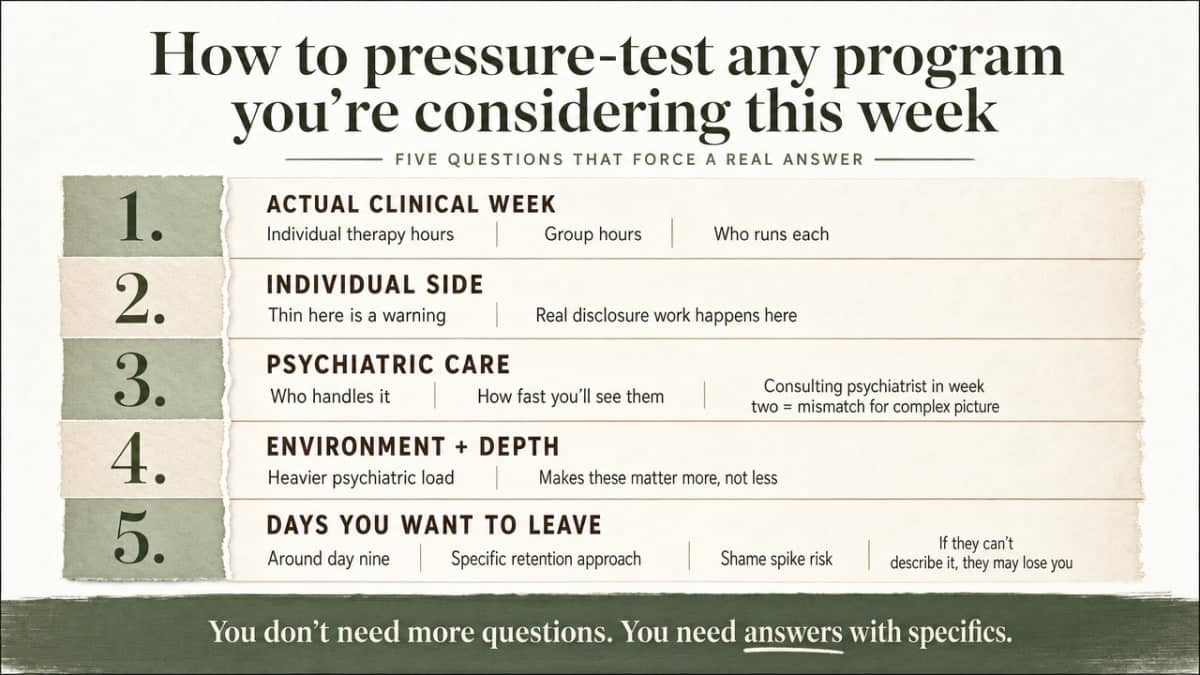
- Ask what the actual clinical week looks like — how many hours of individual therapy, how many hours of group, and who runs each. Programs that struggle here are usually thin on the individual side, which is where most of the real disclosure work happens.
- Ask who handles psychiatric care and how fast you’ll see them. If the answer involves a consulting psychiatrist you might meet in week two, and your picture is complex, that’s a mismatch. Heavier psychiatric load makes environment and clinical depth matter more, not less 11.
- Ask what happens on the days you want to leave. Every man wants to leave around day nine. A program that can’t describe its retention approach specifically is a program that will lose you when shame spikes 15.
- Ask about census and admissions screening. Smaller isn’t automatically better, but it changes group intimacy and the odds you’ll be candid.
- Ask what discharge and aftercare look like in weeks five through fifty-two. Residential is a launchpad. If they can’t map the runway, the room they put you in barely matters.
Frequently Asked Questions
Is men’s-only rehab actually more effective than coed rehab?
Not on average, no. Large randomized trials of SUD treatment have generally not found gender-of-program effects on primary outcomes like abstinence and retention 5. Where men’s-only care earns its keep is in specific subgroups and specific frictions — disclosure, distraction, trauma disclosure in week one — not in a blanket claim of clinical superiority.
Will I be more distracted in a coed program?
Depends on your history. If your drinking has run alongside relationships, affairs, or using attention to manage discomfort, a coed floor asks you to hold a variable you’re trying to put down. Interestingly, when researchers asked men directly, many described mixed-gender group interaction as helpful to their process 7. Know your own pattern before you decide.
Does a men’s-only setting make it easier to talk about trauma?
For many men, yes — but the room does not do the trauma work. Men’s behavioral health literature has consistently found that masculinity norms and help-seeking barriers change what men will say out loud 15. Removing the coed dynamic can lower the disclosure bar in week one. The clinical modality still has to be there.
I have co-occurring depression or anxiety. Does that change the decision?
Yes, meaningfully. Research on psychiatric symptom severity as a moderator found that single-gender group treatment appeared to confer added benefit when symptoms were running high 11. That study was in women — worth naming honestly — but the mechanism isn’t gender-locked. Heavier psychiatric load makes room composition and clinical depth matter more, not less.
How do I protect my privacy and professional reputation during residential treatment?
Choose a smaller-census program with tight admissions screening. Fewer people on the floor means fewer paths crossed. Ask directly about confidentiality practices, visitor policies, and how the program handles employment verification and communication with outside parties. A men’s-only setting narrows the community further. None of this is vanity — it’s legitimate risk management for a competent professional.
What should I ask a program before I commit?
Five things: hours of individual versus group therapy each week and who runs each; how quickly you see a psychiatrist and how dual diagnosis is handled; what the program does when patients want to leave around day nine; census size and admissions screening; and what discharge and aftercare look like across the first year.
References
- A systematic review of gender-responsive and integrated substance use disorder treatment programs for women with co-occurring disorders. https://pubmed.ncbi.nlm.nih.gov/36283062/
- Gender and Use of Substance Abuse Treatment Services. https://pmc.ncbi.nlm.nih.gov/articles/PMC6470905/
- Executive Summary. https://www.ncbi.nlm.nih.gov/books/NBK83249/
- Chapter 6—Treatment Considerations for Special Populations. https://www.ncbi.nlm.nih.gov/books/NBK576547/
- Sex and Gender Differences in Substance Use Disorders. https://pmc.ncbi.nlm.nih.gov/articles/PMC5945349/
- Gender-specific addiction research needed now more than ever. https://pmc.ncbi.nlm.nih.gov/articles/PMC12853563/
- Women’s and men’s experiences in group therapy for substance use disorders: A qualitative analysis. https://pubmed.ncbi.nlm.nih.gov/34730866/
- Women’s and Men’s Experiences in Group Therapy for Substance Use Disorders. https://pmc.ncbi.nlm.nih.gov/articles/PMC8799487/
- Group therapy for women with substance use disorders: results from the Women’s Recovery Group Study. https://pubmed.ncbi.nlm.nih.gov/25042759/
- The Women’s Recovery Group Study: A Stage I trial of a women-focused group treatment for substance use disorders. https://pmc.ncbi.nlm.nih.gov/articles/PMC3679366/
- High psychiatric symptom severity is a moderator of substance abuse treatment outcomes among women in single vs. mixed gender group treatment. https://pubmed.ncbi.nlm.nih.gov/18821452/
- The relative effectiveness of women-only and mixed-gender treatment for substance-abusing women. https://pubmed.ncbi.nlm.nih.gov/21315540/
- Gender-based Outcomes and Acceptability of a Computer-assisted Psychosocial Intervention for Substance Use Disorders. https://pmc.ncbi.nlm.nih.gov/articles/PMC4414709/
- Substance Abuse in Women. https://pmc.ncbi.nlm.nih.gov/articles/PMC3124962/
- Addressing the Specific Behavioral Health Needs of Men. https://pubmed.ncbi.nlm.nih.gov/23805437/