
Key Takeaways
- Evaluate residential programs against operational standards: ASAM Level 3 clinical management and Arkansas’s 28-hour weekly minimum for structured treatment, with 5 weekday and 3 weekend hours.5
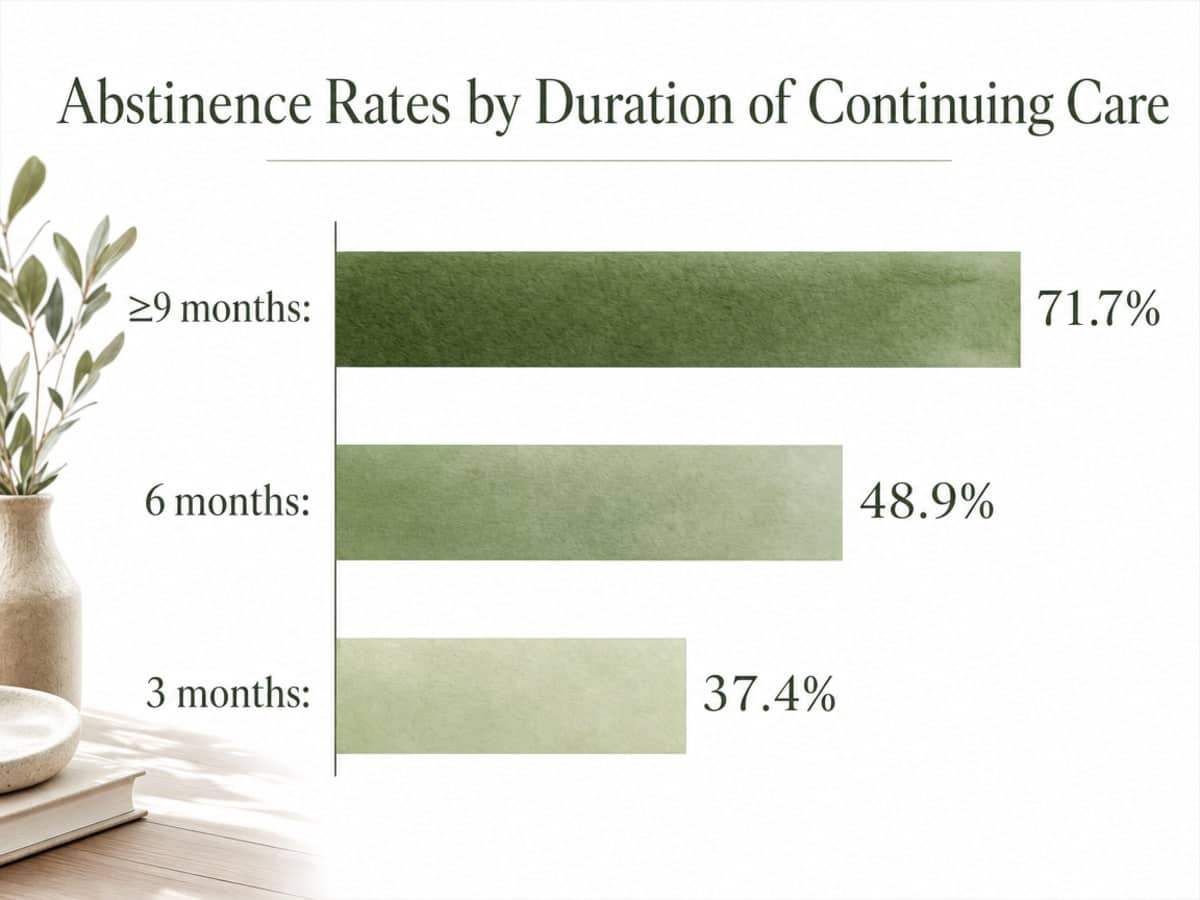
- Continuing care after discharge determines whether recovery holds — nine months of outpatient engagement produced a 71.7% twelve-month abstinence rate versus 37.4% at three months.8
- Confidentiality for working professionals runs through 42 CFR Part 2, which blocks use of treatment records in civil, criminal, administrative, or legislative proceedings without specific consent.13
- Press intake on medical director presence, staff ratios, licensure documentation, discharge planning timelines, and how wearables or medications like naltrexone and acamprosate actually shape clinical decisions.15
The Decision You’re Actually Making
You already know why you’re reading this. The question isn’t whether something needs to change — it’s whether you can afford to step out of your life for 30, 60, or 90 days, and whether the place you step into will be worth the disappearance.
That’s the real decision. Not “do I have a problem.” Not “is rehab for people like me.” The decision is whether a residential program can deliver enough clinical intensity to actually shift the patterns you’ve been managing around, protect your name while it does, and hand you off to something durable on the other side.
Most brochures won’t help you answer that. They’ll show you a lake, a chef’s kitchen, and a testimonial in soft focus. What they usually won’t show you is the weekly hour count, the licensure documentation, the discharge plan template, or the specific federal rule that governs what can be said about your admission in a courtroom.
This piece is built around those things. Treat it as an evaluation framework, not a sales funnel. By the end, you’ll have concrete criteria to hold any men’s residential program against — including questions the intake coordinator should be able to answer without pausing. If a program can’t meet the floor, you’ll know. If it can, you’ll know that too.
The reading takes about fifteen minutes. The decision is yours.
What ‘Residential’ Should Actually Mean
ASAM Level 3 and the 28-Hour Floor
Before you compare programs, you need a yardstick. Two exist, and they’re not marketing language — they’re the operational definitions clinicians and regulators actually use.
The first comes from the American Society of Addiction Medicine. ASAM Level 3 means a structured residential setting staffed twenty-four hours a day and clinically managed. That last phrase matters. “Clinically managed” means there is medical and counseling oversight built into the day, not a house where you sleep and drive yourself to appointments. Level 3 has sublevels — from clinically managed low-intensity residential up through medically monitored intensive inpatient — and any serious program should be able to tell you which one it operates and why that fits your presentation.7
The second yardstick is state licensure. In Arkansas, residential substance use disorder programs must provide a minimum of twenty-eight hours of structured treatment weekly: at least five hours daily Monday through Friday and at least three hours daily on Saturday and/or Sunday. That’s the floor, not the ceiling. Programs are also required to hold an active license from the state, and that license is tied to on-site reviews and documented compliance with staffing and facility standards.4,5
Two questions land the point. Ask the intake coordinator which ASAM level the program operates at, and ask for the weekly structured-hour count. If the answer is vague, or if “structured treatment” gets stretched to include meals and free time, you’ve learned something important before you sign anything.
Detox, Clinical Hours, and What Fills the Day
Twenty-eight hours a week works out to roughly four to five hours of clinical programming most days. If you’re picturing that as one long group session and a nap, adjust your picture.
A typical residential day for men starts with medical check-in — vitals, sleep, any withdrawal symptoms if you’re still early enough in the process for that to matter. Detox itself, when it’s needed, is a separate phase that happens before the full programming schedule takes hold. Alcohol and benzodiazepine withdrawal can be medically dangerous, and a program worth its license runs detox under medical supervision with clear protocols for tapering, hydration, seizure risk, and psychiatric symptoms that surface once the substance is gone.
Once you’re past acute withdrawal, the week fills out with the components SAMHSA describes as standard residential care: group counseling, individual counseling, psychoeducation, and 12-Step involvement. Group is where most of the hours land — cognitive-behavioral work, relapse prevention, process groups where men learn to name what they’ve been avoiding. Individual counseling gives you a single clinician who knows your case in detail. Psychoeducation teaches you the mechanics of what happened in your brain and body, which turns out to matter more than most men expect.1
Ask for a sample weekly schedule on paper. Not the marketing version — the actual one, with hours and session types labeled. Look at what fills the day when nothing dramatic is happening. That’s what your recovery will actually look like: repetitive, structured, sometimes tedious, and cumulatively effective. If the schedule is thin, or if too much of it is unstructured “reflection time,” you’re looking at a hotel with counselors, not a clinical program.
The Case for a Men-Only Setting — Honestly
The evidence here is more mixed than a men’s rehab brochure will tell you. It’s worth stating plainly.
Residential treatment is associated with significantly better abstinence outcomes for men than for women, according to SAMHSA’s treatment-modality guidance. That finding is a real reason the residential category exists as a serious option for you specifically. Men also arrive at treatment with different patterns — American men are two to five times more likely than women to develop a substance use disorder, and binge-drinking prevalence runs higher. A program built around those patterns can move faster than one that has to serve everyone equally.1,2
At the same time, the broader review literature is honest about limits: gender-specific treatment is not universally more effective than mixed-gender treatment, though some subgroups of men and women do benefit from single-gender settings. Anyone selling you men-only care as a clinically proven upgrade across the board is overstating the case.3
What a men-only setting can offer is more specific. A room full of men in group has different rules of engagement — different silences, different defenses, different admissions when things finally break loose. If you’re a professional who has spent twenty years performing competence, being in a room where no one is impressed by your title, and no one is your opposite-sex peer, changes what you’re willing to say. That’s not a clinical claim. It’s a social one, and it matters.
The point isn’t that men-only is always superior. The point is that if the setting removes friction from your engagement, you’ll do more of the work. And the work is what changes things.
Residential Is the Start, Not the Finish
Here is the part most men underestimate when they’re pricing out thirty, sixty, or ninety days: the residential episode is not the treatment. It’s the setup for the treatment. What actually determines whether you’re still sober a year from now is what you do in the nine to twelve months after you walk out the front door.
The evidence on this is unusually clean. In a review of continuing care after initial substance use treatment, patients who stayed engaged in outpatient continuing care for at least nine months had a 71.7% abstinence rate at the twelve-month mark. At six months of continuing care, the rate dropped to 48.9%. At three months, it fell to 37.4%. Same treatment episode up front. Same population. The only variable that moved was how long they stayed connected to structured care afterward — outpatient sessions, group participation, check-ins with a counselor who already knew the case.8
Read that spread carefully before you file it. Nine months of continuing care roughly doubles the twelve-month abstinence rate compared to three months. The residential stay is what makes continuing care possible; continuing care is what makes the residential stay stick.
This changes how you should evaluate a program. When you’re on the intake call, ask what the discharge plan looks like on paper. Ask whether the program runs its own continuing care groups or hands you a referral list on your last day. Ask what happens in month four, when the initial urgency has faded and your Monday calendar is full again. A serious program will have an answer that involves scheduled contact, a named clinician, and a group you’re expected to attend.
A program that treats discharge as an exit rather than a transition is quietly telling you it doesn’t own the outcome.
The practical consequence for your planning: don’t budget only for the residential window. Budget for the year. That doesn’t mean another year of living away from your life — outpatient continuing care is designed to fit around work, family, and the calendar you’re trying to preserve. It means accepting up front that finishing residential is a real accomplishment and also, on its own, an incomplete one. The men who stay sober treat the ninety-day mark as the end of the beginning, not the finish line.
If you’re going to spend the time and money to disappear for a month or three, protect the investment by staying connected to care after you come back.
Confidentiality When Your Career Is on the Line
If you’re an attorney, a physician, an executive with a board seat, or a business owner whose name is on the door, the question underneath every other question is the same one: what happens to my file, and who can see it?
The answer is more protective than most men realize, and it has a specific name. Substance use disorder treatment records held by federally assisted programs are governed by 42 CFR Part 2, a federal confidentiality rule that operates alongside HIPAA and, in important places, goes further than HIPAA does. The plain-language version: your records receive a layer of protection specifically designed for the reality that admitting to treatment can cost people their livelihoods.14
The most important sentence in the regulation, for your purposes, is this one. Records subject to Part 2
“may not otherwise be used or disclosed in any civil, criminal, administrative, or legislative proceedings”
without your written consent or a specific court order that meets Part 2’s heightened standard. Read that twice. A subpoena in a divorce, a licensing board inquiry, a business dispute where opposing counsel goes fishing — none of those, standing alone, entitles anyone to your treatment file. HIPAA doesn’t offer that. Part 2 does.12,13
What this looks like in practice: a Part 2 program cannot even confirm that you are a patient without your consent. If your assistant calls the front desk asking whether you checked in, the answer is that the program can neither confirm nor deny. If a family member calls, same answer, unless you’ve signed a specific release naming that person and the information they can receive. The consent forms are granular on purpose — you decide who gets told what, and you can revoke consent.13
There is a practical action item here, not just reassurance. Before admission, ask the intake coordinator to walk you through the program’s Part 2 notice and its consent forms. Ask specifically how the program handles employer inquiries, court orders, and calls from other treating physicians. A serious program will have written procedures and will explain them without hedging. If the answers are casual, or if staff conflate HIPAA and Part 2 as if they’re the same rule, that’s information about how carefully your records will actually be handled once you’re inside.
The protection isn’t absolute. Court orders that meet Part 2’s specific criteria can compel disclosure, mandated reporting for imminent harm still applies, and recent updates to Part 2 have adjusted how records flow between providers for care coordination. But the baseline is designed for someone in exactly your position: a working man who needs treatment and whose career depends on the file staying where it belongs.12
Your name is not the price of admission. It’s what the rule was written to protect.
Medication, Monitoring, and What the Evidence Actually Supports
Naltrexone, Acamprosate, Disulfiram — and Why Meds Aren’t the Whole Plan
If alcohol is your primary problem, ask the medical director on day one whether pharmacotherapy is on the table. Three medications have real evidence behind them and are part of standard care for eligible patients:15
- Naltrexone
- blunts the reward loop that makes the next drink feel worth it;
- Acamprosate
- helps steady the post-withdrawal brain chemistry that drives protracted craving;
- Disulfiram
- produces a sharp aversive reaction if you drink while taking it.
None of these is a cure, and no serious clinician will present them that way. SAMHSA’s guidance is explicit that medication for alcohol use disorder belongs inside a broader plan that includes counseling and psychosocial support. The medication changes the physiology; the counseling changes the pattern. Take one without the other and you’re doing half the work.15
Two things to press on at intake. First, ask whether a psychiatric evaluation is standard or optional — untreated depression, anxiety, or ADHD often sits underneath the drinking, and a program that doesn’t screen for it is treating the symptom. Second, ask what the medication plan looks like at discharge. Naltrexone and acamprosate are typically continued for months after residential, and the prescriber handoff is where plans quietly fall apart if no one owns it.
Wearable Biosensors: Promising, Not Proven
You’ll see wearable monitoring marketed hard right now — wristbands, patches, rings pulling continuous data on heart rate, sleep, sweat, and stress. Some of that is real progress. Some of it is running ahead of the evidence.
Here’s the honest read. For opioid use, biosensors have shown they can detect physiologic patterns consistent with administration in real time, which gives clinicians objective data to pair with what a patient reports in session. That’s a meaningful addition to a treatment plan, especially when self-report is compromised by shame or memory gaps. Broader reviews of wearable and wireless mHealth tools in substance use disorders describe them as the most commonly studied technology in the field, with applications in decreasing heavy use, tracking relapse-related factors, and monitoring overdose risk.9,11
The alcohol picture is more cautious. A review of wearable biosensors in alcohol use disorder concludes that current devices are most useful for tracking consumption in research trials and that their full clinical potential is not yet realized. Translation: the tech can measure things passively that used to require a breathalyzer, but the integration into day-to-day treatment decisions is still emerging.10
What this means for you: if a program uses wearables, ask specifically how the data changes clinical decisions. Does a spike in resting heart rate at 2 a.m. trigger a check-in the next morning? Does the counselor actually see the sleep trend before your session? A wearable that feeds a dashboard nobody reads is a screensaver. One that shapes the next conversation is a tool. Ask which one you’re being sold.
Questions the Brochure Won’t Answer
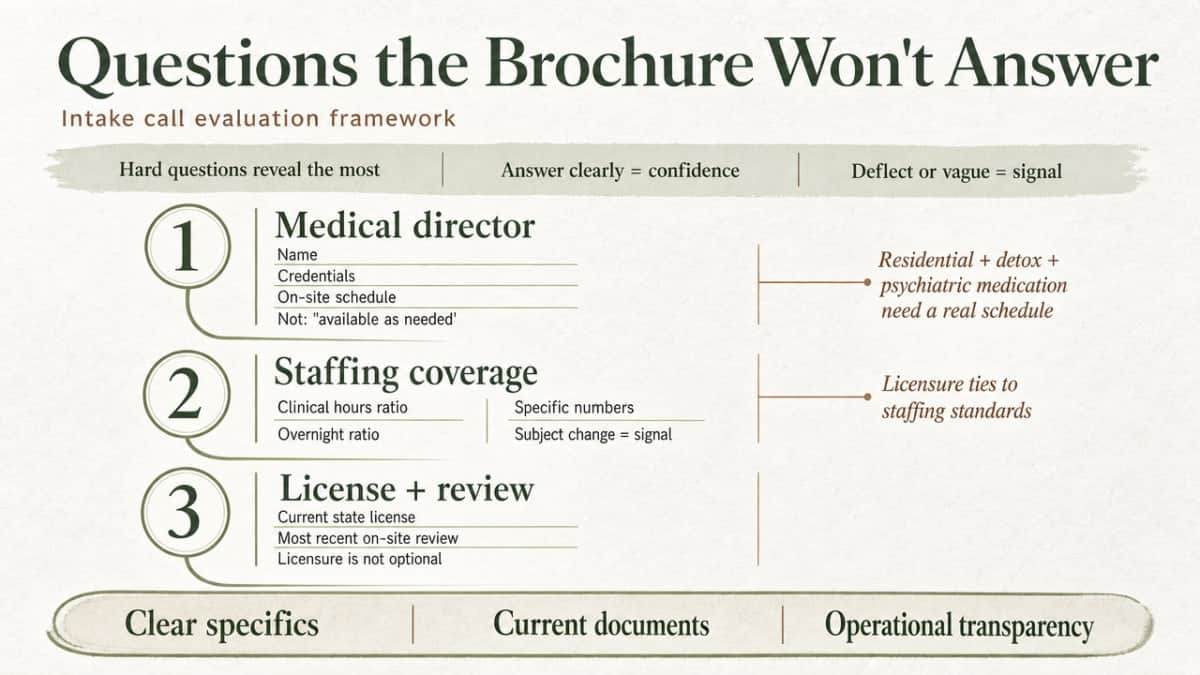
Every serious program has staff who can answer hard questions without flinching. The ones that can’t are telling you something. Here’s a short list to run through on the intake call, in the order that tends to expose the most.4,6,13
Who is the medical director, and how often are they on site? You want a name, credentials, and a real schedule. “Available as needed” is not an answer for a residential program handling detox and psychiatric medication.
What is the staff-to-client ratio during clinical hours, and what does it drop to overnight? Arkansas ties licensure to staffing standards for a reason. Programs that meet the floor will quote you specific numbers. Programs that don’t will change the subject.
Can I see the current state license and the most recent on-site review? Licensure in Arkansas is not optional for any entity operating a treatment program. A program should produce documentation without hesitation.
What percentage of your clients complete the full recommended length of stay? Completion rates are the closest thing to an honest outcome metric a program will share pre-admission. If they won’t share it, ask why.
Who writes my discharge plan, and when do they start? The right answer involves a named clinician and a start date early in your stay — not the afternoon before you leave.
How do you handle a call from my spouse, my law partner, or opposing counsel? The answer should reference 42 CFR Part 2 and consent forms specifically. Vague reassurance about “discretion” is not the same as regulatory compliance.
What does the fourth week look like? Anyone can run a good first week. The programs that actually work have thought through what happens once the crisis energy fades and the schedule has to carry you on its own.
Write these down before the call. Take notes on how the answers land — not just the content, but whether the person on the phone sounds like they’ve said these things a hundred times or is composing them as they go. You’ll know the difference.
What Progress Looks Like on Paper
Recovery doesn’t announce itself. It shows up in documents, in small operational shifts, in the ordinary things you can point to and say, that happened.
Track the concrete markers. A completed medical detox with vitals stable and withdrawal protocols closed out. A signed treatment plan with a named clinician, specific goals, and review dates on the calendar. A discharge plan written down by the second or third week, not the last afternoon — with your continuing care schedule, prescriber handoffs for any medications like naltrexone or acamprosate, and the name and number of the outpatient counselor you’ll see next.15
Then the softer ones, which matter as much. The first honest conversation with your spouse where you don’t manage her reaction. A group session where you said the thing you’ve never said out loud. A morning you woke up without the low-grade calculation of when you could drink again.
Ninety days is not a finish line. It’s a foundation you can build on, provided you stay connected to care long enough for the gains to hold. If you’re weighing a program like Serenity Park Recovery Center or any other men’s residential setting, hold it to the standards in this piece. The floor exists for a reason. You deserve a program that clears it.8
Frequently Asked Questions
How long does men’s residential rehab typically last?
Residential stays generally run 20 to 90 days, with length matched to your clinical picture rather than a package. Detox complexity, co-occurring conditions, and prior treatment attempts push the number up. The residential window is only the front end — outcomes hold when it’s paired with at least nine months of continuing care afterward.8
Will my employer or the courts find out I went to rehab?
Not without your written consent or a court order that meets the heightened Part 2 standard. Under 42 CFR Part 2, your records can’t be used in civil, criminal, administrative, or legislative proceedings absent specific authorization. The program can’t even confirm you’re a patient to an outside caller without a signed release.13,14
Is a men-only program actually better than a mixed-gender one?
The honest answer is mixed. Residential care is associated with significantly better abstinence outcomes for men specifically, but the broader literature finds gender-specific programs aren’t universally superior to mixed-gender care, though some men benefit from single-gender settings. If the room helps you say what you’ve been avoiding, that matters more than the label.1,3
What should a residential program’s daily schedule look like?
Ask for the actual schedule on paper. Arkansas requires residential programs to deliver at least 28 structured treatment hours weekly — a minimum of 5 hours daily Monday through Friday and 3 hours daily on Saturday and/or Sunday. Expect group counseling, individual counseling, psychoeducation, and 12-Step involvement filling most of those hours.1,5
Do I need medication like naltrexone or acamprosate to recover?
Not everyone needs pharmacotherapy, but for alcohol use disorder, naltrexone, acamprosate, and disulfiram have real evidence and are part of standard care for eligible patients. SAMHSA is clear that these medications work inside a broader plan with counseling and psychosocial support — not as standalone fixes. Ask the medical director whether you’re a candidate.15
What happens after I leave residential treatment?
You transition into outpatient continuing care — scheduled sessions, group participation, and check-ins with a counselor who knows your case. This is where the real durability of recovery gets built. Before you leave, you should have a written discharge plan with named clinicians, prescriber handoffs for any medications, and dates on the calendar. Not a referral list handed over on the last afternoon.8
References
- Treatment Modalities and Settings. https://www.ncbi.nlm.nih.gov/books/NBK144286/
- Addressing the Specific Behavioral Health Needs of Men (Quick Guide to TIP 56). https://library.samhsa.gov/product/addressing-specific-behavioral-health-needs-men/sma14-4882
- Gender and Use of Substance Abuse Treatment Services. https://pmc.ncbi.nlm.nih.gov/articles/PMC6470905/
- Licensure Standards for Alcohol and Other Drug Abuse Treatment Programs (Arkansas DHS). https://humanservices.arkansas.gov/wp-content/uploads/Licensure_Standards_for_Alcohol_and_Other_Drug_Abuse_Treatment_Programs.pdf
- Arkansas Summary – State Residential Treatment for Substance Use, Mental Health, and Co-Occurring Conditions. https://aspe.hhs.gov/sites/default/files/2021-08/StateBHCond-Arkansas.pdf
- 007.25.00 Ark. Code R. 001 – Licensure Standards for Alcohol and/or Other Drug Abuse Treatment Programs. https://www.law.cornell.edu/regulations/arkansas/007-25-00-Ark-Code-R-001
- Overview of Substance Use Disorder (SUD) Care Clinical and Quality Measures – ASAM Resource Guide. https://www.medicaid.gov/state-resource-center/innovation-accelerator-program/iap-downloads/reducing-substance-use-disorders/asam-resource-guide.pdf
- The Continuing Care Model of Substance Use Treatment. https://pmc.ncbi.nlm.nih.gov/articles/PMC4007701/
- Wearable Biosensors to Detect Physiologic Change During Opioid Use. https://pmc.ncbi.nlm.nih.gov/articles/PMC4996791/
- A Review of Wearable Biosensors in Alcohol Use Disorder. https://pubmed.ncbi.nlm.nih.gov/33828497/
- Wearable and Wireless mHealth Technologies for Substance Use Disorders. https://pubmed.ncbi.nlm.nih.gov/33738178/
- Fact Sheet: 42 CFR Part 2 Final Rule. https://www.hhs.gov/hipaa/for-professionals/regulatory-initiatives/fact-sheet-42-cfr-part-2-final-rule/index.html
- 42 CFR Part 2 – Confidentiality of Substance Use Disorder Patient Records. https://www.ecfr.gov/current/title-42/chapter-I/subchapter-A/part-2
- Understanding Confidentiality of Substance Use Disorder Patient Records. https://www.hhs.gov/hipaa/part-2/index.html
- Medication for the Treatment of Alcohol Use Disorder: A Brief Guide. https://library.samhsa.gov/product/medication-treatment-alcohol-use-disorder-brief-guide/sma15-4907