
Key Takeaways
- Men consistently delay addiction treatment due to self-reliance norms, stigma, and resistance to vulnerability, and arriving late raises the medical and practical cost of eventual care 2.
- For higher-severity cases, residential treatment shows a stronger abstinence signal for men than outpatient care, making dose-to-severity matching the central clinical decision 1.
- Programs worth choosing deliver four things together: adequate-dose residential care, gender-responsive clinical content, integrated treatment for depression and trauma, and structured aftercare that survives the return to work.
- Evaluate any program by asking for outcomes across substance use, retention, and quality of life, paired completion and length-of-stay figures, on-site psychiatric care, and a concrete written aftercare plan 5.
The quiet call from the parking garage
You already know why you’re reading this. Maybe you’re in the car after a long day, engine off, phone in your hand, searching in a private window. Maybe the drink at lunch turned into three, and the meeting went fine anyway, which is somehow the part that scares you. Maybe your spouse said something at breakfast and you spent the rest of the morning replaying it between calls.
Whatever brought you here, you are not at rock bottom. You are functioning. You are also tired in a way that sleep does not fix. Both things are true at the same time, and that combination is more common than the marketing around addiction treatment ever admits.
Here is what this article will do. It will walk you through what the research actually says about treating addiction in men — not what sounds good on a website, but what the evidence supports. It will name the specific patterns that keep professional men out of care longer than they should be 2. It will describe what a real residential week looks like, what outcomes look like when a program is built well, and what does not reliably work on its own.
You do not have to decide anything today. You just have to read honestly. That is a fair first move, and it counts.
Why men arrive late, and what that costs
Men do not usually walk into treatment on time. That is not a character flaw. It is a pattern documented well enough that researchers have stopped debating whether it exists and started asking what to do about it.
A 2024 systematic review synthesizing 16 studies on help-seeking for addiction among men found that gender consistently shaped the behavior, with women showing a higher propensity to reach out for help and men delaying, minimizing, or avoiding it altogether 2. The review named three barriers that came up again and again:
- Masculine norms that equate self-reliance with worth
- Stigma around being seen as someone who cannot handle his own life
- A deep resistance to appearing vulnerable in front of anyone, including a clinician 2
SAMHSA’s clinical guidance for men echoes the same pattern from a different angle, noting that men are less likely than women to recognize and acknowledge behavioral health problems in the first place 3.
What that looks like in your life is probably not dramatic. It looks like telling yourself the number of drinks is fine because the work still gets done. It looks like a quiet promise to cut back after this deal closes, this trial ends, this quarter. It looks like handling it, which is a word that has done more damage to more men than most diagnoses.
The cost of arriving late is not moral. It is medical and practical. Alcohol use gets more entrenched. Sleep deteriorates. Depression deepens under the surface. The window where a shorter, less disruptive intervention would have worked closes, and the eventual treatment becomes longer and more expensive than the one you avoided. Arriving now, even three years later than you should have, is still earlier than arriving next year.
The four things that actually move the needle
Adequate-dose residential care for higher-severity cases
Not every man needs residential treatment. That has to be said honestly, because the industry has a habit of recommending the most intensive product to whoever walks through the door. But for higher-severity cases — daily drinking, physical withdrawal risk, prior failed outpatient attempts, co-occurring depression or anxiety that will not sit still — the evidence for residential care is stronger than the marketing usually explains.
A 2019 systematic review of 23 studies found moderate-quality evidence that residential treatment improves outcomes across substance use, employment, criminal justice involvement, and mental health domains 4. The review is careful about its limits: many of the studies were non-randomized, follow-up windows varied, and the evidence for residential care being superior to well-delivered intensive outpatient is mixed 4. That honesty matters. It means the question is not “is residential care better than everything else,” but “is residential care the right dose for this person, at this severity, right now.”
For men specifically, SAMHSA’s clinical guidance reports something worth pausing on: residential treatment, compared to outpatient, is associated with significantly better abstinence outcomes for men — a signal that does not appear as strongly for women 1. That does not make residential care a universal prescription. It makes it a serious option for men whose severity, environment, or previous attempts have already answered the question of whether they can white-knuckle it at home.
If you have tried the shorter path and it did not hold, that is data. Use it.
Gender-responsive clinical content, not gender-themed decor
Men-only signage on the front door is not clinical content. A lot of programs stop there and call it gender-responsive. It is not.
Real gender-responsive treatment addresses the specific ways men arrive at addiction, stay stuck in it, and either engage with or resist recovery. SAMHSA’s protocol on men’s behavioral health names the pieces plainly: male socialization patterns that discourage emotional expression, the weight of provider and protector roles, unresolved trauma that has been quietly running the show for decades, fatherhood, and the co-occurring disorders that ride alongside the drinking 3. The protocol is direct that many of these recommendations rest on clinical consensus more than randomized trials, but the through-line is consistent: treatment content should match how men actually work 3.
What that looks like in a real program is boring on paper and useful in practice. Group content that names anger before it names sadness, because that is often the accessible door. Individual therapy that treats emotional restriction as a skill deficit to be built, not a character trait to be scolded. Conversations about work identity, marriage, and being a father that are treated as clinical variables rather than sentimental extras. That is the difference between a men-only room and a room built for men.
Integrated treatment for depression, trauma, and the drinking underneath them
You may have already noticed that the drinking is not really the whole story. Something else is running underneath it — a low grade depression you have called being tired, a trauma you have called ancient history, an anxiety you have called being driven. Treating the alcohol without treating what sits beneath it is how men end up in their third or fourth program.
The I-ACT residential program for veterans with SUD and co-occurring mental health conditions was built on exactly this premise: integrated care that treats the psychiatric picture and the addiction picture as one clinical problem, not two referrals. Scores on both substance use and depression measures significantly decreased from intake to discharge, with clinically significant improvement in depression, including among patients with dual diagnoses 7. That is what integration looks like when it actually happens.
The evidence on trauma-specific work for men is more modest and worth stating that way. The randomized study of Helping Men Recover in a Miami-Dade drug court found that participants were more likely to report improvements in overall health and were more likely to build recovery-supportive relationships with family and friends, though most other outcomes did not differ from usual programming 9. Real, not miraculous. Enough to justify treating trauma as part of the clinical work, not enough to justify treating it as a magic bullet.
Structured aftercare that survives the return to work
The month you spend in residential care is not the intervention. It is the beginning of it. What determines whether the work holds is what happens on the Tuesday morning six weeks later, when you are back at your desk, the calendar is full, and the old script starts whispering.
The 2023 realist review of residential SUD treatment identified the mechanisms that make residential care actually work: a sense of belonging, meaning in life, and self-determination — the ability to feel like an author of your own choices rather than a passenger 6. Those mechanisms do not survive on their own once you leave the building. They have to be transplanted into your regular week through structured aftercare: a continuing care group that meets on a predictable schedule, individual therapy that continues without a gap, peer support you actually show up to, and a treatment plan that names what happens the first time you feel the pull to drink again.
Arkansas licensure standards require residential programs to build aftercare planning into treatment 10. The programs that take that seriously write plans you would actually follow on a hard week. The ones that do not, hand you a photocopy.
What a real residential week looks like
The word “intensive” gets used loosely in this category. It is worth translating into hours on a calendar, because that is what you will actually live.
Arkansas licensure standards require residential SUD programs to deliver at least 28 hours of structured treatment each week, with a minimum of 5 hours daily Monday through Friday, plus weekend programming, and the facility must provide separate bedroom areas for men and women 10. That is the floor, not the ceiling. Programs that take the work seriously usually run past it. But even at the minimum, you are looking at something closer to a full-time job than a retreat.
A real week has a shape. Mornings tend to open with a check-in group and a short mindfulness or movement block, because your nervous system has spent years being managed by a substance and needs to relearn how to settle on its own. Mid-morning is usually clinical group work — CBT, relapse prevention, a psychoeducation block on the biology of what alcohol has been doing to your sleep and your liver. Afternoons carry the heavier lifting: individual therapy once or twice a week, a process group where men actually talk to each other, and specialized work on trauma, anger, or family dynamics depending on your treatment plan. Evenings hold 12-step or peer support meetings, structured recreation, and quiet time that is actually quiet.
Weekends do not disappear. Programming continues, though the pace softens — family sessions when appropriate, longer recreation blocks, time to write, time to sleep the way you have not slept in years. The point of the schedule is not to keep you busy. It is to give your week a spine that your old routine did not have, so that when you leave, you have felt what a structured day feels like from the inside.
What outcomes actually look like when the model is right
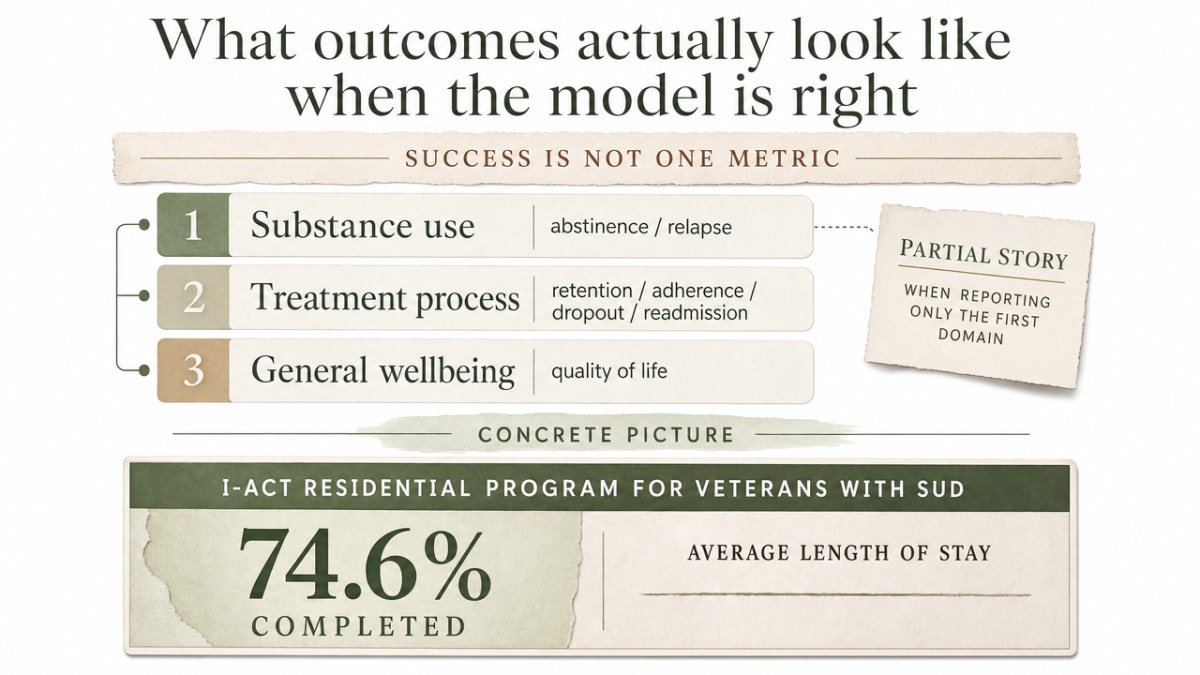
The question you probably want answered is the one most program websites dodge: what does success actually look like in numbers? The honest answer is that success in addiction treatment is not one metric. It is at least three, and a well-designed program will tell you how it performs on all of them.
Researchers who study SUD treatment outcomes group the metrics into three domains:
- Substance use itself (abstinence and relapse)
- Treatment process (retention, adherence, dropout, readmission)
- General wellbeing (quality of life) 5
A program that only reports on the first without the other two is telling you a partial story.
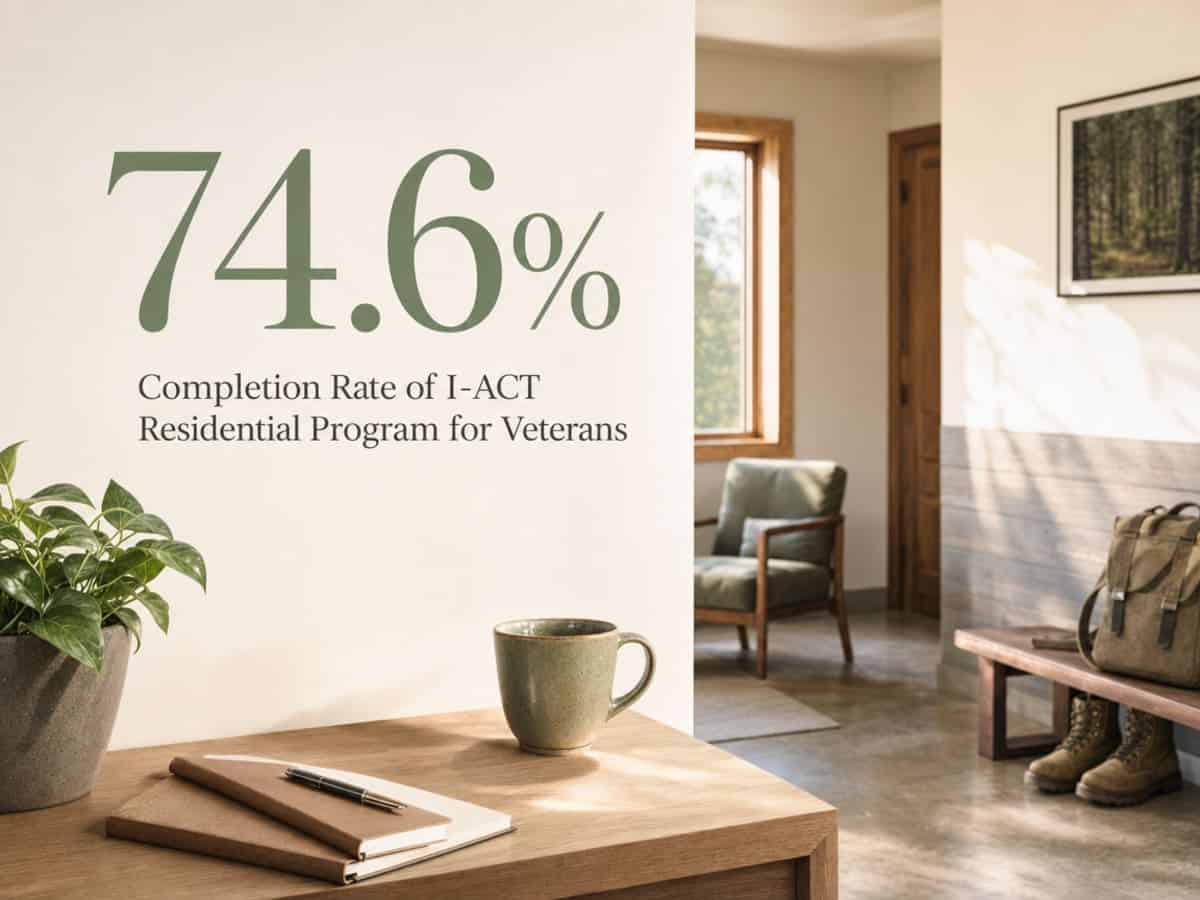
The I-ACT residential program for veterans with SUD gives you a concrete picture of what integrated, well-delivered care produces. Across the cohort, 74.6% of men completed the program, with an average length of stay of 34.2 days 7. Scores on both substance use and depression measures significantly decreased from intake to discharge, and the improvement in depression reached clinical significance, including among patients carrying a dual diagnosis 7. That is a program doing three things at once: keeping men in treatment long enough for the work to take hold, moving the substance use numbers, and moving the psychiatric numbers alongside them.
Continuous health monitoring as clinical decision support
Wearables in a treatment setting are not a gimmick and they are not the point. They are a source of data that helps a clinician adjust care faster than a weekly check-in ever could. Framed that way, they earn their place.
Here is what actually matters clinically. Early recovery is a period of nervous system upheaval. Your resting heart rate is higher than it should be. Your sleep is fragmented in ways you cannot fully report because you were asleep for it. Your stress response is spiking at moments you do not consciously notice. A wearable that captures heart rate, heart rate variability, sleep stages, and activity gives your clinician a continuous read on what your body is doing between sessions, rather than a self-report from a man who has spent twenty years underreporting.
That data changes small decisions. If your sleep collapsed for three nights in a row, medication timing can be adjusted before it becomes a crisis. If your stress markers climb every afternoon at the same time, that pattern gets brought into individual therapy as a specific thing to work on, not a vague feeling. It is the same clinical judgment that has always driven good care, now with more signal and less guessing.
What does not reliably work on its own
A short, honest list is more useful here than a long one. These are the approaches that have kept a lot of professional men circling the same problem for years, not because they are useless, but because they are being asked to do work they cannot do alone.
Willpower is not a treatment. It is a personality trait that has probably carried you through law school, residency, or building a company from nothing. Alcohol use disorder is a medical condition that does not care how disciplined you are in every other domain of your life. Framing it as a character contest is how men lose years.
Weekend detoxes and quiet tapers at home carry real medical risk with alcohol and benzodiazepines, and they almost never address what was driving the use in the first place. Getting through withdrawal is the beginning of treatment, not a substitute for it.
Generic outpatient care can work for lower-severity cases, but for men with daily use, prior failed attempts, or co-occurring depression, the evidence points toward more structured settings — with residential care showing a stronger abstinence signal for men specifically 1. Matching dose to severity is the whole point. Under-treating a serious problem is not gentleness. It is delay.
How to judge a program before you sign anything
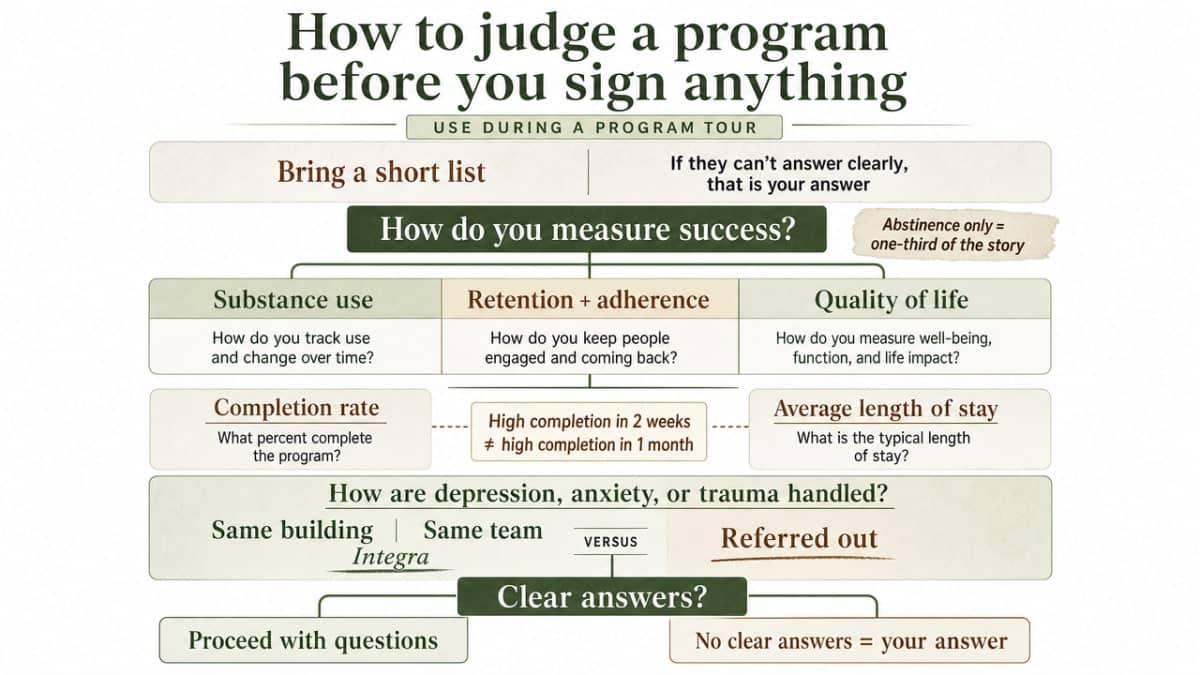
Most program tours are designed to make you feel welcome, not to answer the questions that actually matter. Bring a short list and use it. If a program cannot answer these clearly, that is your answer.
- Ask how they measure success across all three outcome domains, not just one — substance use, retention and adherence, and quality of life 5. A program that only reports on abstinence is telling you a third of the story.
- Ask what their completion rate looks like and what the average length of stay is that produces it, because a high completion rate on a two-week program is not the same as one on a month-long program 7.
- Ask how they handle co-occurring depression, anxiety, or trauma — specifically, whether psychiatric care and addiction care happen in the same building with the same team, or whether you will be referred out. Integrated care is not a slogan; it is a staffing model 7.
- Ask what the aftercare plan actually contains before you leave. Names, appointment times, a continuing care group on your calendar — not a photocopy 10.
- Ask what the weekly structured hours look like. If the answer is vague, you have your answer.
Protecting the career while treating the illness
The fear you have not said out loud yet is about the license, the partnership, the practice, the board seat, the marriage. It is a legitimate fear. It is also the reason a lot of good men wait too long and end up losing exactly what they were trying to protect.
A few things are worth knowing before you decide. Most professional licensing boards have confidential pathways for physicians, attorneys, pilots, and executives who seek treatment voluntarily, and those pathways are almost always more protective than what happens after an incident forces the issue. FMLA covers a residential stay for many employees, and short-term disability often applies. A 34-day average length of stay is not a career-ending absence; it is a defensible medical leave, planned quietly, with a return-to-work structure built in 7.
Residential care, by design, contains the discretion problem. You are not in your city, not on your calendar, not answering the phone. The people around you are in the same situation. That privacy is a clinical feature, not just a comfort. Protecting your career starts with treating the illness now, on your terms, rather than later on someone else’s.
A note on where this care lives
The care described in this article is not theoretical. It exists, in small residential programs built specifically for men, in places like Little Rock, where the point is to get you out of your city, out of your calendar, and into a structured week that meets the licensure floor and usually clears it 10. Serenity Park Recovery Center is one of those programs — men-only, residential, twenty beds, medically supervised detox, integrated psychiatric care, and continuous biometric monitoring built into the clinical model rather than bolted on. If the description here fits what you have been looking for, that is worth a phone call.
Frequently Asked Questions
Is residential treatment actually more effective for men than outpatient care?
It depends on severity, but the signal is real. SAMHSA’s clinical guidance reports that residential treatment, compared with outpatient, is associated with significantly better abstinence outcomes for men — a pattern that does not appear as strongly for women 1. For higher-severity cases, prior failed attempts, or co-occurring conditions, that finding matters. For lower-severity use, well-delivered outpatient can be enough.
How long does residential treatment typically last, and can I take that much time away from work?
In the I-ACT residential study, the average length of stay was 34.2 days 7. That is a defensible medical leave, not a career-ending absence. FMLA covers residential care for many employees, short-term disability often applies, and most professional licensing boards have confidential pathways for voluntary treatment that are more protective than what happens after an incident forces the issue.
What makes a program truly gender-responsive versus just labeled ‘men-only’?
Men-only signage is not clinical content. Gender-responsive care addresses male socialization, emotional restriction, trauma, provider and protector roles, fatherhood, and co-occurring disorders inside the actual group and individual work 3. If group content only names sadness before anger, or treats emotional expression as a character upgrade rather than a skill to build, the program is themed, not built for men.
I think I also have depression or unresolved trauma. Do I need to treat those separately?
No — and separating them is often how men end up in a third or fourth program. The I-ACT integrated model treated substance use and psychiatric symptoms as one clinical problem, and depression scores improved to clinical significance alongside substance use reductions, including in dual-diagnosis patients 7. Ask whether psychiatric care and addiction care happen in the same building, with the same team.
How should I evaluate a residential program before committing?
Ask for outcomes across all three domains researchers actually track: substance use, treatment process (retention and adherence), and quality of life 5. Ask for completion rate paired with average length of stay, not one without the other. Ask whether psychiatric care is on-site. Ask what the written aftercare plan contains before discharge. Vague answers to concrete questions are the answer.
What role does continuous health monitoring or wearable technology play in treatment?
It is clinical decision support, not a gimmick. Early recovery is a period of measurable nervous system upheaval — elevated resting heart rate, fragmented sleep, stress spikes you cannot consciously track. A wearable gives your clinician a continuous read between sessions rather than a self-report from a man who has spent years underreporting. That data lets small medication and therapy adjustments happen before a bad week becomes a crisis.
References
- Treatment Modalities and Settings. https://www.ncbi.nlm.nih.gov/books/NBK144286/
- Patterns and Challenges in Help-Seeking for Addiction among Men. https://pubmed.ncbi.nlm.nih.gov/39458039/
- Addressing the Specific Behavioral Health Needs of Men. https://pubmed.ncbi.nlm.nih.gov/23805437/
- The effectiveness of residential treatment services for individuals with substance use disorders: A systematic review. https://pubmed.ncbi.nlm.nih.gov/31254749/
- Substance Use Disorder Treatment Outcomes: Metrics and Criteria. https://pmc.ncbi.nlm.nih.gov/articles/PMC12180564/
- A realist review of residential treatment for adults with substance use disorder. https://pubmed.ncbi.nlm.nih.gov/36747370/
- The Individualized Addictions Consultation Team Residential Program. https://pubmed.ncbi.nlm.nih.gov/33583351/
- Gender and Cultural Adaptations for Diversity: A Systematic Review of Alcohol and Substance Abuse Interventions for Latino Males. https://pubmed.ncbi.nlm.nih.gov/29364763/
- Trauma Treatment for Men in Recovery for Substance Use Disorders. https://www.ojp.gov/ncjrs/virtual-library/abstracts/trauma-treatment-men-recovery-substance-use-disorders-randomized
- Licensure Standards for Alcohol and Other Drug Abuse Treatment Programs. https://humanservices.arkansas.gov/wp-content/uploads/Licensure_Standards_for_Alcohol_and_Other_Drug_Abuse_Treatment_Programs.pdf