
Key Takeaways
- A rehab admissions call is a short screening conversation, usually twenty to forty minutes, where a person at the facility triages your situation rather than running a full clinical assessment.
- You are not required to give your full name, employer, or identifying details to keep the conversation going, and federal law under 42 CFR Part 2 blocks the program from sharing your information without written consent 1, 2.
- The questions map to the six ASAM dimensions and stay narrow on purpose, covering recent use, medical concerns, a brief mental health screen, and program fit, while trauma and full history are deferred to intake 5, 9, 10.
- The call ends in one of four ways, including hanging up without deciding anything, and none of them obligate you to admission, notification of employers or licensing boards, or a bed that night 1.
The Call You Have Been Putting Off
The phone has been sitting on your desk for weeks. Maybe months. You have opened the browser tab, closed it, opened it again. You have rehearsed what you might say and then found a reason to push it to next Monday, next quarter, after this deposition, after this close, after the holidays.
You are not stalling because you do not know you need help. You are stalling because you do not know what happens when someone answers.
That is a fair thing to want to know before you dial. You are a professional. You do not walk into rooms unprepared, and you are not about to start with this one. The fear is rarely the treatment itself. It is the vulnerability of the first sixty seconds. Who picks up. What they ask. Whether your name ends up somewhere it should not. Whether saying the words out loud commits you to a bed tonight.
Here is what actually happens on that call, minute by minute, at a well-run admissions line like the one at Serenity Park Recovery Center in Little Rock. No script. No sales pitch. Just the conversation, previewed.

The First Two Minutes: Who Answers and What They Say
You dial. It rings twice, maybe three times. A person picks up. Not a call center in another state, not an automated tree asking you to press 1 for admissions, 2 for billing. A person, at the desk in Little Rock, who does this every day.
The first thing you will hear is a greeting and a first name. The second thing, usually within thirty seconds, is a version of this: Is this a good time to talk, and are you safe right now? That question is not rhetorical. It is the first triage step, and it is there because the person on the other end needs to know whether you are calling from your office between meetings or from a bathroom floor.
You do not have to give your last name. You do not have to give your employer, your address, or your date of birth to keep the conversation going. A first name, or even a first initial, is enough to move forward.
Somewhere in those first two minutes, before any real questions get asked, the person will tell you that this conversation is confidential and that federal law protects records of substance use treatment 2. That notice is not a formality. It is the frame around everything that comes next, and it is the reason you can keep talking without deciding anything.
The Anatomy of a 20-to-40 Minute Screening Call
Clinical guidance for treatment entry recommends limiting the initial contact to about an hour, with the remainder reserved for your questions and a plain-language orientation to what treatment actually looks like 5. In practice, at a small residential program like Serenity Park, the working portion of the call usually lands somewhere between twenty and forty minutes. Not because anyone is rushing you off the phone, but because the goal of this conversation is narrow. The team is trying to answer three questions: Are you safe right now, what level of care fits what you are describing, and what is the next step you are willing to take today.
- 0–2 minutes: Greeting, a check on whether you are safe and free to talk, and the federal confidentiality notice.
- 2–10 minutes: Basic screening. What brought you to the phone today, what you have been using, how recently, and whether anything about your physical state needs immediate attention.
- 10–25 minutes: Clinical questions organized around the six ASAM dimensions, translated into ordinary language.
- 25–35 minutes: Insurance verification basics, logistics, and what admission would actually involve if you chose it.
- 35–40 minutes: Next steps, your questions, and how the call ends.
That pacing is deliberate. The person on the phone is not trying to complete a full biopsychosocial assessment in one sitting, and clinical guidance is explicit that the initial contact should not attempt one 5. What they are doing is triaging: gathering enough to know whether you need a medical detox conversation today, whether residential treatment is a reasonable fit, and whether there is anything in your current situation that would change the answer.
You control the pace inside that clock. If the ten-minute mark arrives and you need to stop, you stop. If you want to sit at minute five and ask three questions before the next one gets asked, you do. The structure is there to protect your time, not to run out it.
What They Actually Ask You (And What They Do Not)
The questions that come next are narrower than you are probably expecting. The person on the phone is trained to gather what triage requires and to leave the rest for later. There is a specific reason for that restraint: the clinical guidance for treatment entry warns against overwhelming a caller with a full assessment on first contact, because doing so tends to shut the conversation down 5.
So here is what you will actually be asked in the first thirty minutes.
What brought you to the phone today. Open-ended. You answer in your own words. There is no correct version.
What you have been using, and how recently. Alcohol, benzodiazepines, opioids, stimulants, sleep aids, anything prescribed and anything not. The recency question matters because it drives the withdrawal-risk conversation. If your last drink was two hours ago, that is a different call than if it was two days ago.
Whether you have any current medical issues or medications. Short list. Blood pressure, seizures, heart conditions, anything a physician would want to know before you walked into a detox bed.
Whether you have ever been treated before, in any setting. Yes or no is enough. They are not asking for a chronology.
A brief screen for depression, anxiety, or thoughts of harming yourself. This is standard. Every reputable program screens for co-occurring mental health concerns at first contact 3, 6. It is two or three questions, not a psychiatric interview.
Basic insurance information, if you have it. Carrier and member ID, not a financial deep-dive.
Notice what is not on that list. You will not be asked about your childhood, your marriage, your trauma history, your legal record, your family’s substance use, or the details of your worst night. Those questions belong to a full intake interview that happens after you decide to move forward, not before 10. You will not be asked to name your employer, your firm, or your title. You will not be asked to justify why you waited this long to call.
The Clinical Logic Behind the Questions: ASAM’s Six Dimensions in Plain English
When the middle of the call arrives and the questions get more specific, they are not random. They map to a six-part framework the American Society of Addiction Medicine has used for decades to decide what level of care actually fits a person on any given day 9. The person on the phone is not running through it out loud, and they will not name it. But once you know what they are listening for, the questions stop feeling like an interrogation and start sounding like triage, which is exactly what they are.
Here is the plain-English version of what each dimension sounds like in a real conversation.
- Acute intoxication and withdrawal potential.When was your last drink or use? What happens to you physically when you stop? This is the dimension that determines whether you need a medical detox conversation today.
- Biomedical conditions and complications.Any current medical issues, medications, or recent hospitalizations we should know about? Blood pressure, seizures, liver, heart. The floor for admitting you safely.
- Emotional, behavioral, or cognitive conditions.Are you dealing with depression, anxiety, or thoughts of harming yourself right now? Two or three questions, not a psychiatric evaluation.
- Readiness to change.What made today the day you picked up the phone? They are listening for where you are, not grading you.
- Relapse and continued use potential.Have you tried to stop before? What tends to happen when you do? This shapes whether outpatient support is realistic or whether residential makes more sense.
- Recovery and living environment.Is the place you go home to tonight one where stopping is possible? Not a judgment of your household. A clinical read on the environment around you.
Each of those six areas feeds a single decision: what level of care matches what you are describing, right now. Ambulatory support, medically monitored detox, residential treatment, or something in between 9. The person on the phone is not making that call alone, and they are not making it in the next thirty seconds. They are gathering enough for a clinician to weigh in and for the two of you to have a real conversation about what makes sense.
That is why the questions can feel clinical and personal at the same time. They are asking about your body, your head, and your kitchen because all three matter to whether you walk into a safe next step or a mismatched one. Nothing about it is designed to catch you out. It is designed to keep you from ending up in the wrong bed.
Confidentiality: What 42 CFR Part 2 Actually Protects on This Call
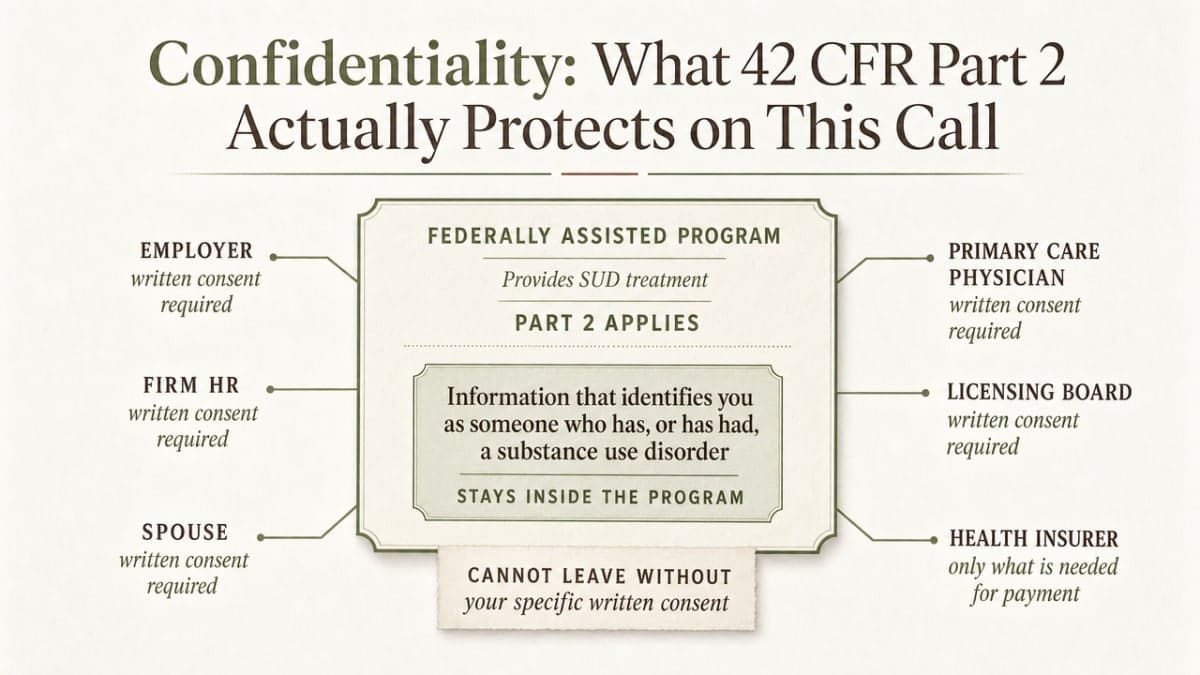
When the person on the phone tells you that federal law protects the confidentiality of substance use disorder records, they are referring to a specific regulation: 42 CFR Part 2 2. It is worth understanding what that actually means, because “private” and “confidential” get used loosely in a lot of places, and this one has teeth.
Part 2 applies to federally assisted programs that hold themselves out as providing SUD treatment. In practical terms, it means the program cannot share information that would identify you as someone who has, or has had, a substance use disorder without your specific written consent 1. Not with your employer. Not with your firm’s HR department. Not with your spouse. Not with your primary care physician. Not with a licensing board. Not with a health insurer for anything beyond what payment requires, and even then, only with your authorization.
The regulation requires the program to tell you, at admission, that these protections exist 2. That is why the confidentiality notice comes so early in the call. It is not a disclaimer being read at you. It is a required notice, and it sets the ground rules for everything you say next.
The 2024 final rule modernized how consent works, including provisions for a single consent covering treatment, payment, and health care operations, and tightened limits on redisclosure by the parties who receive information 4. What did not change is the core principle: information tying your name to SUD treatment does not leave the program unless you say, in writing, exactly who it can go to and for what purpose 1.
There are narrow exceptions. Medical emergencies where a treating clinician needs to know, court orders that meet specific statutory requirements, and certain communications required to coordinate your own care 2. None of those exceptions cover a curious partner at your firm, a suspicious spouse, or a licensing board fishing for information. If any of those parties are going to hear anything, it will be because you signed a form authorizing it, in the specific language Part 2 requires 1.
That is the frame around the call. You can describe what you have been drinking, how often, what happened last Tuesday night, and what you are afraid of, and none of it walks out of the building attached to your name without your signature.
The Professional-Continuity Questions You Are Really Asking
Under the questions on the surface, there is a second conversation running the whole time. It is the one about your career. It sounds like this: If I say yes to any of this, who finds out, and what does it cost me.
You are allowed to ask those questions out loud. In fact, most admissions clinicians would rather you did, because the answers change what a realistic next step looks like.
The partner track. The bar association. The medical board. The board seat. The client list you are supposed to be closing this month. The spouse who does not know yet, or who knows and is exhausted. None of these are footnotes to the clinical picture. They are the clinical picture, because they shape what “recovery environment” actually means for you 9.
Here is what the person on the phone can tell you. A residential stay does not automatically trigger notification to anyone. Your employer does not get a call. Your licensing board does not get a call. Your spouse does not get a call. Any communication with a third party requires your written authorization in the specific form the regulation requires 1. If you have already self-reported to a physician health program or a lawyer assistance program, that is a different conversation with its own consent forms, and the admissions team will walk you through it.
What they can also tell you is what a leave of absence typically looks like for someone in your situation, how the timing of admission interacts with a trial calendar or a call schedule, and whether a shorter medical detox stay is clinically appropriate as a first step before a longer residential commitment 5. These are logistical questions, not clinical ones, and they belong on this call.
Ask them.
First Call vs. Full Intake Assessment: What Gets Deferred
One of the reasons the first call feels lighter than you expect is that most of the heavy lifting is not happening on it. There is a full clinical assessment coming, but it is a separate conversation, on a different day, with a different purpose. Knowing where the line falls between the two is what makes the phone call answerable in the first place.
What the first phone call covers
- Immediate safety check: are you okay right now, and is anything acute happening physically 5.
- Brief screen for substance use and co-occurring mental health concerns 3.
- Program fit: does what you are describing match what this facility actually treats.
- Insurance basics: carrier and member ID, not a full financial workup.
- Next steps: admission timing, detox conversation, or a referral if the fit is not right.
What the full intake assessment covers later
- Comprehensive biopsychosocial assessment across medical, psychiatric, social, and functional domains 8.
- DSM-5 substance use disorder diagnosis assigned by a credentialed clinician 8.
- Formal ASAM level-of-care determination documenting medical necessity 8.
- Detailed personal and family history, social network, legal involvement, and full substance use timeline 10.
- Treatment planning, goal setting, and consent forms specific to your care.
The distinction matters because payer requirements have pushed the intake side into the territory of formal documentation. Before a program can authorize residential SUD services, a credentialed clinician has to complete the biopsychosocial assessment, assign a DSM-5 diagnosis, and document the ASAM level of care that matches your presentation 8. None of that happens on the phone. It cannot. It requires time, structured tools, and a clinician sitting with you long enough to do it properly.
The clinical guidance on treatment entry is explicit about the split. Trying to complete a full assessment during first contact tends to overwhelm the caller and shut the conversation down before it starts 5. So the phone call stays narrow on purpose: enough information to know whether admission is safe and appropriate, and to schedule the next step. The intake interview that follows is where the depth lives, including the personal and family background, social ties, legal history, and full drug-use chronology that a comprehensive interview covers 10.
What that means for you, right now, is simpler than it sounds. The phone call is not the assessment. It is the conversation that decides whether an assessment is the right next thing.
How the Call Ends: Four Possible Outcomes, None of Them Binding
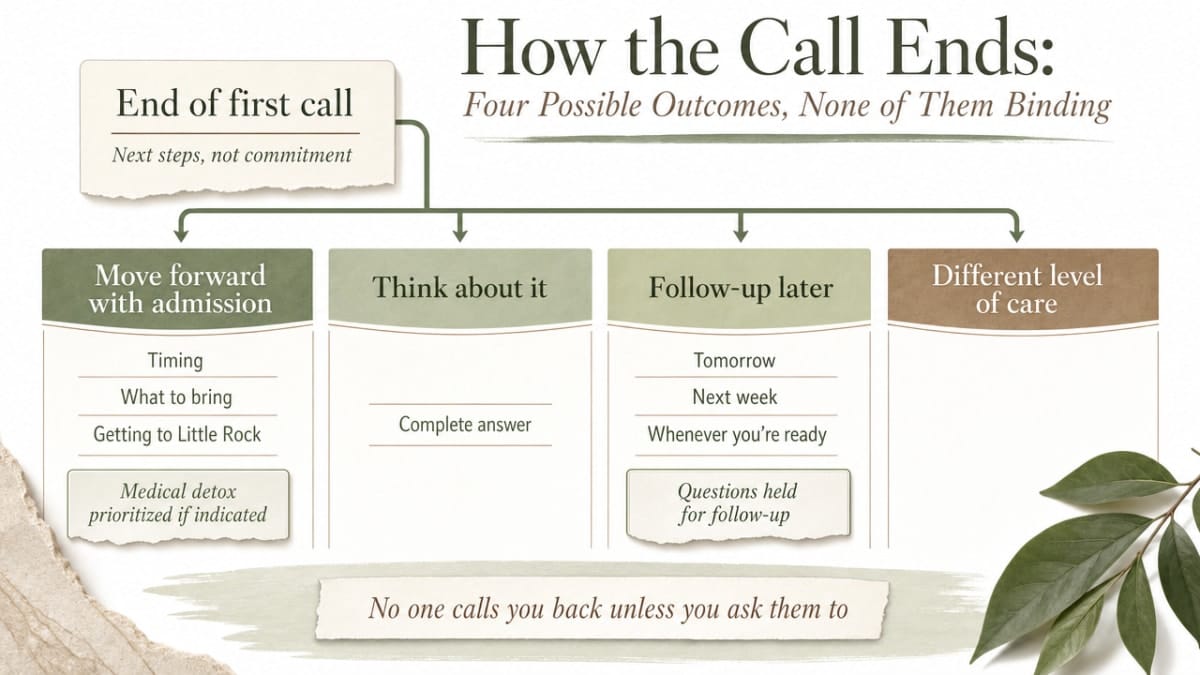
The last five minutes of the call are the ones you are probably most afraid of. This is where you assume a decision gets forced. It does not. The clinical guidance on treatment entry treats the close of first contact as an orientation to next steps, not a commitment point 5.
There are four realistic ways the conversation ends.
You decide to move forward with admission. The team walks you through timing, what to bring, and how to get to Little Rock. If a medical detox conversation is clinically indicated based on what you described, that gets prioritized.
You decide you want to think about it. That is a complete answer. You can ask them to hold your questions for a follow-up call tomorrow, next week, or whenever you are ready. No one calls you back unless you ask them to.
You decide a different level of care fits better. If what you are describing points to outpatient support rather than residential, a well-run admissions team will say so and offer a referral. That is triage doing its job 9.
You decide to hang up without deciding anything. Also allowed. No record follows you out of the call attached to your name without your written authorization 1.
Whichever ending arrives, you leave the call with more information than you had when you dialed, and none of it obligates you to a bed tonight.
Before You Dial: A Short Preparation Note
You do not need to prepare much. That is the point of a screening call. But a few small things will make the next thirty minutes easier on you.
Have a quiet room and a closed door. Not because the person on the other end will be loud, but because you will be. Emotionally, at least. It is harder to say the true version of what has been happening when someone might walk in.
Have your insurance card within reach, if you have one. Carrier name and member ID are all that gets asked on this call. If you do not have insurance, or you do not want to use it for privacy reasons, say so. That is a conversation the admissions team is used to having.
Have a rough sense of the last few days. When you last used, how much, how you feel physically right now. You do not need dates or quantities down to the ounce. Approximate is fine.
Then dial. One call, no commitment. The Serenity Park admissions line in Little Rock answers directly, and the confidentiality frame is in place before you say your first name 2.
Frequently Asked Questions
Do I have to give my full name when I call?
No. A first name, or even a first initial, is enough to keep the conversation going. Admissions staff will not press you for a last name, an employer, or an address in the opening minutes. If you decide later to move toward admission, more identifying information becomes necessary for insurance and clinical records, but that step only happens after you say yes to it.
Will making this call obligate me to check in for treatment?
No. The call is a screening conversation, not an intake or an admission. Clinical guidance treats first contact as a chance to gather enough information for triage and orientation, with the full assessment reserved for a later session 5. You can hang up, take a week to think, or ask for a referral to a different level of care. Nothing about picking up the phone commits you to a bed.
Can the admissions team contact my employer, licensing board, or spouse without my permission?
No. Federal law bars a Part 2 program from sharing information that would identify you as someone with a substance use disorder without your specific written consent 1. Your employer, your firm, your licensing board, and your spouse do not get a call unless you sign an authorization naming that party and the purpose. Narrow exceptions exist for medical emergencies and qualifying court orders, and they do not cover routine inquiries.
How long does the first admissions call actually take?
Clinical guidance recommends limiting initial contact to about an hour, with time built in for your questions and a plain-language orientation to what treatment involves 5. In practice, the working portion of the call usually runs twenty to forty minutes. You control the pace. If you need to stop early, you stop. If you want to slow down and ask questions in the middle, the person on the phone will wait.
Will I be asked about trauma, family history, or legal issues on this first call?
No. Those topics belong to the full intake interview that happens after you decide to move forward, not to a screening call 10. The first conversation stays narrow: recent substance use, current medical concerns, a brief mental health screen, and program fit 3. If a question feels like too much, saying “I would rather not answer that on the phone” is a complete response, and the clinician will move on.
What should I have in front of me before I dial?
Very little. A quiet room with a closed door, your insurance card if you have one and want to use it, and a rough sense of the last few days: when you last used, roughly how much, and how you feel physically right now. Approximate answers are fine. You do not need dates, quantities, or a written history. The rest of what the call needs, you already carry with you.
References
- Understanding Confidentiality of Substance Use Disorder Patient Records. https://www.hhs.gov/hipaa/part-2/index.html
- 42 CFR Part 2 — Confidentiality of Substance Use Disorder Patient Records. https://www.ecfr.gov/current/title-42/chapter-I/subchapter-A/part-2
- Chapter 3—Screening and Assessment of Co-Occurring Disorders. https://www.ncbi.nlm.nih.gov/books/NBK571017/
- Federal Register, Volume 89 Issue 33 (Friday, February 16, 2024). https://www.govinfo.gov/content/pkg/FR-2024-02-16/html/2024-02544.htm
- Chapter 5. Treatment Entry and Engagement – Substance Abuse Treatment for Persons With Co-Occurring Disorders. https://www.ncbi.nlm.nih.gov/books/NBK64084/
- Substance Use Disorder Treatment for People With Co-Occurring Disorders (TIP 42, updated). https://www.psychiatry.wisc.edu/wp-content/uploads/2023/05/SAMHSA-TIP-42.pdf
- Screening and Assessment (Chapter 3, TCU Corrections-based Treatment Manual). https://ibr.tcu.edu/wp-content/uploads/2025/10/Screening-and-Assessment.pdf
- The ASAM Criteria and Utilization Management Self‑Led Training 2024. https://hcpf.colorado.gov/sites/hcpf/files/The%20ASAM%20Criteria%20and%20UM%20Self%20Led%20Training%202024.pdf
- 2 Settings, Levels of Care, and Patient Placement (TIP 45 Detoxification and Substance Abuse Treatment). https://www.ncbi.nlm.nih.gov/books/NBK64109/
- Revised Intake Interview (Institute of Behavioral Research, TCU). https://ibr.tcu.edu/wp-content/uploads/2013/10/CRINTAKE.doc