
Key Takeaways
- Alcohol and benzodiazepine withdrawal can cause fatal seizures or delirium tremens, so treat shaking, sweating, or heavy daily use as a medical emergency and call 911 or go to an ED.
- Opioid withdrawal is rarely fatal alone, and an emergency department can start buprenorphine the same day to relieve symptoms within an hour regardless of insurance 10.
- Uninsured adults are far less likely to receive substance use treatment, with only 11.03% getting a past-year visit versus 15.61% of continuously covered adults, so delay increases risk 9.
- In Arkansas, call SAMHSA at 1-800-662-HELP, then connect with a DHS catchment-area provider that funds detox and MAT for uninsured residents 12, 13.
- Safe medical detox uses validated tools like CIWA or COWS, substance-specific medications, round-the-clock vitals, and a scheduled follow-up before discharge 2, 14.
- Coverage bridges exist through state-funded treatment, Medicaid enrollment during admission, MAT without prior authorization, and hospital charity care, so upfront cash is not required 7, 8, 13.
- Detox is only the start; leave with a confirmed MAT appointment, medication in hand, and counselor contact to prevent relapse and overdose risk 2, 3, 14.
- Family members can call helplines, gather intake details, and bring ID and medications without the person’s permission, and should call 911 if a loved one refuses during alcohol or benzo withdrawal 12, 13, 14.
If you’re shaking right now, start here
If you’re reading this while experiencing withdrawal symptoms, you are in the right place. Take a breath. You do not need insurance to start. Here is a concise guide:
- If you’re withdrawing from alcohol or benzodiazepines (Xanax, Klonopin, Valium, Ativan), this is a medical emergency. Seizures and delirium tremens can be fatal. Call 911 or go to an emergency department immediately. Federal law ensures hospitals cannot turn you away due to inability to pay.
- If you’re withdrawing from opioids (heroin, fentanyl, oxycodone, Percocet), an emergency department can start buprenorphine today and provide relief within hours, regardless of insurance status 10.
- If you’re not in immediate danger but need help fast, call SAMHSA’s National Helpline: 1-800-662-HELP (4357). It’s free, confidential, available 24 hours a day, and connects you to treatment options that fit your financial situation 12.
- If you live in Arkansas, the state funds detox and substance use treatment for uninsured residents through the DHS Office of Substance Abuse and Mental Health 13.
You have taken the first step by seeking information. The following sections will detail what to do in the next few hours, differentiate withdrawal types, and explain financial assistance.
Which withdrawal are you facing? The answer changes what you do next
Alcohol or benzodiazepines: treat this like a medical emergency
Alcohol and benzodiazepine (Xanax, Klonopin, Valium, Ativan, Librium) withdrawals are the two types that can be fatal. This is not an exaggeration; clinical guidelines categorize these differently from opioid withdrawal due to their severe risks.
The most dangerous signs are seizures and delirium tremens (DTs). DTs typically manifest 48 to 96 hours after the last use, causing confusion, hallucinations, rapid heart rate, dangerously high blood pressure, and uncontrolled body temperature. You are at higher risk if you drink heavily daily, have a history of withdrawal seizures, mix alcohol with benzodiazepines, or are already experiencing sweating, shaking, and a pounding heart.
A safe medical detox for these substances involves benzodiazepines administered on a scheduled or symptom-triggered protocol, continuous monitoring of vital signs, and inpatient observation, especially if there’s a risk of withdrawal from multiple substances 1, 4, 14. This combination of medication and close medical supervision is the standard of care, transforming a life-threatening situation into a survivable one 14.
Opioids: painful, rarely fatal alone, and treatable in an ED today
Opioid withdrawal from substances like heroin, fentanyl, oxycodone, Percocet, or hydrocodone is intensely uncomfortable, characterized by body aches, nausea, stomach cramps, sweating, chills, and persistent diarrhea. While agonizing, opioid withdrawal alone is rarely fatal in an otherwise healthy adult.
An emergency department can provide immediate relief by initiating buprenorphine treatment. A clinician will use the Clinical Opiate Withdrawal Scale (COWS) to assess your withdrawal severity. Once your score is sufficiently high, a first dose of buprenorphine can significantly reduce symptoms within an hour. Emergency department-initiated buprenorphine has been shown to improve rates of continued addiction treatment engagement and reduce illicit opioid use compared to referral alone 10. This treatment is available regardless of your insurance status.
Upon arrival, inform the triage nurse:“I’m in opioid withdrawal and I want to start buprenorphine.”This statement will expedite your care.
It is crucial to inform staff if you have also been heavily drinking or using benzodiazepines alongside opioids. Combining these substances carries a risk of respiratory depression, and guidelines recommend inpatient management when polysubstance withdrawal is a concern 1, 4. Providing complete information ensures your safety.
Why uninsured people wait too long, and why you shouldn’t
Many individuals without insurance delay seeking treatment not because they lack desire, but because they perceive barriers to access. A study of low-income adults with substance use disorders revealed that only 11.03% of uninsured adults had a past-year substance use treatment visit, compared to 15.61% of those with continuous coverage 9. This disparity indicates that being uninsured often leads to delayed care, including inpatient services, emergency visits, and outpatient treatments 9.
Delaying treatment can exacerbate risks. Alcohol and benzodiazepine withdrawal become more dangerous without timely intervention. Opioid withdrawal can erode your resolve, making relapse seem like the only option for relief. Every hour spent hesitant to seek help is an hour during which accessible pathways to care are available and staffed.
You have found this information, which is a significant step. Continue to pursue the available resources.
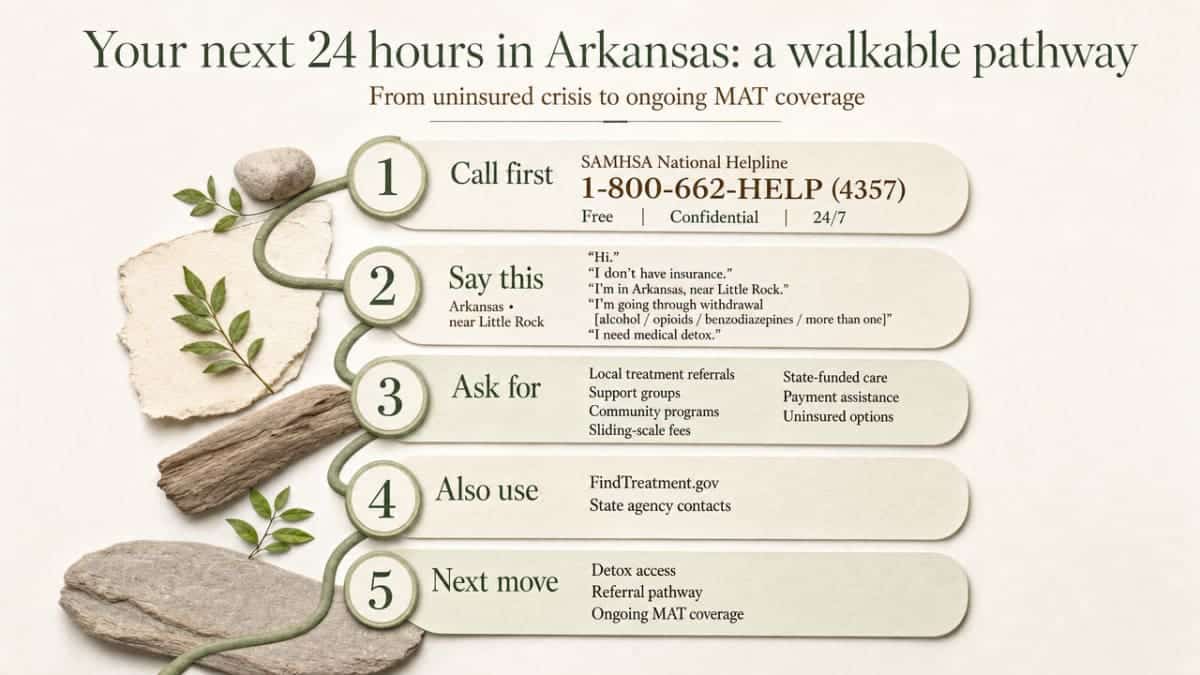
Your next 24 hours in Arkansas: a walkable pathway
Call 1-800-662-HELP first, and what to say when they pick up
Making the call is the crucial first step. SAMHSA’s National Helpline — 1-800-662-HELP (4357) — is a free, confidential service available 24/7. Operators provide referrals to local treatment, support groups, and community programs. They can also direct you to facilities offering sliding-scale fees, state-funded care, or payment assistance for uninsured individuals 12. SAMHSA’s own guidelines recommend this helpline as a primary resource for those without coverage, alongside FindTreatment.gov and state agency contacts 11.
It is acceptable if your voice trembles. Here is a script you can use:
“Hi. I don’t have insurance. I’m in Arkansas, near Little Rock. I’m going through withdrawal from [alcohol / opioids / benzodiazepines / more than one]. I need medical detox. Can you help me find a place I can go today?”
This concise statement is sufficient. You do not need to provide extensive personal history. If they ask follow-up questions about substance use, duration, or previous seizures, answer honestly, as this helps them direct you to the appropriate level of care.
Have a pen and paper ready to note down phone numbers and addresses. If writing is difficult, ask them to text or email the referrals, or have someone else listen on speakerphone. Making this call is a significant accomplishment.
The Arkansas DHS route for uninsured residents
Arkansas offers a state-funded system specifically for uninsured residents. The Arkansas Department of Human Services, through its Office of Substance Abuse and Mental Health, funds substance use disorder treatment for uninsured and underinsured individuals, including services and medication for opioid and other substance use disorders 13. The state is divided into catchment areas, each with contracted providers. When you contact DHS or are routed there by SAMHSA, you will be connected to the provider serving your region, who can facilitate access to a licensed detox bed 13.
The recommended sequence for accessing care is:
- SAMHSA National Helpline at 1-800-662-HELP — available 24/7, free, and can provide local contact information 12.
- Arkansas DHS catchment-area provider — the state-funded entry point for detox and Medication-Assisted Treatment (MAT) for uninsured residents 13.
- Licensed detox facility — where medical detox occurs under professional supervision.
- Medicaid enrollment bridge — many uninsured adults become Medicaid-eligible during or after detox. Arkansas Medicaid covers detox services in licensed facilities and MAT for eligible beneficiaries 8.
- Ongoing MAT — Arkansas policy dictates that healthcare insurers, including Medicaid, generally cannot require prior authorization for most MAT medications (injectables are an exception), allowing for prompt initiation of buprenorphine and methadone 7.
You do not need to memorize these steps. The DHS staff are trained to guide you. Your role is to state your location, the substance you are withdrawing from, and that you lack insurance. They will handle the rest.
A practical tip: bring an ID and any medication bottles from home if possible, as this can expedite paperwork. If you do not have an ID, still go.
Walking into an emergency department is a real option
If the phone process feels overwhelming or your condition is worsening, proceed directly to an emergency department (ED).
Under federal law (EMTALA), any hospital with an ED must screen and stabilize an emergency medical condition regardless of your ability to pay. This includes severe withdrawal. You cannot be denied care at the door due to lack of insurance. While you may receive a bill later, the immediate care is guaranteed. Information on managing bills will be covered in the next section.
What to communicate at triage:
- Alcohol or benzodiazepines: “I’ve been drinking heavily every day” (or “I’ve been taking Xanax/Klonopin daily”) “and I stopped. I’m shaking, sweating, and I’m scared of a seizure.” This statement will prioritize your triage.
- Opioids: “I’m in opioid withdrawal and I want to start buprenorphine today.” EDs can assess you using the COWS scale and initiate buprenorphine immediately. This pathway is linked to better engagement in ongoing addiction treatment than referral alone 10.
Bring your ID and any medication bottles if accessible. If not, still go. Before leaving, ask the hospital social worker or case manager (every ED has one) about charity care, hospital financial assistance, and Medicaid enrollment. This conversation can help transition your ED visit into covered detox care.
You are entitled to walk in and receive care.
What a safe medical detox actually looks like
The monitoring and medications that make it safe
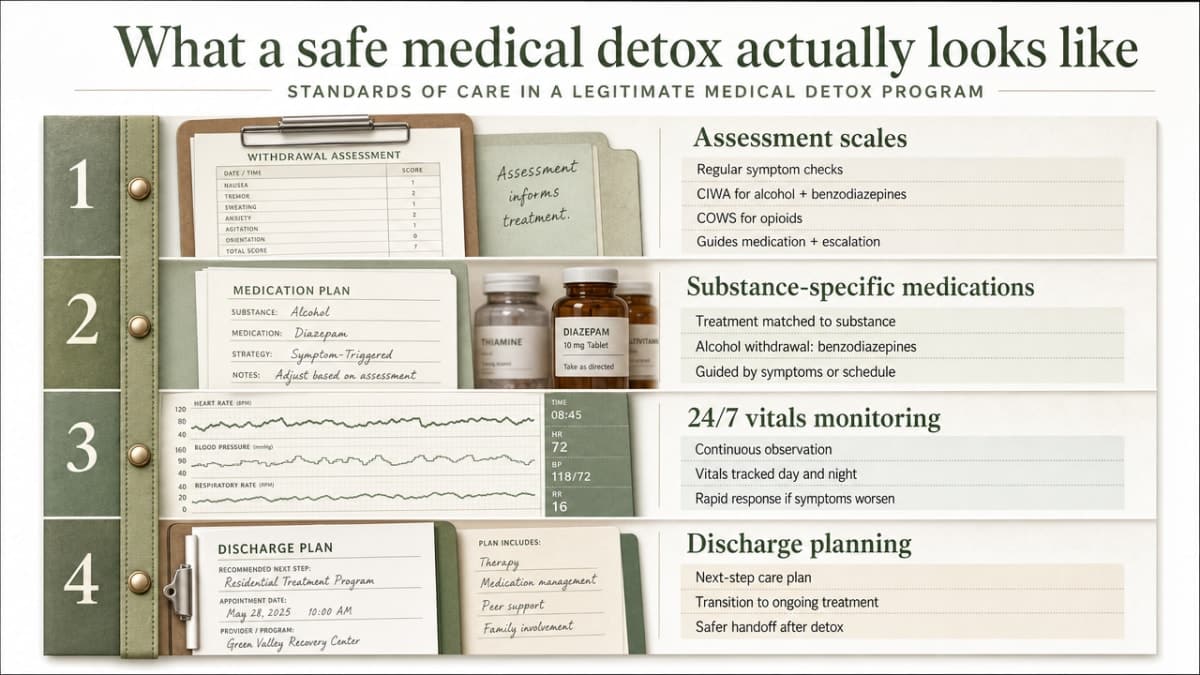
When you enter a legitimate medical detox facility—whether a hospital or licensed residential program—certain standards of care should be observed. Understanding these helps you identify a quality program, even during a difficult time.
Your withdrawal symptoms will be regularly assessed using a standardized scale. For alcohol and benzodiazepines, the Clinical Institute Withdrawal Assessment for Alcohol (CIWA) scale is commonly used. For opioids, the COWS scale is applied. Clinical guidelines consistently mandate the use of validated withdrawal tools before and during treatment to guide medication administration and escalation of care 2, 14.
Medications will be tailored to the specific substance. Benzodiazepines are the standard for alcohol withdrawal, given on a scheduled or symptom-triggered basis to prevent seizures and manage hyperadrenergic symptoms 4, 14. For opioid withdrawal, buprenorphine or methadone is the standard, initiated once your COWS score is high enough to avoid precipitated withdrawal 2, 3, 6. If you have been using both alcohol and opioids, guidelines recommend inpatient management with both medication classes and close monitoring for respiratory depression 1, 4.
Vital signs will be checked frequently, around the clock. This includes blood pressure, heart rate, temperature, and oxygen saturation. Consistent monitoring is a hallmark of medical detox, distinguishing it from unsupervised settings.
Discharge planning involves a seamless transition, not an abrupt end. TIP 45, the federal detox standard, specifies that a follow-up appointment for continuing medical care should be scheduled before you leave the detox setting 14. A program that does not discuss your post-detox care is a red flag.
Why home detox from alcohol or benzos is not a money-saver
The financial argument for home detox also proves flawed. An ambulance ride after a seizure, an intensive care unit stay for uncontrolled DTs, or an injury requiring emergency trauma care will incur far greater physical, financial, and temporal costs than seeking state-funded or Medicaid-covered detox upfront. Arkansas Medicaid covers substance abuse detoxification in licensed facilities for eligible beneficiaries 15, and DHS funds treatment for uninsured residents 13. The safer option is also often the more economical one.
While opioid withdrawal at home is more often survivable, “survivable” does not equate to “advisable.” Without buprenorphine or methadone, relapse rates are high, and the risk of overdose sharply increases after a period of abstinence. Guidelines recommend detox in a supervised setting linked to ongoing MAT 2, 3.
Paying for it: the bridges from uninsured to covered
You do not need immediate funds to access safe detox. You need to understand the available pathways to coverage.
Bridge one: state-funded treatment. The Arkansas DHS directly funds SUD treatment for uninsured and underinsured residents 13. This is a primary no-cost option for those without current coverage.
Bridge two: emergency Medicaid enrollment. Many uninsured adults qualify for Medicaid without realizing it. Medicaid coverage for SUD treatment expanded significantly after the Affordable Care Act, encompassing detoxification, inpatient, and outpatient services 8. Arkansas Medicaid specifically covers substance abuse detoxification in licensed facilities 15. Ask a hospital social worker, detox intake coordinator, or DHS caseworker for assistance with immediate application; many facilities can enroll patients during admission, allowing for retroactive coverage of the stay.
Bridge three: MAT with no prior-authorization delay. Once stable, Arkansas policy stipulates that healthcare insurers, including Medicaid, cannot require prior authorization for most MAT medications, with injectable forms being the primary exception 7. This means buprenorphine and methadone can be started without administrative delays.
Bridge four: hospital charity care and sliding-scale programs. If you receive a bill, do not ignore it. Request a financial assistance application in writing. SAMHSA’s helpline can also direct you to facilities offering sliding-scale fees or payment plans 12.
The safest path to treatment is already established for you. Utilize these resources.
After detox: the handoff that keeps you alive
Detoxification is a starting point, not the conclusion of treatment. The period immediately following cessation of substance use carries the highest risk of relapse, and for opioids, the highest risk of overdose. A comprehensive detox program will include planning for this critical transition before you are discharged.
Federal detox standards mandate that a follow-up appointment for continuing medical care be scheduled before you leave the detox setting 14. Guidelines for opioid use disorder further emphasize that withdrawal management should seamlessly transition into ongoing treatment with buprenorphine or methadone 2, 3. If post-detox care is not discussed, inquire about plans for day four, day ten, and week six.
An effective handoff includes:
- a confirmed appointment with a MAT prescriber,
- a prescription or dose in hand to prevent treatment gaps,
- contact information for a counselor or peer support, and,
- if Medicaid enrollment began during detox, continued processing of paperwork to ensure ongoing care coverage 7, 8.
You have invested significant effort to reach this point. Protect your progress by asking one crucial question at discharge: “Who is my next appointment with, and when?”
For the family member making the call
If you are assisting a loved one, this section is for you.
You do not need their explicit permission to gather information. Call 1-800-662-HELP yourself, or the Arkansas DHS line, and inquire about the intake process 12, 13. Document the address, hours, and the name of the person you speak with. This preparation ensures that when your loved one agrees to seek help, the necessary information is readily available.
Bring their ID, phone, any medication bottles, and a change of clothes. Drive them if possible. If they refuse and are withdrawing from alcohol or benzodiazepines, call 911, as these withdrawals can lead to seizures without warning 14.
It is natural to feel scared. Advocating for someone else is not overstepping; it is providing crucial support they may be unable to seek themselves.
Frequently Asked Questions
Can I really get medical detox in Arkansas if I have no insurance?
Yes. The Arkansas Department of Human Services (DHS) funds substance use disorder treatment for uninsured and underinsured residents through its Office of Substance Abuse and Mental Health. They have contracted providers in each catchment area 13. Call 1-800-662-HELP or the DHS line, state your location and the substance you are withdrawing from, and they will direct you to a licensed detox provider.
Is it safe to detox from alcohol or benzodiazepines at home to save money?
No. Withdrawal seizures and delirium tremens can be fatal. Clinical guidelines recommend inpatient management whenever there is a significant risk of severe or polysubstance withdrawal 1, 14. State-funded and Medicaid-covered detox options exist to ensure that cost is not a barrier to safe treatment 13, 15. Seek care at an emergency department or licensed detox facility; do not attempt to detox alone.
Will an emergency department turn me away because I can’t pay?
No. Under the Emergency Medical Treatment and Labor Act (EMTALA), any hospital with an emergency department must provide screening and stabilization for emergency medical conditions, regardless of your ability to pay. Severe alcohol, benzodiazepine, or opioid withdrawal qualifies as an emergency. While you may receive a bill afterward, discuss charity care, hospital financial assistance, and Medicaid enrollment with the hospital social worker before you leave; these conversations can often reduce or eliminate the bill.
What do I say when I call the SAMHSA helpline at 1-800-662-HELP?
Keep your message concise: “I don’t have insurance. I’m in Arkansas. I’m going through withdrawal from [substance]. I need medical detox today.” The helpline is free, confidential, and available 24/7. Counselors provide referrals to facilities that offer sliding-scale fees, state-funded care, or payment assistance 11, 12. Answer any follow-up questions honestly, as this helps them direct you to the appropriate level of care.
Can an ER start buprenorphine for opioid withdrawal the same day?
Yes. Emergency clinicians can assess your withdrawal using the COWS scale. Once your score is sufficiently high, they can administer a first dose of buprenorphine, which typically alleviates symptoms within an hour 2. Emergency department-initiated buprenorphine is associated with higher rates of engagement in ongoing addiction treatment and reduced illicit opioid use compared to referral alone 10. Walk in and specifically ask for buprenorphine.
How do I move from uninsured detox into ongoing treatment and Medicaid coverage?
Ask the intake coordinator or hospital social worker for assistance with applying for Medicaid during admission. Many uninsured adults qualify for Medicaid and are unaware of it, and Arkansas Medicaid covers detox and Medication-Assisted Treatment (MAT) 8, 15. Arkansas policy prohibits prior authorization for most MAT medications, ensuring that buprenorphine or methadone can continue without administrative delays 7. Ensure you leave detox with a confirmed follow-up appointment for ongoing care.
References
- Concurrent opioid and alcohol withdrawal management. https://pmc.ncbi.nlm.nih.gov/articles/PMC10696169/
- Management of Opioid Use Disorder, Opioid Withdrawal, and Opioid Overdose Prevention in Hospitalized Adults: A Systematic Review of Existing Guidelines. https://www.ncbi.nlm.nih.gov/pmc/articles/PMC9474657/
- Guidelines for the Psychosocially Assisted Pharmacological Treatment of Opioid Dependence (WHO). https://www.ncbi.nlm.nih.gov/books/NBK143185/pdf/Bookshelf_NBK143185.pdf
- Guidelines for Managing Substance Withdrawal in Jails (Bureau of Justice Assistance). https://bja.ojp.gov/doc/guidelines-managing-substance-withdrawal-jails.pdf
- The ASAM/AAAP Clinical Practice Guideline on the Management of Stimulant Use Disorder. https://stacks.cdc.gov/view/cdc/156927/cdc_156927_DS1.pdf
- Quick Guide for Physicians Based on TIP 40—Clinical Guidelines for the Use of Buprenorphine in the Treatment of Opioid Addiction. https://radarcart.boisestate.edu/library/files/2017/07/SMA05-4003.pdf
- Arkansas Department of Human Services – Medication-Assisted Treatment Policy (MAT) and Insurance Requirements. https://humanservices.arkansas.gov/wp-content/uploads/MAT-Revised-Website-posting-12.14.pdf
- Medicaid coverage in substance use disorder treatment after the Affordable Care Act. https://pubmed.ncbi.nlm.nih.gov/31202283/
- Healthcare coverage and service access for low-income adults with substance use disorders. https://pmc.ncbi.nlm.nih.gov/articles/PMC9086121/
- Initiating Buprenorphine Treatment in the Emergency Department (NIDA). https://nida.nih.gov/nidamed-medical-health-professionals/discipline-specific-resources/emergency-physicians-first-responders/initiating-buprenorphine-treatment-in-emergency-department
- Help for mental health, drugs, alcohol: No Insurance. https://www.samhsa.gov/find-support/health-care-or-support/professional-or-program/no-insurance
- National Helpline for Mental Health, Drug, Alcohol Issues. https://www.samhsa.gov/find-help/helplines/national-helpline
- Find Substance Abuse or Mental Health Treatment. https://humanservices.arkansas.gov/divisions-shared-services/shared-services/office-of-substance-abuse-and-mental-health/samh-treatment/
- TIP 45 Detoxification and Substance Abuse Treatment. https://www.govinfo.gov/content/pkg/GOVPUB-HE20_400-PURL-gpo124442/pdf/GOVPUB-HE20_400-PURL-gpo124442.pdf
- Counseling Services Section II (Arkansas Medicaid). https://humanservices.arkansas.gov/wp-content/uploads/CNSLSERV_II.doc