
Key Takeaways
- Drinking more or longer than you intended is the first clinical criterion, and it usually shows up as a pattern of small overruns rather than one dramatic night.7
- Repeatedly making sincere plans to cut back and quietly returning to baseline meets the criterion for unsuccessful efforts to control drinking.12
- Cravings that arrive on their own between drinks, like an afternoon countdown or a pull toward the airport bar, signal that alcohol has shifted from choice to demand.8
- Work, family, and health quietly paying the bill counts even when performance looks intact, because the losses show up in what you’ve stopped doing rather than what’s broken.1
- Needing more alcohol to get the same effect is tolerance, a physical adaptation on the checklist that men often mistake for a compliment rather than a symptom.1
- Morning tremor, sweating, GI distress, poor sleep, or a drink that takes the edge off physical symptoms is withdrawal, and it changes whether stopping on your own is safe.6
- Continuing to drink after you’ve clearly seen the damage isn’t a character failure but a listed medical criterion, because willpower alone stops being enough at a certain point.12
The Man Who Doesn’t Look Like He Needs Help
You’re probably not the guy in the movie. You didn’t lose the job. The car’s still in the garage. Your kids’ school forms got signed on time, and the last review at work used the word “exceptional.” That’s part of why you’re reading this at whatever hour it is, in a browser tab you’ll close before anyone walks in.
Here’s the thing about the men who quietly need help with drinking: most of them don’t look like they do. They close deals. They coach Little League. They pour a good bourbon at dinner and know the difference between a rye and a wheated mash. The stereotype of the man who’s lost everything has kept a lot of capable men sick for a decade longer than they had to be, because if he doesn’t look like that guy, the thinking goes, he must be fine.
Clinicians stopped using the word “alcoholic” as a diagnosis years ago. The current framework describes alcohol use disorder on a spectrum, based on how many specific symptoms show up in a year and how much they’re costing you. That shift matters here, because it means the question isn’t whether you’ve hit some cinematic bottom. It’s whether the pattern you’re living inside has quietly outgrown you. The next section shows you exactly how that line is drawn.8
If you’re the one worried about him: you’re not overreacting. Keep reading.
How Clinicians Actually Define the Line
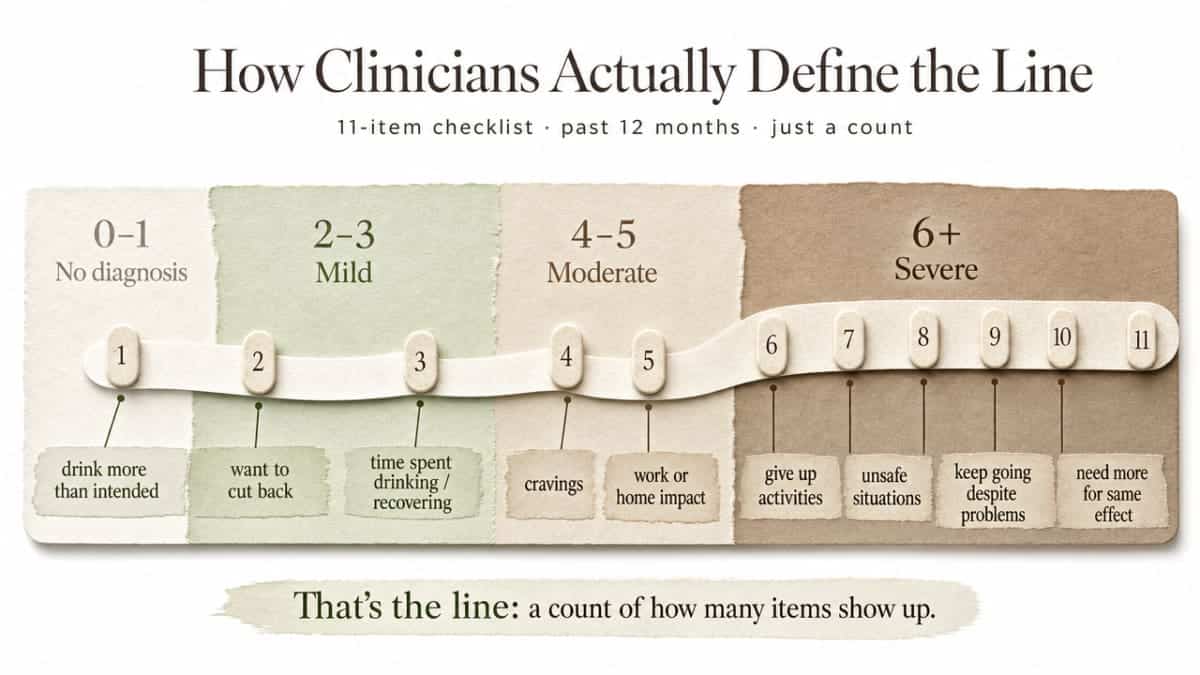
Here’s the framework a doctor would use if you sat down across from her tomorrow. Alcohol use disorder is diagnosed on an 11-item checklist covering the last 12 months of your drinking. Two or three of those items showing up means mild AUD. Four or five is moderate. Six or more is severe.2
That’s it. That’s the line. No blood test, no breathalyzer, no scene where someone tells you what you are. Just a count.
The eleven items aren’t exotic. They cover things like drinking more than you meant to, wanting to cut back and not quite pulling it off, spending real time on drinking or recovering from it, cravings that show up on their own, drinking getting in the way of work or home life, giving up things you used to care about, drinking in situations where it isn’t safe, keeping at it even when it’s causing problems, needing more to get the same effect, and physical symptoms when you stop. Two of those in a year, and you meet criteria.1
That threshold surprises most men. You’ve probably been picturing a much higher bar — the kind of drinking that ends careers or marriages in a single week. The actual clinical line sits a lot closer to ordinary life than the movies suggested.
The DSM update that produced this checklist also retired the older split between “alcohol abuse” and “alcohol dependence”. So if a family member once got labeled one or the other, or if you’ve been telling yourself you’re not “dependent” because you don’t shake in the morning, that vocabulary isn’t the map anymore. The map is the count.8
The next seven sections walk through the criteria most men actually recognize when they see them named. Keep a mental tally as you read. You can decide what to do with the number when you’re done.
Sign 1: You Drink More or Longer Than You Meant To
You told yourself two, and you had five. You told yourself you’d close the laptop at nine and be in bed by ten, and here you are at 12:40 pouring what you’re pretending is the last one. Nobody made you. You just kept going.
This is the first item on the clinical checklist for a reason. It’s the one almost everyone underestimates because it feels like a personality quirk instead of a symptom. The technical language calls it drinking in larger amounts or for a longer period than intended. In plain terms: the plan you had at 6pm is not the plan your evening actually ran on.7
A sharp mind rationalizes this easily. The client stayed for a third round. The game went to overtime. Your buddy needed to vent. There’s always a reason on the outside, which is why it takes a while to notice that the reasons keep showing up and the ceiling keeps moving.
Here’s the tell: it’s not the one big night. It’s the pattern of small overruns. If you can think of three or four evenings in the last month where the actual pour count outran the one you intended when you started, that’s the criterion. Not a character flaw. A data point.12
If you’re the one worried about him: this is often the sign a partner sees first, and dismisses first. Trust the pattern, not the excuses.
Sign 2: The Promises to Cut Back Keep Breaking
You’ve made the deal with yourself. Nothing during the week. Two drinks max on Saturday. Dry January. No more after 10pm. You’ve probably made some version of it more than once, maybe with a real plan behind it, maybe on a Sunday morning when your head was pounding and the math on last night’s pours felt worse than you remembered.
And for a while, it holds. Three days. Nine days. Half of January. Then something shifts — a hard week, a good week, a dinner where refusing would have felt like a whole conversation — and the rule bends. Not shatters. Bends. You tell yourself this one is the exception, and the exception becomes the pattern again.
The clinical language for this is a persistent desire or unsuccessful efforts to cut down or control drinking. What matters isn’t that you tried and slipped once. Everyone slips. What matters is the loop: the sincere plan, the honest effort, the quiet return to baseline, repeated. If you’ve made and broken that promise to yourself more than twice in t he last year, that’s the criterion. Add it to the tally.12
If you’re the one worried about him: you’ve probably heard the promises. You’re not wrong to have stopped counting on them. That doesn’t mean he’s not trying.
Sign 3: Cravings Show Up Between Drinks
There’s a moment in the afternoon — maybe it’s 3:15, maybe it’s the drive home — when your brain starts running a countdown you didn’t set. Not thirst. Not habit exactly. Something more like a low hum that gets louder the closer you get to whatever your usual first pour looks like. If work runs late and the pour gets pushed, that hum gets sharper, not softer.
Craving got added to the clinical checklist deliberately, because it turns out to be one of the more reliable signals that drinking has moved from something you do to something that’s asking to be done. The formal language is a strong desire or urge to use alcohol. In real life it’s the airport bar you find yourself walking toward before you’ve decided to. The way a stressful email routes straight to a mental image of a glass. The garage beer before you go inside because the noise between you and the front door needs muting.1,8
Men tend to file this under “I’ve had a long day.” Sometimes that’s what it is. When it’s daily, and when the day doesn’t have to be long anymore, that’s the criterion. Add it.
Sign 4: Work, Family, or Health Are Quietly Paying the Bill
Your reviews are still strong. Your kids still hug you when you walk in. Your labs from last year came back mostly fine. From the outside, nothing’s broken. That’s exactly the version of this sign that hides longest.
The clinical language covers three related items on the checklist: drinking that gets in the way of major role obligations, giving up or cutting back on activities you used to care about, and continued use despite ongoing social or interpersonal problems. In practice, it rarely looks like getting fired. It looks like doing the deposition prep hungover and doing it 15% worse than you would have. It looks like sleeping through the Saturday ride you used to live for, then telling yourself you were just tired. It looks like the same short argument with your wife on Sunday morning, the one you both stopped bothering to finish.1
Men who are still performing at work often use that performance as proof nothing’s wrong. The more useful question is what the drinking is quietly subtracting: the run you don’t take anymore, the friend you stopped calling back, the second half of the evening you don’t really remember with your kids. If two or three things you used to value have gone quiet in the last year, and the drinking is somewhere in that story, that’s the criterion. Add it.12
If you’re the one worried about him: the losses are usually invisible from the outside. You’re seeing what his coworkers can’t.
Sign 5: The Same Drink Doesn’t Land the Way It Used To
The two-finger pour that used to take the edge off now barely registers. You’ve noticed it. Maybe you upgraded to a taller glass and told yourself it’s about the ice. Maybe you started opening the second beer while the first is still cold because one just feels like waiting. Maybe your wine pours have quietly doubled in the last two years and nobody’s said anything, including you.
The clinical name for this is tolerance — needing more alcohol to get the same effect, or noticing that the amount you used to drink doesn’t do what it used to. It’s one of the eleven items on the checklist, and it tends to be the one men are least worried about because it doesn’t feel like a problem. It feels like a compliment. You can hold your liquor. You’ve built up a respectable ceiling. Your friends comment on it.1
Here’s what it actually means: your body has adapted to a level of alcohol that used to be more than it could handle. That adaptation is a physical fact, not a personality trait. And it usually travels with the next sign, which is what happens when the alcohol isn’t there.6
Sign 6: Mornings Feel Like Weather You Have to Wait Out
The alarm goes off and there’s a half-second before you’re fully awake where you already know what kind of morning it’s going to be. Your hands aren’t quite steady when you reach for the water glass. Your stomach isn’t right. There’s a light film of sweat you didn’t earn. The headache is there, but underneath it is something more mechanical — a low hum in your nervous system that won’t settle until you’ve had coffee, a hot shower, and about ninety minutes.
You’ve built a routine around it. You know that by 10am you’ll feel like yourself again. On the weekends you might notice a Sunday shake in your hands that eases once you eat something. Maybe your sleep has quietly gotten worse — falling asleep is easy, staying asleep past 3am isn’t. Maybe your GI system has opinions it didn’t used to have. Maybe your last physical mentioned blood pressure that’s crept up, or liver enzymes that are a little off the mark.6
This is withdrawal. Not the movie version. The everyday, low-grade version that men explain away as “getting older” or “a rough night’s sleep.” The clinical criterion is characteristic withdrawal symptoms, or drinking to relieve or avoid them. If you’ve ever had a beer or a glass of wine specifically because it took the edge off how you were feeling — not because you wanted it, but because you needed the physical noise to stop — that’s the second half of the criterion.1
If you’re the one worried about him: the morning shake, the 3am wake-ups, the beer before the shower — those aren’t habits. They’re symptoms.
Sign 7: You Keep Drinking Even When It’s Costing You
This is the one that’s hardest to name from the inside. Something has already gone sideways — a fight that went further than it should have, a doctor’s appointment where the labs weren’t what you told yourself they’d be, a moment in the car with your kid that you replayed for a week. You saw the connection. Not vaguely. You saw it. And the next Friday, the pour happened anyway.
The clinical language is drinking continued despite persistent or recurrent physical or psychological problems likely caused or worsened by alcohol. In lived terms: the evidence came in, you registered it, and the pattern didn’t move. That gap between knowing and stopping is the criterion. It’s also the part that makes men feel the worst about themselves, because it looks like a character failure. It isn’t. It’s one of the eleven items on a medical checklist, and it’s on that list precisely because willpower alone stops being enough at a certain point.1,12
If you’re nodding at this one, add it. And notice that nodding is not the same as failing. It’s information.
If you’re the one worried about him: he already knows. Naming it out loud isn’t news to him.
Counting Your Signs Without Talking Yourself Out of the Answer
So here’s the tally. Two or three of the seven signs above showing up in the last year meets criteria for mild alcohol use disorder. Four or five is moderate. Six or more is severe. That’s the whole scoring system. It’s the same one your doctor would use.2
A quick word before you finalize your number, because this is where a smart mind does its best work against itself. If you found yourself reading a sign and thinking “yeah, but not really” or “that’s not the same thing because —” pause on that one. The “yeah, but” is usually where the honest answer lives. You don’t need to argue yourself into a criterion. You also don’t need to argue yourself out of one.
And remember the seven signs in this article aren’t all eleven items on the full checklist. There are four more your doctor would ask about, including things like drinking in physically risky situations and hazardous use. Your real count could be higher than what you tallied here. If you want a version you can walk through yourself, the CDC’s Check Your Drinking tool covers the same territory in about five minutes and doesn’t ask for your name.1,3
Whatever your number is, it’s a starting point, not a verdict. One sign is worth paying attention to. Two or more is worth a conversation with someone trained to have it.
Why Men Wait Longer Than They Should
Most men who eventually get help for drinking will tell you they saw the signs years before they picked up the phone. The gap between recognition and action is the part nobody warns you about.
Some of that gap is cultural. Men, on average, drink more heavily than women and are less likely to reach out early, in part because the same traits that make you good at your job — self-reliance, high pain tolerance, the instinct to handle it yourself — work against you here. Asking for help feels like admitting you couldn’t. The math on that is quiet and expensive.10
Some of it is the vocabulary. If “alcoholic” is the only word in your head for someone who needs treatment, and that word doesn’t fit the man you see in the mirror, the exit ramp closes before you take it. That’s why the clinical framing matters. Two signs is a starting point. It doesn’t demand a label. It just names a pattern worth talking about.8
And some of it is the assumption that treatment means dropping out of your life. It doesn’t have to.
Matching the Sign Count to the Right Level of Care
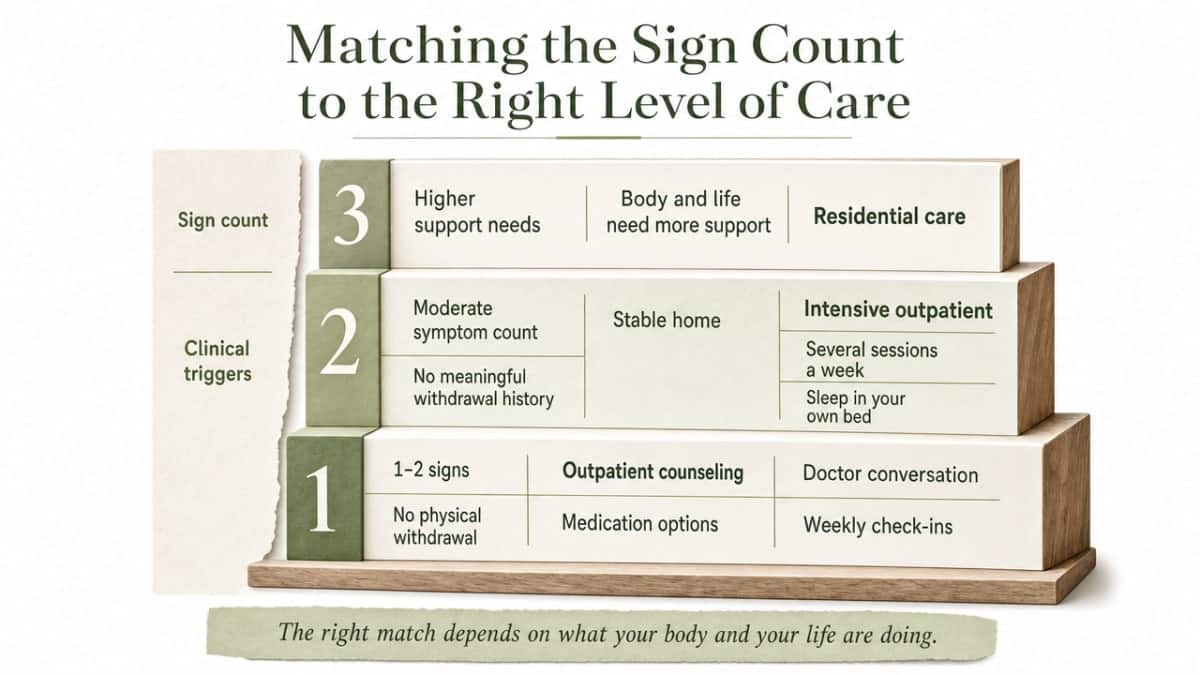
Your number does something useful: it points to what kind of help is likely to fit. Treatment isn’t one size, and the CDC is direct about that — support ranges from a conversation with your primary care doctor all the way up to residential care, and the right match depends on what your body and your life are doing, not on how the drinking looks on paper.4
At the lighter end of the ladder, one or two signs without physical withdrawal often responds to outpatient counseling, a conversation with your doctor about medication options like naltrexone or acamprosate, and a real plan you check in on weekly. Intensive outpatient sits a step above that — several sessions a week while you keep sleeping in your own bed — and tends to fit men with moderate symptom counts, a stable home, and no meaningful withdrawal history.11
The ladder changes shape when a few specific things are true.2,6,11
- If you’re in the range of moderate to severe on the count.
- If mornings involve tremor, sweats, GI distress, or elevated blood pressure that eases with a drink.
- If you’ve tried outpatient before and it didn’t hold.
- If home isn’t a place where staying sober is realistic — the bar cart in the study, the buddy who’s already texting about Friday, the wife who’s exhausted from being the accountability plan.
- If there’s a co-occurring anxiety, depression, or sleep issue that’s been quietly running underneath the drinking.
Any one of those tips the conversation toward medically supervised detox and residential care. More than one, and it’s the honest recommendation. That’s the level Serenity Park is built for — a small, men-only residential setting in Little Rock where the medical piece is handled first and the rest of the work follows.
If you’re the one worried about him: you don’t have to figure out which level fits. That’s what the first phone call is for.
What a Confidential First Call to Serenity Park Sounds Like
The first call is not a sales pitch and not a commitment. It’s a conversation, usually about twenty to thirty minutes, with someone whose entire job is to listen carefully to what you just tallied and help you figure out what to do with it. You can call from your car. You can call from a hotel room between meetings. You do not have to have a decision made before you dial.
Here’s what actually gets covered. Someone on the admissions team will ask about your drinking pattern in the last few months — how much, how often, how the mornings feel. They’ll ask about any withdrawal symptoms specifically, because that determines whether medically supervised detox needs to be the first step. They’ll ask about your health history, medications you’re on, any prior treatment attempts, and whether there’s anxiety, depression, or sleep trouble running alongside the drinking. They’ll ask about your work situation and your family, not to judge either, but because those shape what a good plan looks like.6
Discretion is a real question, and it’s a fair one to ask directly. For men with public-facing jobs, they’ll walk through what your employer and clients would and wouldn’t know, how time away gets framed, and how records are handled. Little Rock is far enough from most of our clients’ cities that the geography itself does some of the work.
If residential fits, they’ll explain what the first 72 hours look like — medical intake, detox monitoring, the wearable that tracks your vitals overnight so the clinical team can adjust care in real time. If a lighter level of care fits better, they’ll say that too, and point you toward it. SAMHSA also runs a free, confidential 24/7 helpline if you want a completely neutral first conversation before calling any specific program.5
One call. No paperwork. No commitment. Just a real person on the other end of the line, at whatever hour you’re reading this.
Frequently Asked Questions
How do I know if my drinking is bad enough to need treatment, or if I just need to cut back?
The clinical line is a count, not a feeling. Two or three of the eleven DSM-5 signs in the last year meets criteria for mild alcohol use disorder, four or five is moderate, six or more is severe. If you’re at two or above, a conversation with someone trained to have it is a smarter move than another solo attempt to cut back.2
Can I go to treatment without my employer or clients finding out?
Yes, and it’s a reasonable thing to ask about directly on the first call. Treatment records are protected health information, and residential programs regularly work with men in public-facing roles on how time away is framed. Serenity Park’s admissions team walks through this specifically, including what your employer, clients, and family would and wouldn’t know before you commit to anything.4
What actually happens on a first call to a residential program like Serenity Park?
About twenty to thirty minutes of questions, no paperwork, no commitment. Someone asks about your drinking pattern, any withdrawal symptoms, your health history, prior treatment, and what’s happening at home and at work. They’ll flag whether medically supervised detox needs to be step one. If a lighter level of care fits better than residential, they’ll tell you that and point you there.6
I’m his wife (or son, or best friend). How do I bring this up without pushing him further away?
Name what you’re seeing, not what you think it means. The morning shake, the broken promises to cut back, the evenings that ran longer than planned — describe the pattern, not the label. Offer him a specific next step that costs him nothing: the CDC’s Check Your Drinking tool takes five minutes and doesn’t ask for a name, or SAMHSA’s confidential 24/7 helpline.3,5
Do I need medically supervised detox, or can I just stop drinking on my own?
If your mornings involve tremor, sweating, GI distress, insomnia, elevated blood pressure that eases with a drink, or any history of seizures, stopping on your own isn’t safe. Alcohol withdrawal is one of the few withdrawals that can be medically dangerous. Call your doctor or a program before you set a quit date. Medically supervised detox exists precisely for the symptoms you’re describing.6
Why residential care instead of outpatient counseling or an app?
Outpatient works well for milder cases with a stable home and no withdrawal risk. Residential is the honest recommendation when the count is moderate to severe, when prior outpatient didn’t hold, when home isn’t a sober environment, or when a co-occurring anxiety, depression, or sleep issue is running underneath the drinking. Matching level of care to severity is what actually improves outcomes.11
References
- Alcohol Use Disorder: From Risk to Diagnosis to Recovery. https://www.niaaa.nih.gov/health-professionals-communities/core-resource-on-alcohol/alcohol-use-disorder-risk-diagnosis-recovery
- Alcohol Use Disorder: Screening, Evaluation, and Management. https://www.ncbi.nlm.nih.gov/books/NBK436003/
- Check Your Drinking | Alcohol. https://www.cdc.gov/alcohol/checkyourdrinking/index.html
- Treatment of Substance Use Disorders | Overdose Prevention. https://www.cdc.gov/overdose-prevention/treatment/index.html
- National Helpline for Mental Health, Drug, Alcohol Issues | SAMHSA. https://www.samhsa.gov/find-help/helplines/national-helpline
- Alcohol use disorder – Symptoms, diagnosis and treatment. https://bestpractice.bmj.com/topics/en-us/198
- Substance Use Disorders vs. Substance Abuse and Dependence: DSM‑5 Changes. https://addiction-certificate.psychiatry.ufl.edu/about-the-program/articles/substance-use-disorders-vs-substance-abuse-and-dependence-dsm-5-changes/
- Alcohol Use Disorder: A Comparison Between DSM–IV and DSM–5. https://www.niaaa.nih.gov/publications/brochures-and-fact-sheets/alcohol-use-disorder-comparison-between-dsm
- Alcohol Screening and Brief Intervention in Primary Care. https://www.ncbi.nlm.nih.gov/pmc/articles/PMC5513687/
- Gender Differences in Alcohol Use and Alcohol-Related Problems. https://www.ncbi.nlm.nih.gov/pmc/articles/PMC3860460/
- Treatment of Alcohol Use Disorder: A Review of Evidence-Based Interventions. https://www.ncbi.nlm.nih.gov/pmc/articles/PMC6601606/
- Understanding Alcohol Use Disorder. https://www.niaaa.nih.gov/publications/brochures-and-fact-sheets/understanding-alcohol-use-disorder