
Key Takeaways
- Residential treatment in Little Rock means living on-site in a 20-bed men-only house with 24-hour clinical coverage, medical detox, and at least 24 treatment hours weekly under ASAM Level 3.5.9
- For men specifically, SAMHSA’s protocol finds residential produces significantly better abstinence outcomes than outpatient, especially when the home environment, co-occurring conditions, or severity of use undermine recovery.2
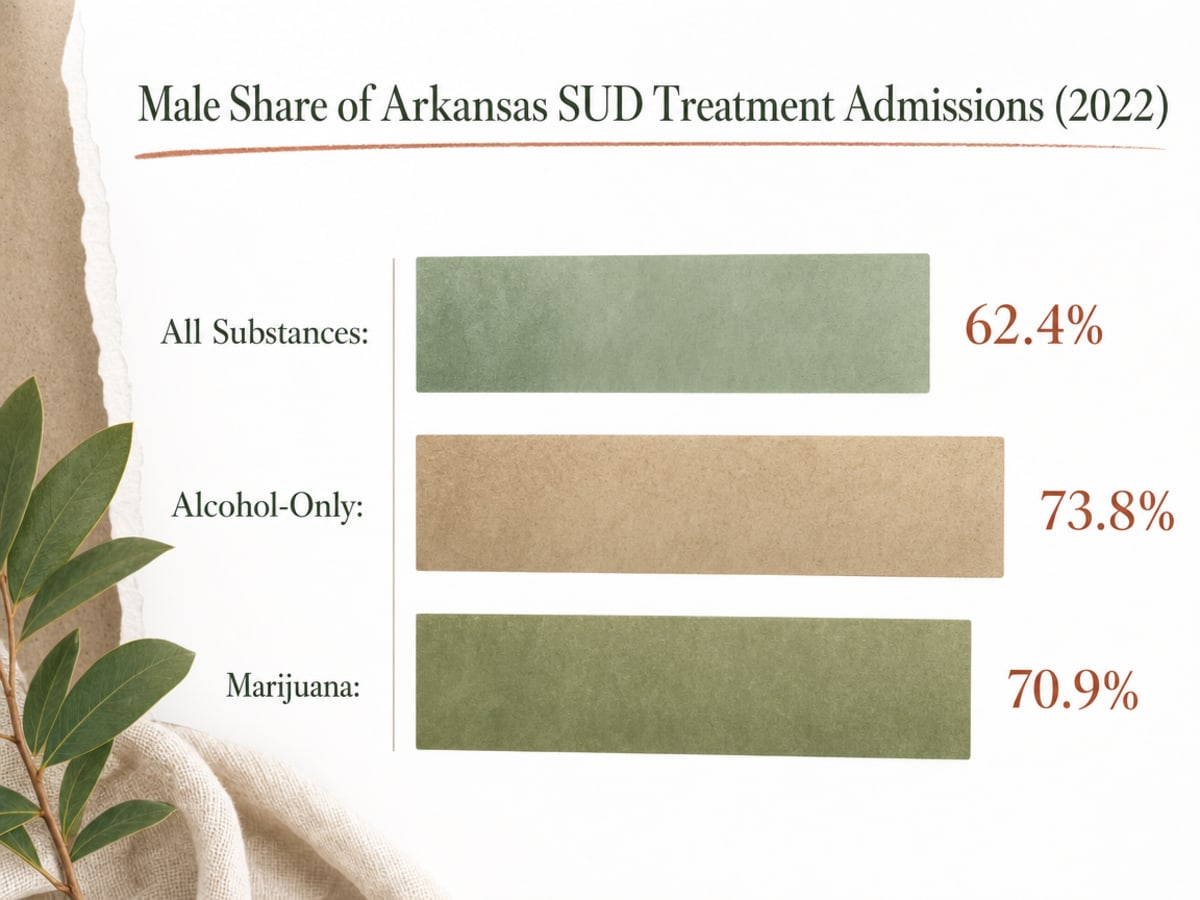
- Arkansas men make up 62.4% of state substance use treatment discharges and 73.8% of alcohol-only admissions, so weighing private men-only programs against DHS-funded regional options is a real local decision.7
- Before committing, compare length-of-stay fit (30, 60, or 90 days), overnight staffing, detox capability, wearable-informed clinical work, employer leave logistics, and the written continuing care plan past discharge.5
What a 20-Bed Men’s House Actually Looks Like at 6:30 a.m.
The first thing you notice is the quiet. Not silence — quiet. Coffee is on in the kitchen. Someone is already outside on the porch, jacket zipped against the Little Rock morning. A staff member you met yesterday nods at you from the hallway. You slept in a bed, in a room, in a house. Not a hospital ward. Not a cell.
This is residential treatment. And if you are picturing something else — bright fluorescents, a rolling IV pole, a locked door — that picture is wrong.
At Serenity Park, the house holds 20 men. That is the whole census. You will learn the other guys’ names by day three, whether you want to or not. You eat with them. You sit in group with them. You watch someone three weeks ahead of you tie his running shoes and think, okay, that could be me.
The clinical term for this level of care is straightforward: a live-in setting where treatment happens on-site, around the clock, with no commuting to appointments. What that means at 6:30 a.m. is simpler. You wake up somewhere safe. Your job for the next 30, 60, or 90 days is to be here. Everything else — the office, the drive home, the bottle in the garage — is on the other side of the front door.1
Residential, Defined by the Building You Sleep In
The Clinical Definition, in Plain English
Residential treatment means you live where you get care. Not a metaphor. A house, a bed, meals, therapy, medical staff, all under one roof. No commute. No 7 p.m. drive home past the liquor store you know by name. The clinical literature defines it as a live-in setting where treatment happens on-site, around the clock.1
Regulators put a number on it. The ASAM framework calls this Level 3.5 — clinically managed, high-intensity residential care — and expects a minimum of 24 treatment hours per week inside the building. That is not a suggestion. It is the floor.9
What that translates to at Serenity Park: 20 beds, one house, medical detox available on arrival, and a schedule that fills your day so completely that early recovery is not something you have to plan. It is something the building does for you. You show up to breakfast. You show up to group. Someone knows if you don’t.
That is the whole idea. The environment is the intervention.
Residential vs. Outpatient for Men, Specifically
Here is where most articles hedge. This one won’t.
SAMHSA’s Treatment Improvement Protocol on men’s behavioral health — the federal government’s own evidence synthesis on treating men — states it plainly: residential treatment is associated with significantly better abstinence outcomes for men compared with outpatient care, and the effect is particularly pronounced for men with severe substance use disorders, co-occurring mental health conditions, or home environments that undermine recovery. The same protocol notes this gender-specific finding does not extend to women in the research base. For men, the setting itself does work that outpatient cannot replicate.2
Think about why that might be true for you, specifically.
Outpatient means you drive to a session two or three evenings a week. You sit in a room for 90 minutes. Then you go home. Home is where the bourbon is. Home is where your phone rings at 9 p.m. with a client emergency and the pattern of pouring a drink to think through it is wired into your nervous system. Outpatient asks you to change the pattern while standing inside it.
Residential removes you from the pattern entirely. For 30, 60, or 90 days, the decisions that have been running your life — what to drink, when, how much, how to hide it — are simply not available. A systematic review of residential care across 23 studies found moderate-quality evidence for improvements in substance use, mental health, and social functioning. The evidence is not perfect. Attrition is real. But the direction is clear.3
For a man weighing the two options: outpatient makes sense when your environment is safe, your co-occurring conditions are stable, and your work has flex. Residential is the answer when any of those three are shaky. If you are reading this at 11 p.m. after another day of holding it together at work and losing it at home, you already know which category you are in.
A Day Inside the House: 6:30 a.m. to Lights Out
Morning: Wake-Up, Vitals, and the Wearable on Your Wrist
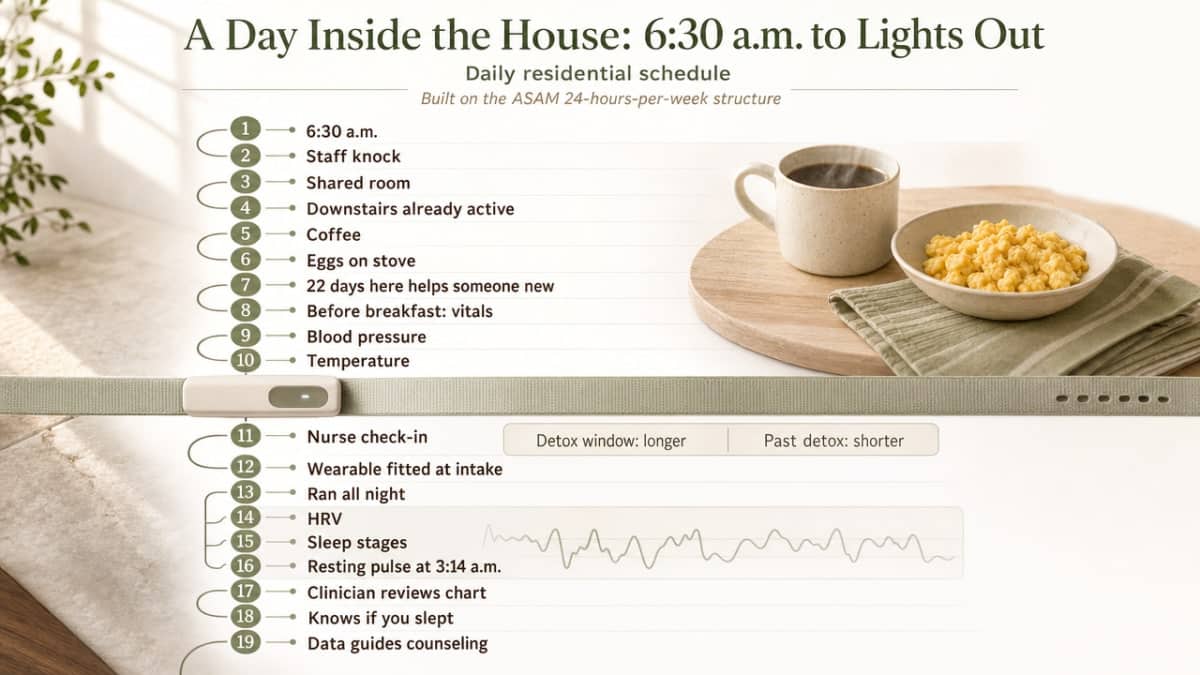
6:30 a.m. A staff member knocks. Not a shout — a knock. You are up, in a room with one or two other men, and the day has already started downstairs. Coffee. Eggs on the stove. The guy who has been here 22 days is telling someone new where the sugar is.
Before breakfast, vitals. Blood pressure, temperature, a quick check-in with the nurse if you are still in the detox window. If you are past detox, it is shorter. The wearable on your wrist — the Huml Health device you were fitted with on intake — has been running all night. Heart rate variability. Sleep stages. Resting pulse at 3:14 a.m. The clinician pulling up your chart already knows whether you actually slept or whether you laid there staring at the ceiling until four.
That data is not a gimmick. It is why the counselor you sit with at 10 a.m. can ask a specific question — your sleep was fractured Tuesday night, what was going on? — instead of a generic one.
Breakfast is at 7:30. Community meeting at 8:15. First group at 9. The ASAM framework that governs this level of care requires a minimum of 24 treatment hours a week inside the building. By lunch, you are already three hours into that count. You did not drive anywhere. You did not decide anything harder than which shirt to put on.9
That is the point.
Afternoon: Group, Individual Counseling, and the Space Between
Lunch ends around 12:30. The afternoon is where the real work sits.
Group therapy runs 90 minutes to two hours. Twelve or so men in a circle, one clinician, one topic. Some days it is craving. Some days it is anger, or the wife who stopped calling, or the son who will not look at you. You do not have to talk. But you sit there. And after enough afternoons, you do talk, because the guy two chairs over just said the thing you have been carrying alone for six years.
Individual counseling is 45 to 60 minutes, once or twice a week depending on your treatment plan. Same counselor each time. The office is at the end of the hall, past the kitchen. This is where the wearable data actually gets used — the clinician can see that your stress markers spiked Thursday afternoon and ask what was happening at 3 p.m. Usually you remember.
Between blocks, there is space. Not empty space. Structured space. Fitness time in the gym. A walk. A yoga session. Nutrition support. A book on the porch. This matters more than the schedule suggests: a 2023 realist review of residential treatment found that programs work partly through mechanisms of belonging, meaning, and autonomy — the moments between groups where you decide, on your own, to lace up your shoes and go outside.6
Evening and Overnight: Who Is in the Building at 2 a.m.
Dinner is at 6. After dinner, most nights, there is a 12-step meeting on-site or a recovery education session. Some evenings a family call, if that is part of your plan. By 9:30 the house starts to quiet down. Lights out is not a rule so much as a rhythm — the guys who have been here three weeks are already in bed, and you learn to follow the current.
Then comes the question nobody asks out loud on the intake call: who is in the building at 2 a.m.?
You are not alone in the dark. That, more than any single group session, is what the building actually does.
Why Men-Only, 20 Beds Changes the Social Physics
Twenty beds is a small number on purpose. So is men-only. Both decisions change what happens in the room before a single clinician opens their mouth.
Start with the size. In a 200-bed facility, you are a name on a whiteboard. In a house of 20, you are the guy who takes his coffee black, who cannot sit through group without bouncing his knee, who cracked open on Wednesday and no one has forgotten. The staff know your face. The other men know your story by the end of the first week. That level of visibility is uncomfortable. It is also the point.
The 2023 realist review of residential treatment for adults with SUD found that programs work through three mechanisms: the need to belong, finding meaning, and self-determination. Belonging does not scale. It happens between specific people who eat the same meals and hear the same 4 a.m. footsteps. Twenty beds is the size where that becomes possible.6
Now the men-only part.
You have spent thirty years learning how to perform in front of women — your mother, your wife, the woman across the conference table. Some of that performance is fine. Some of it is armor you cannot afford to keep wearing in group therapy. SAMHSA’s Treatment Improvement Protocol on men’s behavioral health is direct about this: men with SUD often benefit from settings that let them work through shame, trauma, and identity without the social calculus of a mixed-gender room.2
What that means in practice: the guy across from you crying about his daughter is not embarrassed you saw it. The conversation about anger, about failure, about the times you were not the man you told yourself you were — that conversation moves faster in a room of men. Not because women slow it down. Because the armor comes off sooner when the audience is the same.
Twenty beds. All men. It is a specific design, and the design is doing work.
Why Little Rock, Why Now: The Arkansas Picture
You are not an outlier. That is the first thing the state data tells you.
The 2022 SAMHSA Treatment Episode Data Set for Arkansas breaks down who actually walks into treatment here. Men account for 62.4% of all substance use treatment discharges in the state. For alcohol-only admissions, that number jumps to 73.8%. For marijuana, 70.9%. Roughly three out of four Arkansas men who finally get help for a drinking problem are in the same category you are considering right now.7
Read that again if you need to. The room is not empty.
What the numbers do not tell you is why so many men wait so long. You can guess. The job. The kids’ schedules. The idea that stepping away for 30 days will collapse something you have spent 20 years building. The Little Rock version of that math is specific — the practice down on Chenal, the crew on the jobsite in North Little Rock, the case you told opposing counsel you’d have ready by the 15th.
Arkansas has a public treatment system. The Department of Human Services organizes state-funded care through eight regional catchment areas and does support residential placement for men without insurance. That system exists and it matters. It is also not the same conversation as choosing a private, 20-bed, men-only program with medical detox on-site and a wearable device on your wrist from intake. Both are legitimate. They serve different men at different moments.8
Serenity Park sits in that second category, in Little Rock, for a specific reason. The men who fill these 20 beds are usually the ones who cannot be gone for six weeks without a real plan for the office — and cannot afford to keep pretending everything is fine for another quarter.
What the Wearable Actually Tells the Clinical Team
The device on your wrist is not a Fitbit. It looks like one. It is not.
Serenity Park uses Huml Health wearables from intake forward, and the data feeds directly into the clinical workflow. Heart rate. Heart rate variability. Sleep architecture — how much of the night you actually spent in deep sleep versus lying awake. Resting pulse trends across days. Stress markers that shift hours before you notice you are agitated.
In the first 72 hours, when you are in detox, that stream matters most. Alcohol and benzo withdrawal can spike autonomic activity long before symptoms become obvious to the person going through it. The nurse looking at your overnight trace knows if your resting heart rate climbed from 78 to 104 between midnight and 4 a.m. She adjusts your medication before you ever ring the bell.
Three weeks in, the same data does different work. Your counselor sees that your sleep collapsed the night after Tuesday’s family call. That is not a coincidence. That is the conversation for Wednesday morning.
This is what data-informed care means at this level. A 2019 systematic review found moderate-quality evidence that residential treatment improves substance use, mental health, and social functioning outcomes. The wearable does not replace that clinical work. It sharpens it.3
The Practical Things You’re Actually Worried About
Work, the Mortgage, and What to Tell the Office
Let’s say the quiet part out loud. You are not stalling because you don’t want to get better. You are stalling because you cannot picture how the office runs without you for a month, and you have not figured out what to tell the partners, the crew, or your assistant who books your calendar three weeks out.
Fair. That is the actual problem.
Here is what tends to be true. Most professional men who come through a 20-bed residential program do not tell the office they are in treatment. They tell the office they are handling a medical issue. That is accurate. Substance use disorder is a medical condition, and FMLA protections apply to it the same way they apply to any serious health condition — up to 12 weeks of job-protected leave if you and your employer qualify. Your HR department has processed this exact request before. You are not the first partner, physician, or superintendent to file one.
Discretion is built into the structure. There is no name on the sign at Serenity Park. Mail goes to a P.O. box if you want it to. You handle the message to the office once, on day one, and then the building takes the phone out of your hand.
The mortgage keeps getting paid. Autopay does not care where you sleep.
30, 60, or 90 Days: Length of Stay as Clinical Fit
You want a number. Most men do. Thirty days sounds survivable. Ninety days sounds like a different life.
The honest answer is that length of stay is a clinical decision, not a calendar decision. It gets set based on what you walked in with — the severity of the use, whether you are detoxing off alcohol or benzodiazepines or opioids, whether there is a co-occurring depression or anxiety diagnosis underneath, and what the home you are going back to actually looks like.
That said, the evidence points in one direction. A continuing care review of substance use treatment found that patients receiving three months or more of care — whether in long-term residential, outpatient, or a combination — demonstrated significantly better outcomes than patients with treatment episodes shorter than three months. Three months is the number the research keeps circling back to.5
That does not mean you have to sit in a residential bed for 90 straight days. It means the arc of your care — detox, residential, then structured continuing care after discharge — should add up to at least that.
At Serenity Park, 30 days is often where the medical stabilization and initial clinical work land. Sixty and 90 days are for the men whose situation warrants deeper work before they walk out the front door. Your intake conversation is where that gets decided. Not now, on your phone, at 11 p.m.
After Discharge: Why the First 90 Days Aren’t the Whole Story
The front door opens both ways. That is the part most men do not think about until they are standing at it with a duffel bag.
The research is clear on this point. Patients who receive three months or more of care — counting long-term residential, structured outpatient, or a combination — show significantly better outcomes than men whose treatment ends at 30 or 60 days. And when continuing care runs six to twelve months past discharge, abstinence rates keep climbing. The number the literature keeps returning to is a year of some kind of engagement, not a year in a bed.5
What that looks like after Serenity Park: a written discharge plan built before you leave, not scribbled on your last day. Step-down to intensive outpatient if that fits. A continuing care group that meets weekly. Alumni connections with the men who slept in the room next to yours. A named outpatient provider in Little Rock or wherever you are headed, with the first appointment already on the calendar.
Ninety days inside is a strong start. It is not the finish line. It is the platform the next year gets built on.
Is This the Right Level of Care for You
Here is the honest test. If your drinking or using has escalated to the point where cutting back on your own has stopped working, if the home you go back to every night is where the pattern lives, if you have tried outpatient before and watched it not hold — residential is the level of care built for you.
If you are detoxing off alcohol or benzodiazepines, that decision gets easier. Medically supervised withdrawal is not something to attempt in your guest room. Residential care solves the medical piece and the environmental piece in the same building.
What you do not know yet is whether Serenity Park’s specific version of this — 20 beds, men only, wearable-integrated care, medical detox on-site, Little Rock — is the fit for your situation. That is not a question you answer from an article. That is a phone call with someone who will ask about the last two weeks, the substance, the home, the work, and tell you plainly whether this level of care matches what you actually need.
Make the call. Ask the fit question. Then decide.
Frequently Asked Questions
Can I keep my phone and stay reachable for a real work emergency?
Phone access is limited and structured, not banned outright. Most men hand the device off at intake and get scheduled windows to check in with family and, when clinically appropriate, a designated work contact. For a true emergency — a hospitalized parent, a legal matter that cannot wait — the clinical team helps you make the call. The point is not isolation. It is removing the phone as the reflex you reach for at 9 p.m.
How is men’s residential treatment different from outpatient rehab?
You live where you get care. No commute, no evenings back home, 24-hour clinical coverage inside the building. Outpatient means driving to sessions two or three nights a week and sleeping in the same environment that shaped the pattern. For men specifically, the federal SAMHSA protocol on men’s behavioral health finds residential produces significantly better abstinence outcomes than outpatient — a gender-specific effect the same protocol does not report for women.1,2
How long will I need to stay — 30, 60, or 90 days?
The number depends on what you walked in with — the substance, the severity, whether you are detoxing, and what home looks like on discharge day. Thirty days handles medical stabilization and initial clinical work for many men. Sixty or 90 days go deeper. The evidence points one direction: patients who receive three months or more of care, counting residential plus continuing care, show significantly better outcomes than those with shorter episodes. Your intake conversation sets the number.5
Who is in the building overnight if something goes wrong at 2 a.m.?
On-site clinical and support staff, in the building, awake. Not on-call from home. Residential care is defined as 24-hour care, and that includes overnight coverage. If you wake up at 2 a.m. with your heart racing during detox, someone is downstairs. If your wearable flags an irregular reading at 3:47 a.m., a clinician is already looking at the trace before you ring the bell.9
What do I tell my employer, and is my job protected while I’m away?
Most professional men frame it as a medical leave for a serious health condition. That is accurate. Substance use disorder is a medical condition, and FMLA provides up to 12 weeks of job-protected leave if you and your employer qualify. Your HR team has processed this type of request before. You handle the message on day one, then the building takes the phone out of your hand for the rest of it.
What happens after I’m discharged — am I just sent home?
No. Discharge planning starts weeks before you leave, not on your last morning. Expect a written plan: step-down to intensive outpatient if it fits, a weekly continuing care group, alumni connections with the men you lived with, and a named outpatient provider with the first appointment already scheduled. Continuing care over six to twelve months is where abstinence rates keep climbing in the research. The 30 days inside is the platform, not the finish.5
References
- Treatment Modalities and Settings (Chapter, Principles of Addiction Medicine–style monograph). https://www.ncbi.nlm.nih.gov/books/NBK144286/
- Addressing the Specific Behavioral Health Needs of Men (SAMHSA TIP 56). https://library.samhsa.gov/sites/default/files/sma14-4882.pdf
- The effectiveness of residential treatment services for individuals with substance use disorders: A systematic review. https://pubmed.ncbi.nlm.nih.gov/31254749/
- Is residential treatment effective for opioid use disorders? A longitudinal comparison of treatment outcomes among opioid dependent, opioid misusing, and non-opioid using emerging adults with substance use disorder. https://www.ncbi.nlm.nih.gov/pmc/articles/PMC4253677/
- The Continuing Care Model of Substance Use Treatment: What Works, and for Whom?. https://www.ncbi.nlm.nih.gov/pmc/articles/PMC4007701/
- A realist review of residential treatment for adults with substance use disorder. https://pubmed.ncbi.nlm.nih.gov/36747370/
- 2022 Treatment Episode Data Set: Discharges (TEDS-D) – Arkansas. https://www.samhsa.gov/data/node/51427
- Find Substance Abuse or Mental Health Treatment (Arkansas DHS Office of Substance Abuse and Mental Health). https://humanservices.arkansas.gov/divisions-shared-services/shared-services/office-of-substance-abuse-and-mental-health/samh-treatment/
- Okla. Admin. Code § 450:18-1-2 – Definitions. https://www.law.cornell.edu/regulations/oklahoma/OAC-450-18-1-2
- Arkansas Epidemiological State Profile of Substance Use. https://humanservices.arkansas.gov/wp-content/uploads/arkansasepidenmiological2015.pdf
- Probation Revocations in Pulaski County: Findings Report. https://publichealth.uams.edu/wp-content/uploads/2022/03/Probation-Revocations-in-Pulaski-County-Findings-Report.pdf