
Key Takeaways
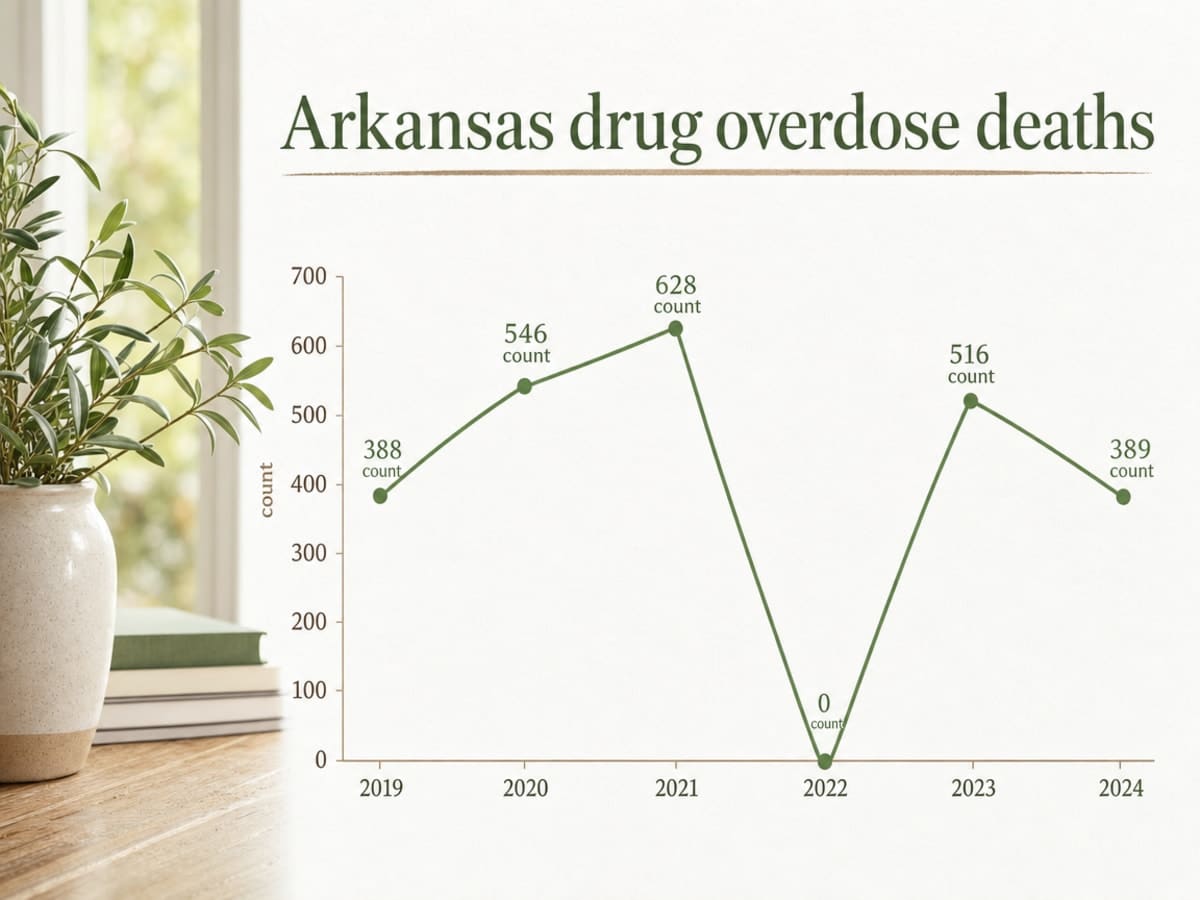
- Arkansas overdose deaths dropped to 389 in 2024 from a 2021 peak of 628, but an ARPA-funded capacity build-out means new facilities need harder vetting, not softer 15, 7.
- Five verifications separate a real Arkansas program from marketing: OADAP licensure, national accreditation from Joint Commission, CARF, or COA, LADAC counselor credentials, ASAM level of care, and structured aftercare 10, 3, 11, 12, 13.
- Ask whether detox is medically managed with 24-hour nursing, whether psychiatric evaluation happens on-site within the first week, and whether admission can happen within 48 hours 12, 14, 13.
- Call admissions with the nine-question script, log vague answers in a second column, and keep dialing Arkansas facilities until one program answers every item in writing.
Due Diligence, Not a Shopping Trip
You are not picking a resort. You are vetting a clinical vendor whose work will determine whether a man you care about — maybe yourself — walks out sober, stable, and still employed. That reframe matters, because most residential treatment websites are built to look like the former.
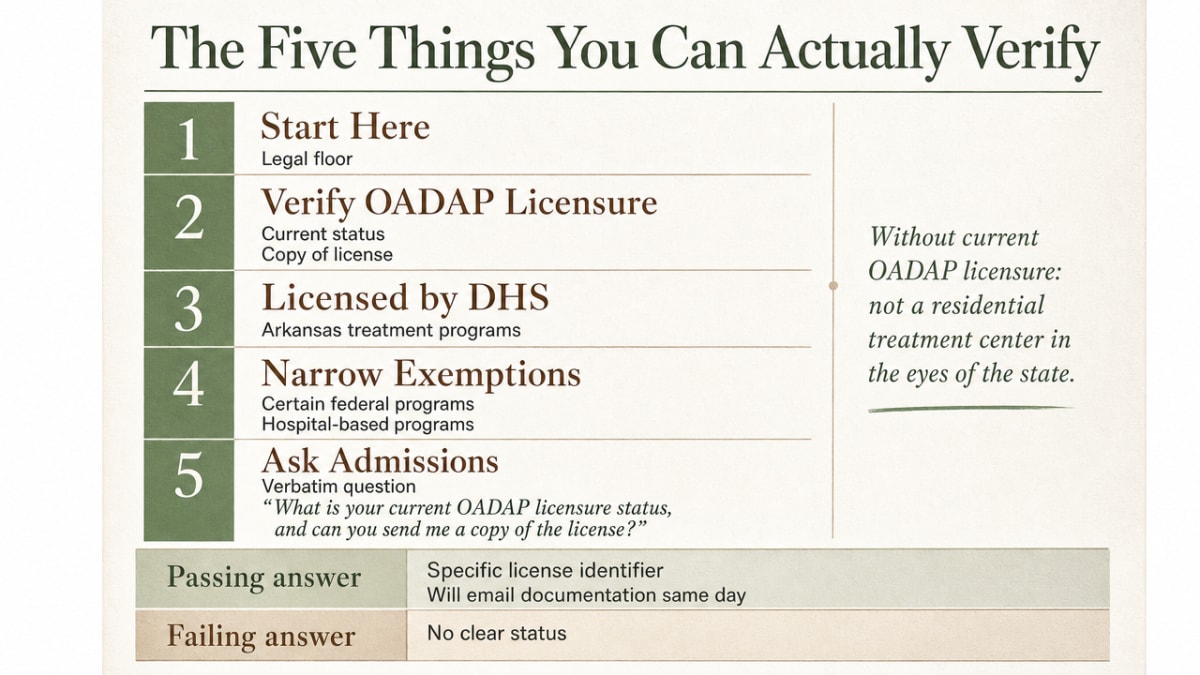
The good news: you already know how to run diligence. You do it on contracts, expert witnesses, contractors, and hires. The same instinct applies here. There are exactly five things you can verify about any Arkansas facility before you ever tour it — state licensure through DHS, national accreditation, staff credentials, ASAM level of care, and structured aftercare 10, 3, 11, 12, 13. Everything else on the website is marketing.
This checklist walks each verification, names the exact question to ask admissions, and shows what a passing answer sounds like. Serenity Park shows up later, once, as a worked example of a Little Rock program that clears every bar. Not as the pitch. If the checklist works, it works on any facility you call.
Why the Bar Has to Be Higher in Arkansas
Arkansas is not a low-stakes market. Provisional data from the Arkansas Department of Health shows drug overdose deaths climbing from 388 in 2019 to 546 in 2020 and a peak of 628 in 2021, then landing at 516 in 2023 and 389 in 2024 — a roughly 24.6% year-over-year drop, but still above where the state started six years ago 15. The trend is moving the right direction. It has not moved far enough for anyone to relax their standards.
That context matters because Arkansas is also in the middle of a capacity build-out. The Department of Human Services is using ARPA grant funding to help Medicaid providers construct new residential substance abuse treatment facilities and upgrade existing ones 7. More beds are coming online. New signage is going up. Some of those programs will be excellent. Some will be brand new operations still learning how to run a residential milieu, and their websites will look identical to programs with a decade of clinical track record.
The Five Things You Can Actually Verify
State Licensure Through DHS and OADAP
Start here. Every entity operating a substance abuse treatment program in Arkansas has to be licensed by the DHS Office of Alcohol and Drug Abuse Prevention (OADAP), and nearly every provider holding itself out to the public as an alcohol or drug treatment program falls under that requirement, with narrow exemptions for certain federal or hospital-based programs 10, 2. That is the legal floor. Not a nice-to-have. A facility without current OADAP licensure is not a residential treatment center in the eyes of the state — it is a business.
What to ask admissions, verbatim:“What is your current OADAP licensure status, and can you send me a copy of the license?”A passing answer sounds like a specific license identifier and a willingness to email documentation the same day. A failing answer sounds like “we’re fully compliant” without a document, or a pivot to accreditation without addressing licensure at all.
Licensure gets you the baseline: the facility exists on paper, has been reviewed onsite, and is subject to ongoing DHS oversight 10. It does not tell you the care is good. It tells you the operation is real. That is why licensure is item one of five, not item one of one.
National Accreditation: Joint Commission, CARF, or COA
Accreditation is the second layer, and in Arkansas it is tied directly to licensure. Programs accredited by the Joint Commission, CARF, or the Council on Accreditation (COA) qualify automatically for state licensure if they also meet Arkansas core standards in treatment planning, supervision, health and safety, and physical plant requirements 3, 1. Translation: a nationally accredited program has cleared two review processes, not one.
Ask for the accrediting body by name and the date of the most recent survey. “We’re accredited” is not an answer. “We hold Joint Commission Behavioral Health Care Accreditation, last surveyed in [year]” is. If the facility cannot name the body or the survey year, treat it the way you would a contractor who cannot name their bond carrier.
One caveat worth holding. Accreditation is a periodic review, not a live feed. A program can hold current accreditation and still have staffing turnover, leadership changes, or a shift in clinical culture the surveyor never saw 3. That is why you also check staffing credentials and levels of care directly. Accreditation is a strong signal. It is not a substitute for the next three verifications.
Staffing Credentials: LADAC, LAADAC, and the Medical Director
The people in the room matter more than the paint on the walls. Arkansas licenses addiction counselors through the State Board of Examiners of Alcoholism and Drug Abuse Counselors (ASBEADAC), and the tier you want to hear named is Licensed Alcoholism and Drug Abuse Counselor (LADAC) — a master’s-level clinician in a health or behavioral sciences field with supervised experience and a code of ethics behind the credential 11. LAADAC is the advanced tier. Both are meaningful. “Certified addiction specialist” without a state license is not the same thing.
Ask:“How many of your primary counselors hold LADAC or LAADAC licensure through ASBEADAC?”A confident program will give you a number and tell you who supervises the rest. A vague answer — “our clinical team is highly trained” — is a red flag dressed up as reassurance.
Then move to the medical director. For opioid treatment programs, Arkansas requires the medical director to be ASAM-certified, have documented working experience in an opioid treatment program, or have documented continuing education in addiction treatment 4. Even outside of OTPs, that is the standard worth asking for. Get the medical director’s name, credentials, and ASAM status in writing. If the website lists “our medical team” without naming a physician, you do not have a medical director you can verify. You have marketing copy.
ASAM Levels of Care: Medically Managed vs. Clinically Managed
This is the verification most families skip, and it is the one that determines whether the man in your life is safe on day two. The American Society of Addiction Medicine (ASAM) defines levels of care by how much medical supervision each patient gets. Medically managed services — the higher intensity levels — involve daily medical care and 24-hour nursing coverage. Clinically managed services are directed by non-physician addiction specialists, with medical support available but not continuous 12. Both are legitimate. They are for different clinical pictures.
Someone with heavy daily alcohol use, benzodiazepine dependence, an opioid tolerance built over years, unstable vitals, or a psychiatric crisis needs medically managed detox with 24-hour nursing. Withdrawal from alcohol and benzodiazepines can kill people. That is not a scare tactic — it is the reason ASAM created the distinction. Someone stepping down from a completed detox into residential rehabilitation may be appropriate for clinically managed residential care, where the daily driver is therapy and structure rather than medical monitoring 12.
Arkansas layers its own floor on top. Adult residential SUD programs regulated by DHS must deliver a minimum of five hours of structured treatment per day Monday through Friday and three hours per day on Saturday and Sunday 6. Ask any residential program to walk you through a typical Tuesday and a typical Saturday. If they cannot describe those hours by activity — group, individual, medical rounds, education, family — the schedule is aspirational, not operational.
Ask admissions two specific questions. First:“What ASAM level of care are you licensed to deliver, and is there 24-hour nursing on-site?”Second:
“If my [husband, son, brother] arrives still drinking or still using, do you admit directly to medically supervised detox, or do you refer out?”The answers tell you whether the program can hold him at his worst, or only at his best.
Structured Aftercare and Continuing Support
Residential is a chapter, not the book. SAMHSA’s quality guidance is explicit that programs worth choosing offer a full range of services and connect patients into ongoing support before discharge, not after 13, 16. Ask what happens on day 31.
A passing answer names specific handoffs:
- an outpatient or intensive outpatient referral with an appointment already scheduled,
- medication management continuity if MAT is part of the plan,
- a continuing care group the alumni actually attend, and
- mutual-help integration such as 12-step or SMART Recovery meeting connections 8.
Arkansas’s Office of Substance Abuse and Mental Health frames the state’s approach as a recovery-oriented system of care for exactly this reason — the acute stay is one node in a longer network 5.
Two red flags to listen for. First, “we help you find aftercare when you’re ready” — meaning discharge planning has not started. Second, no named alumni program or continuing care group. A facility that cannot describe how it stays connected to men after they leave is a facility with no view of its own outcomes. You are looking for the opposite: a program that treats aftercare as part of the admission, not a farewell handshake.
Clinical Practice: The Questions NIDA and SAMHSA Would Ask
The state paperwork tells you a facility is real. The next filter tells you whether the care inside it is any good. Two federal guides do most of that work for you, and both are written for exactly your situation.
NIDA’s five questions are the spine:
- Does the program use treatments backed by scientific evidence?
- Does it tailor treatment to each patient?
- Is the duration of treatment sufficient?
- Does it offer comprehensive services beyond the addiction itself?
- Does it integrate mutual-help programs like 12-step or SMART Recovery 8?
Ask them in that order. “Evidence-based” should come back as named modalities — cognitive behavioral therapy, motivational interviewing, contingency management, medication-assisted treatment where clinically appropriate — not as a catchphrase. Individualized care should come back as a treatment planning process with a named clinician assigned to your loved one, not a boilerplate schedule everyone follows.
SAMHSA’s quality guide layers on the operational tests. A quality program should offer a full range of services and, critically, be able to see a person within 48 hours of the call. If admissions cannot get him in within two days without a clinical reason for the delay, SAMHSA’s guidance is direct: find another provider 13. That benchmark alone eliminates a surprising number of glossy websites. It also protects you from the false urgency the opposite direction — the program that promises a bed “tonight” without asking a single clinical question. Both extremes are red flags.
The five signs SAMHSA names — accreditation, medication options for SUD, evidence-based practices, a defined position on family involvement, and connections to ongoing support networks — map cleanly onto the verifications you already ran in the previous section 13, 16. Use them as the checkpoint on your admissions call. If any one of the five draws a vague answer, note it. Two vague answers, and you are on the wrong call.
Red-Flag Language on Facility Websites
Once you know what to verify, the marketing copy starts reading differently. A homepage stops being persuasive and starts being a source document. Here is the language pattern-matching that saves you a call.
“Luxury” and “boutique” with no clinical detail. Amenities are not care. A facility that leads with thread count, chef-prepared meals, and “executive” accommodations but does not name its accrediting body, its medical director, or its ASAM level of care is selling a hotel stay. The Arkansas core standards for licensure are about treatment planning, supervision, health and safety, and physical plant — not linens 1.
“Holistic curriculum” with no listed therapies. Holistic is fine as an adjective. It is a red flag as a noun. If the site cannot name cognitive behavioral therapy, motivational interviewing, medication-assisted treatment, or another modality backed by evidence, the curriculum has not been built — it has been described 8.
“Our medical team” with no named physician. You should be able to find the medical director’s name, credentials, and ideally their ASAM status on the site or in a follow-up email within a day 4. “Board-certified doctors on staff” is not verifiable. A name is.
No accreditation body listed. “Fully accredited” without naming Joint Commission, CARF, or COA is not accreditation — it is a word 3.
A bed “tonight” with no clinical screening. Speed is good. Skipping the intake assessment is not. If no one is asking about withdrawal risk, psychiatric history, or medications before offering admission, the program is filling a bed, not treating a patient 13.
Two of these on one page is a pattern. Three is your answer.
Co-Occurring Conditions and Integrated Care
Addiction rarely arrives alone. The man you are trying to help is often carrying depression, an anxiety disorder, unaddressed trauma, or an eating disorder alongside the drinking or the pills — and treating the substance use without the rest is how people cycle back through admissions. SAMHSA’s most recent advisory on co-occurring disorders is direct on this point: recovery is more durable when care is integrated, person-centered, and evidence-based rather than delivered in parallel silos 14.
What that means for your checklist is specific. Ask admissions:“Do you have psychiatric evaluation on-site, and who provides medication management for mental health conditions during residential?”A passing answer names a psychiatrist or psychiatric nurse practitioner, describes when the initial evaluation happens (ideally within the first week), and explains how psychiatric medications are coordinated with any MAT already in play. A failing answer sends mental health care off-site to a referral partner the program cannot schedule for you.Ask one more:
“How do you handle trauma work while someone is still stabilizing?”You want to hear that trauma-focused therapy is sequenced carefully, not skipped and not rushed. Integrated care is a capability, not a brochure line.
Serenity Park as a Worked Example
Run the checklist against Serenity Park Recovery Center in Little Rock and see what a passing card looks like. This is not a pitch — it is a demonstration that the five verifications are answerable, in writing, by a real facility.
Licensure and accreditation. Serenity Park operates as a licensed Arkansas residential substance abuse treatment program under the DHS/OADAP framework that governs every legitimate provider in the state 10, 2. Ask for the license identifier and the current accreditation letter. You should get both.
Levels of care and staffing. The program delivers medically supervised detox and residential addiction treatment for men, which is the combination that matters when someone arrives still drinking or still using and needs medical stabilization before therapy begins 12. The staffing model pairs a medical director and psychiatric care with LADAC-credentialed counselors doing individual and group work, mapping directly onto the Arkansas counselor licensure tier you were told to ask for by name 11, 4. Capacity is capped at 20 men at a time — the kind of small residential setting where the daily schedule can actually meet the state’s structured-treatment floor rather than approximate it 6.
Clinical breadth and aftercare. The program integrates psychiatric evaluation, dual diagnosis capability, individual counseling, group therapy, 12-step facilitation, family resources, and discharge planning that hands off to a continuing care group and alumni support — the ongoing-support piece SAMHSA names as one of the five signs 13, 14. Wearable biotech monitoring through a partnership with Huml Health tracks heart rate, stress, and sleep so clinicians can adjust care based on live physiologic data rather than self-report alone. Treat that as a feature, not the reason to choose. The reason to choose is that every earlier box is checked.
Run the same audit on any facility on your shortlist. If the answers come back this specific, keep the call going.
The Printable Question Set for Admissions Calls
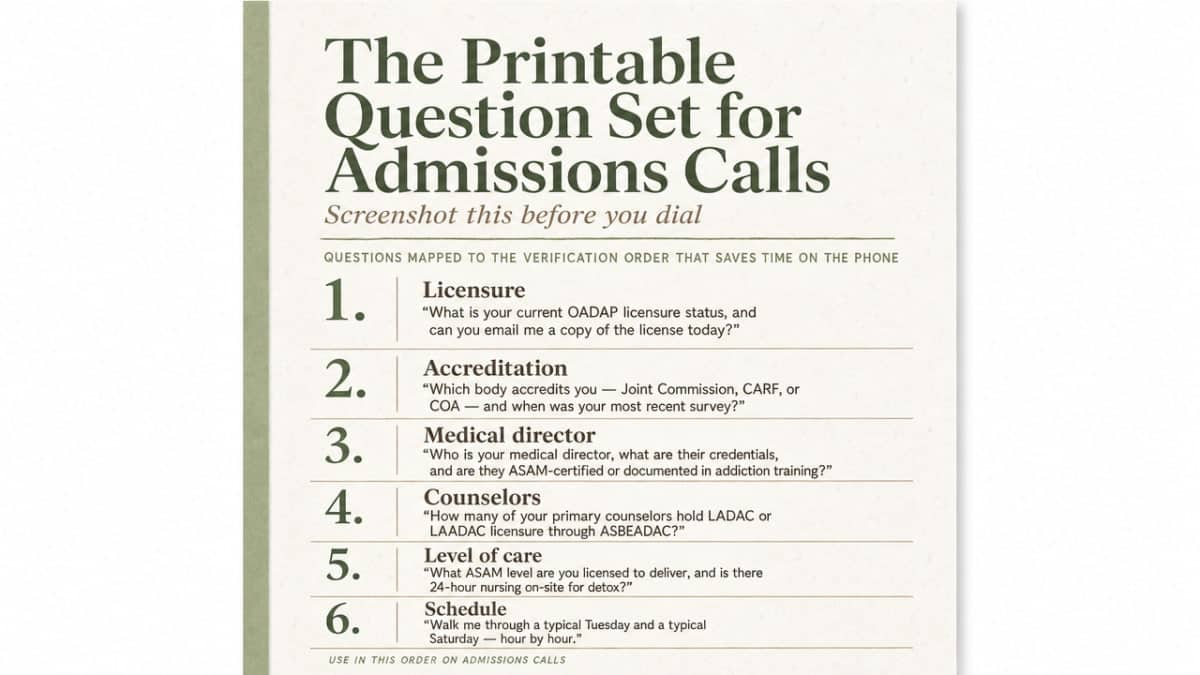
Screenshot this before you dial. These are the questions that map to the five verifications, in the order that saves you the most time on the phone.
- Licensure: “What is your current OADAP licensure status, and can you email me a copy of the license today?” 10
- Accreditation: “Which body accredits you — Joint Commission, CARF, or COA — and when was your most recent survey?” 3
- Medical director: “Who is your medical director, what are their credentials, and are they ASAM-certified or documented in addiction training?” 4
- Counselors: “How many of your primary counselors hold LADAC or LAADAC licensure through ASBEADAC?” 11
- Level of care: “What ASAM level are you licensed to deliver, and is there 24-hour nursing on-site for detox?” 12
- Schedule: “Walk me through a typical Tuesday and a typical Saturday — hour by hour.” 6
- Co-occurring care: “Is psychiatric evaluation on-site, and who manages mental health medications during residential?” 14
- Intake speed: “Can you assess and admit him within 48 hours?” 13
- Aftercare: “What does discharge planning look like on day one, and who runs your continuing care group?” 13
Write the answers in a single column. Vague responses in a second column. If the second column has more than two entries when the call ends, keep dialing.
Frequently Asked Questions
How do I verify that an Arkansas treatment center is actually licensed?
Ask the facility directly for its current OADAP license identifier and request a copy by email the same day. Every entity operating a substance abuse treatment program in Arkansas must be licensed by the DHS Office of Alcohol and Drug Abuse Prevention, with narrow exemptions for certain federal or hospital-based programs 10, 2. If admissions cannot produce documentation, move on.
Is national accreditation from the Joint Commission or CARF the same as state licensure in Arkansas?
No, but they are linked. Programs accredited by the Joint Commission, CARF, or the Council on Accreditation qualify automatically for Arkansas licensure if they also meet state core standards in treatment planning, supervision, health and safety, and physical plant requirements 3, 1. Verify both. Accreditation is a periodic survey, not a live feed, so ask for the survey year alongside the accrediting body’s name.
What is the difference between medically managed and clinically managed residential treatment?
Medically managed services include daily medical care and 24-hour nursing coverage on-site. Clinically managed residential care is directed by non-physician addiction specialists, with medical support available but not continuous 12. Someone actively withdrawing from alcohol, benzodiazepines, or opioids needs the medically managed level. Someone stepping down from a completed detox into rehabilitation may be appropriate for clinically managed residential. Ask which level the program is licensed to deliver.
What counselor credentials should I ask about by name?
Ask for Licensed Alcoholism and Drug Abuse Counselor (LADAC) or the advanced tier, LAADAC, both issued through the Arkansas State Board of Examiners of Alcoholism and Drug Abuse Counselors (ASBEADAC) 11. LADAC clinicians hold a master’s degree in a health or behavioral sciences field, supervised experience, and an enforced ethics code. “Certified addiction specialist” without state licensure is not the same credential and should not be treated as one.
What marketing language on a facility’s website should raise red flags?
Watch for “luxury” or “boutique” language with no named accrediting body 3, “holistic curriculum” without listed evidence-based therapies like CBT or motivational interviewing 8, and “our medical team” with no physician named 4. Also flag any program offering a bed “tonight” without a clinical screening, since SAMHSA’s guidance sets a 48-hour intake benchmark that still includes proper assessment, not bed-filling 13.
Why does integrated care for co-occurring conditions belong on the checklist?
Because addiction rarely arrives alone. SAMHSA’s advisory on co-occurring disorders is direct that recovery is more durable when substance use and mental health conditions are treated together through evidence-based, integrated, person-centered care rather than in parallel silos 14. Ask whether psychiatric evaluation happens on-site within the first week and who manages mental health medications during residential. Off-site referrals the facility cannot schedule are a warning sign.
References
- 007.25.95 Ark. Code R. 003 – Licensure Standards Manual for Substance Abuse/Addiction Treatment Programs. https://www.law.cornell.edu/regulations/arkansas/007-25-95-Ark-Code-R-003
- 20 CAR § 433-102. Procedures for licensure. https://codeofarrules.arkansas.gov/Rules/Rule?levelType=section&titleID=20&chapterID=128&subChapterID=170&partID=666&subPartID=3986§ionID=24512
- 20 CAR § 433-206. Commission on Accreditation. https://codeofarrules.arkansas.gov/Rules/Rule?levelType=section&titleID=20&chapterID=128&subChapterID=170&partID=666&subPartID=3987§ionID=24526
- Title 20. Public Health and Welfare – Part 433. https://webftp.blr.arkansas.gov/Home/FTPDocument?path=CAR/Parts/20CARpt433.pdf
- Office of Substance Abuse and Mental Health. https://humanservices.arkansas.gov/divisions-shared-services/shared-services/office-of-substance-abuse-and-mental-health/
- Arkansas Summary – State Residential Treatment for Behavioral Health Conditions. https://aspe.hhs.gov/sites/default/files/2021-08/StateBHCond-Arkansas.pdf
- Adult Substance Abuse Residential Treatment Facilities – ARPA Grant Funding Opportunities. https://humanservices.arkansas.gov/newsroom/hcbs/arpa-grant-funding-opportunities-for-arkansas-medicaid-providers/adult-substance-abuse-residential-treatment-facilities/
- SEEKING DRUG ABUSE TREATMENT: KNOW WHAT TO ASK. https://nida.nih.gov/sites/default/files/treatmentbrochure_web.pdf
- Treatment Materials for Patients | National Institute on Drug Abuse. https://nida.nih.gov/nidamed-medical-health-professionals/treatment/treatment-materials-patients
- Part 433. Licensure Standards for Substance Abuse Treatment Programs. https://codeofarrules.arkansas.gov/Rules/Rule?levelType=part&titleID=20&chapterID=128&subChapterID=170&partID=666&subPartID=null§ionID=null
- ASBEADAC – Licensure. https://healthy.arkansas.gov/boards-commissions/boards/examiners-of-alcoholism-and-drug-abuse-counselors-arkansas-state-board/licensure/
- Overview of Substance Use Disorder Care Clinical Guidelines …. https://www.medicaid.gov/state-resource-center/innovation-accelerator-program/iap-downloads/reducing-substance-use-disorders/asam-resource-guide.pdf
- FINDING QUALITY TREATMENT FOR SUBSTANCE USE …. https://library.samhsa.gov/sites/default/files/pep18-treatment-loc.pdf
- Evidence-Based Care for Clients with Co-Occurring Substance Use …. https://library.samhsa.gov/product/advisory-evidence-based-care-clients-co-occurring-substance-use-disorders-eating-disorders/pep25-02-010
- Substance Misuse Education and Prevention. https://healthy.arkansas.gov/programs-services/prevention-healthy-living/substance-misuse-education-and-prevention/
- Finding Quality Treatment for Substance Use Disorders. https://library.samhsa.gov/product/finding-quality-treatment-substance-use-disorders/pep18-treatment-loc