
What to Know About Medication Management in Little Rock, AR
Key Takeaways
- Arkansas removed prior authorization for buprenorphine, methadone, and naltrexone under Act 964, so a valid prescription and SAMHSA-aligned plan is enough to start MAT tonight in Little Rock 3, 11.
- The first 24 hours involve a medical evaluation, a mandatory PDMP check before any controlled medication, and a matched MAT choice — usually buprenorphine for opioids, naltrexone for alcohol 4, 5.
- Since the July 2025 Section 1115 demonstration approval, Arkansas Medicaid covers a full continuum including residential detox and medically supervised withdrawal, not only outpatient MAT visits 15.
- Before admitting, compare programs on Medicaid-enrolled prescribers, overnight nursing coverage, how quickly the first MAT dose starts, PDMP practice, and a booked outpatient handoff at discharge 8, 12.
You made it to the search bar. That counts.
If you are reading this at 2 a.m. with shaking hands, or reading it for someone you love who is asleep on the couch again, take a breath. Looking this up is the first small thing that goes right in a long stretch of things going wrong. That matters more than you think.
You do not need a lecture on addiction. You need to know what actually happens when a man in Little Rock walks into a detox program tonight, who is going to be watching him, what medications he might be given, and whether insurance is going to fight him at the door. The short answer: Arkansas has spent the last several years quietly building a system that says yes to medication-assisted treatment faster than most states, with no prior authorization for the main FDA-approved medications used in detox 3.
The rest of this guide walks through that system in plain language. Not to sell you on anything. To make the next call less terrifying. You already did the hard part by looking.
What actually happens in the first 24 hours
Intake, medical evaluation, and the PDMP check
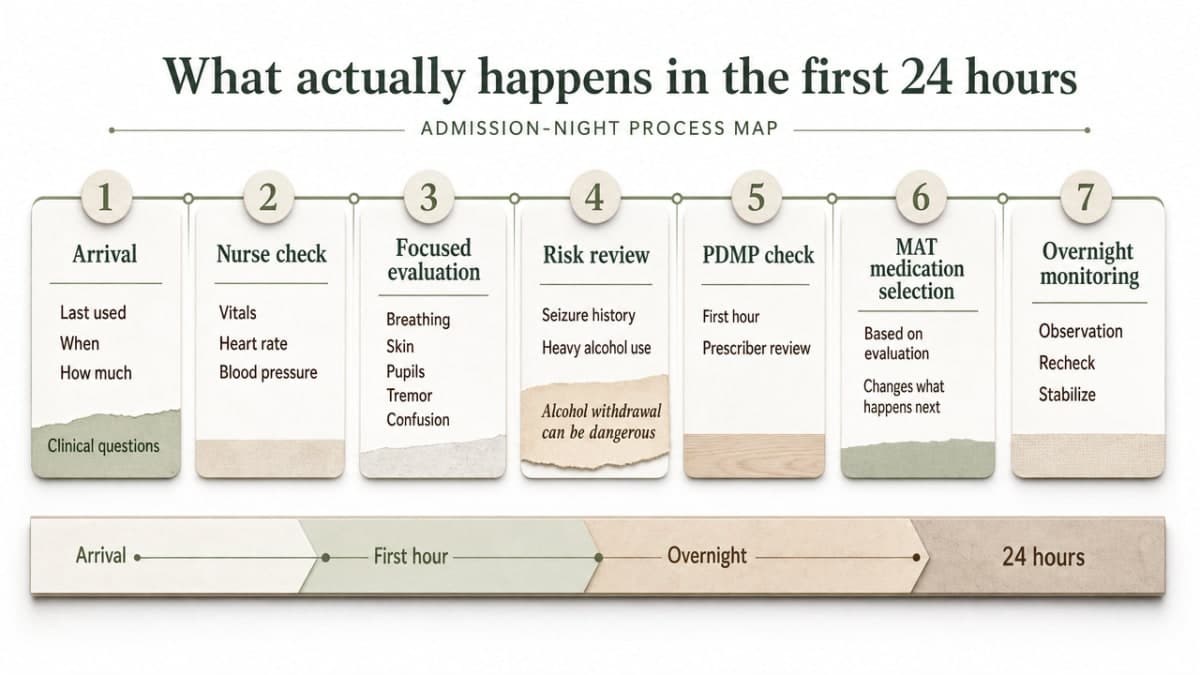
You walk in. Maybe someone drives you. Maybe you drove yourself and you are not sure how. The first thing that happens is not paperwork in any meaningful sense — it is a person asking you what you last used, when, and how much. Be honest. This is not a moral test. It is a clinical one, and the answers change what happens next.
A nurse takes vitals. A medical provider does a focused evaluation: your heart rate, your blood pressure, your breathing, your skin, your pupils, whether you are tremoring, whether you are confused, whether you have a history of seizures. If you have used alcohol heavily for years, that last question matters a lot — alcohol withdrawal can kill you in a way opioid withdrawal usually does not. The team is looking for that.
Somewhere in the first hour, the prescriber pulls up the Arkansas Prescription Drug Monitoring Program. Every controlled-substance prescription filled in an Arkansas pharmacy, mail-order pharmacy delivering into Arkansas, or clinic dispensary lands in this database 5. The rule requiring prescribers to use it has been in effect since December 28, 2023 4. It is not a trap. It tells the prescriber what is already in your system on paper — the benzodiazepine your primary care doctor put you on two years ago, the hydrocodone from an old surgery, anything that could interact with what they are about to give you.
Then, if MAT is indicated, they start it. There is no fax to your insurance company. No 48-hour wait. Arkansas Act 964 removed prior authorization for buprenorphine, methadone, and naltrexone 3. That was the whole point of the law.
Starting MAT: buprenorphine, methadone, naltrexone, and naloxone
You are probably not going to be handed a menu. The prescriber picks based on what you used, how long you used it, how you are metabolizing it right now, and what other health issues are on the table. Here is what those four names actually mean for you.
- Buprenorphine
- (often as Suboxone film or sublingual tablets) is the workhorse for opioid withdrawal in residential detox. It occupies the same brain receptors as the opioids your body is screaming for, without the full high, and it takes the edge off the sickness fast. Arkansas Medicaid covers it without prior authorization when prescribed as part of a MAT plan 11.
- Methadone
- is a longer-acting option, and in Arkansas it can only be dispensed for opioid use disorder through a licensed Opioid Treatment Program that meets federal 42 C.F.R. Part 8 standards 1. In a residential detox setting, buprenorphine is more common; methadone shows up when the clinical picture calls for it and the program is set up to deliver it.
- Naltrexone
- is different. It blocks opioid receptors instead of activating them, and it is also used for alcohol use disorder. You cannot start it while opioids are still active in your body — you have to be past acute withdrawal first. For some men, especially those detoxing off alcohol, this is the medication that shows up on day three or four.
- Naloxone
- is the reversal medication. If your breathing slows dangerously, this is what a nurse pushes. You will not be prescribed it as a daily dose; it is the seatbelt in the room.
None of these are being handed out based on a hunch. Arkansas Medicaid requires that MAT follow SAMHSA guidelines — medications used alongside counseling and behavioral therapy, not in place of it 9. The prescriber’s job is to match the medication to your body tonight, and adjust it tomorrow.
The overnight hours: what monitoring looks like
Night one is usually the hardest. Your body is still shedding the substance, the first dose of MAT is settling in, and the anxiety of being somewhere unfamiliar makes everything louder. You will not sleep well. That is expected. It is also survivable, and it is watched.
Nursing staff check on you on a schedule — vitals, symptom scales, a quick look at how your skin feels, whether you are keeping fluids down, whether the tremor is easing or worsening. If you are on a licensed program that meets Arkansas’s opioid treatment or residential standards, that staffing pattern is not optional; it is built into the license 12.
Modern residential programs often add continuous physiologic monitoring on top of the nurse rounds. A wearable can track heart rate, sleep patterns, and stress indicators in real time, so that when your pulse spikes at 3 a.m. someone knows before you have to press a call button. That data does not replace the nurse — it gives the nurse a clearer signal.
What you should feel by morning is not “fine.” You should feel less sick than you were at intake. If withdrawal symptoms are escalating instead of easing, the team adjusts the dose, adds an adjunct medication for nausea or sleep, or changes the plan. That is normal. Detox is not a fixed recipe. It is a series of small corrections, and each one is a small win — even if you cannot feel it yet.
Why the intervention window matters right now
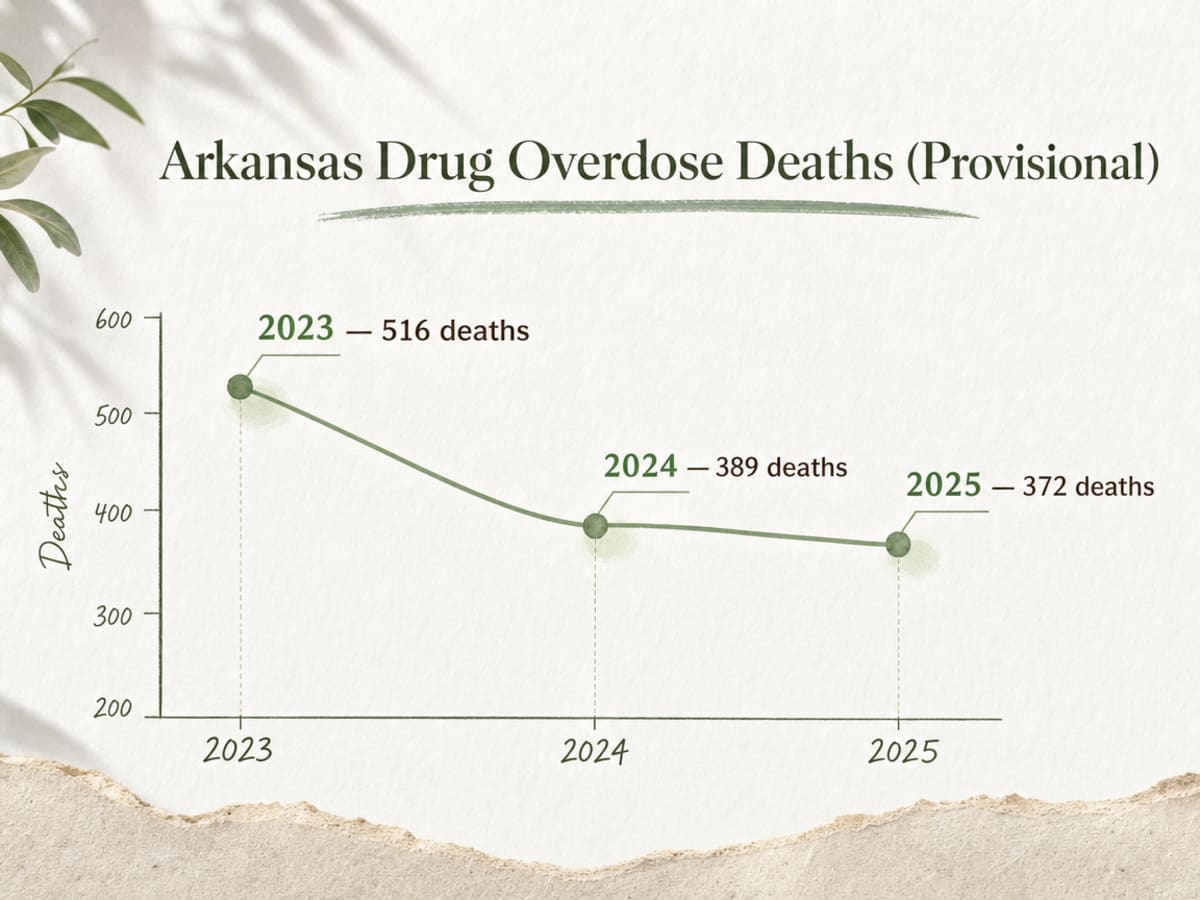
Here is a number worth sitting with for a moment. Arkansas recorded 516 provisional drug overdose deaths in 2023. That dropped to 389 in 2024 and 372 in 2025 2. The line is bending. Naloxone is more available. MAT is easier to start. Prescribers are checking the PDMP before they hand out anything that could pile onto an already dangerous mix. Something is working.
None of that changes what your body is doing tonight. A statewide trend is not a personal guarantee. Overdose is not the only outcome on the table either — a bad alcohol withdrawal at home can put you in a hospital, or worse, before anyone knows to call for help. The reason the window matters is that the machinery designed to catch you exists right now, in this state, without the delays that used to sit between a man in crisis and a first dose.
Who is actually watching your medication
The team behind a single dose decision
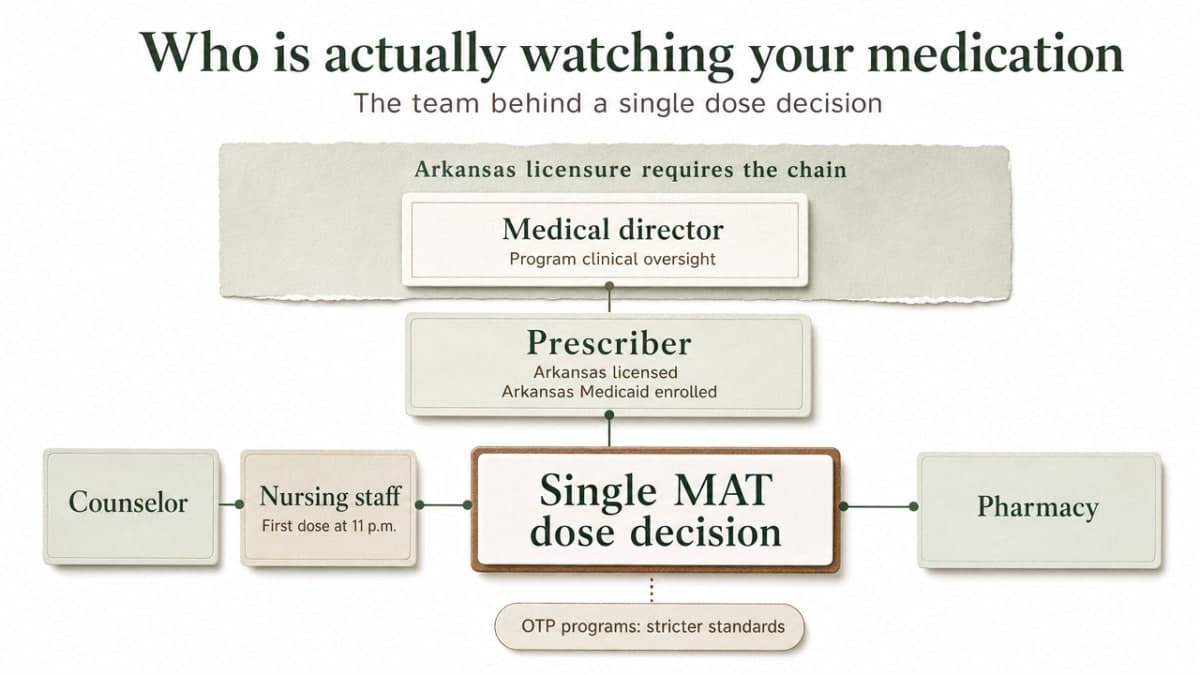
The word “prescriber” makes it sound like one person. It is not. When a nurse pushes a first dose of buprenorphine into your hand at 11 p.m., a small chain of people has already signed off on that moment, and each one of them exists because Arkansas requires them to.
Start with the prescriber. Any provider of MAT for opioid or alcohol use disorder in Arkansas has to be licensed in the state and enrolled with Arkansas Medicaid 8. That is not a rubber stamp — enrollment ties them to specific clinical rules and audits. Behind the prescriber sits a medical director who is responsible for the program’s overall clinical decisions, and if the program is a licensed Opioid Treatment Program, it has to meet a separate, stricter set of standards on top of the general licensure rules that cover every alcohol and drug treatment program in the state 12.
Then there is the counselor. This part often gets skipped in explanations, and it matters: Arkansas Medicaid follows the SAMHSA definition of MAT, which is medication plus counseling and behavioral therapy 9. A program that hands you Suboxone and sends you back to your room is not doing MAT. It is doing something else. The counselor is not decoration — the medication is only half of what the state is paying for.
Nursing staff run the 24-hour rotation. Pharmacy verifies. And on a night when your blood pressure keeps climbing, all of those roles talk to each other about whether the next dose changes. You will probably only see two or three faces. The rest of the team is working in the chart.
That is a lot of hands on one small decision. It is supposed to be. A man in acute withdrawal is not a routine prescription — the licensure rules exist precisely because a single tired provider making calls alone in the middle of the night is how mistakes happen 12.
What the prescriber is legally required to check
Before that first dose reaches your hand, the prescriber has a short list of things they are not allowed to skip. This is not bedside manner. It is rule-book work, and it is on your side.
The Prescription Drug Monitoring Program query is the big one. Under the Arkansas PDMP rule in effect since December 28, 2023, prescribers are expected to check the statewide database before writing controlled-substance prescriptions 4. That query pulls every controlled prescription you have filled at an Arkansas pharmacy, a mail-order pharmacy shipping into Arkansas, or a dispensing clinic 5. If you have been getting benzodiazepines from one clinic and opioids from another, it shows up. That is not so anyone can lecture you. It is so no one starts a MAT medication on top of a hidden interaction that could stop your breathing.
The prescriber also has to confirm that what they are giving you falls inside Arkansas Medicaid’s MAT framework — SAMHSA-aligned medication paired with counseling, delivered by a licensed and enrolled provider 8, 9. And they have to document a valid prescription and clinical rationale in your chart, because that documentation is what makes the no-prior-authorization coverage rule actually work at the pharmacy counter 1.
None of this slows down the moment when you finally get relief. It happens in the background while a nurse is taking your vitals.
How coverage works in Arkansas without prior authorization
Medicaid, Act 964, and the phrase you should know
The phrase to hold onto is this: a valid prescription and SAMHSA-aligned compliance. That is what Arkansas Medicaid asks for to cover the main MAT medications. Not a pre-approval form. Not a call center. A valid prescription from a Medicaid-enrolled provider, and a treatment plan that follows the federal MAT guidelines. That is the whole gate 11.
Act 964 of 2019 is the law that made this real. Arkansas was the first state to require both commercial insurers and Arkansas Medicaid to remove prior authorization for FDA-approved MAT medications — buprenorphine, methadone, and naltrexone 3. The Department of Human Services memo implementing it named Suboxone film and buprenorphine sublingual tablets specifically, effective January 1, 2020 10. The CMS state plan amendment locking it in went further: Arkansas Medicaid“may not require prior authorization… nor impose other requirements other than a valid prescription and compliance with MAT guidelines”from SAMHSA for the key opioid use disorder medications 11.
What does that mean for you at 11 p.m. tonight? It means the prescriber does not have to stop and wait for an insurance clerk to say yes before your first dose. It means the preferred oral MAT drugs do not count against Medicaid’s monthly prescription limit when they are prescribed as part of a MAT plan 11. It means one of the classic reasons men in Arkansas used to give up before they started — “my insurance won’t cover it fast enough” — is not a reason anymore.
The 2026 update to the state plan (SPA AR-25-0015, effective October 1, 2025) keeps that structure in place and confirms current coverage of naltrexone, buprenorphine, and methadone 1. MAT is available to all qualifying Medicaid beneficiaries in Arkansas 14. If someone tells you otherwise at the door, that is the sentence to repeat back.
Residential detox coverage under the 2025 Section 1115 demonstration
Coverage for the medication is one thing. Coverage for the bed you are lying in while you take it is another. That second piece got substantially stronger in July 2025.
CMS approved Arkansas’s Section 1115 SUD/SMI demonstration on July 22, 2025, and the benefit package it authorizes is specific. It covers “OUD/SUD treatment services across a comprehensive continuum of care,” including MAT, intensive care in residential and inpatient settings, and medically supervised withdrawal management 15. In plain terms: federal Medicaid dollars now match state spending on residential detox in Arkansas, not just outpatient MAT visits.
That matters because withdrawal is not a doctor’s office event. If you have been drinking heavily every day for years, or using opioids at a level that has your heart racing right now, the safe place to be is somewhere with a nurse on shift and a prescriber on call. Before the demonstration was expanded, that kind of stay was often out of reach for Medicaid beneficiaries. Now the coverage is designed to include it 15.
The demonstration is honest about the limits. Arkansas still has gaps in provider capacity at higher levels of SUD care 15. Not every bed in the state is available every night. But the coverage is there. When you call a program, the right question is not “will insurance pay” — it is “do you have a bed tonight.”
The first week, week two, and what discharge planning looks like
By day three or four, the worst of the physical storm is usually behind you. Your sleep is still bad. Your appetite is coming back in strange bursts. Your dose of buprenorphine or naltrexone is being fine-tuned, not started fresh. This is where medication management stops being about crisis and starts being about steadiness.
In the first week, the prescriber is watching for a stable dose that keeps cravings and withdrawal quiet without over-sedating you. Vitals get taken less often. Counseling sessions start showing up on your schedule, because Arkansas Medicaid requires that MAT include counseling and behavioral therapy alongside the medication — it is not a stand-alone prescription 9. If you have a co-occurring anxiety or depression picture, psychiatric evaluation gets folded in during this stretch.
Week two is when discharge planning gets serious. A licensed program in Arkansas is expected to plan for what comes after residential care, not just what happens inside it 12. That means a real handoff: a Medicaid-enrolled outpatient MAT prescriber to continue your buprenorphine or naltrexone, a counseling schedule that does not have a two-week gap, and a plan for where you sleep the night you walk out. The 2025 Section 1115 demonstration covers this continuum of care by design — residential, outpatient MAT, and the transitions between them 15.
Ask about the handoff before you agree to admit. A good program already has answers.
What to ask before you say yes to a program tonight
If you can, before the door closes behind you, ask a few questions. If you cannot, have whoever is with you ask them. None of these are hostile. A good program answers them without flinching.
Who is the prescriber, and are they enrolled with Arkansas Medicaid? That enrollment ties them to specific clinical standards, not just a license on a wall 8.
Is there a nurse on-site through the night? Licensed programs are built around 24-hour staffing patterns for a reason 12. If the answer gets vague, that is a signal.
Which MAT medications do you use, and how quickly can the first dose start? In Arkansas, there is no prior authorization standing between you and buprenorphine, methadone, or naltrexone when a valid prescription is in place 1, 3. If someone tells you they need to wait on insurance, that is not how this state works.
Will you check the PDMP? The right answer is yes, tonight, before anything controlled is given 4.
What does discharge look like? Ask who your outpatient prescriber will be and when the first appointment is booked. The continuum is what the 2025 demonstration was built to fund 15. A program that cannot answer that question yet has more work to do before you trust the handoff.
One next step, tonight
You do not have to figure out the whole road. You have to make one call. Pick up the phone, tell whoever answers what you used last and when, and let them do the rest. In Arkansas, the machinery on the other end of that call is built to move fast — no prior authorization to clear, a PDMP check the prescriber can run in minutes, and Medicaid coverage that extends to the residential bed, not just the medication 1, 15. That is one call. You already did the harder thing by reading this far.
Frequently Asked Questions
Do I need prior authorization from my insurance before starting MAT in Arkansas?
No. Under Act 964, Arkansas Medicaid and commercial insurers cannot require prior authorization for buprenorphine, methadone, or naltrexone when there is a valid prescription and the treatment plan follows SAMHSA guidelines 3, 11. That means the prescriber can start your first dose tonight without waiting on an insurance clerk to say yes.
Which medications are typically used during detox in Little Rock?
Buprenorphine (often Suboxone film or sublingual tablets) is the most common medication for opioid withdrawal in residential detox. Methadone is used through licensed Opioid Treatment Programs when the clinical picture calls for it 1. Naltrexone is often started later, especially for alcohol use disorder. Naloxone stays on hand as the reversal medication. The prescriber matches the choice to your body.
Will the prescriber check my prescription history before giving me anything?
Yes. Under the Arkansas PDMP rule effective December 28, 2023, prescribers query the statewide database before writing controlled-substance prescriptions 4. The database shows every controlled prescription filled at Arkansas pharmacies, mail-order pharmacies shipping into Arkansas, and dispensing clinics 5. That check is not a judgment on you. It protects you from a hidden drug interaction on top of your first MAT dose.
Does Arkansas Medicaid cover residential detox, not just outpatient MAT?
Yes, as of the July 2025 Section 1115 demonstration approval. CMS authorized federal matching funds for a full continuum of SUD care in Arkansas, including MAT, intensive care in residential and inpatient settings, and medically supervised withdrawal management 15. The bed you are lying in during detox is covered, not only the medication in your hand. Ask a program to confirm current Medicaid enrollment.
Who is actually monitoring me overnight during withdrawal?
Nursing staff on a 24-hour rotation, backed by a prescriber on call and a medical director. Arkansas licensure standards build that staffing pattern into the license itself for alcohol and drug treatment programs, with additional requirements for Opioid Treatment Programs 12. You will see a nurse checking vitals through the night. If your numbers move the wrong way, the prescriber is reached and the plan changes.
What should I ask a program before I agree to admit tonight?
Four questions cover most of it. Is the prescriber enrolled with Arkansas Medicaid 8? Is a nurse on-site overnight 12? How soon can the first MAT dose start, given there is no prior authorization to wait on 1? And who is your outpatient prescriber after discharge, since the Section 1115 demonstration was built to fund that handoff 15? Clear answers mean a real program.
References
- Arkansas State Plan Amendment (SPA) AR-25-0015. https://www.medicaid.gov/medicaid/spa/downloads/AR-25-0015.pdf
- Substance Misuse Education and Prevention. https://healthy.arkansas.gov/programs-services/prevention-healthy-living/substance-misuse-education-and-prevention/
- Arkansas sets standard for states by removing prior authorization. https://www.ama-assn.org/press-center/ama-press-releases/arkansas-sets-standard-states-removing-prior-authorization
- RULES PERTAINING TO ARKANSAS PRESCRIPTION DRUG MONITORING PROGRAM. https://healthy.arkansas.gov/wp-content/uploads/PDMP_Rule.pdf
- Arkansas Prescription Drug Monitoring Program. https://healthy.arkansas.gov/programs-services/prevention-healthy-living/substance-misuse-injury-prevention/prescription-drug-monitoring-program/
- Arkansas State Plan Amendment (SPA) AR-23-0017. https://www.medicaid.gov/medicaid/spa/downloads/AR-23-0017.pdf
- Drug Overdose Deaths in the United States, 2023–2024. https://www.cdc.gov/nchs/products/databriefs/db549.htm
- PHYSICN-1-23 Provider Manual Update. https://humanservices.arkansas.gov/wp-content/uploads/PHYSICN-1-23up.doc
- Medication-Assisted Treatment Packet. https://humanservices.arkansas.gov/wp-content/uploads/Medication-Assisted-Treatment-Packet-for-Posting.pdf
- MAT memorandum – Arkansas Department of Human Services. https://humanservices.arkansas.gov/wp-content/uploads/MATmemo.doc
- Arkansas State Plan Amendment 20-0013 Approval Package. https://www.medicaid.gov/medicaid/spa/downloads/AR-20-0013.pdf
- Licensure Standards for Alcohol and Other Drug Abuse Treatment Programs. https://humanservices.arkansas.gov/wp-content/uploads/Licensure_Standards_for_Alcohol_and_Other_Drug_Abuse_Treatment_Programs.pdf
- 016.06.21 Ark. Code R. § 008 – State Plan Amendment 2021-0003 – Medication Assisted Treatment. https://www.law.cornell.edu/regulations/arkansas/016-06-21-Ark-Code-R-SS-008
- SECTION II – COUNSELING AND CRISIS SERVICES (Arkansas Medicaid Manual). https://codeofarrules.arkansas.gov/Rules/PartDocument?partID=1354
- Arkansas Section 1115 Demonstration Approval: Opioid Use Disorder / Substance Use Disorder / Serious Mental Illness. https://www.medicaid.gov/medicaid/section-1115-demonstrations/downloads/ar-opps-sud-smi-appvl-07222025.pdf