
Key Takeaways
- Arkansas licenses detox and residential SUD treatment separately under DHS, but one facility can legally hold both licenses and operate them as a single continuous episode of care 1, 2.
- The gap between detox discharge and residential admission is where most dropouts happen—SAMHSA flags every between-level transition as a high-risk moment, and outpatient-only handoffs correlate with significantly higher against-medical-advice departures 7, 8.
- In Arkansas, geography and a 78.5-per-100 opioid dispensing rate make co-located care especially consequential, since a second facility often means a long drive home during the most fragile days 4.
- Before choosing a program, confirm one legal entity holds both licenses at one address, one intake and insurance verification cover the full stay, and the same clinical team carries through from detox into residential 1, 2.
The Handoff Is Where Recovery Breaks
You already know withdrawal is dangerous. What most people do not tell you is that the moment right after withdrawal—when detox ends and the next phase of care is supposed to begin—is often where the whole thing falls apart. Not because you gave up. Because the system asked you to start over.
In a traditional path, you finish detox at one facility, get discharged, and are expected to admit yourself somewhere else for residential treatment. New building. New intake paperwork. A second insurance verification. A different nurse who has never seen your chart. Sometimes a gap of days between the two, spent at home, still fragile, with the substance you just came off of still within reach.
That gap is not a small logistical inconvenience. SAMHSA’s own protocol identifies transitions between levels of care as a high dropout risk moment, one that requires deliberate planning to survive 7. The chart-review evidence on inpatient opioid detox is more direct: patients whose only post-detox plan was outpatient care were significantly more likely to leave against medical advice than those transitioning into residential 8.
If you are researching Arkansas options for yourself or for someone you love, this is the part worth understanding before you compare amenities or price. The handoff is the fracture point. The rest of this guide is about how to avoid standing on it.
What Arkansas Actually Requires of Detox and Residential Programs
Before you compare any two facilities, it helps to know what the state itself demands. Arkansas does not leave detox and residential treatment loosely defined. The Department of Human Services writes both into licensure, and the rules are specific enough that you can use them as a checklist when you are on the phone with an admissions coordinator.
Start with detox. Under Arkansas licensure standards, medically supervised detoxification requires 24-hour nursing coverage, vital-sign monitoring at least once every six hours, and a minimum stay of 72 hours 1. That 72-hour floor exists for a reason. Alcohol and benzodiazepine withdrawal in particular can turn dangerous well past the first 24 hours, and the state’s rule reflects what national withdrawal-management guidelines already say about the window when seizures and delirium are most likely 5. If a program tells you a man can be “detoxed” in a day and a half, that program is not describing medically supervised detox as Arkansas defines it.
Residential treatment is a separate license. Arkansas defines a residential SUD program as a 24-hour, seven-day-a-week live-in facility that provides intake, individual and group therapy, case management, and room and board 1. The clinical intensity requirement is where the state gets specific: every licensed adult residential SUD program in Arkansas must deliver at least 28 hours of structured treatment per week 2. Not 28 hours of “programming.” Twenty-eight hours of structured clinical work—therapy, groups, case management contact—every week you are there.
Both licenses fall under the same regulatory umbrella. The DHS Office of Alcohol and Drug Abuse Prevention regulates all adult residential SUD treatment facilities in the state, and the Division of Behavioral Health Services funds the broader continuum: detoxification, residential treatment, outpatient care, and specialized services 2, 3. That matters for you because it means a single Arkansas facility can legally hold both licenses and operate detox and residential as one continuous episode of care under one regulator, one clinical record, one team.
When you are vetting a program, ask two direct questions. Is the detox medically supervised under Arkansas DHS licensure, with 24-hour nursing and the 72-hour minimum? And is the residential license held by the same entity in the same building, so that day four does not require a discharge and a new admission somewhere else? If both answers are yes, you are looking at a continuum the state has already built rules around. If either answer is no, you are looking at two programs pretending to be one.
Why the Detox-to-Residential Gap Is a Dropout Event, Not a Paperwork Event
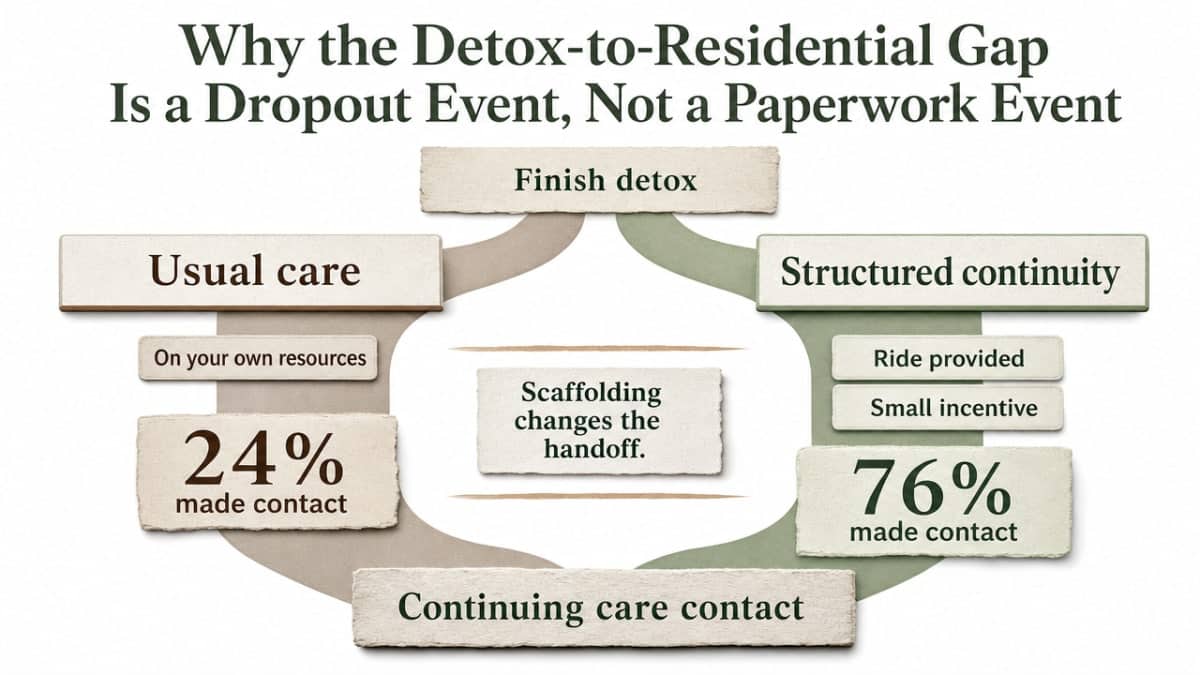
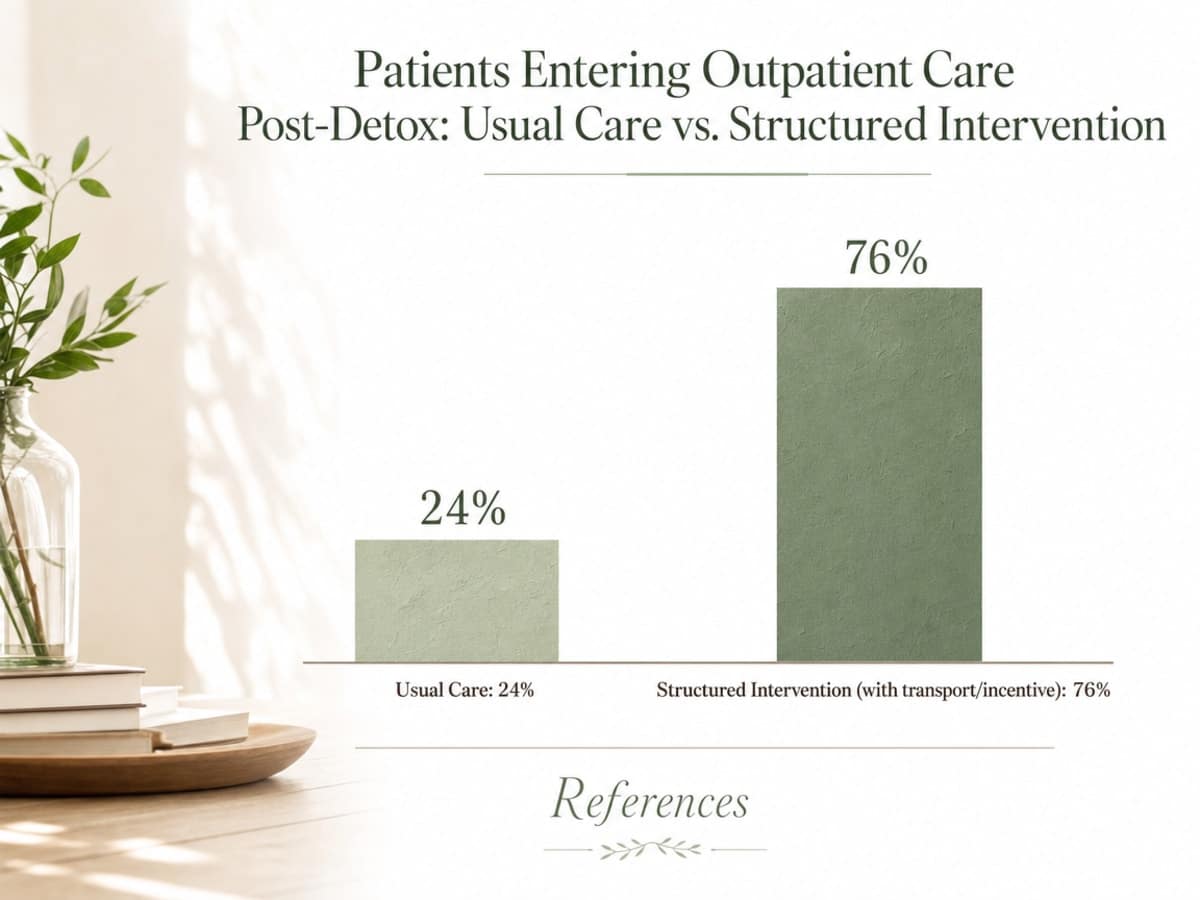
Here is the part that surprises most families when they finally see the numbers. In one study of patients who finished short-term medically assisted detox, only 24% under usual care actually made contact with the outpatient continuing care program they were referred to. When those same patients were offered a ride to the appointment and a small incentive, that number jumped to 76% 9. The difference was whether the transition had scaffolding around it or not.
The study looked specifically at short-term detox patients moving into outpatient follow-up. While the exact percentages may not translate directly to every detox-to-residential handoff in Arkansas, the underlying finding does: when you leave the transition to the patient’s own resources—his phone, his car, his ability to place a call at 8 a.m. on day four of feeling terrible—most of them do not make it across the gap.
SAMHSA’s clinical guidance says the same thing in plainer language. Any move between levels of care is a high dropout risk moment, and clinicians are expected to build a specific transition plan rather than assume the patient will find his way to the next program 7. TIP 45 goes further and recommends introducing the client to the counselor who will handle the next phase while detox is still happening, and cutting the time between initial call and appointment to as close to zero as possible 6.
This is why the handoff is not a paperwork event. Paperwork is what you notice. The dropout is what happens while you are doing the paperwork.
The Second Intake Problem: What a Fragmented Path Costs a Working Professional
If you run a practice, a firm, or a job site, you already know what a second intake really costs. It is not just an inconvenience. It is a second window where the wheels can come off.
Picture the standalone-detox path. Day one, you check into a detox unit. You hand over your ID, your insurance card, your medication list, and a version of your history you have probably never said out loud to a stranger before. A nurse takes your vitals every six hours for the next 72, which is what Arkansas licensure requires of medically supervised detox 1. By day three or four, you are stabilized, and you are also done. The unit discharges you.
Now the second intake begins. New facility. New admissions coordinator. A second insurance verification, which can take hours or days depending on the payer and the day of the week. A new clinician who has not read your chart taking your history again—the drinking, the relapses, the reason you finally called. A new treatment plan built from scratch by people who did not watch you sweat through night two.
For a working professional, each of those steps is also a career exposure. A second admissions call routed through a workplace phone. A second EAP conversation. A second gap on the calendar that has to be explained to a partner, a chief of staff, or a foreman. The federal privacy protections around SUD records are strong, but every additional touchpoint is another human being who has to be trusted to handle the file correctly.
Then there is the gap itself. Even when the two facilities coordinate well, there is often a day, sometimes several, between detox discharge and residential admission. You go home. Or to a hotel. The alcohol is still in the cabinet. The dealer’s number is still in the phone. This is the exact window SAMHSA describes as high dropout risk, and it is the window the buprenorphine detox chart review flagged: patients whose only post-detox plan was outpatient—meaning they went home before the next level of care—were significantly more likely to leave against medical advice than those transitioning directly into residential 7, 8.
The cost of a fragmented path is not measured in intake forms. It is measured in the number of moments where a competent, motivated man is asked to relaunch his own recovery from a standing start, while still fragile, with the substance still available. That is what you are actually paying for when you accept a two-facility model.
One Facility vs. Two: A Practical Comparison
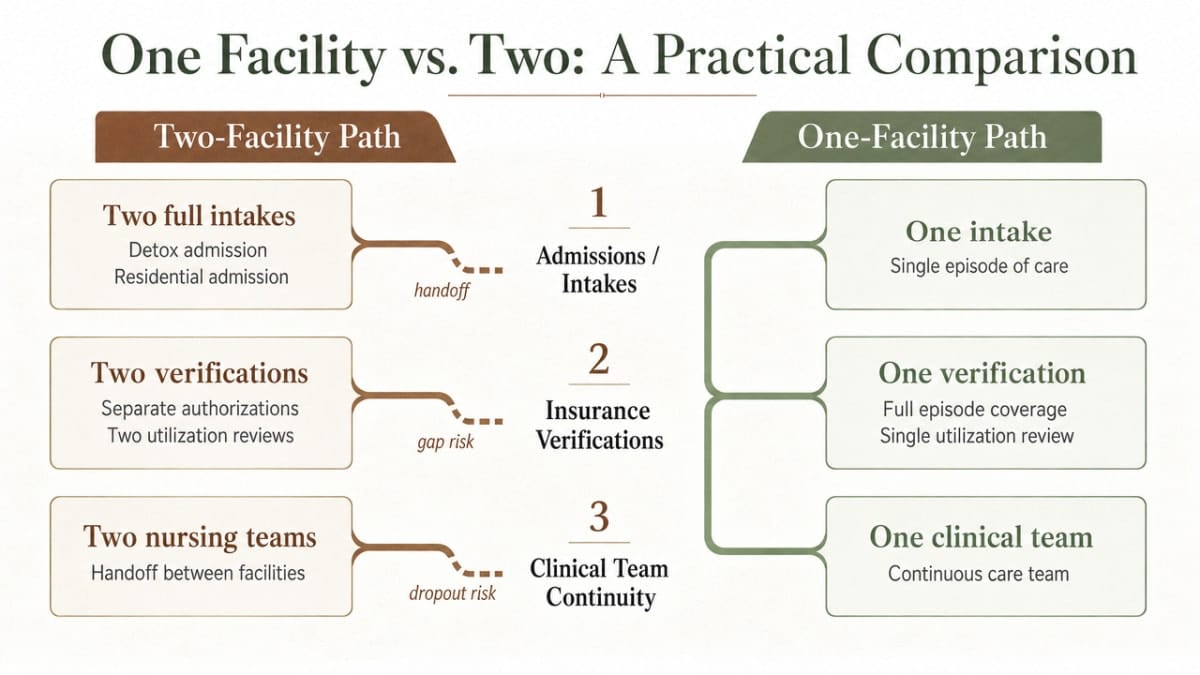
Set the marketing language aside for a minute and look at the two paths as an operations question. What is actually different about doing this in one building versus two? Here is the honest side-by-side, using variables the state itself already regulates and the transition risks SAMHSA already names.
| Variable | Two-Facility Path | One-Facility Path |
|---|---|---|
| Number of admissions intakes | Two. A full intake at the detox facility, then a second full intake at the residential facility on a different day. | One. Intake occurs once at admission; residential is a continuation of the same episode of care. |
| Insurance verifications | Two separate verifications, often with two different payer authorizations and two utilization-review conversations. | One verification covering the full episode, with a single utilization-review relationship. |
| Clinical team continuity | Two nursing teams, two counselors, two treatment plans. The residential clinicians did not observe the 72-hour supervised withdrawal window Arkansas requires 1. | The same nurses, counselors, and case manager carry forward from the detox stay into the 28-hour-per-week structured residential program 1, 2. |
| Gap days between levels of care | Anywhere from hours to several days, often spent at home while awaiting a bed. The substance and the environment that led to use are both accessible. | None. The move is from one wing to another on the same day detox medical criteria are met. |
| Documented dropout-risk transitions | Two: the discharge from detox and the re-admission to residential. SAMHSA names each between-level transition as a high dropout risk moment 7. | One continuous stay. The between-level transition is absorbed inside the same facility, same chart, same team. |
Read the right-hand column not as a sales pitch but as an operational description. Every row is something Arkansas licensure or SAMHSA guidance already treats as significant. The one-facility path does not add features. It removes friction the state has already flagged.
The point is not that one path is easy. Detox and residential treatment are hard work in either building. The point is that the two-facility path builds in avoidable failure points, and the one-facility path does not.
Why Most Men Never Reach Sustained Treatment
Here is the sobering pattern national data keeps showing. Getting into treatment once is hard. Staying in it long enough for it to work is harder. And most men who need care never make it to the second part.
One study using HEDIS quality measures tracked over 15,000 patients with a documented substance use disorder diagnosis. Only 30.0% initiated any treatment within 14 days of that diagnosis. Of those who did, just 6.9% went on to engage—meaning two or more additional treatment contacts within 30 days of the first. Overall, only 2.1% of the patients cleared both bars 11. The cohort in that study was cannabis use disorder patients inside a large health system, so the exact figures are not a forecast for alcohol or opioid patients in Arkansas. But the shape of the drop-off is consistent with what HHS reports across the SUD population: initiation is thin, and engagement after initiation is thinner 10.
What that pattern tells you is important. When you or someone you love finally makes the call, you are already inside a very narrow group. The question is no longer whether treatment exists. The question is whether the path from that first call through detox, into residential, and into sustained follow-up has enough continuity that you do not become one of the men who initiated and then quietly disappeared.
Every added handoff—every second intake, every gap night at home, every new clinician who has to start over—is a place the engagement number goes down. A single-facility path does not guarantee you finish. It just removes the exits the system built into the standard route.
The Arkansas Context: Why This Decision Lands Harder Here
If you were sitting in Boston or Denver, you might have a dozen combined detox-and-residential facilities within an hour’s drive. Arkansas is not that state. The geography itself changes the calculus of a two-facility path.
Start with the map. If you live in Fayetteville, Jonesboro, El Dorado, or Texarkana, the nearest licensed men’s residential program is already a drive. Now imagine that drive twice—once to a detox unit, then, days later, a second drive to a separate residential campus. Or worse, a discharge home in between, with hours on the road ahead of you while you are still shaky and the bottle is still in the console.
Then there is the demand side. Arkansas had an opioid dispensing rate of 78.5 prescriptions per 100 people in 2023, and 32 counties recorded rates above 100—meaning more than one opioid prescription per resident that year 4. That is context, not diagnosis. But it tells you the treatment need across the state is real, and the men calling for help are not concentrated in one zip code.
Arkansas’s Division of Behavioral Health Services funds the continuum—detox, residential, outpatient—through contracted providers statewide 3. What the state funds and what your county has within reach are two different things. That is why co-location is not a luxury here. It is often the only version of continuity that actually works.
How Serenity Park Is Built Around the Missing Transition
Serenity Park Recovery Center sits in Little Rock as a men’s residential facility licensed to hold both the detox and residential pieces under one roof. That structural choice is the point. When you arrive for medically supervised withdrawal, you are already in the building where you will stay for the weeks that follow. The nurse who documents your first set of vitals is on the same team as the counselor you will meet in week two. Your chart does not get faxed anywhere. It does not get faxed at all.
The capacity matters too. Twenty beds is small on purpose. In a 200-bed hospital wing, continuity is a policy people try to enforce. In a 20-bed men’s facility, continuity is just what happens because the same clinical team sees the same men every shift. TIP 45 recommends introducing the client to his rehabilitation counselor while detox is still underway and cutting the time between initial call and next appointment as close to zero as possible 6. At this scale, both happen without a coordination meeting.
The wearable monitoring through Huml Health belongs in that same category—a clinical continuity tool, not an amenity. Heart rate, sleep, and stress data collected during the 72-hour supervised withdrawal window Arkansas requires 1 do not reset when detox ends. The same clinicians keep watching the same signals through the 28-hour-a-week residential phase 2. That means a spike in resting heart rate on day nine gets read against day two’s baseline by someone who was there for both.
None of this is exotic. It is what SAMHSA’s guidance already describes as best practice—introduce the next counselor early, minimize the gap, keep the team stable 6, 7. Serenity Park is built so those recommendations are not aspirations. They are just how the day works.
How to Evaluate Any Arkansas Facility Claiming Combined Detox and Residential Care
Plenty of programs will tell you they offer both detox and residential treatment. Fewer of them actually operate the two as one continuous episode of care. Here is what to ask, and what a real answer sounds like.
Ask who holds the licenses. Arkansas issues separate licenses for medically supervised detox and adult residential SUD treatment, and both fall under DHS oversight 1, 2. If the same legal entity holds both licenses at the same physical address, you are looking at one program. If the “detox partner” is a different company down the road, you are looking at two.
Ask what happens on day four. The honest answer is either “he moves down the hall” or “we discharge him and re-admit him.” There is no third option. If the coordinator hesitates or describes a “warm handoff” to a separate facility, you now know the gap exists.
Ask about the clinical team. Does the same nursing staff cover both phases? Will the residential counselor meet him during detox, the way TIP 45 recommends 6? Or does a new team pick up the chart in week two?
Ask about intake and insurance. One authorization for the full episode, or two? One intake, or two? A single verification is a strong signal the facility treats this as one stay, not two.
If the answers line up, you are evaluating real continuity. If they do not, keep calling.
Fewer Transitions, Fewer Places to Fall Through
If you have read this far, you already understand the argument. Withdrawal is dangerous, but the days right after withdrawal are where most men quietly disappear from treatment. Every extra intake, every gap night at home, every new clinician meeting you for the first time is another place recovery can end.
You do not need a perfect facility. You need one that removes the exits. In Little Rock, Serenity Park is licensed to hold both detox and residential under one roof, with the same nursing team, the same counselor, and the same chart carrying through from the 72-hour supervised withdrawal window into the weeks that follow 1, 2. That is not a promise about outcomes. It is a promise about the path.
If you are the one making this call—for yourself, for a brother, for a husband—pick the option with fewer transitions. There will be fewer places to fall through.
Frequently Asked Questions
Can detox and residential treatment legally happen in the same facility in Arkansas?
Yes. Arkansas issues separate licenses for medically supervised detox and adult residential SUD treatment, and both fall under the DHS Office of Alcohol and Drug Abuse Prevention 2. A single facility can hold both licenses at the same address, which is what allows detox and residential to run as one continuous episode of care under one clinical team and one chart 1.
How long does medical detox take before residential treatment begins?
Arkansas licensure sets a minimum medically supervised detox stay of 72 hours, with vital signs monitored at least every six hours and 24-hour nursing coverage 1. The actual length depends on the substance and how your body responds. Alcohol and benzodiazepine withdrawal often runs longer than the 72-hour floor. When detox and residential live in the same building, the move to the next phase happens the day you are medically ready.
Will I have to do a second intake and insurance verification when I move from detox to residential?
At a two-facility path, yes—a second admissions process and a second payer authorization. At a single facility holding both licenses, no. One intake, one verification, one utilization-review relationship covering the full episode. That difference matters if you want fewer people touching the file and fewer calendar gaps to explain at work. Ask the coordinator directly whether the residential admission is a new admission or a continuation.
Why is the transition from detox to residential considered a high-risk moment?
SAMHSA’s clinical guidance names every move between levels of care as a high dropout risk point that requires deliberate planning 7. The chart-review evidence on inpatient opioid detox is more direct: patients whose only post-detox plan sent them home to outpatient care were significantly more likely to leave against medical advice than those transitioning into residential 8. The gap itself, not motivation, is what pulls men out of treatment.
What should I ask an Arkansas facility to confirm they truly offer combined detox and residential care?
Four questions. Does the same legal entity hold both the detox and residential licenses at the same physical address 1, 2? On day four of detox, does he move down the hall or get discharged and re-admitted? Does the residential counselor meet him during detox, as TIP 45 recommends 6? And is there one intake and one insurance authorization for the whole stay, or two? Clear answers tell you everything.
Is residential treatment after detox better than going straight to outpatient care?
For men with more severe or complex substance use disorders, higher-intensity residential care after detox is associated with better retention outcomes than outpatient alone 12. The buprenorphine detox study found that patients whose post-detox plan sent them home to outpatient treatment had significantly higher dropout rates than those moving into residential 8. Outpatient can work for milder cases, but for severe withdrawal or repeated relapses, residential first is the stronger bridge.
References
- Licensure Standards for Alcohol and Other Drug Abuse Treatment Programs. https://humanservices.arkansas.gov/wp-content/uploads/Licensure_Standards_for_Alcohol_and_Other_Drug_Abuse_Treatment_Programs.pdf
- Arkansas Summary – State Residential Treatment for Behavioral Health Conditions. https://aspe.hhs.gov/sites/default/files/2021-08/StateBHCond-Arkansas.pdf
- Behavioral Health Services – Division of Behavioral Health Services. https://www.dfa.arkansas.gov/wp-content/uploads/0710_dbhs2017.pdf
- Arkansas Prescription Drug Monitoring Program Annual Report 2023. https://healthy.arkansas.gov/wp-content/uploads/Prescription-Drug-Monitoring-Program-Annual-Report-2023.pdf
- The ASAM Clinical Practice Guideline on Alcohol Withdrawal Management. https://pubmed.ncbi.nlm.nih.gov/32511109/
- Quick Guide for Clinicians Based on TIP 45: Detoxification and Substance Abuse Treatment. https://nida.nih.gov/sites/default/files/samhsa_detoxification_and_substance_abuse_treatment.pdf
- Chapter 3. Intensive Outpatient Treatment and the Continuum of Care. https://www.ncbi.nlm.nih.gov/books/NBK64088/
- Predictors of Dropout from Inpatient Opioid Detoxification with Buprenorphine: A Chart Review. https://pmc.ncbi.nlm.nih.gov/articles/PMC4230007/
- How Care Continuity Interventions in Substance Abuse Treatment Compare to Usual Care. https://pmc.ncbi.nlm.nih.gov/articles/PMC3642211/
- Best Practices and Barriers to Engaging People with Substance Use Disorders in Treatment. https://aspe.hhs.gov/reports/best-practices-barriers-engaging-people-substance-use-disorders-treatment-0
- The Prevalence of HEDIS Initiation and Engagement in Treatment among Patients with Cannabis Use Disorder. https://pmc.ncbi.nlm.nih.gov/articles/PMC6639163/
- Summary of Evidence – Inpatient and Outpatient Treatment Programs for Substance Use Disorder. https://www.ncbi.nlm.nih.gov/books/NBK507689/