
Key Takeaways
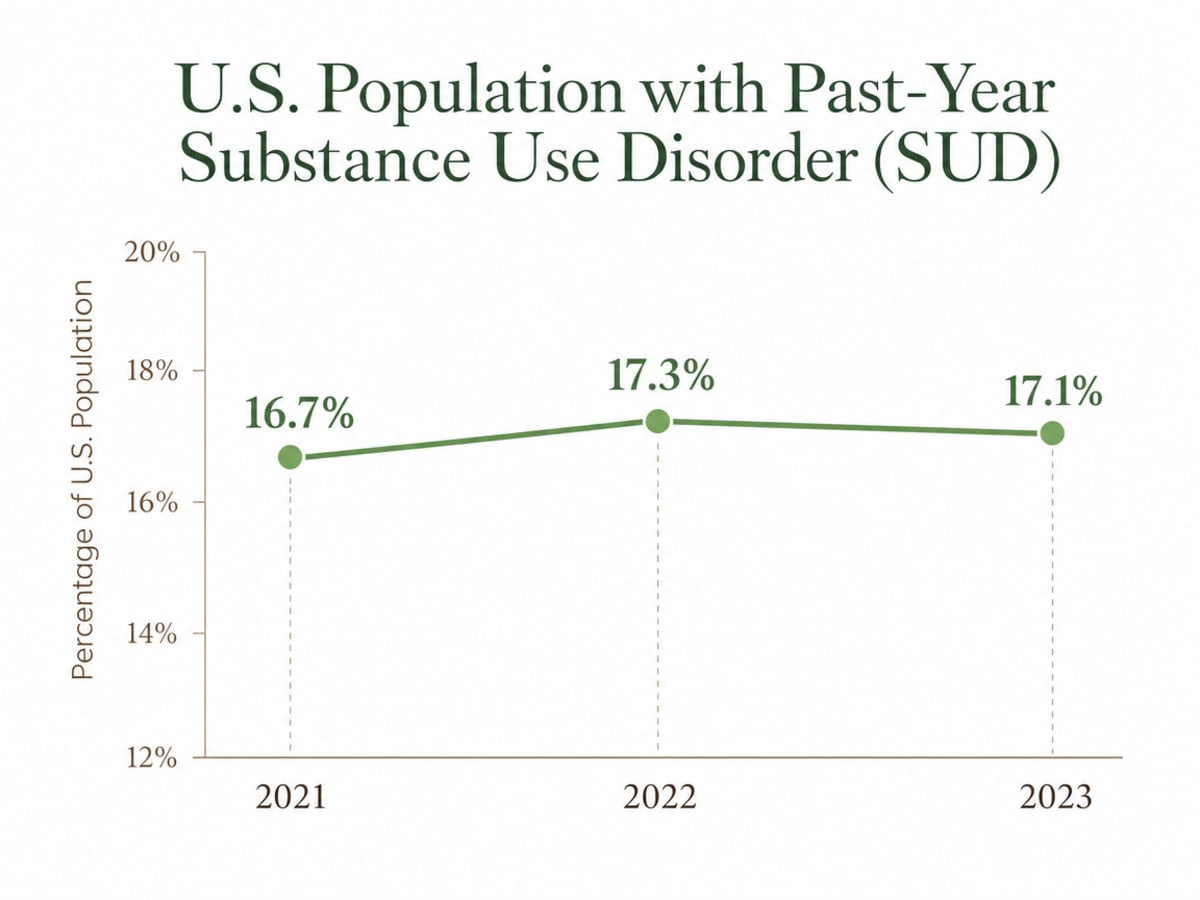
- Past-year substance use disorder has held steady near 17% of Americans since 2021, and for many men the driver underneath the drinking is untreated trauma rather than willpower 1.
- Between 20% and 50% of people entering addiction treatment carry a lifetime PTSD diagnosis, so programs that skip trauma screening at intake miss the diagnosis in a third to half of clients 15.
- Arkansas licensure already requires residential behavioral health to be co-occurring capable and trauma-informed, with trauma screening at initial assessment — the floor, not a differentiator 7, 8.
- When evaluating an Arkansas program, ask by name which trauma protocol runs concurrently with detox, whether psychiatry is in-house, and who the outpatient trauma clinician will be at discharge 6.
The 6 p.m. bourbon that became the 4 p.m. bourbon
You know the drink. It used to be a ritual — the pour after the last email, the ice cracking while you loosened your tie or peeled off work boots. Then the timeline moved. The 6 p.m. bourbon became the 5:30. Then the 4. Some weeks you’re pouring during a call, glass out of frame, telling yourself it’s fine because the work still goes out on time.
And the work does go out on time. That’s the trap. You are the partner who still hits billables, the physician who still runs the schedule, the owner who still makes payroll. Nothing has burned down. Which is exactly why nothing has changed.
Here is the part worth naming: you are not a rare case. Past-year substance use disorder in the U.S. has held between roughly 16.7% and 17.3% of the population age 12 and older from 2021 through 2023 — tens of millions of people, most of them functioning in daylight and unraveling in private 1. Prevalence isn’t drifting downward with awareness campaigns. It’s steady, because the thing underneath it is steady.
That thing, more often than the man doing the drinking realizes, is trauma. Not the word you’d use out loud. Maybe not something you’d even call trauma if a friend described it. But something older than the bourbon, and honest enough to require the bourbon earlier every year.
This guide is written for the version of you that already suspects that. What comes next is what to do about it — clinically, and in Arkansas.
Why standard rehab keeps missing what’s actually driving it
Most programs are built around the substance. Detox the alcohol out of you. Group-process the drinking. Send you home with a relapse-prevention plan and a sponsor’s number. That model works for a slice of people. For the man whose use has already outlasted two or three attempts at cutting back, it usually doesn’t — because the drinking or the pills or the stimulant were never the primary problem. They were the answer to a problem the program never asked about.
Look at the overlap the clinical literature has been documenting for a decade. Roughly 30% to 60% of people with PTSD also carry a comorbid alcohol or drug use disorder 3. Flip the lens and it stays uncomfortable: among people who show up for addiction treatment, 20% to 50% have a lifetime PTSD diagnosis, and 15% to 40% meet criteria in the last year 15. These are not fringe cases. This is the population walking through the front door of most treatment centers, and a program that isn’t screening for trauma at intake is, statistically, missing the diagnosis in something like a third to half of its clients.
The reason it gets missed is partly structural. The old sequencing logic said: get him sober first, stabilize him, then — years later, if he’s still standing — refer him out to a trauma specialist. In practice, the referral rarely happens. He relapses inside the gap. The nightmares came back, the hypervigilance came back, the 3 a.m. wakeups came back, and the fastest thing he knew how to do about any of it was the drink he already knew.
There’s also a cultural piece. Men in your bracket — the ones running firms, hospitals, sites — tend to arrive at treatment describing a discipline problem. Willpower. Bad habit. Something to be white-knuckled into submission. A program that accepts that framing at face value will treat the willpower. It will not treat the deposition you can’t stop replaying, the accident you were on scene for, the childhood house you still dream about. Those show up on a trauma screener. They rarely show up in a standard SUD intake.
The self-medication pattern, named plainly
Here is the plainest version of it. You are not drinking because you love the taste anymore. You are drinking because it is the fastest, most reliable thing you have ever found to turn the volume down.
Down on what, exactly? Depends on the man. For some it’s the deposition you’re prepping and the one from three years ago that still shows up unannounced. For some it’s the accident you were first on scene for. For some it’s a house you grew up in and haven’t described out loud to anyone, ever. The specifics differ. The mechanism is the same: something inside you is running hot, and alcohol — or the benzo, or the stimulant to get through the day and the alcohol to come back down — brings the temperature back to something you can live inside.
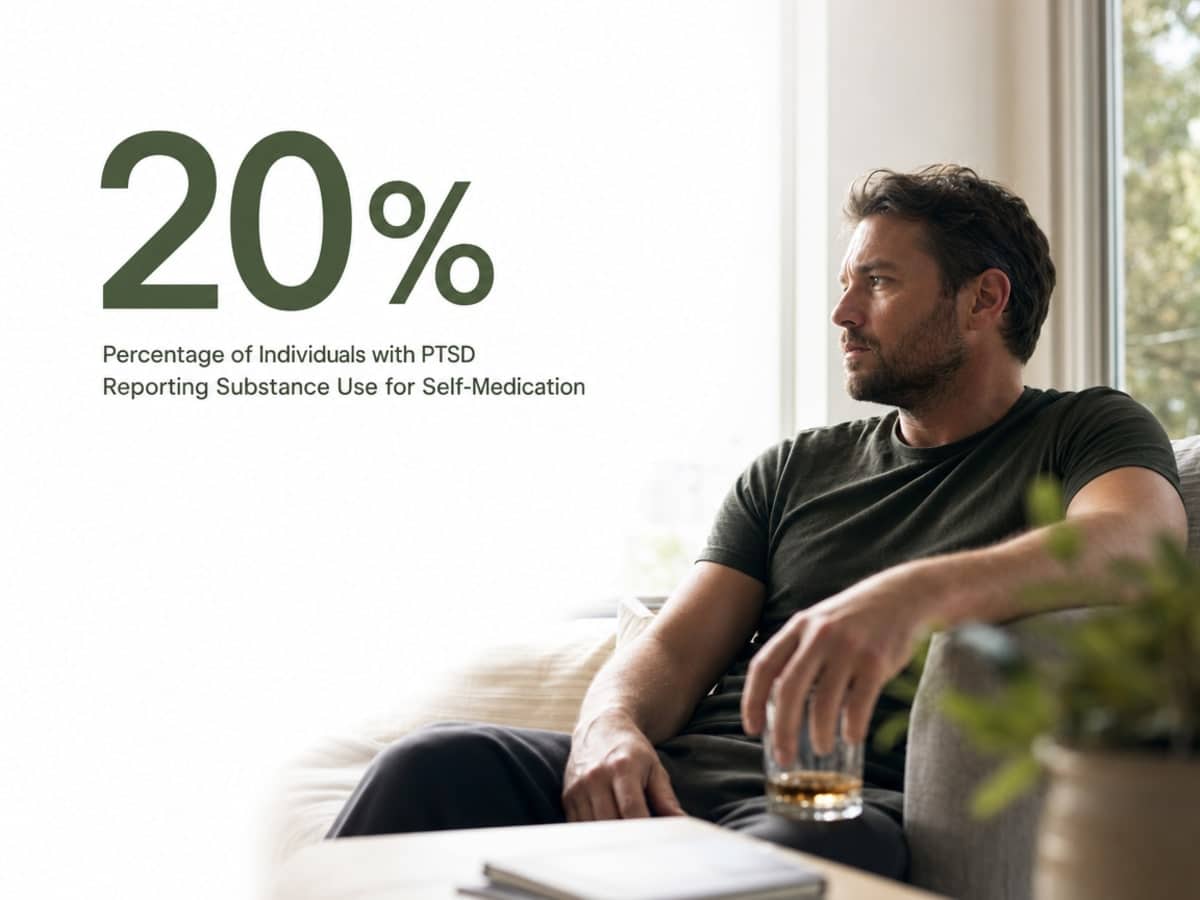
The clinical name for that mechanism is self-medication, and it is one of the most consistent findings in the trauma-and-addiction literature. Among community members with PTSD, roughly 20% report using alcohol or drugs specifically to relieve their trauma symptoms — and men are significantly more likely than women to do it 5. That study looked at ordinary adults, not a treatment sample, which is part of why it matters here. It captured the man who hasn’t called anyone yet.
For alcohol in particular, the pattern has a name and a body of evidence behind it: drinking-to-cope motives and tension-reduction expectancies drive a meaningful share of the overlap between PTSD symptoms and alcohol use disorder 4. Translated: the drink works. That is the uncomfortable truth the field has stopped pretending isn’t true. If the drink didn’t do something — didn’t shorten the runway from wired to asleep, didn’t take the edge off the replay loop — you would have quit years ago on willpower alone. It works. Just briefly, and at a cost that keeps compounding.
Naming this isn’t a diagnosis. It’s a hypothesis you can test with a clinician who knows what to ask.
What ‘trauma-focused’ actually means clinically
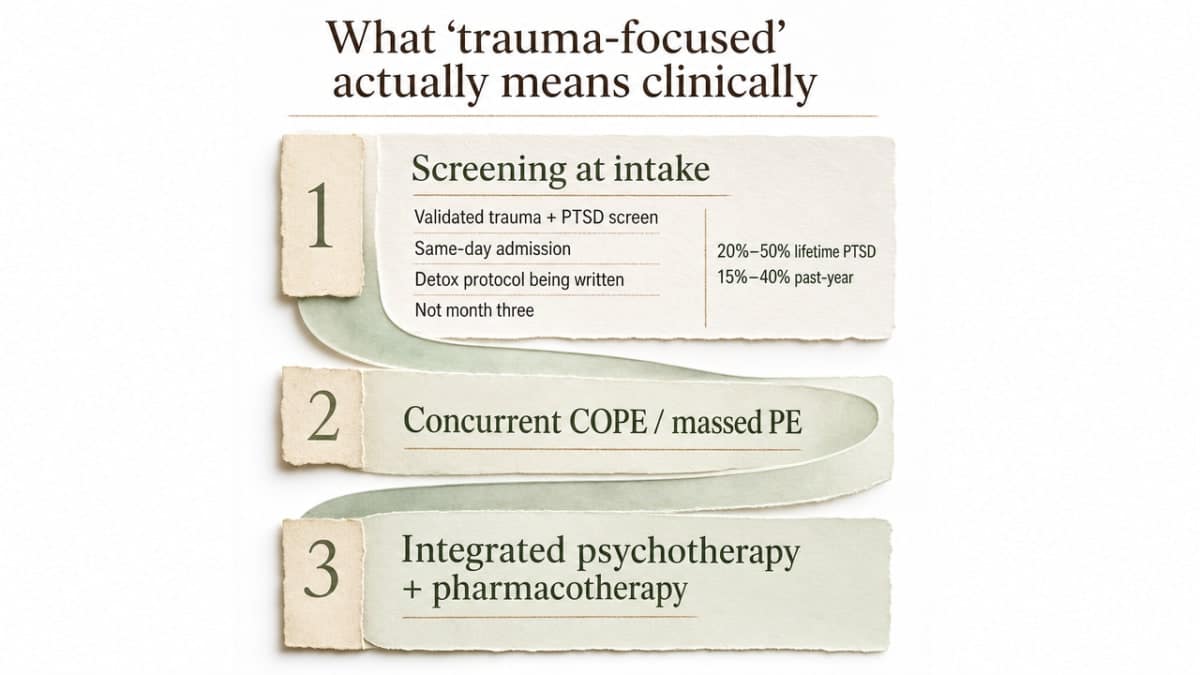
The phrase gets thrown around by every marketing team in behavioral health. It means something specific, though — three things, actually, that separate a genuinely trauma-focused residential program from one that has ‘trauma-informed’ on its website and a couple of trained clinicians on staff. Here is what a program with the framework actually does differently, and what you should hear described when you ask.
Screening at intake, not month three
In a genuinely trauma-focused program, a validated trauma and PTSD screen is part of your admission — the same day the detox protocol is being written, not a memo that gets added after group therapy stops working. The reason is arithmetic. If 20% to 50% of the men walking through the door carry a lifetime PTSD diagnosis, and 15% to 40% meet criteria in the past year, then screening late means you are misassessing something like a third of your census at admission 15. Whatever treatment plan gets built in that first week is being built on incomplete information.
Operational trauma-informed models codify this explicitly: systematic trauma and PTSD screening at intake, environment and staff trained to hold the disclosures that come back, and a direct pathway from a positive screen to trauma-focused therapy inside the program 2. Not a referral three months out. A pathway.
What this looks like from your side is straightforward: someone asks you real questions on day one or two, and what you say changes what your program looks like on day ten.
Concurrent, not sequential: COPE and massed prolonged exposure
For a long time, the field ran on a sequencing logic that sounded reasonable and turned out to be wrong for most men: stabilize the substance use first, then, after six months or a year of sobriety, refer the patient out for trauma work. Clinicians were nervous — reasonably — about running exposure-based therapy on someone with active alcohol or opioid use. Destabilization was the worry.
What the last decade of trials has shown is that the caution was overcalibrated for structured residential settings. Concurrent Treatment of PTSD and Substance Use Disorders Using Prolonged Exposure — the COPE protocol — integrates trauma-focused CBT and exposure work directly into addiction treatment, session by session, on the same weeks. Individual trauma-focused CBT delivered alongside SUD interventions produces better PTSD outcomes than treatment-as-usual 6. And a newer wrinkle: massed prolonged exposure, delivered daily in an intensive block rather than spread across months of weekly outpatient visits, appears well-suited to residential SUD care and can improve PTSD-plus-SUD outcomes when delivered inside a structured program 6.
Why this matters for you, practically: the 30 to 45 days you’re carving out of your life is enough time to actually do the trauma work, not just talk around it. Massed formats are built for exactly the window a residential stay gives you. The old model — get sober now, deal with the trauma later, out there, on your own — was the model that kept sending you back to treatment. Concurrent care is the version that stops writing the referral into the gap where you relapse.
Integrated psychotherapy plus pharmacotherapy as the current standard
The current consensus, as of the 2024 narrative review that synthesizes the field, is unambiguous: trauma-focused psychotherapies combined with pharmacotherapy show the most efficacy and are the recommended approach for co-occurring PTSD and SUD 10. Not one or the other. Both, coordinated, from the same clinical team.
On the medication side, that means a psychiatrist involved in your care from the beginning — someone managing SSRIs or other evidence-based options for PTSD and mood, managing detox and post-acute withdrawal, and specifically avoiding the pitfalls that come up in dual-diagnosis prescribing. Benzodiazepines, for instance, are contraindicated for most patients carrying both PTSD and SUD 15. That is the kind of decision that a program without integrated psychiatric care tends to get wrong, or punt on entirely.
On the therapy side, that means the trauma protocol and the addiction protocol are being run by clinicians who talk to each other about your case — often the same clinician, in a small enough program. What you should not hear described is a program where the therapist handles the drinking and someone external, someday, handles the trauma. That is the old model. It is not the standard anymore.
What Arkansas actually requires of a residential program
Here is a piece most Arkansans never hear from a treatment center’s website: the state already expects the kind of care you’re looking for. It isn’t a boutique claim. It’s licensure.
Under Arkansas Code of Rules 20 CAR § 705-203, crisis stabilization and SUD-related services must be delivered by a co-occurring disorder capable multidisciplinary team, with medically supervised screening and detox, and motivational strategies designed to move you into further treatment rather than a discharge summary and a phone list 7. The regulatory posture is explicit: the state does not treat mental health and substance use as separate silos to be handled by separate providers.
The residential piece is even more direct. Federal profiling of Arkansas’ residential behavioral health system documents that Acute Crisis Units must provide services that are “co-occurring disorder capable and trauma informed,” and Therapeutic Communities must offer “person-centered, culturally competent, trauma-informed and co-occurring capable services,” with initial assessments that include screening for both co-occurring disorders and trauma 8. Read that again. Trauma screening at initial assessment is not a differentiator in Arkansas — it is the floor.
The honest gap is between what licensure requires and what programs actually deliver day to day. Trauma-informed can be a training certificate on a wall, or it can be the way the intake clinician asks the third question. The regulation gives you a standard to hold a program to; it does not guarantee the program is meeting it.
The state context around all of this is worth naming, because it explains both the urgency and the incompleteness of the current picture. Arkansas’ drug overdose death rate fell from 21.7 per 100,000 in 2022 to 17.7 in 2023, and provisional 2024 counts show 389 overdose deaths statewide, down from 516 in 2023 11, 12. That is real progress — hundreds of families who did not get the call last year that they got the year before. It is also not a finish line. Nearly 400 Arkansans still died of overdose in the most recent data, and overdose deaths are the visible tip of a much larger population of men whose drinking, benzos, or stimulant use hasn’t killed them yet but is quietly running their lives.
What all of this means for you, practically: when you evaluate an Arkansas residential program, you are not asking the facility to invent trauma-informed care for your case. You are asking it to demonstrate that it meets a standard the state already set — screening at intake, integrated co-occurring capability, medically supervised detox, and a clinical pathway from a positive trauma screen into actual trauma-focused therapy inside the same walls.
What a program in Arkansas should actually offer
If you’re going to spend four to six weeks of your life inside a residential program, the checklist you carry into the admissions call matters more than the marketing brochure. Here is what to listen for, and what should raise a flag if it’s missing.
A trauma and PTSD screen at intake, delivered by a clinician, not a checkbox on a paperwork stack. Ask what instrument they use and when it happens. Day one or day two is the answer you want. Anything vaguer than that — “our therapists get to know clients over time” — means the program is running the old model and hoping you disclose on your own. The operational literature is specific: systematic screening at admission is a core component of trauma-informed residential care, not an optional add-on 2.
Medically supervised detox integrated with psychiatric care, in the same facility, under the same clinical team. Arkansas licensure already assumes co-occurring capable, multidisciplinary staffing 7. If the program hands you off between a detox unit and a separate residential provider — different building, different clinicians, different paperwork — you are living through the fragmentation the state’s regulatory frame was written to prevent.
An actual trauma protocol delivered inside the walls. Ask by name. COPE. Prolonged exposure. CPT. Whether they offer massed formats appropriate to a 30 to 45 day stay. If the therapist you’d be working with can’t describe which protocol you’d be doing and roughly when it would start, they don’t have one — they have good intentions and a general orientation.
Small enough that your case is actually known. A 200-bed facility running standardized programming cannot personalize sequencing to a trauma history the way a small-census program can. Ask the ratio. Ask who the psychiatrist is and how often you’ll see them. Ask what happens if your sleep collapses in week two.
A discharge plan that names the outpatient trauma clinician you’ll continue with after you leave, warm-handed off before you get on the plane or in the truck. Not a photocopied list of numbers.
These aren’t luxury features. They are the working definition of a program meeting the standard Arkansas already put on paper 8.
The Serenity Park capability set, in specifics
Held against the standard the last section named, here is what Serenity Park brings to the room, described by capability rather than adjective.
A 20-man census in Little Rock. That number is the whole point. It is small enough that your intake clinician, your primary therapist, and the psychiatrist managing your medications are the same people who know your sleep collapsed on night nine and why. Trauma sequencing is impossible to personalize at scale; it has to be built for one man’s history at a time.
Medically supervised detox and residential care under one clinical team, in one building. No handoff between a detox unit and a separate residential provider — the fragmentation Arkansas’ co-occurring capable requirement was written to prevent 7. Psychiatric evaluation is part of admission, not an outside referral, which is what integrated trauma-focused care actually requires when medications and trauma work have to be coordinated 10.
Wearable physiological monitoring through the Huml Health partnership. Heart rate, heart rate variability, sleep architecture, stress markers — read continuously, reviewed clinically. For trauma work this is instrumentation, not a gadget. Hyperarousal and disrupted sleep are the physiological signature of PTSD, and having objective data on both, night over night, lets the treatment team see whether a protocol is regulating your nervous system or whether it is time to adjust.
Adult men only. Group work with peers who recognize the deposition, the on-call weekend, the job site. That is not a marketing claim. It is a clinical choice about who is in the room while you talk.
After the 30 to 45 days
The stay ends. That is worth naming, because most of the men who relapse do it in the six weeks after discharge, when the structure lifts and the old cues come back on schedule — the drive home, the Sunday-night dread, the deposition on the calendar. A trauma-focused program that treats week six as the finish line has already lost you.
What you want written into your discharge plan, before you pack, is specific. The name of the outpatient trauma clinician you will continue with, ideally someone who runs the same protocol you started inside — CPT, prolonged exposure, or a COPE continuation — so week seven picks up where week five left off, not from zero 6. A psychiatrist to manage medications, because the current standard is trauma-focused psychotherapy plus pharmacotherapy sustained past discharge, not a 30-day prescription that expires in a parking lot 10.
The rest is scaffolding. A continuing care group with men who understand the work you just did. Family resources for the people who lived through your drinking and are now living through your recovery. Alumni support that is more than a birthday email. And a plan for the physiological markers — sleep, HRV, stress load — that were being watched inside, because those are the early warnings that trauma symptoms are creeping back before you reach for the drink.
Discharge is not the end of treatment. It is the point where treatment stops being residential and starts being the rest of your life.
The one hard phone call
You have read this far, which means part of you already knows. The drinking is not the whole story. The pattern is older than the pour, and every attempt to willpower it into submission has confirmed that.
The next move is not a decision about treatment. It is a conversation. A confidential call with the clinical team in Little Rock, on a line that does not go to a call center. What gets said on that call is honest: what you have been carrying, what you have been using to manage it, what a 30 to 45 day residential stay would actually look like for someone in your position — the calendar, the privacy, the psychiatry, the trauma work.
One call. That is the whole ask. The rest is a clinical question, and it deserves clinical answers.
Frequently Asked Questions
How do I know if my drinking is actually a trauma problem and not just a habit?
You probably don’t, cleanly, and that’s what a clinician is for. The tells that point toward trauma rather than habit are specific: you drink to shorten the runway to sleep, to quiet a replay loop, or to stop scanning the room. Drinking-to-cope motives are one of the most consistent signals of a PTSD–alcohol link 4. A proper screener at intake will tell you more in an hour than years of self-assessment.
What makes trauma-focused treatment different from a standard Arkansas rehab program?
Standard programs treat the substance. Trauma-focused programs screen for PTSD at admission, run a named trauma protocol — COPE, prolonged exposure, CPT — concurrently with addiction treatment, and coordinate psychiatric medication in the same team 6. The current consensus is that integrated trauma-focused psychotherapy plus pharmacotherapy outperforms the old sequential model of sober-first-then-trauma 10. If a program can’t name its protocol, it doesn’t have one.
Do I have to be sober before I can start trauma therapy?
No — and that older sequencing logic is what has kept many men cycling through treatment. Clinicians were once cautious about exposure work with active use, but recent trials show that trauma-focused therapy delivered inside a structured residential setting, including massed prolonged exposure formats, is feasible and improves outcomes 6. Detox stabilizes you physiologically; the trauma work starts in the same stay, not years later.
Can a professional protect his privacy and career while in residential treatment?
Yes, when the program is built for it. A small-census residential setting in Little Rock — 20 men, not 200 — limits who is in the room and how your case moves. Confidentiality is legally protected under 42 CFR Part 2 for SUD records. Practical planning matters too: FMLA coverage, disability protections, and how your admissions team structures communication with your firm or practice during the stay.
How long does trauma-focused residential treatment typically last?
Thirty to forty-five days is the working range for men with co-occurring trauma and substance use. That window is long enough to complete detox, run a massed trauma protocol, and stabilize medications with a psychiatrist — the components integrated care actually requires 10. Shorter stays can complete detox but rarely leave room to do the trauma work. Length gets adjusted by clinical picture, not by calendar.
What should I ask a program in Arkansas to confirm it’s genuinely trauma-focused?
Five questions. What validated trauma screener do you use at intake, and when? Which trauma protocol will I do — COPE, PE, CPT — and what week does it start? Is the psychiatrist in-house or a referral? Is detox and residential care under one clinical team? Who is the outpatient trauma clinician I’ll continue with at discharge? Arkansas licensure already assumes co-occurring capable, trauma-informed care 8. Ask them to prove it.
References
- Results from the 2021 to 2024 National Surveys on Drug Use and Health (NSDUH) – Companion Report. https://www.med.unc.edu/fammed/nctac/wp-content/uploads/sites/1256/2025/09/2024-nsduh-companion-report.pdf
- Implementing and evaluating a trauma-informed model of care in a residential youth treatment service for substance use and mental health. https://pmc.ncbi.nlm.nih.gov/articles/PMC10572352/
- Treatment of comorbid posttraumatic stress disorder and substance use disorders. https://www.ptsd.va.gov/professional/articles/article-pdf/id1635224.pdf
- A Systematic Review of the Self-Medication Hypothesis in the Comorbidity of Posttraumatic Stress Disorder and Alcohol Use Disorder. https://pmc.ncbi.nlm.nih.gov/articles/PMC7572615/
- The use of alcohol and drugs to self-medicate symptoms of posttraumatic stress disorder. https://pubmed.ncbi.nlm.nih.gov/20186981/
- Behavioral Interventions for Comorbid PTSD and Substance Use Disorders. https://www.ptsd.va.gov/publications/rq_docs/V31N2.pdf
- 20 CAR § 705-203. Crisis stabilization, psychiatric, substance use disorder-related services. https://codeofarrules.arkansas.gov/Rules/Rule?levelType=section&titleID=20&chapterID=187&subChapterID=232&partID=798&subPartID=3266§ionID=20340
- Arkansas Summary – State Residential Treatment for Behavioral Health Conditions. https://aspe.hhs.gov/sites/default/files/2021-08/StateBHCond-Arkansas.pdf
- Family Centered Treatment initiative shows measurable impact for Arkansas children and families. https://humanservices.arkansas.gov/news/family-centered-treatment-initiative-shows-measurable-impact-for-arkansas-children-and-families/
- Posttraumatic Stress Disorder and Substance Use Disorders: A Narrative Review. https://pubmed.ncbi.nlm.nih.gov/39407067/
- Changes in Drug Overdose Mortality and Selected Drug Type by State: 2022–2023. https://www.cdc.gov/nchs/data/hestat/drug-overdose/drug-overdose-2022-2023.htm
- Substance Misuse Education and Prevention. https://healthy.arkansas.gov/programs-services/prevention-healthy-living/substance-misuse-education-and-prevention/
- About OSAMH. https://humanservices.arkansas.gov/divisions-shared-services/shared-services/office-of-substance-abuse-and-mental-health/about-osamh/
- Find Substance Abuse or Mental Health Treatment. https://humanservices.arkansas.gov/divisions-shared-services/shared-services/office-of-substance-abuse-and-mental-health/samh-treatment/
- Substance use disorders, trauma, and PTSD. https://www.ncbi.nlm.nih.gov/pmc/articles/PMC4393537/
- Behavioral Health Services – Division of Behavioral Health Services. https://www.dfa.arkansas.gov/wp-content/uploads/0710_dbhs2017.pdf