
Key Takeaways
- Federal guidance treats stays under 90 days as of limited effectiveness, but recent research shows length only works when paired with real continuing care, not standalone duration 1, 7.
- Clinicians should set your length of stay using the six ASAM dimensions, where prior relapses and an unstable recovery environment push the recommendation toward the full 90-day dose 12.
- A serious 90-day program runs five to six hours of active clinical programming most days, names its evidence-based therapies, and updates treatment plans with you rather than about you 11.
- Evaluate a facility using the congressional consumer framework: chronic-disease orientation, active state licensure, independent accreditation, credentialed staff, and embedded co-occurring care 14.
- In Arkansas, a 90-day stay is not one approval but a 30-day block plus extension requests built on documented medical necessity, so ask who manages authorizations and denials 4.
- Aftercare has to be engineered before discharge, with named outpatient providers, psychiatric handoffs, and scheduled self-help attendance—the strongest predictors of retention and clinician-advised completion 9.
- A smaller or men-only setting can change outcomes when prior relapses were driven by shame, professional identity, or trauma content that mixed groups made harder to address 11.
When 30 Days Wasn’t Enough: Reading the Research Behind a Longer Stay
You already know how this story goes. You did the 30 days. You meant it. You came home with a plan, a sponsor’s number in your phone, maybe a fresh set of coins in a drawer. And then, weeks or months later, something cracked. If you are reading this from that place—sober enough to search, tired enough to consider a longer runway—you are not starting over. You are making a more informed clinical decision than you did last time.
That decision deserves better than a directory of names on a map. Searching for a 90-day residential center near you is really two questions stacked on top of each other: what does a longer stay actually change, and how do you tell a program built for chronic relapse from one that just sells the calendar? The research answers both, but not in the neat way rehab marketing suggests.
Federal guidance leans toward three months or more as the minimum useful dose for most people 1. Recent work complicates that picture in ways worth knowing before you commit 7. And a growing body of evidence points to something the 30-day cycle rarely delivers: residential care treated as one phase in a continuing arc, not a finish line with a discharge date 6.
The pages ahead walk through what the evidence actually says, how clinicians decide 90 days fits your situation, what a serious program looks like from the inside, and how to evaluate a facility near you without falling for the brochure. You have done the hard work of being honest about where you are. This is what to do with that honesty next.
Why 90 Days Became the Benchmark—And Where That Number Breaks Down
The Clinical Case for Three Months
The 90-day figure did not come from marketing. It came from NIDA’s principles guide, which states plainly that for residential or outpatient treatment, participation under 90 days is of limited effectiveness, and longer stays are recommended for maintaining positive outcomes 1. That is the source most quoted, and most misquoted, in this space.
What earns the number its weight is what happens alongside it. A longitudinal study of adults with co-occurring mental health and substance use disorders found that staying at least 90 days in the index residential episode—and receiving at least 12 weeks of outpatient mental health treatment after discharge—was associated with reduced substance use and fewer psychiatric inpatient admissions at six months 5. The 90 days did not act alone. It acted as the platform for what followed.
A 2025 systematic review on retention and duration lines up with that pattern, noting that a three-month retention period was among the strongest predictors of successful treatment discharge across studies 8. If you have relapsed after shorter stays, this is likely the research your intake calls have referenced, even if no one named it. Three months is not the ceiling of what is possible. It is the floor beneath which most people, statistically, do not get enough traction to hold what they gained.
The Honest Counterweight: What Recent Research Complicates
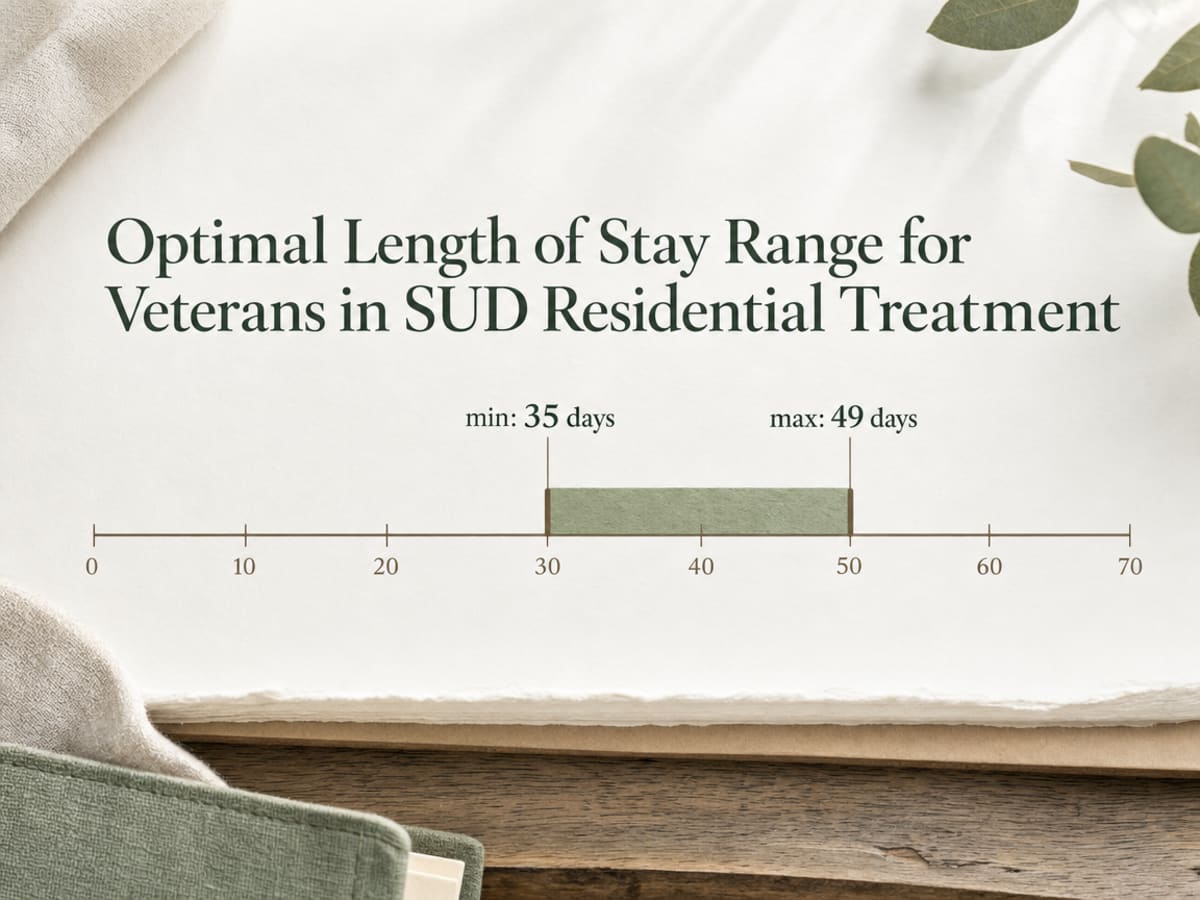
Here is what the brochures leave out. A 2025 dose-response study of veterans in VA residential SUD programs found that the literature is genuinely mixed on optimal length of stay—some studies favor around 30 days, others push toward 90 or more—and identified a length-of-stay band between 35 and 49 days as offering favorable tradeoffs between outcomes and access 7. That is a narrower window than three months, in a specific population (veterans, VA system), with access to care weighted alongside clinical benefit.
Older continuing-care research goes further. One review cited data in which patients receiving residential treatment averaging 90 days showed significantly less improvement on the ASI alcohol composite score than patients whose average stay was 15 to 30 or 31 to 45 days 6. That finding sounds like it should end the argument. It does not. It reframes it. What the continuing-care literature is saying is that duration without integration—without a real handoff to outpatient care, self-help groups, and community supports—does not automatically outperform a shorter, well-connected episode.
How Clinicians Decide 90 Days Is the Right Dose for You
The Six Dimensions Behind an ASAM Placement
You have probably heard intake coordinators say the word ASAM without ever seeing what sits underneath it. That vocabulary matters more than you think, because a program that decides your length of stay based on what your insurance will pay first and what your clinical picture demands second is not really deciding at all. The ASAM Criteria are the national standard for placement, continued stay, transfer, and discharge across addiction and co-occurring conditions 13. A serious 90-day center will describe them without being asked.
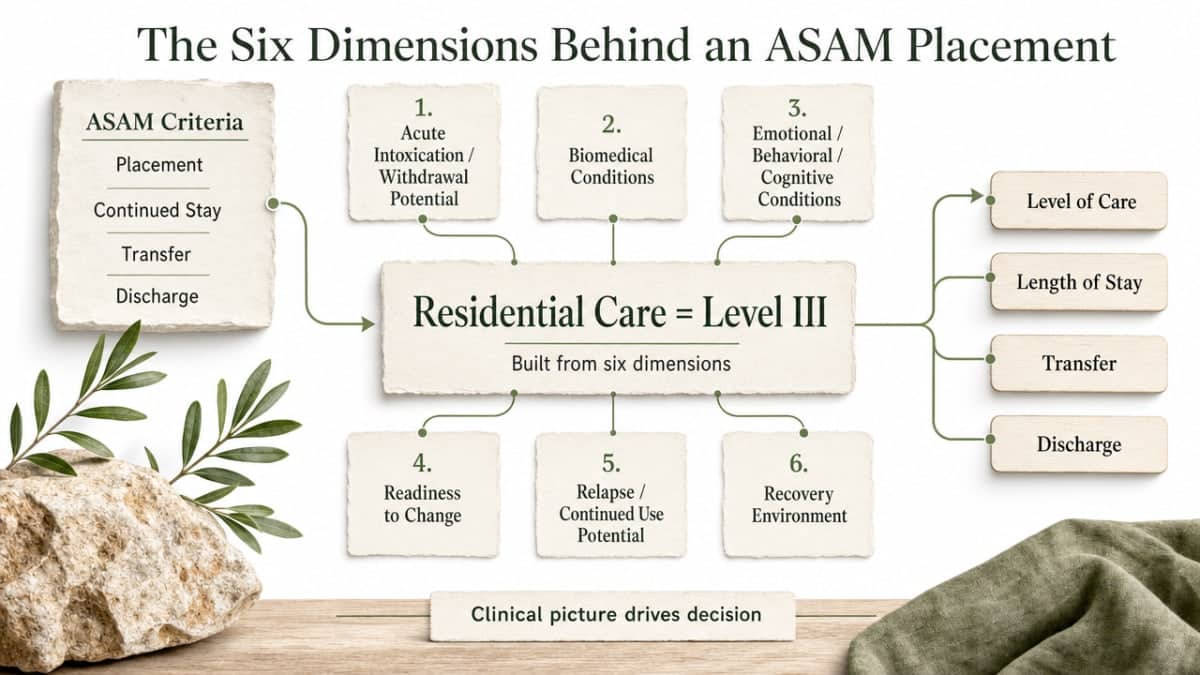
Under ASAM, patients are assigned to a level of care after being evaluated across six criteria dimensions that reflect the severity of the problems in front of them 12. Residential care lives at Level III, and the case for it is built from those six angles, not from a single test score or a symptom list.
Read those six again with your own history in mind. Dimension five, relapse potential, is where a pattern of prior treatment attempts speaks loudest. Dimension six, recovery environment, is where the honest answer about your home, your job, your neighborhood, and the people around your phone actually changes the recommendation. If the assessor is not asking about those two in detail, you are not being placed. You are being processed.
Chronic Relapse Changes the Calculus
A prior relapse is not a personal indictment. It is clinical information. When the assessor works through dimension five, a history of returning to use after 30- or 60-day episodes raises the severity score in a way that pushes toward a longer residential dose, and it should. That is how the criteria are designed to function.
Co-occurring conditions push in the same direction. The longitudinal work on adults with co-occurring mental health and substance use disorders found that staying at least 90 days in the index residential episode, combined with at least 12 weeks of outpatient mental health care after discharge, was associated with lower substance use and fewer psychiatric inpatient admissions at six months 5. If depression, anxiety, PTSD, or ADHD has been part of your relapse pattern, that finding is speaking directly to your situation.
What this means for you, sitting with the phone: when you call a facility, ask how they use the six ASAM dimensions to set your recommended length of stay, and ask what would move you from 60 days to 90. If the answer is a shrug or a sales pitch, keep dialing.
What a Serious 90-Day Program Actually Looks Like Day-to-Day
If the last program you were in felt like a lot of waiting between a few good groups, you already know what a soft schedule costs. A serious 90-day residential facility runs a structured clinical day, not a resort itinerary with therapy sprinkled in. Expect roughly five to six hours of active clinical programming, most days of the week, with the rest of the day scaffolded by meals, meetings, movement, and reflection that reinforces what happened in group.
Arkansas’s own licensure standards for opioid treatment set a useful floor for what “structured” should mean. Phase I under state rules requires near-daily attendance—at least six days a week for a minimum of 90 days—and no fewer than four counseling hours per week 2, 3. Those numbers are the regulatory minimum for one modality, not a ceiling for residential care. A residential program worth 90 days of your life should exceed them by a wide margin, with individual counseling weekly at minimum and group therapy scheduled most days.
The content of those hours matters as much as the count. Look for a program that names its evidence-based therapies out loud—cognitive behavioral therapy, motivational interviewing, relapse prevention work, trauma-focused modalities where clinically indicated—alongside psychiatric care for co-occurring conditions and integrated 12-step or peer support participation 11, 14. The systematic review evidence for residential treatment is moderate-quality precisely because programs vary so much in what they actually deliver 11. Two facilities can both call themselves 90-day residential centers and run very different clinical operations underneath.
A useful test: ask what a Tuesday looks like. A serious answer names specific groups, the clinician leading them, when psychiatric medication management happens, and how the day connects to the treatment plan updated with you—not written about you. If the answer is a vague “lots of therapy and community,” you are looking at a schedule someone wrote for the website. The days that hold you through week six, when the newness has worn off and the real work starts, are the days built by people who take clinical structure seriously.
Evaluating a Facility: A Framework Drawn From Congressional Consumer Guidance
Licensing, Accreditation, and the Chronic-Disease Question
The most useful checklist you can bring to an intake call did not come from a rehab review site. It came from a 2017 U.S. House hearing document written to help consumers evaluate addiction treatment centers, and it starts with a question that filters out a surprising number of facilities: does this center treat addiction as a chronic disease and strive for continuity of care 14? That question is not rhetorical. It is a stress test. A program that treats addiction as an acute event—90 days and a handshake—will answer differently than one built around the reality of a relapsing condition.
From there, the guidance gets specific. Is the center listed on the state’s licensure website, and has the program received any major citations against its license 14? In Arkansas, licensure standards for alcohol and drug treatment programs set concrete expectations around treatment planning timelines, structured programming hours, and staffing that a licensed facility must meet 2. If a facility’s name does not appear on the state list, or the license has been sanctioned, that is information you can act on before the first phone call ends.
Independent accreditation from a recognized behavioral health body is the next filter 14. Ask, and ask by name.
Staff Credentialing and Co-Occurring Disorder Capability
The same House guidance pushes hard on who is actually in the room with you 14. Ask which clinicians hold state licensure, which counselors are certified for substance use treatment, and how the program credentials its medical and psychiatric staff. A facility that hesitates on those answers is telling you something.
The co-occurring question deserves its own beat. If depression, anxiety, PTSD, or ADHD has shaped your relapse pattern before, you need a program where a psychiatric provider is embedded in the clinical week, not consulted by phone when someone escalates. The longitudinal work on adults with co-occurring conditions is direct on this point: the 90 days matter more when they are paired with real mental health treatment, both during and after the stay 5. “Dual diagnosis capable” written on a brochure is not the same as a psychiatrist who sees you weekly.
A fair test: ask how medication decisions get made, how often you will meet with a prescriber, and how the psychiatric plan travels with you at discharge. Specific answers—names, cadences, handoff protocols—tell you the capability is real. Vague reassurance tells you it is not.
The Continuity-of-Care Test
Here is where most 90-day programs quietly fail. The House document frames continuity of care as a defining feature of a serious center, not an add-on service 14. That framing lines up with the continuing-care literature, which treats residential treatment as one phase in an ongoing trajectory rather than a stand-alone episode—and warns that duration without integration into outpatient and community supports does not automatically outperform a shorter, well-connected stay 6.
So ask the questions that reveal whether continuity is actually built. Who writes your discharge plan, and when does it start—week one or week eleven? Does the facility have named outpatient providers, IOP referrals, and psychiatric handoffs it works with regularly, or will you be handed a printout of phone numbers? Is there an alumni structure that keeps you in contact with staff and peers after you leave, and what does that contact look like in month four, when the risk curve rises again?
A program that can answer those questions with specifics is thinking about the ninety-first day. That is the program worth your ninety.
What ‘Near Me’ Means in Arkansas: Licensure, Prior Authorization, and Access
The “near me” in your search is doing more work than you think. It is not just about a drive time from Little Rock or a familiar exit off I-40. It is about which facility your state license file vouches for, which one your insurance will actually authorize for a stay long enough to matter, and whether the local regulatory setup treats 90 days as a realistic clinical endpoint or a series of hurdles.
Start with the license file. Arkansas’s licensure standards for alcohol and drug treatment programs set the operational floor a residential facility has to meet—treatment plan timelines, structured programming hours, staffing ratios 2. Before you tour a place, confirm it appears on the state’s licensure list and check whether it carries active citations. That is a fifteen-minute step that changes the shape of the conversation.
Then look at how longer stays actually get authorized. Under Arkansas’s rule for hospital-based residential SUD units, prior authorizations run in blocks of one to thirty days, with additional days approved through extension requests based on documented medical necessity 4. A 90-day stay is not a single approval. It is a 30-day block plus extensions, each one built on ASAM-anchored medical necessity documentation the facility has to write and defend. Ask, plainly: who on the clinical team handles those extensions, how often have they been denied, and what happens if a denial comes through in week five?
That question separates programs that treat administrative continuity as clinical work from programs that will hand you a discharge date when the paperwork gets hard. The right “near me” is the facility close enough to reach and licensed to hold you for the full dose the criteria support.
Building the Aftercare That Makes 90 Days Stick
The ninety-first day is where most of this actually gets decided. You already know that in your bones. The stretch between the discharge handshake and the first month home is where the last plan came apart, and no residential program, however good, changes that on its own. What changes it is whether the aftercare was engineered while you were still inside the building.
The evidence is unusually direct here. In the co-occurring longitudinal work, the 90 days paid off when they were paired with at least 12 weeks of outpatient mental health treatment after discharge—the pairing was the finding, not the residential stay alone 5. The continuing-care literature makes the same case from a different angle: residential care read as one phase in an ongoing arc, with outpatient and community supports carrying the load after, is what separates a long stay that holds from a long stay that fades 6.
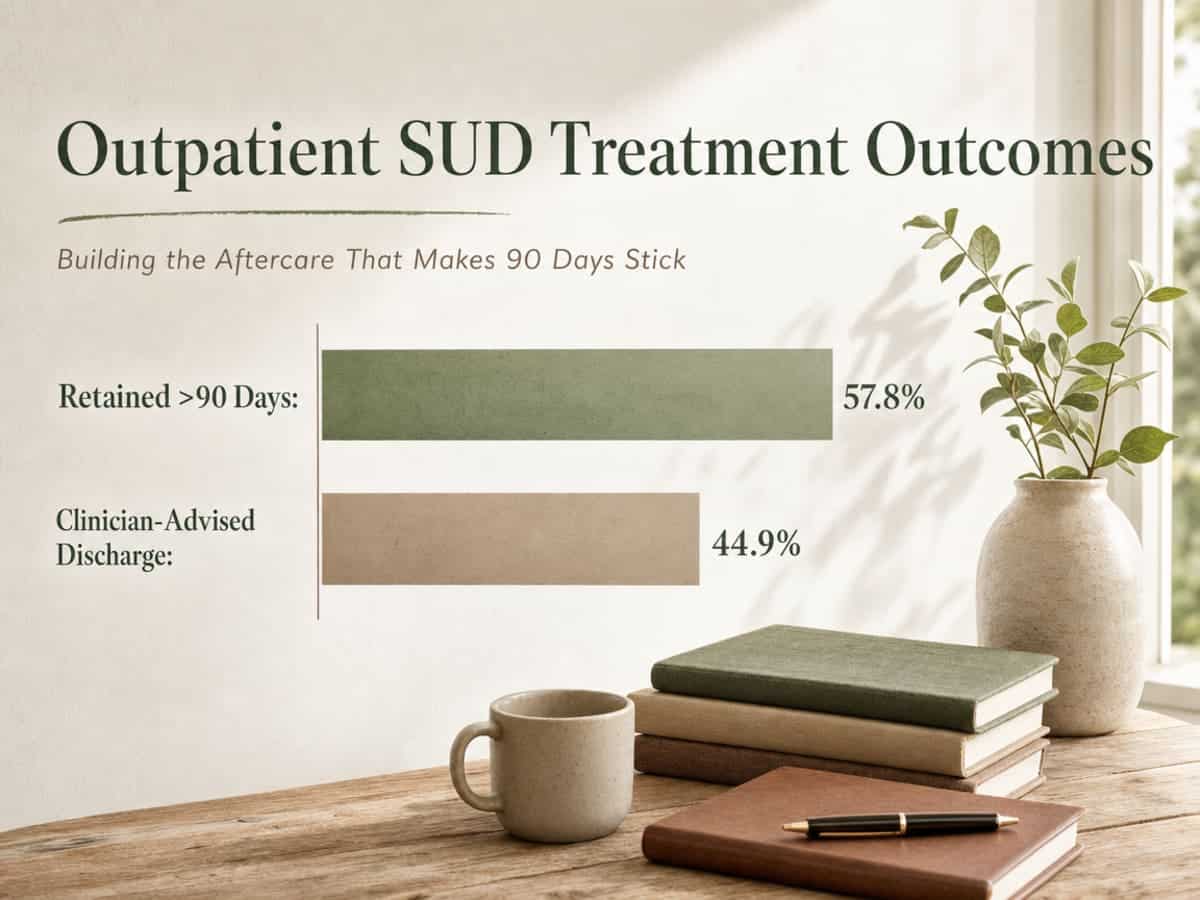
Outpatient data sharpens the picture of what “holding” looks like. In a study of outpatient SUD treatment, 57.8% of clients stayed longer than 90 days prior to discharge, while 44.9% were discharged on clinician advice—meaning retention and clinician-advised completion are not the same thing 9. Staying engaged is one bar. Finishing the way your clinician says you should finish is a higher one.
The same study points to what closes that gap: attending self-help groups and setting concrete recovery goals were the strongest predictors of both >90-day retention and clinician-advised completion 9. Neither is exotic. Both have to be structured into your aftercare plan by name—which meetings, which nights, which goals, reviewed with whom, on what schedule—before you walk out the front door.
So ask the facility, plainly: who writes your aftercare plan, when does it start, and what is scheduled for weeks one, four, and twelve after discharge? A serious answer names an outpatient provider, a psychiatric handoff, a specific meeting schedule, and an alumni contact who calls you—not the other way around. That is the ninety-first day being built while you still have the structure of the ninetieth.
When a Smaller, Men-Only Setting Answers the Right Question
Not every relapse is a program failure. Some are a fit failure. If your prior stays happened in larger, mixed-population facilities where the group work felt performative and the schedule felt one-size-fits-all, the honest question is not whether residential care works. It is whether a different structural setup would have held you differently.
The systematic review evidence on residential treatment is unambiguous on one point: outcomes depend heavily on the specific characteristics of the program, not on the label residential itself 11. Small-census facilities tend to run tighter clinical days because fewer clients means individual counseling actually happens weekly, treatment plans get updated with you rather than about you, and a psychiatric provider can know your case rather than your chart number. Men-only settings sharpen that further when your relapse pattern involves shame dynamics, professional identity, or trauma content that a mixed group makes harder to name out loud.
A newer thread worth knowing about: some smaller residential programs now pair traditional evidence-based treatment with wearable biotech that gives clinicians continuous data on heart rate, sleep, and stress patterns. Used well, that data supports the same continuing-care discipline the research keeps pointing back to 6—personalizing what happens in week six based on what your body is actually doing, not what you reported in group. Ask whether the setting matches how you fail, not how a brochure looks.
Frequently Asked Questions
Is a 90-day program really better than 30 or 60 days if I’ve relapsed before?
For most people, yes—federal guidance treats participation under 90 days as of limited effectiveness and recommends longer stays for maintaining outcomes 1. If your relapse pattern follows shorter episodes, that history raises the clinical case for a longer dose. But length alone is not the mechanism. The 90 days work when they are paired with real aftercare and continuing supports.
How do clinicians decide whether I actually need 90 days of residential care?
A serious assessor uses the ASAM Criteria, weighing six dimensions: acute withdrawal risk, biomedical conditions, emotional and cognitive status, readiness to change, relapse potential, and recovery environment 12. Prior relapses raise dimension five. An unstable home or workplace raises dimension six. Together those two often push the recommendation from a shorter residential stay toward the full 90-day dose.
What should I ask a facility to tell a clinical program from a marketing front?
Ask whether they treat addiction as a chronic disease and how continuity of care is built into discharge 14. Confirm active state licensure and independent behavioral health accreditation. Ask which clinicians are credentialed, how psychiatric care is delivered weekly, and who writes your aftercare plan. Specific names, cadences, and handoff protocols signal a clinical operation. Vague reassurance signals a sales one.
How does insurance and prior authorization work for a 90-day stay in Arkansas?
Under Arkansas’s hospital-based residential SUD rule, prior authorizations run in blocks of one to thirty days, with additional days approved through extension requests based on documented medical necessity 4. A 90-day stay is a first authorization plus extensions, each anchored in ASAM criteria the clinical team writes and defends. Ask who manages those extensions and how often denials have happened.
What does aftercare look like after a 90-day residential program ends?
Strong aftercare names specifics before you leave: a scheduled outpatient provider, a psychiatric handoff, self-help meetings on named nights, and written recovery goals reviewed on a set cadence. Those two elements—self-help attendance and goal setting—were the strongest predictors of both >90-day retention and clinician-advised completion in outpatient SUD care 9. An alumni contact who calls you, not the reverse, matters too.
Does a smaller, men-only setting make a real clinical difference?
It can, because residential outcomes depend heavily on specific program characteristics rather than the residential label itself 11. Smaller census usually means individual counseling actually happens weekly and treatment plans get updated with you. Men-only settings can help when relapse patterns involve shame, professional identity, or trauma content that mixed groups make harder to name. Ask whether the setting matches how you failed before.
References
- Principles of Drug Addiction Treatment: A Research-Based Guide (Third Edition). https://nida.nih.gov/sites/default/files/podat-3rdEd-508.pdf
- Licensure Standards for Alcohol and Other Drug Abuse Treatment Programs. https://humanservices.arkansas.gov/wp-content/uploads/Licensure_Standards_for_Alcohol_and_Other_Drug_Abuse_Treatment_Programs.pdf
- 20 CAR § 433-323. Opioid treatment – Code of Arkansas Rules. https://codeofarrules.arkansas.gov/Rules/Rule?levelType=section&titleID=20&chapterID=128&subChapterID=170&partID=666&subPartID=3988§ionID=24551
- Interested Persons – Hospital Based Residential Treatment for Substance Use Disorder. https://humanservices.arkansas.gov/wp-content/uploads/Hospital-Based-Residential-Treatment-for-Substance-Use-Disorder-A.pdf
- Stability of Outcomes Following Residential Drug Treatment for Adults with Co-Occurring Disorders. https://pmc.ncbi.nlm.nih.gov/articles/PMC3146302/
- The Continuing Care Model of Substance Use Treatment. https://pmc.ncbi.nlm.nih.gov/articles/PMC4007701/
- Finding the optimal length of stay for veterans in substance use residential treatment. https://pubmed.ncbi.nlm.nih.gov/40024631/
- Substance Use Disorder Treatment Outcomes: A Systematic Review of Retention and Duration. https://pmc.ncbi.nlm.nih.gov/articles/PMC12180564/
- Determinants of Outpatient Substance Use Disorder Treatment Retention and Completion. https://pmc.ncbi.nlm.nih.gov/articles/PMC10460408/
- Residential Treatment for Substance Use Disorder: A Review of Clinical Effectiveness and Guidelines. https://www.ncbi.nlm.nih.gov/books/NBK541232/
- The effectiveness of residential treatment services for individuals with substance use disorders: A systematic review. https://pubmed.ncbi.nlm.nih.gov/31254749/
- Patient Placement Criteria: Linking Typologies to Managed Care. https://pmc.ncbi.nlm.nih.gov/articles/PMC6876533/
- The ASAM Criteria: Treatment Criteria for Addictive, Substance-Related, and Co-Occurring Conditions. https://integrationacademy.ahrq.gov/resources/11086
- What to Look for in an Addiction Treatment Center. https://docs.house.gov/meetings/IF/IF02/20171212/106716/HHRG-115-IF02-20171212-SD008.pdf