
Key Takeaways
- Insight rarely changes drinking behavior because the experiential system that drives cravings learns through rehearsal and lived repetition, not through verbal reasoning in a counselor’s office 12.
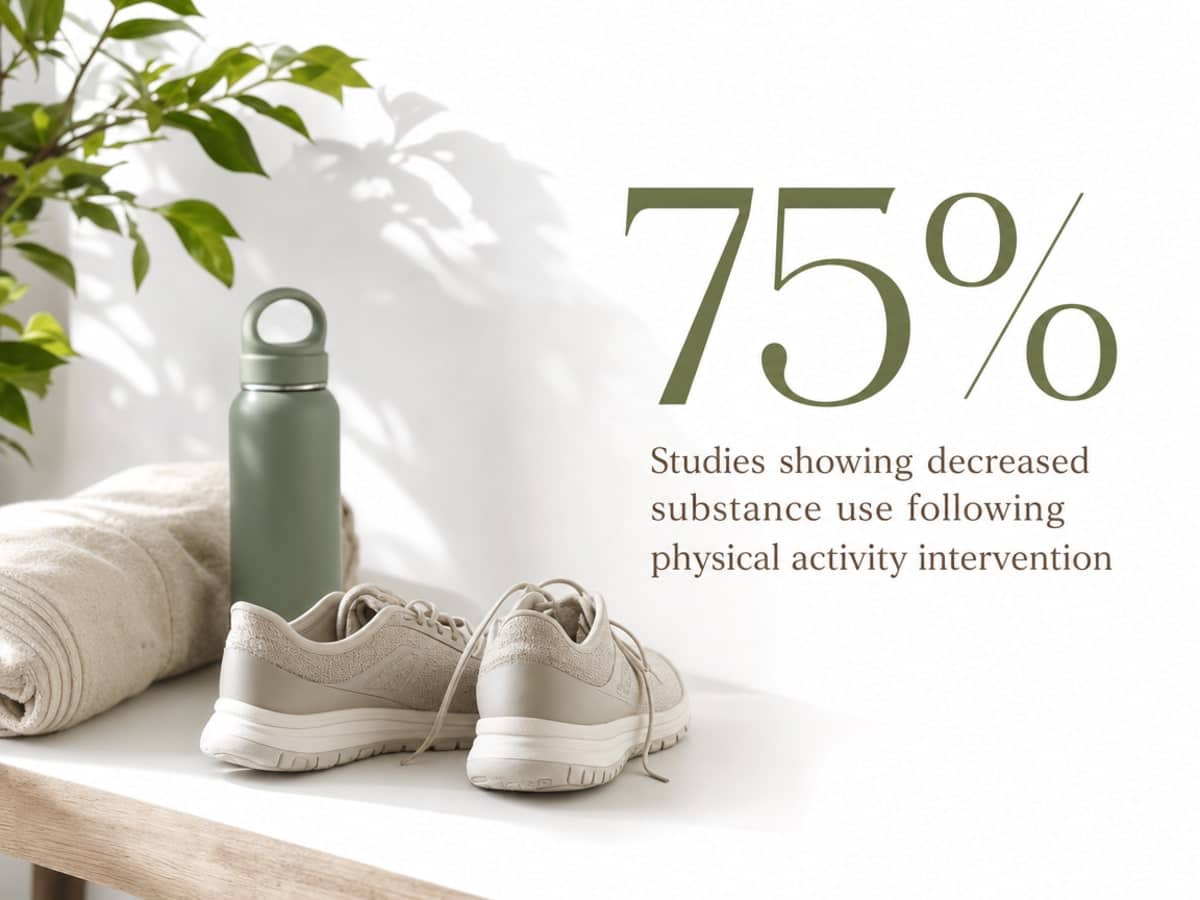
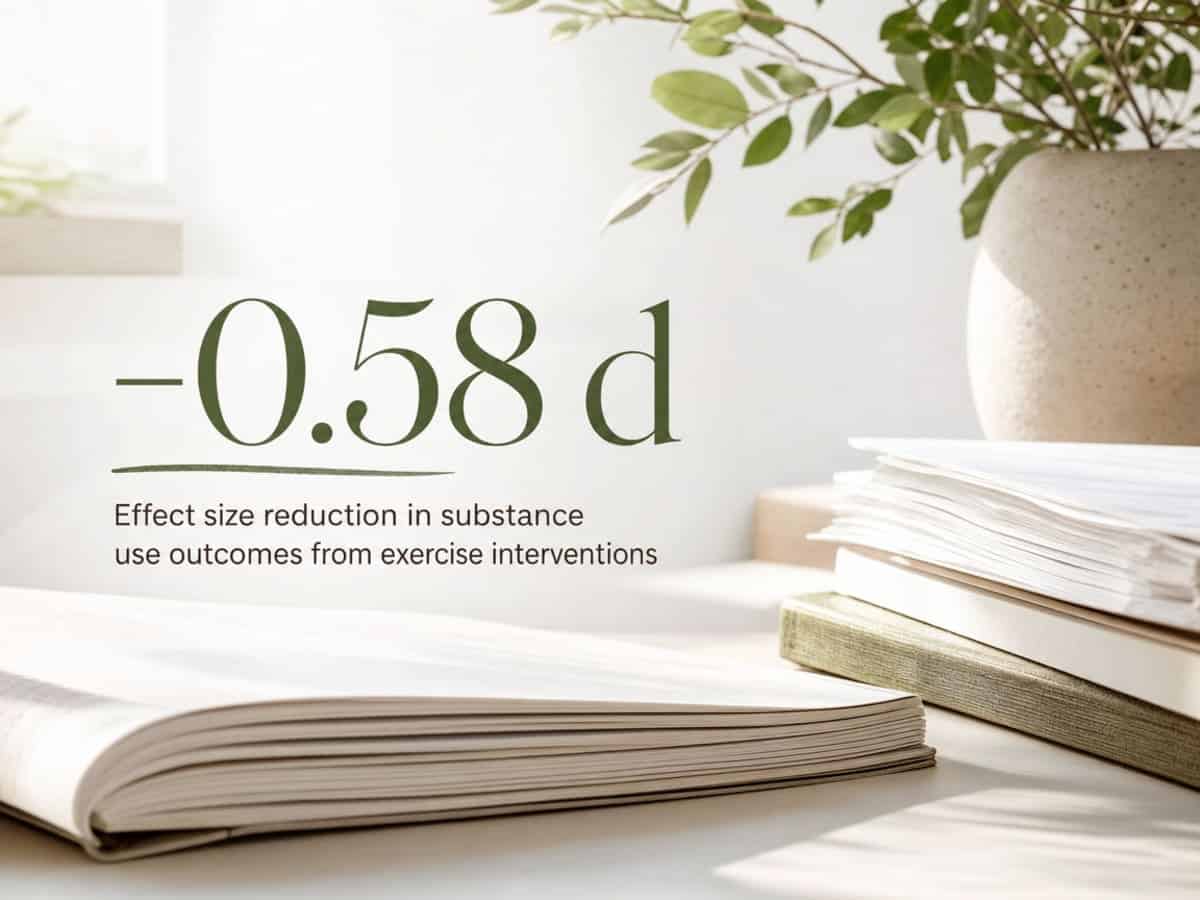
- The trial data backs experiential work: 75% of physical activity studies showed reduced substance use, and exercise interventions produced medium-effect reductions in cravings and stress 1, 2, 6.
- Experiential therapy belongs alongside detox, medication management, and counseling, not in place of them, and it did not out-perform other active treatments on abstinence alone 9.
- Judge a program by who runs the enactment groups, how movement integrates with the treatment plan, and whether it offers real variety across aerobic, strength, yoga, and cooperative work 8, 13.
The problem with talking your way out of a drinking problem
You’ve probably sat across from a counselor, or in a folding chair in a church basement, and talked about the drinking. Maybe you were articulate about it. Maybe you named the stressors, the family history, the client dinners, the pressure you’re under. And then you went home and poured a drink anyway.
That gap between what you understand and what you actually do is the whole reason you’re here, reading this instead of calling somebody. You’re not lazy. You’re not in denial in the cartoon sense. You’ve thought about this problem more carefully than most people think about anything. The insight is there. The behavior hasn’t budged.
Here’s what makes that maddening: the part of you that reaches for the bottle on a Tuesday night doesn’t answer to the part of you that can explain, in complete sentences, why it shouldn’t. Researchers have a name for this split. Epstein’s cognitive-experiential theory describes two learning systems running in parallel, and psychotherapy only works when the experiential one actually changes, not just the verbal one 12. Talking is the rational system’s language. Drinking lives somewhere else.
So if you’ve been told experiential therapy is a euphemism for hikes and arts and crafts, that’s a fair thing to be skeptical of. It’s also wrong. What follows is what experiential work actually is, what the evidence says it does, and what a day of it looks like when it’s done seriously.
Two systems, one stuck behavior
Why insight rarely changes what you do at 9 p.m. on a Tuesday
You already know why you drink. You could probably outline it on a napkin: the pressure at work, the way your father handled his own stress, the fact that nothing else quiets your head at the end of a long day. You’ve said it out loud in offices that charge by the hour. The knowing has not stopped the pouring.
That’s not a character flaw. It’s how the brain is wired. Epstein’s cognitive-experiential theory describes two parallel systems that both run your life: a verbal, rational system that reasons in sentences, and a nonverbal experiential system that learns automatically from what you actually live through 12. The rational system is where insight lives. The experiential system is where habits, cravings, and automatic reactions live. When 9 p.m. hits and your shoulders are up around your ears, the experiential system is driving. It has years of practice.
There’s a second piece to this. Research on cravings shows that people who habitually try to shove away uncomfortable feelings, what clinicians call experiential avoidance, report stronger alcohol and drug cravings, even after controlling for how much they use 4. The more you talk about a feeling instead of feeling it, the more the urge builds underneath. Understanding the problem isn’t the same as changing what happens in your body when the problem shows up.
The experiential system learns by rehearsal, not by lecture
Think about how you learned to drive. Nobody handed you a manual and called it done. You sat behind the wheel, made mistakes on quiet streets, felt the car respond, and eventually stopped thinking about it at all. That’s the experiential system doing its job. It changes through repetition, through consequences you can feel, through corrective experiences that stack up until the new response becomes the automatic one.
Epstein was direct about the implication for therapy: the point isn’t to reorganize what you can explain. The point is to produce constructive changes in the experiential system, and changes in the rational system only matter to the extent they feed that 12. You can rewrite your beliefs about drinking on paper. Your nervous system won’t update from the paper.
This is where experiential therapy earns its name. Instead of describing the hard moment, you rehearse it. Instead of talking about your body, you move it. Instead of predicting how you’d handle a Saturday afternoon alone, you build one and walk through it with people who won’t let you disappear into the usual coping. The 2025 meta-analysis of experiential dynamic therapies across mood, anxiety, and substance-related disorders found large effects versus inactive controls and durable advantages at follow-up, which is what you’d expect from work that rewires the system actually driving the behavior 11.
What the evidence actually says about doing the work
Movement, cravings, and the numbers behind the claim
Skepticism about experiential work usually collapses on contact with the trial data. A 2023 systematic review pulled together 43 studies, most of them randomized controlled trials, of physical activity interventions delivered during substance use disorder treatment. Cessation or reduction of substance use was the most measured outcome, and 75% of the studies tracking it showed a decrease following the physical activity intervention 1. That is not a wellness talking point. That is three out of four trials, across different substances and settings, watching men and women use less after structured movement was folded into their treatment.
The same review reported aerobic capacity improved significantly in 71% of studies that measured it, and muscular capacity in 60% 1. Your body gets stronger. That matters here, because craving is not a thought you can argue with. It is a full-body event, and the body you take into it changes how it lands.
There is a mechanism underneath the numbers. When you avoid an uncomfortable internal state, the urge tends to build, not fade. Research on adults with substance use problems found that lower experiential avoidance was significantly linked to lower alcohol and drug cravings, even after accounting for how much people used 4. Movement-based work forces you into contact with your own physiology, in a controlled way, with people around. You feel the discomfort of a hard hike or a heavier lift and you finish it. The next time your chest tightens at 9 p.m., that finished-it memory is in the room with you.
Stress, depression, and quality of life for men with co-occurring struggles
Most men reading this are not only wrestling with the drinking. There is anxiety somewhere in the mix. There is sleep that stopped working. There is a low-grade depression that has been dressed up as being tired, or being busy, or being fine. Experiential work has been studied against exactly those problems, not just abstinence.
A 2025 meta-analysis using robust variance estimation looked at exercise interventions across substance use trials and reported a medium effect size reduction in substance use and craving outcomes, d = -0.58 2. In plain terms, that is a real, measurable dent in urges and use, not a rounding error. Sitting next to that, a 2024 systematic review of randomized trials of physical exercise in patients with substance use disorders found a standardized mean difference of 0.63 for improvements in stress and depression, along with higher quality-of-life scores across domains 6. Two separate research groups. Two different outcomes. The cravings go down. The stress and depression go down. The daily experience of being alive gets better.
That parallel matters if you have been treating the drinking as the whole problem. The 2024 review noted a non-significant trend on cravings specifically, so the strongest signal in mood and quality of life should be taken on its own terms, not oversold as a craving cure 6. Which is honest, and useful. Experiential programming earns its place because it moves the mental health load a man is carrying, and that load is usually part of why the drink kept working in the first place.
Experiential dynamic therapies as a recognized category, not a fringe
If you still hear the word experiential and picture drum circles, it is worth knowing that this is a formally studied class of psychotherapy with its own body of controlled trials. A 2025 meta-analysis pooled 57 randomized trials of experiential dynamic therapies covering mood, anxiety, personality, somatic, and substance-related disorders, with a combined sample of 4,330 people 11. Against inactive controls, the effect at post-treatment was large (Hedges’ g = -0.96) and got larger at follow-up (g = -1.11), meaning people kept improving after the work ended 11. Compared with other active treatments, the effects were smaller but still favored experiential dynamic therapy at follow-up, and dropout rates were comparable to other therapies 11.
Read that last part again. Dropout was not worse. The stereotype that action-based therapy is for people who cannot handle real treatment does not survive the data. Men stayed. Then they kept getting better after they left.
None of this replaces the work you would do in one-to-one counseling or in medication management. It sits alongside it, and it earns its seat by producing durable change in the system that actually runs your Tuesday night. The category has a research base. Your skepticism was reasonable. The evidence is now on the other side of it.
Rehearsing the moments that usually break you
Psychodrama in plain English: practicing the hard conversation before it lands
Psychodrama is a word that sounds like it belongs in a black box theater. The practice itself is less exotic. You take a moment that has been chewing on you, the fight with your wife, the review with your boss, the phone call you have been ducking, and you walk it out on your feet with other men in the room. Somebody plays the other person. You say the thing you have been rehearsing at the bar. You get to hear it out loud, feel your chest tighten, and try again with a different response before the real moment arrives.
That sounds soft until you look at what it does to bodies under load. A study of trauma-focused psychodrama inside inpatient substance use treatment centers tracked PTSD symptoms across two to three weeks of group participation and found symptoms declined by more than 25%, which meets the National Center for PTSD’s threshold for clinically meaningful change 8. These were people carrying the kind of history that usually makes cravings worse, and the enactment work moved the needle in weeks, not years.
The mechanism is not mysterious. You cannot argue yourself out of a nervous system response you have never practiced surviving. Rehearse it in a room where nothing catastrophic can happen, and your body starts to know something your calendar has not caught up to yet.
The client dinner, the layover, the Sunday afternoon alone
Ask a man in recovery where he actually falls apart, and he will not describe a trigger from a workbook. He will describe a Tuesday client dinner where the wine list gets handed to him and everyone is watching to see if he picks. He will describe a four-hour layover in Dallas where the airport bar is the only thing open and nobody he knows will ever see him. He will describe the Sunday afternoon after the kids leave for their mother’s house, when the quiet gets loud.
Those are the moments experiential work is built for. You do not talk about the layover. You build one. Somebody plays the bartender. Somebody plays the colleague texting about the deal. You practice ordering the club soda with lime three different ways until one of them stops sounding like an apology. You practice what you do with your hands. You practice the sixty seconds after you sit down, which is where most men lose it.
Group formats matter here too. A 2025 controlled study of a psychodrama-based group intervention with substance-using participants reported significant reductions in total anger, trait anger, anger expression, and self-injury behaviors compared with controls 5. Anger and the drink are usually in the same car. Learning to interrupt the first is often how you get out of the second.
Skepticism is fair here. You may not believe rehearsal changes what you do on a real Sunday. That is what the reps are for. You do not have to believe it going in. You have to finish enough of them that your body starts to.
What a day at Serenity Park actually looks like
Fitness outings, cooperative groups, and outdoor time
A morning at Serenity Park does not start with a folding chair. It starts with your body. There is a fitness outing, a session in the gym, or time outdoors on Arkansas ground that does not care about your job title. You sweat next to men who are carrying the same weight you are, and nobody asks you to name your feelings before breakfast.
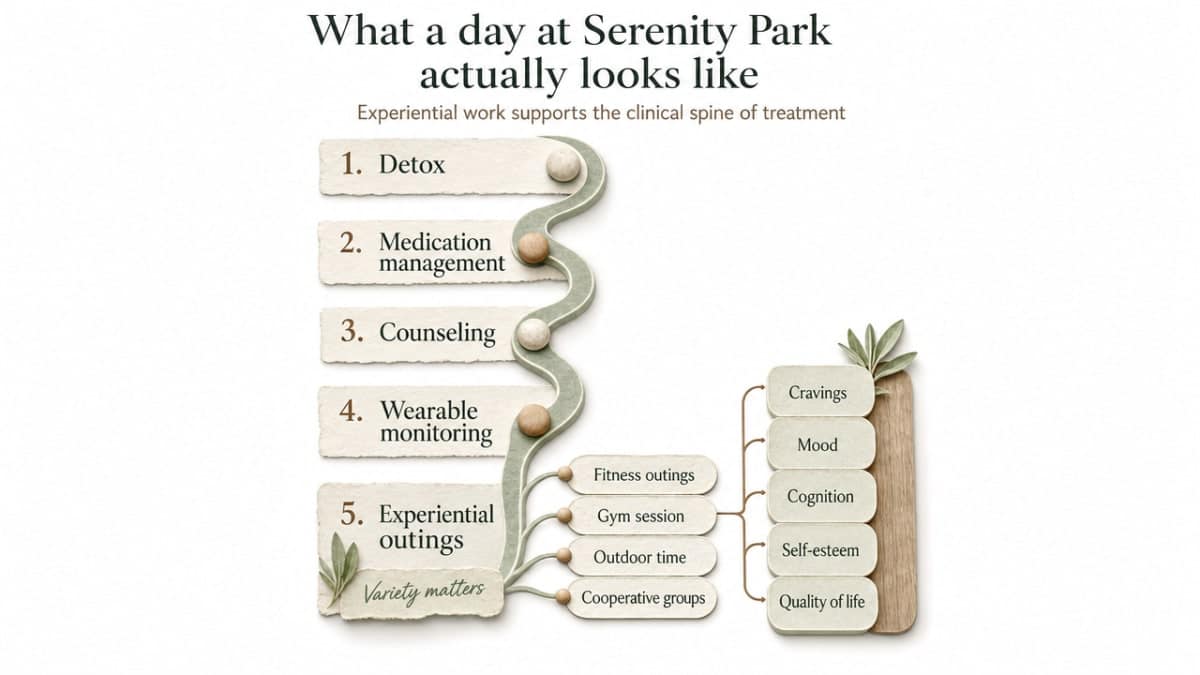
This is not filler between the real sessions. A 2024 narrative review that pulled together 23 systematic reviews and meta-analyses on activity in substance use treatment documented consistent benefits from aerobic work, strength training, yoga, outdoor adventure, and cooperative games, across cravings, mood, cognition, self-esteem, and quality of life 13. The variety matters. A hike does something a bench press does not. A cooperative game where five men have to solve a problem together does something a solo run cannot touch.
Recreational outings do a second thing that is harder to measure and easier to feel. You spend an afternoon fishing or walking a trail with men who saw you at your worst on Monday, and by Thursday you have a version of yourself that has done something other than drink. That version gets a vote at 9 p.m., too.
How experiential work sits alongside detox, medication, and counseling
Experiential programming is not a substitute for the clinical spine of your treatment. It sits next to it. If you arrive needing medically supervised detox, that comes first, with the medication management and psychiatric evaluation your body actually requires. Individual counseling and group therapy keep running through the week. The wearable monitoring in partnership with Huml Health tracks heart rate, stress, and sleep so your clinicians can adjust care from real data, not guesswork.
The experiential pieces, the fitness outings, the group work, the rehearsal of hard moments, are how the change gets into your body while the clinical work is happening in your chart. A 2025 meta-analysis of experiential dynamic therapies across 57 randomized trials found dropout rates comparable to other therapies, meaning men stay in this kind of work at the same rate they stay in traditional formats 11. You are not choosing between doing and talking. You are getting both, on the same day, in a program built so one reinforces the other.
What experiential therapy is not
It is worth saying plainly, because overclaiming is how good ideas get discredited. Experiential therapy is not a replacement for detox, medication, or the clinical care your body may actually need. If you are physically dependent on alcohol or benzodiazepines, no hike is going to carry you through withdrawal safely. That is what medically supervised detox is for, and it comes first.
That is not a reason to skip the movement work. It is a reason to stop selling it as the whole answer. Experiential therapy earns its place as an adjunct, doing the specific job talk therapy struggles to do, alongside the counseling, the medication management, and the psychiatric care that carry their own weight. Anyone promising you a rope climb instead of a treatment plan is selling you something else.
How to judge whether a program does experiential work seriously
Not every place that puts a hike on the schedule is doing experiential therapy. Some programs use outings as filler between the sessions that actually get billed. You can tell the difference by asking a few direct questions before you sign anything.
- Ask who runs the movement and enactment groups. Licensed clinicians and trained facilitators should be leading psychodrama, role-play, and group problem-solving, not activity staff working from a laminated schedule. The trials that showed a greater than 25% reduction in PTSD symptoms in inpatient settings used trauma-focused psychodrama delivered by clinicians who knew what they were doing 8. The format matters. So does who is holding it.
- Ask how the experiential work connects to your treatment plan. If the fitness outing and the counseling session never talk to each other, you are getting parallel activities, not integrated care. Serious programs use behavior-change techniques like goal-setting and self-monitoring to make activity-based work stick, and they document it 13.
- Ask about variety. Aerobic work, strength, yoga, outdoor time, and cooperative groups each do something different 13. A program that only offers one is guessing. A program that offers several is paying attention.
If sitting in a circle is what’s kept you from calling
Here is the honest read. You have thought about this longer than most people would. You have probably ruled out a handful of programs because the brochure looked like a summer camp for feelings, and that is a reasonable filter. The version of treatment you have been picturing, folding chairs and everyone taking turns, is not what a day here actually looks like.
A morning might start with a workout or an outing on Arkansas ground. The clinical work is real. The medication management, the psychiatric evaluation, the individual counseling, the discharge planning. The experiential pieces sit next to that spine so the change gets into your body while the treatment plan gets into your chart.
You do not have to be sold on any of it before you walk in. You have to be willing to see what a day looks like when it is built for men who learn by doing. That is the ask. Come look at it, and decide from there.
Frequently Asked Questions
Is experiential therapy covered by insurance the same way traditional counseling is?
Coverage depends on how the work is billed. When experiential pieces are folded into licensed group therapy, individual counseling, or a residential treatment day, they’re usually covered under the same benefits that pay for the rest of your care. Standalone recreation is a different story. Ask admissions to run your specific plan before you commit.
Do I need to be in decent physical shape to benefit from the movement-based parts of the program?
No. The movement work is scaled to where your body actually is on day one. A 2024 review across 23 systematic reviews found benefits across aerobic work, strength, yoga, outdoor time, and cooperative games, meaning the program has options whether you’ve been running marathons or haven’t seen a gym in a decade 13. You start where you start.
What if I hate group activities and role-play feels ridiculous to me?
That reaction is common, and it’s not disqualifying. Nobody hands you a script on day one. You watch. You participate when you’re ready. The 2025 meta-analysis of experiential dynamic therapies found dropout rates comparable to other therapies, which means men who felt exactly like you do stayed and finished the work 11. The ridiculousness usually fades by the second rep.
Can experiential therapy replace medication-assisted treatment or detox?
No. If your body is physically dependent on alcohol or benzodiazepines, withdrawal can be dangerous and needs medically supervised detox with appropriate medication management. Experiential work is an adjunct. A randomized outpatient trial found exercise did not out-perform another active treatment on drug use itself, even while improving fitness and self-efficacy 9. Detox and medication come first. Movement supports the rest.
How do I keep the gains from experiential work once I go home?
The point of rehearsing hard moments in-house is that the reps travel with you. Discharge planning, continuing care groups, and alumni support extend the work into your regular week. Behavior-change techniques like goal-setting and self-monitoring, documented across activity-based SUD programs, help the new responses stick after you leave 13. The pattern you built here goes home in your body.
Is a residential program with experiential therapy appropriate if I’m a working professional who can’t disappear for months?
Yes. Residential stays are calibrated to what your clinical picture actually requires, not to a fixed calendar. Serenity Park serves up to 20 men at a time, with discharge planning built to hand you back to your life. Discretion is part of how the program is designed. Admissions can walk you through length-of-stay options that fit what your work and family situation will allow.
References
- Characteristics and impact of physical activity interventions during substance use disorder treatment excluding tobacco: A systematic review. https://pmc.ncbi.nlm.nih.gov/articles/PMC10132651/
- The effect of exercise interventions on substance-use outcomes. https://pmc.ncbi.nlm.nih.gov/articles/PMC12882691/
- A Review of Exercise Interventions for Rehabilitation in Drug Dependence. https://pmc.ncbi.nlm.nih.gov/articles/PMC12692742/
- Experiential avoidance, distress tolerance, and substance use cravings. https://pmc.ncbi.nlm.nih.gov/articles/PMC6126664/
- The Effect of a Psychodrama-Based Group Intervention on Anger and Self-Injury Behaviors in Adolescents with Substance Use Disorders. https://pubmed.ncbi.nlm.nih.gov/40906942/
- A Systematic Review of the Benefits of Physical Exercise on Mental Health and Quality of Life in Patients With Substance Use Disorders. https://pubmed.ncbi.nlm.nih.gov/39376893/
- Effectiveness of Drama-Based Intervention in Improving Mental Health of Individuals with Psychological Disorders: A Systematic Review and Meta-Analysis. https://pmc.ncbi.nlm.nih.gov/articles/PMC10048456/
- La eficacia del psicodrama centrado en el trauma en el tratamiento del trastorno de estrés postraumático en centros de tratamiento de abuso de sustancias. https://pmc.ncbi.nlm.nih.gov/articles/PMC7252437/
- Reinforcing Exercise to Improve Drug Abuse Treatment Outcomes: A Randomized Controlled Study in a Substance Use Disorder Outpatient Treatment Setting. https://www.ncbi.nlm.nih.gov/pmc/articles/PMC7007340/
- Physical Activity and the Development of Substance Use Disorders: A Systematic Review of the Literature. https://pmc.ncbi.nlm.nih.gov/articles/PMC6192057/
- The Efficacy of Experiential Dynamic Therapies: A 10‑Year Systematic Review and Meta‑Analysis Update. https://pmc.ncbi.nlm.nih.gov/articles/PMC12102587/
- An Integrative Theory of Psychotherapy: Research and Practice (Cognitive‑Experiential Theory). https://pmc.ncbi.nlm.nih.gov/articles/PMC5034936/
- Enhancing Substance Use Disorder Recovery through Integrated Physical Activity and Behavioral Interventions: A Comprehensive Approach to Treatment and Prevention. https://pmc.ncbi.nlm.nih.gov/articles/PMC11201577/