
Key Takeaways
- Federal parity law and ACA essential health benefit rules require most Arkansas commercial and Marketplace plans to cover detox, residential, PHP, IOP, MAT, and outpatient counseling 5, 6.
- A July 22, 2025 CMS Section 1115 approval now allows Arkansas Medicaid to draw federal matching funds for short-term residential SUD care in IMD settings through June 30, 2030 1.
- Actual out-of-pocket costs in Arkansas hinge on three plan-specific factors: whether rehab is a covered benefit, whether the stay meets ASAM medical necessity, and whether the facility is in-network.
- A fifteen-minute benefits verification call using your member ID reveals deductible balance, prior authorization requirements, and network status far faster than reviewing plan documents alone.
Understanding Rehab Coverage in Arkansas: Beyond a Simple Yes
Yes, most health insurance plans in Arkansas cover drug and alcohol rehab, including detox and, increasingly, residential treatment. The question isn’t whether coverage exists, but rather the specific details of your plan. Federal parity law mandates that most commercial plans treat substance use disorder benefits no more restrictively than medical or surgical benefits 6. Additionally, Marketplace and small-group plans must include mental health and SUD services as essential health benefits 5. A significant development on July 22, 2025, saw CMS approve a Section 1115 demonstration, allowing Arkansas Medicaid to draw federal matching funds for short-term residential and inpatient SUD treatment, a category previously largely excluded 1.
Therefore, the answer to “does insurance cover drug rehab in Arkansas” is nuanced: yes, but four key questions determine your actual out-of-pocket costs. This article will explore each of these factors, demonstrating how a quick verification call can provide more clarity than hours of online research.
What’s Covered: Detox, Residential, and Beyond
Federal Mandates for Arkansas Plans
Before examining your specific insurance card, it’s crucial to understand the foundational federal regulations that apply to nearly all plans in Arkansas.
The Mental Health Parity and Addiction Equity Act (MHPAEA) prevents commercial plans from imposing stricter rules on substance use disorder treatment than on medical or surgical care. This means deductibles, copays, visit limits, and prior authorization processes for SUD care cannot be more restrictive than for other medical benefits 6. For instance, a plan cannot cap rehab at seven days if it would cover a comparable medical hospitalization for a longer, medically necessary period.
The Affordable Care Act (ACA) further reinforces this by requiring individual and small-group plans to include mental health and substance use disorder services as one of ten essential health benefit categories 5. This category encompasses a wide range of services, including detox, residential treatment, intensive outpatient programs, medication-assisted treatment, and follow-up counseling.
These federal mandates ensure that for almost every commercial and marketplace plan in Arkansas, rehab is a covered benefit by law. The remaining task is to understand how your particular plan manages the specific details of this coverage.
Impact of the July 22, 2025, Medicaid Policy Change
Historically, Arkansas Medicaid faced limitations regarding residential rehab coverage. Federal rules often prohibited Medicaid from funding care in Institutions for Mental Diseases (IMDs), which are residential facilities specializing in mental health or addiction above a certain size. While detox within a residential SUD facility and some limited residential services billed as outpatient care were sometimes covered, full residential treatment in an IMD was largely excluded 7.
This changed significantly on July 22, 2025, with CMS approval of a Section 1115 demonstration. Arkansas can now access federal matching funds for short-term residential and inpatient SUD treatment delivered in IMD settings. This approval, valid through June 30, 2030, integrates residential care into a required continuum of services, from outpatient to residential and community-based follow-up 1.
This policy shift complements existing Medicaid initiatives, such as the 2022 ARHOME amendment, which established Life360 HOMEs to provide intensive care coordination and person-centered supports for individuals with serious mental illness and SUD 4. CMS clarified that Life360 services supplement existing medical coverage 9. The new IMD coverage now allows the residential component to be fully integrated into this framework.
For individuals with Arkansas Medicaid, this means the options for residential care are substantially different and broader than they were previously. It’s crucial to seek updated information rather than relying on outdated summaries.
Decoding Your Insurance Card: Employer, Marketplace, ARHOME, or Medicare Advantage
Employer-Sponsored Commercial Plans
If your insurance is provided by your employer—such as Blue Cross Blue Shield of Arkansas, UnitedHealthcare, Cigna, Aetna, or a self-funded plan administered by one of these—you generally have robust coverage for rehab in Arkansas.
Large group health plans are fully subject to the MHPAEA. This means financial requirements like deductibles and copays, and treatment limitations such as day limits or prior authorization, cannot be more restrictive for SUD care than for other medical and surgical benefits 6. Consequently, services like detox, residential treatment, partial hospitalization, intensive outpatient programs, medication-assisted treatment, and outpatient counseling are typically included in your plan’s benefits.
While the core benefits are consistent, the administrative aspects vary. Your deductible has a specific reset date, and your out-of-pocket maximum limits your annual spending. Prior authorization might be required before admission or reviewed concurrently during treatment. Some plans use ASAM criteria for medical necessity, while others use similar internal guidelines.
Understanding these nuances doesn’t require you to decipher complex policy documents alone. A benefits verification call can clarify exactly how these elements apply to your specific situation.
ACA Marketplace Plans
For plans purchased through healthcare.gov—such as individual policies from Ambetter, QualChoice, or Blue Cross Blue Shield of Arkansas—mental health and substance use disorder services are a mandatory essential health benefit 5. This is a regulatory requirement, not an optional add-on.
Arkansas Marketplace plans are categorized into bronze, silver, gold, and sometimes platinum tiers. These tiers primarily affect your cost-sharing, not the scope of covered services. A bronze plan typically has a higher deductible and lower premium, meaning you’ll pay more out-of-pocket before insurance covers a residential stay. Conversely, a gold plan usually has a lower deductible and higher premium. Silver plans, especially with cost-sharing reductions for eligible incomes, can significantly reduce your out-of-pocket expenses for rehab.
Regardless of the tier, rehab remains a covered benefit, and parity rules apply just as they do for employer-sponsored plans. The main difference lies in the financial structure and how much you contribute before your plan takes over.
ARHOME: Medicaid with a Commercial Card
ARHOME is Arkansas’s Medicaid expansion program, but beneficiaries receive a commercial insurance card, typically from Blue Cross Blue Shield or Ambetter. This is because ARHOME utilizes Medicaid funds to purchase private qualified health plan coverage from these carriers 10. This means you are a Medicaid beneficiary, but your daily claims are processed by a commercial insurer. Both statements are simultaneously true.
This dual nature is important for rehab coverage. While your benefits are administered by the commercial carrier, an underlying Medicaid layer can provide supplemental services, such as the Life360 HOME care coordination and person-centered supports authorized by the 2022 ARHOME amendment 4. CMS explicitly stated that these Life360 services are supplementary to the medical care already covered by your Qualified Health Plan 9.
The July 2025 Section 1115 approval is particularly relevant for ARHOME beneficiaries. Short-term residential and inpatient SUD treatment in IMD settings can now receive federal matching funds through June 30, 2030 1. This type of care was largely inaccessible through Medicaid previously. When discussing coverage, it’s most accurate to state, “I have ARHOME through [BCBS or Ambetter],” as this provides admissions teams with the necessary information.
Medicare Advantage and Traditional Medicare
For individuals with Medicare, whether traditional Medicare Part A and B or a Medicare Advantage plan from a private carrier, SUD treatment is a covered benefit. Detox in a hospital setting is generally covered under Part A. Outpatient counseling and Medication-Assisted Treatment (MAT) are covered under Part B. Medicare Advantage plans bundle these benefits and often include additional services, but they also introduce network restrictions and prior authorization requirements not present in traditional Medicare.
Residential rehab has historically been a more restricted category under Medicare compared to commercial or ARHOME coverage. If Medicare is your primary insurance, it is highly advisable to make a verification call early in the process to understand the specifics of what a residential stay would entail financially.
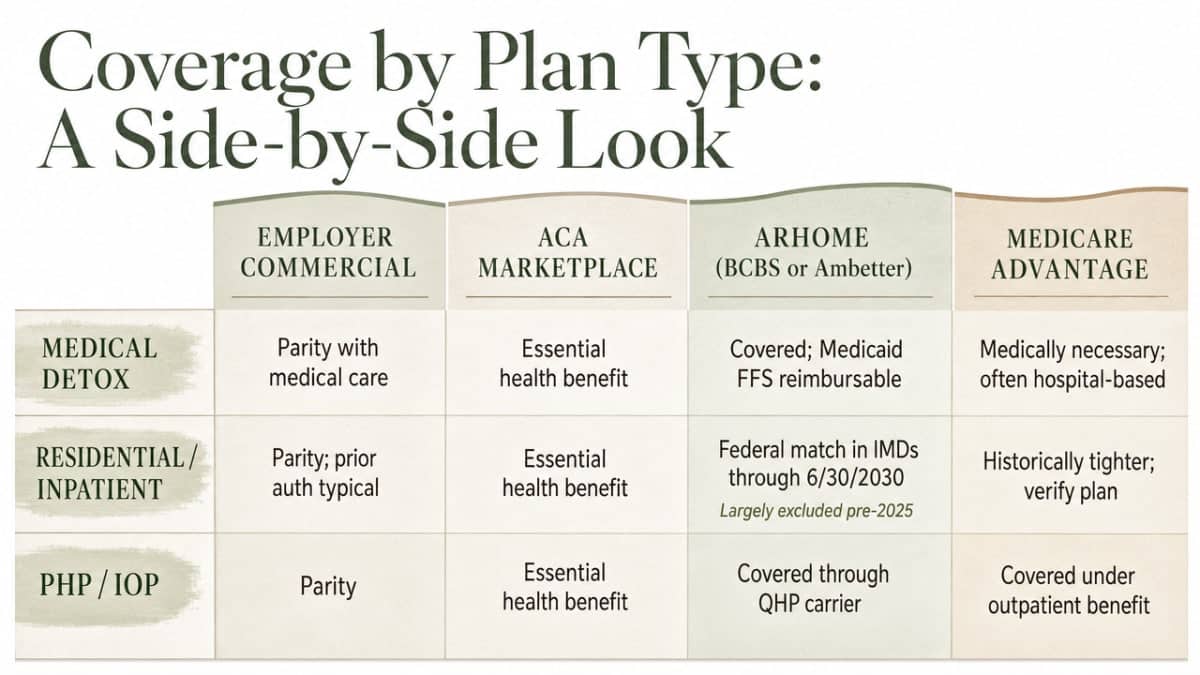
Coverage by Plan Type: A Side-by-Side Look
The table below summarizes coverage for various SUD services across different plan types in Arkansas, reflecting current federal and state policies.
| Service | Employer Commercial | ACA Marketplace | ARHOME (BCBS or Ambetter) | Medicare Advantage |
|---|---|---|---|---|
| Medical Detox | Covered at parity with medical care 6 | Covered as essential health benefit 5 | Covered; reimbursable under Medicaid fee-for-service 7 | Covered when medically necessary; often hospital-based |
| Residential / Inpatient | Covered at parity; prior auth typical 6 | Covered as essential health benefit 5 | Now eligible for federal match in IMDs through 6/30/2030 1; was largely excluded pre-2025 7 | Historically tighter; verify per plan |
| PHP / IOP | Covered at parity 6 | Covered as essential health benefit 5 | Covered through QHP carrier 10 | Covered under outpatient benefits |
| MAT (medication-assisted treatment) | Covered at parity 6 | Covered as essential health benefit 5 | Covered; part of required continuum 1 | Covered under Part B / MA outpatient |
| Aftercare / Outpatient Counseling | Covered at parity 6 | Covered as essential health benefit 5 | Covered; Life360 HOMEs add care coordination on top 9 | Covered under outpatient benefits |
Notably, the residential column reflects the most significant recent policy change: the July 22, 2025, Section 1115 approval, which opened federal matching funds for short-term residential SUD care in IMD settings, addressing a primary gap in Arkansas Medicaid coverage 1. For commercial and marketplace plans, the underlying principle remains consistent: parity and essential health benefits ensure coverage. The variables are your deductible, prior authorization requirements, and network status.
If this grid doesn’t fully clarify your situation, a benefits verification call, as discussed in a later section, is the next step.
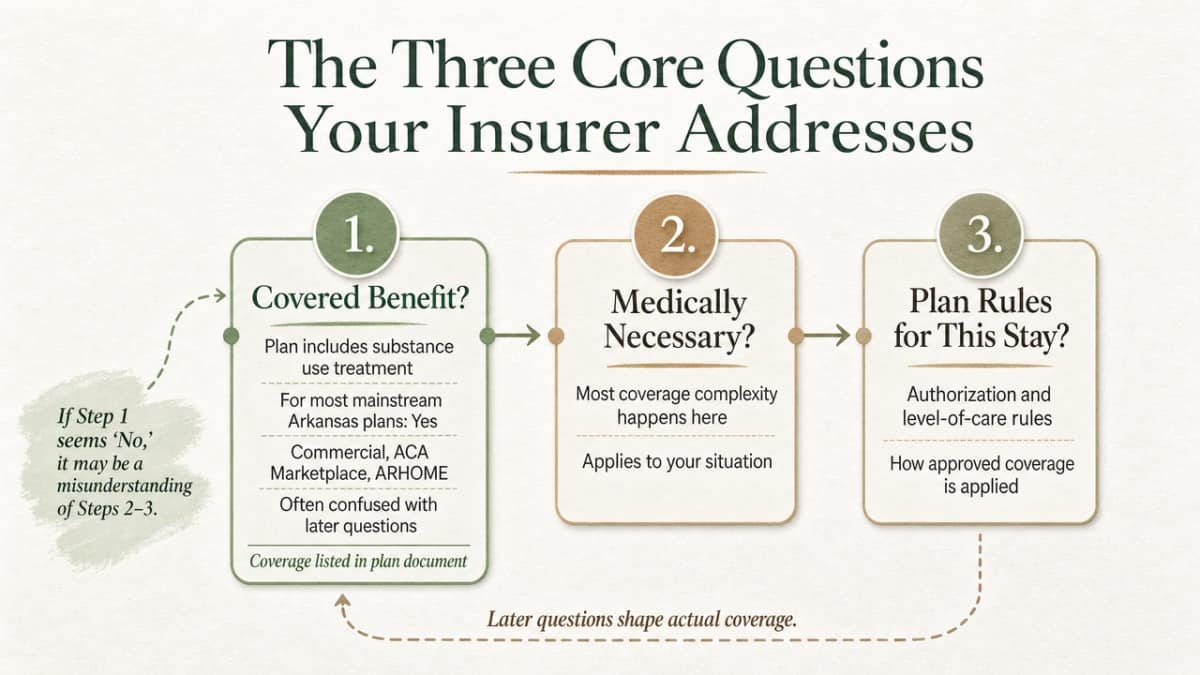
The Three Core Questions Your Insurer Addresses
Is Rehab a Covered Benefit Under This Plan?
This is often the simplest question and is frequently confused with other aspects of coverage. A “covered benefit” means that your plan document explicitly includes substance use disorder treatment as a service for which your insurer will pay.
For nearly all mainstream Arkansas plans—including employer commercial, ACA Marketplace, and ARHOME through Blue Cross Blue Shield or Ambetter—the answer is yes. This is mandated by parity law for commercial plans 6 and by the essential health benefits rule for marketplace and small-group plans 5. If you encounter information suggesting otherwise for a standard Arkansas plan, it’s likely a misunderstanding of the subsequent two questions.
Is This Stay Medically Necessary for You?
This is where most coverage complexities arise. “Medically necessary” is the insurer’s term for determining if your specific clinical condition warrants the particular level of care requested at that moment.
For SUD treatment, insurers typically rely on the ASAM criteria, which evaluate six dimensions: intoxication and withdrawal risk, medical conditions, emotional and behavioral factors, readiness to change, relapse potential, and your recovery environment. A clinician assesses your status across these dimensions, and the insurer uses this information to determine the appropriate level of care: outpatient, intensive outpatient, partial hospitalization, residential, or medically managed inpatient.
Medical necessity explains why two individuals with identical insurance plans might receive different coverage decisions for the same facility. One person’s withdrawal risk, co-occurring conditions, and home environment might justify residential care, while another’s clinical profile might indicate intensive outpatient as the more suitable starting point. These are not denials of coverage but rather determinations of the most appropriate care level based on clinical need.
A comprehensive clinical assessment prior to admission is crucial for transforming this question from a potential dispute into a well-documented decision.
Is This Facility In-Network?
Network status significantly impacts your out-of-pocket costs. It doesn’t alter whether rehab is covered or if your stay is medically necessary, but it dictates the financial terms once those factors are established.
In-network facilities have pre-negotiated rates with your insurer. Your deductible, copay, and coinsurance apply at the in-network level, and you are protected from balance billing. While many commercial policies offer out-of-network benefits, your share of the cost is typically higher, and the facility may bill you for the difference between what your insurer pays and their standard charges.
For ARHOME beneficiaries, the network is determined by the Qualified Health Plan (QHP) carrier on your card (BCBS or Ambetter) 10, not directly by Medicaid. This underscores why understanding the ARHOME distinction, as discussed earlier, is vital during the admissions process.
Addressing Denials: Common Triggers and Resolutions
Most rehab “denials” in Arkansas are not outright rejections of coverage but rather denials of specific details, typically falling into three categories.
The first common reason is insufficient clinical documentation. When a plan deems a residential stay not medically necessary, it often means the ASAM assessment on file did not adequately detail withdrawal risk, co-occurring conditions, or a home environment that necessitates the requested level of care. This can frequently be resolved with a more thorough assessment or a peer-to-peer review between the treating clinician and the insurer’s medical director.
The second trigger is a missed or delayed prior authorization. Most commercial plans require authorization before admission for residential care. Parity rules do not eliminate this step; they only ensure it’s no more restrictive than for medical services 6. Submitting authorization with the clinical assessment before arrival can prevent delays and complications.
The third issue is a network mismatch. If a facility is out-of-network and your plan has limited out-of-network benefits, the denial pertains to the reimbursement rate, not the treatment itself. In such cases, discussions about single-case agreements or exploring in-network alternatives are appropriate next steps.
Serenity Park proactively manages authorization submissions and peer reviews with carriers, often resolving these issues before they become a concern for the individual.
The 15-Minute Verification Call: Unlocking Your Specific Coverage Details
While online resources provide general information, they cannot tell you the exact cost of your specific rehab stay. This requires someone to review your individual plan document in conjunction with your clinical needs. This is precisely what a benefits verification call accomplishes, typically within fifteen minutes.
Before calling, have your insurance card ready. A verification specialist will request your member ID, group number, the behavioral health phone number on the back of the card, and the primary policyholder’s name if it’s not you. With this information, they can access your actual plan document—not a summary—and answer the three core questions: Is rehab a covered benefit? Is your specific stay medically necessary? Is the facility in-network?
For most Arkansas commercial or marketplace plans, rehab is a covered benefit due to parity law and essential health benefits 5, 6. Medical necessity is determined by a clinical assessment using ASAM criteria, and the specialist can advise on required documentation. Network status is quickly confirmed through the carrier’s provider directory.
After the call, you will have a clear understanding of your deductible balance, remaining out-of-pocket maximum, prior authorization requirements, and a plain-language estimate of your financial responsibility. Serenity Park regularly conducts these verification calls with major commercial insurers, ensuring you receive accurate information without having to navigate complex insurance jargon yourself.
Alternative Paths: State-Funded and Self-Pay Options
If you are uninsured, between jobs, or if your plan’s out-of-pocket costs are prohibitive, other options are available. The Arkansas Department of Human Services funds SUD treatment and medication services for uninsured and underinsured residents through providers organized by catchment area 2. This serves as a vital safety net for those facing coverage gaps during a crisis.
Self-pay is another viable option, often chosen by professionals for privacy reasons, even when they have insurance. A hybrid approach, where insurance covers detox and self-pay extends residential treatment, is also common. Serenity Park’s admissions team can provide a detailed breakdown of self-pay costs alongside your benefits summary, allowing you to make an informed decision based on clear financial figures.
Privacy and Professional Implications of Rehab Coverage
For individuals in professional roles, the question of rehab coverage extends beyond finances to concerns about privacy and how treatment might appear on official records.
Your Explanation of Benefits (EOB), issued by your insurer after a claim, is sent to the primary policyholder at their address. If you are the policyholder, it comes to you. If you are covered under a spouse’s plan, it goes to them. EOBs describe services using billing codes, not diagnostic details, but a residential admission will appear as a claim, similar to any other inpatient medical or behavioral health stay.
Your employer receives aggregate claims data and information about premium contributions, but not your individual medical records. HIPAA regulations protect your clinical information from being shared with your HR department. Time off for treatment can be managed through FMLA, short-term disability, or a planned leave, without disclosing your specific diagnosis.
Serenity Park’s admissions team handles verification calls discreetly, using your member ID and only disclosing their identity as a treatment provider once you have indicated how you wish to proceed.
Frequently Asked Questions
Does insurance in Arkansas cover both detox and residential rehab?
Yes, in most cases. Detox has long been reimbursable across commercial, marketplace, and Medicaid coverage in Arkansas. Residential rehab is covered on commercial and ACA marketplace plans under parity and essential health benefit rules 5, 6. Additionally, the July 22, 2025, Section 1115 approval expanded federal matching funds for short-term residential SUD care under Medicaid through June 30, 2030 1.
I have ARHOME through Blue Cross Blue Shield or Ambetter — is that Medicaid or commercial insurance?
It is both simultaneously. ARHOME utilizes Medicaid funds to purchase private qualified health plan coverage from BCBS or Ambetter 10. Your daily claims are processed by the commercial carrier, while an underlying Medicaid layer can provide supplemental services like Life360 HOME care coordination 4, 9. When discussing your coverage with an admissions team, stating “ARHOME through [BCBS or Ambetter]” provides the necessary clarity.
What does ‘medically necessary’ actually mean when an insurer reviews a rehab stay?
“Medically necessary” refers to whether a clinician’s documentation of your withdrawal risk, medical conditions, mental health status, readiness for change, relapse potential, and home environment supports the specific level of care being requested. Most insurers use ASAM criteria to align this clinical picture with appropriate care levels (outpatient, IOP, PHP, residential, or medically managed inpatient). It’s the plan’s way of determining if the requested stay is appropriate for your individual situation, not a blanket denial of rehab coverage.
Will a residential rehab stay show up on my employer’s insurance paperwork?
Your employer typically sees aggregate claims data and premium contributions, not your individual diagnosis or medical chart. HIPAA protects your clinical records from being shared with HR. The Explanation of Benefits (EOB) is sent to the primary policyholder and describes services in billing terms. A residential admission will appear as a claim, similar to any other inpatient stay, but without specific diagnostic details.
How long does it take to verify my benefits before admission?
Typically, it takes about fifteen minutes once your insurance card information is provided. A verification specialist directly accesses your plan document to confirm your deductible balance, remaining out-of-pocket maximum, prior authorization requirements, and network status. This information is then translated into a clear estimate of your financial responsibility. Serenity Park routinely handles these calls with major commercial insurers, simplifying the process for you.
What if my plan denies coverage or I’m uninsured?
Most denials are related to specific details, such as insufficient clinical documentation, a missed prior authorization, or a network mismatch, and can often be resolved through a peer-to-peer review or an updated assessment. If you are uninsured or underinsured, the Arkansas Department of Human Services funds SUD treatment and medication services through designated providers 2. Self-pay and hybrid payment arrangements are also options that Serenity Park’s admissions team can discuss with you.
References
- July 22, 2025 Janet Mann Deputy Secretary and Medicaid Director, Arkansas Department of Human Services (Section 1115 demonstration approval letter). https://www.medicaid.gov/medicaid/section-1115-demonstrations/downloads/ar-opps-sud-smi-appvl-07222025.pdf
- Find Substance Abuse or Mental Health Treatment – Arkansas DHS Office of Substance Abuse and Mental Health. https://humanservices.arkansas.gov/divisions-shared-services/shared-services/office-of-substance-abuse-and-mental-health/samh-treatment/
- AR.0003.R11.00 – Arkansas Section 1915(b)(4) Waiver Listing. https://www.medicaid.gov/medicaid/section-1115-demo/demonstration-and-waiver-list/190876
- HHS Approves Arkansas’ Medicaid Waiver to Provide Medically Necessary Housing and Nutrition Support Services. https://www.cms.gov/newsroom/press-releases/hhs-approves-arkansas-medicaid-waiver-provide-medically-necessary-housing-nutrition-support-services
- Essential Health Benefits (EHB) Benchmark Plans. https://www.cms.gov/CCIIO/Resources/Data-Resources/ehb
- The Mental Health Parity and Addiction Equity Act (MHPAEA) Fact Sheet. https://www.cms.gov/cciio/programs-and-initiatives/other-insurance-protections/mhpaea_factsheet
- Arkansas Summary — State Residential Treatment for Behavioral Health Conditions. https://aspe.hhs.gov/sites/default/files/2021-08/StateBHCond-Arkansas.pdf
- ARHOME Program Summary. https://humanservices.arkansas.gov/wp-content/uploads/02-ARHOME-Summary.pdf
- Centers for Medicare & Medicaid Services – ARHOME Demonstration Approval (2022 Amendment). https://www.medicaid.gov/sites/default/files/2022-11/ar-arhome-ca-11012022_0.pdf
- ARHOME – Arkansas Department of Human Services. https://humanservices.arkansas.gov/divisions-shared-services/medical-services/healthcare-programs/arhome/