
Key Takeaways
- Skepticism about creative therapy in men’s recovery is trained by masculine norms, not evidence—men report more hesitation about art therapy despite its clinical role 14.
- Music therapy as an add-on to standard care shows moderate-certainty evidence for reducing craving and lifting treatment motivation during detox and short-term rehab 12.
- A male-inpatient pilot found emotion-regulation-focused group music therapy feasible and acceptable, with 70.77% attendance, 7.69% dropout, and zero adverse events 3.
- Art and music therapy sit alongside detox, counseling, medication, and psychiatric care—giving men another route in when words won’t come, not a replacement for core treatment 1.
If drawing your feelings sounds ridiculous, start here
If the idea of sketching your emotions on a piece of newsprint makes you want to close this tab, you’re not alone. A lot of men walk into treatment ready to do the hard stuff—detox, group, one-on-one counseling, even medication—and then hear the words “art therapy” and immediately picture a circle of adults holding crayons.
That reaction is fair. It’s also worth pausing on.
Art and music therapy get a bad rap in men’s recovery, and part of that is cultural. Research on attitudes toward art therapy has found that men are less likely than women to say they’d try it, and more likely to worry about how it looks 14. Layer on masculine norms that already make asking for help feel like a loss, and you get a lot of guys quietly deciding a whole category of treatment isn’t for them 9.
Here’s the thing the skepticism misses. These aren’t recreational activities tacked onto a schedule. Music therapy, in particular, has moderate-certainty evidence as an add-on to standard care for people with substance use disorders 12. Art therapy has a smaller but growing evidence base tied to emotion regulation and brain-network changes in recovery 2.
You don’t have to be good at either one. You don’t have to like either one. What you need to know before you decide anything is what the research actually shows, what a session actually looks like, and where these therapies fit alongside detox, counseling, and medication.
That’s what the rest of this guide walks through—honestly, without overselling.
Why these therapies feel ‘not for men’—and why that’s the point
The shame layer: masculine norms and help-seeking
The discomfort you feel when someone hands you a paintbrush in a treatment setting isn’t random. It’s trained.
Most men grow up learning that competence looks like control, that emotion looks like weakness, and that asking for help costs you something. When you translate those rules into a group room, art therapy hits every tripwire at once. You’re being asked to make something visible, something imperfect, in front of other men.
Researchers who study masculinity and mental illness stigma describe this as constant monitoring—men deciding, moment by moment, when to conceal or reveal anything that could get read as weakness 10. SAMHSA’s clinical guidance on men in behavioral health treatment names the same pattern: masculine gender norms can make men feel more shame than women about seeking help for mental health concerns in the first place 9.
You can see it in the data on art therapy specifically. When college students were asked whether they’d try it, most said yes—but men were significantly less likely than women to endorse participating, and more ambivalent about whether they’d feel judged for it 14.
None of that means the therapy doesn’t work. It means the room has to be built for men who walk in already braced.
The emotional-access problem clinicians actually see
Here’s what clinicians who work with men in addiction treatment run into over and over: a lot of guys can’t easily name what they’re feeling. Not because they don’t feel it. Because the vocabulary was never built.
SAMHSA’s guidance on treatment issues for men puts it plainly. A significant number of men in substance use treatment have trouble accessing or expressing emotions, from emotional numbness to difficulty labeling anger, sadness, or shame 8. If you’ve spent decades using alcohol or another substance to smooth over what you couldn’t put into words, that gap gets wider, not narrower.
That’s the actual problem creative therapies are built to work around.
Instead of asking you to say what you feel, a music therapy or art therapy session gives you a different route in—a rhythm, an image, a song someone else wrote that says the thing you couldn’t. Recent clinical work on art therapy in addiction argues it does exactly this: helps people access and express emotions and identify internal resources they didn’t know they had 5.
The stereotype says these therapies are soft. The clinical reality is that they’re a workaround for a very hard problem.
How common creative therapy really is in U.S. addiction treatment
Here’s something the skeptic in you probably hasn’t heard: creative therapies aren’t a boutique add-on that a handful of programs invented last year. They’re baked into a meaningful share of U.S. addiction treatment already.
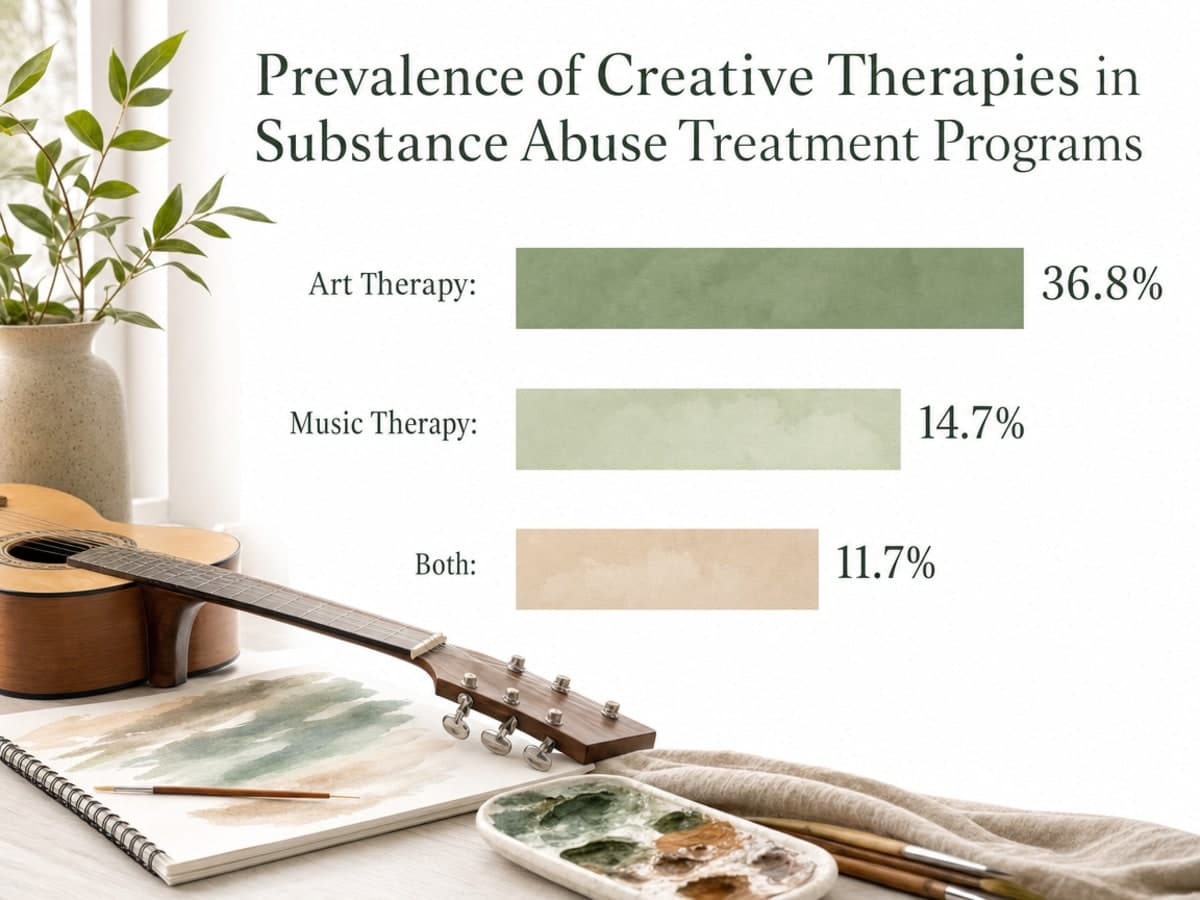
A national study of substance abuse treatment programs looked at how often facilities actually offer these therapies:
- Roughly 36.8% of programs offer art therapy.
- About 14.7% offer music therapy.
- Around 11.7% offer both 4.
That’s not fringe. That’s more than one in three programs quietly using art therapy as part of standard care, alongside detox, counseling, and medication management.
The same study found that programs using motivational enhancement therapy—a well-established, evidence-based approach for building readiness to change—were significantly more likely to offer art therapy than programs that didn’t 4. In other words, the facilities most invested in getting men engaged with treatment are the ones most likely to have a charcoal pencil or a guitar in the building.
That correlation matters. It suggests clinicians aren’t reaching for creative therapy because it’s cheap or easy to staff. They’re reaching for it because it helps get people who are ambivalent, guarded, or shut down to actually participate.
If you walked into ten residential programs tomorrow, you’d likely find art therapy on the schedule at three or four of them. The question isn’t whether serious programs use it. It’s whether the one you choose uses it well.
What the music therapy evidence actually shows
Craving down, motivation up: the 2022 meta-analysis
If you want to know whether music therapy earns its spot on a treatment schedule, this is the study to start with.
In 2022, a systematic review and meta-analysis pooled the randomized and quasi-randomized trials of music therapy for people with substance use disorders in detox and short-term rehab. The headline finding: when music therapy was added on top of standard care, patients showed a medium-sized reduction in substance craving (standardized mean difference of −0.66) and a small-to-medium increase in motivation for treatment or change (SMD of 0.41) compared with standard care alone 12.
Translate that out of statistics speak. Craving is the thing that pulls you back toward a drink or a pill when you’re three days into detox and your body is loud. Motivation is the thing that gets you to the next session, the next week, the next conversation with your counselor. Those are the two levers that decide whether early recovery holds.
Two other things matter about this review. The certainty of the evidence was rated moderate, not low—meaningful for a field where a lot of complementary approaches sit on shakier ground. And no studies reported serious adverse events 12. NCCIH’s federal summary of the same evidence reaches the same conclusion in plainer language: music therapy as an adjunct can produce moderate reductions in craving and lift motivation in detox and short-term rehab 1.
You don’t have to love the idea. The numbers hold up.
What happened when men actually showed up: a male-inpatient RCT
Meta-analyses are useful, but they pool a lot of different people. The question you probably actually want answered is narrower: what happens when men—specifically men, in an inpatient setting, being treated for alcohol dependence—get put in a room with a music therapist?
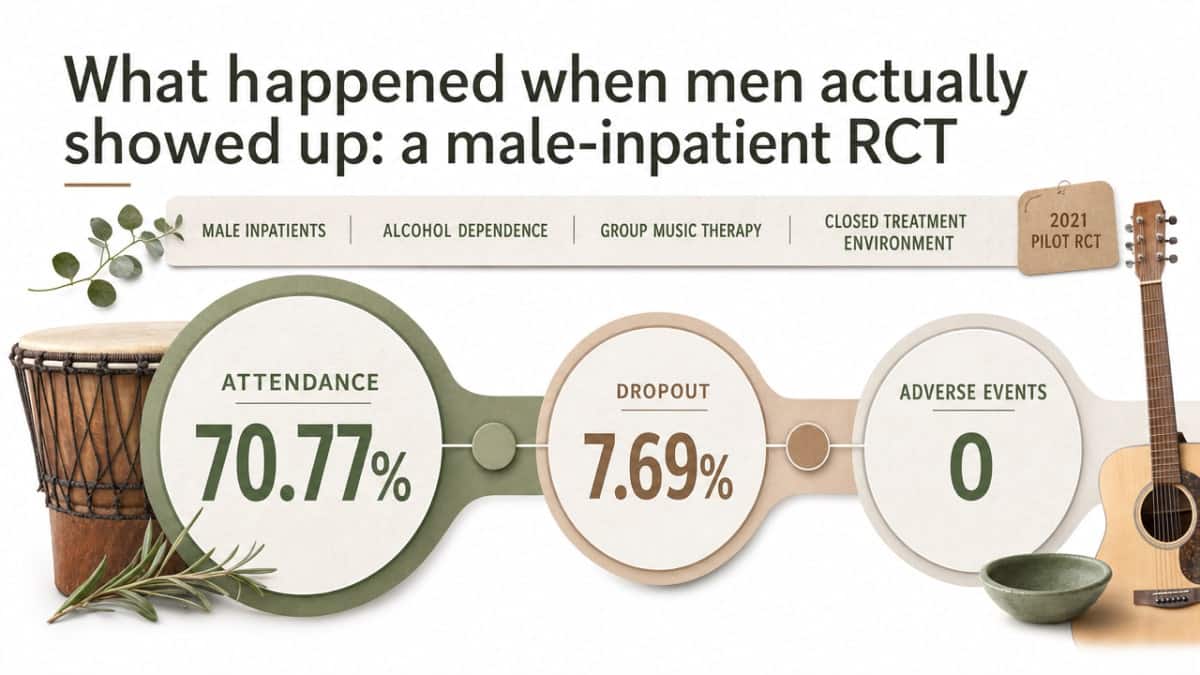
A 2021 pilot randomized controlled trial answered that directly. Researchers ran a group music therapy program built around emotion-regulation skills for male inpatients with alcohol dependence in a closed treatment environment 3. Not co-ed. Not outpatient. Men in residential care, working on the same clinical problem a lot of Serenity Park’s residents are working on.
Three numbers from that study matter more than any of the outcome measures.
- Attendance was 70.77%.
- Dropout was 7.69%.
- Zero adverse events occurred throughout the intervention 3.
Men in a locked inpatient unit—men who, statistically, walked in braced and skeptical—showed up to more than seven out of every ten sessions and almost never quit. That is the answer to the quiet question underneath all of this: will other guys actually do this, or will I be the only one sitting there feeling stupid?
Participants also reported more relaxation, better mood, and trends toward improved sleep and lower anxiety compared with controls, though the sample was too small to make those differences statistically significant 3. The authors’ conclusion was measured but clear: emotion-regulation-focused group music therapy is feasible and acceptable for men with alcohol dependence in a closed inpatient environment 3.
Feasible and acceptable is not glamorous language. It’s the language that means men actually engaged.
Where the evidence is honestly still thin
You deserve the caveats too.
The 2022 meta-analysis found no clear effect of music therapy on depressive symptoms, anxiety, or motivation to stay sober long-term, and the data on treatment retention were limited 12. An earlier systematic review, published in 2008, concluded that no consensus existed at that point about music therapy’s efficacy in addiction, given how few and how varied the studies were 13.
The picture has improved since then, but it’s not settled. Music therapy has good evidence for reducing craving and lifting near-term motivation as an add-on to standard care. It does not have good evidence that it, on its own, treats depression, prevents relapse a year out, or replaces counseling and medication.
That’s a reason to use it as one tool among several. It’s not a reason to skip it.
What art therapy does—and what it doesn’t (yet) prove
A pilot RCT: dependence, depression, anxiety, impulsivity
Music therapy has the bigger meta-analysis behind it. Art therapy’s evidence base is smaller, but the trials that exist are more interesting than the stereotype allows.
In 2023, researchers published a pilot randomized clinical trial of art therapy for patients with alcohol use disorder. The design was simple: weekly 60-minute group art therapy sessions over 10 weeks, layered on top of standard care. What made it unusual is that the team measured both sides of the mind-body ledger—psychological scales for dependence, depression, anxiety, and impulsivity, and biomedical markers including natural killer cells, addiction biomarkers, and EEG profiles 11.
The results pointed in one direction:
- Alcohol dependence scores dropped.
- Depression scores dropped.
- Anxiety dropped.
- Impulsivity—the trait that quietly drives a lot of relapse decisions—dropped too 11.
The authors concluded that art therapy was associated with effective prevention and recovery in this group.
Two caveats matter. The sample was small, which is what “pilot” means. And these are early results that need to be repeated in bigger, multi-site trials before anyone can promise you a specific outcome.
What the study does earn art therapy is a place in the room. Not as the whole treatment. As one of the tools that showed measurable movement on the exact problems men in residential care are trying to solve.
The brain-network case for art as recovery work
The other piece of the art therapy case is mechanistic. If you want to know why a charcoal stick or a lump of clay could possibly move the needle on addiction, a 2025 review of art therapy and brain networks lays it out.
The argument goes like this. Addiction hijacks the reward system, dulls attention, blunts motivation, and makes emotional regulation harder 2. Those aren’t character problems. They’re brain-network problems. Art therapy, according to this review, engages the same networks recovery depends on—reward, cognition, attention, motivation, emotional regulation, and social connection 2.
Put in plain terms: making something with your hands, deciding what color goes where, sitting with an image you don’t have words for yet—those are cognitive and emotional workouts. They ask the parts of the brain addiction quieted to come back online.
A recent clinical case-study paper says something similar from a different angle. Art helps people with substance use disorders access and express emotions and identify internal resources they didn’t know they still had 5.
None of this proves art therapy on its own cures addiction. What it does is explain why a session that looks unimpressive from the outside can matter clinically. The work is quieter than counseling. It’s not smaller.
What a session actually looks like at Serenity Park
The music therapy group: guitars, headphones, a room with a door
Picture a group room with the door closed. Six to ten men. A board-certified music therapist. Acoustic guitars leaning against chairs, a small drum kit in the corner, a set of shakers and hand percussion in a bin, and a stack of headphones for the guys who’d rather listen than play.
Nobody hands you sheet music. Nobody makes you sing.
At Serenity Park, a music therapy session tends to open the way the male-inpatient trial designed its groups—around emotion-regulation skills 3. The therapist might put on a track and ask what it lands on in your body. Or hand out shakers and run a simple rhythm exercise so the group has something to do with its hands while people start talking. Sometimes a guy brings in a song that meant something during his drinking years and the group unpacks what it was actually saying.
The point isn’t performance. It’s giving your nervous system a way to slow down and your feelings a place to show up that isn’t a paragraph you have to say out loud.
That structure is why attendance in the male-inpatient trial ran above 70% with almost no dropout 3. Men keep coming back to rooms that don’t ask them to perform vulnerability on demand.
The art therapy group: charcoal, clay, and a prompt you can refuse
The art therapy room looks less like a classroom and more like a workshop. A long table. Charcoal, graphite, oil pastels, watercolor, a bin of clay. No easels facing the group so your work is on display. A licensed art therapist running the room.
A session usually opens with a prompt. Draw the shape of what today feels like. Build something with your hands that represents the part of you that’s tired. Pick a color for the version of yourself that started drinking, and a color for the one sitting here now.
You can refuse the prompt. You can do something else. You can sit and watch the first time.
What matters is that you’re in the room while the work is happening. The 2023 pilot RCT that measured art therapy’s impact used a similar format—weekly 60-minute group sessions over 10 weeks—and reported drops in alcohol dependence, depression, anxiety, and impulsivity by the end 11. Nobody had to be good at drawing. They had to keep showing up and keep making something.
That’s the ask. Nothing more polished than that.
How creative therapy fits with detox, counseling, and MAT
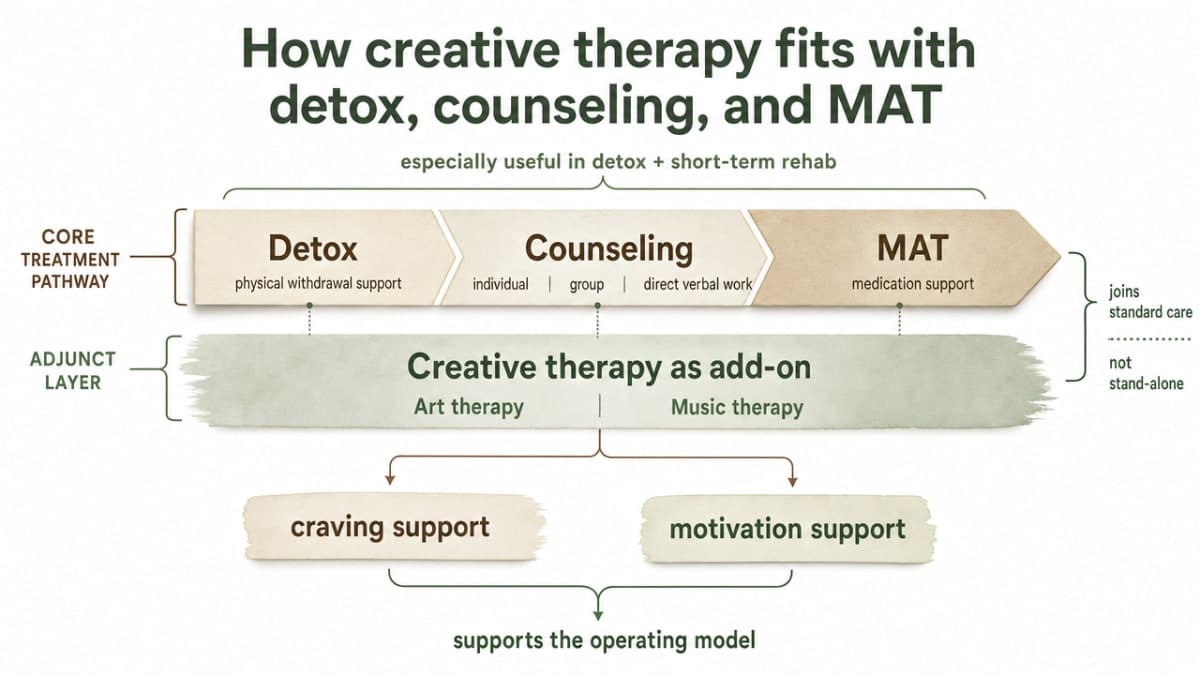
Here’s the honest framing: art and music therapy don’t replace anything. They sit next to the work that’s already doing the heavy lifting.
At Serenity Park, that layering looks concrete. Medically supervised detox and medication-assisted treatment handle the physical pull of withdrawal. Individual counseling and group therapy do the direct verbal work—looking at what you drank over, what happened at home, what you’re going back to. Psychiatric care manages depression, anxiety, or dual-diagnosis conditions running underneath the substance use.
Music therapy and art therapy fit in the gaps those approaches don’t reach as easily. When you can’t say what you feel in a counseling chair, a rhythm exercise or a charcoal sketch gives your nervous system another route 5. Arts-based approaches have also been linked to better treatment readiness and lower craving in residential contexts where pain and distress overlap 6.
Think of it as more tools on the same bench—not a swap.
More than one door into the same room
If you’ve read this far, you already know the honest version. Music therapy has real evidence behind it as an add-on for craving and motivation 1. Art therapy has a smaller, promising case built on emotion regulation and brain-network engagement 2. Neither one is a stand-alone cure. Both are legitimate ways in.
The thing worth holding onto is this: no man in recovery has to process what’s happening through only one channel.
At Serenity Park, the schedule is built that way on purpose. Medical detox and medication management handle what your body is doing. Individual counseling and group therapy handle the direct verbal work. Psychiatric care addresses depression, anxiety, or whatever’s been running underneath. Art therapy, music therapy, mindfulness, yoga, and fitness outings give you other routes when words won’t come—which, for a lot of men, is most days at first 8.
You don’t have to pick the door that scares you least on day one. You walk in, and the doors are all there.
That’s the offer. More than one way to do the work.
Frequently Asked Questions
Do I have to be good at art or music to participate?
No. Nobody is grading you. The male-inpatient music therapy trial that ran group sessions built around emotion-regulation skills didn’t require any musical background, and men still attended more than 70% of sessions 3. You can shake a percussion egg, listen with headphones, or push charcoal around a page. Showing up is the skill that matters.
Is art or music therapy a replacement for counseling or medication?
No, and any program that pitches it that way is overselling. The music therapy meta-analysis measured benefits specifically as an add-on to standard care—not as a stand-alone treatment 12. At Serenity Park, creative therapy runs alongside medical detox, medication-assisted treatment, individual counseling, group therapy, and psychiatric care. It’s an additional route in, not a swap for what’s already working.
What if I refuse to participate or want to sit out a session?
You can. In the art therapy room, refusing a prompt or sitting and watching the first time is a normal part of the process. Given how masculine norms and stigma shape whether men engage at all, forcing participation tends to backfire 9. The room is set up so being present counts—your therapist would rather have you there quietly than not there at all.
Is there real research behind this, or is it just a feel-good add-on?
There’s real research, especially for music therapy. A 2022 systematic review found moderate-certainty evidence that music therapy as an add-on to standard care reduces craving and lifts motivation for treatment 12. Art therapy’s evidence is smaller and earlier-stage, with pilot trials showing drops in dependence, depression, anxiety, and impulsivity 11and mechanistic reviews linking it to recovery-relevant brain networks 2.
Will I be in a group with women, or is it men only?
Serenity Park is a men’s residential facility, so your art and music therapy groups are men only. That matters clinically. Qualitative research on group therapy in addiction treatment found that men and women engage differently with mixed-gender and single-gender formats 7. A men-only room lowers the performance pressure and lets emotional work happen without the extra layer of who’s watching.
How do art and music therapy fit alongside detox and the rest of treatment?
They layer on top. Medical detox and MAT handle withdrawal. Counseling and group do the direct verbal work. Psychiatric care addresses depression or anxiety underneath. Creative therapies give your nervous system another route when words are hard to reach 8, and arts-based approaches have been linked to better treatment readiness and lower craving in residential care 6. More tools on the same bench.
References
- Mind and Body Approaches for Substance Use Disorders. https://www.nccih.nih.gov/health/providers/digest/mind-and-body-approaches-for-substance-use-disorders-science
- Art therapy’s engagement of brain networks for enduring recovery from addiction. https://pmc.ncbi.nlm.nih.gov/articles/PMC11743619/
- Efficacy of Group Music Therapy Based on Emotion-Regulation Skills on Male Inpatients With Alcohol Dependence: A Randomized, Controlled Pilot Trial. https://pmc.ncbi.nlm.nih.gov/articles/PMC8581445/
- The Use of Art and Music Therapy in Substance Abuse Treatment Programs. https://pmc.ncbi.nlm.nih.gov/articles/PMC4268880/
- The face of addiction through artworks based on clinical case studies. https://pmc.ncbi.nlm.nih.gov/articles/PMC13422313/
- An Integrative Review of Arts-Based Strategies for Addressing Pain and Substance Use Disorder During the Opioid Crisis. https://pubmed.ncbi.nlm.nih.gov/33942641/
- Women’s and men’s experiences in group therapy for substance use disorders: A qualitative analysis. https://pubmed.ncbi.nlm.nih.gov/34730866/
- Treatment Issues for Men – Addressing the Specific Behavioral …. https://www.ncbi.nlm.nih.gov/books/NBK144290/
- Working With Specific Populations of Men in Behavioral …. https://www.ncbi.nlm.nih.gov/books/NBK144297/
- ‘It Puts You at Odds With Society’: Masculinity and Men’s Experiences of Mental Illness Stigma. https://pubmed.ncbi.nlm.nih.gov/42172189/
- A pilot randomized clinical trial of biomedical link with mental health in art therapy intervention programs for alcohol use disorder: Changes in NK cells, addiction biomarkers, electroencephalography, and MMPI-2 profiles. https://pmc.ncbi.nlm.nih.gov/articles/PMC10162529/
- Music therapy for people with substance use disorders. https://pmc.ncbi.nlm.nih.gov/articles/PMC9082681/
- Music therapy for the treatment of patients with addictions – a systematic review. https://pubmed.ncbi.nlm.nih.gov/19042198/
- Identifying Attitudes and Beliefs of College Students Toward Art Therapy. https://dash.harvard.edu/server/api/core/bitstreams/da4cfa15-e2cc-40d6-b934-32df14c42ff3/content