
Key Takeaways
- Men typically enter treatment with thinner social networks and lower perceived support than women, making isolation the starting condition rather than a side effect of using.2
- Three measurable variables drive men’s recovery: network composition weighted toward sober peers, group cohesion tight enough to make honest disclosure possible, and shared prosocial activity.4,13,14
- Residential and shared housing outperform outpatient care for men because proximity dissolves the posturing tax — one close relationship formed inside an Oxford House cut relapse probability nearly five-fold.17
- The work doesn’t end at discharge; alumni continuity and layered friend and 12-step support independently predict more abstinent days in the year following treatment.19
The Man With 400 Contacts and No One to Call
You know the feeling, even if you’d never say it out loud. Your phone is full. Your calendar is full. There are people who would take your call at any hour — for a deal, for a favor, for a drink. And there is no one, not really, who knows what’s actually happening at 11 p.m. on a Tuesday when you’re pouring another one and telling yourself it’s the last.
That gap between the visible life and the private one is the thing. It’s not a character flaw. It’s not weakness. It’s the specific loneliness of a competent man who has spent years being the person other people lean on. You built a life where asking for help would cost you something — standing, maybe, or the story you tell yourself about who you are.
So the drinking, or the pills, or whatever it is, becomes the thing you do alone. Late. With the door closed. And the more it grows, the smaller the circle of people who could actually know about it becomes.
Here’s what the research keeps showing, quietly and without drama: men arrive at treatment with less social support than women do, on average, and often with a network that either doesn’t know about the problem or is part of it. The 400 contacts don’t help. What helps is a small number of men who understand, without needing the whole story, what you’re carrying.2
That’s what this piece is about. Not the marketing word brotherhood. The actual mechanism underneath it — and why, in early sobriety, it does work you can’t do alone.
Why Men Arrive More Alone Than They’ll Admit
The isolation is usually there long before the drinking gets bad. It just gets easier to see once the drinking hides it.
A 2024 study of adults in U.S. substance use treatment measured perceived social support at intake and found that men reported significantly lower support than women across the board. That’s not a footnote. That’s the starting line. The men walking into treatment, on average, showed up with less of the thing the research keeps naming as one of the strongest predictors of staying sober — people who actually know them, who they’d let close enough to tell the truth to.2
The same study noted that food insecurity dragged men’s support scores down further. Which is to say: the men who were struggling on more than one front were the ones with the fewest hands to hold onto. If you’re the high-functioning version — the guy whose bills are paid and whose calendar looks impressive — the numbers still apply to you, just wearing a nicer suit. The support gap isn’t about resources. It’s about relational depth.2
Think about who you’d actually call. Not who’d pick up. Who would you let hear you when your voice was doing that thing it does when you haven’t slept and you’re scared. For a lot of men, the honest answer is a very short list. Sometimes no one.
Part of this is how you were built. The masculinity research is blunt about it: men delay asking for help because asking for help conflicts with the story of independence and control most of us were handed as boys 10. You learned early that competence was the price of belonging. So you got competent. And then, quietly, you got alone.
Here’s the part worth sitting with. The isolation isn’t evidence that something’s wrong with you. It’s evidence of how the game was set up. Men in treatment often begin from a position of thinner networks and higher stigma around admitting struggle — which means the first job of any serious recovery environment isn’t to teach you a new coping skill. It’s to put you in a room with other men who understand, without needing the whole story, why the door was closed in the first place.2,10
That’s not a soft observation. That’s the clinical baseline. You can’t rebuild what you never got to name.
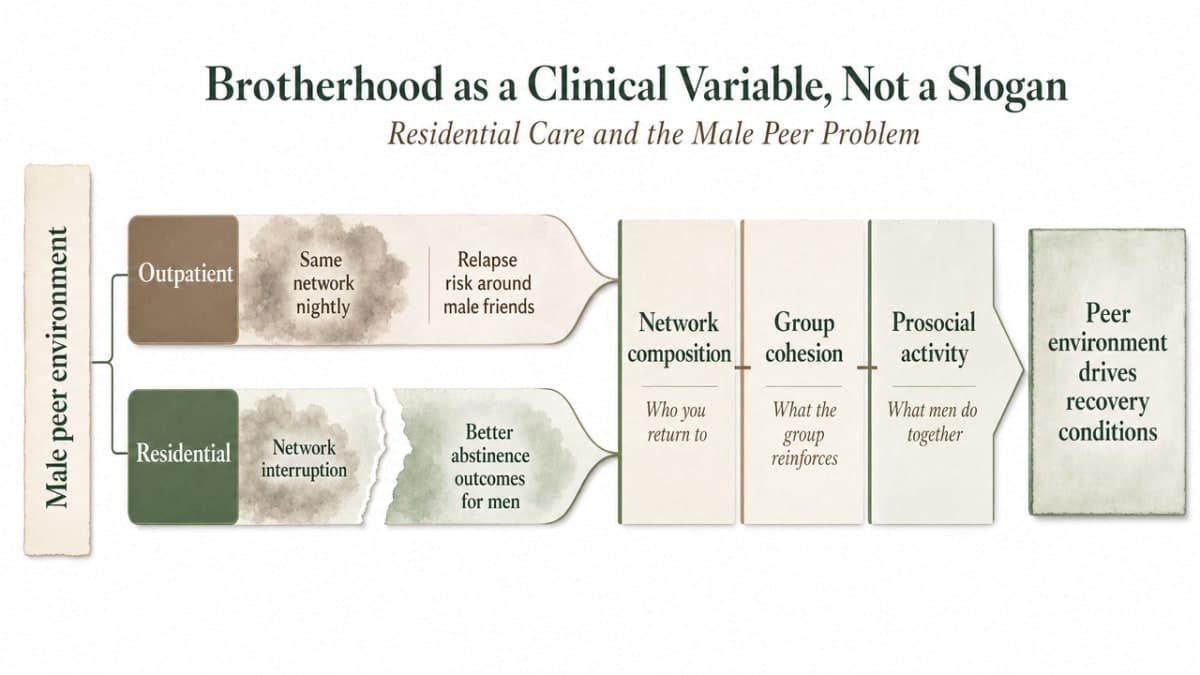
Brotherhood as a Clinical Variable, Not a Slogan
Residential Care and the Male Peer Problem
Here’s a finding worth pausing on. When researchers compare treatment settings by gender, residential care is associated with significantly better abstinence outcomes for men than outpatient care — and in the same body of evidence, men’s relapses are more likely to happen around male friends than around romantic partners. Read that twice. The peer environment isn’t a background variable. For men, it’s close to the whole story.8
Which puts something uncomfortable on the table. The guys you drink with, the guys you use with, the guys who wouldn’t think anything of a Wednesday night that turns into a Thursday morning — they’re not the reason you got here, but they’re a reason it’s hard to leave. Outpatient care sends you home to that network every night. Residential care doesn’t. That’s the structural difference, and for men, the numbers say it matters.
It isn’t about willpower. It’s about proximity. A moderate-quality body of evidence supports residential treatment as a setting where multiple outcomes improve compared with pretreatment functioning, and the mechanism most consistently named across studies is what happens between residents, not just what happens between resident and clinician.7
A male-only residential setting takes this one step further. It doesn’t just remove you from the network that formed around your using. It replaces it, for a while, with a network that formed around getting out of it. Twenty men, more or less, in one house. Same kitchen. Same schedule. Same reason for being there. You don’t have to explain yourself in a way you would around people who’ve never had to think about any of this.
The problem residential care is solving, for men specifically, isn’t just the substance. It’s the room the substance lives in.
What Brotherhood Actually Does That Willpower Can’t
Strip away the language for a second. What is a male-only recovery community actually doing to you, mechanically, that you couldn’t do on your own with enough discipline?
Three things, mostly. Each of them shows up in the research as an independent predictor of whether men stay sober.
The first is network composition. A study of men in substance use treatment found that having more recovery-oriented peers in your social network predicted lower substance use during and after treatment, while networks dominated by using peers predicted worse outcomes. That sounds obvious on paper. In practice, it’s the thing you can’t engineer alone. You don’t build a sober peer group from scratch by reading a book about it. You build it by being in a room with men who are also building one, day after day, until the ratios of your life quietly change.13
The second is group cohesion. Research on therapy groups and 12-step involvement shows that higher cohesion within a group — the felt sense that these are your people, that they’ll notice if you’re not there — predicts better abstinence outcomes and fewer substance-related problems over time. Cohesion isn’t sentiment. It’s a measurable property of a group, and it’s the thing that makes honest disclosure possible. You’ll say things in a group that has cohesion that you would never say in a group that doesn’t. And what you say, out loud, in front of other men, changes what you’re able to do the next week.14
The third is prosocial activity. The recovery capital research on men found that strengths tied to shared, meaningful activity — the mundane stuff, the group tasks, the outings, the projects — are especially strong predictors of recovery capital growth for men specifically. Women, in the same study, gained recovery capital across a broader range of domains. Men gained it most through doing things with other men. That’s not a metaphor. That’s the finding.4
Put those three together and you have something more useful than the word brotherhood by itself. You have a peer network that leans toward sobriety, a group tight enough to hold you to it, and a set of shared activities that give the whole thing something to be about besides not drinking. That’s the mechanism. When people who’ve been through it say the community is what saved them, this is what they’re pointing at, even if they don’t have the vocabulary for it.
None of it replaces the clinical work. But the clinical work, on its own, without the peer environment doing its part, is a smaller lever than most men entering treatment realize.
The Posturing Tax: What a Male-Only Room Removes
Put a man in a room where he thinks he’s being evaluated and watch what happens to what he says. The voice drops a little. The story gets edited. The parts that would make him look like less get sanded down before they leave his mouth. This is not a moral failing. It’s what men learned to do a long time ago, and most of us are so good at it we don’t notice we’re doing it.
Call it the posturing tax. It’s the energy you spend, every time you’re in a group, keeping a version of yourself intact. In mixed company — mixed gender, mixed status, mixed reason for being there — the tax goes up. The masculinity research is direct about this: men delay treatment and edit their disclosures in settings where vulnerability feels like it costs something. And in early sobriety, when the truth is often ugly and unresolved, that editing is the difference between a group that works and a group that doesn’t.10
A male-only room doesn’t magically dissolve the tax. But it lowers it. When every other man in the circle is also here because his drinking or using got away from him, the field flattens. Nobody in that room needs you to be the competent one. Nobody’s impressed by your resume, and nobody’s going to be more impressed if you clean up the story. What replaces the performance, slowly, is something closer to accuracy — the actual chronology of how bad it got, said out loud, in front of men who won’t flinch.
The room isn’t smaller because the group is smaller. It’s smaller because there’s less to hide.
What Shared Housing Actually Does
There’s a difference between going to treatment during the day and living in it. You feel it in the first week. The clinical hours end, and instead of driving home to the couch where you used to drink, you walk down a hallway to a kitchen where somebody else is making eggs at 10 p.m. because he couldn’t sleep either. That’s not a program feature. That’s the mechanism.
The research on shared sober housing is more concrete than most people realize. In a multilevel analysis of 229 residents across 42 recovery homes, living in an Oxford House for at least six months was associated with higher abstinence self-efficacy, a larger sober network, and better employment outcomes — and forming even a single relationship inside the house reduced the probability of relapse nearly five-fold. Read the last part slowly. Not a program completion. Not a therapeutic breakthrough. One relationship, formed in the house, with another man who lives there. That’s the variable that moved the number.17
Think about what that implies. The clinical work matters — nobody in the research is arguing otherwise. But the thing predicting whether you’re still sober a year later isn’t the number of groups you sat through. It’s whether, somewhere in that house, you let one guy get close enough to actually know you. Just one.
Shared housing does something outpatient care structurally cannot. It compresses the distance. You eat with these men. You do dishes with them. You see them at 6 a.m. before anyone’s put their face on, and you see them at 11 p.m. when the day’s been a long one. That kind of proximity is where the fake versions of yourself run out of gas. You cannot hold a curated identity together across a shared kitchen for thirty days.
The Oxford House long-term data reinforces the same point: peer-based sober living homes are associated with sustained abstinence and better functioning compared with standard aftercare, and the protective mechanism named across studies is the shared responsibility of the house itself. Cooking. Cleaning. Showing up to the meeting because your name is on the list and other men are counting on you. The mundane stuff is the medicine.12
What shared housing actually does, when it works, is put you back inside the ordinary rhythms of a life — but with different men in the room. That’s the whole trick.

How Brotherhood Shows Up in the Room
It doesn’t announce itself. Nobody stands up on day three and says, welcome to the brotherhood. What actually happens is quieter, and it happens in the ordinary moments between the clinical hours.
It shows up when a guy you’ve barely spoken to notices you didn’t eat breakfast and pushes a plate across the table without making a thing of it. It shows up when the group has been sitting in silence for a minute after somebody said the true version of what happened at home, and another man clears his throat and says yeah, me too, and the room exhales. It shows up in the ride back from an outing, in the front seat, when the conversation drops a layer because there’s no audience.
Peer-delivered recovery support — the informal work men do for each other alongside the clinical staff — is associated with better engagement and reduced substance use across the evidence base. That’s the research language for a thing you can feel by week two. You start listening for someone else’s name in the schedule. You notice when he’s not there.15
What you’re building, without particularly trying, is relational health — the kind of reciprocal, honest connection that predicts better substance use outcomes in adults in recovery. Not friendship in the Instagram sense. Something older. Men who’ve seen each other on the worst morning of the month and stayed in the room.16
You won’t call it brotherhood while it’s happening. You’ll just notice, one Thursday, that the guys around you know things about you that nobody in your outside life does — and that you haven’t had a drink in a while.
The People Who Stay: Alumni, Continuity, and the Long Tail
The men who came before you are the part of the program nobody thinks to ask about on the intake call. But they’re the reason it holds.
Ninety days ends. Then what. This is the question most men don’t ask out loud because the answer is uncomfortable — the clinical container closes, and if nothing else has taken its place, the old peer network is still there, waiting, largely unchanged. That’s why the alumni piece isn’t sentimental. It’s structural. The men who finished six months ago, a year ago, three years ago — the ones who still show up for the Saturday meeting, who take the phone call at 9 p.m., who remember what week two felt like — are the bridge between the house and the rest of your life.
The research on continuing care makes the point plainly. In a study of 489 adults in continuing care, greater friend support and higher 12-step involvement each independently predicted more days abstinent in the year following treatment. Not one or the other. Both, layered. The friend support in that study wasn’t abstract — it was a network shift, from people around the old life to people around the new one. Alumni are what that shift looks like in practice for a man who leaves residential care and still needs someone who understands what he walked out of.19
What you’re inheriting, if the house does this part right, isn’t a mailing list. It’s a small line of men who’ve already answered the questions you’re about to face — the first wedding with an open bar, the first bad quarter, the first Sunday night when the old pattern would have been a drink. They pick up. That’s the long tail. That’s the part of the work you don’t finish; you join it.

Increased odds of Digital Recovery Support Services (D-RSS) use for men with <1 year of recovery
What Serenity Park Looks Like From the Inside
Twenty men, give or take. One house in Little Rock. That’s the whole footprint. Not because small is a marketing angle, but because a room this size is what makes the mechanism work — you cannot hide in a group of twenty the way you can in a group of a hundred, and the men around you learn your name and your tells inside a week.
The rhythms are ordinary on purpose. Shared meals. Shared chores. Group therapy in the morning, one-on-one work through the day, meetings in the evening, and the unstructured hours in between that turn out to be where most of the real conversations happen — on the porch, in the kitchen, on the drive back from a group outing when nobody’s performing anymore. That mix of shared living, structured clinical work, and prosocial activity is the same pattern the research keeps pointing at when men’s recovery capital actually grows.4
You’ll meet men who finished six months ago and still come back for the Saturday meeting. You’ll meet the guy in bed nine who checked in a week before you did. Neither of them needs the sanitized version of your story. That’s the culture. Not a slogan on a wall — a room where the posturing tax finally drops to zero, and what’s left is the work, and the men doing it with you.
You don’t complete Serenity Park. You join something, and then you keep showing up.
Frequently Asked Questions
Why does a male-only environment matter in residential treatment?
Men in mixed settings tend to edit themselves — the story gets shorter, the ugly parts get smoothed. Research on masculinity and help-seeking finds that men delay treatment and hold back disclosure when vulnerability feels like it costs standing. A male-only room lowers that cost. Everyone in the circle is here for the same reason, which makes the honest version of the story easier to say out loud.10
Is brotherhood in recovery just marketing language, or does it reflect something clinical?
It reflects measurable things. Network composition — how many recovery-oriented peers you have — independently predicts substance use outcomes for men in treatment. Group cohesion, the felt sense that these are your people, predicts abstinence over time. Brotherhood is the shorthand for those variables working together. The word is soft. The mechanism underneath it — who’s around you, and how tight the group is — is not.13,14
I have plenty of friends and colleagues. Why would I need a new peer group to get sober?
Because most of those relationships weren’t built to hold this. A 2024 study found men enter treatment reporting significantly lower social support than women, even when their outside lives look full. Contacts aren’t the same as depth. And for men specifically, relapse is more likely to happen around male friends than around partners — which means the peer network isn’t neutral. It’s part of the terrain.2,8
What actually happens in shared housing that makes it different from outpatient care?
Proximity. Outpatient sends you back to the same kitchen every night. Shared housing puts you in a different one — with men who understand the hour and the reason. Long-term data on Oxford House residents shows sustained abstinence and better functioning tied to shared responsibility inside the home. The mundane part — cooking, chores, the 6 a.m. version of each other — is where the work sticks.12
I’m private and skeptical of group work. Will I be forced to share things I’m not ready to share?
No one hands you a script on day one. What the research keeps showing is that disclosure follows cohesion, not the other way around — men open up when the group has earned it. You’ll listen before you speak. You’ll notice which men flinch and which don’t. By the time you say the harder thing, it won’t feel like a performance. It’ll feel like a Tuesday.14
What happens to these relationships after treatment ends?
They become the continuing-care piece nobody puts on a brochure. In a study of 489 adults in continuing care, greater friend support and higher 12-step involvement each independently predicted more days abstinent in the year after treatment. The men you meet in the house — and the alumni who still show up for the Saturday meeting — are what that support looks like once the clinical container closes.19
References
- Sex differences in social support and self-efficacy within a recovery community. https://pubmed.ncbi.nlm.nih.gov/16389499/
- Social Support and Associated Factors Among Men and Women in Pre-COVID Substance Use Treatment. https://pubmed.ncbi.nlm.nih.gov/38108980/
- Gender differences in lifetime and current use of online support for recovery from alcohol use disorder. https://pmc.ncbi.nlm.nih.gov/articles/PMC9246832/
- Differences in addiction and recovery gains according to gender – gender barriers and specific differences in overall strengths growth. https://pubmed.ncbi.nlm.nih.gov/35287696/
- Men and women who attend Al-Anon: gender differences in reasons for attendance, health status and personal functioning, and drinker characteristics. https://pubmed.ncbi.nlm.nih.gov/25245105/
- Controlled Trial Examining the Strength-Based Grit Program for Adolescents in Residential Substance Use Treatment. https://pubmed.ncbi.nlm.nih.gov/36360714/
- The effectiveness of residential treatment services for individuals with substance use disorders: A systematic review. https://pubmed.ncbi.nlm.nih.gov/31254749/
- Treatment Modalities and Settings (Substance Abuse Treatment: Addressing the Specific Needs of Women). https://www.ncbi.nlm.nih.gov/books/NBK144286/
- Outcomes of a comprehensive treatment program for adolescents with a substance-use disorder. https://pubmed.ncbi.nlm.nih.gov/11516589/
- Men, masculinity, and help-seeking: Implications for addiction treatment. https://pubmed.ncbi.nlm.nih.gov/25922169/
- Recovery capital in males and females with substance use disorders. https://pubmed.ncbi.nlm.nih.gov/31008965/
- Long-term outcomes of Oxford House recovery homes. https://pubmed.ncbi.nlm.nih.gov/29282414/
- Social networks, social support, and substance use among men in treatment. https://pubmed.ncbi.nlm.nih.gov/27532677/
- Group cohesion and 12-step participation as predictors of substance use outcomes. https://pubmed.ncbi.nlm.nih.gov/25535045/
- Peer-delivered recovery support services for individuals with substance use disorders: A systematic review. https://pubmed.ncbi.nlm.nih.gov/27246790/
- Relational health, social support, and substance use outcomes in adults in recovery. https://pubmed.ncbi.nlm.nih.gov/30489646/
- The Importance of Social Support in Recovery Populations: Toward a Multilevel Understanding. https://pmc.ncbi.nlm.nih.gov/articles/PMC10259869/
- Investigating Social Support and Network Relationships in Substance Use Disorder Recovery. https://pmc.ncbi.nlm.nih.gov/articles/PMC4375072/
- Effects of Social Support and 12-Step Involvement on Recovery Among People in Continuing Care for Cocaine Dependence. https://pmc.ncbi.nlm.nih.gov/articles/PMC6803054/