
Key Takeaways
- Men often channel grief into heavier drinking, overwork, or irritability rather than mourning, and bereavement is consistently linked to escalated alcohol and drug use after a loss 6, 8.
- When grief becomes chronic or prolonged, it drives co-occurring substance use that rarely resolves through detox alone, since the underlying loss keeps generating the distress substances were used to mute 1, 9, 11.
- Arkansas recorded 372 overdose deaths in 2025, and rural areas often lack clinicians trained in both complicated grief and addiction, making integrated residential care in Little Rock a practical option 14, 16.
- Residents weighing treatment can look for programs that screen for loss at intake, use Complicated Grief Treatment components, and protect confidentiality under 42 CFR Part 2 and HIPAA 10, 13.
When Drinking Escalates After Loss
Think back to when your drinking or drug use increased. Was it after a significant loss—a funeral, a divorce, a difficult phone call? If you can pinpoint a time, you might already recognize a connection that many men don’t articulate: your substance use didn’t appear randomly; it followed a loss.
You might not have identified it as grief. Men often label it as stress, a rough patch, or a phase. You might have told yourself you were managing it, maintaining your responsibilities at work and home. The increased drinking or pill use felt like a necessary cost to keep everything else intact.
Research consistently shows a link between bereavement and increased alcohol and drug use. Men, in particular, are more prone to escalate substance use after a significant loss compared to women, often avoiding discussion about it 6, 8. Societal expectations for men often channel grief into alcohol, overwork, or silence instead of professional counseling 12.
This isn’t a sign of weakness; it’s a predictable pattern documented in clinical literature for decades. It suggests that the origin of your substance use might not be the substance itself, but rather the loss you experienced.
This article explores how grief-focused addiction treatment addresses this underlying connection in Arkansas, demonstrating why treating the loss beneath the drinking can lead to lasting change that willpower alone cannot achieve.
How Grief Manifests in Men
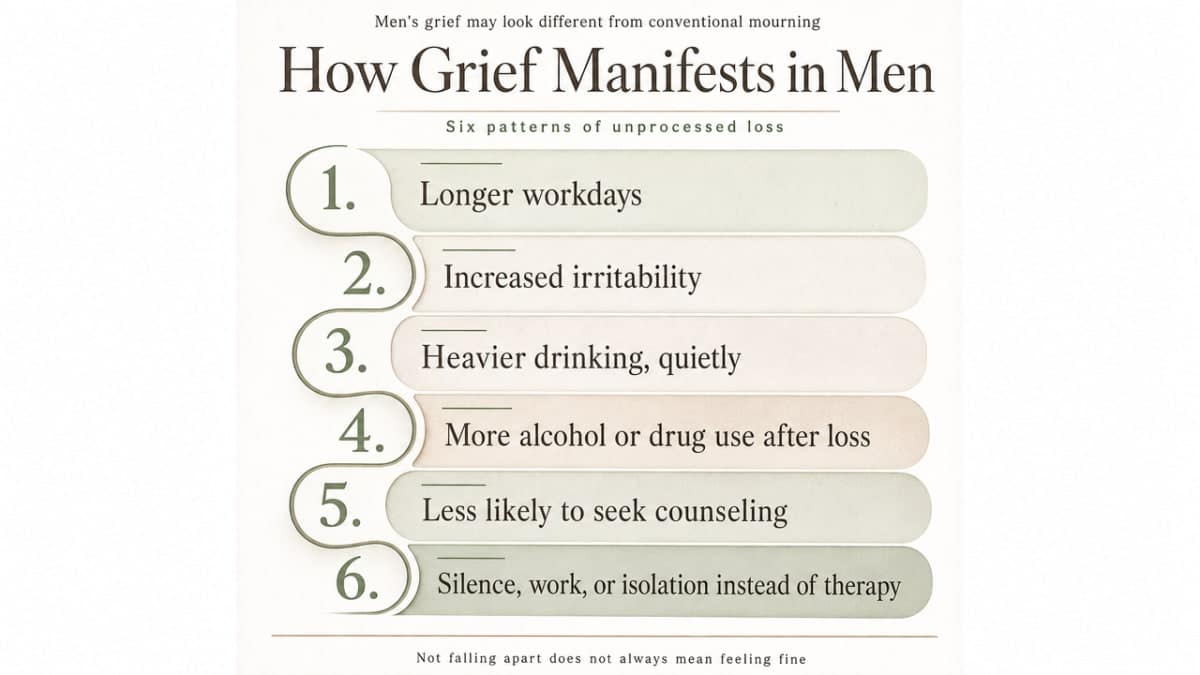
Grief in men often doesn’t resemble conventional mourning. Instead of tears or emotional breakdowns, it might appear as longer workdays, increased irritability, or a heavier pour at night. The common perception of grief—intense sadness or withdrawal—often doesn’t align with how men experience it.
This discrepancy can lead many men to overlook their own grief. If they haven’t “fallen apart,” they might believe they are fine. However, studies indicate that men are more likely than women to increase alcohol and drug use after a significant loss and less likely to seek counseling. This is largely due to societal norms that encourage men to “handle it” silently, channeling grief toward substances, work, or isolation rather than therapy 8, 12.
Six common patterns emerge in men dealing with unprocessed loss:
- Heavier drinking, quietly: The amount consumed increases, often unnoticed by others, but recognized by the individual.
- Working past exhaustion: Over-engagement in work becomes a distraction, providing an escape from stillness and reflection.
- Irritability and anger: Minor frustrations trigger disproportionate reactions, indicating underlying emotional distress.
- Withdrawal from family: Physical presence without emotional engagement, leading to feelings of disconnect from loved ones.
- Sleep collapse: Difficulty falling or staying asleep without substances, or waking in the early hours with unidentifiable emotional turmoil.
- The “I’m fine” facade: A superficial declaration of well-being that masks deeper unresolved issues.
These behaviors are not character flaws but rather the forms grief takes when it’s not acknowledged or processed. For men, these coping mechanisms can inadvertently lead to substance use problems 8, 12.
Recognizing these patterns provides valuable insight, suggesting that substance use may be serving an unacknowledged purpose related to loss.
The Loss Fueling Substance Use
Substance use often serves a specific function: it mutes pain. For many men, this pain stems from a loss. Sometimes the connection is clear, like increased drinking after a parent’s death. Other times, it’s more subtle, such as a gradual increase in alcohol consumption after a divorce, where the link isn’t immediately obvious. Loss can also be less conventionally defined, like a child’s estrangement, the death of a close friend, or the inability to perform activities that once defined one’s identity.
Clinically, this connection is significant. Unresolved grief, much like unresolved trauma, can drive self-medication, with substances becoming a tool to manage overwhelming feelings 11. When grief becomes chronic—diagnosed as complicated grief or prolonged grief disorder—the likelihood of co-occurring substance use problems increases 1, 9. Depression often mediates this link, creating a cycle where drinking initially used to “take the edge off” exacerbates mood problems, which in turn fuels further drinking 7.
This creates a detrimental cycle: a loss occurs, leading to coping mechanisms like increased substance use. These coping strategies eventually cause more problems, intensifying negative feelings and driving further substance use. Meanwhile, others may only perceive the substance use, not the underlying loss.
This dynamic explains why treating only the substance often fails. Individuals may complete detox and therapy but still carry the original emotional wound. The urge to return to substances isn’t a lack of willpower; it’s the unresolved wound seeking its familiar, albeit harmful, coping tool.
Treating Grief as a Clinical Target
There’s a crucial distinction between typical grief, which eventually subsides, and grief that becomes chronic or “stuck.” While most individuals navigate the former, some experience the latter, necessitating a different approach to treatment.
Clinicians refer to this persistent form as complicated grief or, more recently, prolonged grief disorder. It’s characterized by intense, unremitting longing, preoccupation with the deceased or the loss, difficulty accepting the reality of the situation, and significant functional impairment that persists for months or even years 9. This is distinct from ordinary sadness or depression, though depression often co-occurs 7. It requires specialized intervention.
When grief reaches this chronic level, the risk of developing co-occurring substance use problems increases, and these substance issues become harder to treat if the grief remains unaddressed 1, 9. Some experts view unresolved loss as a form of untreated trauma, continuously generating distress that substances are used to quiet 11. Removing the substance without addressing the underlying grief is akin to taking away a tool without understanding its purpose.
The clinical strategy involves treating grief not as a fleeting emotion, but as a specific clinical target. This means actively screening for grief during intake at a residential program, rather than waiting for the individual to bring it up. It involves identifying the nature of the loss, assessing for complicated or prolonged grief, and integrating this into the treatment plan, similar to how depression, anxiety, or trauma would be addressed.
At Serenity Park, this framework is central to the residential program in Little Rock. Grief is considered an integral part of the clinical picture from the outset. If grief is driving substance use, treating it merely as a temporary mood overlooks its profound impact. Addressing it as a clinical target provides a foundation for effective and lasting recovery.
Components of Grief-Focused Addiction Treatment
Grief-focused addiction treatment is a structured clinical process designed to alter the relationship between loss and substance use, preventing grief from continually leading back to addiction.
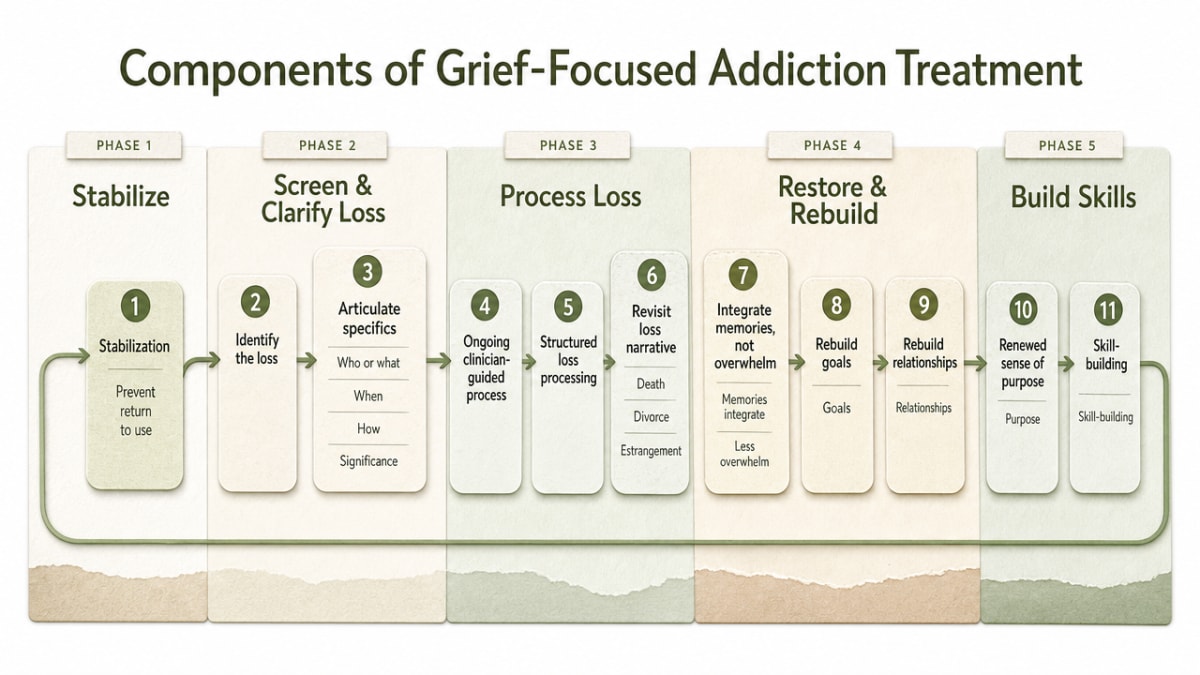
This treatment involves several key components:
- Identifying and articulating the specifics of the loss—who or what was lost, when, how, and its significance. This is not a one-time discussion but an ongoing process with a trained clinician who guides the individual through difficult emotions.
- Structured loss processing, where the narrative of the loss (e.g., death, divorce, estrangement) is revisited in a way that helps memories integrate rather than overwhelm.
- Clinicians focus on restoration, helping individuals rebuild goals, relationships, and a renewed sense of purpose, particularly for men who may have lost roles central to their identity.
- Equipping individuals with skills to manage grief outside of therapy sessions, ensuring that intense emotional waves don’t automatically trigger substance use 10.
The evidence-based approach, known as Complicated Grief Treatment (CGT), has demonstrated significant positive effects on grief symptoms in various studies 10. Integrating this grief-focused work with substance abuse treatment is crucial.
A pilot study combining motivational interviewing with complicated grief therapy for individuals with both complicated grief and substance dependence showed promising results: a significant increase in days abstinent and a notable decrease in cravings by the end of treatment 15. While a pilot study, it highlights that explicitly treating grief as a clinical target can positively impact substance use outcomes.
The core principle is that by addressing the underlying emotional function that substances serve, the power of those substances diminishes.
Practically, this treatment is phased. The initial stages of residential care prioritize medical stabilization, education about grief’s impact on the body and brain, and screening for specific losses. Intensive grief work is typically deferred until individuals are medically stable and have established foundational coping skills 2, 13. Deeper processing occurs once this foundation is secure, within a supportive program environment.
This phased approach ensures that grief-focused addiction treatment is a practical and effective plan, not just a concept.
Addressing Loss in Arkansas
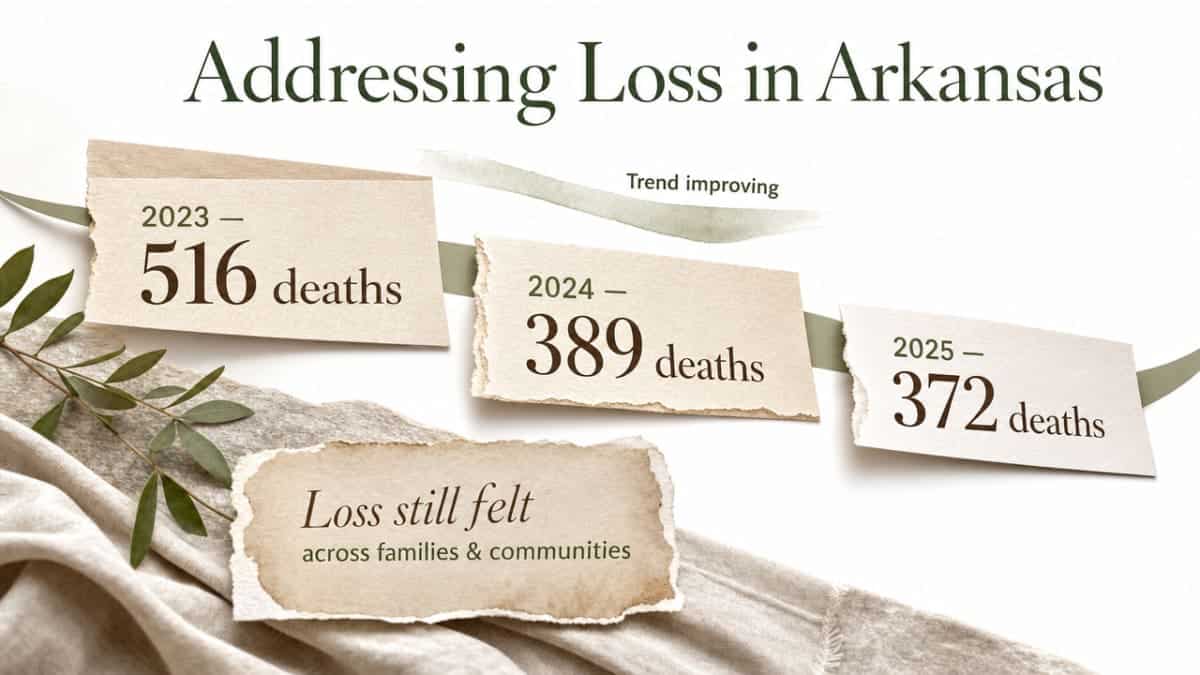
For residents of Arkansas, personal loss often intersects with broader community experiences. The state has faced significant challenges with drug overdoses, with 372 deaths in 2025, 389 the previous year, and 516 in the year before that 16. While these numbers show a positive trend, each statistic represents a profound loss—a father, son, brother, or friend—leaving behind a ripple effect of grief within families and communities.
You may be directly affected by such a loss, which could be contributing to increased substance use. Alternatively, you might be struggling with a different form of loss—a parent, a marriage, a job, or a past version of yourself—and your family may be concerned about your well-being.
Arkansas also presents challenges in accessing specialized grief support. Research indicates higher rates of post-loss alcohol and sedative misuse in rural areas with limited specialized grief services 14. In many parts of the state, finding a therapist trained in complicated grief who also understands addiction can be extremely difficult, often leading individuals to self-medicate.
This underscores the importance of residential programs like Serenity Park in Little Rock. While Arkansas offers state-funded behavioral health services and trauma resources 3, 4, 5, a residential setting provides concentrated, integrated care for men who are outwardly functional but struggling with unacknowledged loss and escalating substance use. It offers a focused environment where both grief and substance use are addressed by the same team, within a timeframe that is manageable.
The impact of loss is deeply personal, and the response to it should be equally direct and comprehensive.
Residential Treatment at Serenity Park
Upon entering Serenity Park, the initial focus is on medical stabilization. For individuals with heavy alcohol, opioid, or benzodiazepine use, safe detoxification is paramount. Medically-supervised detox addresses physical symptoms like tremors, sleep disturbances, and blood pressure, creating a stable foundation before other therapeutic work begins. Clinicians emphasize that intensive grief work is not initiated during this early phase, as it can destabilize someone still adjusting to sobriety. Instead, the focus is on stabilization, education, and initial screening 2, 13.
Grief is explicitly addressed during the screening process. Serenity Park’s intake includes a thorough review of loss history—identifying who or what was lost, when, how, and its impact on substance use. If the patterns align with complicated or prolonged grief, this becomes an integral part of the individualized treatment plan 13.
The treatment week is structured to include individual counseling, where grief work is paced by a clinician. Group therapy provides a supportive environment with other men who share similar experiences of loss. Psychiatric care addresses co-occurring conditions like depression or anxiety that often accompany grief 7. Core components of Complicated Grief Treatment—loss processing, restoration work, and emotion regulation skills—are integrated as the clinical foundation strengthens 10.
The setting at Serenity Park is designed for focused care, accommodating up to 20 men in Little Rock. Wearable monitoring technology (Huml Health) tracks physiological data like sleep, heart rate, and stress, providing the clinical team with insights into physical well-being between sessions. This data is particularly valuable as grief work deepens, allowing the team to adjust care as individuals navigate intense emotions.
Towards the end of the stay, the focus shifts to discharge planning, including 12-step integration, aftercare strategies, alumni support, and ongoing care groups. This ensures that the grief work continues beyond the residential program, supporting sustained recovery.
Professional Continuity: Time, Discretion, and Cost
Concerns about taking time away from professional responsibilities are common. Residential care, however, operates within a defined timeframe. Serenity Park’s program, with its small census, ensures that intake, clinical sessions, and discharge planning are efficiently coordinated. For many, the choice isn’t between 30 days of treatment and no treatment, but between 30 days now and potentially years of worsening substance use driven by unaddressed grief 2.
Regarding discretion, federal patient privacy laws (42 CFR Part 2 and HIPAA) strictly limit what a treatment center can disclose without explicit written consent. Serenity Park maintains confidentiality, meaning employers, colleagues, and extended family are not informed of your presence. The decision of what to communicate about your time away is entirely yours, to be made on your own timeline.
While residential treatment involves a financial investment, it’s important to consider the long-term costs. Clinical research suggests that treating substance use without addressing underlying grief often leads to repeated treatment episodes, which ultimately incur greater financial, temporal, and functional costs than a comprehensive program that tackles the root cause 11, 13. The true question isn’t just the cost of 30 days, but the potential cost of years if grief continues to fuel addiction.
Frequently Asked Questions
Is increased drinking after a significant death a grief problem or a drinking problem?
It’s typically both, and attempting to separate them often perpetuates the cycle. Bereavement is consistently linked to increased alcohol use, with men often escalating drinking after a loss instead of discussing it 6, 8. If drinking intensified after a death, it’s likely serving a function related to grief. Treating one without addressing the other leaves the underlying issue unresolved.
If years have passed since the loss, can grief still be a contributing factor?
Yes. When grief becomes chronic, it doesn’t diminish with time. Prolonged grief disorder is characterized by persistent intense longing and functional impairment that can last for months or years after the loss, often co-occurring with substance use disorders 9. If substance use began after a loss years ago and has never truly subsided, the loss is likely still a driving force. The passage of time does not automatically heal an unaddressed wound.
Can I receive residential treatment in Arkansas without my employer or coworkers knowing?
Yes. Federal patient privacy laws (42 CFR Part 2 and HIPAA) strictly protect your confidentiality, preventing a treatment center from disclosing your information without your written consent. Serenity Park does not inform employers, boards, or extended family. What you choose to tell colleagues about your time away—such as medical leave or a family matter—is your decision, to be communicated on your own terms. The clinical team safeguards your information, allowing you to control your narrative.
I’ve been to rehab before without lasting success. How is grief-focused treatment different?
If the underlying loss was never addressed, previous treatments may have only managed symptoms without tackling the root cause. Clinicians often describe unresolved grief as functioning like untreated trauma, continuously generating the distress that substances are used to alleviate 11. When grief is identified, screened, and treated as a specific clinical component alongside substance use 1, 13, the urge to use substances loses its primary source, leading to more sustainable recovery than relying solely on willpower.
I didn’t cry after the loss and don’t feel sad now. Do I still need grief work?
Most likely, yes. Men often express grief not through visible sadness, but through behaviors like increased drinking, longer work hours, heightened irritability, and withdrawal from family. These patterns are influenced by masculine norms that channel loss into substance use or silence instead of emotional expression 8, 12. A lack of tears doesn’t mean the loss didn’t impact you; it often means the emotion was redirected. Grief work addresses how these feelings actually manifest, rather than how they are expected to.
How does grief-focused addiction treatment differ from standard grief counseling?
Standard grief counseling typically assumes sobriety and the ability to engage with the loss. Grief-focused addiction treatment, however, recognizes the intertwined nature of loss and substance use, addressing both within a single, integrated clinical plan. It’s phased, beginning with stabilization and detox, followed by loss processing, restoration, and emotion regulation skills derived from Complicated Grief Treatment. This comprehensive approach, supported by trained staff, ensures individuals are supported through intense emotions 10, 13. A weekly outpatient session with a grief counselor often cannot provide this level of integrated support.
References
- Understanding the Relationship Between Complicated Grief and Substance Use Disorders: A Case Study Comparison. https://pmc.ncbi.nlm.nih.gov/articles/PMC7673378/
- Co-Occurring Substance Use Disorders and Grief during Recovery. https://pubmed.ncbi.nlm.nih.gov/34965842/
- Find Substance Abuse or Mental Health Treatment. https://humanservices.arkansas.gov/divisions-shared-services/shared-services/office-of-substance-abuse-and-mental-health/samh-treatment/
- Programs for Mental Health & Substance Abuse Issues. https://humanservices.arkansas.gov/learn-about-programs/programs-for-mental-health-substance-abuse-issues/
- Reports & Publications – Office of Substance Abuse and Mental Health. https://humanservices.arkansas.gov/divisions-shared-services/shared-services/office-of-substance-abuse-and-mental-health/reports-publications/
- Bereavement and Health Risk Behaviors: A Review. https://pmc.ncbi.nlm.nih.gov/articles/PMC9533948/
- Grief, Depression, and Substance Use in Bereaved Adults. https://pmc.ncbi.nlm.nih.gov/articles/PMC3675356/
- Gender Differences in Bereavement and Substance Use. https://pmc.ncbi.nlm.nih.gov/articles/PMC3868062/
- Prolonged Grief Disorder and Comorbid Substance Use. https://pmc.ncbi.nlm.nih.gov/articles/PMC3868718/
- Evidence-Based Treatments for Complicated Grief. https://pmc.ncbi.nlm.nih.gov/articles/PMC8171308/
- Trauma, Loss, and Substance Use Disorders: Clinical Implications. https://pmc.ncbi.nlm.nih.gov/articles/PMC5393935/
- Bereavement, Masculinity, and Help-Seeking Among Men. https://pmc.ncbi.nlm.nih.gov/articles/PMC5326677/
- Integrating Grief Counseling into Substance Abuse Treatment. https://pmc.ncbi.nlm.nih.gov/articles/PMC4536912/
- Substance Use and Bereavement in Rural Populations. https://pmc.ncbi.nlm.nih.gov/articles/PMC7074404/
- Treating complicated grief and substance use disorders: a pilot study. https://pubmed.ncbi.nlm.nih.gov/16616164/
- Substance Misuse Education and Prevention – Arkansas Department of Health. https://healthy.arkansas.gov/programs-services/prevention-healthy-living/substance-misuse-education-and-prevention/