
Key Takeaways
- Jonesboro has real resources — the Craighead County Crisis Stabilization Unit, the OSAMH support line at 1-844-763-0198, and state-funded SUD slots for the uninsured 1, 2— but the network is small.
- The 20-county regional catchment serving Northeast Arkansas 2overlaps heavily with the professional class in Jonesboro, so privacy concerns about local intake, referrals, and recovery meetings are legitimate rather than paranoid.
- Little Rock sits about 130 miles south under the same Arkansas licensure standards 5, offering residential care and medically supervised detox in a different community without leaving the state’s clinical framework.
- Before choosing a door, compare licensure level, whether detox is medically supervised, what wearable monitoring actually informs clinically 10, 11, and how payment — Medicaid, ARKids, state slots, or private pay 4, 7— shapes your options.
What Northeast Arkansas actually offers when you’re ready to ask
If you’re reading this at your desk, in your truck, or at the kitchen table after everyone else went to bed, you already know something has to change. That’s the hard part. The rest is logistics.
Here’s what’s actually true about getting addiction help in and around Jonesboro. You have a real safety net. Craighead County has a Crisis Stabilization Unit for immediate mental health and substance-related crises, run by St. Bernard’s Medical Center and open to referrals from any Arkansas county 2. The state runs a Mental Health and Addiction Support Line at 1-844-763-0198, weekdays 8 to 5, that will point you to a provider in your catchment area 1. If you’re uninsured, Arkansas funds SUD treatment slots through eight regional catchment areas 1. If you’re on Medicaid or ARKids, outpatient counseling and some hospital detox are covered benefits 7.
That network is well built, and it works for a lot of people. But it wasn’t designed with your specific problem in mind.
Your problem is that Jonesboro is small enough that the receptionist at the outpatient clinic went to high school with your sister. The referral coordinator answering the state line routes you into the same regional provider system your general counsel’s wife volunteers for. The 12-step meeting on Tuesday nights is where your biggest client’s brother-in-law goes.
So the real question isn’t whether help exists near you. It does. The question is whether help near you is help you’ll actually walk into.
The rest of this piece walks through what’s local, what the limits of local look like for someone in your position, and what it means to get treatment inside Arkansas but outside your own zip code. Take it at your pace. You’re already doing the hardest thing on the list.
The local safety net: Craighead County CSU, OSAMH, and the 20-county catchment
Start with what’s actually built into your region, because knowing what exists changes how you think about what to do next.
The Craighead County Crisis Stabilization Unit sits at 837 Willett Road in Jonesboro. It’s staffed and operated by St. Bernard’s Medical Center, and it was created under Act 423 of 2017 as an alternative to jail and emergency rooms for people in crisis tied to mental health or substance misuse. It serves 20 counties across the Northeast and East-central region of Arkansas, and it will accept referrals from any county in the state 2. If tonight is the night things fall apart, that’s a real door.
Step back one level and you have the Office of Substance Abuse and Mental Health, or OSAMH. That’s the state office that distributes federal grant funds for SUD treatment and contracts community-based prevention, treatment, and recovery services across Arkansas 3. You don’t have to know the org chart to use it. You just call the Mental Health and Addiction Support Line at 1-844-763-0198, weekdays 8 to 5, and a real person routes you toward a provider inside your catchment area. Arkansas is divided into eight of those, and the state funds SUD slots for residents who don’t have insurance 1.
Below that, you have community mental health centers and outpatient providers scattered across the region, plus opioid treatment programs and national directories like FindTreatment.gov, all catalogued through the DHS treatment page 1. It’s a serviceable ladder: crisis stabilization at the top, a state phone line and provider network in the middle, community outpatient at the base.
Here’s the piece that matters for your decision, though, and it’s not written on any DHS page. That same 20-county catchment 2 is the entire professional class of Northeast Arkansas. Your accountant’s brother. Your division manager’s daughter. The general contractor who built out your office. The nurse practitioner your wife sees. Everyone with a Jonesboro area code and a professional life anywhere between Blytheville, Batesville, and West Memphis pulls from that same referral pool.
And because OSAMH is the entity distributing the funds and shaping the contracts, the provider list is finite 3. It’s not a bad list. It’s just a small one, relative to how many people who know you also touch it.
Little Rock sits about 130 miles south. Roughly two and a half hours down US-63 and I-40, depending on traffic through Bald Knob. Same Arkansas licensure standards, same state oversight, different community entirely. Keep reading; the next few sections walk through what that actually buys you and what it doesn’t.
The Craighead County substance-use picture, without the panic
Before you decide anything, it helps to look at the numbers without letting them stampede you.
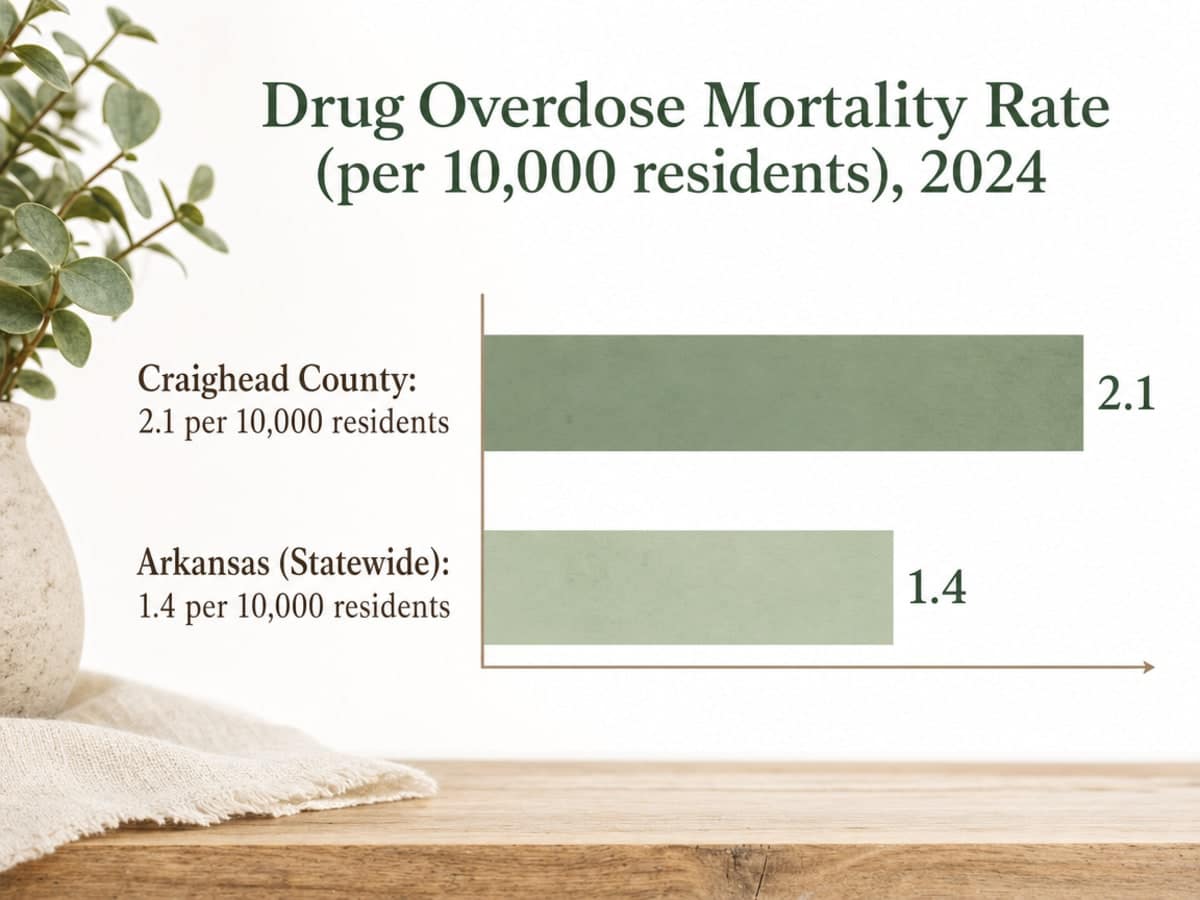
Craighead County shows a drug overdose mortality rate of roughly 2.1 per 10,000 residents, compared to about 1.4 per 10,000 statewide in Arkansas 8. That gap is real. It’s not catastrophic, and it’s not a headline you need to carry around in your chest. What it tells you is straightforward: Northeast Arkansas is running slightly hotter than the state average, and Craighead County is the population center where that heat concentrates.
A few things sit underneath that number. Jonesboro is the regional hub. Arkansas State University pulls in a young adult population. Ag industry, healthcare, logistics, and manufacturing bring in shift workers and traveling professionals. Prescription patterns, alcohol access, and the same slow drift toward stimulants and fentanyl-contaminated supply that’s showing up statewide all touch Craighead County first because it’s the county with the density 8.
So yes, you or someone you love may be part of a slightly elevated local trend. That’s not a moral verdict on you. It’s a public health snapshot that says the environment is real, the risk is real, and you were never being dramatic about it.
Here’s what the number doesn’t tell you. It doesn’t tell you what kind of drinking or use is behind it. It doesn’t tell you whether the people who died were connected to treatment. It doesn’t tell you what would have happened if any one of them had walked into detox two weeks earlier.
What it does tell you is that treatment access matters more in a county like yours than in a quieter one, and that whatever you’re carrying, you’re not carrying it in a vacuum. Other men in Craighead County are sitting with the same math tonight. Some of them will make the call. Some of them won’t.
You don’t have to solve the county’s numbers. You only have to solve yours. And solving yours starts with getting honest about whether the local network is one you’ll actually use — which is the next question worth sitting with.
Why staying local can quietly stop a professional man from starting
Here’s the pattern that plays out over and over with men in your position, and it’s worth naming because it’s probably why you’ve stalled once or twice already.
You decide, quietly, that you’re going to look into help. Maybe you get as far as the state support line, or a browser tab open to an outpatient clinic on Stadium or Southwest Drive. Then you start running the scenarios. The clinic parking lot faces the road. Your truck is recognizable. The intake paperwork asks for your employer. The counselor’s last name sounds familiar. Somebody’s cousin works front desk. You close the tab. You tell yourself you’ll figure it out next week.
That’s not weakness. That’s a real risk calculation running on incomplete information, and it’s the single most common reason capable men in Northeast Arkansas don’t start.
A few things stack up locally in ways they don’t in bigger metros. Jonesboro’s professional class is tight. If you’re a partner, a physician, a plant manager, or you sign the front of the checks at a family business, your face is known in more rooms than you actively think about. The referral pool inside the OSAMH-contracted network is finite by design, because that’s how state-funded and community-based treatment gets distributed 3. Outpatient counseling and hospital detox routed through Medicaid or ARKids run through documented channels 7. None of that is a flaw in the system. It’s how a publicly accountable safety net has to work.
But a publicly accountable safety net and a private treatment decision aren’t the same product.
There’s also the meeting problem. Community-based recovery meetings in Craighead County are populated by the same slice of the region that populates your Rotary lunch, your church parking lot, and your kid’s travel ball bracket. Walking into one of those rooms is a legitimate act of courage. It’s also, for some men, a bridge too far on day one.
So you don’t go. Not because you don’t want to get better. Because the first door you can see is the wrong shape for you.
What helps is separating two decisions that get tangled together. The first is whether you need help. If you’re still reading, you’ve mostly answered that one. The second is which door you walk through first. Those don’t have to be the same door your neighbor would use, and choosing a different one isn’t hiding. It’s picking a setting where you can actually put the drink down or hand over the pills without spending the first three days worrying about who saw you in the lobby.
Distance solves that. Not as a permanent escape, but as a clean starting line.
Same state, different room: what a residential stay in Little Rock looks like
About 130 miles south of your driveway, you’re in a different community entirely. Same state licensure. Same DHS oversight. Different pool of people who might know your name.
That matters more than it sounds like it should. Arkansas sets detailed licensure standards for alcohol and other drug abuse treatment programs, covering diagnostic services, primary treatment, facility requirements, and ongoing oversight 5. A residential program in Pulaski County operates under those same standards a program in Craighead County does. You’re not stepping outside the state’s clinical framework by driving to Little Rock. You’re staying inside it, in a room where nobody at intake shares a pew with your father-in-law.
Here’s what a residential stay typically looks like, in plain terms.
You arrive. There’s a medical intake. If you’ve been drinking heavily or using opioids or benzodiazepines, the first days involve medically supervised detox, which means a clinical team monitors your vitals and manages withdrawal with appropriate medication so the body doesn’t do something dangerous on its own. That phase is short — usually a handful of days — and it exists specifically so the harder work can start from a stable baseline.
After that, days settle into a rhythm. Individual counseling. Group therapy. Psychiatric evaluation if there’s a dual diagnosis piece — anxiety, depression, ADHD, trauma — that’s been quietly running underneath the drinking or the pills. Twelve-step material is available if you want it. So is behavioral therapy, mindfulness work, some fitness, some recreational time outdoors, some meals that don’t come out of a gas station.
Serenity Park sits in Little Rock and runs this model for men — up to 20 clients at a time, medically supervised detox, residential treatment, individual and group counseling, psychiatric care, discharge planning, and alumni support after you go home. The small census is deliberate. You’re not a number on a whiteboard in a 200-bed facility. You’re one of twenty men working the same problem in the same building.
A few things are different about residential that outpatient can’t replicate. You sleep there. You eat there. Your phone use is structured. The daily temptation architecture of your regular life — the bar you drive past, the drawer with the bottle, the group text that always ends at happy hour — is simply not in the room. That’s not a personality upgrade. It’s an environment change that lets the clinical work actually stick.
And because you’re in Pulaski County instead of Craighead County, the person sitting next to you at breakfast isn’t someone who’ll be at your industry lunch next month. That anonymity isn’t the whole point of treatment. But for a man who’s been stalling for a year because the local door felt too public, it’s often the thing that finally lets him walk through one.
Little Rock isn’t an escape from Arkansas. It’s a different room inside the same house.
Medically supervised detox and wearable biometric monitoring: where the evidence actually is
Two things are worth separating here, because they get marketed together and they aren’t the same.
Medically supervised detox is standard, established care. It’s the piece where a clinical team manages your withdrawal with appropriate medication and monitoring so your body doesn’t crash while it clears alcohol, opioids, or benzodiazepines. Arkansas licenses detox settings specifically, and the state’s rules define what a substance abuse detoxification provider has to look like operationally 5. If a residential program in Little Rock offers medically supervised detox, it’s operating inside that same regulatory frame a Jonesboro-area provider would. This isn’t experimental. It’s the reason detox happens in a facility instead of a bathroom floor.
Wearable biometric monitoring is a newer layer sitting on top of that standard care, and this is where honesty matters. The research is real, but it’s early.
There are two live examples worth knowing about. One is a registered pilot study of ambulatory heart rate variability biofeedback for substance use disorder — NCT05454657 — which randomized participants to treatment-as-usual versus treatment-as-usual plus wearable HRV biofeedback, measuring whether the added biometric layer changed craving and use patterns 10. The other is NCT07079826, a 2025-registered double-blind, sham-controlled randomized pilot of the Sparrow Link, a wearable neuromodulation device being evaluated for its role in reducing opioid withdrawal symptoms in hospitalized adults 11.
Read those carefully. Both are pilots. Neither is proof that wearing a device makes you get sober. What they show is that clinical researchers now consider continuous biometric data — heart rate, heart rate variability, sleep patterns, autonomic signals during withdrawal — worth measuring during active SUD treatment.
So here’s the honest read for you as a patient. A residential program that pairs medically supervised detox with wearable monitoring isn’t offering you a miracle. It’s offering clinicians more data points to adjust your care in real time — sleep quality on night three, stress response during a hard group session, whether your nervous system is settling or spiking. Serenity Park uses wearables through a partnership with Huml Health for exactly that purpose. It’s a useful tool inside a proven treatment framework, not a substitute for one.
Ask the question that way when you’re comparing programs. Not “do they have tech,” but “what do they actually do with it.”
Paying for care: Medicaid, ARKids, state-funded slots, and private pay
Money is usually not the reason a professional man delays this call, but it’s still worth being clear about what’s covered and what isn’t, because the answer shapes which door makes sense.
If you’re on Medicaid, or your family is on ARKids, outpatient counseling for substance use is a covered benefit, and some hospital detox is covered as well, in an acute or general hospital setting or in a residential substance abuse treatment facility depending on need and age 7. Medicaid rules also spell out that intensive outpatient SUD treatment and detox have to happen in facilities DHS has specifically licensed for those services 4. That’s why not every clinic in Northeast Arkansas can bill for detox — the setting itself has to hold the right license.
If you’re uninsured, Arkansas funds SUD treatment slots through eight regional catchment areas, and the OSAMH support line at 1-844-763-0198 is the front door to find one 1. That’s a real option, and it’s how a lot of Arkansans get care they otherwise couldn’t afford.
If you’re paying privately — and most high-functioning professionals in your bracket end up here by choice, not necessity — the calculation shifts. You’re no longer optimizing for what a state-contracted network will authorize. You’re picking the setting that fits how you actually need to disappear for a few weeks. Private-pay residential in Little Rock is one of those settings. Same Arkansas licensure standards apply to that program that apply to any Jonesboro-area provider 5. The bill is different. The clinical floor isn’t.
One practical note: don’t let insurance drive the geography by default. If discretion matters more than reimbursement, say that out loud when you’re deciding.
Leaving Jonesboro for treatment without blowing up work or home
The logistics are usually simpler than the decision itself. Once you’ve decided to go, most of what feels unmanageable turns out to be a short list of conversations and a couple of pieces of paperwork.
Start with the calendar. A residential stay runs a few weeks in most cases — long enough to complete detox, get through the early part of the clinical work, and build a discharge plan. For most professional men that means blocking off roughly four to six weeks. You don’t need to explain the medical reason to anyone who doesn’t have a legal need to know. “Medical leave” is a complete sentence.
At work, two paths cover most situations. If you’re a partner, owner, or senior executive, you’re already used to structuring coverage for a surgery or a family emergency. Use the same muscle. Delegate the standing meetings, forward the critical accounts to one trusted person, and set an out-of-office that closes the loop without opening a new one. If you’re a W-2 employee at a Jonesboro-area employer, FMLA and short-term disability generally cover medically necessary treatment; HR handles the paperwork, and the clinical facility’s admissions team writes the documentation. Your diagnosis stays between you and your provider.
At home, be honest with the one or two people who need to be. A spouse. Maybe a parent or an adult sibling. Not the group text. Not the neighborhood. The people carrying it with you deserve to know; everyone else can wait.
One more practical piece. Ask the admissions team what they need before you arrive — insurance card, medication list, a small bag, a phone policy. Then let them handle the rest. Your job between now and check-in isn’t to be organized. It’s to get in the car.
Little Rock is two and a half hours south. Serenity Park is one option in that room — a men’s residential program with medically supervised detox, wearable biometric monitoring through the Huml Health partnership, up to 20 clients, and staff who do this every week. Same Arkansas licensure 5. Different community. A clean starting line.
Frequently Asked Questions
Is there a crisis option in Jonesboro if things escalate tonight?
Yes. The Craighead County Crisis Stabilization Unit at 837 Willett Road is staffed by St. Bernard’s Medical Center and takes short-term stabilization referrals for mental health and substance-related crises from any Arkansas county 2. If tonight is the night, that’s a real door. If it’s not full crisis but close, call the OSAMH support line at 1-844-763-0198, weekdays 8 to 5 1.
How do I get help privately without running into someone I know?
Get out of the 20-county regional catchment that pulls from your professional network. The Craighead County CSU serves 20 counties across Northeast and East-central Arkansas 2, and OSAMH-contracted providers work inside a finite state-shaped network 3. Little Rock sits about 130 miles south, still under Arkansas licensure 5, but in a different community. Private-pay residential care there doesn’t route through local referral channels or a receptionist your sister knows.
Does going to Little Rock mean lower-quality care than staying local?
No. Arkansas licenses alcohol and drug abuse treatment programs to a single set of standards covering diagnostic services, primary treatment, facility requirements, and oversight 5. A residential program in Pulaski County operates under the same clinical framework as a Jonesboro-area provider. What changes with distance is the community you’re inside during treatment, not the regulatory floor the program has to meet.
What if I have Medicaid or ARKids instead of private insurance?
Medicaid covers outpatient substance use counseling and some hospital detox, in acute hospital or residential SUD facility settings depending on need and age 7. Detox and intensive outpatient services have to happen in facilities DHS specifically licenses for those levels of care 4. Call the OSAMH support line at 1-844-763-0198 to find a Medicaid-participating provider, or ask about state-funded slots if you’re uninsured 1.
How long is a residential stay, and how do I explain the absence at work?
Most residential stays run roughly four to six weeks, long enough for detox, early clinical work, and a discharge plan. You don’t owe anyone a diagnosis. “Medical leave” is a complete sentence. If you’re a partner or owner, structure coverage the way you would for surgery. If you’re a W-2 employee, FMLA and short-term disability generally apply; HR handles the paperwork, and the admissions team writes the clinical documentation. Your specifics stay between you and your provider.
Is wearable biometric monitoring in treatment actually proven?
Honest answer: it’s promising, not settled. Two registered pilots are worth knowing. NCT05454657 is a pilot of ambulatory heart rate variability biofeedback added to treatment-as-usual for SUD 10. NCT07079826 is a 2025-registered double-blind, sham-controlled pilot of the Sparrow Link neuromodulation device for opioid withdrawal in hospitalized patients 11. Both are pilots. Wearables give clinicians more real-time data inside proven treatment; they don’t replace it.
References
- Find Substance Abuse or Mental Health Treatment. https://humanservices.arkansas.gov/divisions-shared-services/shared-services/office-of-substance-abuse-and-mental-health/samh-treatment/
- Crisis Stabilization Units – Arkansas Department of Human Services. https://humanservices.arkansas.gov/divisions-shared-services/shared-services/office-of-substance-abuse-and-mental-health/crisis-stabilization-units/
- About OSAMH – Arkansas Department of Human Services. https://humanservices.arkansas.gov/divisions-shared-services/shared-services/office-of-substance-abuse-and-mental-health/about-osamh/
- Counseling Services Section II. https://humanservices.arkansas.gov/wp-content/uploads/CNSLSERV_II.doc
- Licensure Standards for Alcohol and Other Drug Abuse Treatment Programs. https://humanservices.arkansas.gov/wp-content/uploads/Licensure_Standards_for_Alcohol_and_Other_Drug_Abuse_Treatment_Programs.pdf
- Contact OSAMH – Arkansas Department of Human Services. https://humanservices.arkansas.gov/divisions-shared-services/shared-services/office-of-substance-abuse-and-mental-health/contact-osamh/
- ARKids – Additional Resources That Can Help Your Family. https://humanservices.arkansas.gov/divisions-shared-services/medical-services/healthcare-programs/arkids/arkids-additional-resources-that-can-help-your-family/
- 2021 State Profile of Substance Use – SEOW Annual Profiles Report Part 1. https://humanservices.arkansas.gov/wp-content/uploads/SEOW-2021-Annual-Profiles-Report-Part-1.pdf
- Provisional Drug Overdose Deaths: Counts and Rates by County, 2018. https://www.cdc.gov/nchs/health_policy/Provisional-Drug-Overdose-Deaths-Counts-and-Rates-by-County-2018.pdf
- Heart Rate Variability Biofeedback for Substance Use Disorder: Detailed Protocol (NCT05454657). https://cdn.clinicaltrials.gov/large-docs/57/NCT05454657/Prot_SAP_000.pdf
- NCT07079826 – Sparrow Link Neuromodulation Device for Opioid Withdrawal in Hospitalized Patients. https://clinicaltrials.gov/study/NCT07079826