
Key Takeaways
- Arkansas runs behavioral health through DHS and OSAMH, which combines substance use and mental health services under one office and offers a support line for uninsured residents 1, 2.
- Midlife addiction typically follows a specific trigger — divorce, layoff, health scare, or legal event — and rides alongside chronic medical conditions and co-occurring depression that reshape treatment needs 14, 15.
- Choosing a Little Rock program means matching the care level to your actual risk: medically supervised detox first if you’ve been drinking daily for years, then residential, then IOP — not the reverse.
- FMLA protects up to 12 weeks of leave for SUD treatment, so the practical next step is verifying insurance benefits or calling DHS at 1-844-763-0198 before picking a program 1.
The Month That Made You Open This Tab
You didn’t Google this at 2 p.m. on a Tuesday. You opened this tab after something broke — the papers got served, HR asked for a private meeting, the cardiologist used the word if, or your daughter finally said the thing she’s been holding for a year. Something in the last month or two made denial too expensive to keep paying for.
If that’s where you are, you’re not alone in the timing. Research on adults tracks exactly this pattern: job loss and marital separation are linked to significant increases in heavy drinking and drug use in the year that follows 14. The disruption doesn’t just coincide with the drinking picking up. It drives it. And it usually drives men your age to a laptop before it drives them to a phone.
So take a breath. You’re 40, 47, 53. You’ve built things. You’ve run rooms. You know how to make a decision when the information is bad and the timeline is short. This is that kind of decision, and you already have most of the skills for it.
What follows is written for men in that window — Arkansas men whose coping strategy stopped working — and for the wife, sister, or HR contact reading it on their behalf. No lectures. Just what treatment at this stage of life actually looks like, and how to tell if a program in Little Rock is built for you or built for someone half your age.
Why Midlife Addiction Doesn’t Look Like a 22-Year-Old’s
The Trigger Set: Divorce, Layoff, Cath Lab, Courtroom
Look at the men who walk into residential treatment at 47. They are almost never there because of a wild weekend. They are there because something specific broke, and the drinking or the pills — which had been quietly working for a decade — suddenly stopped covering the gap.
Four entry points show up over and over in this age band:
- A divorce filing or a separation you didn’t see coming.
- A layoff, a demotion, or a performance improvement plan that everyone at work knows is really a countdown.
- A health scare — the cath lab, the elevated liver enzymes, the blood pressure the nurse practitioner won’t stop mentioning.
- A legal event — a DUI on a two-lane road outside Little Rock, a possession charge, a custody hearing where your use came up in an affidavit.
This is not a hunch. Researchers who tracked adults through major life events found that job loss and marital separation were linked to significant increases in heavy drinking and drug use in the year that followed 14. The disruption pulls the drinking up with it. A broader review of midlife and older-adult substance use disorders found the same pattern from a different angle: late-onset problems in this age band cluster around stressful life events — retirement, bereavement, social isolation, the slow erosion of the roles a man used to define himself by 12.
Read that carefully, because it matters for how you think about yourself right now. You are not a person with a broken character. You are a person whose life took a hit, and whose 20-year workaround finally cracked under the weight. That is a different clinical picture, and it needs a different room.
A Body With 20+ Years on the Odometer
Here is the part nobody says out loud at intake: your body at 47 is not your body at 27. If you have been drinking heavily since your late twenties, or taking hydrocodone since a back surgery in 2011, your organs have been running that program for a long time. The detox math is different.
A clinical review focused specifically on middle-aged adults with substance use disorders found what most primary care doctors already suspect — men in this age band tend to show up with multiple chronic medical conditions layered under the addiction, along with high rates of co-occurring depression and anxiety 15. Hypertension you’ve been medicating around. A fatty liver your labs have been hinting at. Sleep apnea you never got the mask for. Type 2 diabetes that the drinking is quietly making worse.
The Depression Riding Underneath the Drinking
Ask most men in their late forties what they feel, and you’ll get “tired,” “fine,” or “stressed.” Push a little, and something else comes up. Numb. Angry at nothing in particular. Awake at 3 a.m. running the same loop. Not interested in the things that used to matter. The drinking or the pills weren’t just recreational — they were doing a job. They were quieting something.
The same review of middle-aged adults with substance use disorders is direct about this: high rates of co-occurring depression and anxiety are the rule, not the exception, in this age group 15. When Arkansas restructured its behavioral health system, it consolidated substance use and mental health under one office precisely because the two problems arrive together and can’t be treated in separate rooms 2.
What that means for you: a program that treats the drinking without touching the depression is going to send you back into the same weather that made the drinking necessary in the first place. Integrated care — psychiatric evaluation, medication management, individual counseling on the grief and the resentment, not just relapse-prevention worksheets — is not a nice-to-have at 47. It’s the whole point.
What Arkansas Actually Offers You Right Now
The State Landscape: DHS, OSAMH, and the Support Line
Before you pick a program, it helps to see the map you’re standing on. Arkansas runs its behavioral health system through the Department of Human Services, and inside DHS sits the Office of Substance Abuse and Mental Health — OSAMH — which oversees SUD treatment, crisis stabilization units, peer recovery, and the state’s opioid response work 4. The state is divided into eight catchment areas, each with designated providers, and DHS runs a mental health and addiction support line at 1-844-763-0198 to point residents toward the right one 1.
If you’re uninsured, that line is your fastest path in. DHS funds SUD treatment for adults without insurance who are living with a drug or alcohol use disorder 1. If you have a private insurance card in your wallet, you’re not locked into the public system — but knowing it exists is useful, because it tells you what the baseline looks like and what a private residential program has to clear to be worth choosing.
Arkansas also folded mental health and substance use under one office on purpose. Midlife addiction rarely arrives alone, and the state’s program design assumes co-occurring conditions rather than treating them as an edge case 2.
Levels of Care, Compared Honestly
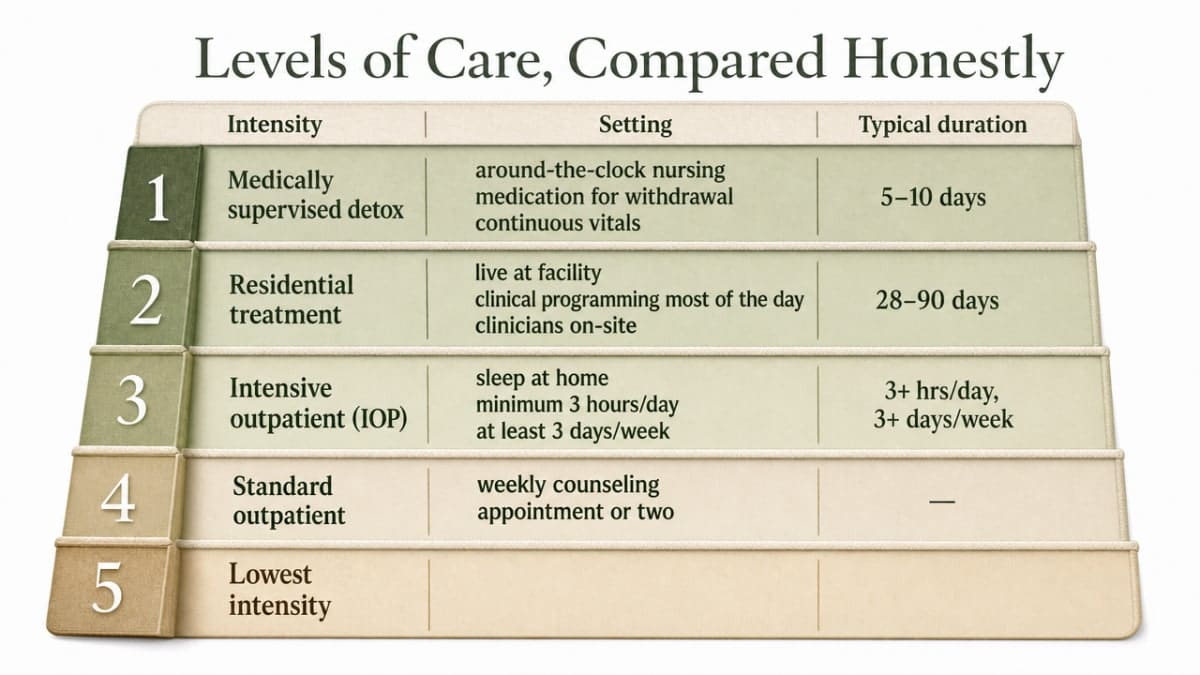
People throw around the word “rehab” like it’s one thing. It isn’t. There are at least five different care levels operating in Arkansas right now, and picking the wrong one wastes weeks you don’t have.
- At the top of the intensity ladder sits medically supervised detox — around-the-clock nursing, medication to manage withdrawal, continuous vitals — typically 5 to 10 days depending on what you’ve been using and how long.
- Residential treatment comes next: you live at the facility, usually 28 to 90 days, with clinical programming most of the day and clinicians on-site.
- Then intensive outpatient, or IOP, which under Arkansas Medicaid rules has to run a minimum of three hours a day, at least three days a week — you sleep at home and work programming around the rest of your life 8.
- Standard outpatient is a weekly counseling appointment or two, more of a maintenance layer than a treatment engine.
- And sitting slightly outside the ladder is the Crisis Stabilization Unit — a 16-bed short-term facility staffed by mental health professionals and licensed nurses, meant to stabilize a mental health or substance misuse crisis over days, not weeks 5.
The honest version: if you’ve been drinking heavily every day for a decade, IOP first is usually a mistake. Your body needs the detox floor before your head can use the counseling. If you’re stable medically but everything else is on fire, residential is the room where the fire gets put out. IOP is where you go once the acute risk is handled and you’re rebuilding around a job. Knowing where you actually sit on this ladder — not where you’d prefer to sit — saves you a relapse.
When a Crisis Stabilization Unit Comes First
Some men don’t walk into treatment. They arrive at it — after a night in an ER, a call to the police from the driveway, a blackout that ended somewhere they can’t quite reconstruct. If that’s the last 48 hours, a Crisis Stabilization Unit may be the right first stop, not residential.
Arkansas’s CSUs are 16-bed facilities staffed by mental health professionals and licensed nurses, built as short-term alternatives to jail or the emergency department when someone is in acute mental health or substance misuse crisis 5. Think days, not weeks. The job is to get you medically and psychiatrically stable enough that the next decision — detox, residential, going home with a plan — can actually be made by a person who can think again. If you’re past the crisis window and just tired of the pattern, skip the CSU. Call a residential program directly.
Why an Age- and Gender-Specific Track Changes the Room
The Case for Not Sitting in Group With 20-Somethings
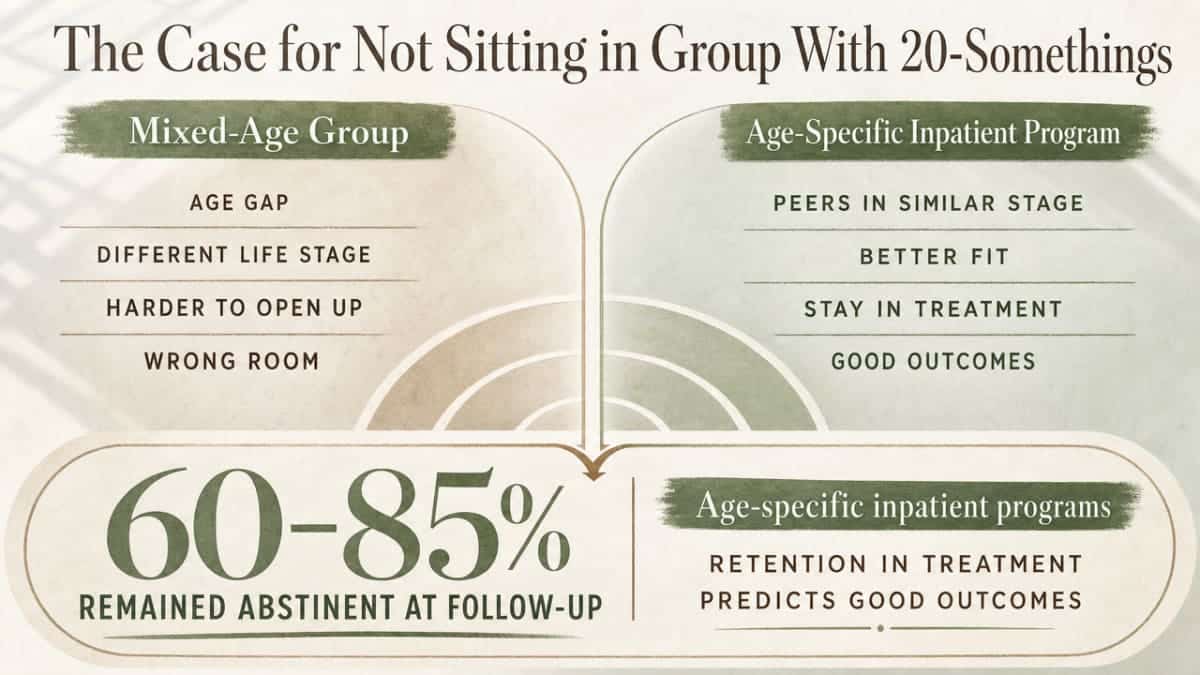
Picture the group room for a second. You’re 49. You’re sitting on a plastic chair in a semicircle. To your left is a 22-year-old who has been using for eighteen months and just lost his second retail job. Across from you is a 24-year-old who still lives with his parents. You are supposed to open up in this room about the marriage you spent 21 years building, the son who won’t return your calls, and the plant floor where 60 people used to report to you.
You will not. And that’s not because you’re guarded. It’s because the room is wrong.
SAMHSA’s guidance on treating substance use disorder in older adults is direct about what happens when you get the room right. Age-specific inpatient programs report that 60 to 85 percent of older adults remained abstinent at follow-up, and retention in treatment predicts good outcomes regardless of the specific therapeutic approach 7. That’s older-adult data, not a midlife-men headline — but it’s the design rationale for building tracks around life stage instead of throwing every man into the same room. When peers share the same reference points — mortgages, teenage kids, a 25-year career arc, a body that doesn’t bounce back — men stay. When men stay, they get better.
The 22-to-55 age band Serenity Park runs isn’t a marketing detail. It’s a decision about who is in the chair next to you when you finally say the hard thing.
Male-Typical Triggers and a Men-Only Room
Ask a room of midlife men what got them here, and the answers cluster. Work that stopped being satisfying and started being survival. Drinks after every shift because that’s what the crew does. The bourbon in the desk drawer during a bad quarter. Research on gender differences in substance use documents this pattern plainly: men are more likely than women to report work-related stress and social drinking norms as primary contributors to their substance use 13. The trigger isn’t a party. It’s a Tuesday.
That matters for the room you sit in. In a mixed-gender group, a 48-year-old man usually edits himself — around the anger, around the shame about not providing, around the specific way his drinking wrecked his marriage. In a men-only room, that editing drops. You can say the thing about your father, or your ex-wife, or the guy at work you can’t stand, without translating it first.
Serenity Park is men-only by design, and the midlife track puts you with peers who have run crews, closed deals, coached little league, and blown all of it up in ways that look uncomfortably similar to yours. That is not accidental. That’s the whole intervention.
Inside a Small-Capacity Residential Program in Little Rock
Medically Supervised Detox at 47, Not 27
Detox at your age is not a hangover with a nurse in the room. It’s a medical event that has to be run by people who understand what daily drinking for two decades has done to your liver, your heart rhythm, and your autonomic nervous system.
A 25-year-old detoxing off alcohol usually sweats through a rough 72 hours and comes out the other side. A 47-year-old with hypertension, a fatty liver, and a resting heart rate that’s been quietly climbing needs something more careful. The clinical review of middle-aged adults with SUDs is blunt about it: men in this age band typically present with multiple chronic medical conditions layered under the addiction, along with high rates of co-occurring depression and anxiety 15. That changes the risk profile of withdrawal, and it changes what the first 5 to 10 days should look like.
At Serenity Park, medically supervised detox means around-the-clock nursing, medication to manage withdrawal symptoms — the tremors, the blood pressure spikes, the sleeplessness that can turn into something worse — and a physician who is reading your labs, not just your intake form. Medication-assisted treatment is on the table if opioids are part of the picture, not a philosophical debate. The goal is simple: get you through the acute window safely, so your brain is clear enough to actually use the next four weeks.
Wearable Biotech as a Clinical Instrument
Here’s a small thing that turns out to matter: at 47, you can’t feel what your body is doing the way you could at 27. The signals are quieter. The recovery is slower. The place where a spike in resting heart rate used to feel like something now just feels like Tuesday.
Serenity Park’s partnership with Huml Health puts a wearable device on you during detox and residential care that streams continuous data to your clinical team — resting heart rate, heart rate variability, sleep architecture, stress markers. This isn’t a fitness gadget clipped onto a treatment brochure. It’s an instrument. When your autonomic nervous system is still rattled on day six and the numbers say so, your medication plan gets adjusted before you feel it going sideways. When your sleep finally starts consolidating in week three, your team can see that the antidepressant is doing its job.
The wearable does not replace the clinician. It gives the clinician a second set of eyes on a body that has spent 20 years hiding what it’s doing. For a midlife detox, that’s the difference between guessing and knowing.
Twenty Beds, Not Two Hundred
Serenity Park serves up to 20 men at a time. That’s the whole census. Not 20 per unit. Not 20 in your track. Twenty on the property.
The math on that is worth sitting with. In a 200-bed facility, you are one of a crowd — moved through group rooms on a schedule, assigned to a counselor whose caseload is full, sharing a psychiatrist with 60 other men. At 20 beds, the counselor knows your ex-wife’s name, remembers what your daughter said on the family call, and notices when you didn’t eat breakfast. The psychiatric evaluation happens in a real conversation, not a 15-minute slot.
Small capacity is also privacy. If discretion matters — and at 47, with a career still in front of you, it usually does — a 20-man residence in Little Rock is a very different footprint than a regional campus with a parking lot full of visitors.
Career Continuity, FMLA, and the Phone in Your Pocket
Here’s the question you probably haven’t asked out loud yet: What happens to my job while I’m gone?
The good news is that the math usually works. The Family and Medical Leave Act gives eligible employees up to 12 weeks of unpaid, job-protected leave for a serious health condition — and substance use disorder, when you’re getting treatment for it, qualifies. Most residential stays run 28 to 60 days. That fits inside the FMLA window with room on either side for detox and step-down. Your HR team has processed this exact request before, whether you know it or not. They are not allowed to tell your manager the diagnosis. They can only confirm you’re on protected leave.
The harder question is what you do with your phone. At Serenity Park, phone and laptop access is a clinical decision, not a house rule. Early in detox, when your body and brain are still finding the floor, access is limited on purpose — you can’t do good work at week one, and trying to will pull you out of the treatment your body actually needs. As you move deeper into residential, structured windows for calls, email, and family check-ins open up. If you’re running a business, that reality gets built into your plan, not fought against.
Discharge planning starts early for the same reason. You are going back to a job, a marriage in repair, a mortgage. The plan has to assume that. Anything less is a program built for someone whose life hasn’t started yet.
Life After Discharge: Peers, MAT, and the Long Middle
The van pulls out of the parking lot on day 35 and you’re back on the interstate. This is the part that decides everything, and it’s the part most brochures skip.
Two things carry midlife men through the long middle. The first is peers. Arkansas has built out a certified peer recovery workforce through OSAMH — men and women who have lived the arc you’re just finishing and who are trained to sit in it with you 10. For a 49-year-old, a peer who ran his own crew before he got clean is worth more than any worksheet. That’s who you want on speed dial at 9 p.m. on a Sunday.
The second is medication, when it fits. If opioids were part of your story, medication-assisted treatment is covered under Arkansas Medicaid when prescribed by a licensed provider, and it’s available on the private side through most commercial plans 8. Buprenorphine or naltrexone isn’t a crutch. It’s a tool that keeps the craving quiet enough for the therapy to do its work.
Serenity Park’s discharge planning assumes you’re going back to a job, a marriage under repair, and a life that didn’t pause. Alumni support, continuing care groups, a step-down into IOP if it fits — that’s the scaffolding. You built the first 47 years. The next chapter gets built one Tuesday at a time.
Frequently Asked Questions
How long will I actually be away from work?
Plan on 30 to 60 days for most men, with detox taking the first 5 to 10 of those. FMLA gives eligible employees up to 12 weeks of unpaid, job-protected leave, and SUD treatment qualifies. Your HR contact processes leave, not diagnosis. Your manager gets a return date, not a story.
Can I keep my phone and laptop during treatment?
Access is a clinical decision, not a blanket ban. During detox, devices are limited so your body can actually stabilize. As you move through residential, structured windows open for calls, email, and family check-ins. If you run something that can’t sit dark for 30 days, that gets built into your plan.
What does detox feel like at 47 versus 27?
Slower, heavier, and medically riskier. Two decades of use leaves a mark on your liver, blood pressure, and sleep. Middle-aged men often carry chronic conditions and co-occurring depression that shape withdrawal 15. That’s why medically supervised detox — nursing around the clock, medications for symptoms, physician review — isn’t optional at your age.
Will my private insurance cover a residential program in Little Rock?
Most commercial plans cover medically necessary detox and residential treatment for substance use disorder, though benefit levels vary. Call the admissions team with your card in hand — they run a verification of benefits before you commit. If you’re uninsured, Arkansas DHS funds SUD treatment for residents without coverage 1.
Can my wife and kids visit while I’m in treatment?
Yes, and family involvement is part of the clinical work, not a bolt-on. Scheduled visits, family calls, and structured sessions with a counselor help repair what the drinking damaged. Early detox days are usually reserved for medical stabilization. Once you’re steady, your wife and adult kids become part of the plan.
What happens the day I’m discharged?
You leave with a written plan, not a handshake. That includes a step-down into IOP if it fits, a psychiatrist for medication management, a certified peer specialist to call on hard nights 10, and alumni group access. Discharge planning starts in your first week, because the long middle is where recovery actually holds.
References
- Find Substance Abuse or Mental Health Treatment. https://humanservices.arkansas.gov/divisions-shared-services/shared-services/office-of-substance-abuse-and-mental-health/samh-treatment/
- Programs for Mental Health & Substance Abuse Issues. https://humanservices.arkansas.gov/learn-about-programs/programs-for-mental-health-substance-abuse-issues/
- About OSAMH – Arkansas Department of Human Services. https://humanservices.arkansas.gov/divisions-shared-services/shared-services/office-of-substance-abuse-and-mental-health/about-osamh/
- Office of Substance Abuse and Mental Health. https://humanservices.arkansas.gov/divisions-shared-services/shared-services/office-of-substance-abuse-and-mental-health/
- Crisis Stabilization Units – Arkansas Department of Human Services. https://humanservices.arkansas.gov/divisions-shared-services/shared-services/office-of-substance-abuse-and-mental-health/crisis-stabilization-units/
- Contact OSAMH – Arkansas Department of Human Services. https://humanservices.arkansas.gov/divisions-shared-services/shared-services/office-of-substance-abuse-and-mental-health/contact-osamh/
- Treating Substance Use Disorder in Older Adults. https://library.samhsa.gov/sites/default/files/SAMHSA_Digital_Download/PEP20-02-01-011%20PDF.pdf
- Outpatient Behavioral Health Counseling Services. https://humanservices.arkansas.gov/wp-content/uploads/CNCLSERV-New-22route.pdf
- ARKids – Additional Resources That Can Help Your Family. https://humanservices.arkansas.gov/divisions-shared-services/medical-services/healthcare-programs/arkids/arkids-additional-resources-that-can-help-your-family/
- Peer Resources – Arkansas Department of Human Services. https://humanservices.arkansas.gov/divisions-shared-services/shared-services/office-of-substance-abuse-and-mental-health/arkansas-peer-recovery/peer-resources/
- Drug Overdose Death Data. https://www.cdc.gov/drugoverdose/resources/data.html
- Substance Use Disorders in Midlife and Older Adults: A Brief Overview. https://www.ncbi.nlm.nih.gov/pmc/articles/PMC3680460/
- Gender Differences in Substance Use and Recovery. https://www.ncbi.nlm.nih.gov/pmc/articles/PMC3860469/
- The Impact of Life Events on Substance Use in Adults. https://www.ncbi.nlm.nih.gov/pmc/articles/PMC4968993/
- Substance Use Disorders in Middle-Aged Adults: Clinical Considerations. https://www.ncbi.nlm.nih.gov/pmc/articles/PMC4553654/