
Key Takeaways
- Start with one triage call in the next hour: 911 for medical emergencies, 988 for suicidal or emotional crisis, or SAMHSA at 1-800-662-HELP for treatment referral.11, 12
- Choose medically supervised inpatient detox when suicidal thoughts, psychosis, cardiac symptoms, mixed substances, or an unsafe home are in the picture, and downgrade later if appropriate.1
- Expect a three-phase withdrawal arc: a heavy crash in days 1–3, sharp cravings and low mood through day 10, then uneven improvement past day 14.1
- No FDA-approved medication turns meth withdrawal off; detox uses symptom-targeted meds plus 24/7 supervision to keep him safe through the hardest week.3, 7
- Intake calls are triage, not interrogation — expect questions about safety, use history, insurance, and bed availability, and a plain sentence is enough to start.11
- In Arkansas, DHS funds stimulant use disorder treatment for uninsured and underinsured residents, and Me Over Meth connects families to local recovery resources.9, 10
- Pack light: ID, insurance card, medication list with bottles, phone and charger, comfortable clothes, and hand off communication to one trusted contact.
- Detox is only step one; ask intake how they connect to contingency management and other behavioral treatment, and schedule that handoff before discharge.2, 6
The Next 60 Minutes: A Triage Decision, Not a Search Result
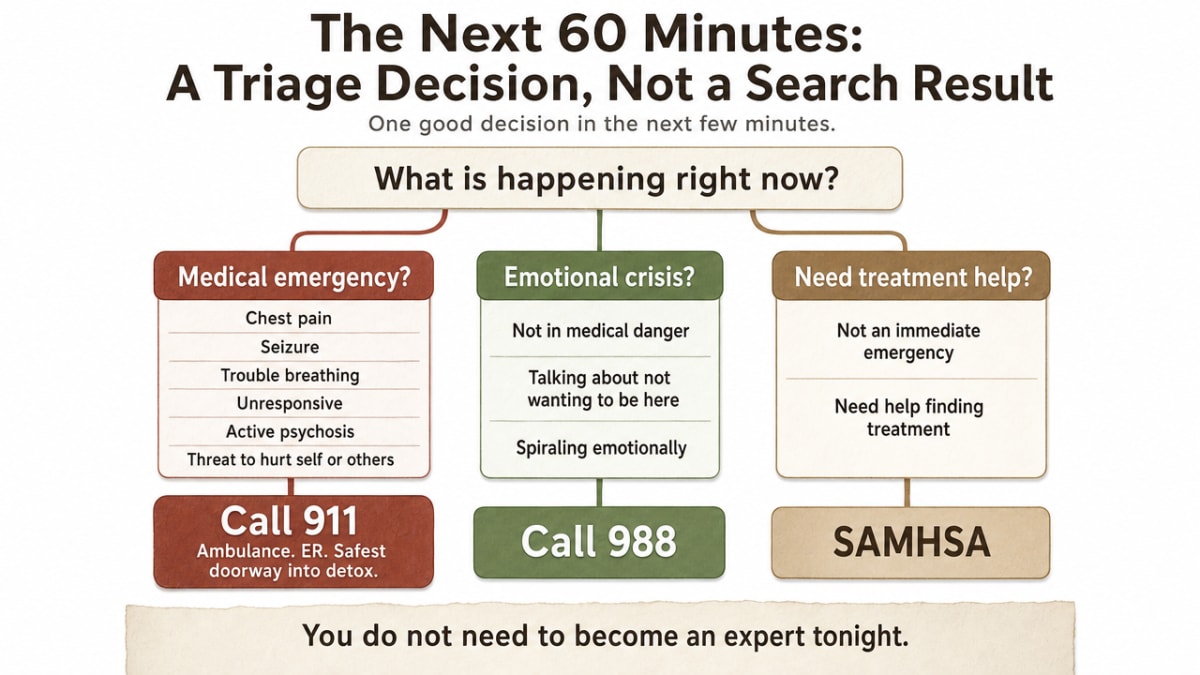
If you’re reading this on a phone at 2 a.m., with a shaky hand or a scared partner next to you, take a breath. You don’t need to become an expert on addiction tonight. You need to make one good decision in the next few minutes.
That decision has three branches, and which one you pick depends on what’s happening in the room right now.
If there’s a medical emergency, call 911. Chest pain, a seizure, trouble breathing, an unresponsive body, active psychosis, or a real threat to hurt himself or someone else — those are ambulance moments, not phone-tree moments. Meth can push a heart and a mind past what they can handle. Paramedics can stabilize him and get him to an ER, which is often the safest doorway into detox.
If he’s not in medical danger but he’s talking about not wanting to be here anymore, or he’s spiraling emotionally, call or text 988. The 988 Suicide & Crisis Lifeline is free, confidential, and open 24/7 for mental health and substance use crises — you can call, text, or chat.12 The person on the other end will not judge him. They will help him get through the next hour.
If he’s shaky but stable and ready — or almost ready — to get into treatment, call SAMHSA at 1-800-662-HELP. It’s a 24/7 free and confidential treatment referral line that can point you toward local detox and treatment providers.11 In Arkansas, the Department of Human Services Office of Substance Abuse and Mental Health also funds treatment for uninsured and underinsured residents and can connect you with a provider near you.9
Who Should Be In a Medically Supervised Detox (and Who Can Step Down)
Meth withdrawal doesn’t look the same for everyone, and that matters for where you end up in the next 24 hours. Some people can get through the crash at home with a trusted person nearby and a doctor’s follow-up. Others need a bed with a nurse walking past the door every hour. The difference isn’t willpower. It’s what’s happening in his body and mind right now.
A medically supervised inpatient detox is the safer setting when any of the following are in the picture:
- Suicidal thoughts, self-harm, or severe depression during the crash. The days after the last hit can bring a heavy drop in mood, and that’s when the risk is highest.
- Psychosis or paranoia — hearing things, seeing things, believing people are after him. This can happen with heavy or long-term use and needs medical eyes on it.
- Chest pain, high blood pressure, irregular heartbeat, or a recent seizure. Meth is hard on the heart and the brain, and those symptoms don’t wait politely for an outpatient appointment.
- Other substances in the mix — alcohol, benzodiazepines, opioids, or fentanyl. Withdrawal from alcohol or benzos can be dangerous on its own, and combined use raises the stakes.
- A history of failed attempts to stop at home, especially if he’s used within hours of trying to detox before.
- No safe, sober place to land. If home is where the drug lives, home is not detox.
Clinical guidance from the CADTH review of meth withdrawal management supports this same split: inpatient supervision is prioritized when medical or psychiatric risk is meaningful, and outpatient care can work for people with milder symptoms and stable support around them.1
If none of those red flags apply — he’s uncomfortable but stable, he has someone with him, and there’s a clinic that can see him within a day or two — an outpatient or intensive outpatient path may be reasonable. That’s a call to make with a clinician, not alone at the kitchen table.
Here’s the honest part: most men who search “meth detox near me” at 1 a.m. have at least one item on that list. If you’re not sure, assume he needs the higher level of care and let the intake team downgrade him after they’ve laid eyes on him. That’s a much safer error than the other direction.
What Meth Withdrawal Actually Feels Like, Day by Day
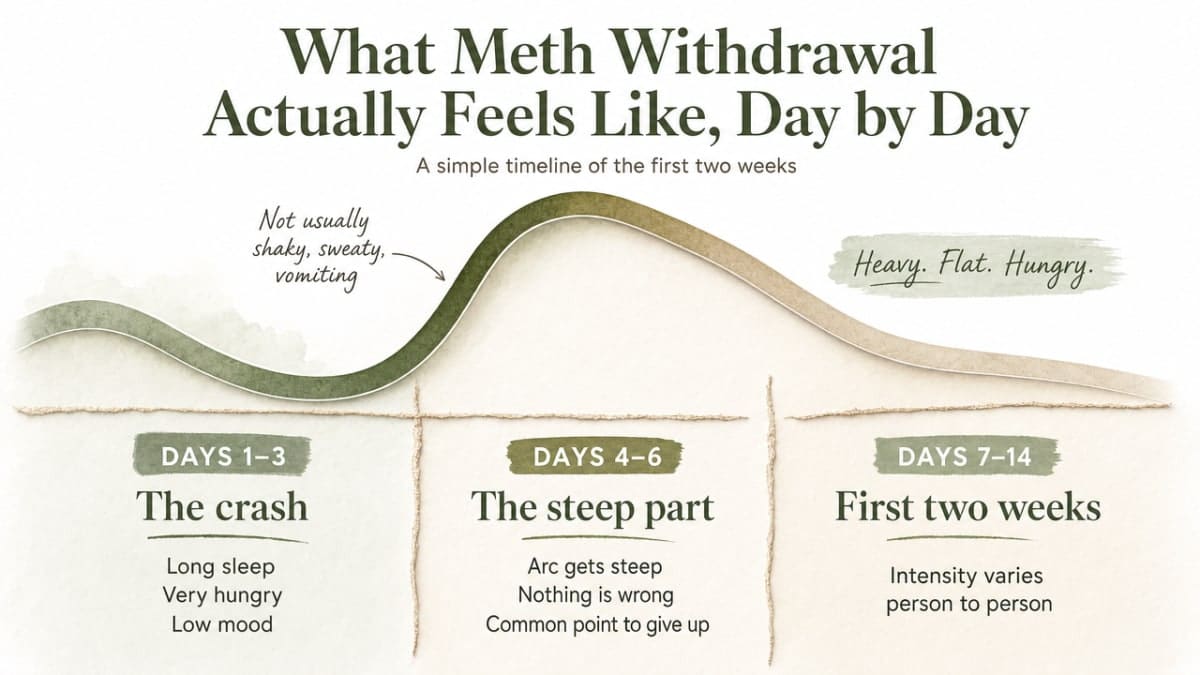
One of the hardest parts of walking into detox is not knowing what’s coming. So here’s the map, in plain language. Meth withdrawal doesn’t hit like alcohol or opioid withdrawal — it’s not usually a shaky, sweaty, vomiting kind of thing. It’s a heavy, flat, hungry kind of thing. And it moves in phases.
Clinical reviews of meth withdrawal describe a fairly consistent arc across the first two weeks, even though the intensity varies person to person.1 Knowing the shape of it helps, because a lot of men give up on day five or six thinking something is wrong. Nothing is wrong. That’s just where the arc gets steep.
Days 1 to 3: the crash. This is the body finally cashing the check. Expect a lot of sleep — sometimes 12, 14, 18 hours at a stretch — and when he’s awake, he’ll be hungry in a way that feels almost frantic. Mood will be low and flat. He may barely talk. This is not laziness or depression as a personality trait. This is the dopamine system that meth hijacked trying to remember how to work on its own.
Days 4 to 10: the acute stretch. This is the hardest part, and it’s where medical supervision earns its keep. The heavy sleep gives way to broken sleep and vivid, unsettling dreams. Cravings sharpen. Nothing feels good — food is bland, jokes don’t land, music sounds flat. That numbness has a clinical name (anhedonia), but he’ll just feel it as “why bother.” Mood swings can be sharp. And this is the window where suicidal thoughts are most likely to show up.1 That’s why an inpatient bed, with staff who check in through the night, matters so much here. He is not weak for feeling this. His brain is running on empty and trying to refill.
Days 11 to 14 and beyond: the slow climb. Sleep starts to settle. Appetite normalizes. He’ll have longer stretches where he feels almost like himself, punctuated by cravings that can still hit hard, especially around old triggers — a certain street, a certain contact in his phone, a certain time of day. Energy comes back unevenly. Some days will feel like real progress. Some days will feel like day four all over again. Both are normal.1
Two things worth saying out loud before he walks in the door.
First, the crash is the drug leaving. It is not who he is. The flat, foggy man on day two is not the person he’ll be on day thirty. Detox staff have seen this arc thousands of times, and they know the difference between the withdrawal and the man.
Second, the cravings don’t disappear on day fourteen. They soften and get further apart, but for meth in particular, the pull can linger for weeks or months. That’s not a failure of detox — it’s exactly why detox has to hand off to real behavioral treatment, not drop him at the curb.
If you’re the one making the call for him, share this timeline with him if he can hear it. Sometimes just knowing that day six is supposed to feel like this is enough to get him through day six.
The Honest Truth About “Detox Meds” for Meth
Here’s the part nobody puts on the billboard: there is no pill that turns meth withdrawal off. There is no methadone equivalent for meth. There is no patch, no shot, no drip that makes the crash disappear.
That’s not a failure of the detox center you call tonight. It’s where the science actually is. The National Institute on Drug Abuse is direct about it — there is no FDA-approved medication for methamphetamine use disorder or any other stimulant use disorder.3 So if a place promises a “meth detox medication” like it’s a cure, be careful. That’s not what the research says.
What a good medically supervised detox actually does with medication is different, and honestly more useful. Staff use short-term, symptom-targeted meds to take the edge off specific problems while his brain and body reset. Something to help him sleep when the insomnia hits on day five. Something for the anxiety and agitation. Something for the depression that lands like a weight during the crash. A CDC review of meth clinical management points to off-label options like mirtazapine, bupropion, and naltrexone combinations that clinicians sometimes use to help reduce cravings and stabilize mood during and after withdrawal.7 These aren’t cures. They’re tools for specific symptoms, chosen for the specific man in the bed.
There is one bright spot on the research horizon worth naming. A Phase III NIH trial found that injectable naltrexone paired with oral bupropion was safe and effective for adults with moderate to severe methamphetamine use disorder — a real step forward, even though the combination is not yet FDA-approved for this use.8 It’s a signal that better options are coming, not a prescription you can pick up on the way to detox tomorrow.
So here’s what to hold onto. The value of a medical detox for meth isn’t a magic drug. It’s the 24/7 supervision, the safe bed, the nurse who checks on him at 3 a.m., the doctor who can treat the chest pain or the paranoia or the suicidal thought before it becomes an emergency. It’s the food, the fluids, the sleep, and the people who don’t flinch at what he’s going through. That’s what keeps him alive through the hardest week. The medications support that work — they don’t replace it.
Making the Call: What Actually Happens When You Dial
A lot of men freeze on the call itself. Not because they don’t want help, but because they don’t know what the voice on the other end is going to ask, and they’re afraid of saying the wrong thing. So here’s what actually happens.
Whether you dial SAMHSA at 1-800-662-HELP, the Arkansas DHS line, or a specific detox center’s intake number, the person who picks up is trained to keep you on the phone. They are not police. They are not going to shame you. SAMHSA’s line is free, confidential, and staffed 24/7 for exactly this call.11
Expect three kinds of questions.
Safety first. Are you safe right now? Any thoughts of hurting yourself? When did he last use, and how much? Any chest pain, seizures, or hallucinations? This is triage, not interrogation. If anything he says sounds like an emergency, they’ll help you get to an ER or loop in 988.12
Basics next. Age, city or ZIP, insurance if any, and whether he’s used anything else — alcohol, benzos, opioids, fentanyl. If he doesn’t have insurance, say so. It doesn’t end the call. In Arkansas, DHS funds treatment for uninsured and underinsured residents with stimulant use disorder, and the intake person can route you into that pathway.9
Availability last. They’ll check what beds are open, how soon he can be admitted, and whether transportation is a problem. Sometimes admission is same-day. Sometimes it’s tomorrow morning. If the wait is longer than feels safe, ask what to do in the meantime — that’s a fair question, and they have answers.
You don’t need a speech. “My brother has been using meth. He wants to stop. What do I do?” is enough. They take it from there.
Local Pathways in Arkansas Worth Knowing Before You Hang Up
If you’re in or near Little Rock, you have more options than a generic web search will show you. Two of them are worth writing down before you make another call.
The first is the Arkansas Department of Human Services Office of Substance Abuse and Mental Health. DHS funds Arkansas providers to deliver treatment and medication services for uninsured and underinsured residents with stimulant use disorder, including meth.9 That means if he doesn’t have insurance, or his insurance doesn’t cover what he needs, there is a state-funded pathway built for exactly this situation. The DHS site lists regional contacts and a statewide number that can route you to a provider in your catchment area.9 Ask for the SAMH intake line and say you’re looking for meth detox or stimulant use disorder treatment.
The second is Me Over Meth, a public education initiative from Arkansas DHS that connects people and families to treatment and recovery resources. Its core message is worth hearing tonight: treatment for meth use disorder works, and recovery is possible.10 That’s not a slogan. That’s the state health agency saying, on the record, that men walk into this every week and walk out into a real life on the other side.
Two numbers on the fridge: SAMHSA at 1-800-662-HELP for 24/7 national referral,11 and the Arkansas DHS SAMH line for local, state-funded options.9 Between them, you have a way in — insurance or no insurance, tonight or first thing tomorrow.
What to Pack and What to Tell the People at Home
Keep the packing simple. Detox is not a hotel stay, and nobody expects a curated bag.
- An ID, an insurance card if you have one, a list of any medications he’s currently taking (including doses), and a phone with a charger.
- Three or four changes of comfortable clothes, slip-on shoes, basic toiletries, and any prescription glasses.
- Two or three emergency contacts written down on a piece of paper, in case the phone dies or gets locked in intake.
- If he takes something for blood pressure, diabetes, or a mental health condition, bring the actual bottles so the medical team can see them.
Leave the rest. No cash, no valuables, no anything that resembles a substance. Intake will search the bag; that’s normal, not personal.
Now the harder part: what to say to the people at home. You don’t owe anyone a full explanation tonight. A short, honest sentence to one person is enough. “I’m going into detox for a few days. I’ll call when I can.” That’s it. A boss, a landlord, a kid’s school — those calls can wait or be handled by someone else.
Pick one trusted person to be the point of contact while he’s inside. Give them the facility’s main number. That single handoff protects him from a phone lighting up with questions he can’t answer during the crash, and it gives the family somewhere to route their worry.
Detox Is Step One. Here’s What Step Two Looks Like.
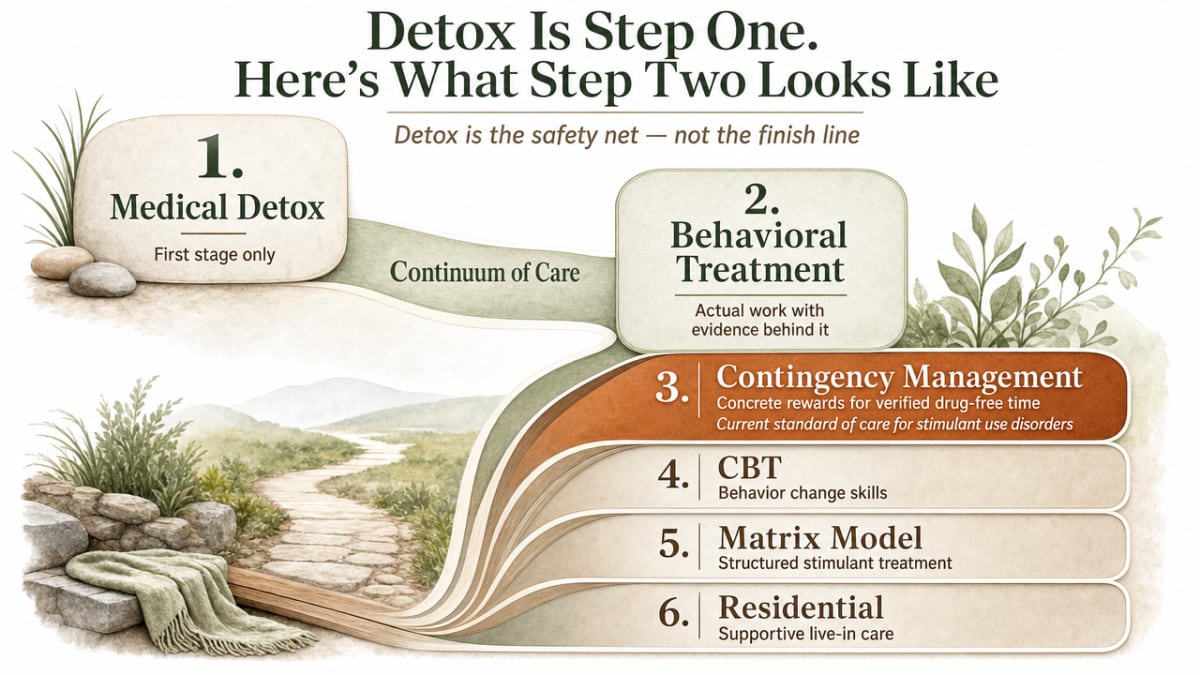
Here’s the sentence that most detox brochures leave out, and the one the National Institute on Drug Abuse says plainly: medical detoxification is only the first stage of addiction treatment, and by itself does little to change long-term drug use.6 Read that twice. Detox is not the finish line. Detox is the safety net that gets him to the actual work.
That’s not bad news. That’s the map. Because the actual work has evidence behind it, and it’s specific.
The ASAM/AAAP clinical practice guideline names contingency management as the current standard of care for stimulant use disorders, including meth.2 In plain language, contingency management is a structured behavioral program that gives concrete rewards — vouchers, small incentives, tangible reinforcement — for verified drug-free time. It sounds almost too simple. It isn’t. It’s the intervention with the strongest track record for stimulant addiction, and NIDA points to it specifically as especially effective for meth and cocaine.4
Alongside contingency management, real recovery usually includes cognitive-behavioral therapy, group work, and structured programs like the Matrix Model that combine counseling, family education, and drug testing over several months.5 For men whose home life, work, or history of relapse makes outpatient care shaky, that behavioral work happens inside a residential program, where the environment itself removes the daily triggers while new habits get built.
So when you’re on the phone with an intake team, ask two questions past the detox bed. What behavioral treatment do you offer after detox, and does it include contingency management or a comparable evidence-based program? Where do I go — or where does he go — the day he’s medically cleared? If the answer is “we’ll figure that out later,” push for a real one. Discharge planning should start on day one, not day seven.
The men who stay well after meth are almost never the ones who did detox and went home. They’re the ones who used detox as the doorway into weeks or months of behavioral treatment, with people around them who understood the crash and the pull that comes after. That’s the arc worth planning for tonight, even while you’re still just trying to get through tonight.
For the Family Member Reading Over His Shoulder
If you’re the wife, mother, brother, or son who found this page first, a word for you.
You are not going to fix this in one night. What you can do is make the next right call and stay in the room. That’s already a lot.
While he’s in detox, your job shrinks to three things. Handle the outside world — work, kids, the bills he can’t touch this week. Be the single point of contact so his phone isn’t a battlefield during the crash. And take care of your own body: eat, sleep, call one person who knows what’s happening.
Do not try to be his therapist. The staff has that covered, and the ASAM/AAAP guideline names contingency management and structured behavioral treatment as the standard of care that follows detox.2 Your role is different, and it lasts longer. You’re the person who will still be here on day thirty, day ninety, and next spring.
Frequently Asked Questions
How long does meth detox take?
Most medically supervised meth detox programs run 5 to 10 days, though the withdrawal arc itself stretches longer. The crash phase lands in the first 1 to 3 days, the hardest stretch of cravings and low mood runs through day 10, and gradual improvement continues into the second week and beyond.1Cravings can linger for weeks, which is why the day you leave detox isn’t the day treatment ends.
Can I detox from meth at home safely?
Sometimes, but not if there’s suicidal thinking, psychosis, chest pain, other substances in the mix, or no sober person around. Clinical guidance reserves outpatient or home detox for milder cases with stable support and a clinician following along.1If you’re unsure, call SAMHSA at 1-800-662-HELP for a professional read on which setting fits.11Guessing wrong at home is a much bigger risk than one night in a supervised bed.
Is there a medication that stops meth cravings during detox?
No single medication turns cravings off. There is no FDA-approved drug for methamphetamine use disorder.3What detox clinicians do use is short-term, symptom-targeted medication — something for sleep, anxiety, or the heavy depression of the crash — and off-label options like mirtazapine or bupropion when appropriate.7A Phase III NIH trial of injectable naltrexone plus oral bupropion showed real promise, though it’s not yet FDA-approved for this use.8
What if I don’t have insurance or money to pay for detox?
You still have a path. In Arkansas, the Department of Human Services funds treatment for uninsured and underinsured residents with stimulant use disorder, including meth.9Call the DHS SAMH line and say you’re looking for stimulant use disorder treatment. Nationally, SAMHSA’s 1-800-662-HELP line is free and 24/7 and can point you toward local providers with sliding-scale or grant-funded beds.11Don’t let cost be the reason you don’t call tonight.
What happens after detox ends?
Behavioral treatment is the actual work. The ASAM/AAAP clinical guideline names contingency management — structured rewards for verified drug-free time — as the current standard of care for stimulant use disorder.2That usually pairs with cognitive-behavioral therapy, group work, and often a residential program that removes daily triggers while new habits get built. Ask your intake team about the specific behavioral program that follows their detox, and get it scheduled before discharge.
How do I help a family member who won’t call for himself?
You can make the call for him. SAMHSA’s line will talk with a family member, walk you through options, and help you plan a conversation.11Arkansas DHS’s Me Over Meth initiative also offers resources aimed at families, with a clear message that treatment works and recovery is possible.10If he’s in acute crisis or talking about not wanting to be here, call or text 988 — that line is for you too.12
References
- Management of Acute Withdrawal and Detoxification for Adults Who Misuse Methamphetamine. https://www.ncbi.nlm.nih.gov/books/NBK545066/
- The ASAM/AAAP Clinical Practice Guideline on the Management of Stimulant Use Disorder. https://stacks.cdc.gov/view/cdc/156927
- Methamphetamine. https://nida.nih.gov/research-topics/methamphetamine
- Treatment. https://nida.nih.gov/research-topics/treatment
- Methamphetamine (NIDA Research Report Series). https://nida.nih.gov/sites/default/files/methrrs.pdf
- Methamphetamine (NIDA Educational Slides). https://nida.nih.gov/sites/default/files/e-methamphetamine-slides.pdf
- Methamphetamine Toxicities and Clinical Management. https://stacks.cdc.gov/view/cdc/164676/cdc_164676_DS1.pdf
- Combination Treatment for Methamphetamine Use Disorder Shows Promise. https://www.nih.gov/news-events/news-releases/combination-treatment-methamphetamine-use-disorder-shows-promise-nih-study
- Find Substance Abuse or Mental Health Treatment. https://humanservices.arkansas.gov/divisions-shared-services/shared-services/office-of-substance-abuse-and-mental-health/samh-treatment/
- Me Over Meth. https://humanservices.arkansas.gov/divisions-shared-services/shared-services/office-of-substance-abuse-and-mental-health/me-over-meth/
- Mental Health and Substance Use Helplines. https://www.samhsa.gov/find-help/helplines
- 988 Suicide & Crisis Lifeline. https://www.samhsa.gov/mental-health/988
- ASAM/AAAP Clinical Practice Guideline (CPG) for Stimulant Use Disorder: Key Takeaways and Future Directions. https://pubmed.ncbi.nlm.nih.gov/40590448/