
Key Takeaways
- Reframe the search around clinical fit rather than proximity, because a well-run program forty minutes away typically outperforms a mediocre one nearby, and the difference is knowable in an afternoon of calls.
- Treat 30 days as ignition, not the engine — it stabilizes him and builds tools, but outcomes depend on how seriously the program treats the aftercare handoff 6.
- Confirm the OADAP license number and, if detox is on the table, a separate Arkansas Department of Health inpatient license before touring — anything vague is your answer 15, 16.
- Use ten specific questions on the first call covering licensure, credentials, individualized planning, MOUD, family involvement, discharge, and outcomes, and judge the coordinator on speed and specificity 1.
- Look for evidence-based texture inside the building: thorough intake, individualized plans, named therapies like CBT and motivational interviewing, integrated mental health care, and weekly clinical team meetings 2, 7.
- If opioids are involved, insist the program offers or coordinates buprenorphine, methadone, or naltrexone — detox without MOUD raises the risk of resumed use, overdose, and death 4.
- Expect a family program with a calendar attached: weekly therapy, a named point of contact, structured education, and inclusion in discharge planning, since family involvement reduces dropout 8, 9.
- Evaluate the written discharge plan as the actual product — step-down care, scheduled first appointment, medication continuation, psychiatric follow-up, peer support, and a relapse protocol built starting in week one 12.
What a 30-Day Search Should Actually Be Solving For
You typed “30 day rehab near me” for a reason, and it probably wasn’t to scroll through a directory. You want to know if the place ten minutes from your house can actually help him — and whether checking him in there this week is a decision you’ll stand behind six months from now.
Here’s the shift that will save you time: the search isn’t really about proximity. It’s about clinical fit. A well-run program forty minutes away almost always beats a mediocre one down the street, and the difference between the two is knowable in about an afternoon of phone calls. You don’t need a medical background to spot it. You need the right questions and a sense of what the answers should sound like.
What follows is a working framework — what 30 days can realistically accomplish, how to verify a program is licensed in Arkansas, what evidence-based care looks like from the outside, how family involvement should be handled, and where the discharge plan fits. Effective treatment is individualized, evidence-based, and treated as long-term management rather than a one-time event 2. Your job this week is to find the program that actually operates that way.
What 30 Days Can and Cannot Do
Before you commit to a program, it helps to know what a month of residential care can realistically move — and what it can’t. The honest answer sits in the research, and it’s more nuanced than either the hopeful pitch or the cynical dismissal you may have already heard.
The clearest finding first: patients who stay in treatment for three months or more tend to have significantly better outcomes at the 12-month mark than those who stay for shorter periods 6. That’s the number treatment clinicians reach for when they talk about “length of stay.” If your husband has a long history of use, prior treatment attempts, or a co-occurring mental health condition, 30 days as a standalone episode is probably not enough — and any program that suggests otherwise isn’t being straight with you.
Here’s the wrinkle that changes how you should think about a 30-day option. One analysis inside that same body of continuing-care research found that alcohol composite scores actually improved more with 15–45 day residential stays than with 90-day stays 6. Read that twice. For some alcohol-focused measures, a shorter, more intensive residential episode paired with strong follow-up care held its own — and then some — against a longer stay. Duration is not a simple dial where more always equals better.
So what does 30 days do well? It gets him out of the environment that’s been reinforcing use. It stabilizes him medically. It builds a therapeutic relationship, introduces evidence-based tools, and — in a good program — sets up the aftercare structure that has to carry the actual work forward. Thirty days is the ignition, not the engine.
What 30 days cannot do: rewire years of drinking or drug use, resolve a marriage, or guarantee anything about month two. That’s not a failure of residential care. It’s the nature of a chronic condition that responds to long-term management rather than a one-time fix. When you evaluate a nearby program, judge it on how seriously it treats the handoff — the discharge plan, the aftercare group, the medication continuation, the family follow-through. That’s where a 30-day stay either compounds or evaporates.
Verify Arkansas Licensure Before You Tour
Before you drive out to see a facility or hand over intake paperwork, spend fifteen minutes confirming the program is actually licensed to do what its website says it does. In Arkansas, this isn’t a formality — it’s the legal floor, and any program operating below it is one you can eliminate from your list before lunch.
Two agencies matter here. The Office of Alcohol and Drug Abuse Prevention (OADAP), under the Department of Human Services, licenses substance abuse treatment programs. State regulation is explicit: any entity holding itself out to the public as an alcohol and drug treatment program must be licensed by OADAP unless specifically exempted 15. The DHS licensure manual spells out what that license actually covers — clinical supervision, treatment planning, progress notes, physical plant, health and safety standards 14. If a program can’t tell you its OADAP license number over the phone, that is your answer.
The second agency matters if medically supervised detox is on the table. Under Arkansas Department of Health rules, no alcohol or drug inpatient treatment center — including hospital-based or medically supervised detox units — may operate in the state without a separate health-facility license 16. A residential program that promises detox but only holds a substance abuse license, not the inpatient facility license, is telling you something important about what they’re actually equipped to do.
Ask three concrete things on the call: the OADAP license number, whether the detox unit holds a separate Arkansas Department of Health license, and the date of the most recent on-site standards review. A licensed program will answer without hesitation. Anything else — vague reassurance, defensiveness, a promise to “send that over later” — is data. Move on.
The Ten Questions to Ask on the First Phone Call
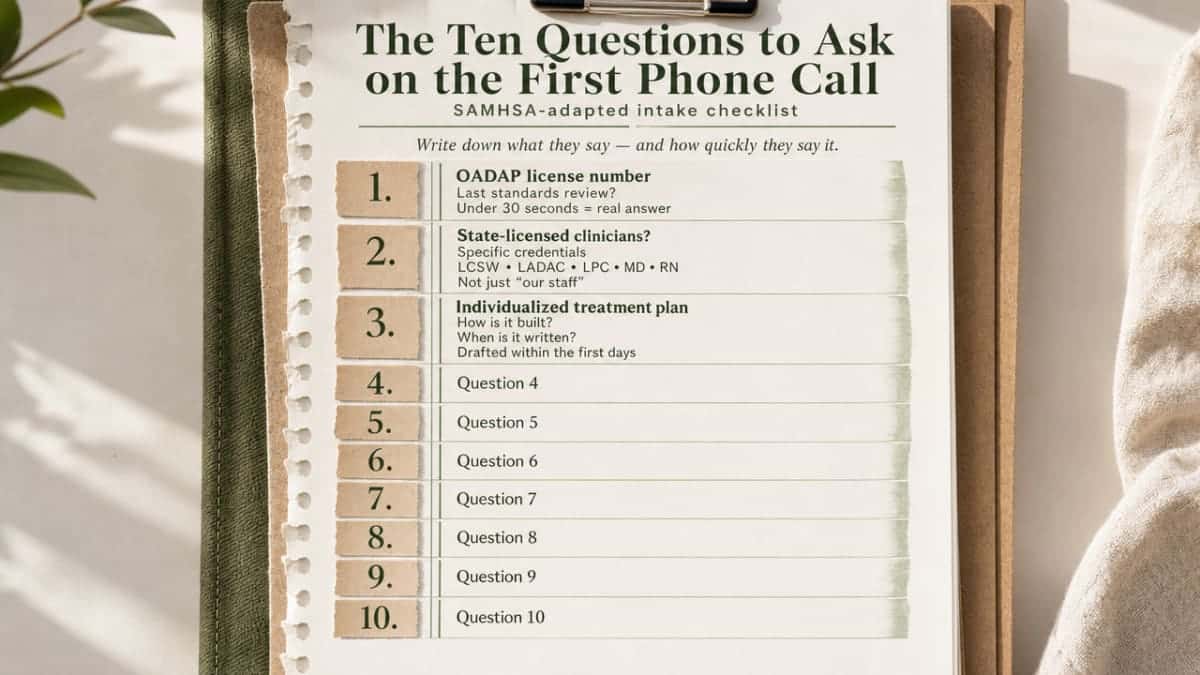
You don’t need to interview a program for an hour to know if it’s serious. Ten questions, asked in the order below, will tell you almost everything. Have a notebook open. Write down not just what they say, but how quickly and specifically they say it. Confidence and detail are the tell.
These are adapted from SAMHSA’s guide for families evaluating treatment 1— the same framework clinicians recommend, translated for a spouse making calls between other obligations.
- What is your OADAP license number, and when was your last standards review? A real answer arrives in under thirty seconds.
- Are your clinicians state-licensed, and what are their specific credentials? You want to hear LCSW, LADAC, LPC, MD, or RN — not “our staff.”
- How do you build an individualized treatment plan, and when is it written? The plan should be drafted within the first few days after a full assessment, not handed to him on day one as a template 1.
- Do you treat co-occurring mental health conditions on-site? Depression, anxiety, PTSD, and trauma sit underneath most substance use. If they refer that out, ask who to and how the coordination works.
- If opioids are part of the picture, do you offer or coordinate buprenorphine, methadone, or naltrexone? The right answer is yes. We’ll come back to why in a moment.
- What does the family program look like, and when am I first involved? Listen for a schedule, not a slogan.
- How is the discharge plan built, and when does that work begin? Aftercare planning should start in the first week, not the last.
- How do you monitor for relapse after he leaves? Check-ins, alumni groups, continuing care, wearable monitoring — you want structure, not a phone tree.
- What outcomes do you track, and can you share them? Retention, completion, and 90-day follow-up rates are fair game.
- What does a typical day inside the program actually look like? You should hear hours of programming, not “we keep the guys busy.”
One more note on how to listen. A good intake coordinator will answer the question you asked, then tell you what you didn’t know to ask. A weaker one will pivot to insurance, availability, or a tour invitation before the clinical questions are answered. That pivot is information. You are not being rude by keeping them on the questions — you are doing the exact work a responsible partner should do.
What Evidence-Based Care Actually Looks Like Inside the Building
When you tour a program or read its schedule, you’re looking for signs that clinicians are doing what the research says works — not just keeping men busy between meals. Evidence-based care has a texture. Once you know what it is, you can spot it in ten minutes.
Start with the assessment. A quality program does a thorough intake in the first day or two — medical history, substance use history, mental health screening, trauma history, family situation — and then writes an individualized treatment plan from what it finds. NIDA’s core principles are explicit that effective treatment addresses multiple needs of the individual, not just the drug use, and matches the plan to the person in front of the clinician 2. If the schedule he receives on day one looks identical to what every other man on the unit gets, that is not individualized care. That is a template.
Next, look at the therapies themselves. You should hear specific names: cognitive behavioral therapy, motivational interviewing, contingency management, relapse prevention, trauma-focused work when indicated. Group therapy should have a curriculum, not just a circle of chairs. Individual counseling should happen at least weekly, ideally more. Psychiatric evaluation should be available on-site or through a clear coordination pathway, because depression, anxiety, and PTSD often sit underneath the substance use — and the systematic review evidence shows residential treatment works best when mental health care is integrated, not bolted on 7.
Then there’s the daily structure. Five to six hours of programming a day is a reasonable benchmark for a residential level of care. Ask what fills the rest of the day: peer support meetings, fitness, nutrition, mindfulness, family calls, homework from group. Structure is therapy in a residential setting, and empty afternoons are a warning sign.
One last test. Ask how the clinical team meets about him. In a serious program, his primary counselor, the psychiatrist, the nurse, and the case manager sit down together weekly to review progress and adjust the plan. If no one can describe that meeting, no one is having it.
If Opioids Are Involved, MOUD Is the Line
If part of what brought you to this search is opioids — pills, heroin, fentanyl, any of it — there is one question that matters more than the tour, the amenities, or the location: does the program offer or coordinate medications for opioid use disorder?
So when you call, ask directly. Do you offer buprenorphine or naltrexone on-site? If not, who do you coordinate methadone care with, and how is that appointment scheduled before he leaves? A program that treats MOUD as optional, philosophical, or something they “don’t really do here” is telling you their approach to opioids is behind the standard of care. That is not a program you want him in this month.
How a Good Program Includes You
Ask any intake coordinator how they involve family, and listen for whether the answer has a calendar attached to it. A serious program can tell you when family therapy sessions happen, how often you’ll get a clinical update, what the visitation schedule looks like, and what the family education curriculum covers. A weaker program says something warm about “loved ones” and moves on.
This matters more than it might sound. Family therapy in residential settings reduces premature dropout and supports the structural changes at home that keep drug use from returning after discharge 8. That’s not a soft benefit — it’s one of the concrete mechanisms by which a 30-day stay holds. A more recent systematic review of randomized trials found that family-centered interventions improved both substance use outcomes and family functioning compared with individual-only treatment 9. Two different bodies of evidence, same conclusion: your involvement is clinical, not ceremonial.
Here’s what that should look like on paper:
- A weekly family therapy session, either in person or by video, starting within the first two weeks.
- A designated point of contact — usually his primary counselor or a family liaison — who returns your calls within a business day.
- Structured family education about addiction as a chronic condition, so you’re not guessing at what’s normal in early recovery.
- An explicit plan for how you’ll be included in the discharge conversation before he walks out the door.
You should also ask what the program expects from you. Boundaries about what to discuss and when. Guidance on how to handle a difficult phone call in week two. A clear read on whether couples work is appropriate now or later. If the answer to all of this is “we’ll play it by ear,” the family component isn’t built.
One warning sign deserves its own sentence. A program that refuses family contact entirely, citing his privacy as a blanket reason, is misreading the standard of care. He can absolutely decline to share specific clinical details — that’s his right. But a program that won’t tell you whether he arrived, whether he’s medically stable, or when family sessions begin isn’t protecting him. It’s insulating itself. That distinction is worth trusting your gut on.
The Discharge Plan Is the Product
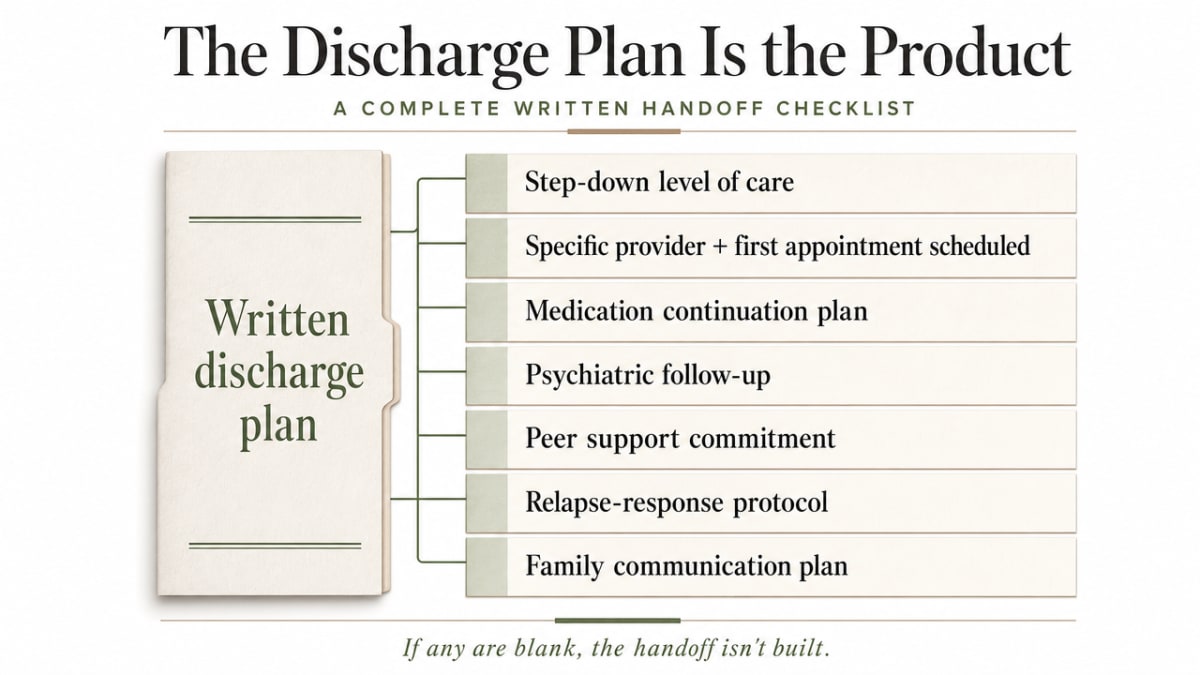
Here’s the reframe that will change how you evaluate every program on your list: the discharge plan is what you’re actually buying. The thirty days inside the building are the setup. The written plan he walks out with — and the structure standing behind it — is what determines whether month two looks like month one or looks like a relapse.
A real discharge plan is a document, not a conversation. Ask to see the template. It should name:
- A step-down level of care (intensive outpatient or outpatient)
- A specific provider and a first appointment already on the calendar
- A medication continuation plan (including MOUD if opioids are in the picture)
- A psychiatric follow-up
- A peer support commitment
- A relapse-response protocol
- A family communication plan
If any of those are blank when he leaves, the handoff isn’t built.
Ask what they measure and report. A recent systematic review of substance use disorder treatment outcomes catalogs the metrics quality programs commonly track: engagement, relapse, readmission, retention, and abstinence 12. You are within your rights to ask for their 30-, 60-, and 90-day figures on each. A program that can quote them is one that runs on data. A program that can’t is running on hope.
One practical marker: aftercare planning should start in the first week of the stay, not in the last 48 hours. If they describe discharge as something the case manager “handles at the end,” you already have your answer. Cross that program off and keep calling.
Wearables and Remote Monitoring: A Real Signal, Not a Gimmick
A growing number of programs are adding wearable devices — wrist sensors, patches, connected rings — to the clinical picture. It sounds like marketing at first. It isn’t, or at least it doesn’t have to be. Two peer-reviewed reviews suggest this technology has real utility when it’s used well.
A review of wearable biosensors in alcohol use disorder treatment found that these devices can provide continuous, objective measures of alcohol consumption, craving, and physiological stress — the kind of data that helps clinicians catch early warning signs before a slip becomes a full relapse 10. A separate systematic review of wearable and wireless mHealth technologies across substance use disorders reached a compatible conclusion: wearable sensors are the most commonly used technology in this space, and they can be used to decrease heavy substance use, mitigate factors related to relapse, and monitor for overdose 11.
What that means practically: if a nearby program uses wearables to track sleep, heart rate variability, and stress patterns during residential care and into aftercare, ask how the data actually reaches a clinician and what triggers a check-in. Continuous data that no one reviews is just a wristband. Data that a counselor uses to schedule a call the day his sleep collapses is a genuine layer of safety in month two — the window where a 30-day stay most often unravels.
Red Flags That Should End the Call
Some answers should end the call before you finish your coffee. Not because the person on the phone is a bad person, but because what they just told you is incompatible with the standard of care you should accept for your husband.
Cross a program off the list if you hear any of the following:
- They can’t produce an OADAP license number 15.
- They promise medically supervised detox but don’t hold a separate Arkansas Department of Health inpatient license 16.
- They treat opioid use disorder without offering or coordinating buprenorphine, methadone, or naltrexone 4.
- They can’t describe an individualized treatment plan process, and everyone on the unit follows the same schedule 2.
- They refuse family contact entirely and cite privacy as a blanket wall 8.
A few softer signals also matter:
- Aftercare planning that starts in the last 48 hours.
- No on-site or coordinated psychiatric care when co-occurring conditions come up.
- An intake coordinator who pushes availability and insurance before answering clinical questions.
- A guarantee of any specific outcome — anyone promising a success rate is either misreading the research or making it up.
Trust the pattern, not any single answer. When two or three of these show up on the same call, you already know.
Making the Decision by Friday
You don’t have to be sure. You have to be careful. Those are different things, and confusing them is how good decisions get stalled.
By the end of the week, you can realistically do this: call three or four nearby programs, ask the ten questions, confirm each one’s OADAP license, and eliminate the ones that stumble. Two will probably stand out. Tour both if you can. Bring the notebook.
When you sit down to choose, weight the boring parts heaviest — licensure, individualized planning, MOUD if opioids are involved, a real family schedule, a written discharge plan built in week one. Those are the elements the evidence keeps pointing back to 7. Amenities are a tiebreaker, not a criterion.
He will not walk out of a 30-day stay finished. He will walk out with a foothold, if the program is any good. Your job this week is picking the one that treats month two as seriously as month one. That’s the whole assignment. You can do this.
Frequently Asked Questions
Is 30 days of rehab long enough to actually work?
For some people and some substances, yes — as a starting point. Thirty days can stabilize him medically, break the daily pattern of use, and set up aftercare. But treatment works best as long-term management, not a single episode 2. Judge the program by how seriously it builds the handoff into outpatient care, medication continuation, and family follow-through. That’s what determines whether month two holds.
How do I verify that a rehab near me is properly licensed in Arkansas?
Ask for the program’s OADAP license number — any substance abuse treatment program in Arkansas must hold one 15. If medically supervised detox is on the table, confirm the facility also holds a separate Arkansas Department of Health inpatient license 16. A licensed program answers both questions within seconds. Vague reassurance, deflection, or promises to send documentation later tells you what you need to know.
What should I ask about family involvement before he checks in?
Ask for the schedule, not the philosophy. When does family therapy start, how often does it happen, who is your point of contact, and how is family included in discharge planning? Family therapy in residential settings reduces premature dropout and supports the changes at home that keep recovery holding 8. A program that can’t put dates and names to its family program hasn’t actually built one.
If opioids are part of the picture, what treatment should the program offer?
The program should offer or directly coordinate medications for opioid use disorder — buprenorphine, methadone, or naltrexone. CDC guidance is explicit that detoxification alone, without MOUD, is not recommended because of increased risks for resumed use, overdose, and overdose death 4. Ask on the first call whether they prescribe on-site and, if not, exactly which clinic handles the handoff and when the appointment is scheduled.
What are the biggest red flags to watch for on a first phone call?
No OADAP license number 15. Detox offered without a separate Arkansas Department of Health inpatient license 16. Opioid treatment without MOUD 4. Identical daily schedules for every man on the unit instead of individualized planning 2. Blanket refusal to communicate with family. Aftercare described as something handled in the final 48 hours. Any guarantee of a specific success rate. Two or three of these on one call is enough.
What should the discharge plan include before he leaves the building?
A written document naming a step-down level of care, a specific outpatient provider with a first appointment already scheduled, a medication continuation plan (including MOUD if relevant), psychiatric follow-up, a peer support commitment, a relapse-response protocol, and a family communication plan. Ask what the program tracks — engagement, relapse, readmission, retention, and abstinence are standard outcome measures quality programs report 12. If anything is blank, the handoff isn’t finished.
References
- A Quick Guide to Finding Effective Alcohol and Drug Addiction Treatment. https://www.michigan.gov/-/media/Project/Websites/mdhhs/Folder2/Folder62/Folder1/Folder162/SAMHSA_Quick_Guide_Find_Treatment.pdf
- Addiction Treatment | National Institute on Drug Abuse (NIDA). https://nida.nih.gov/nidamed-medical-health-professionals/treatment/addiction-treatment
- Practice Guideline for the Treatment of Patients with Substance Use Disorders. https://integrationacademy.ahrq.gov/resources/18791
- Opioid Use Disorder: Treating | Overdose Prevention. https://www.cdc.gov/overdose-prevention/hcp/clinical-care/opioid-use-disorder-treating.html
- CDC Clinical Practice Guideline for Prescribing Opioids for Pain. https://www.cdc.gov/mmwr/volumes/71/rr/rr7103a1.htm
- The Continuing Care Model of Substance Use Treatment. https://pmc.ncbi.nlm.nih.gov/articles/PMC4007701/
- The effectiveness of residential treatment services for individuals with substance use disorders: A systematic review. https://pubmed.ncbi.nlm.nih.gov/31254749/
- Chapter 8—Brief Family Therapy (Treatment Improvement Protocol). https://www.ncbi.nlm.nih.gov/books/NBK64953/
- Family-centered interventions for persons with substance use: A Systematic Review on Randomized Controlled Trials. https://pmc.ncbi.nlm.nih.gov/articles/PMC13068785/
- A Review of Wearable Biosensors in Alcohol Use Disorder Treatment. https://pmc.ncbi.nlm.nih.gov/articles/PMC8019775/
- Wearable and Wireless mHealth Technologies for Substance Use Disorders: A Systematic Review. https://pubmed.ncbi.nlm.nih.gov/33738178/
- Substance Use Disorder Treatment Outcomes: A Systematic Review. https://pmc.ncbi.nlm.nih.gov/articles/PMC12180564/
- Summary of Findings of Included Systematic Reviews (Addiction Treatment Settings). https://www.ncbi.nlm.nih.gov/books/NBK541232/table/rc1052.app4.tab1/
- Licensure Standards for Alcohol and Other Drug Abuse Treatment Programs (Arkansas DHS). https://humanservices.arkansas.gov/wp-content/uploads/Licensure_Standards_for_Alcohol_and_Other_Drug_Abuse_Treatment_Programs.pdf
- Licensure Standards for Alcohol and Other Drug Abuse Treatment Programs (Arkansas Regulations). https://www.law.cornell.edu/regulations/arkansas/016-25-19-Ark-Code-R-SS-015
- Rules for Hospitals and Related Institutions (Arkansas Department of Health). https://healthy.arkansas.gov/wp-content/uploads/Hospital_Rules.pdf