
Key Takeaways
- DBT targets the emotion regulation, impulsivity, and maladaptive coping mechanisms that keep substance use running, rather than treating drinking or drug use as an information or willpower problem 8.
- Arkansas treatment admissions in 2023 spread across alcohol, opiates, amphetamines, and marijuana, reflecting a coping-mix pattern common among high-functioning men whose nervous systems found a chemical shortcut 6.
- Evidence points the right direction: a marijuana use RCT showed DBT reduced emotion-driven craving more than psychoeducation 3, and men in residential DBT skills groups improved distress tolerance and reduced urges 10.
- For Arkansas men weighing residential care, the decision is whether to replace the coping mechanism through structured skills work in Little Rock or keep outsourcing regulation to a substance.
The 6 P.M. Pour Is Not the Problem
You already know the routine. The last email gets sent, the garage door closes behind you, and by the time the ice hits the glass, your shoulders have finally dropped an inch. That drink is not really a drink. It is a nervous system reset you have been outsourcing for years.
If you are reading this, you are probably not new to the conversation. You have tried moderation. Maybe a dry month. Maybe a therapist who talked about thought records and homework sheets. The drinking, or the smoking, or the pills after a bad week keep coming back because none of that touched the actual job the substance was doing for you.
That is what dialectical behavior therapy is built for. DBT was designed for people whose substance use is downstream of emotion regulation and distress tolerance gaps, not for people who simply lack information or willpower 2. It treats the coping mechanism, not just the substance.
This piece is written for the Arkansas man weighing whether that distinction matters, and whether a residential program in Little Rock can deliver on it without blowing up his career. You are not broken. You are running an old operating system. DBT teaches you a new one.
What DBT Actually Does to a Drinking or Using Habit
Built for People Whose Substance Use Started as a Coping Job
Here is the honest read on your situation. You did not wake up one morning and decide to build a life around a bottle or a vape pen. You found something that took the edge off a nervous system that had been running hot for years, and it worked. Until it stopped working and started costing you.
DBT was designed around that exact pattern. When Marsha Linehan and her colleagues adapted DBT for substance use, they built it for people whose using is driven by emotion dysregulation, impulsivity, and thin distress tolerance, not for people who need a lecture on the dangers of alcohol 2. The core assumption is that the substance is doing a job. Remove it without replacing the job, and something else will fill the slot, often quickly.
The systematic review of DBT for substance use disorders describes the treatment as targeting emotion dysregulation, impulsivity, and maladaptive coping as the mechanisms that keep addiction running 8. Notice what is not on that list. There is no assumption that you lack intelligence, moral fiber, or information about your liver.
That framing matters for a man who has already tried the standard playbook. If cognitive behavioral therapy or a moderation app did not stick, it may not be because you failed. It may be because those tools worked one level above where the actual problem lives. DBT goes down a floor and works on the wiring underneath the behavior.
The Four Skill Sets, Mapped to the Moments You Actually Lose
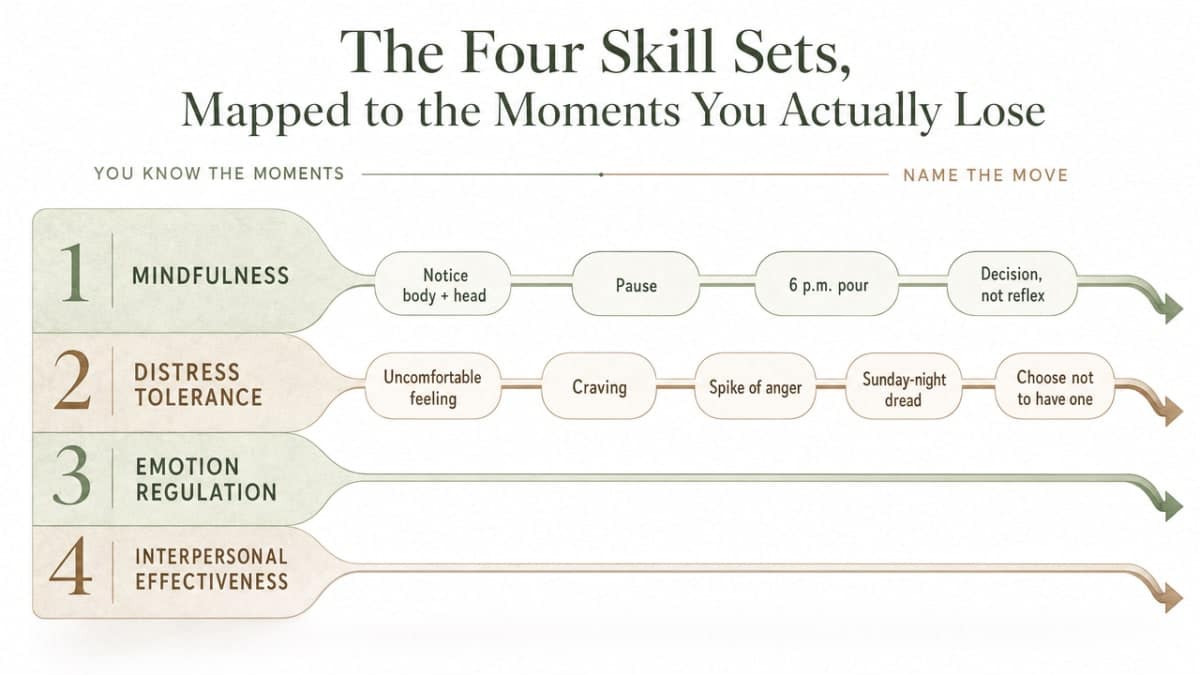
DBT breaks down into four skill areas. The temptation is to list them like a syllabus. That is not useful to you. What is useful is knowing which skill shows up in which moment, because you already know the moments. You just have not had names for the moves.
- Mindfulness
- The skill of noticing what is happening in your body and your head before you are three drinks in and wondering how you got there. It is the pause that lets you catch the 6 p.m. pour as a decision instead of a reflex.
- Distress tolerance
- The ability to sit inside an uncomfortable feeling, a craving, a spike of anger, the Sunday-night dread before a heavy week, without immediately reaching for the thing that flattens it. This is the module built for the moment you know a drink would help and you are choosing not to have one anyway.
- Emotion regulation
- The longer game. It is how you lower the baseline temperature so you are not living in a chronic state of low-grade activation that needs a nightly discharge. Sleep, exercise, how you eat, how you handle a boundary at work — this module treats those as clinical variables, not lifestyle suggestions.
- Interpersonal effectiveness
- The one that closes the loop for a lot of professional men. If you have been drinking to survive the after-work isolation, or to numb the residue from a conflict you did not resolve cleanly, this skill set gives you a way to have the harder conversation instead of anesthetizing your way past it.
These skills are the operational core of DBT-SUD, aimed squarely at emotion dysregulation, impulsivity, and maladaptive coping 2, 8. In practice, at a residential level, you spend time in each module, but the sequence is usually distress tolerance and mindfulness first, because those are the skills that keep you upright through week one when your body is loud and your patience is thin. Emotion regulation and interpersonal effectiveness come in as the noise drops and you can think again.
None of this asks you to become someone else. It asks you to stop outsourcing four specific jobs to a substance.
Behavioral Chain Analysis: The Tool That Treats You Like a Grown Adult
If one DBT tool is going to earn your respect fast, it is behavioral chain analysis. Linehan’s review names it as one of the central strategies in DBT for substance use, and for good reason — it is the closest thing addiction treatment has to a root cause analysis 2.
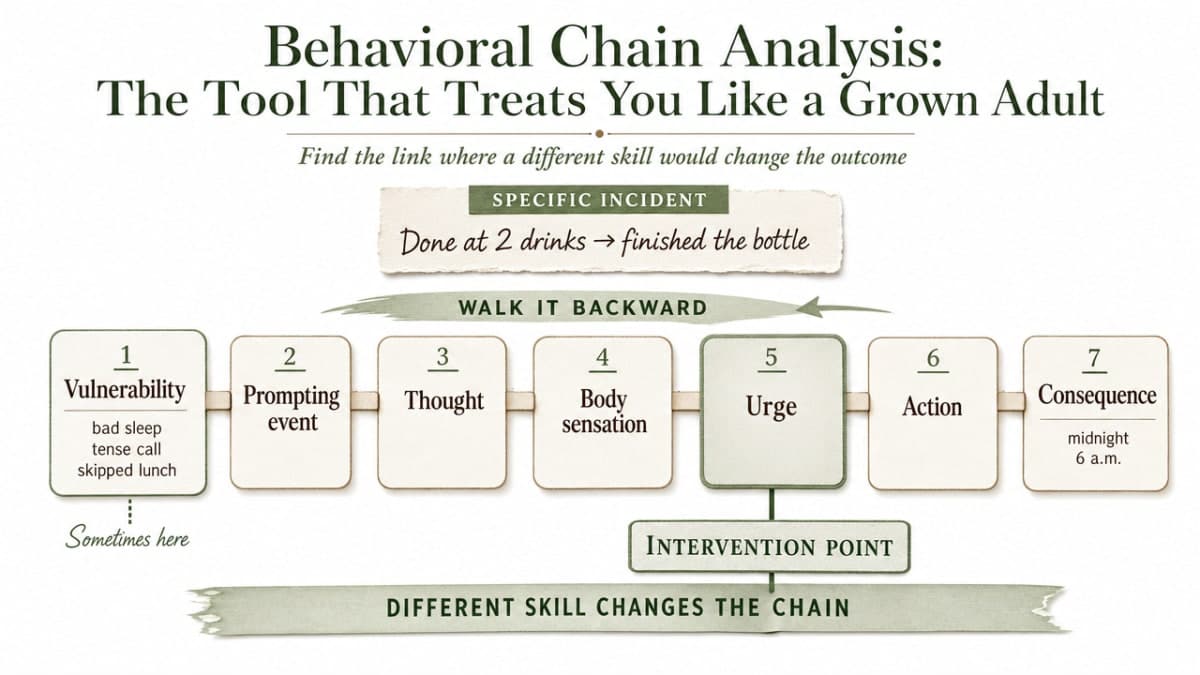
Here is how it runs. You take a specific incident, say last Thursday when you told yourself you were done at two drinks and finished the bottle. You walk it backward link by link. What was the vulnerability going in — bad sleep, a tense call, skipped lunch? What was the prompting event? What thought showed up, what body sensation, what urge, what action, what consequence at midnight and again at 6 a.m.?
You are looking for the intervention point. The link where a different skill would have changed the chain. Sometimes it is at the vulnerability layer. Sometimes it is the thought. Sometimes it is the moment between urge and action, which is where distress tolerance lives.
This is not journaling. It is post-incident review. Any competent adult who has ever debriefed a bad quarter, a lost case, or a botched project understands the logic instantly. DBT just applies it to the part of your life you have been avoiding reviewing.
Why This Fits the Arkansas Man Walking In the Door
What Arkansas Treatment Admissions Actually Look Like
Before you decide whether DBT belongs in your treatment plan, it helps to see what the room actually looks like. Arkansas is not a state with one signature substance problem. It has several running at once, and the mix matters because it tells you what kind of coping is really being treated.
The 2023 SAMHSA treatment admissions data for Arkansas show men and women walking in for a spread of primary substances, with alcohol-only cases sitting alongside alcohol with a secondary drug, heroin and other opiates, amphetamines, and marijuana as the main categories driving admissions across the state 6. The companion discharge dataset lines up the same way, with the same five buckets accounting for most of the treatment episodes Arkansas closed out that year 5. That is not a fentanyl-only story or an alcohol-only story. It is a coping-mix story.
Zoom out one layer and the household survey data fills in the picture. SAMHSA’s 2023 Arkansas tables put past-month alcohol use among adults at a rate that lines up with what any Little Rock bartender or country club steward could tell you anecdotally — drinking is the default social lubricant here, and a lot of it is happening in men who look fine from the outside 7.
What that means for you, practically, is this. Whether the substance you keep circling back to is bourbon on Thursday nights, a vape pen in the truck, or something stronger you have been careful to hide, you are not an outlier in Arkansas. You are the median case. And the median case in this state is almost never a person who lacks discipline. It is a person whose nervous system found a chemical shortcut and stopped looking for another one.
The High-Functioning Coping Pattern Under the Numbers
Now overlay a face on those admission categories. The Arkansas man who ends up in a residential program at 42 rarely got there because he did not know drinking too much was bad for him. He got there because he built a life that ran on a low simmer of stress — a caseload, a call schedule, a P&L, a crew that needs him on-site at six — and he learned that alcohol or something like it was the fastest way to bring the temperature down at the end of the day.
Here is what makes this reader — you — a good match for DBT specifically. You are not someone who needs to be convinced that feelings run the show. You already know they do. You have been managing yours with a drink, a pill, or a joint for years, and the management has gotten more expensive. What you need is a different set of tools that a competent adult can respect and actually use on a Tuesday night in Little Rock. That is what the next section gets into.
The Evidence Base, in Plain English
DBT Reduces Emotion-Driven Craving, Not Just Consumption
You have probably had the argument with yourself where you decide the craving is just a bad habit and you should be able to think your way past it. That argument keeps losing because the craving is not primarily cognitive. It is emotional. It shows up as tightness in your chest, a flatness in your mood, an itch to change how you feel right now.
The cleanest piece of evidence on this comes from a pilot randomized controlled trial that ran 61 patients with marijuana use disorder through either DBT group treatment or a psychoeducation control. The DBT arm produced significantly greater reductions in emotion-related craving and significantly higher rates of cessation than the education-only arm 3. Read that carefully. The people who got information about the harms did worse than the people who got skills for tolerating the feelings that drove the use.
That distinction is the whole game for you. If your using is tied to a feeling — the Sunday-night dread, the residue from a hard conversation, the flat exhaustion at 6 p.m. — a program that only explains the risks is aiming at the wrong target. DBT aims at the mechanism.
The study was a pilot, and marijuana is not everyone’s substance. But the finding lines up with the mechanism DBT was built around, and it is one of the few RCTs that isolates emotion-related craving as a distinct outcome from consumption. That matters because it tells you what the treatment is actually moving.
The Male-Residential Study That Matters Most Here
Most of what gets cited about DBT and addiction comes from studies of women with borderline personality disorder in outpatient settings. Useful work. Not your situation. The study that actually matches your situation is a smaller one, and it does not get quoted enough.
Researchers looked at men in a residential substance use program who went through DBT skills training as part of their treatment. The men who completed the skills groups showed improved distress tolerance and reductions in self-reported substance use urges over the course of care 10. That is a plain-English finding, but pay attention to what it is saying. Distress tolerance went up. Urges went down. Not willpower. Not motivation. The internal capacity to sit with an uncomfortable state without discharging it into a substance.
That is the exact capacity most high-functioning men have been quietly running low on for years. You have discipline. You show up. What you do not have, if you are honest, is a reliable way to be uncomfortable for forty-five minutes without reaching for something.
This is a single-site study with a modest sample. The authors say so themselves. But it is the closest match in the literature to a men’s residential program running DBT skills groups, which is exactly what a facility like Serenity Park operates. When the setting, the population, and the intervention all line up, the finding is worth taking seriously.
Honest Limits and Adjacent Evidence
A few things the evidence does not yet do. The largest and cleanest DBT-SUD trials have historically been in populations with co-occurring borderline personality disorder, and there is a real gap in RCTs testing DBT for substance use without that comorbidity 2. Some of the most positive trials, like the concurrent eating disorder and substance use work, were run in female outpatients — informative on mechanism, but not a direct read on a men’s residential program 4.
What rounds out the picture is convergent evidence from adjacent trials. A randomized trial of emotion regulation group therapy — not pure DBT, but built around the same premise — showed greater reductions in substance use episodes than controls 9. Different protocol, same conclusion: teach people to regulate emotion, and they use less. That convergence is what gives you confidence the mechanism is real, even where the DBT-specific evidence base is still filling in.
You are not being sold certainty. You are being offered a treatment aimed at the actual driver of your using, with evidence pointing the right direction and honest gaps that clinicians name out loud.
How Serenity Park Runs DBT for Men in Little Rock
Skills Training Inside a Residential Week
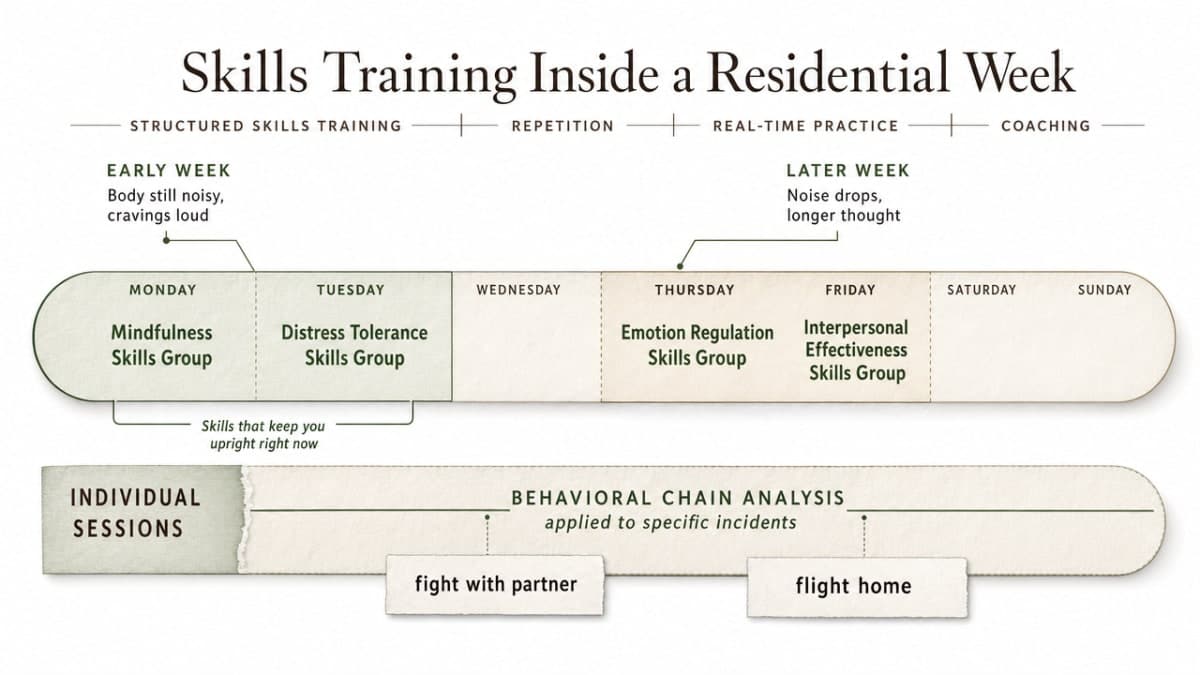
A residential week at Serenity Park is not a wellness retreat, and DBT is not a workshop bolted onto the schedule. It runs as structured skills training built into the clinical week, the way any serious training program would be built — repetition, real-time practice, and coaching from someone who has watched a lot of men try to grip a new skill under pressure.
A typical week runs skills groups on mindfulness and distress tolerance in the early days, when your body is still noisy and cravings are loud. Those are the skills that keep you upright right now. Emotion regulation and interpersonal effectiveness come in as the noise drops and you can hold a longer thought. Individual sessions run alongside the groups, which is where behavioral chain analysis gets applied to your specific incidents — the fight with your partner, the flight home from the sales trip, the night you told yourself two drinks was fine.
The cap of twenty men matters here. In a group that small, you get called on. You cannot back-bench. That is not a punishment. It is the condition under which the male residential DBT evidence was generated in the first place — men in a residential program who actually completed the skills work, not sat near it 10.
Wearable Data as Distress Tolerance You Can See
One of the things that separates the program from a standard residential setup is that distress tolerance stops being a subjective report and becomes something clinicians can actually see. Through the partnership with Huml Health, you wear a device that tracks heart rate, stress signals, and sleep across the day and night.
Here is why that matters for DBT specifically. When you say you are fine, but your resting heart rate at 2 p.m. tells a different story, your clinician has a data point that lines up with what the skill is supposed to be moving. A man learning distress tolerance can see, on a screen, that the twenty-minute urge he thought he would not survive actually crested and fell in eight. That is not a gadget flourish. That is calibration.
It also catches the sleep piece, which is where a lot of emotion regulation quietly lives. Bad sleep is the vulnerability layer that shows up in almost every behavioral chain analysis eventually. Watching it in near real time gives the clinical team something to adjust against instead of guess at.
Carrying the Skills Home After Discharge
The honest truth about any residential program is that the discharge date is not the finish line. It is the moment the skills either travel with you or stay in the building. Serenity Park’s discharge planning, continuing care groups, and alumni support are built around that reality — the skills you learned in Little Rock have to work on a Tuesday night back at your own kitchen island.
That is where the newer evidence on delivering DBT skills between and after sessions comes in. A 2024 randomized controlled trial of a self-guided, internet-delivered DBT program for substance use disorders found it was feasible, acceptable, and produced reductions in substance-related problems across follow-up 1. The takeaway is not that an app replaces treatment. It is that DBT skills reinforce well between structured contact points, which is exactly what a strong aftercare plan is designed to do.
The wearable stays with you. The skills stay with you. The point is to leave with a coping mechanism that fits in your actual life.
You Are Not Choosing a Rehab. You Are Choosing How You Cope.
Strip the brochures away and the real question in front of you is smaller and harder than which facility has the nicest grounds. The question is whether you keep outsourcing your nervous system to a substance, or whether you learn to run it yourself.
Everything in this piece points at that choice. The 6 p.m. pour is not the problem. The problem is that you have not had another tool that works as fast, and you are tired enough at the end of the day that fast is what wins. DBT gives you tools that are slower at first and then, with reps, faster than the drink. Distress tolerance. Behavioral chain analysis. A way to sit through a twenty-minute urge without needing to end it.
Serenity Park’s job in Little Rock is to teach those skills in a men’s residential setting where the coping mechanism gets replaced, not just removed. That is the work. The decision is yours.
Frequently Asked Questions
Is DBT different from the CBT I’ve already tried?
Yes. CBT works on the thoughts driving a behavior. DBT works on the emotional and physiological state underneath the thoughts. If you have already tried thought records and still poured the drink, that is a signal you need the layer DBT targets — distress tolerance and emotion regulation — which the systematic review identifies as DBT-SUD’s core mechanisms 8.
Do I have to have borderline personality disorder for DBT to apply to me?
No. DBT was originally developed for BPD, and Linehan’s review notes the strongest RCTs involved that population 2. Later work has extended DBT skills to substance use populations without BPD, including men in residential treatment 10 and adults with marijuana use disorder 3. The skills are aimed at emotion dysregulation and coping, not a specific diagnosis.
Can I do DBT for addiction without taking time away from work?
Outpatient DBT exists, and self-guided digital DBT has shown feasibility in early trials 1. But if the substance is already running your evenings and weekends, outpatient asks your compromised self to fix your compromised self on lunch breaks. Residential gives the skills real reps before you carry them back into the exact environment that trained the coping in the first place.
What happens to the DBT skills after I leave residential treatment?
They travel if you keep using them. Serenity Park’s continuing care groups and alumni support are designed to keep the reps going after discharge. The 2024 RCT of internet-delivered DBT for substance use showed skills can be reinforced between structured contact points with real reductions in substance-related problems 1. The wearable stays on. The behavioral chain analyses continue.
Does DBT work if my substance of choice is alcohol, not drugs?
Yes. Alcohol dominates Arkansas treatment admissions, with alcohol-only and alcohol-with-secondary-drug categories among the largest buckets in the state’s 2023 data 6. The DBT mechanism — replacing emotion-driven, impulsive coping with skills — does not care what liquid or pill you were reaching for. The male residential DBT skills study did not sort men by substance; it moved distress tolerance 10.
How private is a men’s residential program in Little Rock?
Serenity Park caps at twenty men. That is intentional. A small men’s residential setting means you are not walking hallways with a hundred strangers, and admissions, clinical work, and discharge planning happen with people who understand that professional reputations are part of what you are protecting. Discretion is treated as a clinical requirement, not a marketing line.
References
- Feasibility, Acceptability, and Potential Efficacy of a Self-Guided Internet-Delivered Dialectical Behavior Therapy Intervention for Substance Use Disorders: Randomized Controlled Trial. https://pmc.ncbi.nlm.nih.gov/articles/PMC10828941/
- Dialectical Behavior Therapy for Substance Abusers. https://pmc.ncbi.nlm.nih.gov/articles/PMC2797106/
- A pilot randomized controlled trial of dialectical behavior therapy (DBT) for reducing craving and achieving cessation in patients with marijuana use disorder: feasibility, acceptability, and appropriateness. https://pmc.ncbi.nlm.nih.gov/articles/PMC8835386/
- Outcome of dialectical behaviour therapy for concurrent eating and substance use disorders. https://pubmed.ncbi.nlm.nih.gov/21416557/
- 2023 TEDS-D Arkansas. https://www.samhsa.gov/data/node/51474
- 2023 TEDS-A Arkansas. https://www.samhsa.gov/data/node/51047
- ARKANSAS – National Survey on Drug Use and Health State Tables 2023. https://www.samhsa.gov/data/sites/default/files/reports/rpt56188/2023-nsduh-sae-state-tables_0/2023-nsduh-sae-state-tabs-arkansas.pdf
- Dialectical behavior therapy for substance use disorders: A systematic review. https://pubmed.ncbi.nlm.nih.gov/25613350/
- Emotion regulation group therapy for substance use disorders: A randomized trial. https://pubmed.ncbi.nlm.nih.gov/29709659/
- Dialectical behavior therapy skills training for men with substance use disorders in residential treatment. https://pubmed.ncbi.nlm.nih.gov/29875160/