
Key Takeaways
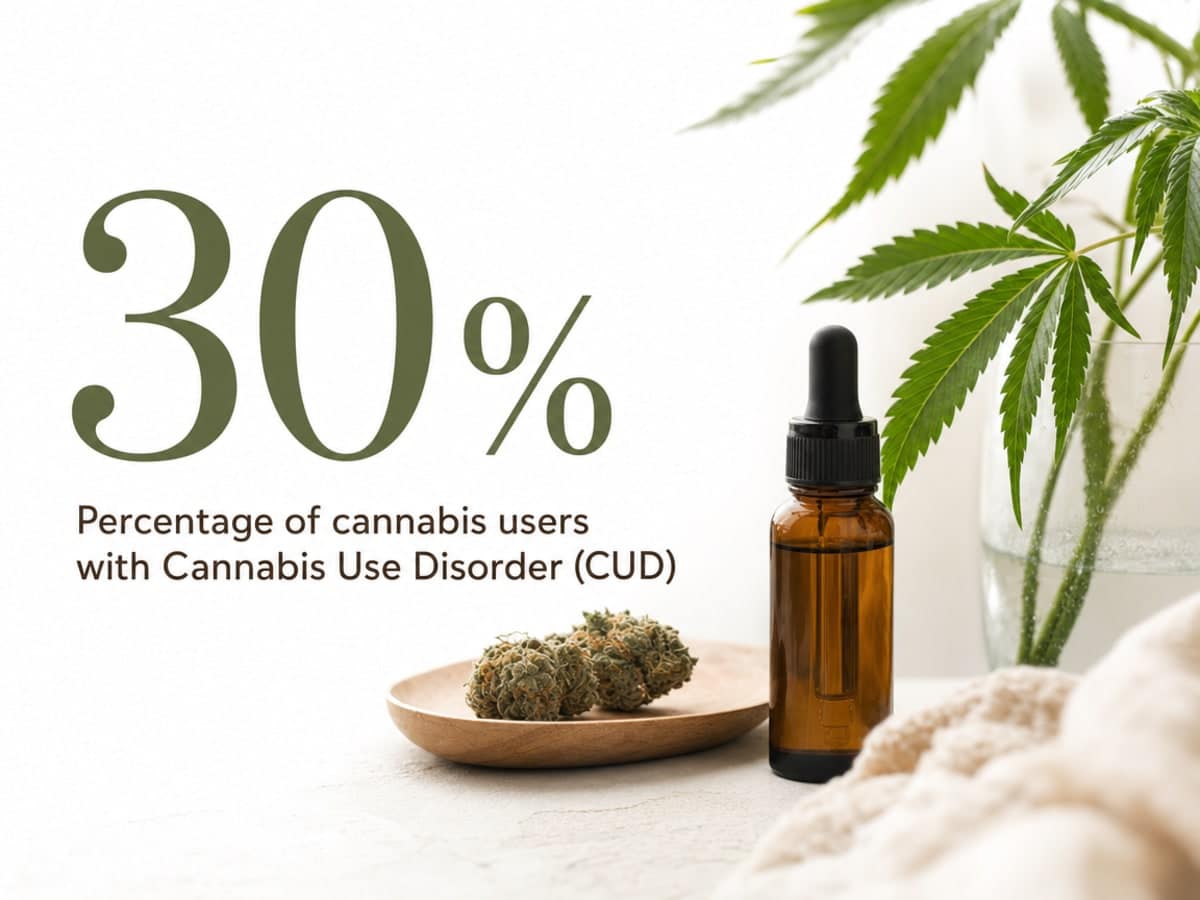
- Cannabis use disorder is a recognized DSM-5-TR diagnosis, and CDC data shows roughly 3 in 10 users develop it, with risk rising for daily high-THC use 2.
- Withdrawal follows a documented arc — starting 24 to 48 hours after last use, peaking around days two and three with insomnia, irritability, and mood symptoms, then resolving over one to two weeks 4.
- Arkansas routes publicly funded care through OSAMH and eight catchment areas 11, while private residential programs offer smaller capacity, individualized plans, and the discretion professional men often need.
- Since no FDA-approved medication exists for cannabis use disorder 9, program design carries the clinical weight — making a quiet first call to ask about intake, privacy, and scheduling is the realistic next step.
When Daily Use Stops Feeling Like a Choice
You’ve probably told yourself it’s just how you unwind. A bowl after the last client email. A cart in the truck before you pull into the driveway. Something to soften the edge of a long day so you can actually be present at dinner — or at least sit through it.
Then one week you tried to stop. Maybe for a physical, maybe because your wife asked, maybe just to prove you could. And by night two you weren’t sleeping. By night three you were snapping at people who didn’t deserve it. Your appetite disappeared. The thought loop wouldn’t quiet down. So you picked it back up, told yourself you’d try again later, and moved on.
Here’s what deserves saying out loud: that wasn’t a lack of discipline. That was withdrawal. And the fact that you can still close deals, run the practice, show up in court, or keep the crew on schedule doesn’t disprove dependence — it’s actually the reason it’s stayed invisible this long.
This guide is written for the man who doesn’t feel like an “addict,” who isn’t sure marijuana even counts, and who is quietly wondering what a serious answer would look like in Arkansas. No lectures. No rock-bottom scripts. Just what the clinical evidence says, what treatment actually involves, and where to start.
Does Cannabis Dependence Actually Count as a Real Condition?
What DSM-5-TR Actually Measures
The clinical answer is yes — and it has been for a while. Cannabis use disorder sits in the DSM-5-TR alongside alcohol, opioid, and stimulant use disorders, measured against 11 specific criteria. Meet two, and you technically qualify for a mild diagnosis. Meet six or more and it’s considered severe 1.
The criteria aren’t about how much you smoke or whether you can hold a job. They’re about a pattern. Reading them slowly, without defending yourself, is the honest exercise:
- Using more, or for longer, than you meant to
- Wanting to cut down and not being able to
- Spending real time getting it, using it, or recovering from it
- Cravings that intrude on your day
- Use interfering with work, school, or home
- Continuing despite arguments or relationship strain
- Giving up activities you used to care about
- Using in situations where it’s physically risky
- Continuing even when you know it’s making a physical or mental health issue worse
- Needing more to get the same effect (tolerance)
- Withdrawal when you stop
Researchers have pointed out — fairly — that tolerance and withdrawal alone can technically trigger a diagnosis, which isn’t always the same thing as a life problem 1. That nuance matters. But if you’re recognizing four, five, or seven of these on the list, that’s not a technicality. That’s a pattern the field takes seriously, and one that tends to strengthen the more heavily and frequently a person uses 5.
Noticing it is the first honest move. It doesn’t make you an addict. It makes you paying attention.
The Three-in-Ten Number and Why It Matters for You
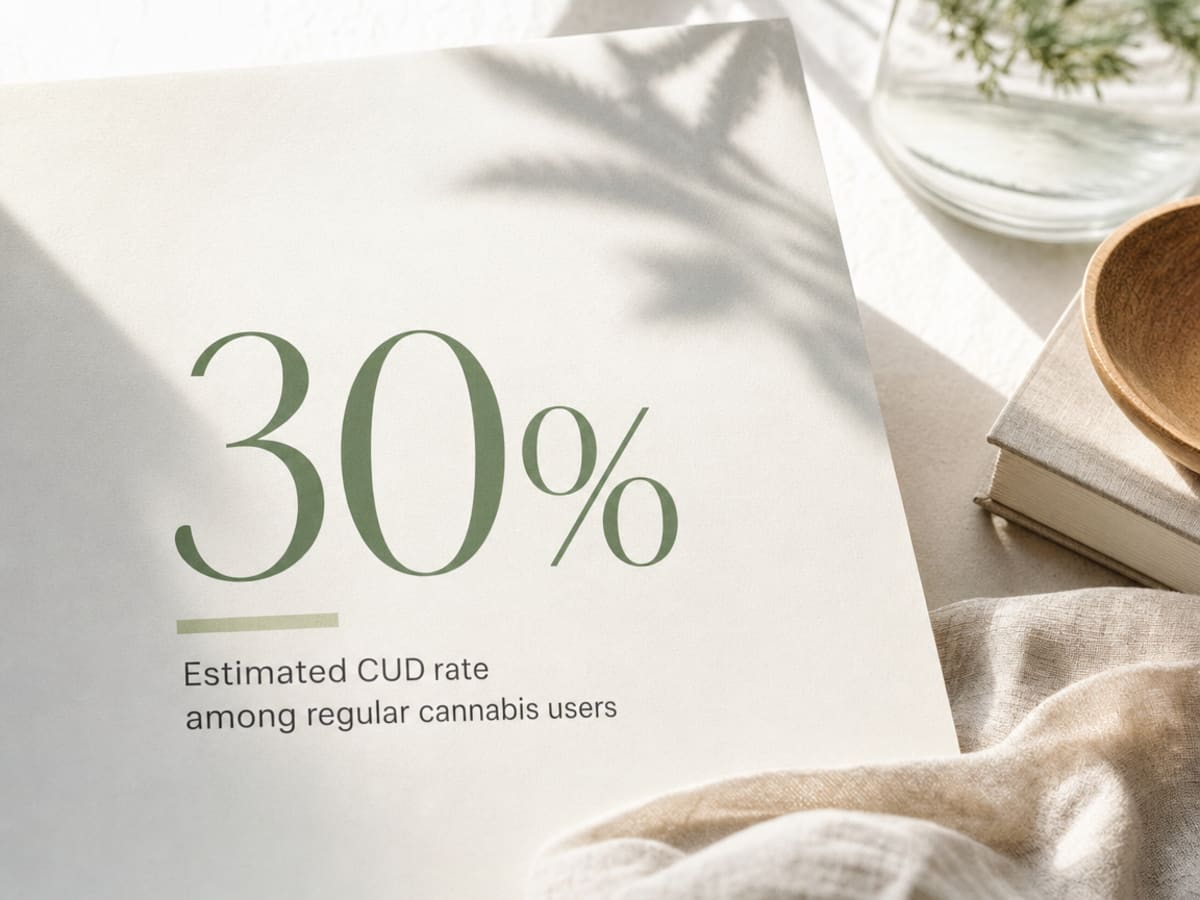
Here’s the figure most people haven’t heard: roughly 3 in 10 people who use cannabis develop cannabis use disorder, according to the CDC, with the risk climbing for those using high-THC concentrates and daily flower 2. That’s not a fringe estimate from an advocacy group. It’s federal public health data.
Sit with the math for a second. If you’ve ever been in a room of ten regular cannabis users — a tailgate, a group text, the guys you smoke with after work — statistically, three of them are already in it. Not “headed toward a problem someday.” In it.
The products have also changed. The flower and carts on the shelf today are not what people smoked in college in 2005. Concentrations are higher, delivery is faster, and tolerance builds correspondingly quickly. That’s part of why the dependence math has shifted, and why smart, capable men keep landing here despite doing everything else in their lives well 2.
So if you’re reading this and quietly running the numbers — how many days a week, how many grams, how long since you last went 48 hours without — you’re not being paranoid. You’re doing exactly the kind of clear-eyed self-assessment you’d do with any other health indicator. And you’re in a much larger group of professional men doing the same math than the culture around weed lets on.
What Cannabis Withdrawal Actually Feels Like
The 24-Hour-to-Two-Week Timeline
The word “withdrawal” gets loaded with images that don’t fit weed — sweating in a hospital bed, hallucinations, the shakes from a bad detox movie. So when you feel off two days after your last hit, it’s easy to write it off as a bad week, a stressful project, something you ate. It usually isn’t.
Cannabis withdrawal has a specific, well-documented arc. Symptoms typically begin 24 to 48 hours after your last use, peak in the first week (with days two and three often the hardest), and resolve over roughly one to two weeks 4. That’s not a suggestion — that’s the pattern researchers have consistently observed across clinical populations.
The symptoms themselves are less dramatic than a movie and more corrosive than you’d think. NIDA’s list is the one to read carefully: irritability, anger, anxiety, insomnia, depressed mood, and tremor 9. Add in the appetite drop, the headaches, the low-grade nausea, and the strange restlessness that has you pacing the kitchen at 2 a.m., and you have the exact profile most men describe when they say “I just couldn’t stick with it.”
Here’s what to sit with: if you’ve tried to take a week off and felt like a worse version of yourself by day three — shorter with your kids, wired but exhausted, unable to fall asleep before midnight — you weren’t imagining it, and you weren’t weak. You were on day three. That’s when the curve peaks. Most people who quit on their own reach for a cart right around that point, not because they lack willpower but because they don’t know the discomfort has a finish line about ten days out.
Knowing the timeline changes the game. It turns a mystery into a countdown.
Why Sleep Falls Apart First
Of all the withdrawal symptoms, sleep is usually the one that breaks people. And it makes sense — cannabis has been the tool you reach for at 10 p.m. for months or years. Take it away, and the system that was leaning on it doesn’t just spring back.
Insomnia is one of the most reliably reported cannabis withdrawal symptoms, sitting right alongside irritability and anxiety in the clinical literature 9. What tends to surprise men is the second layer: vivid, sometimes unsettling dreams. Cannabis suppresses REM sleep while you’re using it, so when you stop, REM comes back all at once. You wake up more tired than when you went to bed, wondering why quitting feels like it’s making everything worse.
By night four or five you’re running on fumes, the peak-week symptoms are landing on an under-slept brain, and the phrase “just one bowl to sleep” starts sounding reasonable. That’s not a character flaw. That’s the exact pressure point where a self-directed quit collapses.
It’s also the point where medically supervised care earns its keep. Sleep support, monitoring, and a structured schedule make the difference between white-knuckling night five alone and moving through it with people who know what’s happening in your body.
The Severity Question: Outpatient vs. Residential
Somewhere between “I can handle this at home” and “I need to check into a facility” sits the honest question: how bad, really, is your withdrawal likely to be? That answer isn’t a guess. There’s data on it.
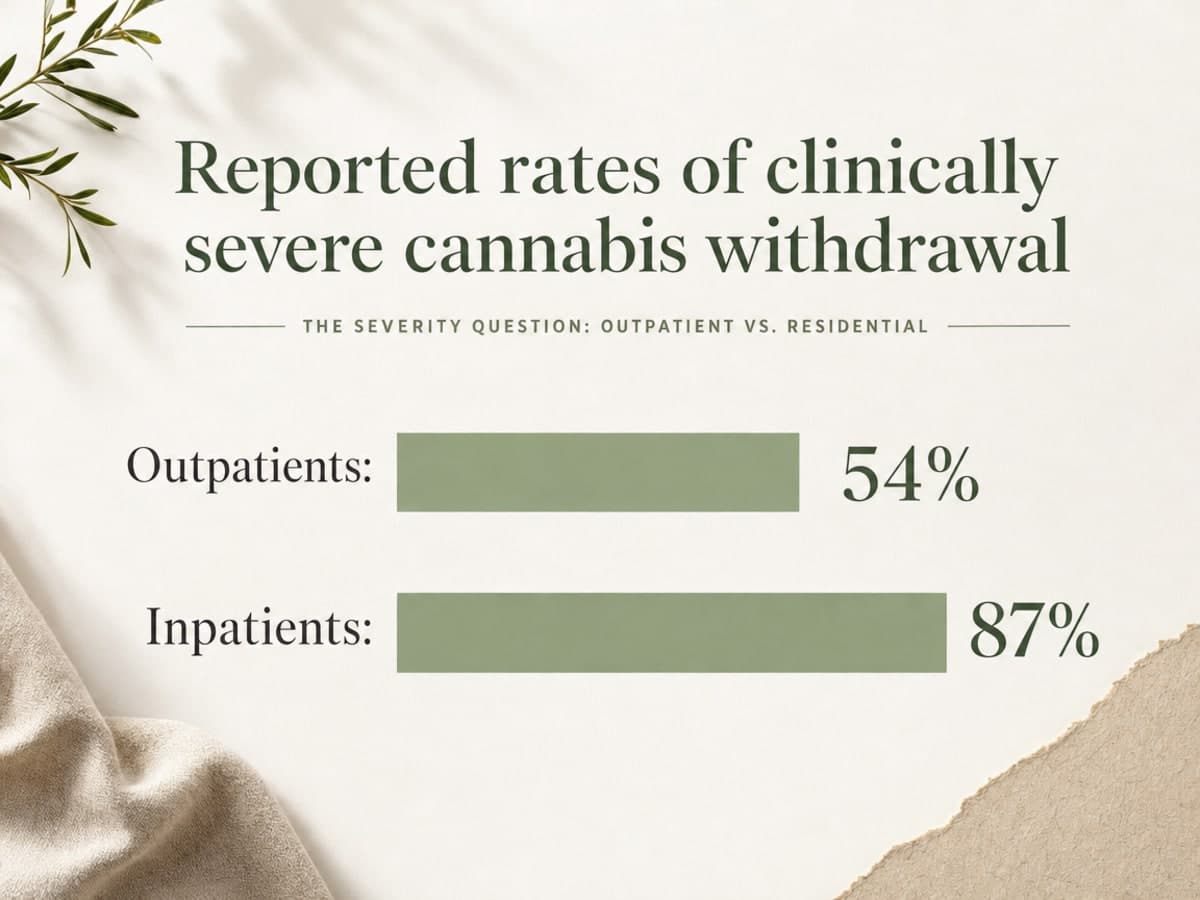
A 2021 review of cannabis use disorder found a striking gap between two treatment settings. Among outpatients being treated for CUD, 54% reported clinically severe withdrawal. Among inpatients, that number jumped to 87% 4. Same substance, same diagnostic criteria — very different intensity, and very different environments in which people were trying to stop.
So where do you fit? If your use has been daily, high-THC, and running for years — and you’ve already tried and failed to stop at home more than once — you’re statistically closer to the inpatient profile than the outpatient one. The 87% isn’t a threat. It’s a heads-up. It’s what the people who look like you, on paper, actually went through when they finally quit.
The practical difference between the two settings isn’t philosophical. Outpatient care means you go home each night — to the same couch, the same drawer, the same 2 a.m. insomnia with no one watching. Residential care means the peak days happen inside a structured environment with clinicians who can adjust sleep support, monitor vitals, and interrupt the exact moment where most self-directed quits fall apart.
For a high-functioning man who has been quietly losing this fight for a year or three, the severity data isn’t an argument for panic. It’s an argument for matching the setting to the actual clinical picture — not the one your pride wants it to be.
What Evidence-Based Treatment Actually Looks Like
CBT, Motivational Enhancement, Contingency Management
If you’re picturing treatment as a circle of folding chairs and someone asking you to admit you’re powerless, park that image for a minute. The evidence base for cannabis use disorder looks more like a working relationship with a skilled clinician than a movie scene.
Three approaches sit at the core, and they’re the same ones a decent program will build your plan around. Cognitive behavioral therapy (CBT) helps you catch the thought-and-trigger loops that turn a stressful call into a cart in your hand ninety minutes later. Motivational enhancement therapy (MET) works the other direction — instead of arguing you into change, a clinician helps you get honest about what you actually want your life to look like, and lets that pull the decision. Contingency management (CM) adds a structured reward system for verified non-use, which sounds simple until you realize how much of daily use is habit reinforcement in reverse.
Across clinical reviews, these three interventions produce small-to-moderate but real reductions in cannabis use and related problems, and they remain the standard of care 8. A 2024 systematic review across adolescents, young adults, and older adults reached the same conclusion — behavioral interventions carry the weight of the treatment response 10.
What that means practically: the therapist matters. The program structure matters. Whether your plan actually addresses your triggers — the 6 p.m. drive home, the anxiety before a hearing, the sleep problem underneath everything — matters more than the label on the door.
Why No Pill Exists — and What That Means for Program Quality
Here’s a fact that surprises most men when they first hear it: there is no FDA-approved medication for cannabis use disorder 9. Nothing. Not a naltrexone equivalent, not a Suboxone equivalent, not a daily tablet that takes the edge off cravings the way varenicline does for nicotine. Researchers have tested candidates. The results haven’t been strong enough to earn approval 10.
That absence changes what you should be shopping for. When there’s no pill, the quality of the program itself becomes the intervention. Everything hinges on the people running your care — how experienced the therapists are, how individualized the plan is, whether sleep and mood are managed medically during peak withdrawal, whether the environment interrupts the cues that keep pulling you back.
This is where a small-capacity, men-only residential setting starts to earn its place. When a facility caps at twenty clients and builds each plan around one person’s actual pattern — daily flower versus concentrates, sleep collapse versus anxiety spikes, ten years of use versus three — the individualization isn’t marketing. It’s the mechanism. In a condition without a medication answer, program design is the answer.
Getting Care in Arkansas: How the System Is Built
The OSAMH Framework and Eight Catchment Areas
Arkansas doesn’t route substance use treatment through a single front door. The state’s Office of Substance Abuse and Mental Health (OSAMH) sits under the Department of Human Services and does the behind-the-scenes work most residents never see — distributing federal grant funds and contracting with community-based providers for prevention, treatment, and recovery services across the state 12.
Geographically, that system is divided into eight catchment areas, each with contracted providers handling publicly funded treatment access 11. If you’re uninsured or underinsured, that’s the pipeline that gets you in — you call the state provider-locator line, get pointed to the catchment provider for your county, and start the intake process there 11.
That framework matters even if you never plan to use it. It’s the backbone of what’s available in-state, and it tells you two useful things. First, care exists in Arkansas — you’re not looking at a treatment desert. Second, the publicly funded pathway is designed around access, not around the discretion, individualization, or scheduling flexibility that a professional man with a demanding calendar usually needs.
Knowing the system exists takes some of the mystery out of what happens next. It also clarifies where private residential care actually fits — and why, for the reader this guide is written for, it usually fits better.
Where Private Residential Care Fits
Private residential treatment isn’t a replacement for the OSAMH network — it’s a different lane, built for a different set of needs. The state system does critical work for Arkansans who need publicly funded access. Private residential care answers a different question: what does treatment look like when discretion, individualization, and a small, controlled environment matter as much as the clinical protocol itself?
For a physician who can’t have his intake paperwork sitting in a shared regional file, an attorney weighing bar considerations, or a business owner who needs to disappear from the office in a way that reads as “medical leave” and not “crisis,” the difference isn’t small. Private residential care usually means smaller client capacity, private-pay or insurance-billed rather than grant-funded, and an intake process that respects why you called quietly instead of walking into a county provider.
It also tends to mean the plan actually gets built around you. In a state-contracted outpatient setting handling high volume, individualization runs into scheduling reality. In a small residential program, the clinician has room to design withdrawal management, therapy cadence, and sleep support around your specific pattern.
Both lanes have their place. The right one depends on what you actually need protected — your access, your privacy, or both.
Serenity Park and the Case for Individualized Residential Care
Here is where the argument for a specific kind of program lands. When the evidence base for cannabis use disorder rests on psychosocial work — CBT, motivational enhancement, contingency management — and no medication exists to smooth the edges 8, the shape of the program you choose is doing most of the clinical work. That’s not a marketing angle. It’s what the research forces you to reckon with.
Serenity Park Recovery Center sits in Little Rock as a men-only residential program capped at twenty clients. That cap matters. It’s the difference between a plan built around your daily flower pattern, your specific sleep collapse, your ten-year use history — and a plan built around the average patient in a caseload of eighty. Individualized isn’t a brochure word here; it’s what small capacity structurally allows.
The program pairs standard evidence-based residential care — medically supervised detox, individual counseling, group therapy, psychiatric care, aftercare planning — with continuous biometric monitoring through wearable devices in partnership with Huml Health. Heart rate, stress, and sleep get tracked in real time, which is particularly useful during the peak withdrawal window when sleep is falling apart and mood is swinging hard 9. Clinicians adjust based on what your body is actually doing, not what you’re able to report on a form at 9 a.m.
What makes the case for Serenity Park in the context of marijuana specifically isn’t dramatic language about weed. It’s the refusal to dismiss it. Same clinical seriousness, same individualized plan, same medical infrastructure that any other substance would get. That’s what you’re looking for.
Making the First Call Without Blowing Up Your Life
The first call is smaller than you think. It’s a conversation, not a commitment. You ask what intake looks like, what the timeline could be, how the program handles privacy and scheduling for someone with a full calendar. You hang up. You think about it. Nothing has changed on your end except that you know more than you did an hour ago.
A few practical moves that keep it low-stakes: call from your personal phone, not the office line. Ask specifically how admissions handles confidentiality — who sees your file, how communication is routed, what “medical leave” documentation can reasonably look like. Verify insurance quietly through the facility rather than your HR portal if that matters to you. Ask what a typical residential stay looks like on the calendar so you can plan around it, not react to it.
You’ve already done the harder work — noticing the pattern, reading this far, being honest with yourself about what withdrawal felt like on night three. Making the call is the next small, realistic win. And it’s the one that actually moves things.
Frequently Asked Questions
Is marijuana dependence actually a real medical condition?
Yes. Cannabis use disorder is listed in the DSM-5-TR with 11 diagnostic criteria covering tolerance, withdrawal, impaired control, and functional impact 1. Roughly 3 in 10 people who use cannabis develop it, per CDC data, with risk rising for daily and high-THC use 2. It’s clinically real, even when your job and life still look intact from the outside.
How long does cannabis withdrawal last after you stop using?
Withdrawal typically starts 24 to 48 hours after your last use, peaks around days two and three, and resolves over one to two weeks 4. Common symptoms include irritability, anxiety, insomnia, depressed mood, and tremor 9. Sleep and mood usually take the biggest hit in the first week. Knowing the arc has a finish line makes the peak days much more manageable.
Do I need residential treatment, or can I quit cannabis on my own?
It depends on your pattern. Clinical data shows 87% of inpatients treated for cannabis use disorder report severe withdrawal, compared to 54% of outpatients 4. If you’ve been daily, high-THC, for years, and you’ve already tried to stop at home more than once, you’re closer to the inpatient profile. Residential care structures the peak withdrawal days so a self-directed quit doesn’t collapse.
What treatments actually work for cannabis use disorder?
The evidence base rests on three psychosocial approaches: cognitive behavioral therapy, motivational enhancement therapy, and contingency management. Reviews consistently show these produce meaningful reductions in use and remain the standard of care 8. A 2024 systematic review across age groups reached the same conclusion — behavioral interventions carry the treatment response 10. The therapist’s skill and program individualization matter more than the label on the door.
Can I get help in Arkansas without my employer or colleagues finding out?
Yes. Private residential programs handle confidentiality differently than the state-contracted OSAMH catchment system that routes publicly funded care 11. Call from a personal line, ask admissions specifically how records are stored and how medical leave documentation is worded, and verify insurance through the facility rather than your HR portal. Discretion is a normal, expected part of the intake conversation, not a special request.
Is there a medication that can help me stop using marijuana?
No. There is currently no FDA-approved medication for cannabis use disorder 9. Candidates have been tested, but none have shown strong enough results to earn approval 10. That’s why program quality carries so much weight — the intervention is the therapy, the structure, and the medical support during peak withdrawal. Look for individualized plans and clinicians experienced with cannabis specifically, not a prescription solution.
References
- Recommendation for Cannabis Use Disorder Diagnosis. https://www.addiction.rutgers.edu/wp-content/uploads/2023/03/jamapsychiatry_chung_2023_vp_230002_1678140893.50556.pdf
- Cannabis Health Effects. https://www.cdc.gov/cannabis/health-effects/index.html
- Cannabis Use Disorder – StatPearls. https://www.ncbi.nlm.nih.gov/books/NBK538131/
- Cannabis Use and Cannabis Use Disorder. https://pmc.ncbi.nlm.nih.gov/articles/PMC8655458/
- Construct Validity of DSM-5 Cannabis Use Disorder Diagnosis and Severity. https://pmc.ncbi.nlm.nih.gov/articles/PMC9590423/
- Marijuana and Public Health: Youth. https://www.cdc.gov/marijuana/factsheets/youth.html
- Cannabis Frequently Asked Questions. https://www.cdc.gov/cannabis/faq/index.html
- Psychosocial Interventions for Cannabis Use Disorder. https://pubmed.ncbi.nlm.nih.gov/30677647/
- Cannabis (Marijuana) | National Institute on Drug Abuse. https://nida.nih.gov/research-topics/cannabis-marijuana
- Treatments for Cannabis Use Disorder across the Lifespan. https://pmc.ncbi.nlm.nih.gov/articles/PMC10968391/
- Find Substance Abuse or Mental Health Treatment. https://humanservices.arkansas.gov/divisions-shared-services/shared-services/office-of-substance-abuse-and-mental-health/samh-treatment/
- About OSAMH – Arkansas Department of Human Services. https://humanservices.arkansas.gov/divisions-shared-services/shared-services/office-of-substance-abuse-and-mental-health/about-osamh/