
Key Takeaways
- Fentanyl now dominates Little Rock’s drug supply, with 102 overdose reversals in the city in 2021 alone and Arkansas fentanyl deaths climbing from 3 in 2014 to 148 in 2020 2.
- Home detox has become riskier because tolerance drops fast during withdrawal, and sedatives like xylazine and medetomidine now mixed into fentanyl do not fully respond to naloxone 9, 15.
- Arkansas requires residential detox to be 24/7 medical care with a withdrawal risk assessment completed within four hours of admission and gender-separated settings by regulation 5.
- Before calling, weigh confidentiality protections under HIPAA and 42 CFR Part 2, insurance versus private-pay trade-offs, admission timing, and whether a men’s-only small-capacity setting fits your situation.
What Fentanyl Changed About Quitting
If you’re reading this at 2 a.m. with your phone tilted away from someone sleeping next to you, take a breath. You are not the first person in Little Rock to sit up in the dark and try to figure out how to stop using fentanyl without wrecking the rest of your life. You will not be the last. And you’re asking the right question by looking at all.
Here is what has changed, and why the old advice about “just riding it out” no longer applies.
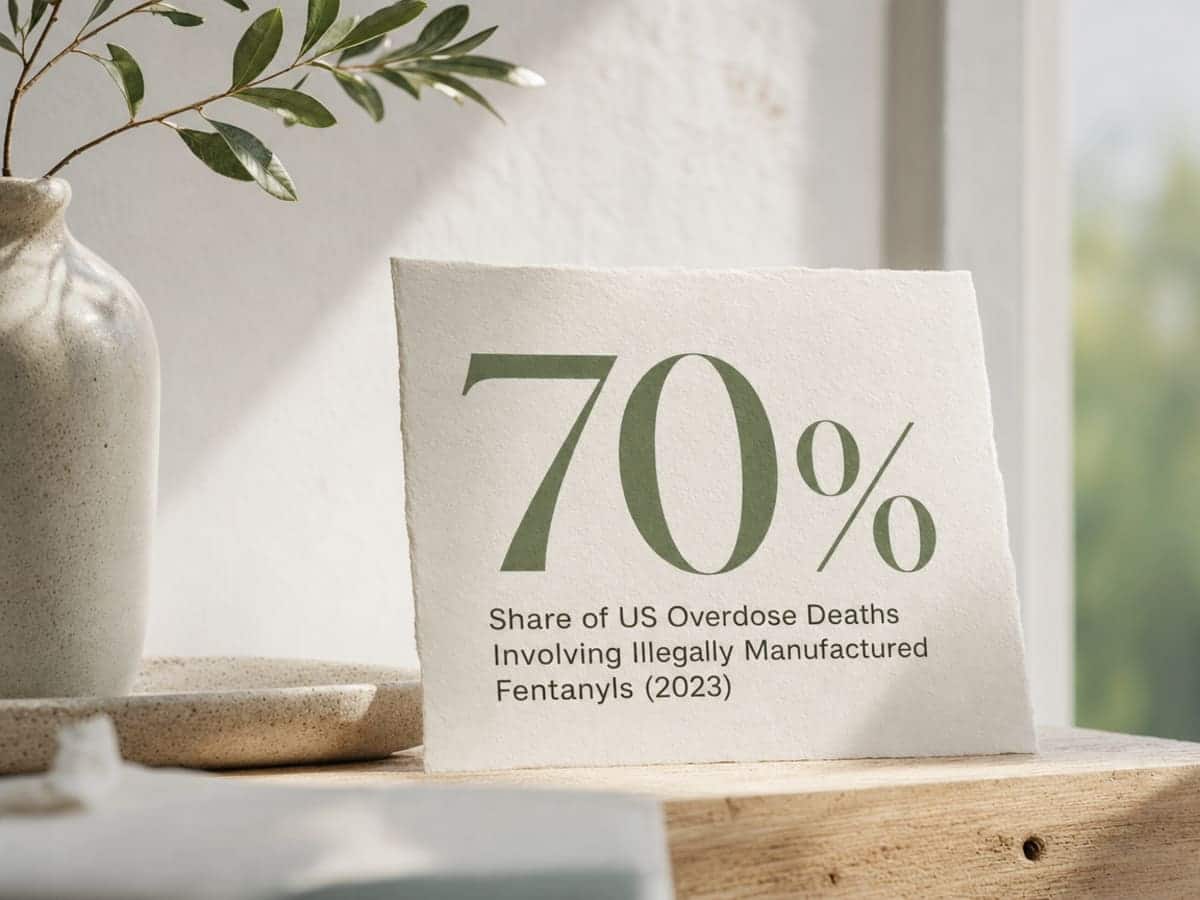
In 2023, roughly 72,000 U.S. overdose deaths — nearly seven in ten — involved illegally manufactured fentanyls, and that share has stayed in the 70 to 80 percent range through 2024 7. Fentanyl is now routinely pressed into counterfeit pills stamped to look like oxycodone, Xanax, or Adderall, and mixed into powders sold as cocaine or methamphetamine, often without the person using them knowing 6. The drug itself is up to 50 times stronger than heroin and 100 times stronger than morphine 6. A dose the size of a few grains of salt can be fatal.
What that means, practically, for you: the pill or bag you have on you tonight is not the same product it would have been ten years ago, or even three. The tolerance you think you have is calibrated to a supply that keeps shifting under you. Every dose is a coin flip you did not agree to.
That’s the part that changes the math on quitting alone. It isn’t just that withdrawal is brutal — though it is. It’s that continuing to use while you “think about it” is no longer a neutral holding pattern. And going cold turkey in a hotel room, hoping nobody at work notices, means you’re managing a medical event by yourself while the drug still in your system is one you can’t verify.
You already know something has to give. This article walks you through what a safer first step actually looks like, in your city, this week.
The Little Rock Numbers You Probably Haven’t Seen
National statistics can feel abstract when you’re sitting in your kitchen in Hillcrest or driving home to West Little Rock after a work dinner where you kept touching your pocket. So here are the numbers that live in your zip code.
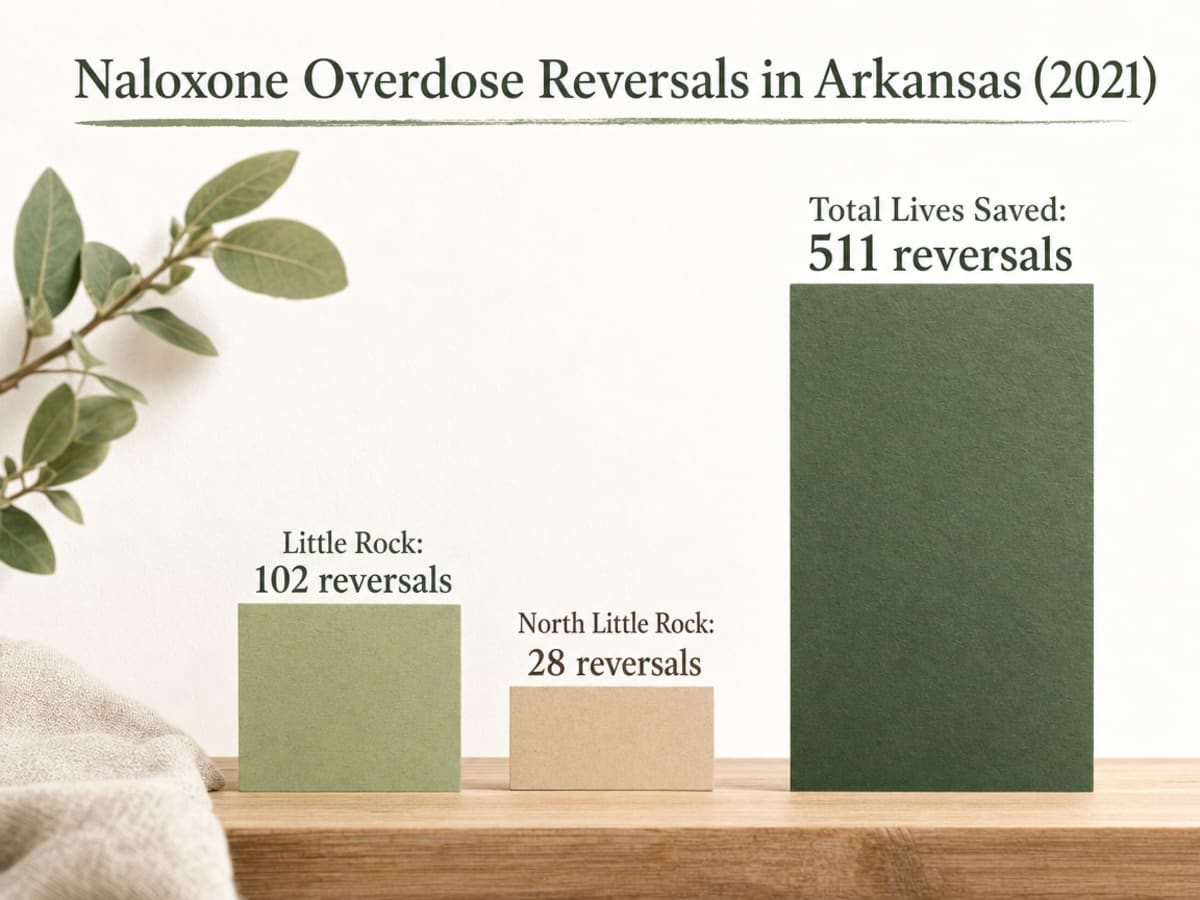
In 2021, the Arkansas Naloxone Saves program documented 511 overdose reversals across the state. Of those, 102 happened in Little Rock. Another 28 happened in North Little Rock 2. That is 130 people in the metro area who stopped breathing, and then started again because someone got to them in time with naloxone. Those are the ones we know about — the ones where a bystander, a paramedic, or a family member was close enough, fast enough, and had the kit.
The same report tracked what was killing people. Arkansas fentanyl deaths went from 3 in 2014 to 148 in 2020 2. In six years, the drug moved from a rounding error in the state’s toxicology data to the leading cause of overdose fatalities. That is not a trend line. That is a curve.
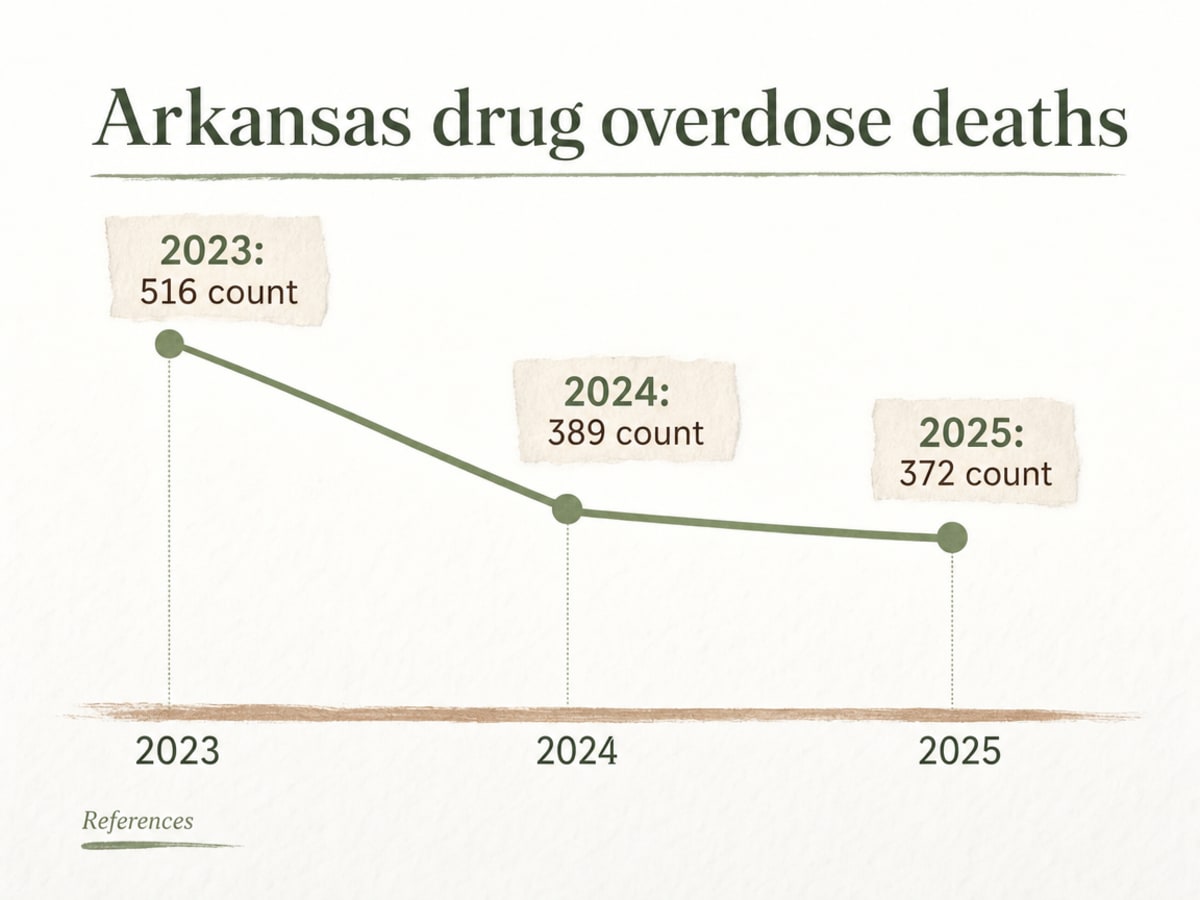
The statewide picture has shifted slightly. The Arkansas Department of Health reported 516 drug overdose deaths in 2023, and provisional data showed 389 in 2024 — a real decline, but still more than one Arkansan dying every day 1. Naloxone access, harm reduction, and public awareness are doing some of the work. What they are not doing is replacing treatment.
Here is what these numbers mean for you, tonight. If you are using fentanyl in Little Rock, you are not statistically safe because the death rate ticked down. You are living inside a metro area where trained responders reversed an overdose roughly every three or four days two years ago, and where the drug supply has only gotten more unpredictable since. The odds are not on your side; they are on the side of the naloxone kit that may or may not be in the room.
You already knew it was bad. Now you have the local math. The next question is what to do with it.
What’s Actually in the Pill or Powder
You may have a story you tell yourself about what you’re taking. It’s a Percocet from a guy at the site who gets them from his cousin. It’s a blue pill, stamped, looks right. It’s a bump of what someone at the party said was cocaine. You know your dose. You know your limits.
Here is the part that has quietly stopped being true.
The DEA and CDC now describe illicit fentanyl as routinely pressed into counterfeit pills designed to look like oxycodone, Xanax, or Adderall, and cut into powders sold as cocaine or methamphetamine — often without the person buying them knowing what they actually contain 6, 12. A pill is not a dosing system. It’s whatever came out of a press in whatever batch, mixed by someone who does not care whether you wake up.
Then there’s what’s riding along with the fentanyl. Xylazine — a veterinary sedative — has been showing up co-detected in fentanyl overdose deaths for several years now, and it doesn’t respond to naloxone the way opioids do 9. In a CDC health alert covering the second half of 2025, 98 percent of drug samples that tested positive for medetomidine, another veterinary sedative, also contained fentanyl 15. Naloxone reverses opioids. It does not reverse those sedatives. If someone finds you unresponsive, the standard rescue kit may only get you partway back.
Combine that with fentanyl analogs like carfentanil, which are more potent still, and non-opioid combinations with benzodiazepines and stimulants that federal advisories keep flagging as increasingly common 10. The supply has become a moving target.
So when you tell yourself you know your dose, be honest about what that sentence actually means now. You know the dose of a product you cannot verify, sold by someone who cannot verify it either, in a market where the sedative on top of the opioid may not be reversible. That isn’t a lecture. That’s the arithmetic of the current supply — and it’s the reason quitting alone, in a house, is no longer the low-key move it used to feel like.
Why Home Detox Isn’t the Private Option It Used to Be
There is a version of this where you take a Friday off, tell your family you’re fighting the flu, sweat it out in the guest room, and walk into work Monday looking a little thin but functional. That version worked for some people, some of the time, back when the drug you were quitting was the drug you thought you were quitting.
Fentanyl withdrawal by itself is not usually the thing that kills people. The danger sits in the two shadows on either side of it.
The first shadow is what happens if you can’t hold the line. Withdrawal is physically punishing — bone-deep aching, vomiting, insomnia that stretches into something close to hallucination — and after 48 or 72 hours of that, the temptation to “just take enough to sleep” becomes its own medical emergency. Your tolerance drops fast during withdrawal. The dose you used comfortably on Tuesday can stop your breathing on Friday. Fentanyl is 50 to 100 times more potent than morphine, and lethal amounts are measured in specks 6. A relapse mid-detox, alone, with no one watching your breathing, is one of the highest-risk overdose scenarios there is.
Home detox also assumes privacy it no longer delivers. An ambulance in your driveway at 3 a.m. is a lot louder than a scheduled admission to a residential program. Neighbors notice. Kids notice. HR notices when you don’t come back Monday because you’re in an ICU. Choosing supervised care is often the quieter option, not the louder one.
What Medically Supervised Detox Looks Like
The word “detox” carries baggage. For a lot of men, it conjures a fluorescent-lit hallway, a clipboard, and losing a week of your life to strangers who talk over you. That is not what a well-run residential detox looks like in 2025, and it is worth walking through what actually happens so the unknown stops doing the work of keeping you stuck.
Arkansas regulates residential addiction treatment as a 24/7 medical environment. State rules require that a withdrawal risk assessment be initiated at admission and completed and filed in your record within four hours of walking through the door 5. That assessment is not a formality. It is how a clinician figures out what your body is likely to do over the next 72 hours, what medications you need, and how closely to watch you. Residential care is defined as continuous, seven days a week, around the clock, with structured treatment layered in as you stabilize 5. Programs must operate as gender-separated settings, which is part of why a men’s residential program is a category the state recognizes, not a marketing angle 5.
Here is roughly how the first 24 hours move.
- You call. Intake asks about what you’ve been using, how much, how recently, your medical history, and your insurance or private-pay preference.
- You arrive. A nurse takes vitals, a clinician runs the withdrawal risk assessment, and within those first four hours a plan is on paper: which medications, on what schedule, and what your monitoring looks like 5.
- Medication-assisted treatment starts when clinically indicated — typically buprenorphine or a comparable protocol — so withdrawal is managed pharmacologically, not by grit.
- You are shown to a room. You sleep, probably for the first real stretch in days. Someone checks on you.
The parts that scare people — the shakes, the nausea, the crawling-out-of-your-skin hours — still happen. They just happen with a clinician down the hall, medication on schedule, and no access to the supply that put you here. That is the difference between white-knuckling it in a hotel and giving your body actual medical support while it resets. It’s not comfortable. It is survivable, and it’s monitored, which is the part your kitchen cannot offer.
The Career, License, and Custody Question
Let’s name the thing that’s actually keeping you on the couch. It isn’t the withdrawal. You’ve read about the withdrawal. It’s the picture in your head of what happens the day after you call — the partner meeting you miss, the licensing board letter, the conversation with your wife’s attorney if this ever surfaces in a custody file. For a lot of professional men in Little Rock, the fear of getting help is louder than the fear of what fentanyl is doing to them.
That fear is not irrational. It’s also not the whole picture.
Residential treatment in Arkansas operates under HIPAA and 42 CFR Part 2, the federal rule that governs substance-use treatment records specifically. Your admission is not reported to your employer, your bar association, your medical board, your chain of command, or the FAA because you walked in the door. Disclosure requires your written consent, with narrow exceptions for court orders and medical emergencies. The intake team can walk you through exactly what that means in your situation before you commit to anything.
Compare that to the alternative you are actually running right now. An overdose at your desk is a disclosure. An ambulance at your house is a disclosure. A DUI on I-630 on the way home is a disclosure. A missed deposition because you couldn’t get out of bed is a disclosure. The scenarios you are trying to avoid by not calling are more likely, not less, the longer you keep using a supply that’s now cut with sedatives naloxone can’t fully reverse 15.
Many licensing boards and employers treat voluntary treatment differently from a crisis that forced their hand. Physician health programs, lawyer assistance programs, and pilot HIMS pathways exist precisely because the professions figured out that men who get care early keep practicing. The specifics vary by board and by employer, and a treatment center’s intake and clinical team can help you think through timing, FMLA, and what — if anything — has to be reported in your case. That’s a real conversation to have on the phone, not a reason to avoid the phone.
Why a Men’s Residential Setting Matters
Arkansas rules don’t just recommend gender separation in residential addiction treatment — they require it 5. That’s not a lifestyle preference baked into a brochure. It’s a regulatory floor, and there’s a reason for it.
The men who end up in fentanyl detox tend to arrive with a specific mix of things they haven’t said out loud in years. A job that requires a face. A father who didn’t do feelings. A back injury from 2016 that started all of this. A marriage that’s been running on autopilot since the second kid. In a mixed-gender group room, that stuff stays locked. In a room of other men — a contractor, a nurse anesthetist, a guy who runs a body shop in Sherwood — it starts to come out around day four, usually over coffee, usually sideways.
There’s also the practical piece. Withdrawal is undignified. You will sweat through sheets. You will cry in ways that will surprise you. Doing that in front of eighteen other men who are doing the same thing is a different experience than doing it in front of a general population. Small-capacity settings — programs that cap at around 20 clients rather than running 80-bed floors — make the difference between being a chart number and being someone the night nurse actually knows by name.
For a professional man weighing whether to call, the men’s-only piece isn’t marketing. It’s the environment where the shame layer comes off fast enough for the clinical work to start.
What Happens When You Actually Call
The reason most men do not pick up the phone is that they don’t know what happens after “hello.” So here it is, in order.
- A person answers, usually within a couple of rings, and usually a clinician or a trained intake counselor rather than a call center. You don’t have to give a last name to start. You will be asked what you’ve been using, how much, how recently, and whether you’ve had a seizure, an overdose, or a hospital visit in the last few weeks. That’s not judgment. That’s the beginning of the withdrawal risk assessment the clinical team has to complete within four hours of admission anyway 5, and getting a head start on it makes your first day easier.
- You will be asked about insurance or private pay. If you’d rather not run your insurance because of how claims might surface, say so. Verification of benefits and self-pay options are both normal conversations at intake — ask what they cost and what the trade-offs are.
- You will be asked when you can come in. For fentanyl, the honest answer is usually “as soon as possible,” because the gap between deciding and arriving is the highest-risk window. Many programs can admit same day or next day. You will get a specific arrival time, a short list of what to bring, and a name to ask for at the door.
The call runs 15 to 25 minutes. It is confidential under 42 CFR Part 2. Nothing about it obligates you to admit. If you hang up and think about it for a day, the file stays where it is.
That’s the whole call. It is smaller than the version in your head.
If Someone You Love Is the One Using
If you’re the one reading this because he isn’t — because he’s asleep on the couch again, or because you found the foil, or because the last three months have felt like living with a stranger who wears your husband’s clothes — the article shifts here to you for a minute.
You cannot detox him. You already know that, even if part of you keeps trying. What you can do is a smaller, more useful thing: you can be the person who has the phone number ready when he cracks the door open, and you can stop treating every conversation like the one that has to work.
A few things that actually help. Keep naloxone in the house, and know that in Arkansas, pharmacists can dispense it to family members under a statewide standing order — you do not need his permission or a prescription in his name 3. Understand what naloxone does and does not do. It reverses an opioid overdose for 30 to 90 minutes, which is why the person needs continued monitoring and emergency care after a dose 4. And with sedatives like xylazine now common in the fentanyl supply, a naloxone save may only be partial 9. It buys minutes, not safety.
When you talk to him, skip the ultimatum script. Say what you’ve seen, say you’re scared, and say there is a men’s residential program in Little Rock where the call itself is confidential and doesn’t obligate him to anything. Then hand him the number, or offer to sit next to him while he dials. You are not managing his recovery. You are shortening the distance between the moment he says yes and the moment someone medical picks up.
The 20-Minute Decision
Somewhere in the next day or two, you are going to make a small decision that decides the bigger one. You will pick up the phone, or you will put it back down. That’s it. That’s the fork in the road.
The call runs 15 to 25 minutes. A person answers. They ask what you’ve been using and when you last used. They walk you through what admission would look like, what confidentiality means under 42 CFR Part 2, and what your options are for insurance or private pay. You are not signing anything. You are not on a list. You are gathering information about a men’s residential detox in your city — the same city where trained responders reversed 102 overdoses in one year 2 — and then you are deciding what to do with that information.
You do not have to feel ready. Ready is a feeling that shows up after the call, not before it. Serenity Park’s intake line is answered by clinicians, not a call center. Twenty minutes. That’s the whole first move.
Frequently Asked Questions
Is it safe to quit fentanyl at home by myself?
Honestly, no — and the reason is not just the withdrawal. Your tolerance drops within days, so if you slip and take your usual dose, that dose can stop your breathing. Fentanyl is 50 to 100 times more potent than morphine, and lethal amounts are tiny 6. Add xylazine or medetomidine in the supply and a partner with a naloxone kit may only get you partway back 15. Supervised detox exists for exactly this window.
Will my employer or licensing board find out if I call a treatment center in Little Rock?
Not because you called. Substance-use treatment records are protected under HIPAA and 42 CFR Part 2, and disclosure to your employer, board, or the FAA requires your written consent, with narrow exceptions for court orders and medical emergencies. Ask the intake team to walk through your specific situation before you commit to anything. The bigger disclosure risk is usually the overdose, DUI, or missed workday you are trying to avoid by not calling.
What actually happens during the first phone call?
A clinician or trained intake counselor answers, usually within a couple of rings. You will be asked what you have been using, how much, how recently, and about any recent overdoses, seizures, or ER visits. You will discuss insurance or private pay, and you will get a specific arrival time if you want to come in. The call takes 15 to 25 minutes, is confidential, and does not obligate you to admit.
How long does medically supervised fentanyl detox take?
The acute stretch typically runs about five to seven days, with the worst physical symptoms peaking in the first 72 hours. Arkansas rules define residential care as 24/7 monitoring with a withdrawal risk assessment completed within four hours of admission, and medication-assisted treatment is used to blunt symptoms rather than force you through them 5. Most men then step into residential treatment for several weeks, because detox alone is stabilization, not the whole recovery.
What if the pills I’m taking aren’t ‘real’ fentanyl—do I still need detox?
If you have been buying illicit pills — blues, fake Percocets, counterfeit Xanax or Adderall — you have almost certainly been taking fentanyl. The DEA and CDC document that counterfeit pills are routinely pressed with illicit fentanyl, often without the buyer knowing 6, 12. Your body has built tolerance and dependence to whatever is actually in them. Detox is about what is in your bloodstream, not what is printed on the pill. Yes, you need supervised care.
How do I talk to my husband or son about going to detox without pushing him away?
Skip the ultimatum and skip the speech you rehearsed in the car. Say what you have seen — specific things, not labels — say you are scared, and hand him a phone number for a men’s residential program in Little Rock where the call is confidential. Offer to sit next to him while he dials. Keep naloxone in the house; Arkansas pharmacists can dispense it to family members under a standing order 3. Then let the clinicians do their part.
References
- Substance Misuse Education and Prevention. https://healthy.arkansas.gov/programs-services/prevention-healthy-living/substance-misuse-education-and-prevention/
- Arkansas Naloxone Saves Program Report. https://agec.uams.edu/wp-content/uploads/sites/2/2022/03/Arkansas-Naloxone-Project-PDF.pdf
- Arkansas Opioid Antagonist Protocol (Naloxone Standing Order). https://healthy.arkansas.gov/wp-content/uploads/Naloxone_Standing_Order_Dr_Bala.pdf
- Act 811. https://humanservices.arkansas.gov/divisions-shared-services/shared-services/office-of-substance-abuse-and-mental-health/prevention-ar/act-811/
- Arkansas Department of Human Services – Division of Behavioral Health Services, Alcohol and Drug Abuse Prevention Rules. https://www.sos.arkansas.gov/uploads/rulesRegs/Arkansas%20Register/2004/jan_2004/016.02.03-001.pdf
- Fentanyl Facts | Stop Overdose. https://www.cdc.gov/stop-overdose/caring/fentanyl-facts.html
- Detection of Illegally Manufactured Fentanyls and Other Opioids in Drug Overdose Deaths, 33 Jurisdictions, 2019–2024. https://www.cdc.gov/mmwr/volumes/73/wr/mm7348a2.htm
- Most Overdose Deaths Involve Illicitly Manufactured Fentanyls. https://archive.cdc.gov/www_cdc_gov/drugoverdose/featured-topics/overdose-deaths-data.html
- Illicitly Manufactured Fentanyl–Involved Overdose Deaths with Detected Xylazine — United States, January 2019–June 2022. https://www.cdc.gov/mmwr/volumes/72/wr/mm7226a4.htm
- Rising Numbers of Deaths Involving Fentanyl and Fentanyl Analogs, Including Carfentanil, and Increased Usage and Mixing with Non-opioids. https://archive.cdc.gov/emergency_cdc_gov/han/han00413.asp
- Fighting Fentanyl: The Federal Response to a Growing Crisis. https://www.cdc.gov/washington/testimony/2022/t20220726.htm
- Facts about Fentanyl. https://www.dea.gov/resources/facts-about-fentanyl
- Drugs of Abuse: A DEA Resource Guide, 2024 Edition – Fentanyl Drug Fact Sheet. https://www.dea.gov/sites/default/files/2025-01/Fentanyl-Drug-Fact-Sheet.pdf
- Overdose Deaths and the Involvement of Illicit Drugs. https://archive.cdc.gov/www_cdc_gov/drugoverdose/featured-topics/VS-overdose-deaths-illicit-drugs.html
- Medetomidine in the U.S. Illegal Fentanyl Supply and Implications for Overdose Response. https://www.cdc.gov/han/php/notices/han00527.html
- Impact of COVID-19 on the Characteristics of Opioid Overdose Deaths in Arkansas. https://pmc.ncbi.nlm.nih.gov/articles/PMC9376304/